elect FIAT PANDA 2014 319 / 3.G Workshop Manual
[x] Cancel search | Manufacturer: FIAT, Model Year: 2014, Model line: PANDA, Model: FIAT PANDA 2014 319 / 3.GPages: 284, PDF Size: 11.54 MB
Page 171 of 284
FUSE LOCATION
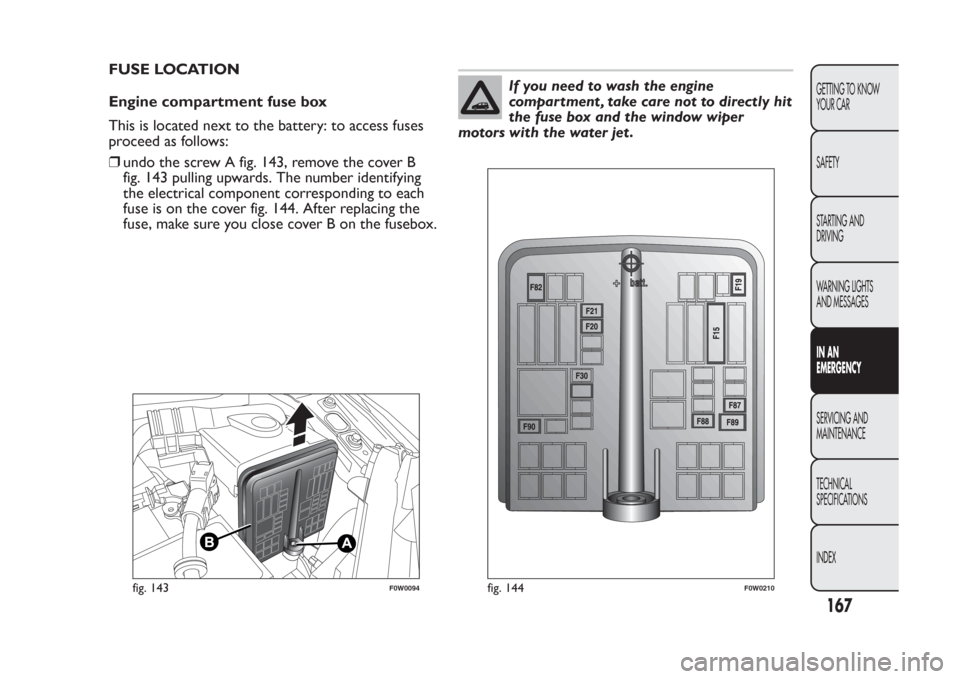
Engine compartment fuse box
This is located next to the battery: to access fuses
proceed as follows:
❒undo the screw A fig. 143, remove the cover B
fig. 143 pulling upwards. The number identifying
the electrical component corresponding to each
fuse is on the cover fig. 144. After replacing the
fuse, make sure you close cover B on the fusebox.
If you need to wash the engine
compartment , take care not to directly hit
the fuse box and the window wiper
motors with the water jet .
fig. 143
F0W0094
fig. 144
F0W0210
167GETTING TO KNOW
YOUR CAR
SAFETY
STARTING AND
DRIVING
WARNING LIGHTS
AND MESSAGESIN AN
EMERGENCYSERVICING AND
MAINTENANCE
TECHNICAL
SPECIFICATIONS
INDEX
Page 174 of 284
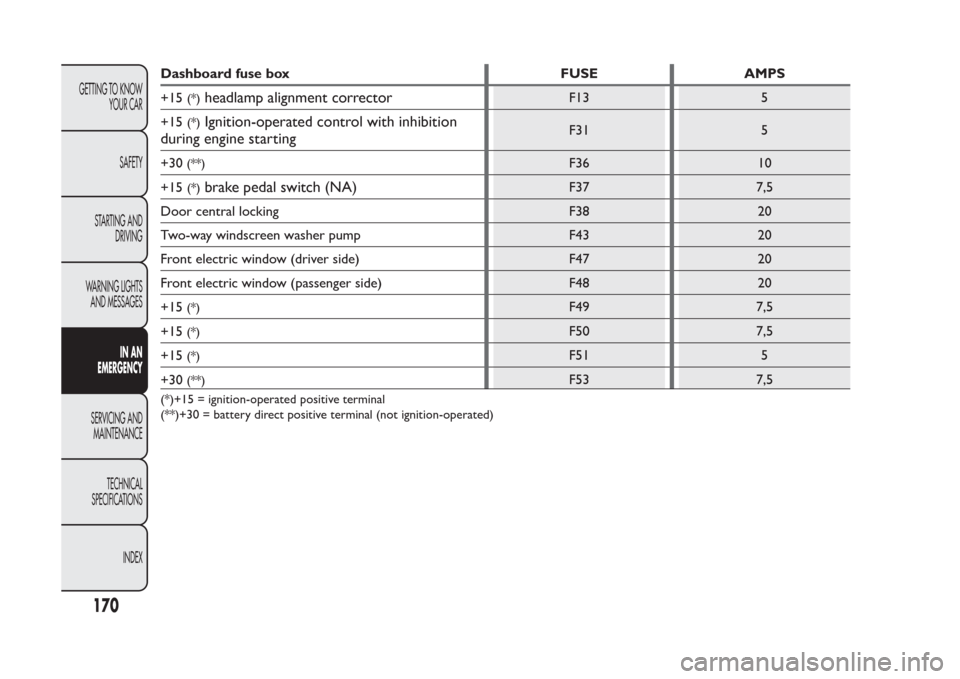
Dashboard fuse box FUSE AMPS
+15
(*)
headlamp alignment corrector
F13 5
+15
(*)
Ignition-operated control with inhibition
during engine starting
F31 5
+30
(**)
F36 10
+15
(*)
brake pedal switch (NA)
F37 7,5
Door central locking F38 20
Two-way windscreen washer pump F43 20
Front electric window (driver side) F47 20
Front electric window (passenger side) F48 20
+15
(*)
F49 7,5
+15
(*)
F50 7,5
+15
(*)
F51 5
+30
(**)
F53 7,5
(*)+15 = ignition-operated positive terminal
(**)+30 = battery direct positive terminal (not ignition-operated)
170
GETTING TO KNOW
YOUR CAR
SAFETY
STARTING AND
DRIVING
WARNING LIGHTS
AND MESSAGES
IN AN
EMERGENCY
SERVICING AND
MAINTENANCE
TECHNICAL
SPECIFICATIONS
INDEX
Page 178 of 284
WARNING
Whilst towing, remember that as the
assistance of the brake servo and the
electric power assisted steering is not available,
greater force needs to be exerted on the brake
pedal and more effort is required on the
steering wheel. Do not use flexible cables when
towing and avoid jerky movements. During
towing, make sure that the trailer hitch does not
damage any components it is touching.When
towing the car, it is compulsor y to respect
specific highway code regulations relating to
the tow hook and procedures for towing on the
road. Do not star t the engine while towing
the car.
WARNING
The front and rear tow hooks should be
used only for emergencies on the road.
You are allowed to tow the car for short
distances using an appropriate device
in accordance with the highway code (a rigid
bar), to move the vehicle on the road in
readiness for towing or transporting via a
breakdown vehicle.Tow hooks MUST NOT be
used to tow vehicles off the road or where there
are obstacles and/or for towing operations
using cables or other non-rigid devices.
Respecting the above conditions, towing must
take place with the two vehicles (one towing,
the other towed) aligned as much as possible
along the same centre line.
WARNING
Do not use tow hooks for securing the
vehicle on ships.
174
GETTING TO KNOW
YOUR CAR
SAFETY
STARTING AND
DRIVING
WARNING LIGHTS
AND MESSAGES
IN AN
EMERGENCY
SERVICING AND
MAINTENANCE
TECHNICAL
SPECIFICATIONS
INDEX
Page 185 of 284
PERIODIC CHECKSEvery 1,000 km or before long journeys, check and, if
necessary, top up the following:
❒engine coolant, brake fluid and windscreen washer
fluid level;
❒tyre inflation pressure and condition;
❒operation of lighting system (headlamps, direction
indicators, hazard warning lights, etc.);
❒operation of screen washer/wiper system and
positioning/wear of windscreen/rear window wiper
blades.
Every 3,000 km, check and top up, if required, the
engine oil level.
HEAVY-DUTY USE OF THE CARIf the car is used mainly under one of the following
conditions:
❒towing a trailer or caravan;
❒dusty roads;
❒short, repeated journeys (less than 7-8 km) at
sub-zero outside temperatures;
❒engine often idling or driving long distances at low
speeds or long periods of idleness;
the following checks must be carried out more often
than indicated in the Scheduled Servicing Plan:
❒check front disc brake pad conditions and wear;
❒check cleanliness of side locks, bonnet and luggage
compartment locks, and cleanliness and lubrication
of linkages;
❒visually inspect conditions of: engine, gearbox,
transmission, pipes and hoses (exhaust - fuel
system - brakes) and rubber elements (boots -
sleeves - bushes - etc.);
❒check battery charge and battery fluid level
(electrolyte);
❒visually inspect condition of the accessory drive
belts;
❒check and, if necessary, change engine oil and
replace oil filter;
❒check and, if necessary, replace pollen filter.
181GETTING TO KNOW
YOUR CAR
SAFETY
STARTING AND
DRIVING
WARNING LIGHTS
AND MESSAGES
IN AN EMERGENCYSERVICING AND
MAINTENANCETECHNICAL
SPECIFICATIONS
INDEX
Page 194 of 284
BATTERYBattery F (see previous pages) does not require the
electrolyte to be topped up with distilled water. A
periodic check carried out at a Fiat Dealership
is, however, necessary to check efficiency.
REPLACING THE BATTERY
If necessary, replace the battery with another
genuine battery with the same specifications. Follow
the battery manufacturer's instructions for
maintenance.
USEFUL ADVICE FOR EXTENDING THE
LIFE OF YOUR BATTERY
To avoid draining your battery and make it last
longer, observe the following instructions:
❒when you park the car, ensure that the doors,
tailgate and bonnet are closed properly, to prevent
any roof lights from remaining on inside the
passenger's compartment;
❒switch off all roof lights inside the car: the car is
however equipped with a system which switches
all internal lights off automatically;
❒do not keep accessories (e.g. sound system, hazard
lights, etc.) switched on for a long time when the
engine is not running;
❒before performing any operation on the electrical
system, disconnect the negative battery pole;
❒Completely tighten the battery terminals.IMPORTANT If the charge level remains under 50%
for a long time, the battery is damaged by sulphation,
reducing its capacity and efficiency at start-up.
The battery will also be more at risk of freezing (this
can happen as early as -10°C). Refer to the paragraph
"Car inactivity" in "Starting and driving" if the car is
left parked for a long time.
If, after buying the car, you wish to install electrical
accessories which require permanent electrical
supply (alarm, etc.) or accessories which influence
the electrical supply requirements, contact a Fiat
Dealership, whose qualified staff will evaluate the
overall electrical consumption.
WARNING
Battery liquid is poisonous and
corrosive. Avoid contact with the skin
and eyes. Keep naked flames and sources of
sparks away from the battery: risk of explosion
and fire.
WARNING
Using the battery with insufficient fluid
irreparably damages the battery and
may cause an explosion.
190
GETTING TO KNOW
YOUR CAR
SAFETY
STARTING AND
DRIVING
WARNING LIGHTS
AND MESSAGES
IN AN EMERGENCYSERVICING AND
MAINTENANCE
TECHNICAL
SPECIFICATIONS
INDEX
Page 195 of 284
Incorrect installation of electric and
electronic devices may cause severe
damage to your car. After purchasing your
vehicle, if you wish to install any accessories (car
alarm, car phone, etc .), please contact your Fiat
Dealership, which will suggest the most
appropriate devices for your vehicle, and will,
most importantly, recommend installing a
oversized battery.Batteries contain substances which are
ver y dangerous for the environment . For
battery replacement , contact a Fiat
Dealership.
WARNING
If the car will be unused for an extended
period of time in extremely cold
weather conditions, remove the battery and
store it in a heated area to avoid it freezing.
WARNING
Always wear appropriate goggles when
working on or near the battery.
BRAKESThe car is equipped with 4 mechanical wear
detection systems for brake pads: one for each wheel
assembly.
When the brake linings are about to wear out,
pressing the brake pedal, a light hiss is heard: this
indication lasts around 100 km (depending on the
driving style and the route type).
In these circumstances it is still possible, proceeding
with caution, to carry on driving.
In any case, contact a Fiat Dealership as soon as
possible to have the worn brake pads replaced.
191GETTING TO KNOW
YOUR CAR
SAFETY
STARTING AND
DRIVING
WARNING LIGHTS
AND MESSAGES
IN AN EMERGENCYSERVICING AND
MAINTENANCETECHNICAL
SPECIFICATIONS
INDEX
Page 201 of 284
Avoid parking under trees as much as possible; the
resin from trees dulls the paintwork and increases
the possibility of corrosion.
IMPORTANT Bird droppings must be washed off
immediately and thoroughly as the acid they contain
is particularly aggressive.
Detergents pollute the environment . Only
wash your car in areas equipped to collect
and treat wastewater from this type of
activity.In order to preserve the aesthetic
appearance of the paint abrasive products
and/or polishes should not be used for
cleaning the car.
Windows
Use specific detergents and clean cloths to prevent
scratching or altering the transparency.
IMPORTANT Wipe the rear window inside gently
with a cloth in the direction of the filaments to avoid
damaging the heating device.
Front headlights
Use a soft, damp cloth soaked in water and
detergent for washing cars.
IMPORTANT Never use aromatic substances (e.g.
petrol) or ketones (e.g. acetone) for cleaning the
plastic lenses of the front headlights.Engine compartment
At the end of every winter, wash the engine
compartment thoroughly, taking care not to aim the
jet of water directly at the electronic control units or
at the windscreen wiper motors. Have this
operation performed at a specialised workshop.
IMPORTANT The washing should take place with the
engine cold and the ignition key in the STOP
position. After the washing operation, make sure
that the various protections (e.g. rubber caps and
guards) have not been removed or damaged.
197GETTING TO KNOW
YOUR CAR
SAFETY
STARTING AND
DRIVING
WARNING LIGHTS
AND MESSAGES
IN AN EMERGENCYSERVICING AND
MAINTENANCETECHNICAL
SPECIFICATIONS
INDEX
Page 202 of 284
INTERIORSPeriodically check for water puddles under the mats
that could cause the panels to rust.
WARNING
Never use flammable products, such as
petrol ether or rectified petrol to clean
the inside of the car.The electrostatic charges
which are generated by rubbing during the
cleaning operation may cause a fire.
WARNING
Do not keep aerosol cans in the car:
they might explode. Aerosol cans must
not be exposed to a temperature exceeding
50°C .When the car is exposed to sunlight ,
internal temperature can greatly exceed this
value.SEATS AND FABRIC PARTS
Remove dust with a soft brush or a vacuum cleaner.
Rub the seats with a sponge and a solution of water
and mild soap.
PLASTIC AND COATED PARTS
Clean interior plastic parts with a damp cloth (if
possible made from microfibre), and a solution
of water and neutral, non-abrasive detergent. To
clean oily or persistent stains, use specific products
free from solvents and designed to maintain the
original appearance and colour of the components.
Remove any dust using a microfibre cloth, if
necessary moistened with water. The use of paper
tissues is not recommended as these may leave
residues.
IMPORTANT Never use alcohol, petrols and
derivatives to clean the instrument panel lens.
198
GETTING TO KNOW
YOUR CAR
SAFETY
STARTING AND
DRIVING
WARNING LIGHTS
AND MESSAGES
IN AN EMERGENCYSERVICING AND
MAINTENANCE
TECHNICAL
SPECIFICATIONS
INDEX
Page 209 of 284
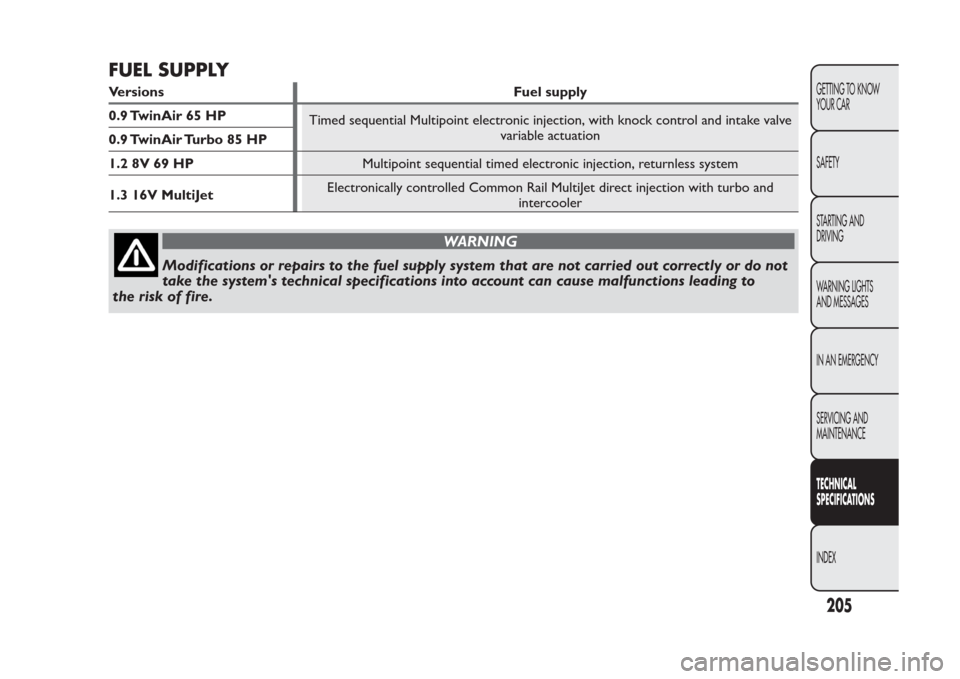
FUEL SUPPLYVersions Fuel supply
0.9 TwinAir 65 HP
Timed sequential Multipoint electronic injection, with knock control and intake valve
variable actuation
0.9 TwinAir Turbo 85 HP
1.2 8V 69 HPMultipoint sequential timed electronic injection, returnless system
1.3 16V MultiJetElectronically controlled Common Rail MultiJet direct injection with turbo and
intercooler
WARNING
Modifications or repairs to the fuel supply system that are not carried out correctly or do not
take the system's technical specifications into account can cause malfunctions leading to
the risk of fire.
205GETTING TO KNOW
YOUR CAR
SAFETY
STARTING AND
DRIVING
WARNING LIGHTS
AND MESSAGES
IN AN EMERGENCY
SERVICING AND
MAINTENANCETECHNICAL
SPECIFICATIONSINDEX
Page 212 of 284
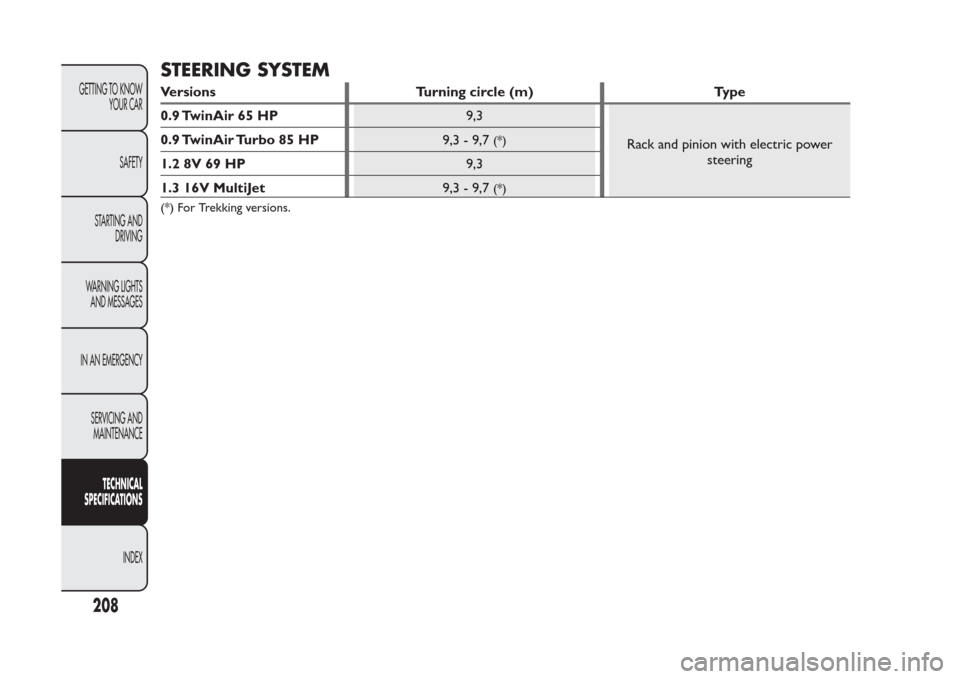
STEERING SYSTEMVersions Turning circle (m) Type
0.9 TwinAir 65 HP9,3
Rack and pinion with electric power
steering 0.9 TwinAir Turbo 85 HP
9,3 - 9,7
(*)
1.2 8V 69 HP9,3
1.3 16V MultiJet
9,3 - 9,7
(*)
(*) For Trekking versions.
208
GETTING TO KNOW
YOUR CAR
SAFETY
STARTING AND
DRIVING
WARNING LIGHTS
AND MESSAGES
IN AN EMERGENCY
SERVICING AND
MAINTENANCE
TECHNICAL
SPECIFICATIONS
INDEX