warning FIAT PANDA 2016 319 / 3.G User Guide
[x] Cancel search | Manufacturer: FIAT, Model Year: 2016, Model line: PANDA, Model: FIAT PANDA 2016 319 / 3.GPages: 204, PDF Size: 18.77 MB
Page 18 of 204
IMPORTANT When the heated rear
window is activated, door mirror
defrosting is activated (for versions/
markets, where provided).
Manual folding
When required, fold the mirrors toward
the vehicle interior.
IMPORTANT When driving, the mirrors
must always be open.
WARNING
15)As the driver's door mirror is curved, it
may slightly alter the perception of
distance.
EXTERIOR LIGHTS
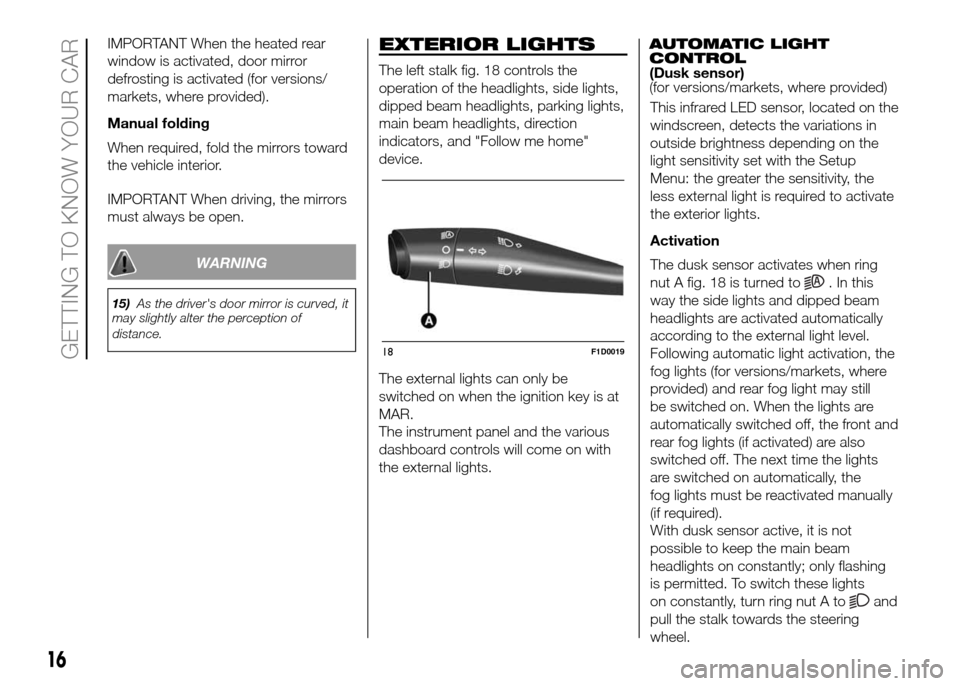
The left stalk fig. 18 controls the
operation of the headlights, side lights,
dipped beam headlights, parking lights,
main beam headlights, direction
indicators, and "Follow me home"
device.
The external lights can only be
switched on when the ignition key is at
MAR.
The instrument panel and the various
dashboard controls will come on with
the external lights.AUTOMATIC LIGHT
CONTROL
(Dusk sensor)
(for versions/markets, where provided)
This infrared LED sensor, located on the
windscreen, detects the variations in
outside brightness depending on the
light sensitivity set with the Setup
Menu: the greater the sensitivity, the
less external light is required to activate
the exterior lights.
Activation
The dusk sensor activates when ring
nut A fig. 18 is turned to
. In this
way the side lights and dipped beam
headlights are activated automatically
according to the external light level.
Following automatic light activation, the
fog lights (for versions/markets, where
provided) and rear fog light may still
be switched on. When the lights are
automatically switched off, the front and
rear fog lights (if activated) are also
switched off. The next time the lights
are switched on automatically, the
fog lights must be reactivated manually
(if required).
With dusk sensor active, it is not
possible to keep the main beam
headlights on constantly; only flashing
is permitted. To switch these lights
on constantly, turn ring nut A to
and
pull the stalk towards the steering
wheel.
18F1D0019
16
GETTING TO KNOW YOUR CAR
Page 19 of 204
On automatic sensor controlled
deactivation, the dipped headlights are
deactivated first, followed by the side
lights a few seconds later.
If the sensor is activated but is
malfunctioning, the side lights and
dipped headlights are switched
on irrespective of the external lighting
conditions: the sensor failure is
indicated on the display. It is also
possible to deactivate the sensor and
switch on the desired lights, if
necessary.
IMPORTANT The sensor cannot detect
the presence of fog. These lights must
therefore be switched on manually in
these circumstances.
SIDE LIGHTS/DAYTIME
RUNNING LIGHTS (DRL)
"Daytime Running Lights"
(for versions/markets, where provided)
16) 17)With the ignition key turned to MAR
and ring nut A fig. 18 turned to position
Othe daytime running lights are
automatically activated; the other lights
and interior lighting remain off.SIDE LIGHTS AND
DIPPED BEAM
HEADLIGHTS
With the ignition key turned to MAR,
turn ring nut A fig. 18 to
. If dipped
beam headlights are activated, the
daytime running lights switch off and
the side lights and dipped headlights
switch on. The
warning light
switches on in the instrument panel.
When the ignition key is turned to
STOP or removed and the ring nut A is
turned fromOto
, all the side
lights and the number plate lights come
on. The
warning light will come
on in the instrument panel.
PARKING LIGHTS
These lights can only be turned on with
ignition key in STOP position or
removed, by moving the ring nut A fig.
18 first to positionOand then to
position
.
The
warning light switches on in
the instrument panel.
MAIN BEAM HEADLIGHTS
To activate the main beam headlights,
with ring nut A fig. 18 at
, pull the
stalk towards the steering wheel
beyond the end of travel position. The
warning light switches on in the
instrument panel.When the stalk is pulled towards the
steering wheel again, beyond the end
of travel position, the main beam
headlights are deactivated, the dipped
beam headlights are reactivated and
the
warning light switches off.
FLASHING
To do this, pull the stalk towards the
steering wheel (unstable position)
regardless of the position of ring nut A
fig. 18. The
warning light switches
on in the instrument panel.
DIRECTION INDICATORS
Bring the stalk to the (stable) position:
upwards:activates the right direction
indicator;
downwards:activates the left direction
indicator.
Warning light
orwill blink on the
instrument panel. The direction
indicators switch off automatically when
the steering wheel is straightened.
"Lane Change" function
If you wish to signal a lane change,
place the left stalk in the unstable
position for less than half a second. The
direction indicator on the side selected
will flash five times and then switch
off automatically.
17
Page 20 of 204
"FOLLOW ME HOME"
DEVICE
This allows the space in front of the
vehicle to be lit for a set time.
Activation:with the ignition key on
STOP or removed, pull the stalk
towards the steering wheel within 2
minutes from turning the engine off.
Each time the stalk is moved, the lights
stay on for an extra 30 seconds up to
a maximum of 210 seconds; then
the lights are switched off automatically.
Each time the stalk is operated, the
warning light on the instrument
panel switches on and the display also
shows a message and how long the
function will remain active.
The
warning light comes on when
the stalk is first moved and stays on
until the function is automatically
deactivated. Each time the stalk is
activated it increases the time that the
lights remain on.
Deactivation:keep the stalk pulled
towards the steering wheel for more
than two seconds.REAR FOG LIGHTS
Press the
button, on the dashboard,
to switch on the rear fog lights.
With rear fog lights on, the
warning
light on the instrument panel will come
on.
FOG LIGHTS/REAR FOG
LIGHTS
(for versions/markets, where provided)
The fog lights can be activated only
when the dipped beam headlights are
on.
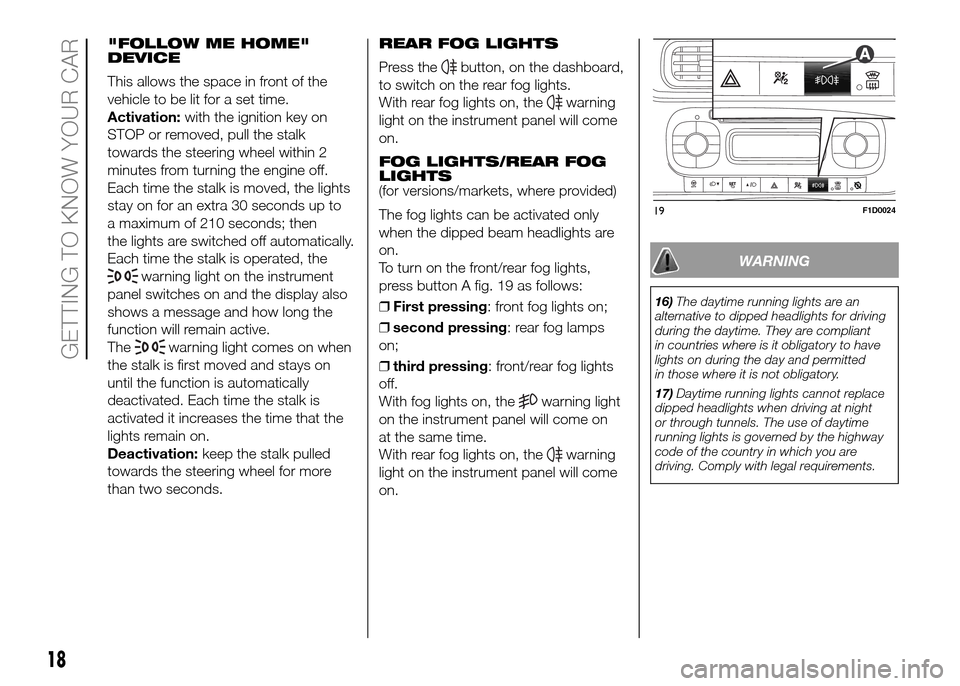
To turn on the front/rear fog lights,
press button A fig. 19 as follows:
❒First pressing: front fog lights on;
❒second pressing: rear fog lamps
on;
❒third pressing: front/rear fog lights
off.
With fog lights on, the
warning light
on the instrument panel will come on
at the same time.
With rear fog lights on, the
warning
light on the instrument panel will come
on.
WARNING
16)The daytime running lights are an
alternative to dipped headlights for driving
during the daytime. They are compliant
in countries where is it obligatory to have
lights on during the day and permitted
in those where it is not obligatory.
17)Daytime running lights cannot replace
dipped headlights when driving at night
or through tunnels. The use of daytime
running lights is governed by the highway
code of the country in which you are
driving. Comply with legal requirements.
19F1D0024
18
GETTING TO KNOW YOUR CAR
Page 23 of 204
6)Make sure the device is switched off
whenever the windscreen must be
cleaned.
7)Do not use the rear window wiper to
remove layers of snow or ice. In such
conditions, the wiper may be subjected to
excessive stress and the motor cut-out
switch, which prevents operation for a few
seconds, may intervene. If operation is
not subsequently restored, contact a Fiat
Dealership.
21
WARNING
4)Do not use the windscreen wiper to
remove layers of snow or ice from the
windscreen. In such conditions, the
windscreen wiper may be subjected to
excessive stress and the motor cut-out
switch, which prevents operation for a few
seconds, may intervene. If operation is
not restored (even after turning the key and
restarting the engine), contact a Fiat
Dealership.
5)Do not operate the windscreen wiper
with the blades lifted from the windscreen.
Page 27 of 204
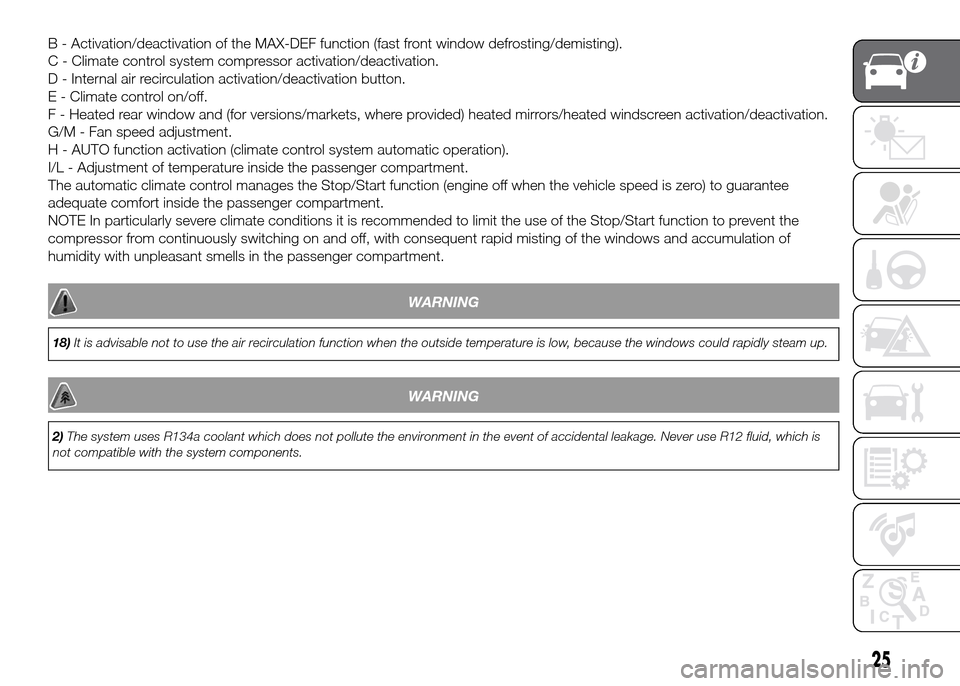
B - Activation/deactivation of the MAX-DEF function (fast front window defrosting/demisting).
C - Climate control system compressor activation/deactivation.
D - Internal air recirculation activation/deactivation button.
E - Climate control on/off.
F - Heated rear window and (for versions/markets, where provided) heated mirrors/heated windscreen activation/deactivation.
G/M - Fan speed adjustment.
H - AUTO function activation (climate control system automatic operation).
I/L - Adjustment of temperature inside the passenger compartment.
The automatic climate control manages the Stop/Start function (engine off when the vehicle speed is zero) to guarantee
adequate comfort inside the passenger compartment.
NOTE In particularly severe climate conditions it is recommended to limit the use of the Stop/Start function to prevent the
compressor from continuously switching on and off, with consequent rapid misting of the windows and accumulation of
humidity with unpleasant smells in the passenger compartment.
WARNING
18)It is advisable not to use the air recirculation function when the outside temperature is low, because the windows could rapidly steam up.
WARNING
2)The system uses R134a coolant which does not pollute the environment in the event of accidental leakage. Never use R12 fluid, which is
not compatible with the system components.
25
Page 28 of 204
ELECTRIC WINDOWS
FRONT ELECTRIC
WINDOWS
19) 20)These operate when the ignition key is
turned to MAR and for about three
minutes after turning the ignition key to
STOP or removing it.
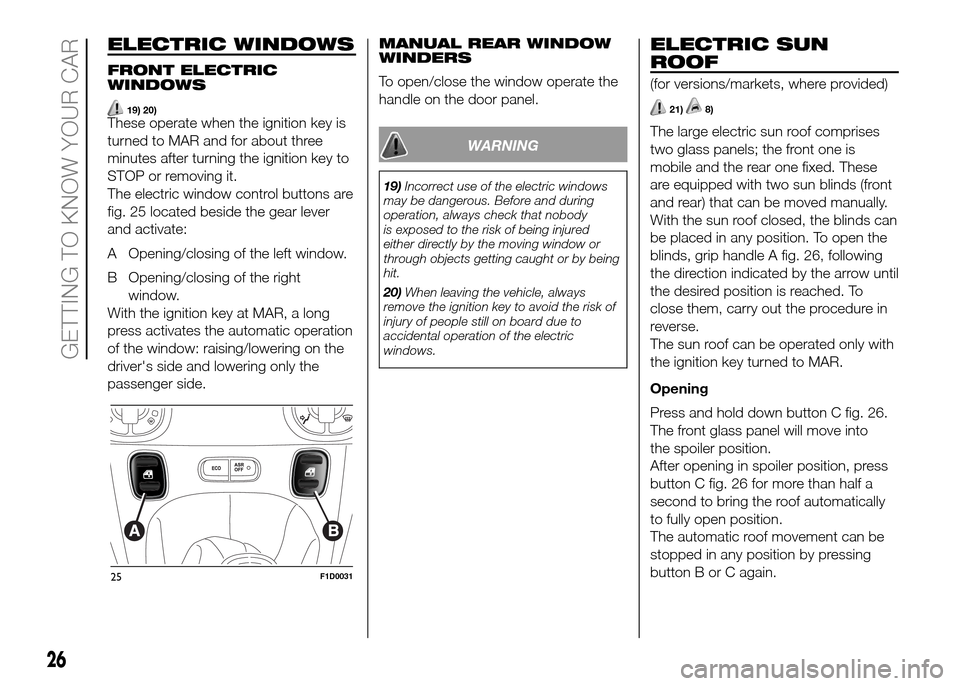
The electric window control buttons are
fig. 25 located beside the gear lever
and activate:
A Opening/closing of the left window.
B Opening/closing of the right
window.
With the ignition key at MAR, a long
press activates the automatic operation
of the window: raising/lowering on the
driver's side and lowering only the
passenger side.MANUAL REAR WINDOW
WINDERS
To open/close the window operate the
handle on the door panel.
WARNING
19)Incorrect use of the electric windows
may be dangerous. Before and during
operation, always check that nobody
is exposed to the risk of being injured
either directly by the moving window or
through objects getting caught or by being
hit.
20)When leaving the vehicle, always
remove the ignition key to avoid the risk of
injury of people still on board due to
accidental operation of the electric
windows.
ELECTRIC SUN
ROOF
(for versions/markets, where provided)
21)8)
The large electric sun roof comprises
two glass panels; the front one is
mobile and the rear one fixed. These
are equipped with two sun blinds (front
and rear) that can be moved manually.
With the sun roof closed, the blinds can
be placed in any position. To open the
blinds, grip handle A fig. 26, following
the direction indicated by the arrow until
the desired position is reached. To
close them, carry out the procedure in
reverse.
The sun roof can be operated only with
the ignition key turned to MAR.
Opening
Press and hold down button C fig. 26.
The front glass panel will move into
the spoiler position.
After opening in spoiler position, press
button C fig. 26 for more than half a
second to bring the roof automatically
to fully open position.
The automatic roof movement can be
stopped in any position by pressing
button B or C again.
25F1D0031
26
GETTING TO KNOW YOUR CAR
Page 30 of 204
❒hold down button B until the roof is
completely closed: the initialisation
procedure has ended;
❒press button B again within 3
seconds from the conclusion of the
initialisation procedure;
❒hold down button B: the roof will
perform an automatic opening and
closing cycle: should this not occur,
repeat the operation from the
beginning;
❒keeping button B held down, wait
until the roof is completely closed.
WARNING
21)When leaving the vehicle, always
remove the key from the ignition to avoid
the risk of injury due to accidental
operation of the sun roof. Improper use of
the roof can be dangerous. Before and
during operation, always check that
nobody is at risk of being injured by the
moving sun roof or by objects getting
caught or hit by it.
WARNING
8)Do not open the sunroof if snow or ice is
over it: you may damage it. In vehicles
with sun roof no roof rack can be fitted.
DUALDRIVE
ELECTRIC POWER
STEERING
22) 23)
This only operates with the key turned
to MAR and the engine started. The
steering allows the force required at the
steering wheel to be adjusted to suit
driving conditions.
IMPORTANT When turning the ignition
key quickly, full power steering
functionality can be achieved after a
few seconds.
CITY FUNCTION
ACTIVATION/
DEACTIVATION
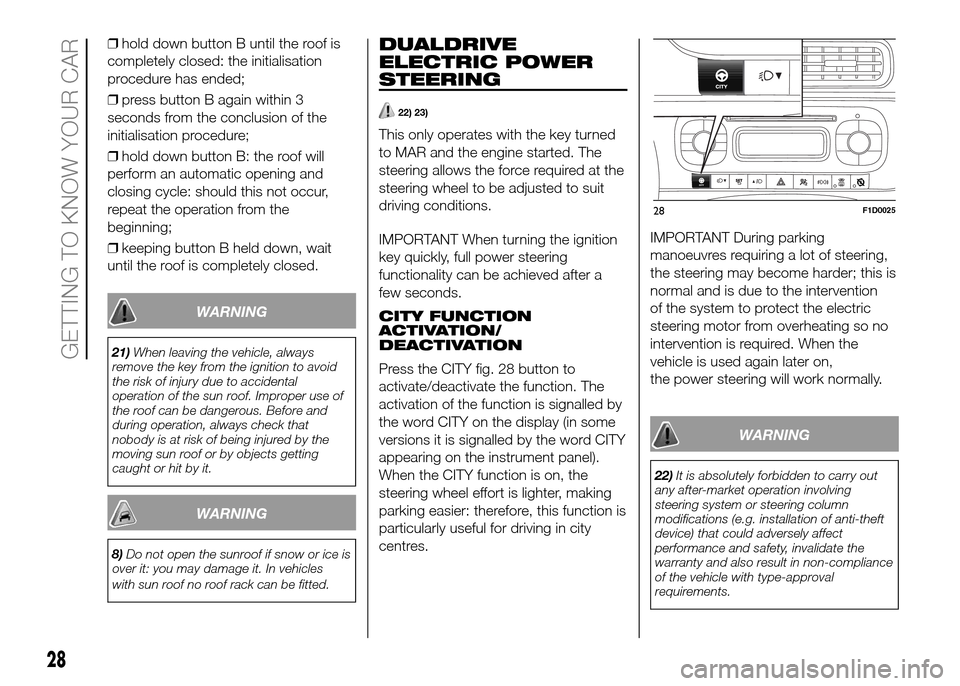
Press the CITY fig. 28 button to
activate/deactivate the function. The
activation of the function is signalled by
the word CITY on the display (in some
versions it is signalled by the word CITY
appearing on the instrument panel).
When the CITY function is on, the
steering wheel effort is lighter, making
parking easier: therefore, this function is
particularly useful for driving in city
centres.IMPORTANT During parking
manoeuvres requiring a lot of steering,
the steering may become harder; this is
normal and is due to the intervention
of the system to protect the electric
steering motor from overheating so no
intervention is required. When the
vehicle is used again later on,
the power steering will work normally.
WARNING
22)It is absolutely forbidden to carry out
any after-market operation involving
steering system or steering column
modifications (e.g. installation of anti-theft
device) that could adversely affect
performance and safety, invalidate the
warranty and also result in non-compliance
of the vehicle with type-approval
requirements.
28F1D0025
28
GETTING TO KNOW YOUR CAR
Page 32 of 204
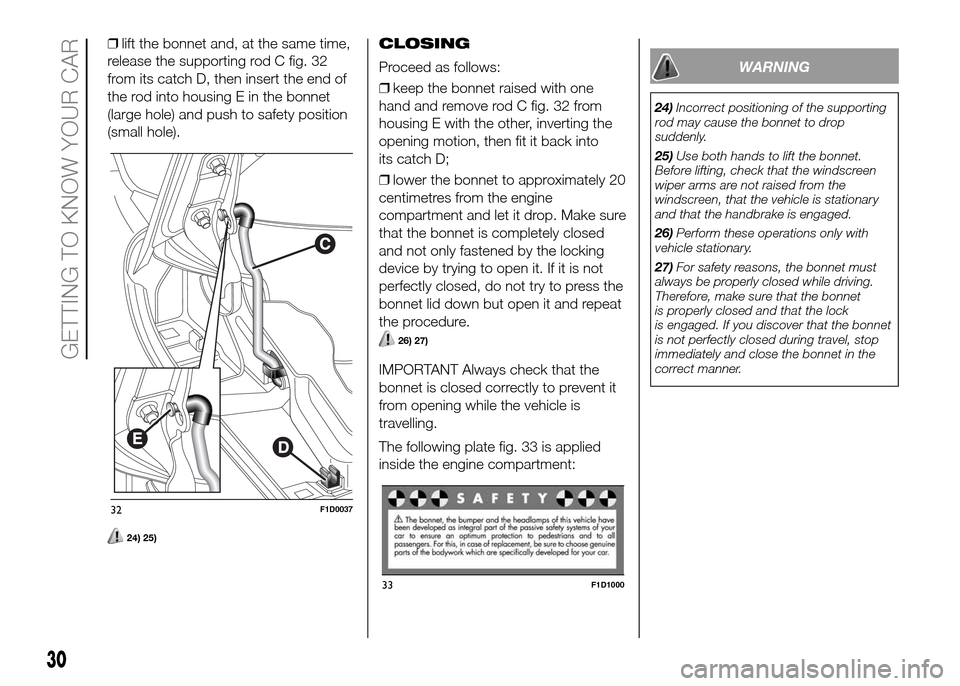
❒lift the bonnet and, at the same time,
release the supporting rod C fig. 32
from its catch D, then insert the end of
the rod into housing E in the bonnet
(large hole) and push to safety position
(small hole).
24) 25)
CLOSING
Proceed as follows:
❒keep the bonnet raised with one
hand and remove rod C fig. 32 from
housing E with the other, inverting the
opening motion, then fit it back into
its catch D;
❒lower the bonnet to approximately 20
centimetres from the engine
compartment and let it drop. Make sure
that the bonnet is completely closed
and not only fastened by the locking
device by trying to open it. If it is not
perfectly closed, do not try to press the
bonnet lid down but open it and repeat
the procedure.
26) 27)
IMPORTANT Always check that the
bonnet is closed correctly to prevent it
from opening while the vehicle is
travelling.
The following plate fig. 33 is applied
inside the engine compartment:
WARNING
24)Incorrect positioning of the supporting
rod may cause the bonnet to drop
suddenly.
25)Use both hands to lift the bonnet.
Before lifting, check that the windscreen
wiper arms are not raised from the
windscreen, that the vehicle is stationary
and that the handbrake is engaged.
26)Perform these operations only with
vehicle stationary.
27)For safety reasons, the bonnet must
always be properly closed while driving.
Therefore, make sure that the bonnet
is properly closed and that the lock
is engaged. If you discover that the bonnet
is not perfectly closed during travel, stop
immediately and close the bonnet in the
correct manner.
32F1D0037
33F1D1000
30
GETTING TO KNOW YOUR CAR
Page 34 of 204
LUGGAGE
COMPARTMENT
INITIALISATION
IMPORTANT If the battery is
disconnected or the protection fuse
blows, the luggage compartment
opening/closing mechanism must be
reinitialised as follows: close all the
doors and the tailgate, press the
button on the remote control, then
press the
button
30) 31) 32)
WARNING
28)Take care not to knock objects on the
roof rack when opening the tailgate.
29)With the engine on, always make sure
that the tailgate is closed: exhaust gases
could be drawn inside the load
compartment.
30)Every attachment has a maximum load
capacity of 100 kg.
31)A heavy load that has not been
secured may cause serious injuries in the
event of an accident.
32)If you are travelling in an area with
limited opportunities for vehicle refuelling
and you wish to bring petrol with you in
a petrol can, you must do so in compliance
with current regulations and using an
approved can, appropriately secured to the
load securing attachments. Anyway, by
doing so, you increase the risk of fire in the
event of an accident with your vehicle.
VERSION WITH LPG
SYSTEM
33) 34) 13)9) 10) 11) 12)
INTRODUCTION
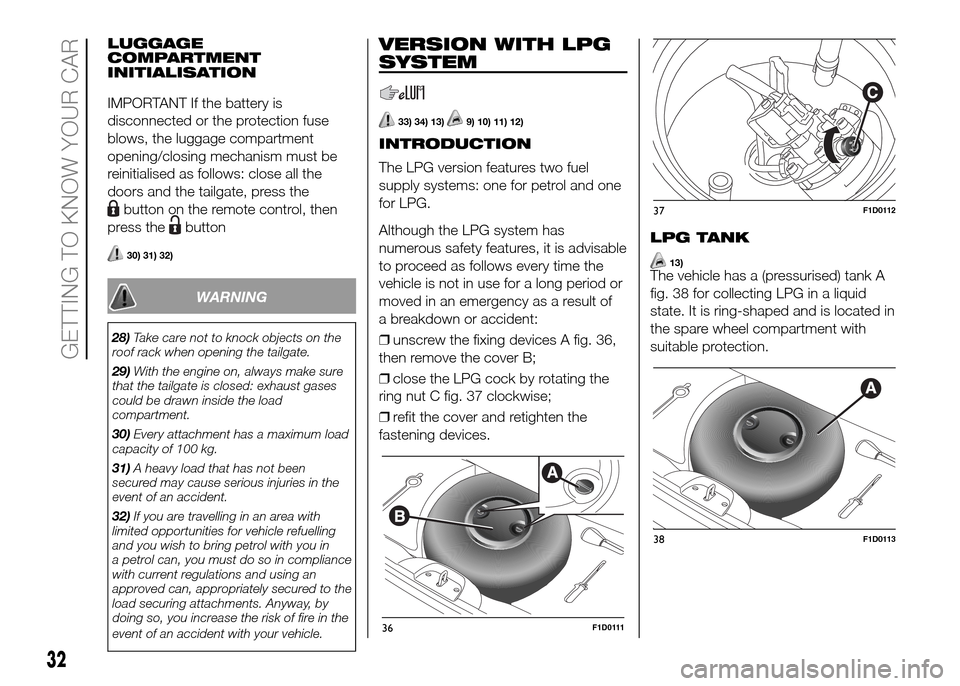
The LPG version features two fuel
supply systems: one for petrol and one
for LPG.
Although the LPG system has
numerous safety features, it is advisable
to proceed as follows every time the
vehicle is not in use for a long period or
moved in an emergency as a result of
a breakdown or accident:
❒unscrew the fixing devices A fig. 36,
then remove the cover B;
❒close the LPG cock by rotating the
ring nut C fig. 37 clockwise;
❒refit the cover and retighten the
fastening devices.LPG TANK
13)The vehicle has a (pressurised) tank A
fig. 38 for collecting LPG in a liquid
state. It is ring-shaped and is located in
the spare wheel compartment with
suitable protection.
36F1D0111
37F1D0112
38F1D0113
32
GETTING TO KNOW YOUR CAR
Page 35 of 204
LPG tank certification
The LPG tank is certified in accordance
with the regulations in force.
In Italy, the tank has a life of 10 years
starting from the vehicle registration
date. If the vehicle has been registered
in a country other than Italy, the
duration and the testing/inspection
procedures of the LPG tank can vary
depending on the national laws of that
country. In any case, when the time limit
in the individual country has run out,
contact a Fiat Dealership to have the
tank replaced.
SELECTION OF
PETROL/LPG SUPPLY
TYPE
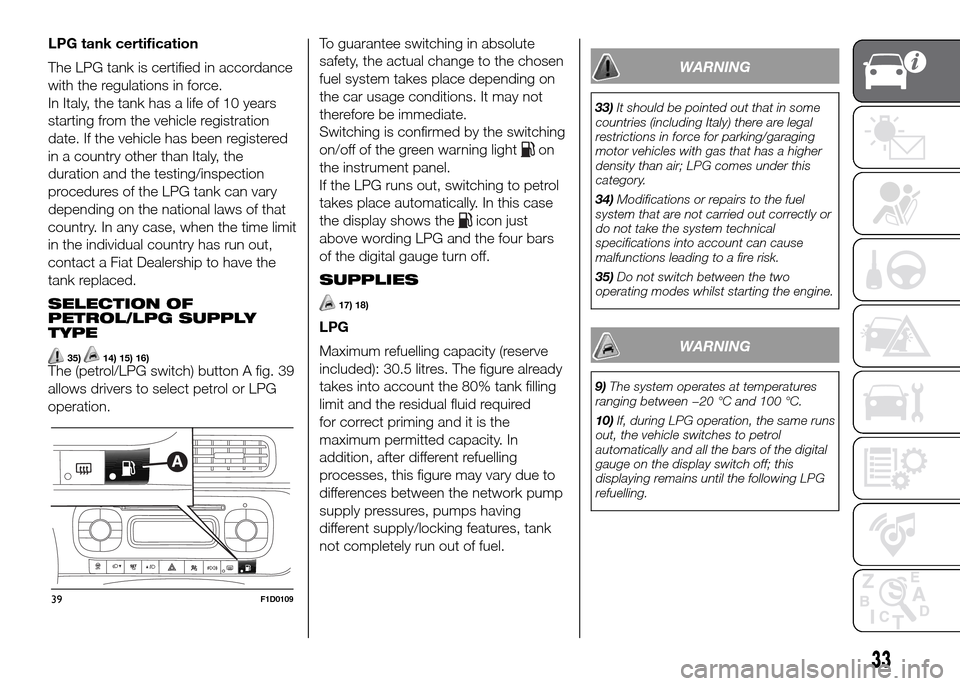
35)14) 15) 16)The (petrol/LPG switch) button A fig. 39
allows drivers to select petrol or LPG
operation.To guarantee switching in absolute
safety, the actual change to the chosen
fuel system takes place depending on
the car usage conditions. It may not
therefore be immediate.
Switching is confirmed by the switching
on/off of the green warning light
on
the instrument panel.
If the LPG runs out, switching to petrol
takes place automatically. In this case
the display shows the
icon just
above wording LPG and the four bars
of the digital gauge turn off.
SUPPLIES
17) 18)
LPG
Maximum refuelling capacity (reserve
included): 30.5 litres. The figure already
takes into account the 80% tank filling
limit and the residual fluid required
for correct priming and it is the
maximum permitted capacity. In
addition, after different refuelling
processes, this figure may vary due to
differences between the network pump
supply pressures, pumps having
different supply/locking features, tank
not completely run out of fuel.
WARNING
33)It should be pointed out that in some
countries (including Italy) there are legal
restrictions in force for parking/garaging
motor vehicles with gas that has a higher
density than air; LPG comes under this
category.
34)Modifications or repairs to the fuel
system that are not carried out correctly or
do not take the system technical
specifications into account can cause
malfunctions leading to a fire risk.
35)Do not switch between the two
operating modes whilst starting the engine.
WARNING
9)The system operates at temperatures
ranging between −20 °C and 100 °C.
10)If, during LPG operation, the same runs
out, the vehicle switches to petrol
automatically and all the bars of the digital
gauge on the display switch off; this
displaying remains until the following LPG
refuelling.
39F1D0109
33