Instrument FIAT PANDA 2016 319 / 3.G Owner's Manual
[x] Cancel search | Manufacturer: FIAT, Model Year: 2016, Model line: PANDA, Model: FIAT PANDA 2016 319 / 3.GPages: 204, PDF Size: 18.77 MB
Page 56 of 204
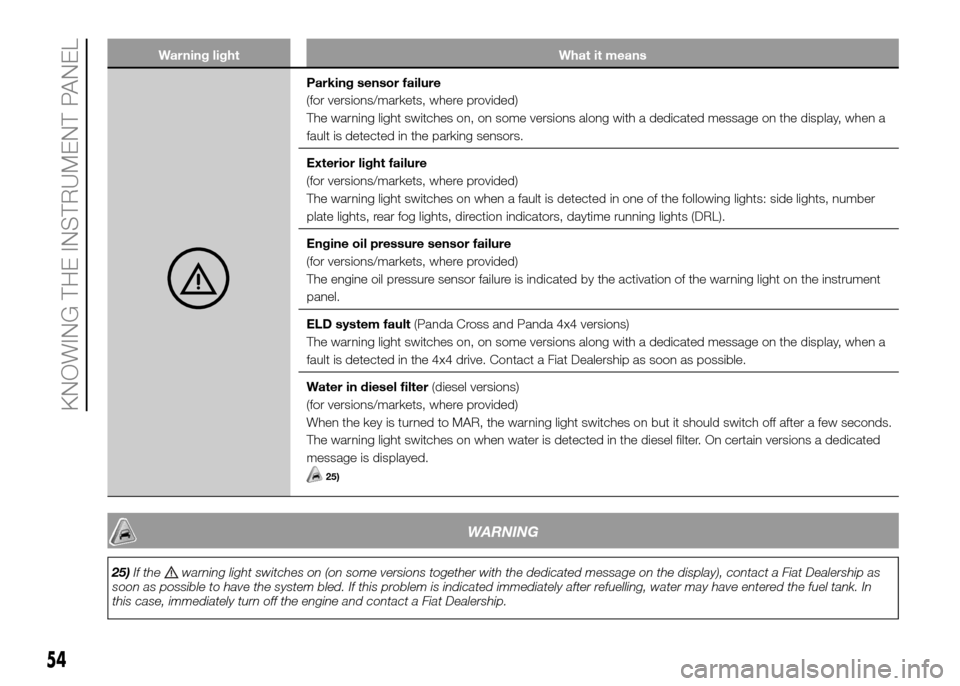
Warning light What it means
Parking sensor failure
(for versions/markets, where provided)
The warning light switches on, on some versions along with a dedicated message on the display, when a
fault is detected in the parking sensors.
Exterior light failure
(for versions/markets, where provided)
The warning light switches on when a fault is detected in one of the following lights: side lights, number
plate lights, rear fog lights, direction indicators, daytime running lights (DRL).
Engine oil pressure sensor failure
(for versions/markets, where provided)
The engine oil pressure sensor failure is indicated by the activation of the warning light on the instrument
panel.
ELD system fault(Panda Cross and Panda 4x4 versions)
The warning light switches on, on some versions along with a dedicated message on the display, when a
fault is detected in the 4x4 drive. Contact a Fiat Dealership as soon as possible.
Water in diesel filter(diesel versions)
(for versions/markets, where provided)
When the key is turned to MAR, the warning light switches on but it should switch off after a few seconds.
The warning light switches on when water is detected in the diesel filter. On certain versions a dedicated
message is displayed.
25)
WARNING
25)If thewarning light switches on (on some versions together with the dedicated message on the display), contact a Fiat Dealership as
soon as possible to have the system bled. If this problem is indicated immediately after refuelling, water may have entered the fuel tank. In
this case, immediately turn off the engine and contact a Fiat Dealership.
54
KNOWING THE INSTRUMENT PANEL
Page 58 of 204
Warning light What it means
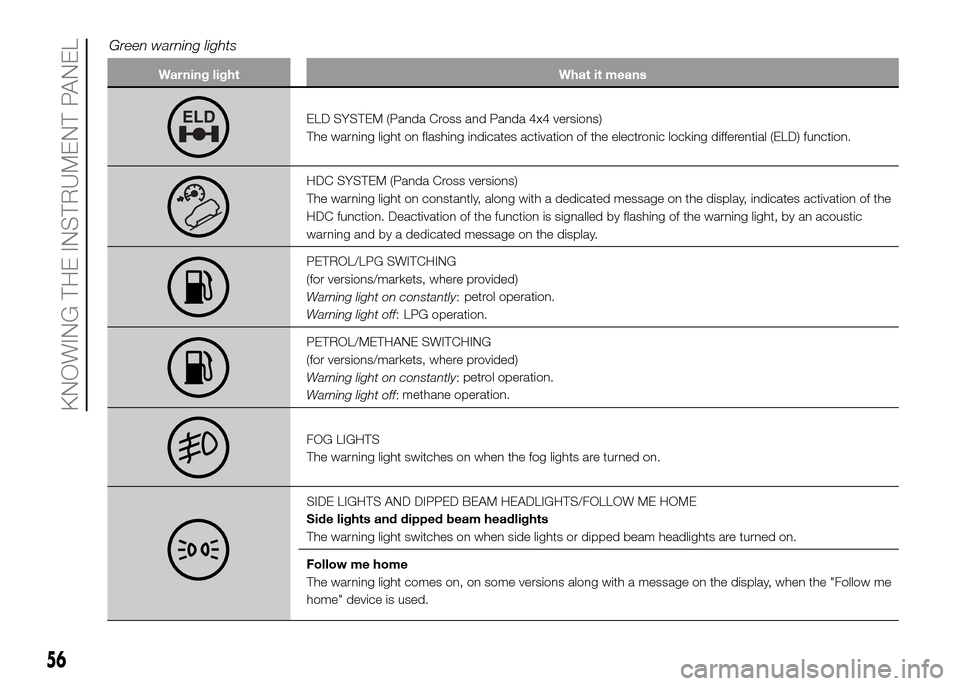
ELD SYSTEM (Panda Cross and Panda 4x4 versions)
The warning light on flashing indicates activation of the electronic locking differential (ELD) function.
HDC SYSTEM (Panda Cross versions)
The warning light on constantly, along with a dedicated message on the display, indicates activation of the
HDC function. Deactivation of the function is signalled by flashing of the warning light, by an acoustic
warning and by a dedicated message on the display.
PETROL/LPG SWITCHING
(for versions/markets, where provided)
Warning light on constantly:
LPG operation.
Warning light off:petrol operation.
PETROL/METHANE SWITCHING
(for versions/markets, where provided)
Warning light on constantly:
methane operation.
Warning light off:petrol operation.
FOG LIGHTS
The warning light switches on when the fog lights are turned on.
SIDE LIGHTS AND DIPPED BEAM HEADLIGHTS/FOLLOW ME HOME
Side lights and dipped beam headlights
The warning light switches on when side lights or dipped beam headlights are turned on.
Follow me home
The warning light comes on, on some versions along with a message on the display, when the "Follow me
home" device is used.
56
KNOWING THE INSTRUMENT PANEL
Green warning lights
Page 60 of 204
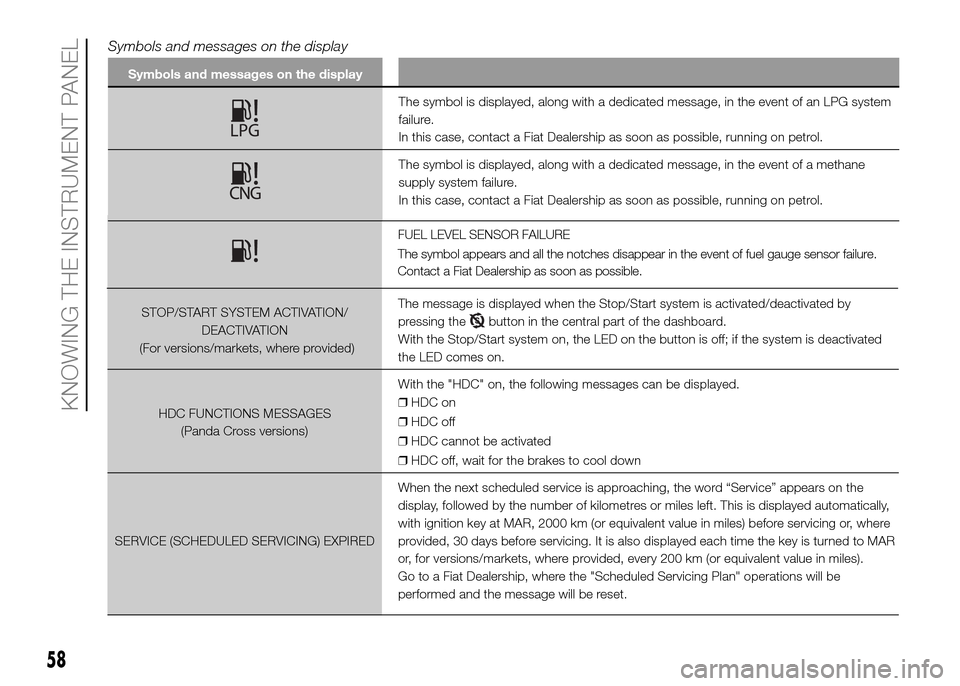
STOP/START SYSTEM ACTIVATION/
DEACTIVATION
(For versions/markets, where provided)The message is displayed when the Stop/Start system is activated/deactivated by
pressing thebutton in the central part of the dashboard.
With the Stop/Start system on, the LED on the button is off; if the system is deactivated
the LED comes on.
HDC FUNCTIONS MESSAGES
(Panda Cross versions)With the "HDC" on, the following messages can be displayed.
❒HDC on
❒HDC off
❒HDC cannot be activated
❒HDC off, wait for the brakes to cool down
SERVICE (SCHEDULED SERVICING) EXPIREDWhen the next scheduled service is approaching, the word “Service” appears on the
display, followed by the number of kilometres or miles left. This is displayed automatically,
with ignition key at MAR, 2000 km (or equivalent value in miles) before servicing or, where
provided, 30 days before servicing. It is also displayed each time the key is turned to MAR
or, for versions/markets, where provided, every 200 km (or equivalent value in miles).
Go to a Fiat Dealership, where the "Scheduled Servicing Plan" operations will be
performed and the message will be reset.
58
KNOWING THE INSTRUMENT PANEL
Symbols and messages on the display
Symbols and messages on the display
The symbol is displayed, along with a dedicated message, in the event of an LPG system
failure.
In this case, contact a Fiat Dealership as soon as possible, running on petrol.
The symbol is displayed, along with a dedicated message, in the event of a methane
supply system failure.
In this case, contact a Fiat Dealership as soon as possible, running on petrol.
FUEL LEVEL SENSOR FAILURE
The symbol appears and all the notches disappear in the event of fuel gauge sensor failure.
Contact a Fiat Dealership as soon as possible.
Page 63 of 204
ACTIVE SAFETY
SYSTEMS
ABS (Anti-lock Braking
System)
This system, which is an integral part of
the braking system, prevents one or
more wheels from locking and slipping
in all road surface conditions,
irrespective of the intensity of the
braking action, ensuring that the vehicle
can be controlled even during
emergency braking.
IMPORTANT To obtain the maximum
efficiency of the braking system, a
bedding-in period of about 500 km is
needed: during this period it is better to
avoid sharp, repeated and prolonged
braking.
The ABS also includes the following
systems: EBD (Electronic Braking Force
Distribution), MSR (Motor
Schleppmoment Regelung) and MBA
(Mechanical Brake Assist) (for
versions/markets, where provided).
System intervention
The driver can feel that the ABS system
has come into action because the
brake pedal pulsates slightly and the
system gets noisier: this is entirely
normal with the system operating.ESC SYSTEM (Electronic
Stability Control)
(for versions/markets, where provided)
This is an electronic system that
controls vehicle stability in the event of
tyre grip loss, helping maintain
directional control. The system is
capable of recognising potentially
dangerous situations in terms of the
stability and intervenes automatically on
the brakes in a differentiated manner
for the four wheels in order to provide a
stabilising torque.
The ESC system switches on
automatically when the engine is
started and cannot be switched off.
System intervention
The intervention of the system is
indicated by the flashing of theESC
warning light on the instrument panel,
to inform the driver that the vehicle is in
critical stability and grip conditions.
56) 57) 58) 59) 60) 61)
HH (Hill Holder) SYSTEM
This system is an integral part of the
ESC system and facilitates starting on
slopes.
It is automatically activated in the
following conditions:
❒uphill: vehicle stationary on a road
with a gradient higher than 5%, engine
running, brake pressed and
transmission in neutral or gear other
than reverse engaged;❒downhill: vehicle stationary on a road
with a gradient higher than 5%, engine
running, brake pressed and reverse
gear engaged.
When setting off, the ESC system
control unit maintains the braking
pressure on the wheels until the torque
necessary for starting is reached, or
in any case for a maximum of 2
seconds, allowing your right foot to be
moved easily from the brake pedal to
the accelerator.
When two seconds have elapsed,
without starting, the system is
automatically deactivated, gradually
releasing the braking pressure. During
this release stage, the typical
mechanical brake release noise can be
heard, indicating that the vehicle is
about to move.
NOTE: the Hill Holder system is not
active with parking brake engaged.
IMPORTANT The Hill Holder system is
not a parking brake, therefore do not
leave the vehicle without activating the
handbrake, switching off the engine,
and engaging first gear, with the vehicle
parked in safe conditions.
61
47) 48) 49) 50) 51) 52) 53) 54) 55)
Page 65 of 204
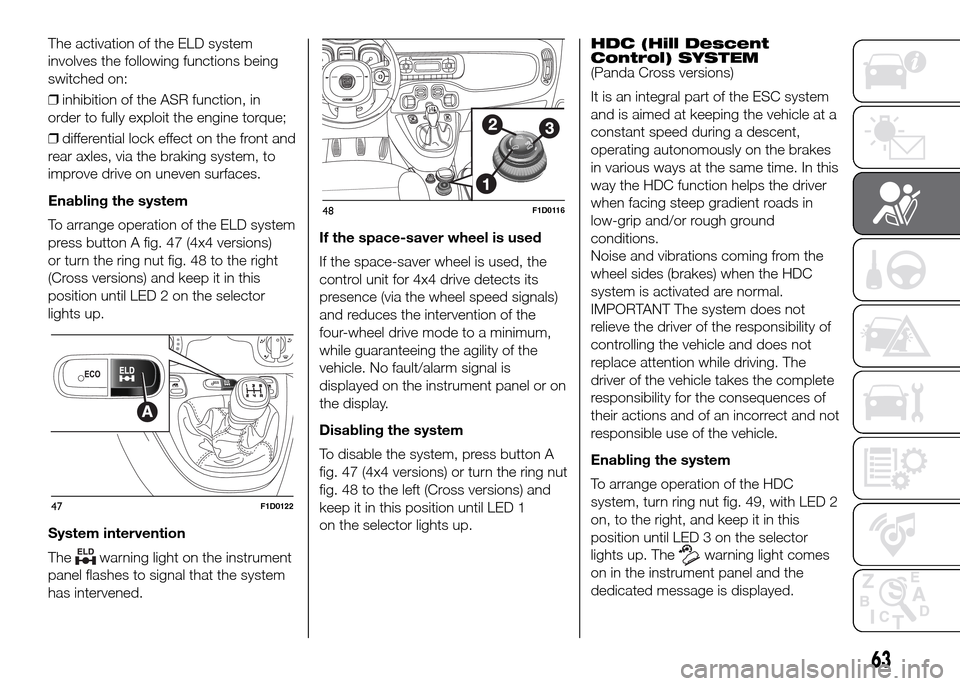
The activation of the ELD system
involves the following functions being
switched on:
❒inhibition of the ASR function, in
order to fully exploit the engine torque;
❒differential lock effect on the front and
rear axles, via the braking system, to
improve drive on uneven surfaces.
Enabling the system
To arrange operation of the ELD system
press button A fig. 47 (4x4 versions)
or turn the ring nut fig. 48 to the right
(Cross versions) and keep it in this
position until LED 2 on the selector
lights up.
System intervention
The
warning light on the instrument
panel flashes to signal that the system
has intervened.If the space-saver wheel is used
If the space-saver wheel is used, the
control unit for 4x4 drive detects its
presence (via the wheel speed signals)
and reduces the intervention of the
four-wheel drive mode to a minimum,
while guaranteeing the agility of the
vehicle. No fault/alarm signal is
displayed on the instrument panel or on
the display.
Disabling the system
To disable the system, press button A
fig. 47 (4x4 versions) or turn the ring nut
fig. 48 to the left (Cross versions) and
keep it in this position until LED 1
on the selector lights up.HDC (Hill Descent
Control) SYSTEM
(Panda Cross versions)
It is an integral part of the ESC system
and is aimed at keeping the vehicle at a
constant speed during a descent,
operating autonomously on the brakes
in various ways at the same time. In this
way the HDC function helps the driver
when facing steep gradient roads in
low-grip and/or rough ground
conditions.
Noise and vibrations coming from the
wheel sides (brakes) when the HDC
system is activated are normal.
IMPORTANT The system does not
relieve the driver of the responsibility of
controlling the vehicle and does not
replace attention while driving. The
driver of the vehicle takes the complete
responsibility for the consequences of
their actions and of an incorrect and not
responsible use of the vehicle.
Enabling the system
To arrange operation of the HDC
system, turn ring nut fig. 49, with LED 2
on, to the right, and keep it in this
position until LED 3 on the selector
lights up. Thewarning light comes
on in the instrument panel and the
dedicated message is displayed.
47F1D0122
48F1D0116
63
Page 66 of 204
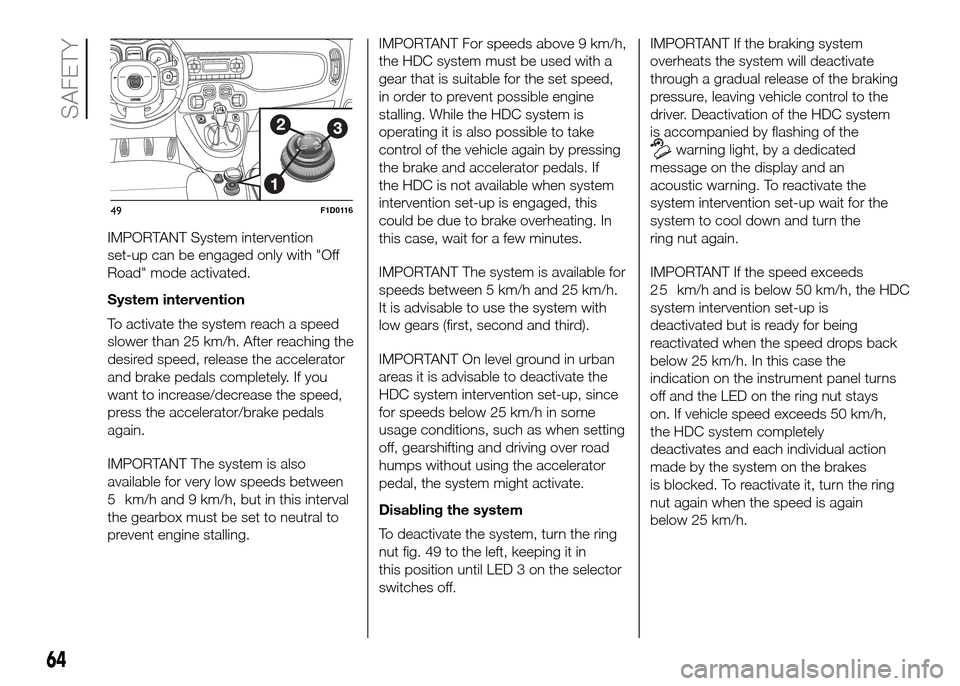
IMPORTANT System intervention
set-up can be engaged only with "Off
Road" mode activated.
System intervention
To activate the system reach a speed
slower than 25 km/h. After reaching the
desired speed, release the accelerator
and brake pedals completely. If you
want to increase/decrease the speed,
press the accelerator/brake pedals
again.
IMPORTANT The system is also
available for very low speeds between
the gearbox must be set to neutral to
prevent engine stalling.IMPORTANT For speeds above 9 km/h,
the HDC system must be used with a
gear that is suitable for the set speed,
in order to prevent possible engine
stalling. While the HDC system is
operating it is also possible to take
control of the vehicle again by pressing
the brake and accelerator pedals. If
the HDC is not available when system
intervention set-up is engaged, this
could be due to brake overheating. In
this case, wait for a few minutes.
IMPORTANT The system is available for
speeds between 5 km/h and 25 km/h.
It is advisable to use the system with
low gears (first, second and third).
IMPORTANT On level ground in urban
areas it is advisable to deactivate the
HDC system intervention set-up, since
for speeds below 25 km/h in some
usage conditions, such as when setting
off, gearshifting and driving over road
humps without using the accelerator
pedal, the system might activate.
Disabling the system
To deactivate the system, turn the ring
nut fig. 49 to the left, keeping it in
this position until LED 3 on the selector
switches off.IMPORTANT If the braking system
overheats the system will deactivate
through a gradual release of the braking
pressure, leaving vehicle control to the
driver. Deactivation of the HDC system
is accompanied by flashing of the
warning light, by a dedicated
message on the display and an
acoustic warning. To reactivate the
system intervention set-up wait for the
system to cool down and turn the
ring nut again.
IMPORTANT If the speed exceeds
system intervention set-up is
deactivated but is ready for being
reactivated when the speed drops back
below 25 km/h. In this case the
indication on the instrument panel turns
off and the LED on the ring nut stays
on. If vehicle speed exceeds 50 km/h,
the HDC system completely
deactivates and each individual action
made by the system on the brakes
is blocked. To reactivate it, turn the ring
nut again when the speed is again
below 25 km/h.
49F1D0116
64
SAFETY
5 km/h and 9 km/h, but in this interval2 5 km/h and is below 50 km/h, the HDC
Page 68 of 204
69)The HBA system is an aid for the driver,
who must always pay full attention while
driving. The responsibility always rests with
the driver. The features of the HBA system
must never be tested in imprudent or
dangerous ways, with the possibility of
putting the safety of the driver, occupants
or other road users at risk.DRIVING
ASSISTANCE
SYSTEMS
TP (Traction Plus)
SYSTEM
(for versions/markets, where provided)
Traction Plus is a driving aid, useful
for setting off in poor grip conditions
(snow, ice, mud, etc.) which allows the
drive force to be distributed in the
best way over the front axle when one
wheel is slipping.
Traction Plus acts by braking the
wheels with poor grip (or those slipping
more than the others), thereby
transferring the drive force to those
which have greater grip on the ground.
Engagement/disengagement
The system is deactivated when
starting. To activate the Traction Plus
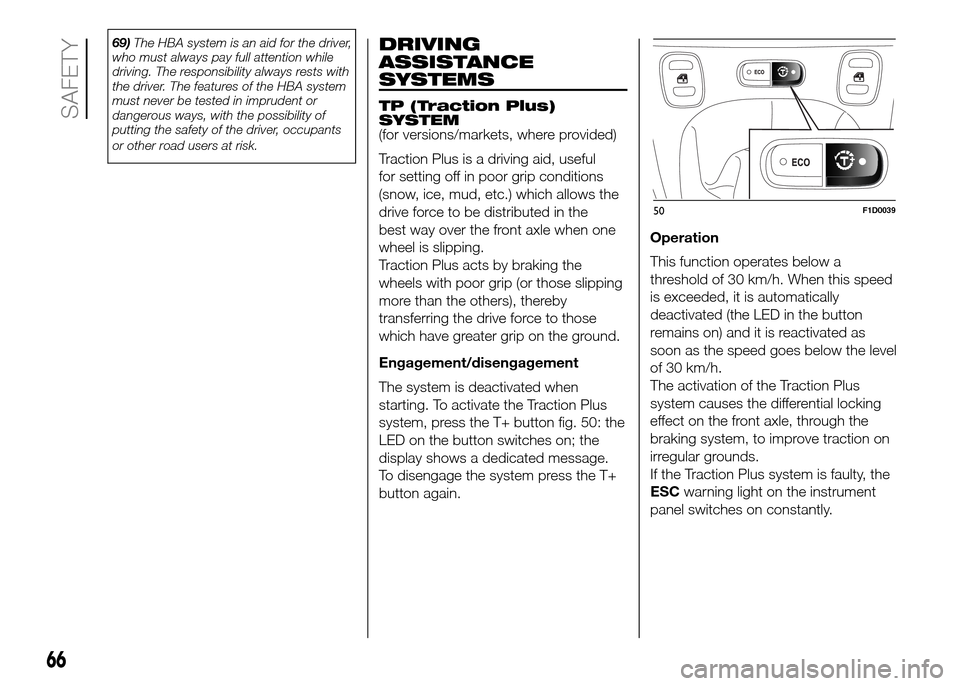
system, press the T+ button fig. 50: the
LED on the button switches on; the
display shows a dedicated message.
To disengage the system press the T+
button again.Operation
This function operates below a
threshold of 30 km/h. When this speed
is exceeded, it is automatically
deactivated (the LED in the button
remains on) and it is reactivated as
soon as the speed goes below the level
of 30 km/h.
The activation of the Traction Plus
system causes the differential locking
effect on the front axle, through the
braking system, to improve traction on
irregular grounds.
If the Traction Plus system is faulty, the
ESCwarning light on the instrument
panel switches on constantly.
50F1D0039
66
SAFETY
Page 71 of 204
If the Reset procedure is not carried
out, in all above cases, the
warning
light may give false indications on
one or more tyres.
To carry out the RESET procedure, with
the vehicle stopped and the ignition
device at MAR, use the Main Menu as
follows:
❒briefly press
button: the display will
show Reset;
❒press
button orto select
(“Yes” or “No”);
❒briefly press the
button: the
display will show "Confirm";
❒press
button orto select
("Yes" to reset or "No" to exit the video
page);
❒hold the
button down again to
return to the standard screen or to the
main menu according to where you
are in the menu.
At the end of the Reset procedure the
display will show the "Reset saved"
message, indicating that the self-
learning has been started.
Working conditions
The system is active for speeds above
15 km/h.In a few situations such as sporty
driving, particular conditions of the road
surface (e.g. icy, snowy, unsurfaced
roads...) the signalling may be delayed
or partial in detecting the contemporary
deflation of more than one tyre.
Under special conditions (e.g. vehicle
loaded asymmetrically on one side,
towing a trailer, damaged or worn tyre,
fitting the space-saver wheel, use of the
"Fix&Go Automatic" kit, fitting snow
chains, fitting different tyres on the
axles) the system may give false
indications or be temporarily
deactivated.
If the system is temporarily deactivated
the
warning light flashes for about
75 seconds and then is continuously
on; at the same time, the display shows
a dedicated message.
This indication is displayed also after
the engine has been switched off and
then on again if the correct operating
conditions are not restored.
WARNING
70)The system is an aid for the driver, who
must always pay full attention while
driving. The responsibility always rests with
the driver, who must take into account
the traffic conditions in order to drive
in complete safety. The driver must always
maintain a safe distance from the vehicle
in front.
71)If the driver depresses the brake pedal
fully or carries out a fast steering during
system operation, the automatic braking
function may stop (e.g. to allow a possible
manoeuvre to avoid the obstacle).
72)The laser beam is not visible at the
naked eye. Do not look directly, or with
optical instruments (e.g. lenses), at the
laser beam from a distance lower than 10
cm: this may cause damage to the sight.
The laser beam is also present when
the key is at MAR but its operation is off,
not available or manually deactivated
with the display Setup Menu.
73)The system intervenes on vehicles
travelling in the same lane. Small sized
vehicles (e.g. bicycles or motorbikes)
or people, animals and things (e.g.
pushchairs) and more in general all those
obstacles with a low reflection of the light
emitted by the laser (e.g. vehicles soiled
with mud) are not taken into consideration.
69
Page 74 of 204
IMPORTANT When putting the back
seat to its normal position, make sure
the seat belts are positioned so they are
ready to use.
ADJUSTING THE SEAT
BELT HEIGHT
(for versions/markets, where provided)
85) 86)
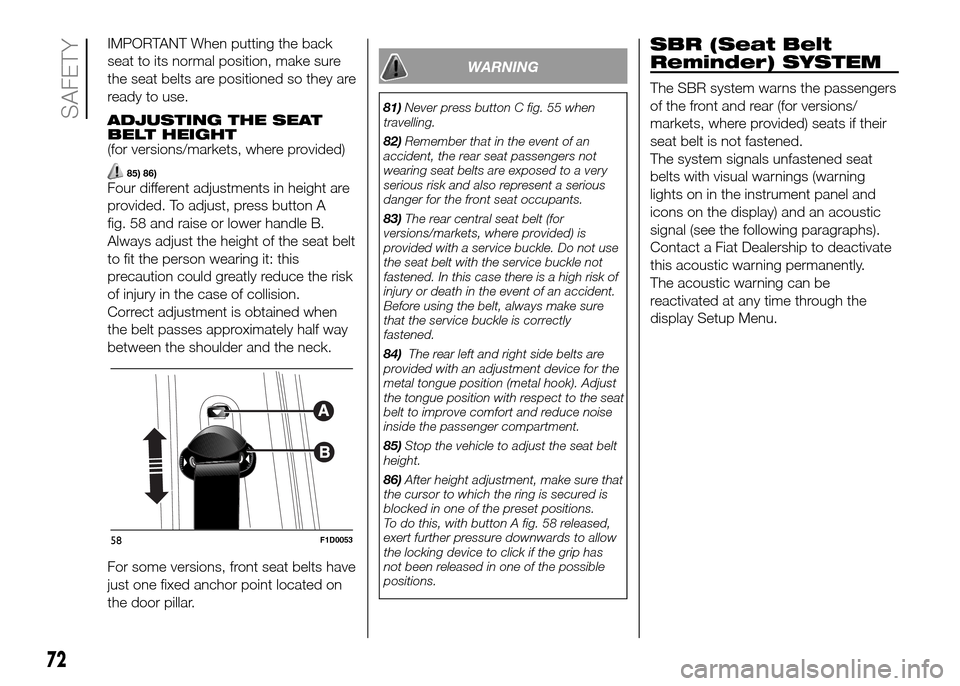
Four different adjustments in height are
provided. To adjust, press button A
fig. 58 and raise or lower handle B.
Always adjust the height of the seat belt
to fit the person wearing it: this
precaution could greatly reduce the risk
of injury in the case of collision.
Correct adjustment is obtained when
the belt passes approximately half way
between the shoulder and the neck.
For some versions, front seat belts have
just one fixed anchor point located on
the door pillar.
WARNING
81)Never press button C fig. 55 when
travelling.
82)Remember that in the event of an
accident, the rear seat passengers not
wearing seat belts are exposed to a very
serious risk and also represent a serious
danger for the front seat occupants.
83)The rear central seat belt (for
versions/markets, where provided) is
provided with a service buckle. Do not use
the seat belt with the service buckle not
fastened. In this case there is a high risk of
injury or death in the event of an accident.
Before using the belt, always make sure
that the service buckle is correctly
fastened.
84)The rear left and right side belts are
provided with an adjustment device for the
metal tongue position (metal hook). Adjust
the tongue position with respect to the seat
belt to improve comfort and reduce noise
inside the passenger compartment.
85)Stop the vehicle to adjust the seat belt
height.
86)After height adjustment, make sure that
the cursor to which the ring is secured is
blocked in one of the preset positions.
To do this, with button A fig. 58 released,
exert further pressure downwards to allow
the locking device to click if the grip has
not been released in one of the possible
positions.
SBR (Seat Belt
Reminder) SYSTEM
The SBR system warns the passengers
of the front and rear (for versions/
markets, where provided) seats if their
seat belt is not fastened.
The system signals unfastened seat
belts with visual warnings (warning
lights on in the instrument panel and
icons on the display) and an acoustic
signal (see the following paragraphs).
Contact a Fiat Dealership to deactivate
this acoustic warning permanently.
The acoustic warning can be
reactivated at any time through the
display Setup Menu.
58F1D0053
72
SAFETY
Page 94 of 204
STARTING THE
ENGINE
118) 119)
36) 37) 38) 39)
Before starting the engine, adjust the
seat, the interior rear view mirrors,
the door mirrors and fasten the seat
belt correctly.
Never press the accelerator pedal for
starting the engine.
VERSIONS WITH MANUAL
GEARBOX
Petrol versions
Proceed as follows:
❒engage the handbrake and place the
gear lever in neutral.For 0.9 TwinAir
and 0.9 TwinAir Turbo versions
engage the handbrake and place the
gear lever in neutral or fully press the
clutch pedal if a gear other than neutral
is engaged;
❒for all versions (except 0.9
TwinAir Turbo)fully depress the clutch
pedal, without pressing the accelerator;
❒turn the ignition key to AVV and
release it as soon as the engine starts.
Diesel versions
Proceed as follows:
❒engage the handbrake, put the gear
lever into neutral and turn the ignition
key to MAR: the warning lights
andon the instrument panel
will turn on;❒wait for the warning lights
and
to turn off and then fully depress
the clutch pedal without pressing the
accelerator;
❒turn the ignition key to AVV as soon
as warning light
switches off.
Release the ignition key as soon as the
engine starts.
IMPORTANT If the engine does not
start at the first attempt, return the
ignition key to STOP before repeating
the procedure. If, with the ignition
key at MAR, the warning lights
and
(only for petrol versions) stay on
in the instrument panel, the ignition key
must be brought back to STOP and
then to MAR again. If the
warning
light stays on, retry with the other
keys provided. Contact a Fiat
Dealership if you still cannot start the
engine.
VERSIONS WITH
DUALOGIC GEARBOX
120)Engine starting is allowed both with a
gear engaged and with the gearbox
in neutral (N).
However, the brake pedal must always
be pressed first if neutral is not
engaged. It is therefore advisable to
place the gear lever in neutral (N) before
starting the engine.LPG AND NATURAL
POWER VERSIONS
The engine always starts up on petrol
independently of the mode previously
selected.
40)
STOPPING THE ENGINE
41)Turn the ignition key to STOP while the
engine is idling.
IMPORTANT After a demanding drive,
before turning the engine off you should
allow it to idle to allow the temperature
in the engine compartment to
decrease.
92
STARTING AND DRIVING
WARNING
118)It is dangerous to run the engine in
enclosed areas. The engine takes in
oxygen and releases carbon dioxide,
carbon monoxide and other toxic gases.
119)Remember that the brake servo
and power steering are not operational until
the engine has been started, therefore
you need to apply much more force than
usual to the brake pedal and steering
wheel.
120)If the engine fails to start with a gear
engaged, the potentially dangerous
situation due to the fact that the gearbox is
automatically placed in neutral will be
signalled by an acoustic signal.