Instrument FIAT PANDA 2016 319 / 3.G Owner's Guide
[x] Cancel search | Manufacturer: FIAT, Model Year: 2016, Model line: PANDA, Model: FIAT PANDA 2016 319 / 3.GPages: 204, PDF Size: 18.77 MB
Page 95 of 204
WARNING
36)If the warning lightflashes for 60
seconds after starting or during an
extended towing period, this indicates a
problem in the glow plug preheating
system. You can use the vehicle as usual if
the engine starts but you should contact
a Fiat Dealership as soon as possible.
37)It is advisable not to demand maximum
performance from your vehicle (e.g.
excessive acceleration, long distances at
maximum rpm, excessively intense braking,
etc.) when it is first used.
38)When the engine is off, do not leave
the key turned to MAR to prevent
unnecessary electrical consumption from
draining the battery.
39)Never bump start the engine by
pushing, towing or coasting downhill. This
could cause fuel to flow into the catalytic
converter and damage it beyond repair.
40)There must therefore always be some
petrol in the tank to protect the petrol
pump and to guarantee temporary
switching from LPG or Methane to petrol
operation, if high performance is required.
41)A quick burst on the accelerator
before stopping the engine serves no
practical purpose; it wastes fuel and is
especially damaging to turbocharged
engines.
HANDBRAKE
121) 122) 123)
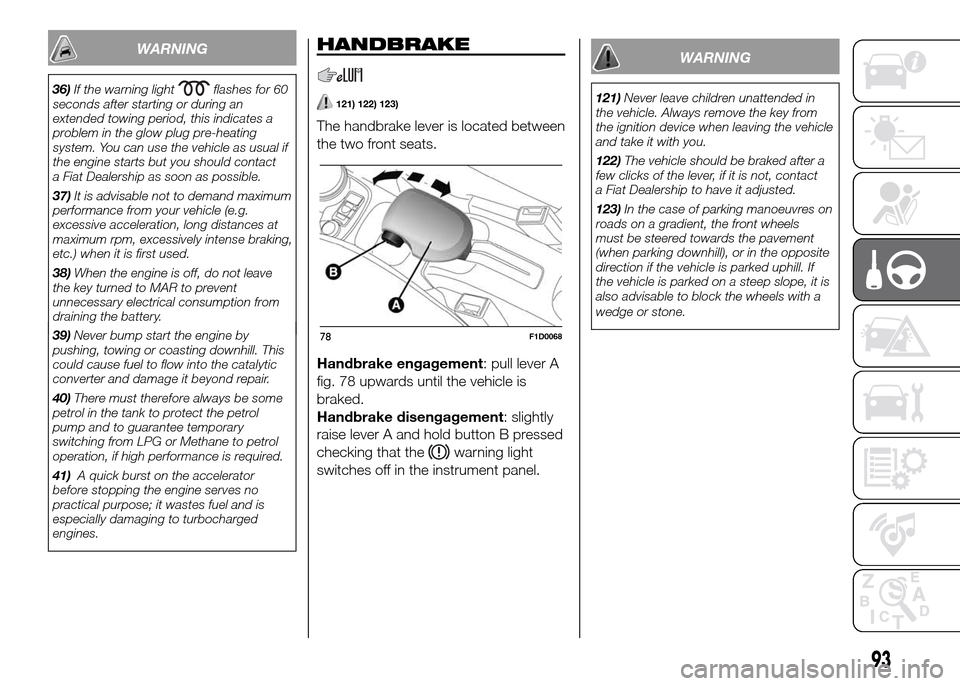
The handbrake lever is located between
the two front seats.
Handbrake engagement: pull lever A
fig. 78 upwards until the vehicle is
braked.
Handbrake disengagement: slightly
raise lever A and hold button B pressed
checking that the
warning light
switches off in the instrument panel.
78F1D0068
93
WARNING
121)Never leave children unattended in
the vehicle. Always remove the key from
the ignition device when leaving the vehicle
and take it with you.
122)The vehicle should be braked after a
few clicks of the lever, if it is not, contact
a Fiat Dealership to have it adjusted.
123)In the case of parking manoeuvres on
roads on a gradient, the front wheels
must be steered towards the pavement
(when parking downhill), or in the opposite
direction if the vehicle is parked uphill. If
the vehicle is parked on a steep slope, it is
also advisable to block the wheels with a
wedge or stone.
Page 100 of 204
MODE SELECTOR
(Panda Cross versions)
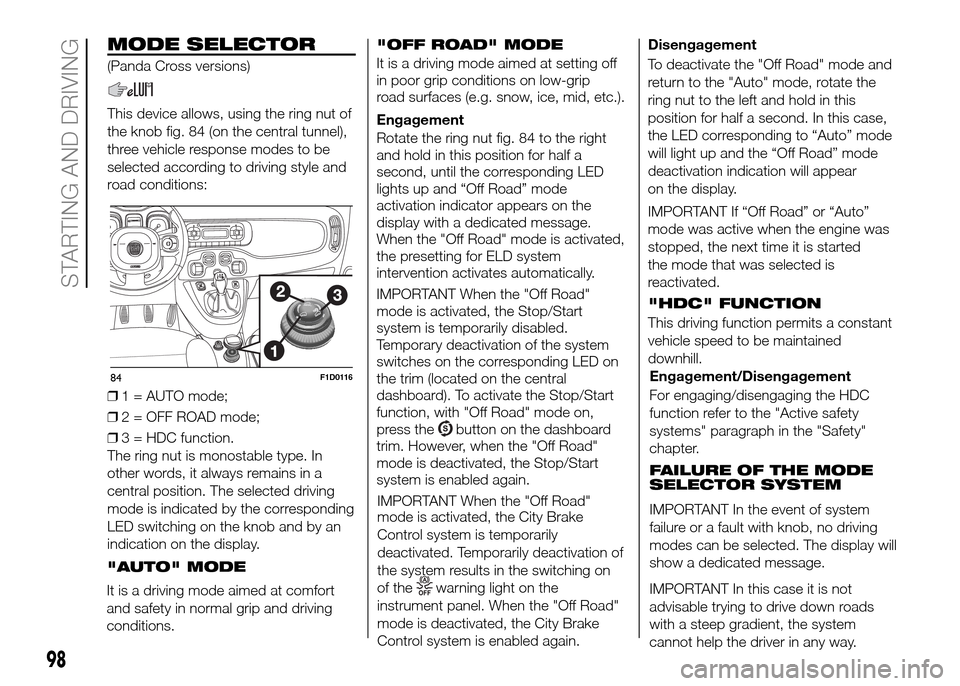
This device allows, using the ring nut of
the knob fig. 84 (on the central tunnel),
three vehicle response modes to be
selected according to driving style and
road conditions:
❒1 = AUTO mode;
❒2 = OFF ROAD mode;
❒3 = HDC function.
The ring nut is monostable type. In
other words, it always remains in a
central position. The selected driving
mode is indicated by the corresponding
LED switching on the knob and by an
indication on the display.
84F1D0116
98
STARTING AND DRIVING
"AUTO" MODE
It is a driving mode aimed at comfort
and safety in normal grip and driving
conditions."OFF ROAD" MODE
It is a driving mode aimed at setting off
in poor grip conditions on low-grip
road surfaces (e.g. snow, ice, mid, etc.).
Engagement
Rotate the ring nut fig. 84 to the right
and hold in this position for half a
second, until the corresponding LED
lights up and “Off Road” mode
activation indicator appears on the
display with a dedicated message.
When the "Off Road" mode is activated,
the presetting for ELD system
intervention activates automatically.
IMPORTANT When the "Off Road"
mode is activated, the Stop/Start
system is temporarily disabled.
Temporary deactivation of the system
switches on the corresponding LED on
the trim (located on the central
dashboard). To activate the Stop/Start
function, with "Off Road" mode on,
press the
button on the dashboard
trim. However, when the "Off Road"
mode is deactivated, the Stop/Start
system is enabled again.
IMPORTANT When the "Off Road"
mode is activated, the City Brake
Control system is temporarily
deactivated. Temporarily deactivation of
the system results in the switching on
of the
warning light on the
instrument panel. When the "Off Road"
mode is deactivated, the City Brake
Control system is enabled again.Disengagement
To deactivate the "Off Road" mode and
return to the "Auto" mode, rotate the
ring nut to the left and hold in this
position for half a second. In this case,
the LED corresponding to “Auto” mode
will light up and the “Off Road” mode
deactivation indication will appear
on the display.
IMPORTANT If “Off Road” or “Auto”
mode was active when the engine was
stopped, the next time it is started
the mode that was selected is
reactivated.
"HDC" FUNCTION
This driving function permits a constant
vehicle speed to be maintained
downhill.
Engagement/Disengagement
For engaging/disengaging the HDC
function refer to the "Active safety
systems" paragraph in the "Safety"
chapter.
FAILURE OF THE MODE
SELECTOR SYSTEM
IMPORTANT In the event of system
failure or a fault with knob, no driving
modes can be selected. The display will
show a dedicated message.
IMPORTANT In this case it is not
advisable trying to drive down roads
with a steep gradient, the system
cannot help the driver in any way.
Page 105 of 204
HAZARD WARNING
LIGHTS
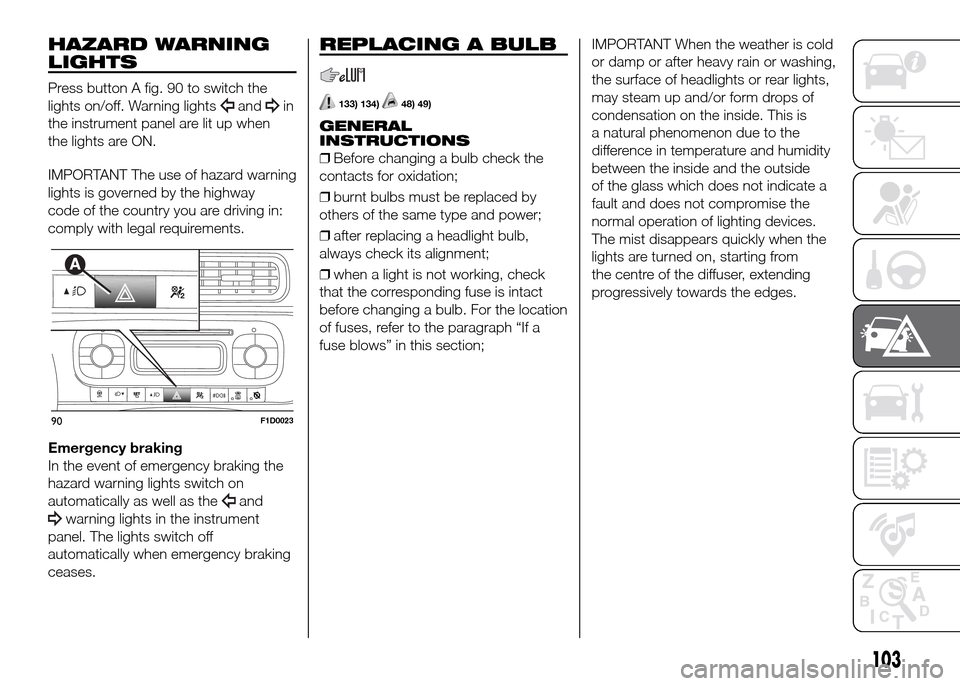
Press button A fig. 90 to switch the
lights on/off. Warning lights
andin
the instrument panel are lit up when
the lights are ON.
IMPORTANT The use of hazard warning
lights is governed by the highway
code of the country you are driving in:
comply with legal requirements.
Emergency braking
In the event of emergency braking the
hazard warning lights switch on
automatically as well as the
and
warning lights in the instrument
panel. The lights switch off
automatically when emergency braking
ceases.
REPLACING A BULB
133) 134)48) 49)
GENERAL
INSTRUCTIONS
❒Before changing a bulb check the
contacts for oxidation;
❒burnt bulbs must be replaced by
others of the same type and power;
❒after replacing a headlight bulb,
always check its alignment;
❒when a light is not working, check
that the corresponding fuse is intact
before changing a bulb. For the location
of fuses, refer to the paragraph “If a
fuse blows” in this section;IMPORTANT When the weather is cold
or damp or after heavy rain or washing,
the surface of headlights or rear lights,
may steam up and/or form drops of
condensation on the inside. This is
a natural phenomenon due to the
difference in temperature and humidity
between the inside and the outside
of the glass which does not indicate a
fault and does not compromise the
normal operation of lighting devices.
The mist disappears quickly when the
lights are turned on, starting from
the centre of the diffuser, extending
progressively towards the edges.
90F1D0023
103
Page 125 of 204
SCHEDULED SERVICING PLAN (petrol versions)
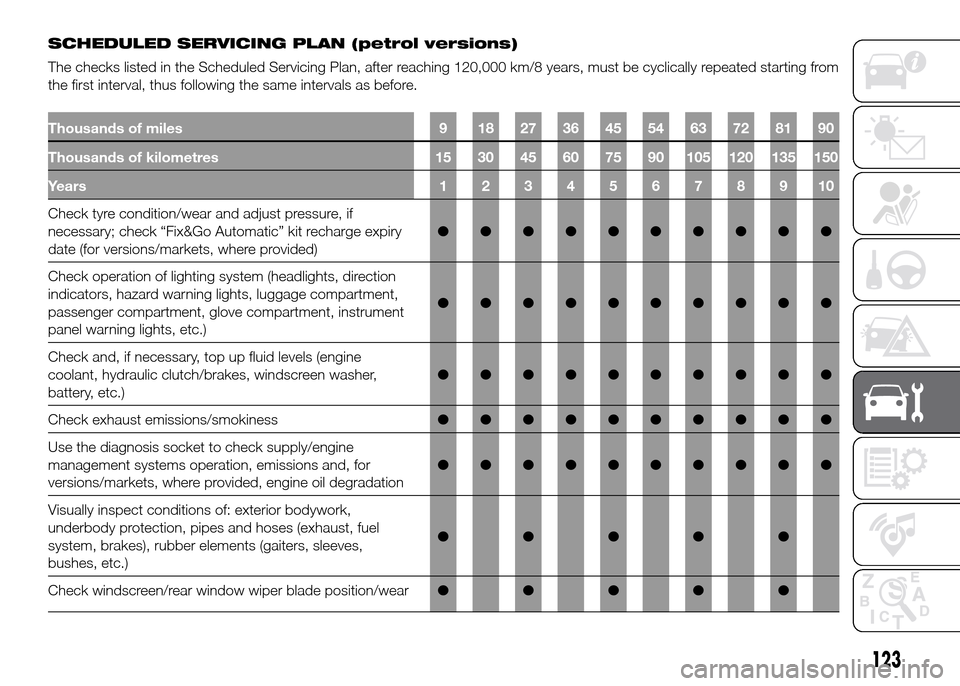
The checks listed in the Scheduled Servicing Plan, after reaching 120,000 km/8 years, must be cyclically repeated starting from
the first interval, thus following the same intervals as before.
Thousands of miles 9 18 27 36 45 54 63 72 81 90
Thousands of kilometres 15 30 45 60 75 90 105 120 135 150
Years12345678910
Check tyre condition/wear and adjust pressure, if
necessary; check “Fix&Go Automatic” kit recharge expiry
date (for versions/markets, where provided)●●●●●●●●●●
Check operation of lighting system (headlights, direction
indicators, hazard warning lights, luggage compartment,
passenger compartment, glove compartment, instrument
panel warning lights, etc.)●●●●●●●●●●
Check and, if necessary, top up fluid levels (engine
coolant, hydraulic clutch/brakes, windscreen washer,
battery, etc.)●●●●●●●●●●
Check exhaust emissions/smokiness●●●●●●●●●●
Use the diagnosis socket to check supply/engine
management systems operation, emissions and, for
versions/markets, where provided, engine oil degradation●●●●●●●●●●
Visually inspect conditions of: exterior bodywork,
underbody protection, pipes and hoses (exhaust, fuel
system, brakes), rubber elements (gaiters, sleeves,
bushes, etc.)●●●●●
Check windscreen/rear window wiper blade position/wear●●●●●
123
Page 130 of 204
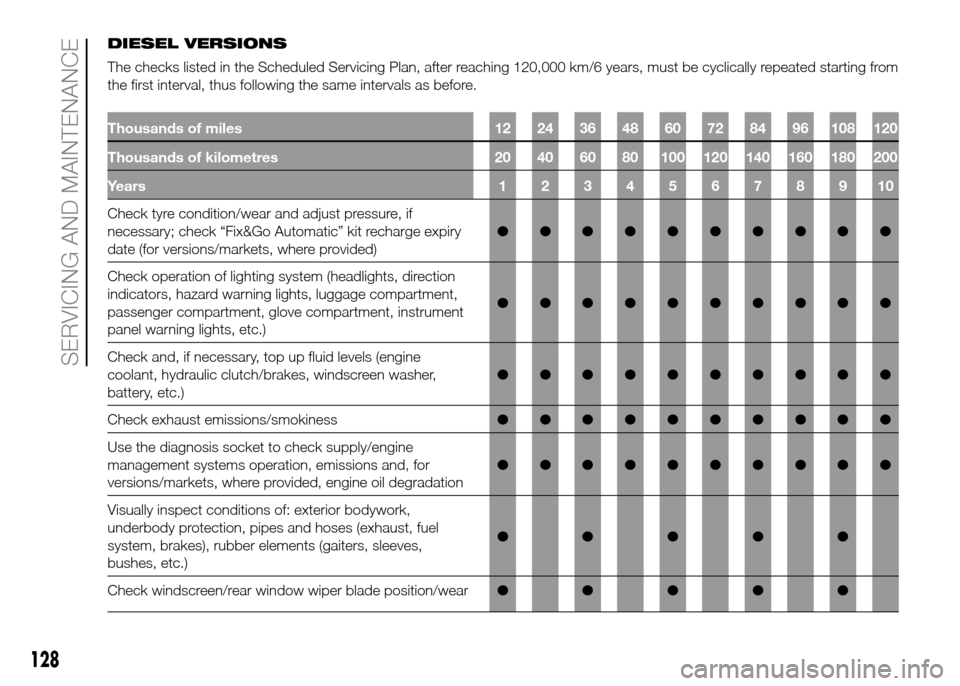
DIESEL VERSIONS
The checks listed in the Scheduled Servicing Plan, after reaching 120,000 km/6 years, must be cyclically repeated starting from
the first interval, thus following the same intervals as before.
Thousands of miles 12 24 36 48 60 72 84 96 108 120
Thousands of kilometres 20 40 60 80 100 120 140 160 180 200
Years12345678910
Check tyre condition/wear and adjust pressure, if
necessary; check “Fix&Go Automatic” kit recharge expiry
date (for versions/markets, where provided)●●●●●●●●●●
Check operation of lighting system (headlights, direction
indicators, hazard warning lights, luggage compartment,
passenger compartment, glove compartment, instrument
panel warning lights, etc.)●●●●●●●●●●
Check and, if necessary, top up fluid levels (engine
coolant, hydraulic clutch/brakes, windscreen washer,
battery, etc.)●●●●●●●●●●
Check exhaust emissions/smokiness●●●●●●●●●●
Use the diagnosis socket to check supply/engine
management systems operation, emissions and, for
versions/markets, where provided, engine oil degradation●●●●●●●●●●
Visually inspect conditions of: exterior bodywork,
underbody protection, pipes and hoses (exhaust, fuel
system, brakes), rubber elements (gaiters, sleeves,
bushes, etc.)●●●●●
Check windscreen/rear window wiper blade position/wear●●●●●
128
SERVICING AND MAINTENANCE
Page 132 of 204
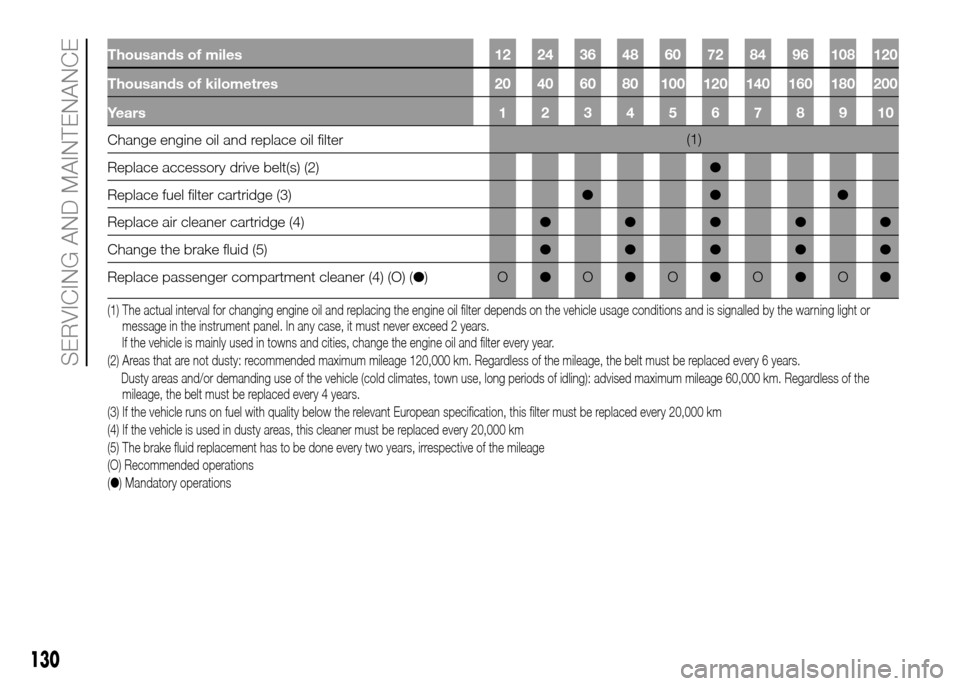
Thousands of miles 12 24 36 48 60 72 84 96 108 120
Thousands of kilometres 20 40 60 80 100 120 140 160 180 200
Years12345678910
Change engine oil and replace oil filter(1)
Replace accessory drive belt(s) (2)●
Replace fuel filter cartridge (3)●●●
Replace air cleaner cartridge (4)●●●●●
Change the brake fluid (5)●●●●●
Replace passenger compartment cleaner (4) (O) (●)O●O●O●O●O●
(1) The actual interval for changing engine oil and replacing the engine oil filter depends on the vehicle usage conditions and is signalled by the warning light or
message in the instrument panel. In any case, it must never exceed 2 years.
If the vehicle is mainly used in towns and cities, change the engine oil and filter every year.
(2) Areas that are not dusty: recommended maximum mileage 120,000 km. Regardless of the mileage, the belt must be replaced every 6 years.
Dusty areas and/or demanding use of the vehicle (cold climates, town use, long periods of idling): advised maximum mileage 60,000 km. Regardless of the
mileage, the belt must be replaced every 4 years.
(3) If the vehicle runs on fuel with quality below the relevant European specification, this filter must be replaced every 20,000 km
(4) If the vehicle is used in dusty areas, this cleaner must be replaced every 20,000 km
(5) The brake fluid replacement has to be done every two years, irrespective of the mileage
(O) Recommended operations
(●) Mandatory operations
130
SERVICING AND MAINTENANCE
Page 137 of 204
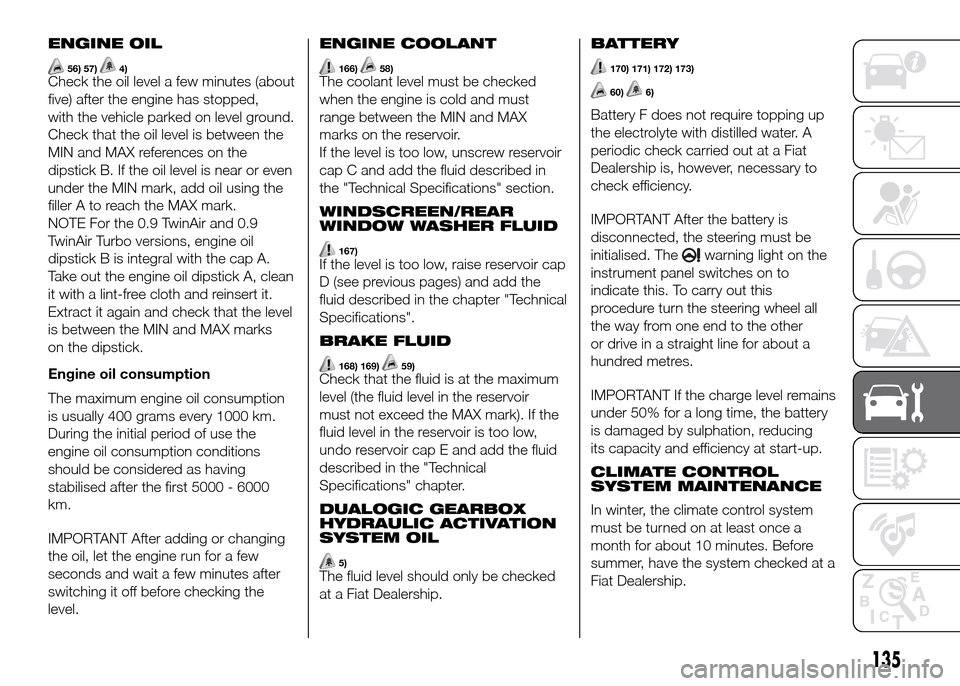
ENGINE OIL
56) 57)4)Check the oil level a few minutes (about
five) after the engine has stopped,
with the vehicle parked on level ground.
Check that the oil level is between the
MIN and MAX references on the
dipstick B. If the oil level is near or even
under the MIN mark, add oil using the
filler A to reach the MAX mark.
NOTE For the 0.9 TwinAir and 0.9
TwinAir Turbo versions, engine oil
dipstick B is integral with the cap A.
Take out the engine oil dipstick A, clean
it with a lint-free cloth and reinsert it.
Extract it again and check that the level
is between the MIN and MAX marks
on the dipstick.
Engine oil consumption
The maximum engine oil consumption
is usually 400 grams every 1000 km.
During the initial period of use the
engine oil consumption conditions
should be considered as having
stabilised after the first 5000 - 6000
km.
IMPORTANT After adding or changing
the oil, let the engine run for a few
seconds and wait a few minutes after
switching it off before checking the
level.ENGINE COOLANT166)58)The coolant level must be checked
when the engine is cold and must
range between the MIN and MAX
marks on the reservoir.
If the level is too low, unscrew reservoir
cap C and add the fluid described in
the "Technical Specifications" section.
WINDSCREEN/REAR
WINDOW WASHER FLUID
167)If the level is too low, raise reservoir cap
D (see previous pages) and add the
fluid described in the chapter "Technical
Specifications".
BRAKE FLUID
168) 169)59)Check that the fluid is at the maximum
level (the fluid level in the reservoir
must not exceed the MAX mark). If the
fluid level in the reservoir is too low,
undo reservoir cap E and add the fluid
described in the "Technical
Specifications" chapter.
DUALOGIC GEARBOX
HYDRAULIC ACTIVATION
SYSTEM OIL
5)The fluid level should only be checked
at a Fiat Dealership.BATTERY
170) 171) 172) 173)
60)6)
Battery F does not require topping up
the electrolyte with distilled water. A
periodic check carried out at a Fiat
Dealership is, however, necessary to
check efficiency.
IMPORTANT After the battery is
disconnected, the steering must be
initialised. The
warning light on the
instrument panel switches on to
indicate this. To carry out this
procedure turn the steering wheel all
the way from one end to the other
or drive in a straight line for about a
hundred metres.
IMPORTANT If the charge level remains
under 50% for a long time, the battery
is damaged by sulphation, reducing
its capacity and efficiency at start-up.
CLIMATE CONTROL
SYSTEM MAINTENANCE
In winter, the climate control system
must be turned on at least once a
month for about 10 minutes. Before
summer, have the system checked at a
Fiat Dealership.
135
Page 154 of 204
15
TECHNICAL SPECIFICATIONS
2
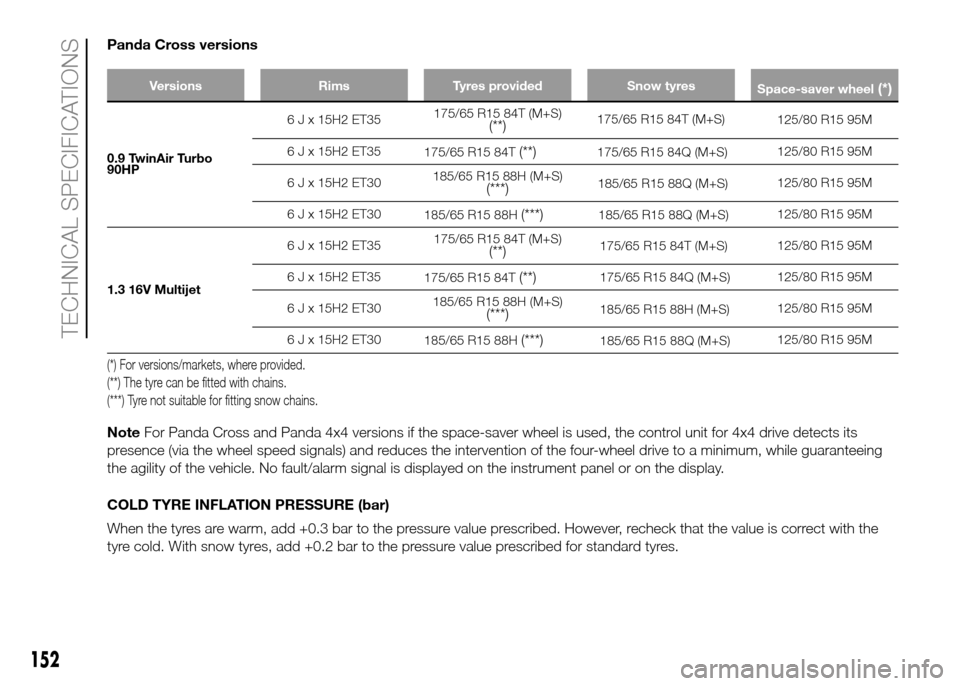
Panda Cross versions
Versions Rims Tyres provided Snow tyres
Space-saver wheel(*)
0.9 TwinAir Turbo
HP6 J x 15H2 ET35175/65 R15 84T (M+S)
(**)125/80 R15 95M
6 J x 15H2 ET35
175/65 R15 84T
(**)125/80 R15 95M
6 J x 15H2 ET30185/65 R15 88H (M+S)
(***)125/80 R15 95M
6 J x 15H2 ET30
185/65 R15 88H
(***)125/80 R15 95M
1.3 16V Multijet6 J x 15H2 ET35175/65 R15 84T (M+S)
(**)125/80 R15 95M
6 J x 15H2 ET35
175/65 R15 84T
(**)125/80 R15 95M
6 J x 15H2 ET30185/65 R15 88H (M+S)
(***)125/80 R15 95M
6 J x 15H2 ET30
185/65 R15 88H
(***)125/80 R15 95M
(*) For versions/markets, where provided.
(**) The tyre can be fitted with chains.
(***) Tyre not suitable for fitting snow chains.
NoteFor Panda Cross and Panda 4x4 versions if the space-saver wheel is used, the control unit for 4x4 drive detects its
presence (via the wheel speed signals) and reduces the intervention of the four-wheel drive to a minimum, while guaranteeing
the agility of the vehicle. No fault/alarm signal is displayed on the instrument panel or on the display.
COLD TYRE INFLATION PRESSURE (bar)
When the tyres are warm, add +0.3 bar to the pressure value prescribed. However, recheck that the value is correct with the
tyre cold. With snow tyres, add +0.2 bar to the pressure value prescribed for standard tyres.
90175/65 R15 84T (M+S)
175/65 R15 84Q (M+S)
185/65 R15 88Q (M+S)
185/65 R15 88Q (M+S)
175/65 R15 84T (M+S)
175/65 R15 84Q (M+S)
185/65 R15 88H (M+S)
185/65 R15 88Q (M+S)
Page 187 of 204
HANDS-FREE FUNCTION
QUICK GUIDE
To start using the hands-free function
with voice recognition andBluetooth®
technology provided byBlue&Me™:
❒Make sure that the ignition key is
turned toMAR
❒Practise the voice commands
❒Register your mobile phone
❒Make a call.
Preparing your mobile phone
phonebook
Before pairing your mobile phone with
Blue&Me™, you must make sure
you have stored the names you want to
contact in the phonebook on your
mobile phone so that you can call them
using the car's hands-free system.
If your phonebook does not contain any
names, enter new names for the most
frequently used numbers. For further
details, consult your mobile phone
manual.
IMPORTANT
❒Access to the phonebook copied to
Blue&Me™is possible only when
the mobile phone from which it was
copied is connected.❒Entries stored in the SIM card or
mobile phone memory can be
transferred toBlue&Me™with different
procedures, depending on your mobile
phone model.
Getting to know the voice
commands
When talking to the system, you can
always use the voice command "Help",
to obtain detailed instructions on the
voice commands available for each
stage of interaction.
To practise the "Help" command
proceed as follows:
❒Press the
control on the steering
wheel.
❒AfterBlue&Me™has given an
acoustic signal to indicate that voice
recognition is active, say "Help".
Blue&Me™will give the list of voice
commands available.
❒At the end of the help message, say
"Settings" and, at the end of the
message, "Help".Blue&Me™will give
the list of voice commands available
for the Settings menu.
❒You can now give one of the available
commands and proceed with the
dialogue as you wish.
❒If you need further help press
and
say "Help".Pairing your mobile phone
IMPORTANT This operation should be
carried out only with the vehicle
stationary.
To pair your mobile phone, proceed as
follows:
❒Press
and say "Settings" and
then, at the end of the message from
Blue&Me™, say "User pairing".
❒The system will show a code number
(PIN) on the instrument panel display,
which is used for the pairing procedure.
For the two subsequent stages,
consult your mobile phone manual.
❒Look for devices with Bluetooth®
technology on your mobile phone (the
setting on your mobile phone could
be called Search or New Device). Find
“Blue&Me” in this list (the name that
identifies theBlue&Me™system
in your vehicle) and select it.
❒When prompted, enter the PIN code
displayed on the instrument panel
using your mobile phone keypad. If
pairing is successful, the system will
say "Connecting" and at the end the
display will show, as confirmation,
details of the mobile phone paired.
185
Page 191 of 204
RIGHT HAND DRIVE VERSIONS
DASHBOARD (RIGHT-HAND DRIVE VERSION)
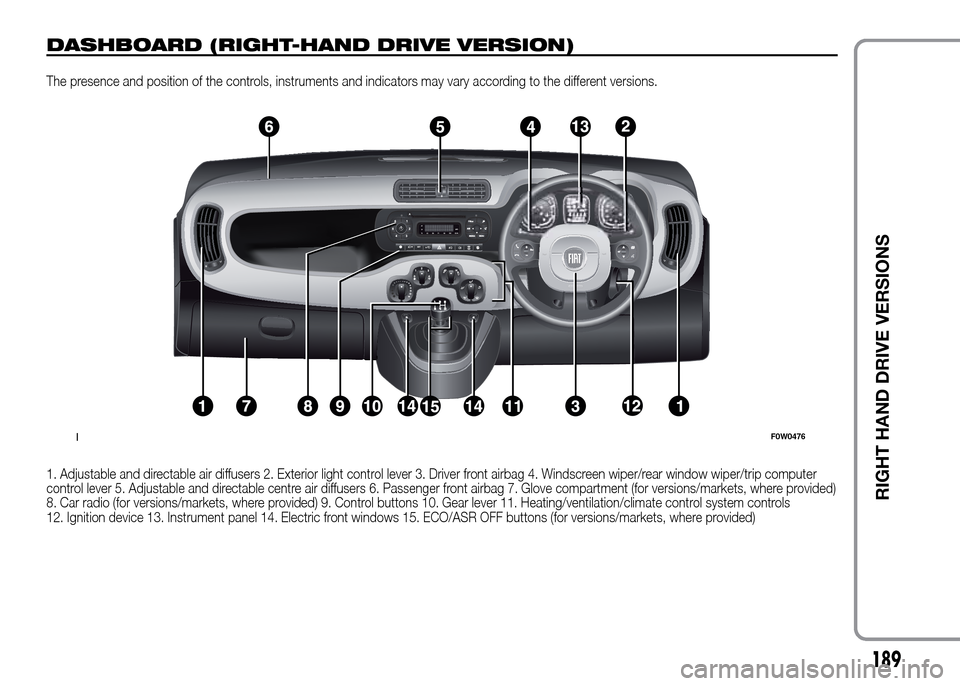
The presence and position of the controls, instruments and indicators may vary according to the different versions.
1. Adjustable and directable air diffusers 2. Exterior light control lever 3. Driver front airbag 4. Windscreen wiper/rear window wiper/trip computer
control lever 5. Adjustable and directable centre air diffusers 6. Passenger front airbag 7. Glove compartment (for versions/markets, where provided)
8. Car radio (for versions/markets, where provided) 9. Control buttons 10. Gear lever 11. Heating/ventilation/climate control system controls
12. Ignition device 13. Instrument panel 14. Electric front windows 15. ECO/ASR OFF buttons (for versions/markets, where provided)
1F0W0476
189