belt FIAT PANDA 2016 319 / 3.G Owner's Manual
[x] Cancel search | Manufacturer: FIAT, Model Year: 2016, Model line: PANDA, Model: FIAT PANDA 2016 319 / 3.GPages: 204, PDF Size: 18.77 MB
Page 92 of 204
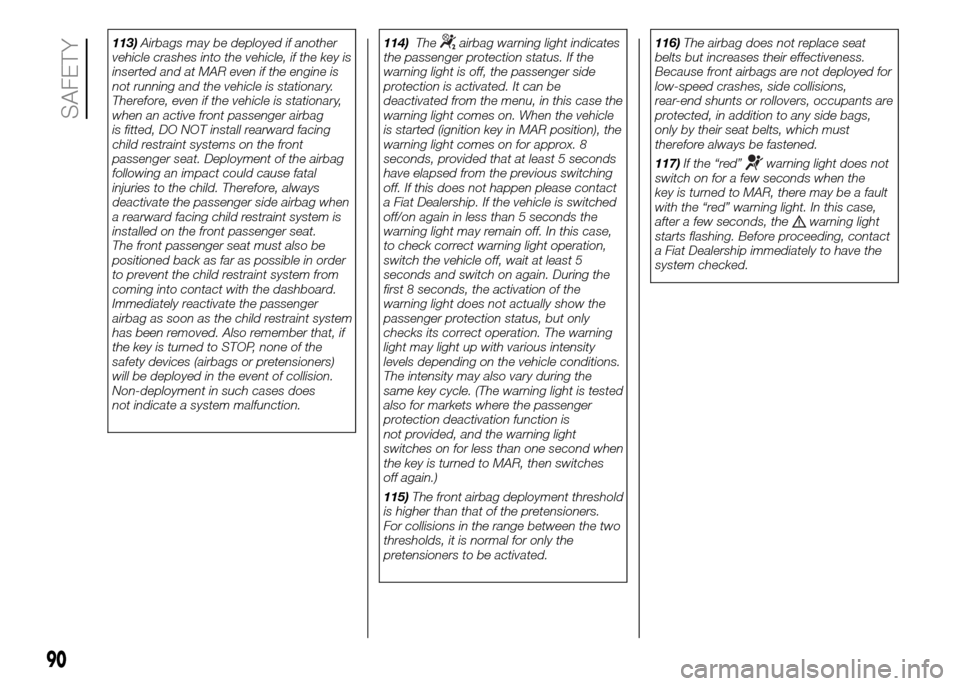
113)Airbags may be deployed if another
vehicle crashes into the vehicle, if the key is
inserted and at MAR even if the engine is
not running and the vehicle is stationary.
Therefore, even if the vehicle is stationary,
when an active front passenger airbag
is fitted, DO NOT install rearward facing
child restraint systems on the front
passenger seat. Deployment of the airbag
following an impact could cause fatal
injuries to the child. Therefore, always
deactivate the passenger side airbag when
a rearward facing child restraint system is
installed on the front passenger seat.
The front passenger seat must also be
positioned back as far as possible in order
to prevent the child restraint system from
coming into contact with the dashboard.
Immediately reactivate the passenger
airbag as soon as the child restraint system
has been removed. Also remember that, if
the key is turned to STOP, none of the
safety devices (airbags or pretensioners)
will be deployed in the event of collision.
Non-deployment in such cases does
not indicate a system malfunction.114)Theairbag warning light indicates
the passenger protection status. If the
warning light is off, the passenger side
protection is activated. It can be
deactivated from the menu, in this case the
warning light comes on. When the vehicle
is started (ignition key in MAR position), the
warning light comes on for approx. 8
seconds, provided that at least 5 seconds
have elapsed from the previous switching
off. If this does not happen please contact
a Fiat Dealership. If the vehicle is switched
off/on again in less than 5 seconds the
warning light may remain off. In this case,
to check correct warning light operation,
switch the vehicle off, wait at least 5
seconds and switch on again. During the
first 8 seconds, the activation of the
warning light does not actually show the
passenger protection status, but only
checks its correct operation. The warning
light may light up with various intensity
levels depending on the vehicle conditions.
The intensity may also vary during the
same key cycle. (The warning light is tested
also for markets where the passenger
protection deactivation function is
not provided, and the warning light
switches on for less than one second when
the key is turned to MAR, then switches
off again.)
115)The front airbag deployment threshold
is higher than that of the pretensioners.
For collisions in the range between the two
thresholds, it is normal for only the
pretensioners to be activated.116)The airbag does not replace seat
belts but increases their effectiveness.
Because front airbags are not deployed for
low-speed crashes, side collisions,
rear-end shunts or rollovers, occupants are
protected, in addition to any side bags,
only by their seat belts, which must
therefore always be fastened.
117)If the “red”
warning light does not
switch on for a few seconds when the
key is turned to MAR, there may be a fault
with the “red” warning light. In this case,
after a few seconds, the
warning light
starts flashing. Before proceeding, contact
a Fiat Dealership immediately to have the
system checked.
90
SAFETY
Page 94 of 204
STARTING THE
ENGINE
118) 119)
36) 37) 38) 39)
Before starting the engine, adjust the
seat, the interior rear view mirrors,
the door mirrors and fasten the seat
belt correctly.
Never press the accelerator pedal for
starting the engine.
VERSIONS WITH MANUAL
GEARBOX
Petrol versions
Proceed as follows:
❒engage the handbrake and place the
gear lever in neutral.For 0.9 TwinAir
and 0.9 TwinAir Turbo versions
engage the handbrake and place the
gear lever in neutral or fully press the
clutch pedal if a gear other than neutral
is engaged;
❒for all versions (except 0.9
TwinAir Turbo)fully depress the clutch
pedal, without pressing the accelerator;
❒turn the ignition key to AVV and
release it as soon as the engine starts.
Diesel versions
Proceed as follows:
❒engage the handbrake, put the gear
lever into neutral and turn the ignition
key to MAR: the warning lights
andon the instrument panel
will turn on;❒wait for the warning lights
and
to turn off and then fully depress
the clutch pedal without pressing the
accelerator;
❒turn the ignition key to AVV as soon
as warning light
switches off.
Release the ignition key as soon as the
engine starts.
IMPORTANT If the engine does not
start at the first attempt, return the
ignition key to STOP before repeating
the procedure. If, with the ignition
key at MAR, the warning lights
and
(only for petrol versions) stay on
in the instrument panel, the ignition key
must be brought back to STOP and
then to MAR again. If the
warning
light stays on, retry with the other
keys provided. Contact a Fiat
Dealership if you still cannot start the
engine.
VERSIONS WITH
DUALOGIC GEARBOX
120)Engine starting is allowed both with a
gear engaged and with the gearbox
in neutral (N).
However, the brake pedal must always
be pressed first if neutral is not
engaged. It is therefore advisable to
place the gear lever in neutral (N) before
starting the engine.LPG AND NATURAL
POWER VERSIONS
The engine always starts up on petrol
independently of the mode previously
selected.
40)
STOPPING THE ENGINE
41)Turn the ignition key to STOP while the
engine is idling.
IMPORTANT After a demanding drive,
before turning the engine off you should
allow it to idle to allow the temperature
in the engine compartment to
decrease.
92
STARTING AND DRIVING
WARNING
118)It is dangerous to run the engine in
enclosed areas. The engine takes in
oxygen and releases carbon dioxide,
carbon monoxide and other toxic gases.
119)Remember that the brake servo
and power steering are not operational until
the engine has been started, therefore
you need to apply much more force than
usual to the brake pedal and steering
wheel.
120)If the engine fails to start with a gear
engaged, the potentially dangerous
situation due to the fact that the gearbox is
automatically placed in neutral will be
signalled by an acoustic signal.
Page 124 of 204
SCHEDULED
SERVICING
Correct servicing is crucial for
guaranteeing a long life for the vehicle
under the best conditions. For this
reason, Fiat has planned a series of
checks and services at fixed distance
intervals and, where provided, at fixed
time intervals, as described in the
Scheduled Servicing Plan.
Before each service, it is always
necessary to carefully follow the
instructions in the Scheduled Servicing
Plan (e.g. periodically check level of
fluids, tyre pressure, etc.).
Scheduled Servicing is offered by all
Fiat Dealerships according to a set time
schedule. If, during each operation, in
addition to the ones scheduled, the
need arises for further replacements or
repairs, these may be carried out with
your explicit agreement only. If your
vehicle is used frequently for towing,
the interval between one service
operation and the next should be
reduced.IMPORTANT Scheduled Servicing
interventions are set out by the
Manufacturer. Failure to have them
carried out may invalidate the warranty.
It is advisable to inform a Fiat
Dealership of any small operating
irregularities without waiting for the next
service.
PERIODIC CHECKS
Every1,000km or before long
journeys, check and if necessary, top
up: engine coolant level; brake fluid
level; screen washer fluid level; tyre
inflation pressure and condition; lighting
system operation (headlights, direction
indicators, hazard warning lights, etc.);
screen washer/wiper system operation
and positioning/wear of windscreen/
rear window wiper blades.
Every3,000km, check and top up if
required: engine oil level.HEAVY-DUTY USE OF THE
VEHICLE
If the vehicle is used under one of the
following conditions: towing a trailer
or motorhome; dusty roads; short (less
than 7-8 km) and repeated journeys
with sub-zero outside temperatures;
engine often idling or driving long
distances at low speed or long periods
of inactivity, the following checks must
be carried out more often than
indicated in the Scheduled Servicing
Plan:
❒check front disc brake pad condition
and wear;
❒check cleanliness of bonnet and
luggage compartment locks,
cleanliness and lubrication of linkage;
❒visually inspect conditions of: engine,
gearbox, transmission, pipes and
hoses (exhaust/fuel system/brakes) and
rubber elements (gaiters/sleeves/
bushes, etc.);
❒check battery charge and battery
fluid level (electrolyte);
❒visually inspect conditions of the
auxiliary drive belts;
❒check and, if necessary, change
engine oil and replace oil filter / pollen
filter / air cleaner.
12
SERVICING AND MAINTENANCE
2
Page 126 of 204
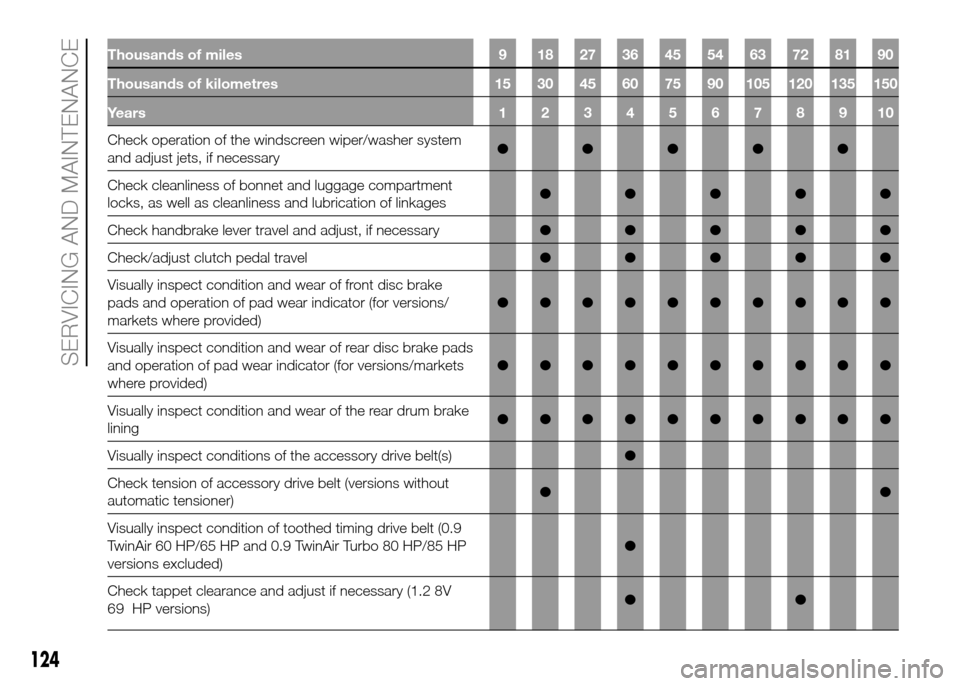
Thousands of miles 9 18 27 36 45 54 63 72 81 90
Thousands of kilometres 15 30 45 60 75 90 105 120 135 150
Years12345678910
Check operation of the windscreen wiper/washer system
and adjust jets, if necessary●●●●●
Check cleanliness of bonnet and luggage compartment
locks, as well as cleanliness and lubrication of linkages●●●●●
Check handbrake lever travel and adjust, if necessary●●●●●
Check/adjust clutch pedal travel●●●●●
Visually inspect condition and wear of front disc brake
pads and operation of pad wear indicator (for versions/
markets where provided)●●●●●●●●●●
Visually inspect condition and wear of rear disc brake pads
and operation of pad wear indicator (for versions/markets
where provided)●●●●●●●●●●
Visually inspect condition and wear of the rear drum brake
lining●●●●●●●●●●
Visually inspect conditions of the accessory drive belt(s)●
Check tension of accessory drive belt (versions without
automatic tensioner)●●
Visually inspect condition of toothed timing drive belt (0.9
TwinAir 60 HP/65 HP and 0.9 TwinAir Turbo 80 HP/85 HP
versions excluded)●
Check tappet clearance and adjust if necessary (1.2 8V
●●
124
SERVICING AND MAINTENANCE
69 HP versions)
Page 128 of 204
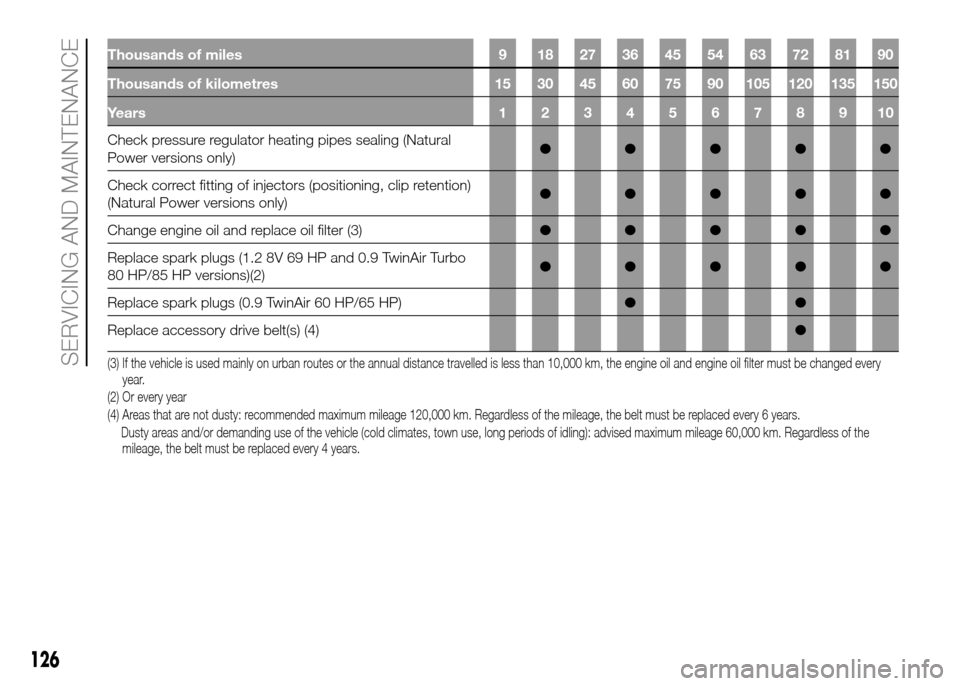
Thousands of miles 9 18 27 36 45 54 63 72 81 90
Thousands of kilometres 15 30 45 60 75 90 105 120 135 150
Years12345678910
Check pressure regulator heating pipes sealing (Natural
Power versions only)●●●●●
Check correct fitting of injectors (positioning, clip retention)
(Natural Power versions only)●●●●●
Change engine oil and replace oil filter (3)●●●●●
Replace spark plugs (1.2 8V 69 HP and 0.9 TwinAir Turbo
80 HP/85 HP versions)(2)●●●●●
Replace spark plugs (0.9 TwinAir 60 HP/65 HP)●●
Replace accessory drive belt(s) (4)●
(3) If the vehicle is used mainly on urban routes or the annual distance travelled is less than 10,000 km, the engine oil and engine oil filter must be changed every
year.
(2) Or every year
(4) Areas that are not dusty: recommended maximum mileage 120,000 km. Regardless of the mileage, the belt must be replaced every 6 years.
Dusty areas and/or demanding use of the vehicle (cold climates, town use, long periods of idling): advised maximum mileage 60,000 km. Regardless of the
mileage, the belt must be replaced every 4 years.
126
SERVICING AND MAINTENANCE
Page 129 of 204
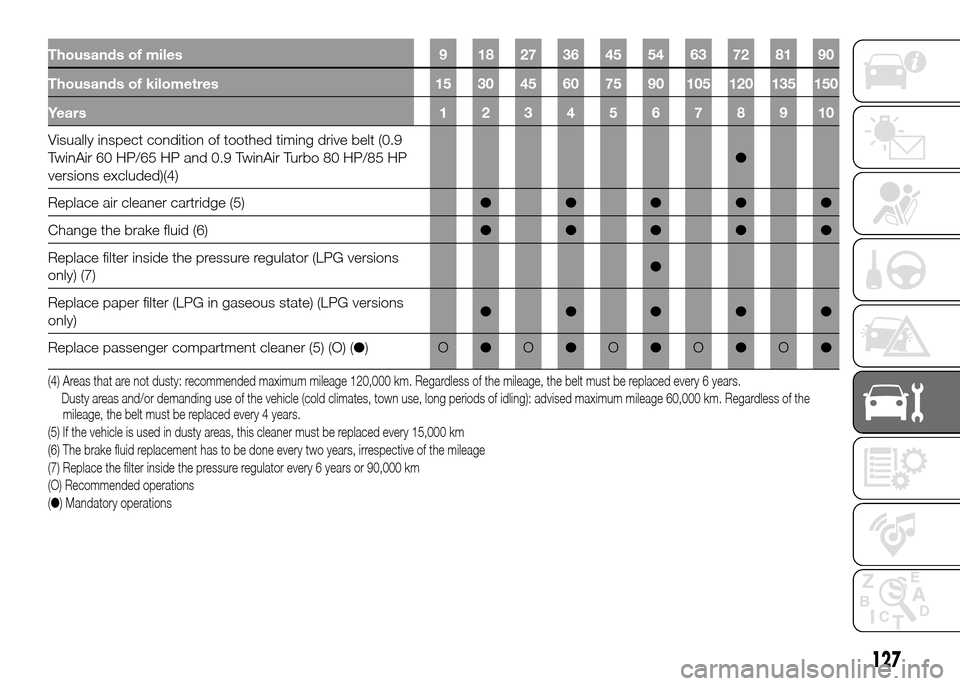
Thousands of miles 9 18 27 36 45 54 63 72 81 90
Thousands of kilometres 15 30 45 60 75 90 105 120 135 150
Years12345678910
Visually inspect condition of toothed timing drive belt (0.9
TwinAir 60 HP/65 HP and 0.9 TwinAir Turbo 80 HP/85 HP
versions excluded)(4)●
Replace air cleaner cartridge (5)●●●●●
Change the brake fluid (6)●●●●●
Replace filter inside the pressure regulator (LPG versions
only) (7)●
Replace paper filter (LPG in gaseous state) (LPG versions
only)●●●●●
Replace passenger compartment cleaner (5) (O) (●)O●O●O●O●O●
(4) Areas that are not dusty: recommended maximum mileage 120,000 km. Regardless of the mileage, the belt must be replaced every 6 years.
Dusty areas and/or demanding use of the vehicle (cold climates, town use, long periods of idling): advised maximum mileage 60,000 km. Regardless of the
mileage, the belt must be replaced every 4 years.
(5) If the vehicle is used in dusty areas, this cleaner must be replaced every 15,000 km
(6) The brake fluid replacement has to be done every two years, irrespective of the mileage
(7) Replace the filter inside the pressure regulator every 6 years or 90,000 km
(O) Recommended operations
(●) Mandatory operations
127
Page 131 of 204
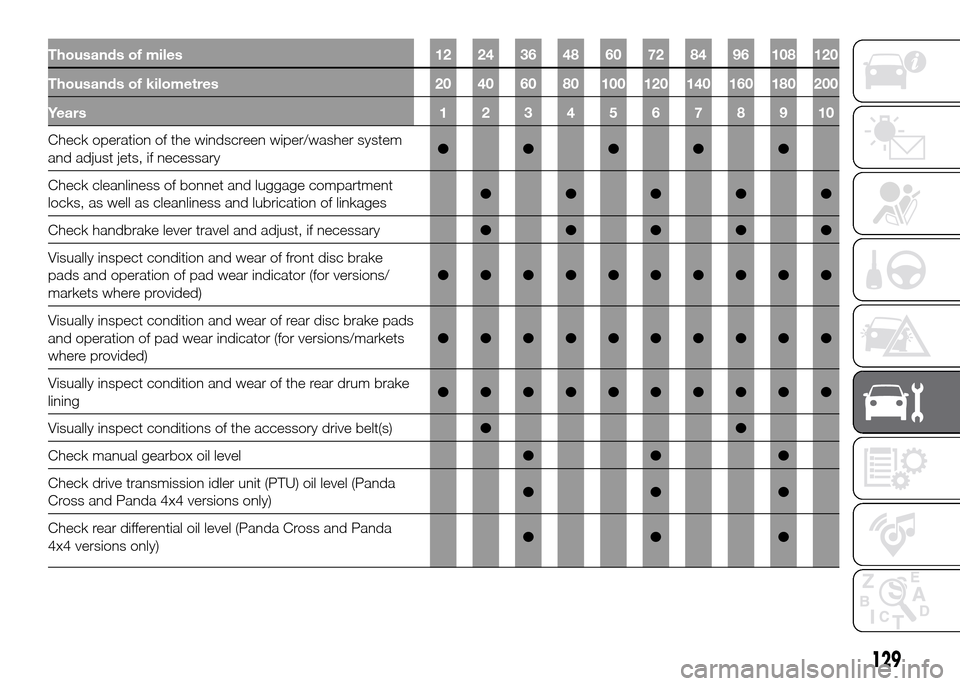
Thousands of miles 12 24 36 48 60 72 84 96 108 120
Thousands of kilometres 20 40 60 80 100 120 140 160 180 200
Years12345678910
Check operation of the windscreen wiper/washer system
and adjust jets, if necessary●●●●●
Check cleanliness of bonnet and luggage compartment
locks, as well as cleanliness and lubrication of linkages●●●●●
Check handbrake lever travel and adjust, if necessary●●●●●
Visually inspect condition and wear of front disc brake
pads and operation of pad wear indicator (for versions/
markets where provided)●●●●●●●●●●
Visually inspect condition and wear of rear disc brake pads
and operation of pad wear indicator (for versions/markets
where provided)●●●●●●●●●●
Visually inspect condition and wear of the rear drum brake
lining●●●●●●●●●●
Visually inspect conditions of the accessory drive belt(s)●●
Check manual gearbox oil level●●●
Check drive transmission idler unit (PTU) oil level (Panda
Cross and Panda 4x4 versions only)●●●
Check rear differential oil level (Panda Cross and Panda
4x4 versions only)●●●
129
Page 132 of 204
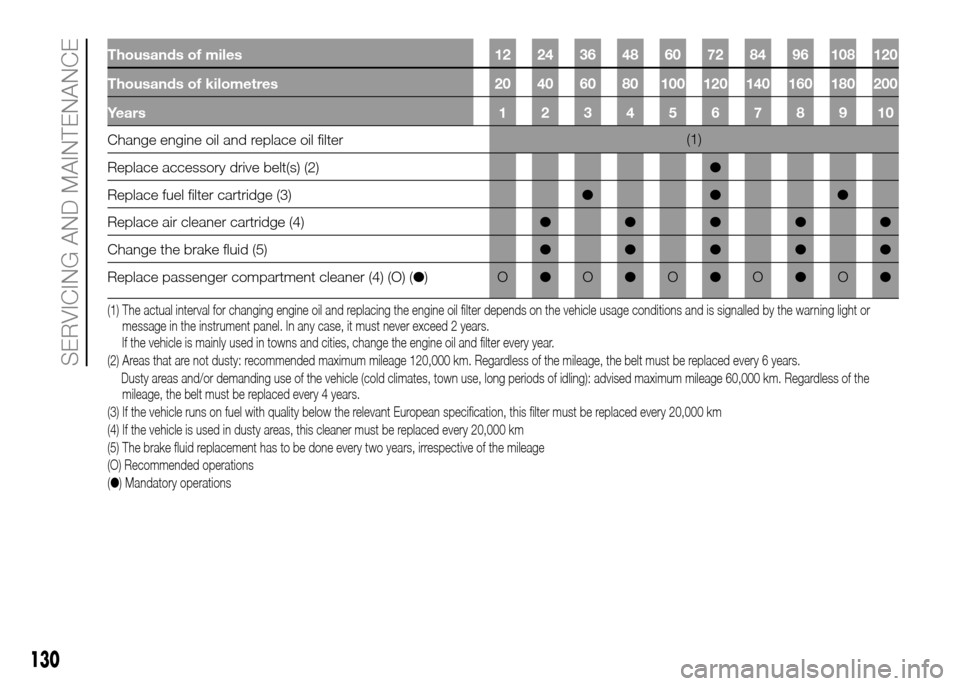
Thousands of miles 12 24 36 48 60 72 84 96 108 120
Thousands of kilometres 20 40 60 80 100 120 140 160 180 200
Years12345678910
Change engine oil and replace oil filter(1)
Replace accessory drive belt(s) (2)●
Replace fuel filter cartridge (3)●●●
Replace air cleaner cartridge (4)●●●●●
Change the brake fluid (5)●●●●●
Replace passenger compartment cleaner (4) (O) (●)O●O●O●O●O●
(1) The actual interval for changing engine oil and replacing the engine oil filter depends on the vehicle usage conditions and is signalled by the warning light or
message in the instrument panel. In any case, it must never exceed 2 years.
If the vehicle is mainly used in towns and cities, change the engine oil and filter every year.
(2) Areas that are not dusty: recommended maximum mileage 120,000 km. Regardless of the mileage, the belt must be replaced every 6 years.
Dusty areas and/or demanding use of the vehicle (cold climates, town use, long periods of idling): advised maximum mileage 60,000 km. Regardless of the
mileage, the belt must be replaced every 4 years.
(3) If the vehicle runs on fuel with quality below the relevant European specification, this filter must be replaced every 20,000 km
(4) If the vehicle is used in dusty areas, this cleaner must be replaced every 20,000 km
(5) The brake fluid replacement has to be done every two years, irrespective of the mileage
(O) Recommended operations
(●) Mandatory operations
130
SERVICING AND MAINTENANCE
Page 194 of 204
IMPORTANT INFORMATION AND RECOMMENDATIONS
WARNING
INTERIOR FITTINGS
❒Never travel with the glove compartment open: it could injure the passenger in the event of a crash.
❒The cigar lighter gets very hot. Handle it carefully and make sure that children do not touch it: risk of fire and/or burns. Always check that
the cigar lighter plug has been released.
ROOF RACK/SKI RACK
❒After travelling for a short distance, check that the fixing screws for the attachments are correctly tightened.
❒Never exceed the maximum permitted loads (see chapter "Technical specifications").
❒Evenly distribute the load and take into account, when driving, the increased responsiveness of the vehicle to side wind.
WIRING FOR RADIO SYSTEM
❒If you wish to have a sound system installed after purchasing the vehicle, first contact a Fiat Dealership whose qualified personnel will give
you advise about a sound system that does not damage the battery charge. Excessive nonrunning consumption damages the battery and
may cause your battery warranty to be terminated.
PROTECTING THE ENVIRONMENT
❒During normal service, the catalytic converter and the diesel particulate filter (DPF) reach high temperatures. Do not therefore park the
vehicle over inflammable materials (grass, dry leaves, pine needles, etc.): fire hazard.
INTERIORS
❒Never use flammable products, such as petrol ether or rectified petrol to clean the inside of the vehicle. The electrostatic charges which are
generated by rubbing during the cleaning operation may cause a fire.
❒Do not keep aerosol cans in the vehicle: they might explode. Aerosol cans must not be exposed to a temperature exceeding 50°C. When
the vehicle is exposed to sunlight, the internal temperature can greatly exceed this value.
POWER SUPPLY
❒Modifications or repairs to the supply system that are not carried out correctly or do not take the system technical specifications into
account can cause malfunctions leading to the risk of fire.
LOADING ADVICE(Panda VAN versions)
❒Abrupt braking or occasional impacts may cause sudden movements of the load with consequent situations of hazard for the driver and
passengers: before setting off, secure the load tightly using the partition and, where provided, the appropriate hooks. For securing use
cables, ropes or belts strong enough to hold the items to be secured.
192
Page 202 of 204
Rear fog lights ................................ 18
Rear light clusters (bulb
replacement) ................................ 107
Rear view mirrors ........................... 15
Refuelling the vehicle ......................
Replacing a bulb ............................ 103
Reversing light/rear fog light ........... 10
SBR (Seat Belt Reminder)
system ......................................... 72
Scheduled servicing ....................... 122
Seat belts....................................... 71
Seats ............................................. 11
– Adjustments .............................. 11
Side bags....................................... 88
Side lights/daytime running lights
(bulb replacement) ....................... 107Snow chains .................................. 154
Starting the engine ......................... 92
Steering lock .................................. 9
Steering wheel ............................... 14
Steering wheel stalks
– left stalk..................................... 16
– right stalk .................................. 20
Stop/Start system .......................... 96
Sun roof ......................................... 26
Supplementary Restraint System
(SRS) - Airbag .............................. 85
Supplies ......................................... 166
Symbols......................................... 4
Technical specifications ................ 141The keys ........................................ 8
Towing the vehicle .......................... 119
Towing trailers ................................
TP system ...................................... 66
Version with LPG system .............. 32
Version with methane system
(Natural Power) ............................ 34
Warning lights on panel ................ 41
Weights.......................................... 158
Wheel (changing)............................ 114
Wheels and tyres ........................... 139
Wheels ........................................... 1
Window cleaning............................ 20
Windscreen/rear window wiper ...... 138
INDEX 99
99
FCA Italy S.p.A. – Mopar – Technical Services – Service Engineering
Largo Senatore G. Agnelli, 3 - 10040 Volvera - Turin (Italy)
Print no. 603.9 9 .846 - 1 1/2015 - 1 Edition 7
48