brake FIAT PANDA 2016 319 / 3.G Owner's Manual
[x] Cancel search | Manufacturer: FIAT, Model Year: 2016, Model line: PANDA, Model: FIAT PANDA 2016 319 / 3.GPages: 204, PDF Size: 18.77 MB
Page 97 of 204
The unstable positions, in other words
those that are abandoned as soon
as the lever is released, are the
positions for requesting a higher gear
(+), requesting a lower gear (–) and
requesting automatic operating mode
(A/M).
IMPORTANT With the engine started,
any error between the lever position
and the gear actually engaged is
signalled by a buzzer until consistency
is restored.
MANUAL MODE
Proceed as follows:
❒press the brake pedal and start the
engine;
❒if AUTO appears on the display,
move the lever A fig. 80 to A/M
to select MANUAL mode;
❒push gear lever A towards (+) to
engage first gear (if starting from N or
R, simply place the lever in the middle
position) or R to engage reverse;
❒release the brake pedal and press
the accelerator pedal;
❒in driving conditions, push lever A of
the gearbox towards (+) to engage
the next gear up or towards (–) to
engage the next gear down.AUTOMATIC MODE
Proceed as follows:
❒press the brake pedal;
❒start the engine;
❒if AUTO does not appear on the
display, move the gear lever A fig. 80 to
A/M to select AUTOMATIC mode;
❒push the gear lever towards (+) to
engage 1st gear (if starting from N or R,
simply place the lever in the middle
position) or R to engage reverse;
❒release the brake pedal and press
the accelerator pedal: the gear most
suited to the vehicle speed will be
engaged.
AUTO-ECO OPERATION
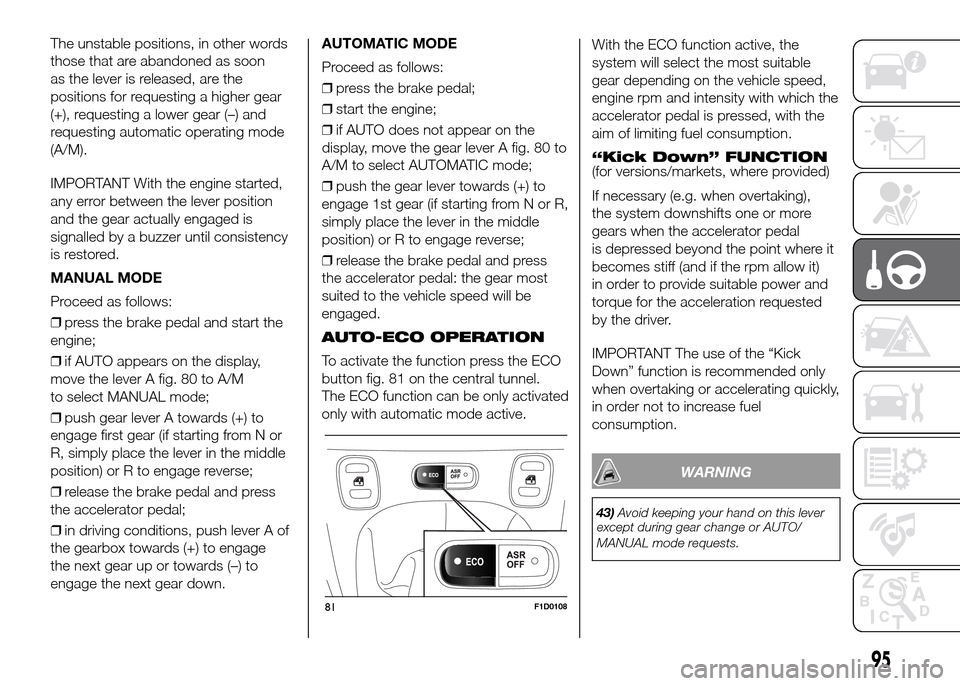
To activate the function press the ECO
button fig. 81 on the central tunnel.
The ECO function can be only activated
only with automatic mode active.
81F1D0108
95
With the ECO function active, the
system will select the most suitable
gear depending on the vehicle speed,
engine rpm and intensity with which the
accelerator pedal is pressed, with the
aim of limiting fuel consumption.
“Kick Down” FUNCTION
(for versions/markets, where provided)
If necessary (e.g. when overtaking),
the system downshifts one or more
gears when the accelerator pedal
is depressed beyond the point where it
becomes stiff (and if the rpm allow it)
in order to provide suitable power and
torque for the acceleration requested
by the driver.
IMPORTANT The use of the “Kick
Down” function is recommended only
when overtaking or accelerating quickly,
in order not to increase fuel
consumption.
WARNING
43)Avoid keeping your hand on this lever
except during gear change or AUTO/
MANUAL mode requests.
Page 99 of 204
OPERATION WITH A
TRAILER
Sensor operation is automatically
deactivated when the trailer's electric
cable plug is fitted in the vehicle's
tow hook socket. The sensors are
automatically reactivated when the
trailer's cable plug is removed.
IMPORTANT
INFORMATION
When parking, take the utmost care
over obstacles that may be above
or under the sensor.
Objects close to the vehicle are not
detected under certain circumstances
and could therefore cause damage
to the vehicle or be damaged.
The following conditions may influence
the performance of the parking
assistance system:
❒the presence of ice, snow, mud or
multiple layers of paint on the surface of
the sensor may reduce its sensitivity
and the system performance;
❒mechanical interference (e.g. washing
the vehicle, rain, strong wind, hail) may
cause the sensor to detect a
non-existent obstacle ("echo
interference");
97
❒the presence of ultrasonic systems
(e.g. pneumatic brake systems of
trucks or pneumatic drills) near the
vehicle could alter the signals sent to
the sensor;
❒the variation in sensor position,
caused by variation in ride (due
to suspension or shock absorber wear),
changing tyres, overloaded vehicle, or
tuning that lowers the vehicle, for
example, may affect parking sensor
system performance;
❒the presence of a tow hook without
trailer interferes with the correct
operation of the parking sensors. If a
fixed tow hook is installed, the sensors
cannot be used. If the customer installs
a removable tow hook, this must
always be disconnected from
the crossmember whenever the trailer
is not attached to prevent the activation
of the sensors.
WARNING
127)The responsibility for parking and
other dangerous manoeuvres always and
in every case lies with the driver. While
carrying out these manoeuvres, always
make sure that no people (especially
children) or animals are in the area
concerned. The parking sensors are used
to assist the driver, who must never allow
his attention to lapse during potentially
dangerous manoeuvres, even those
executed at low speeds.
WARNING
45)The sensors must be clean of mud,
dirt, snow or ice in order for the system to
operate correctly. Be careful not to scratch
or damage the sensors while cleaning
them. Avoid using dry, rough or hard
cloths. The sensors must be washed using
clean water, with the addition of vehicle
shampoo if necessary. When using special
washing equipment such as high pressure
jets or steam cleaning, clean the sensors
very quickly keeping the jet more than
10 cm away.
Page 100 of 204
MODE SELECTOR
(Panda Cross versions)
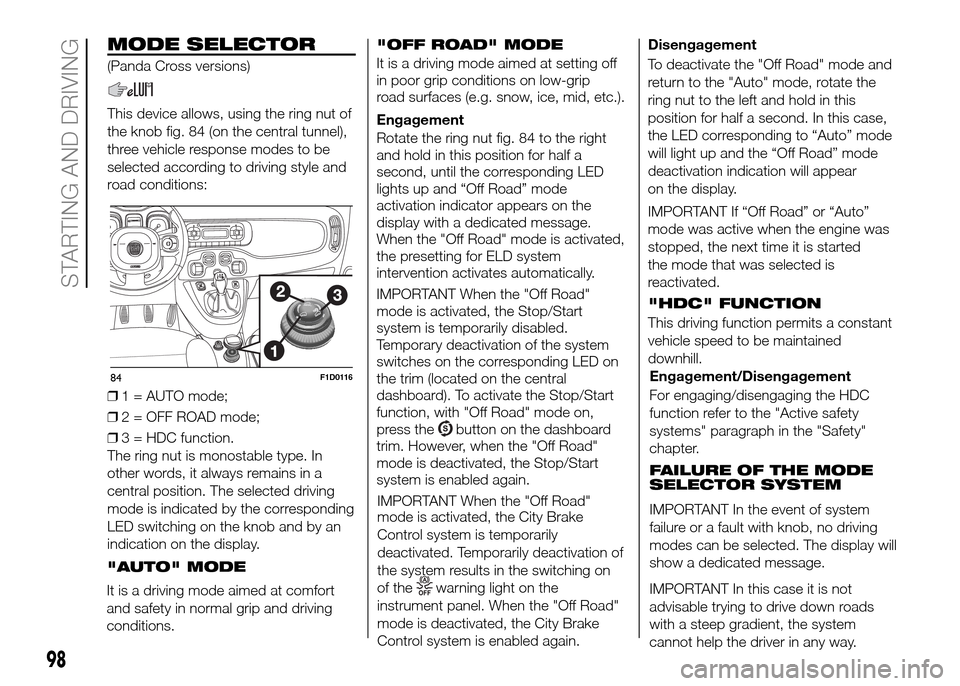
This device allows, using the ring nut of
the knob fig. 84 (on the central tunnel),
three vehicle response modes to be
selected according to driving style and
road conditions:
❒1 = AUTO mode;
❒2 = OFF ROAD mode;
❒3 = HDC function.
The ring nut is monostable type. In
other words, it always remains in a
central position. The selected driving
mode is indicated by the corresponding
LED switching on the knob and by an
indication on the display.
84F1D0116
98
STARTING AND DRIVING
"AUTO" MODE
It is a driving mode aimed at comfort
and safety in normal grip and driving
conditions."OFF ROAD" MODE
It is a driving mode aimed at setting off
in poor grip conditions on low-grip
road surfaces (e.g. snow, ice, mid, etc.).
Engagement
Rotate the ring nut fig. 84 to the right
and hold in this position for half a
second, until the corresponding LED
lights up and “Off Road” mode
activation indicator appears on the
display with a dedicated message.
When the "Off Road" mode is activated,
the presetting for ELD system
intervention activates automatically.
IMPORTANT When the "Off Road"
mode is activated, the Stop/Start
system is temporarily disabled.
Temporary deactivation of the system
switches on the corresponding LED on
the trim (located on the central
dashboard). To activate the Stop/Start
function, with "Off Road" mode on,
press the
button on the dashboard
trim. However, when the "Off Road"
mode is deactivated, the Stop/Start
system is enabled again.
IMPORTANT When the "Off Road"
mode is activated, the City Brake
Control system is temporarily
deactivated. Temporarily deactivation of
the system results in the switching on
of the
warning light on the
instrument panel. When the "Off Road"
mode is deactivated, the City Brake
Control system is enabled again.Disengagement
To deactivate the "Off Road" mode and
return to the "Auto" mode, rotate the
ring nut to the left and hold in this
position for half a second. In this case,
the LED corresponding to “Auto” mode
will light up and the “Off Road” mode
deactivation indication will appear
on the display.
IMPORTANT If “Off Road” or “Auto”
mode was active when the engine was
stopped, the next time it is started
the mode that was selected is
reactivated.
"HDC" FUNCTION
This driving function permits a constant
vehicle speed to be maintained
downhill.
Engagement/Disengagement
For engaging/disengaging the HDC
function refer to the "Active safety
systems" paragraph in the "Safety"
chapter.
FAILURE OF THE MODE
SELECTOR SYSTEM
IMPORTANT In the event of system
failure or a fault with knob, no driving
modes can be selected. The display will
show a dedicated message.
IMPORTANT In this case it is not
advisable trying to drive down roads
with a steep gradient, the system
cannot help the driver in any way.
Page 101 of 204
99
TOWING TRAILERS
128) 129)
IMPORTANT
For towing motorhomes or trailers the
vehicle must be fitted with an approved
tow hook and an adequate electrical
system. Installation must be carried out
by a specialist.
Install any specific and/or additional
door mirrors as specified by the
Highway Code.
Remember that when towing a trailer,
steep hills are harder to climb, braking
distances increase and overtaking
takes longer depending on the overall
weight of the trailer.
Engage a low gear when driving
downhill, rather than constantly using
the brake.
The weight the trailer exerts on the
vehicle tow hook reduces the vehicle's
loading capacity by the same amount.
To make sure that the maximum
towable weight is not exceeded (given
in the vehicle registration document)
account should be taken of the fully
laden trailer, including accessories and
luggage.
Do not exceed the speed limits specific
to each country you are driving in, in
the case of vehicles towing trailers.
In any case, the top speed must not
exceed 100 km/h.An electric brake (or electric winch)
should be supplied directly by the
battery through a cable with a cross
section of no less than 2.5 mm2.
In addition to the electrical branches,
the vehicle electrical system can only
be connected to the supply cable for an
electric brake and to the cable for an
internal light for the trailer, not
exceeding 15 W. For connections, use
the preset control unit with a battery
cable with section not less than 2.5
mm2.
On Panda Cross and Panda 4x4
versions, in the event of prolonged
vehicle use at maximum tow capacity
on slopes, replacing engine oil more
frequently (every 10,000 km) is
advisable.
IMPORTANT The use of auxiliary loads
other than external lights (electric brake,
winch, etc.) must be used with engine
running.
IMPORTANT To install a tow hook
contact a Fiat Dealership.
WARNING
128)The ABS with which the vehicle is
equipped will not control the braking
system of the trailer. Particular caution is
required on slippery roads.
129)Never modify the braking system of
the vehicle to control the trailer brake.
The trailer braking system must be fully
independent of the vehicle’s hydraulic
system.
REFUELLING THE
VEHICLE
130) 131) 132)Always stop the engine before
refuelling.
PETROL ENGINES
Use unleaded petrol only, with an
octane number (R.O.N.) no lower than
95. Never introduce even the smallest
amount of leaded petrol, even in the
event of an emergency, in order to
prevent damage to the catalytic
converter.
DIESEL ENGINES
Only use Diesel for motor vehicles (EN
590 specification).
When using or parking the car for a
long time in the mountains or cold
areas, it is advisable to refuel using
locally available diesel. In this case, it is
also advisable to keep the tank over
50% full.
Page 102 of 204
100
STARTING AND DRIVING
Diesel and petrol versions
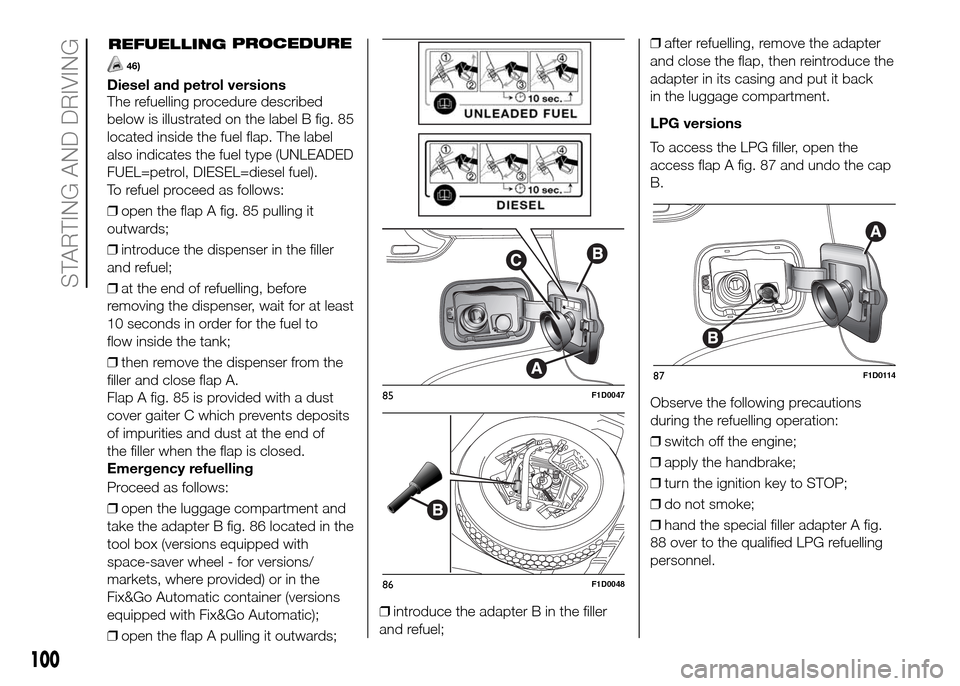
The refuelling procedure described
below is illustrated on the label B fig. 85
located inside the fuel flap. The label
also indicates the fuel type (UNLEADED
FUEL=petrol, DIESEL=diesel fuel).
To refuel proceed as follows:
❒open the flap A fig. 85 pulling it
outwards;
❒introduce the dispenser in the filler
and refuel;
❒at the end of refuelling, before
removing the dispenser, wait for at least
10 seconds in order for the fuel to
flow inside the tank;
❒then remove the dispenser from the
filler and close flap A.
Flap A fig. 85 is provided with a dust
cover gaiter C which prevents deposits
of impurities and dust at the end of
the filler when the flap is closed.
Emergency refuelling
Proceed as follows:
❒open the luggage compartment and
take the adapter B fig. 86 located in the
tool box (versions equipped with
space-saver wheel - for versions/
markets, where provided) or in the
Fix&Go Automatic container (versions
equipped with Fix&Go Automatic);
❒open the flap A pulling it outwards;❒introduce the adapter B in the filler
and refuel;
85F1D0047
86F1D0048
REFUELLINGPROCEDURE
46)
❒after refuelling, remove the adapter
and close the flap, then reintroduce the
adapter in its casing and put it back
in the luggage compartment.
LPG versions
To access the LPG filler, open the
access flap A fig. 87 and undo the cap
B.
Observe the following precautions
during the refuelling operation:
❒switch off the engine;
❒apply the handbrake;
❒turn the ignition key to STOP;
❒do not smoke;
❒hand the special filler adapter A fig.
88 over to the qualified LPG refuelling
personnel.
87F1D0114
Page 106 of 204
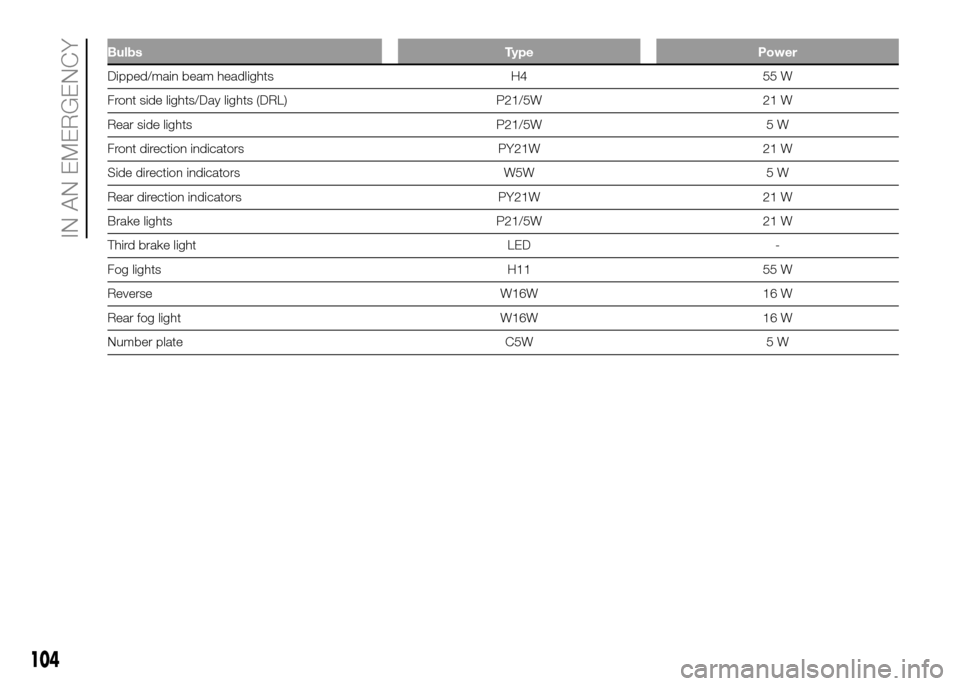
Bulbs Type Power
Dipped/main beam headlights H4 55 W
Front side lights/Day lights (DRL) P21/5W 21 W
Rear side lights P21/5W 5 W
Front direction indicators PY21W 21 W
Side direction indicators W5W 5 W
Rear direction indicators PY21W 21 W
Brake lights P21/5W 21 W
Third brake light LED -
Fog lights H11 55 W
Reverse W16W 16 W
Rear fog light W16W 16 W
Number plate C5W 5 W
104
IN AN EMERGENCY
Page 109 of 204
❒reposition the guard door B fig. 98,
taking care that the tabs are positioned
in their housings and tighten the fixing
screws A.
SIDE LIGHTS/DAYTIME
RUNNING LIGHTS (DRL)
(for versions/markets, where provided -
except Panda Cross versions)
To replace the bulb, proceed as follows:
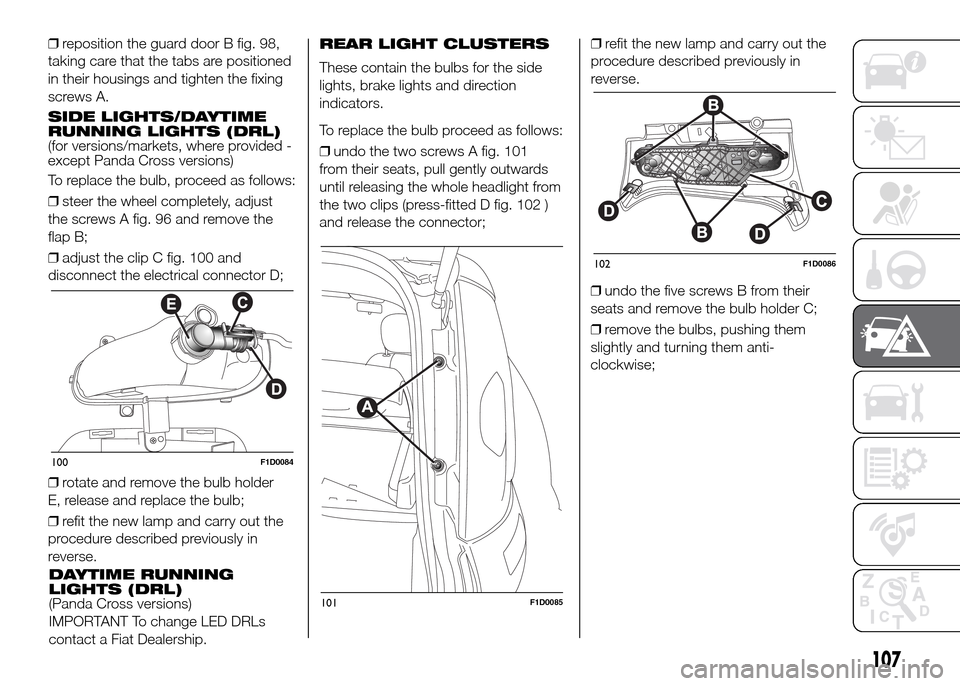
❒steer the wheel completely, adjust
the screws A fig. 96 and remove the
flap B;
❒adjust the clip C fig. 100 and
disconnect the electrical connector D;
❒rotate and remove the bulb holder
E, release and replace the bulb;
❒refit the new lamp and carry out the
procedure described previously in
reverse.
DAYTIME RUNNING
LIGHTS (DRL)
(Panda Cross versions)
IMPORTANT To change LED DRLs
contact a Fiat Dealership.REAR LIGHT CLUSTERS
These contain the bulbs for the side
lights, brake lights and direction
indicators.
To replace the bulb proceed as follows:
❒undo the two screws A fig. 101
from their seats, pull gently outwards
until releasing the whole headlight from
the two clips (press-fitted D fig. 102 )
and release the connector;❒refit the new lamp and carry out the
procedure described previously in
reverse.
100F1D0084
101F1D0085
107
❒undo the five screws B from their
seats and remove the bulb holder C;
❒remove the bulbs, pushing them
slightly and turning them anti-
clockwise;
102F1D0086
Page 110 of 204
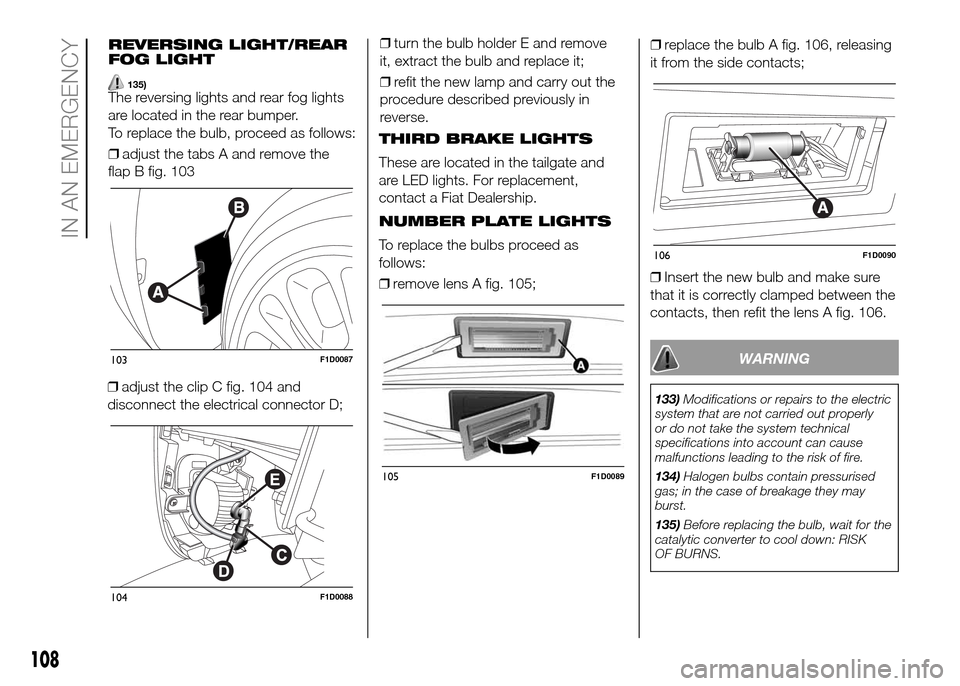
❒adjust the clip C fig. 104 and
disconnect the electrical connector D;❒turn the bulb holder E and remove
it, extract the bulb and replace it;
❒refit the new lamp and carry out the
procedure described previously in
reverse.
THIRD BRAKE LIGHTS
These are located in the tailgate and
are LED lights. For replacement,
contact a Fiat Dealership.
NUMBER PLATE LIGHTS
To replace the bulbs proceed as
follows:
❒remove lens A fig. 105;❒replace the bulb A fig. 106, releasing
it from the side contacts;
❒Insert the new bulb and make sure
that it is correctly clamped between the
contacts, then refit the lens A fig. 106.
WARNING
133)Modifications or repairs to the electric
system that are not carried out properly
or do not take the system technical
specifications into account can cause
malfunctions leading to the risk of fire.
134)Halogen bulbs contain pressurised
gas; in the case of breakage they may
burst.
135)Before replacing the bulb, wait for the
catalytic converter to cool down: RISK
OF BURNS.
103F1D0087
104F1D0088
105F1D0089
106F1D0090
108
IN AN EMERGENCY
REVERSING LIGHT/REAR
FOG LIGHT
135)The reversing lights and rear fog lights
are located in the rear bumper.
To replace the bulb, proceed as follows:
❒adjust the tabs A and remove the
flap B fig. 103
Page 113 of 204
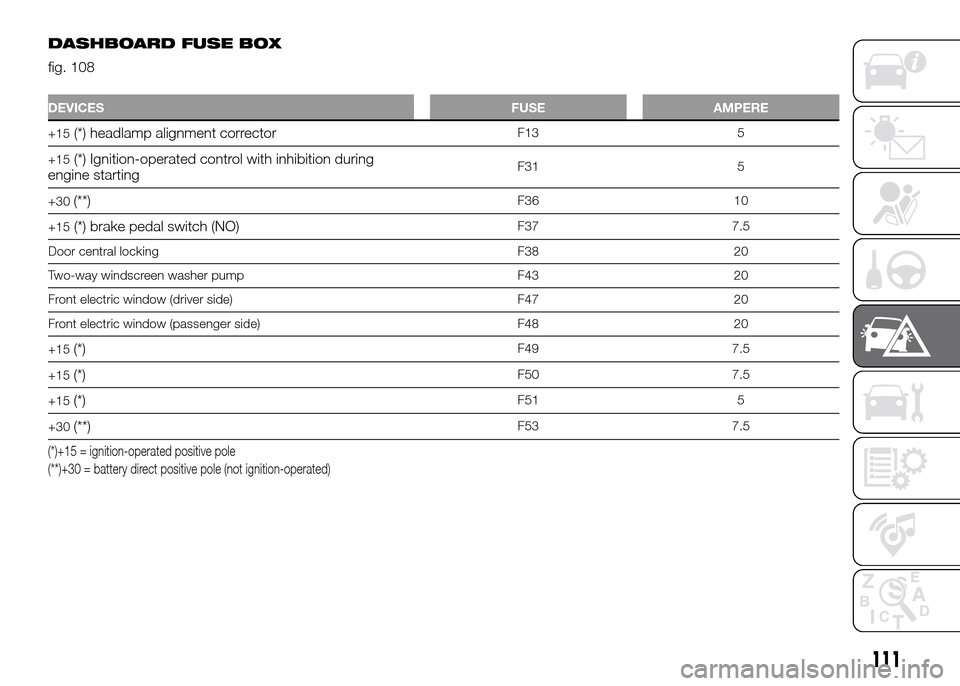
DASHBOARD FUSE BOX
fig. 108
DEVICES FUSE AMPERE
+15(*) headlamp alignment correctorF13 5
+15
(*) Ignition-operated control with inhibition during
engine startingF31 5
+30
(**)F36 10
+15
(*) brake pedal switch (NO)F37 7.5
Door central locking F38 20
Two-way windscreen washer pump F43 20
Front electric window (driver side) F47 20
Front electric window (passenger side) F48 20
+15
(*)F49 7.5
+15
(*)F50 7.5
+15
(*)F51 5
+30
(**)F53 7.5
(*)+15 = ignition-operated positive pole
(**)+30 = battery direct positive pole (not ignition-operated)
111
Page 114 of 204
WARNING
136)If the replaced fuse blows again,
contact a Fiat Dealership.
137)Never replace a blown fuse with metal
wires or other material.
138)Never replace a fuse with another with
a higher amp rating; DANGER OF FIRE.
139)If a general fuse (MEGA-FUSE,
MIDI-FUSE, MAXI-FUSE) cuts in, do not
attempt any repair and contact a Fiat
Dealership.
140)Before replacing a fuse, make sure
that the ignition key has been removed and
that all the other devices are switched off
and/or deactivated.
141)If a general protection fuse for safety
systems (airbag system, braking system),
power unit systems (engine system,
transmission system) or steering system
blows, contact a Fiat Dealership.
WARNING
50)If you need to wash the engine
compartment, take care not to directly hit
the fuse box and the window wiper motors
with the water jet.
CHANGING A WHEEL
142) 143) 144) 145) 146)
JACK
Important notes:
❒the jack weight is 1.76 kg;
❒the jack requires no adjustment;
❒the jack cannot be repaired and in
the event of a fault it must be replaced
by another original one;
❒no tool other than its cranking device
may be fitted on the jack.
CHANGING PROCEDURE
Proceed as follows:
❒stop the vehicle in a position that is
not dangerous for oncoming traffic
where you can change the wheel safely.
The ground should be flat if possible,
and sufficiently firm;
❒switch off the engine, pull up the
handbrake and engage the 1
stgear or
reverse. Wear the reflective safety
jacket (compulsory by law) before
getting out of the vehicle;
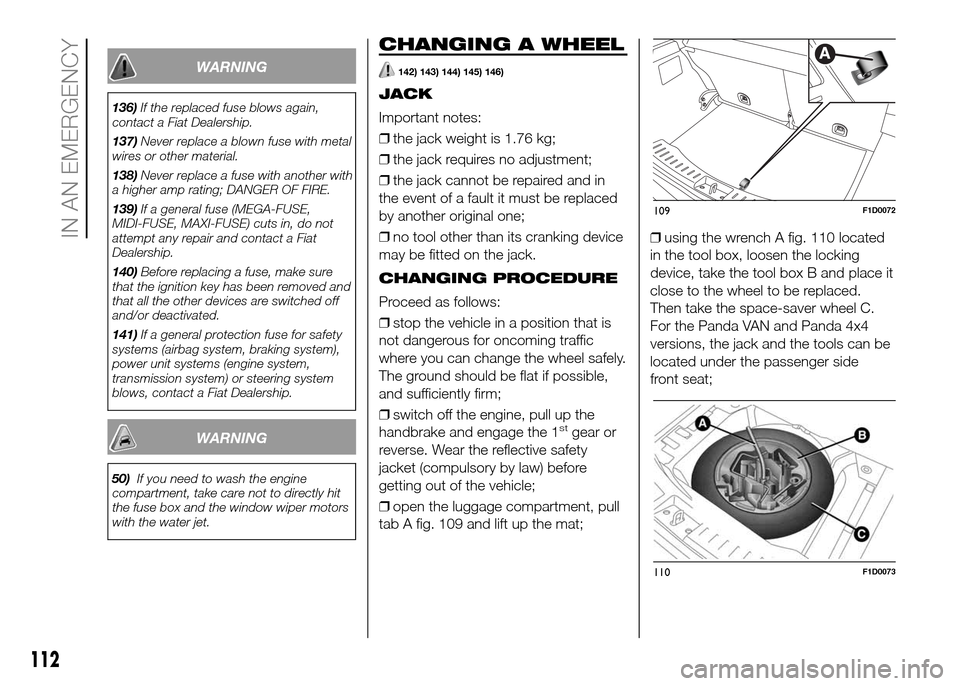
❒open the luggage compartment, pull
tab A fig. 109 and lift up the mat;❒using the wrench A fig. 110 located
in the tool box, loosen the locking
device, take the tool box B and place it
close to the wheel to be replaced.
Then take the space-saver wheel C.
For the Panda VAN and Panda 4x4
versions, the jack and the tools can be
located under the passenger side
front seat;
109F1D0072
110F1D0073
112
IN AN EMERGENCY