dashboard FIAT PANDA 2017 319 / 3.G User Guide
[x] Cancel search | Manufacturer: FIAT, Model Year: 2017, Model line: PANDA, Model: FIAT PANDA 2017 319 / 3.GPages: 216, PDF Size: 19.25 MB
Page 49 of 216
Amber warning lights
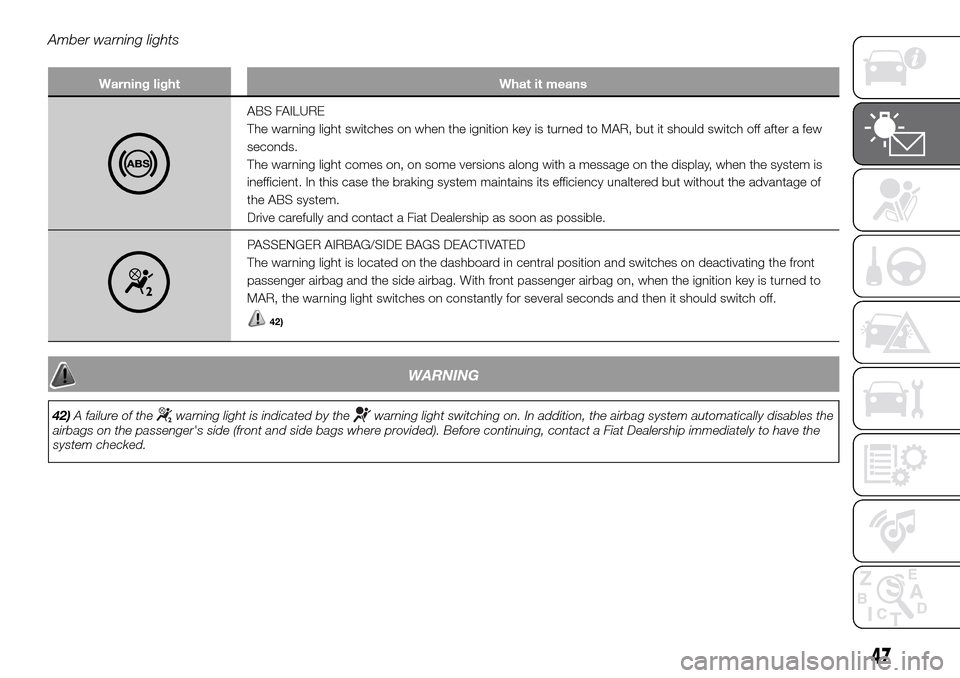
Warning light What it means
ABS FAILURE
The warning light switches on when the ignition key is turned to MAR, but it should switch off after a few
seconds.
The warning light comes on, on some versions along with a message on the display, when the system is
inefficient. In this case the braking system maintains its efficiency unaltered but without the advantage of
the ABS system.
Drive carefully and contact a Fiat Dealership as soon as possible.
PASSENGER AIRBAG/SIDE BAGS DEACTIVATED
The warning light is located on the dashboard in central position and switches on deactivating the front
passenger airbag and the side airbag. With front passenger airbag on, when the ignition key is turned to
MAR, the warning light switches on constantly for several seconds and then it should switch off.
42)
WARNING
42)A failure of thewarning light is indicated by thewarning light switching on. In addition, the airbag system automatically disables the
airbags on the passenger's side (front and side bags where provided). Before continuing, contact a Fiat Dealership immediately to have the
system checked.
47
Page 59 of 216
Symbol or message What it means
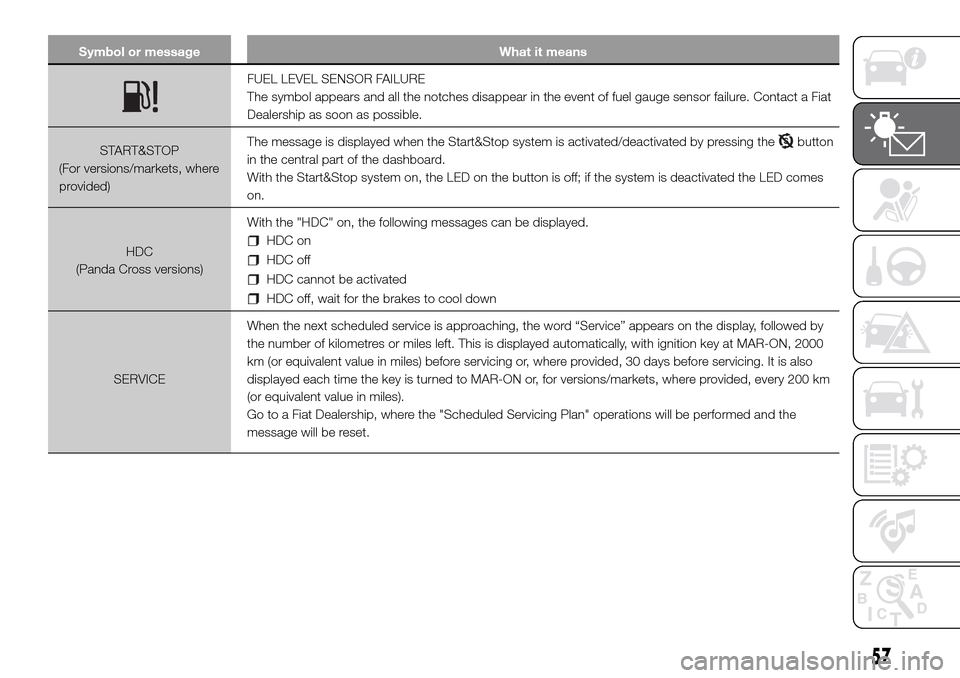
FUEL LEVEL SENSOR FAILURE
The symbol appears and all the notches disappear in the event of fuel gauge sensor failure. Contact a Fiat
Dealership as soon as possible.
START&STOP
(For versions/markets, where
provided)The message is displayed when the Start&Stop system is activated/deactivated by pressing the
button
in the central part of the dashboard.
With the Start&Stop system on, the LED on the button is off; if the system is deactivated the LED comes
on.
HDC
(Panda Cross versions)With the "HDC" on, the following messages can be displayed.
HDC on
HDC off
HDC cannot be activated
HDC off, wait for the brakes to cool down
SERVICEWhen the next scheduled service is approaching, the word “Service” appears on the display, followed by
the number of kilometres or miles left. This is displayed automatically, with ignition key at MAR-ON, 2000
km (or equivalent value in miles) before servicing or, where provided, 30 days before servicing. It is also
displayed each time the key is turned to MAR-ON or, for versions/markets, where provided, every 200 km
(or equivalent value in miles).
Go to a Fiat Dealership, where the "Scheduled Servicing Plan" operations will be performed and the
message will be reset.
57
Page 85 of 216
Main recommendations to carry
children safely
Install the child restraint systems on
the rear seat, which is the most
protected position in the event of an
impact.
Keep children in rearward facing
child restraint systems for as long as
possible, until 3–4 years old if possible.
Should a rearward facing child
restraint system be installed on the rear
seats, it is advisable to position it as
far forward as the position of the front
seat allows.
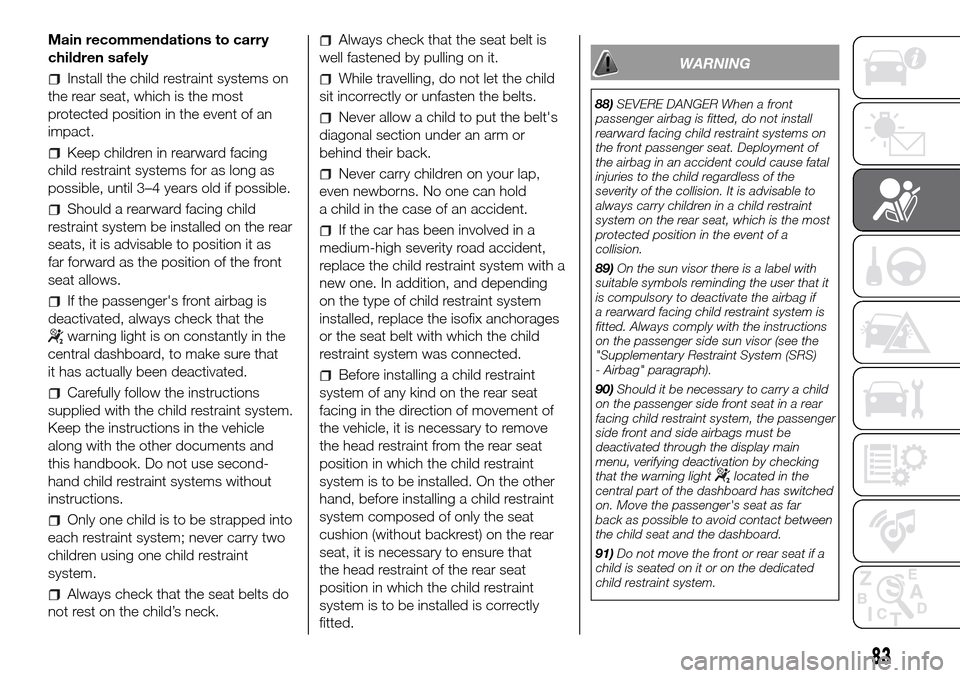
If the passenger's front airbag is
deactivated, always check that the
warning light is on constantly in the
central dashboard, to make sure that
it has actually been deactivated.
Carefully follow the instructions
supplied with the child restraint system.
Keep the instructions in the vehicle
along with the other documents and
this handbook. Do not use second-
hand child restraint systems without
instructions.
Only one child is to be strapped into
each restraint system; never carry two
children using one child restraint
system.
Always check that the seat belts do
not rest on the child’s neck.
Always check that the seat belt is
well fastened by pulling on it.
While travelling, do not let the child
sit incorrectly or unfasten the belts.
Never allow a child to put the belt's
diagonal section under an arm or
behind their back.
Never carry children on your lap,
even newborns. No one can hold
a child in the case of an accident.
If the car has been involved in a
medium-high severity road accident,
replace the child restraint system with a
new one. In addition, and depending
on the type of child restraint system
installed, replace the isofix anchorages
or the seat belt with which the child
restraint system was connected.
Before installing a child restraint
system of any kind on the rear seat
facing in the direction of movement of
the vehicle, it is necessary to remove
the head restraint from the rear seat
position in which the child restraint
system is to be installed. On the other
hand, before installing a child restraint
system composed of only the seat
cushion (without backrest) on the rear
seat, it is necessary to ensure that
the head restraint of the rear seat
position in which the child restraint
system is to be installed is correctly
fitted.
WARNING
88)SEVERE DANGER When a front
passenger airbag is fitted, do not install
rearward facing child restraint systems on
the front passenger seat. Deployment of
the airbag in an accident could cause fatal
injuries to the child regardless of the
severity of the collision. It is advisable to
always carry children in a child restraint
system on the rear seat, which is the most
protected position in the event of a
collision.
89)On the sun visor there is a label with
suitable symbols reminding the user that it
is compulsory to deactivate the airbag if
a rearward facing child restraint system is
fitted. Always comply with the instructions
on the passenger side sun visor (see the
"Supplementary Restraint System (SRS)
- Airbag" paragraph).
90)Should it be necessary to carry a child
on the passenger side front seat in a rear
facing child restraint system, the passenger
side front and side airbags must be
deactivated through the display main
menu, verifying deactivation by checking
that the warning light
located in the
central part of the dashboard has switched
on. Move the passenger's seat as far
back as possible to avoid contact between
the child seat and the dashboard.
91)Do not move the front or rear seat if a
child is seated on it or on the dedicated
child restraint system.
83
Page 86 of 216
92)Incorrect fitting of the child restraint
system may result in an inefficient
protection system. In the event of an
accident the child restraint system may
become loose and the child may be
injured, even fatally. When fitting a restraint
system for newborns or children, strictly
comply with the instructions provided
by the Manufacturer.
93)When the child restraint system is not
used, secure it with the seat belt or with
the ISOFIX anchorages, or remove it from
the vehicle. Do not leave it unsecured
inside the passenger compartment. In this
way, in the case of sudden braking or an
accident, it will not cause injuries to the
occupants.
94)After installing a child restraint system,
do not move the seat: always remove
the child restraint system before making
any adjustment.
95)Always make sure that the chest
section of the seat belt does not pass
under the arms or behind the back of the
child. In the event of an accident the seat
belt will not be able to secure the child,
with the risk of injury, including fatal injury.
Therefore the child must always wear
the seat belt correctly.
96)Do not use the same lower anchorage
to install more than one child restraint
system.
97)If a Universal ISOFIX child restraint
system is not fixed to all three anchorages,
it will not be able to protect the child
correctly. In a crash, the child could be
seriously or fatally injured.98)Fit the child restraint system when the
car is stationary. The child restraint system
is correctly fixed to the brackets when
you hear the click. Follow the instructions
for assembly, disassembly and positioning
that the Manufacturer must supply with
the child restraint system.SUPPLEMENTARY
RESTRAINT SYSTEM
(SRS) - AIRBAG
The vehicle is equipped with:
front driver airbag;
front passenger airbag;
front side bags for pelvis, chest and
shoulder protection of driver and
passenger (for versions/markets, where
provided);
side bags for head protection of
front seat passengers and rear side
seat passengers (window bag).
FRONT AIRBAGS
99)The front (driver and passenger) airbags
protect the front seat occupants in the
event of head-on crashes of medium-
high severity, by placing the cushion
between the occupant and the steering
wheel or dashboard.
Therefore non-activation of airbags in
other types of collisions (side impacts,
rear shunts, roll-overs, etc.) does not
indicate a system malfunction.
Driver and passenger front airbags are
not a replacement of but
complementary to the seat belts, which
should always be worn, as specified
by law in Europe and most non-
European countries.
84
SAFETY
Page 87 of 216
In the event of an impact, those not
wearing a seat belt are projected
forwards, and may come into contact
with the bag which is still inflating.
The protection offered by the bag is
compromised in these circumstances.
The front airbags may not activate in
the case of a frontal impact against
highly deformable objects not involving
the front surface of the vehicle (e.g.
wing collision against guard rail) or in
the case of the vehicle wedging under
other vehicles or protective barriers
(e.g. under trucks or guard rails).
Failure to activate in the conditions
described above is due to the fact that
they may not provide any additional
protection compared with seat belts, so
their activation would be inappropriate.
In these cases, non-deployment does
not indicate a system malfunction.
The driver's and passenger's
front airbags have been designed and
calibrated to protect front seat
occupants wearing seat belts.
At their maximum inflation, their volume
fills most of the space between the
steering wheel and the driver and
between the dashboard and the
passenger.The airbags are not deployed in the
event of minor frontal impacts (for
which the restraining action of the seat
belts is sufficient). It is therefore always
necessary to wear seat belts.
Front airbag driver's side
100)This consists of an instantly inflating
bag contained in a special
compartment in the centre of the
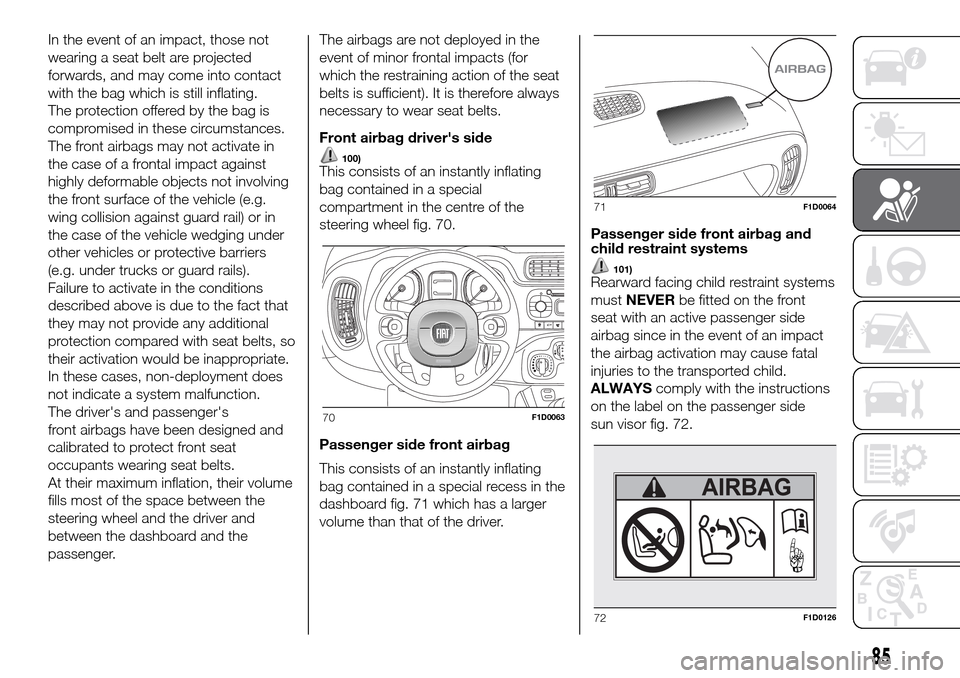
steering wheel fig. 70.
Passenger side front airbag
This consists of an instantly inflating
bag contained in a special recess in the
dashboard fig. 71 which has a larger
volume than that of the driver.Passenger side front airbag and
child restraint systems
101)Rearward facing child restraint systems
mustNEVERbe fitted on the front
seat with an active passenger side
airbag since in the event of an impact
the airbag activation may cause fatal
injuries to the transported child.
ALWAYScomply with the instructions
on the label on the passenger side
sun visor fig. 72.
70F1D0063
71F1D0064
72F1D0126
85
Page 88 of 216
Deactivating the passenger side
airbags: front airbag and side bag
If a child must be carried on the front
seat in a rearward facing child restraint
system, deactivate the passenger
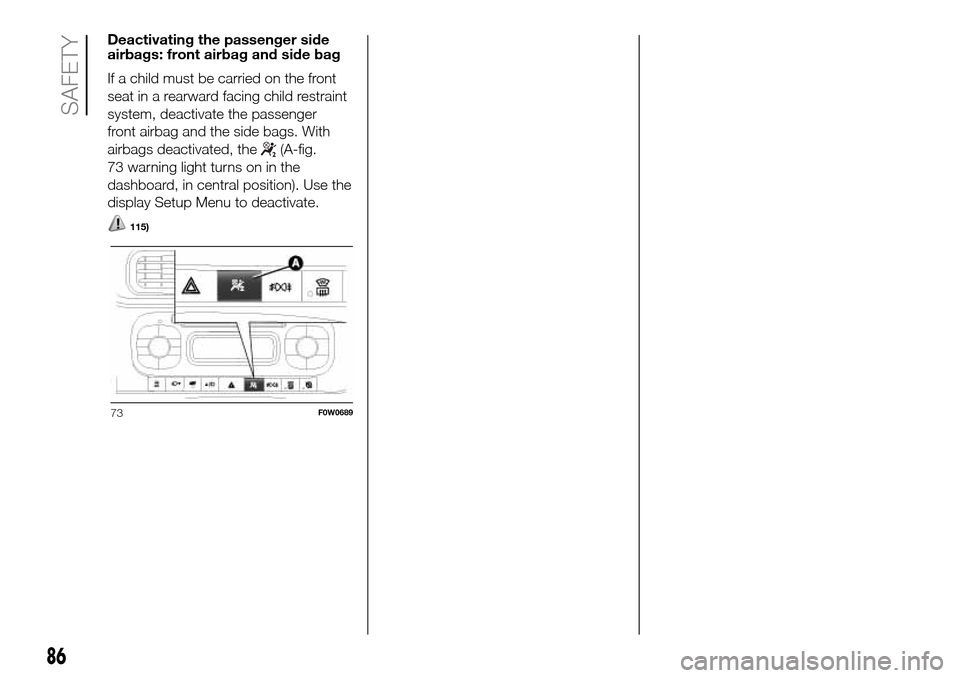
front airbag and the side bags. With
airbags deactivated, the
(A-fig.
73 warning light turns on in the
dashboard, in central position). Use the
display Setup Menu to deactivate.
115)
73F0W0689
86
SAFETY
Page 91 of 216
If the vehicle is scrapped, have the
airbag system deactivated at a Fiat
Dealership.
Pretensioners and airbags are deployed
in different ways on the basis of the
type of collision. Failure to activate one
or more of the devices does not
indicate a system malfunction.
WARNING
99)Do not apply stickers or other objects
on the steering wheel, on the dashboard in
the passenger side airbag area, on the
side upholstery on the roof and on the
seats. Never put objects (e.g. mobile
phones) on the passenger's side
dashboard since they could interfere with
correct inflation of the airbag and also
cause serious injury to the passengers.
100)Always drive with your hands on the
rim of the steering wheel so that the airbag
can inflate freely if required. Do not drive
with your body bent forward. Keep your
back straight against the backrest.101)When there is an active passenger
airbag, DO NOT install rearward facing
child restraint systems on the front seat.
Deployment of the airbag in an accident
could cause fatal injuries to the child
regardless of the severity of the impact.
Therefore, always deactivate the passenger
side airbag when a rearward facing child
restraint system is installed on the front
passenger seat. The front passenger seat
must also be positioned back as far as
possible in order to prevent the child
restraint system from coming into contact
with the dashboard. Immediately reactivate
the passenger airbag as soon as the child
restraint system has been removed.
102)Do not affix rigid objects to the
garment hooks or support handles.
103)Do not rest your head, arms or
elbows on the door, windows or the area in
which the window bag is located to avoid
possible injury during airbag inflation.
104)Never lean your head, arms or
elbows out of the window.
105)If, when the ignition device is turned
to MAR, the
warning light does not
switch on or stays on whilst driving, a fault
may have occurred in the restraint
systems. In this case the airbags or
pretensioners may not be deployed in an
impact or, in a lower number of cases, they
may be deployed accidentally. Contact a
Fiat Dealership immediately to have the
system checked.106)In the event of “yellow”
warning
light failure, the “red”warning light
switches on and, for versions/markets
where provided, the explosive charges of
the passenger airbag and the side bags
are deactivated. When the "red" warning
light is on, before proceeding contact a Fiat
Dealership to have the system immediately
checked (see previous warning).
107)On vehicles with side bags, do not
cover the front seat backrests with extra
covers.
108)Do not travel carrying objects in your
lap, in front of your chest or between
your lips (pipe, pencils, etc.): they could
cause severe injury if the airbag is
deployed.
109)If the car has been stolen or in the
case of attempt to steal it, if it has been
subjected to vandalism or floods, have the
airbag system checked by a Fiat
Dealership.
89
Page 92 of 216
110)The airbags may also be deployed
when the car is not moving, if the key is in
the ignition and turned to MAR-ON or
when the engine is off, if the car is hit by
another moving vehicle. Therefore, even if
the vehicle is stationary, when an active
front passenger airbag is fitted, DO NOT
install rearward facing child restraint
systems on the front passenger seat.
Deployment of the airbag following an
impact could cause fatal injuries to the
child. Therefore, always deactivate the
passenger side airbag when a rearward
facing child restraint system is installed on
the front passenger seat. The front
passenger seat must also be positioned
back as far as possible in order to prevent
the child restraint system from coming
into contact with the dashboard.
Immediately reactivate the passenger
airbag as soon as the child restraint system
has been removed. Also remember that, if
the key is turned to STOP, none of the
safety devices (airbags or pretensioners)
will be deployed in the event of collision.
Non-deployment in such cases does
not indicate a system malfunction.111)The airbag warning lightindicates
the passenger protection status. If the
warning light is off, the passenger side
protection is activated. It can be
deactivated from the menu, in this case the
warning light comes on. When the vehicle
is started (ignition key in MAR position), the
warning light comes on for approx. 8
seconds, provided that at least 5 seconds
have elapsed from the previous switching
off. If this does not happen please contact
a Fiat Dealership. If the vehicle is switched
off/on again in less than 5 seconds the
warning light may remain off. In this case,
to check correct warning light operation,
switch the vehicle off, wait at least 5
seconds and switch on again. During the
first 8 seconds, the activation of the
warning light does not actually show the
passenger protection status, but only
checks its correct operation. The warning
light may light up with various intensity
levels depending on the vehicle conditions.
The intensity may also vary during the
same key cycle. (The warning light is tested
also for markets where the passenger
protection deactivation function is
not provided, and the warning light
switches on for less than one second when
the key is turned to MAR, then switches
off again.)
112)The airbag deployment threshold is
higher than that of the pretensioners.
For collisions in the range between the two
thresholds, it is normal for only the
pretensioners to be activated.113)The airbag does not replace seat
belts but increases their efficiency.
Because front airbags are not deployed for
low-speed crashes, side collisions,
rear-end shunts or rollovers, occupants are
protected, in addition to any side bags,
only by their seat belts, which must
therefore always be fastened.
114)If the “red”
warning light does not
switch on for a few seconds when the
key is turned to MAR, there may be a fault
with the “red” warning light. In this case,
after a few seconds, the
warning light
starts flashing. Contact a Fiat Dealership
immediately to have the system checked.
115)To deactivate the airbags using the
instrument panel menu, see the description
in the "Knowing the instrument panel"
chapter, "Setup Menu" paragraph.
90
SAFETY
Page 97 of 216
DUALOGIC
GEARBOX
(for versions/markets, where provided)
45)
The vehicle can be equipped with an
electronically controlled manual
gearbox known as Dualogic which
allows two operating modes: MANUAL
and AUTO.
GEAR LEVER
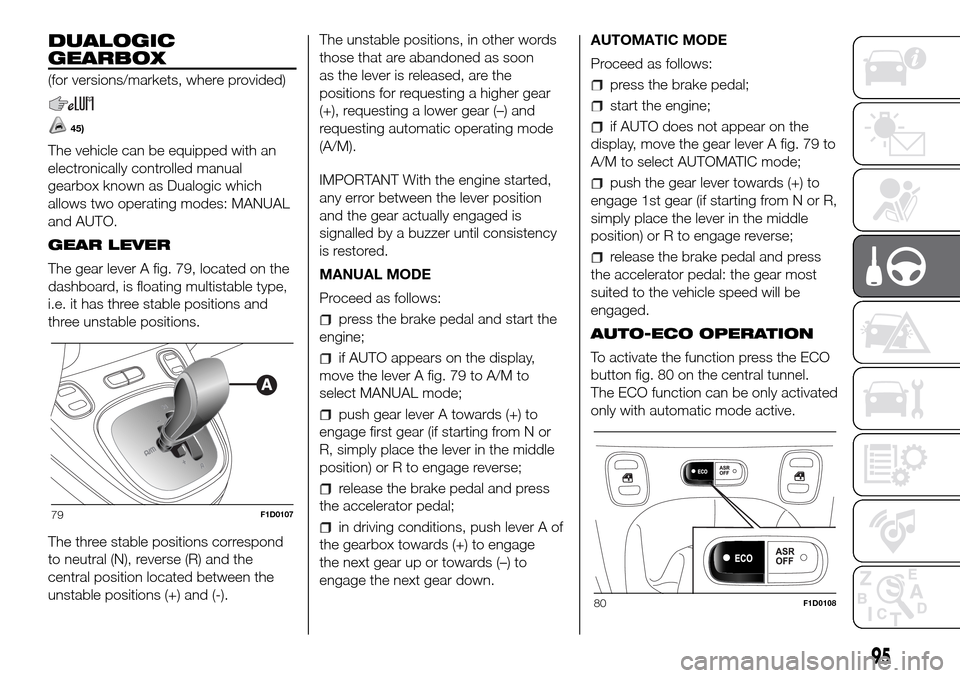
The gear lever A fig. 79, located on the
dashboard, is floating multistable type,
i.e. it has three stable positions and
three unstable positions.
The three stable positions correspond
to neutral (N), reverse (R) and the
central position located between the
unstable positions (+) and (-).The unstable positions, in other words
those that are abandoned as soon
as the lever is released, are the
positions for requesting a higher gear
(+), requesting a lower gear (–) and
requesting automatic operating mode
(A/M).
IMPORTANT With the engine started,
any error between the lever position
and the gear actually engaged is
signalled by a buzzer until consistency
is restored.
MANUAL MODE
Proceed as follows:
press the brake pedal and start the
engine;
if AUTO appears on the display,
move the lever A fig. 79 to A/M to
select MANUAL mode;
push gear lever A towards (+) to
engage first gear (if starting from N or
R, simply place the lever in the middle
position) or R to engage reverse;
release the brake pedal and press
the accelerator pedal;
in driving conditions, push lever A of
the gearbox towards (+) to engage
the next gear up or towards (–) to
engage the next gear down.AUTOMATIC MODE
Proceed as follows:
press the brake pedal;
start the engine;
if AUTO does not appear on the
display, move the gear lever A fig. 79 to
A/M to select AUTOMATIC mode;
push the gear lever towards (+) to
engage 1st gear (if starting from N or R,
simply place the lever in the middle
position) or R to engage reverse;
release the brake pedal and press
the accelerator pedal: the gear most
suited to the vehicle speed will be
engaged.
AUTO-ECO OPERATION
To activate the function press the ECO
button fig. 80 on the central tunnel.
The ECO function can be only activated
only with automatic mode active.
79F1D0107
80F1D0108
95
Page 98 of 216
With the ECO function active, the
system will select the most suitable
gear depending on the vehicle speed,
engine rpm and intensity with which the
accelerator pedal is pressed, with the
aim of limiting fuel consumption.
“Kick Down” FUNCTION
(for versions/markets, where provided)
If necessary (e.g. when overtaking),
the system downshifts one or more
gears when the accelerator pedal
is depressed beyond the point where it
becomes stiff (and if the rpm allow it)
in order to provide suitable power and
torque for the acceleration requested
by the driver.
IMPORTANT The use of the “Kick
Down” function is recommended only
when overtaking or accelerating quickly,
in order not to increase fuel
consumption.
WARNING
45)Avoid keeping your hand on this lever
except during gear change or AUTO/
MANUAL mode requests.
MODE SELECTOR
(Panda Cross versions)
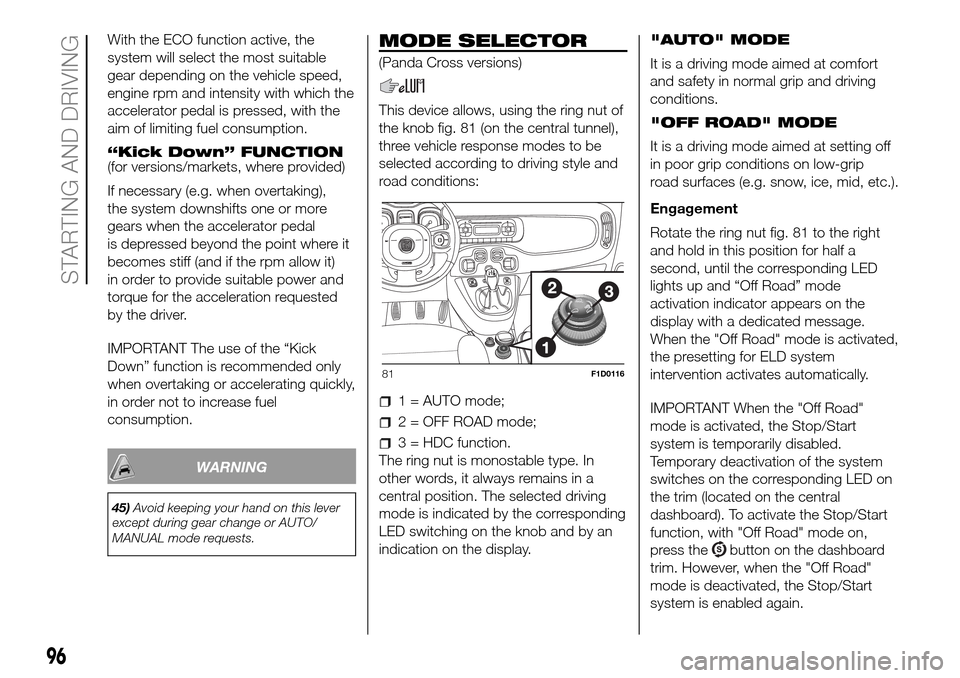
This device allows, using the ring nut of
the knob fig. 81 (on the central tunnel),
three vehicle response modes to be
selected according to driving style and
road conditions:
1 = AUTO mode;
2 = OFF ROAD mode;
3 = HDC function.
The ring nut is monostable type. In
other words, it always remains in a
central position. The selected driving
mode is indicated by the corresponding
LED switching on the knob and by an
indication on the display."AUTO" MODE
It is a driving mode aimed at comfort
and safety in normal grip and driving
conditions.
"OFF ROAD" MODE
It is a driving mode aimed at setting off
in poor grip conditions on low-grip
road surfaces (e.g. snow, ice, mid, etc.).
Engagement
Rotate the ring nut fig. 81 to the right
and hold in this position for half a
second, until the corresponding LED
lights up and “Off Road” mode
activation indicator appears on the
display with a dedicated message.
When the "Off Road" mode is activated,
the presetting for ELD system
intervention activates automatically.
IMPORTANT When the "Off Road"
mode is activated, the Stop/Start
system is temporarily disabled.
Temporary deactivation of the system
switches on the corresponding LED on
the trim (located on the central
dashboard). To activate the Stop/Start
function, with "Off Road" mode on,
press the
button on the dashboard
trim. However, when the "Off Road"
mode is deactivated, the Stop/Start
system is enabled again.
81F1D0116
96
STARTING AND DRIVING