Eco FIAT PANDA 2017 319 / 3.G Owner's Manual
[x] Cancel search | Manufacturer: FIAT, Model Year: 2017, Model line: PANDA, Model: FIAT PANDA 2017 319 / 3.GPages: 216, PDF Size: 19.25 MB
Page 56 of 216
Warning light What it means
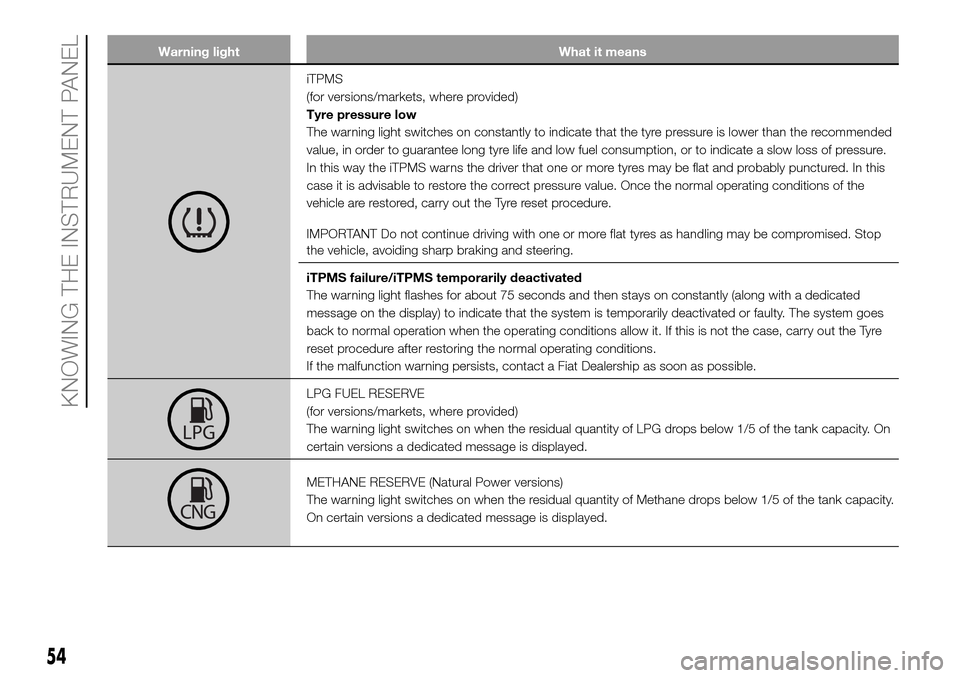
iTPMS
(for versions/markets, where provided)
Tyre pressure low
The warning light switches on constantly to indicate that the tyre pressure is lower than the recommended
value, in order to guarantee long tyre life and low fuel consumption, or to indicate a slow loss of pressure.
In this way the iTPMS warns the driver that one or more tyres may be flat and probably punctured. In this
case it is advisable to restore the correct pressure value. Once the normal operating conditions of the
vehicle are restored, carry out the Tyre reset procedure.
IMPORTANT Do not continue driving with one or more flat tyres as handling may be compromised. Stop
the vehicle, avoiding sharp braking and steering.
iTPMS failure/iTPMS temporarily deactivated
The warning light flashes for about 75 seconds and then stays on constantly (along with a dedicated
message on the display) to indicate that the system is temporarily deactivated or faulty. The system goes
back to normal operation when the operating conditions allow it. If this is not the case, carry out the Tyre
reset procedure after restoring the normal operating conditions.
If the malfunction warning persists, contact a Fiat Dealership as soon as possible.
LPG FUEL RESERVE
(for versions/markets, where provided)
The warning light switches on when the residual quantity of LPG drops below 1/5 of the tank capacity. On
certain versions a dedicated message is displayed.
METHANE RESERVE (Natural Power versions)
The warning light switches on when the residual quantity of Methane drops below 1/5 of the tank capacity.
On certain versions a dedicated message is displayed.
54
KNOWING THE INSTRUMENT PANEL
Page 62 of 216
ACTIVE SAFETY
SYSTEMS
ABS (Anti-lock Braking
System)
This system, which is an integral part of
the braking system, prevents one or
more wheels from locking and slipping
in all road surface conditions,
irrespective of the intensity of the
braking action, ensuring that the vehicle
can be controlled even during
emergency braking.
IMPORTANT To obtain the maximum
efficiency of the braking system, a
bedding-in period of about 500 km is
needed: during this period it is better to
avoid sharp, repeated and prolonged
braking.
The ABS also includes the following
systems: EBD (Electronic Braking Force
Distribution), MSR (Motor
Schleppmoment Regelung) and MBA
(Mechanical Brake Assist) (for
versions/markets, where provided).
System intervention
The driver can feel that the ABS system
has come into action because the
brake pedal pulsates slightly and the
system gets noisier: this is entirely
normal with the system operating.
44) 45) 46) 47) 48) 49) 50) 51) 52)
ESC SYSTEM (Electronic
Stability Control)
(for versions/markets, where provided)
This is an electronic system that
controls vehicle stability in the event of
tyre grip loss, helping maintain
directional control. The system is
capable of recognising potentially
dangerous situations in terms of the
stability and intervenes automatically on
the brakes in a differentiated manner
for the four wheels in order to provide a
stabilising torque.
The ESC system switches on
automatically when the engine is
started and cannot be switched off.
System intervention
The intervention of the system is
indicated by the flashing of theESC
warning light on the instrument panel,
to inform the driver that the vehicle is in
critical stability and grip conditions.
53) 54) 55) 56) 57) 58)
HH (Hill Holder) SYSTEM
This system is an integral part of the
ESC system and facilitates starting on
slopes.
It is automatically activated in the
following conditions:
uphill: vehicle stationary on a road
with a gradient higher than 5%, engine
running, brake pressed and
transmission in neutral or gear other
than reverse engaged;
downhill: vehicle stationary on a
road with a gradient higher than 5%,
engine running, brake pressed and
reverse gear engaged.
When setting off, the ESC system
control unit maintains the braking
pressure on the wheels until the torque
necessary for starting is reached, or
in any case for a maximum of 2
seconds, allowing your right foot to be
moved easily from the brake pedal to
the accelerator.
When two seconds have elapsed,
without starting, the system is
automatically deactivated, gradually
releasing the braking pressure. During
this release stage, the typical
mechanical brake release noise can be
heard, indicating that the vehicle is
about to move.
NOTE: the Hill Holder system is not
active with parking brake engaged.
60
SAFETY
Page 65 of 216
IMPORTANT The system does not
relieve the driver of the responsibility of
controlling the vehicle and does not
replace attention while driving. The
driver of the vehicle takes the complete
responsibility for the consequences of
their actions and of an incorrect and not
responsible use of the vehicle.
Enabling the system
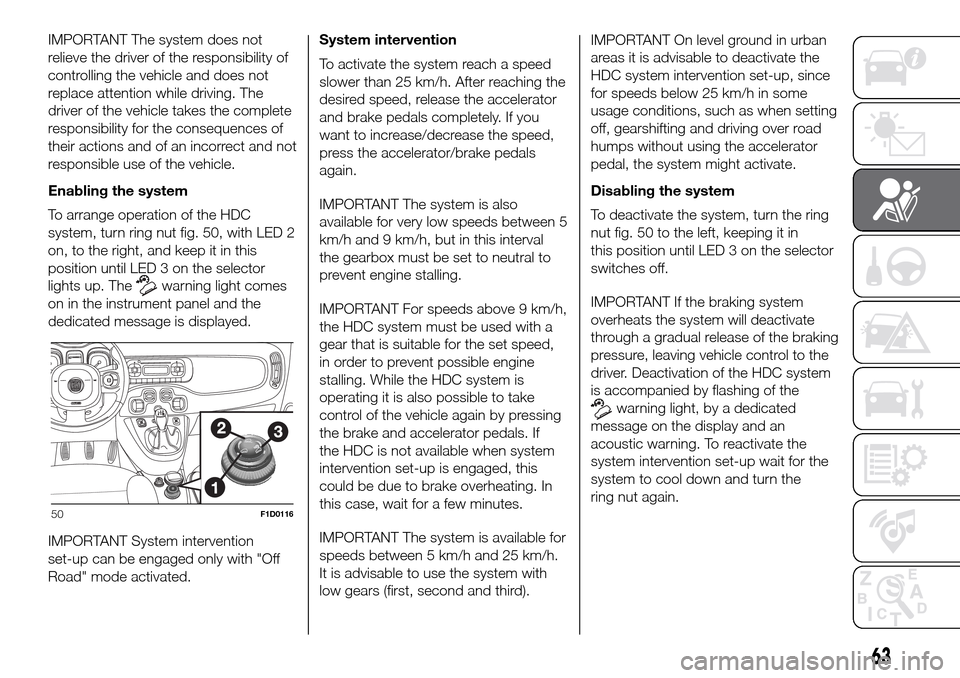
To arrange operation of the HDC
system, turn ring nut fig. 50, with LED 2
on, to the right, and keep it in this
position until LED 3 on the selector
lights up. The
warning light comes
on in the instrument panel and the
dedicated message is displayed.
IMPORTANT System intervention
set-up can be engaged only with "Off
Road" mode activated.System intervention
To activate the system reach a speed
slower than 25 km/h. After reaching the
desired speed, release the accelerator
and brake pedals completely. If you
want to increase/decrease the speed,
press the accelerator/brake pedals
again.
IMPORTANT The system is also
available for very low speeds between 5
km/h and 9 km/h, but in this interval
the gearbox must be set to neutral to
prevent engine stalling.
IMPORTANT For speeds above 9 km/h,
the HDC system must be used with a
gear that is suitable for the set speed,
in order to prevent possible engine
stalling. While the HDC system is
operating it is also possible to take
control of the vehicle again by pressing
the brake and accelerator pedals. If
the HDC is not available when system
intervention set-up is engaged, this
could be due to brake overheating. In
this case, wait for a few minutes.
IMPORTANT The system is available for
speeds between 5 km/h and 25 km/h.
It is advisable to use the system with
low gears (first, second and third).IMPORTANT On level ground in urban
areas it is advisable to deactivate the
HDC system intervention set-up, since
for speeds below 25 km/h in some
usage conditions, such as when setting
off, gearshifting and driving over road
humps without using the accelerator
pedal, the system might activate.
Disabling the system
To deactivate the system, turn the ring
nut fig. 50 to the left, keeping it in
this position until LED 3 on the selector
switches off.
IMPORTANT If the braking system
overheats the system will deactivate
through a gradual release of the braking
pressure, leaving vehicle control to the
driver. Deactivation of the HDC system
is accompanied by flashing of the
warning light, by a dedicated
message on the display and an
acoustic warning. To reactivate the
system intervention set-up wait for the
system to cool down and turn the
ring nut again.
50F1D0116
63
Page 68 of 216
Versions equipped with manual
gearbox: at the end of the automatic
braking the engine may stall and turn
off, unless the driver presses the clutch
pedal.
Versions equipped with "Dualogic"
gearbox(for versions/markets, where
provided): at the end of braking the last
gear stored remains engaged.
IMPORTANT Both on versions
equipped with manual gearbox and on
those with "Dualogic" gearbox (for
versions/markets, where provided),
after the vehicle is stopped the brake
calipers may be stuck for about 2
seconds for safety reasons. Make sure
you press the brake pedal if the vehicle
moves slightly forwards.
IMPORTANT The system doesNOT
activate when reverse is engaged. The
system doesNOTactivate if the front
seat belts are not fastened.
Engagement/disengagement
The system can be deactivated (then
reactivated) through the Setup Menu on
the display.Driving in special conditions
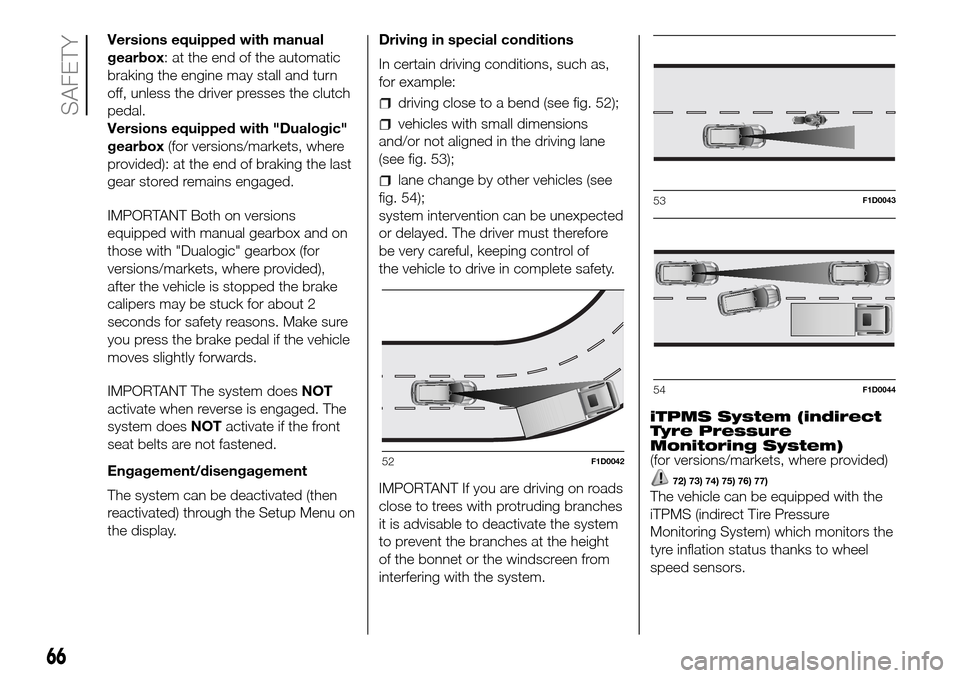
In certain driving conditions, such as,
for example:
driving close to a bend (see fig. 52);
vehicles with small dimensions
and/or not aligned in the driving lane
(see fig. 53);
lane change by other vehicles (see
fig. 54);
system intervention can be unexpected
or delayed. The driver must therefore
be very careful, keeping control of
the vehicle to drive in complete safety.
IMPORTANT If you are driving on roads
close to trees with protruding branches
it is advisable to deactivate the system
to prevent the branches at the height
of the bonnet or the windscreen from
interfering with the system.iTPMS System (indirect
Tyre Pressure
Monitoring System)
(for versions/markets, where provided)
72) 73) 74) 75) 76) 77)
The vehicle can be equipped with the
iTPMS (indirect Tire Pressure
Monitoring System) which monitors the
tyre inflation status thanks to wheel
speed sensors.
52F1D0042
53F1D0043
54F1D0044
66
SAFETY
Page 69 of 216
The system warns the driver if one or
more tyres are flat by the
warning
light continuously lit on the instrument
panel and a dedicated warning
message on the display.
If one tyre only is flat, the system can
indicate its position: it is in any case
recommended to check the pressure
on all four tyres.
This indication is displayed also when
turning the engine off and on again until
the RESET procedure is carried out.
Reset procedure
The iTPMS needs an initial "self-
learning" phase (with length depending
on the driving style and road conditions:
optimal conditions being driving on a
straight road at 80 km/h for at least 20
minutes) which starts when the Reset
procedure is carried out.
The Reset procedure must be carried
out:
each time tyre pressure is modified;
when even only one tyre is changed;
when tyres are rotated/inverted;
when the space-saver wheel is
fitted.Before carrying out the Reset
procedure, inflate the tyres to the rated
pressure values specified in the inflation
pressure table (see "Wheels" paragraph
in the "Technical specifications"
chapter).
If the Reset procedure is not carried
out, in all above cases, the
warning
light may give false indications on
one or more tyres.
To carry out the RESET procedure, with
the vehicle stopped and the ignition
device at MAR, use the Main Menu as
follows:
briefly press thebutton: the
display will show Reset;
press thebutton or the
button to select ("Yes" or "No");
briefly press thebutton: the
display will show "Confirm";
pressbutton orto select
("Yes" to Reset or "No" to exit the video
page);
press thebutton again to return
to the standard screen or to the main
menu according to where you are in the
menu.
At the end of the Reset procedure the
display will show the "Reset saved"
message, indicating that the self-
learning has been started.Operating conditions
The system is active for speeds above
15 km/h.
In a few situations such as sporty
driving, particular conditions of the road
surface (e.g. icy, snowy, unsurfaced
roads...) the signalling may be delayed
or partial in detecting the contemporary
deflation of more than one tyre.
Under special conditions (e.g. vehicle
loaded asymmetrically on one side,
towing a trailer, damaged or worn tyre,
fitting the space-saver wheel, use of the
"Fix&Go Airflat" kit, fitting snow chains,
fitting different tyres on the axles) the
system may give false indications or be
temporarily deactivated.
If the system is temporarily deactivated,
the warning light
flashes for about
75 seconds and then is continuously
on; at the same time, the display shows
a dedicated message.
This indication is displayed also after
the engine has been switched off and
then on again if the correct operating
conditions are not restored.
67
Page 70 of 216
WARNING
67)The system is an aid for the driver, who
must always pay full attention while
driving. The responsibility always rests with
the driver, who must take into account
the traffic conditions in order to drive
in complete safety. The driver must always
maintain a safe distance from the vehicle
in front.
68)If the driver depresses the brake pedal
fully or carries out a fast steering during
system operation, the automatic braking
function may stop (e.g. to allow a possible
manoeuvre to avoid the obstacle).
69)The laser beam is not visible at the
naked eye. Do not look directly, or with
optical instruments (e.g. lenses), at the
laser beam from a distance lower than 10
cm: this may cause damage to the sight.
The laser beam is also present when
the key is at MAR but its operation is off,
not available or manually deactivated
with the display Setup Menu.
70)The system intervenes on vehicles
travelling in the same lane. Small sized
vehicles (e.g. bicycles or motorbikes)
or people, animals and things (e.g.
pushchairs) and more in general all those
obstacles with a low reflection of the light
emitted by the laser (e.g. vehicles soiled
with mud) are not taken into consideration.71)If the car must be placed on a roller
bench (at a speed within 5 and 30 km/h)
for maintenance interventions or if it is
washed in an automatic roller washing
tunnel with an obstacle in the front part
(e.g. another car, a wall or another
obstacle), the system may detect its
presence and activate. In this case the
system must be deactivated through the
display Setup Menu.
72)If the system signals a pressure
decrease on a specific tyre, it is
recommended to check the pressure on all
four tyres.
73)The iTPMS does not relieve the driver
from the obligation to check the tyre
pressure every month; it is not to
be considered a system to replace
maintenance or a safety system.
74)Tyre pressure must be checked with
tyres cold. Should it become necessary for
whatever reason to check pressure with
warm tyres, do not reduce pressure even
though it is higher than the prescribed
value, but repeat the check when tyres are
cold.
75)The iTPMS cannot indicate sudden
tyre pressure drops (for example when
a tyre bursts). In this case, stop the vehicle,
braking with caution and avoiding abrupt
steering.
76)The system only warns that the tyre
pressure is low: it is not able to inflate
them.
77)Insufficient tyre inflation increases fuel
consumption, reduces the tread duration
and may affect the capacity to drive safely.
WARNING
30)The laser sensor may have limited or
absent operation due to weather
conditions such as: heavy rain, hail, thick
fog, heavy snow, formation of ice layers on
the windscreen.
31)Sensor operation may also be
compromised by the presence of dust,
condensation, dirt or ice on the
windscreen, by traffic conditions (e.g.
vehicles that are driving not aligned with
you car, vehicle driving in a transverse
or opposite way on the same lane, bend
with a small radius of curvature), by road
surface conditions and by driving
conditions (e.g. off-road driving). Make sure
the windscreen is always clean. Use
specific detergents and clean cloths to
avoid scratching the windscreen. The
sensor operation may also be limited or
absent in some driving, traffic and road
surface conditions.
32)Projecting loads on the roof of the car
may interfere with the correct operation
of the sensor. Before starting make sure
the load is correctly positioned, in order not
to cover the sensor operating range.
33)If the windscreen must be replaced
due to scratches, chipping or breakage,
contact exclusively a Fiat Dealership.
Do not replace the windscreen on your
own, risk of malfunction! It is advisable to
replace the windscreen if it is damaged
in the laser sensor area.
68
SAFETY
Page 74 of 216
With driver and/or passenger side (with
passenger present) seat belts
unfastened, when 20 km/h are
exceeded or when travelling at a speed
between 10 and 20 km/h for longer
than 5 seconds, an acoustic signal
cycle will be started for the front seats
(continuous acoustic signal for 6
seconds followed by a 90 second
beep) and the warning light will flash.
Once the cycle is complete, the
warning lights stay on with a fixed light
until the vehicle is turned off or the
seat belt fastened.
If the seat belt is unfastened again while
travelling, the acoustic warning restarts
as described previously and the
icon is displayed.
For the rear seats, the reminder cycle is
only activated when any seat belt is
unfastened together with an acoustic
warning (three beeps). If the condition
of any (front or rear) seat belt changes,
also the condition of the other
(front/rear) seat belts is reported.
The visual indication (display of the
icon) will start and stop
independently for each warning light if
several seat belts are unfastened.
The visual indication will change
condition (display of the
icon) after
the corresponding seat belt has been
fastened again.IMPORTANT When the ignition key is
turned to MAR, if all the front and
rear belts are already fastened the
warning lights will be displayed for
30 seconds.
PRE-TENSIONERS
84) 85) 86) 87)
37)
The vehicle is equipped with front seat
belt pretensioners, which draw back
the seat belts by several centimetres in
the event of a strong frontal impact.
This guarantees the perfect adherence
of the seat belts to the occupant's
bodies before the retention action
begins.
It is evident that the pretensioners have
operated when the belt withdraws
towards the retractor. This vehicle is
also equipped with a second
pretensioner (in the kick plate area). Its
activation is signalled by the shortening
of the metal cable.
A slight discharge of smoke may be
produced during the activation of the
pretensioner which is not harmful and
does not involve any fire hazard.
The pretensioner does not require any
maintenance or lubrication. Anything
that modifies its original conditions
invalidates its efficiency.
If, due to unusual natural events (floods,
sea storms, etc.), the device has been
affected by water and/or mud, contact
a Fiat Dealership to have it replaced.
72
SAFETY
Page 77 of 216
Children must be seated safely and
comfortably. Depending on the
characteristics of the child restraint
systems used, you are advised to keep
children in rearward facing child
restraint systems for as long as
possible (at least until 3-4 years old),
since this is the most protected position
in the event of an impact.
The choice of the most suitable child
restraint system depends on the weight
and size of the child. There are various
types of child restraint systems, which
can be secured to the vehicle by means
of the seat belts or with the ISOFIX
anchorages.
It is recommended to always choose
the restraint system most suitable
for the child; for this reason always refer
to the Owner Handbook provided with
the child restraint system, to be sure
that it is of the right type for the children
it is intended for.In Europe the characteristics of child
restraint systems are ruled by the
regulation ECE-R44, dividing them into
five weight groups:
Group Weight groups
Group 0up to 10 kg in
weight
Group 0+up to 13 kg in
weight
Group 1 9 - 18 kg
Group 2 15 - 25 kg
Group 3 22 - 36 kg
All restraint devices must bear the
certification data, together with the
control mark, on a label solidly fixed to
the child restraint system which must
never be removed.
Lineaccessori MOPAR
®includes child
restraint systems for each weight
group. These devices are
recommended having been specifically
designed for Fiat vehicles.
FITTING A CHILD
RESTRAINT SYSTEM
WITH SEAT BELTS
92) 93) 94)
The Universal child restraint systems
installed with the seat belts only are
type-approved on the basis of the ECE
R44 standard and are divided into
various weight groups.IMPORTANT The figures are indicative
and provided for assembly purposes
only. Fit the child restraint system
according to the instructions, which
must be included.
IMPORTANT Following an accident of a
certain importance, it is recommended
to replace both the child restraint
system and the seat belt to which it
was bound.
Group 0 and 0+
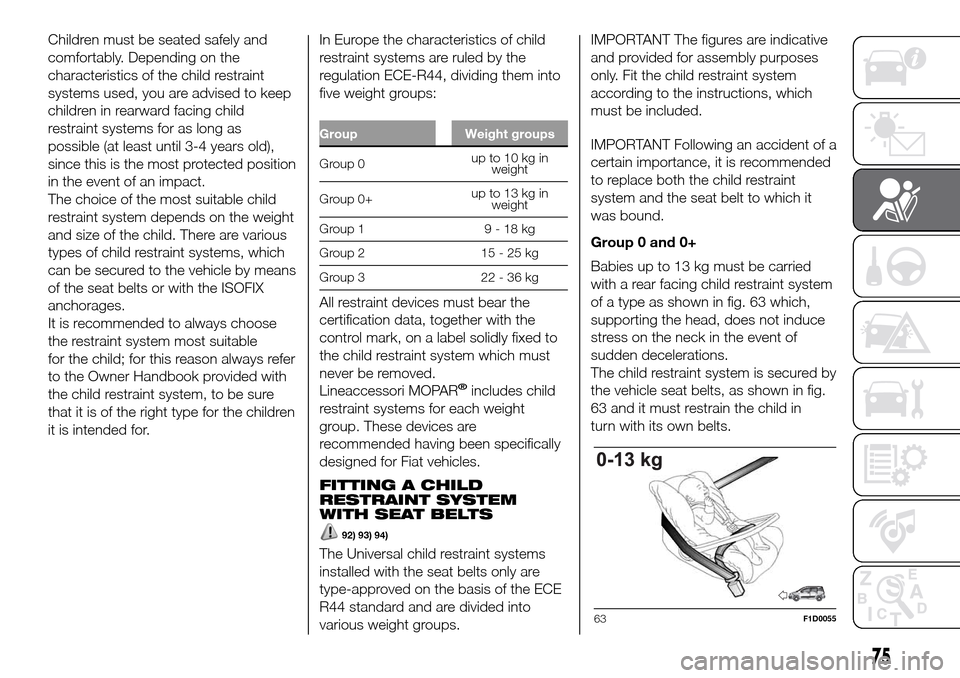
Babies up to 13 kg must be carried
with a rear facing child restraint system
of a type as shown in fig. 63 which,
supporting the head, does not induce
stress on the neck in the event of
sudden decelerations.
The child restraint system is secured by
the vehicle seat belts, as shown in fig.
63 and it must restrain the child in
turn with its own belts.
63F1D0055
75
Page 80 of 216
INSTALLING AN ISOFIX
CHILD CARSEAT
95) 96) 97) 98)The outer rear seats of the vehicle are
equipped with ISOFIX anchorages,
a European standard which makes
fitting a child restraint system quick,
simple and safe.
The ISOFIX system lets you install the
ISOFIX child restraining system without
using the car seat belts but connecting
them directly to the carseat with three
anchors in the car. Traditional child
restraint systems can be fitted
alongside ISOFIX child restraint systems
on different seats in the same vehicle.
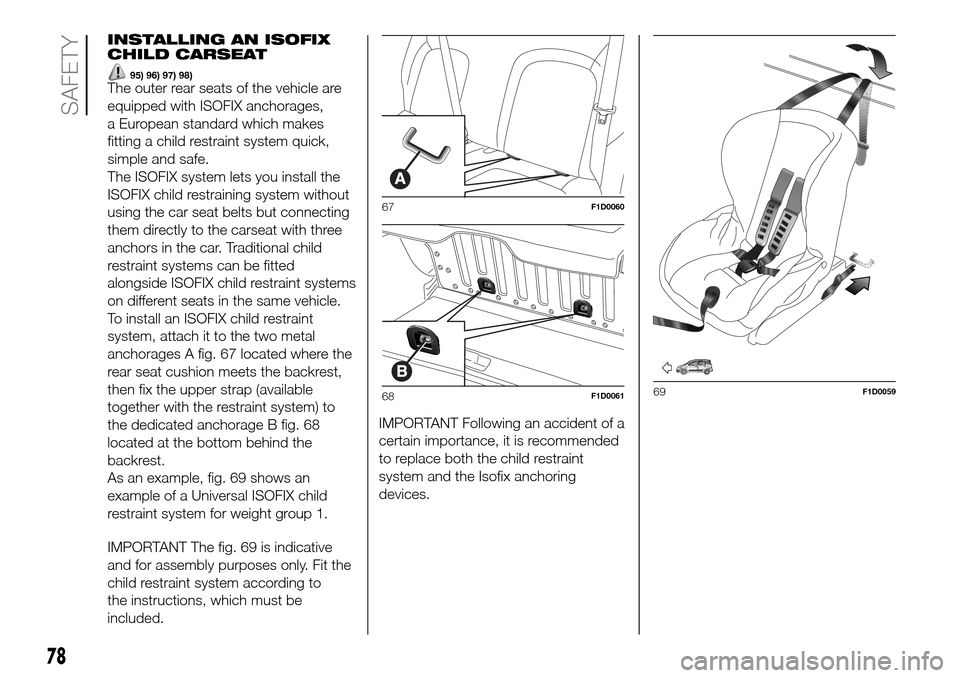
To install an ISOFIX child restraint
system, attach it to the two metal
anchorages A fig. 67 located where the
rear seat cushion meets the backrest,
then fix the upper strap (available
together with the restraint system) to
the dedicated anchorage B fig. 68
located at the bottom behind the
backrest.
As an example, fig. 69 shows an
example of a Universal ISOFIX child
restraint system for weight group 1.
IMPORTANT The fig. 69 is indicative
and for assembly purposes only. Fit the
child restraint system according to
the instructions, which must be
included.IMPORTANT Following an accident of a
certain importance, it is recommended
to replace both the child restraint
system and the Isofix anchoring
devices.
67F1D0060
68F1D006169F1D0059
78
SAFETY
Page 82 of 216
CHILD RESTRAINT SYSTEMS RECOMMENDED BY FCA FOR YOUR PANDA
Lineaccessori MOPAR
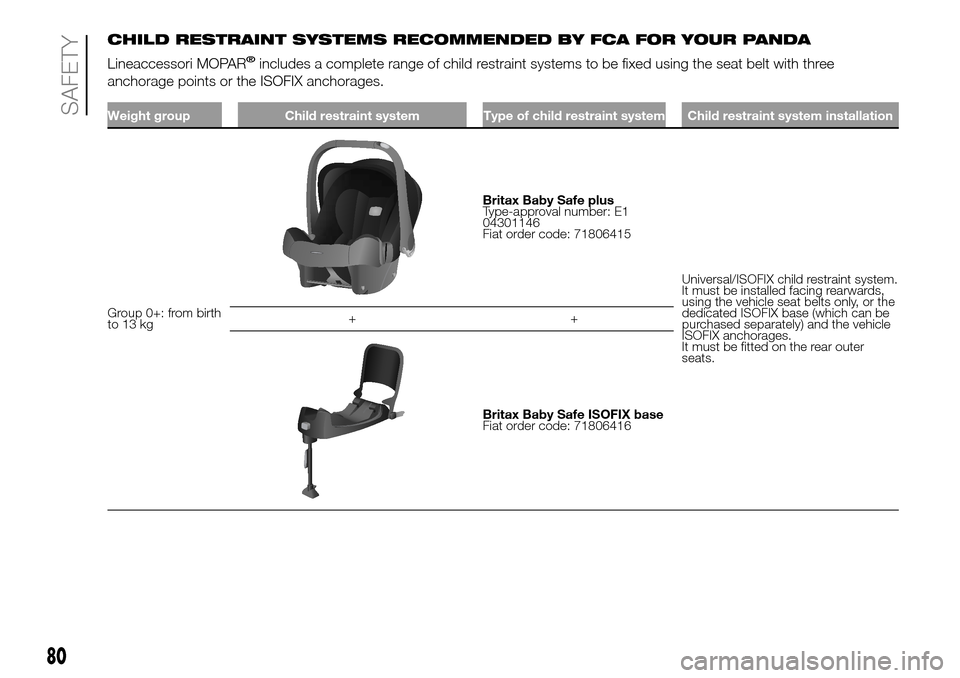
®includes a complete range of child restraint systems to be fixed using the seat belt with three
anchorage points or the ISOFIX anchorages.
Weight group Child restraint system Type of child restraint system Child restraint system installation
Group 0+: from birth
to 13 kg
Britax Baby Safe plus
Type-approval number: E1
04301146
Fiat order code: 71806415
Universal/ISOFIX child restraint system.
It must be installed facing rearwards,
using the vehicle seat belts only, or the
dedicated ISOFIX base (which can be
purchased separately) and the vehicle
ISOFIX anchorages.
It must be fitted on the rear outer
seats. ++
Britax Baby Safe ISOFIX base
Fiat order code: 71806416
80
SAFETY