belt FIAT PANDA 2017 319 / 3.G Owner's Manual
[x] Cancel search | Manufacturer: FIAT, Model Year: 2017, Model line: PANDA, Model: FIAT PANDA 2017 319 / 3.GPages: 216, PDF Size: 19.25 MB
Page 86 of 216
92)Incorrect fitting of the child restraint
system may result in an inefficient
protection system. In the event of an
accident the child restraint system may
become loose and the child may be
injured, even fatally. When fitting a restraint
system for newborns or children, strictly
comply with the instructions provided
by the Manufacturer.
93)When the child restraint system is not
used, secure it with the seat belt or with
the ISOFIX anchorages, or remove it from
the vehicle. Do not leave it unsecured
inside the passenger compartment. In this
way, in the case of sudden braking or an
accident, it will not cause injuries to the
occupants.
94)After installing a child restraint system,
do not move the seat: always remove
the child restraint system before making
any adjustment.
95)Always make sure that the chest
section of the seat belt does not pass
under the arms or behind the back of the
child. In the event of an accident the seat
belt will not be able to secure the child,
with the risk of injury, including fatal injury.
Therefore the child must always wear
the seat belt correctly.
96)Do not use the same lower anchorage
to install more than one child restraint
system.
97)If a Universal ISOFIX child restraint
system is not fixed to all three anchorages,
it will not be able to protect the child
correctly. In a crash, the child could be
seriously or fatally injured.98)Fit the child restraint system when the
car is stationary. The child restraint system
is correctly fixed to the brackets when
you hear the click. Follow the instructions
for assembly, disassembly and positioning
that the Manufacturer must supply with
the child restraint system.SUPPLEMENTARY
RESTRAINT SYSTEM
(SRS) - AIRBAG
The vehicle is equipped with:
front driver airbag;
front passenger airbag;
front side bags for pelvis, chest and
shoulder protection of driver and
passenger (for versions/markets, where
provided);
side bags for head protection of
front seat passengers and rear side
seat passengers (window bag).
FRONT AIRBAGS
99)The front (driver and passenger) airbags
protect the front seat occupants in the
event of head-on crashes of medium-
high severity, by placing the cushion
between the occupant and the steering
wheel or dashboard.
Therefore non-activation of airbags in
other types of collisions (side impacts,
rear shunts, roll-overs, etc.) does not
indicate a system malfunction.
Driver and passenger front airbags are
not a replacement of but
complementary to the seat belts, which
should always be worn, as specified
by law in Europe and most non-
European countries.
84
SAFETY
Page 87 of 216
In the event of an impact, those not
wearing a seat belt are projected
forwards, and may come into contact
with the bag which is still inflating.
The protection offered by the bag is
compromised in these circumstances.
The front airbags may not activate in
the case of a frontal impact against
highly deformable objects not involving
the front surface of the vehicle (e.g.
wing collision against guard rail) or in
the case of the vehicle wedging under
other vehicles or protective barriers
(e.g. under trucks or guard rails).
Failure to activate in the conditions
described above is due to the fact that
they may not provide any additional
protection compared with seat belts, so
their activation would be inappropriate.
In these cases, non-deployment does
not indicate a system malfunction.
The driver's and passenger's
front airbags have been designed and
calibrated to protect front seat
occupants wearing seat belts.
At their maximum inflation, their volume
fills most of the space between the
steering wheel and the driver and
between the dashboard and the
passenger.The airbags are not deployed in the
event of minor frontal impacts (for
which the restraining action of the seat
belts is sufficient). It is therefore always
necessary to wear seat belts.
Front airbag driver's side
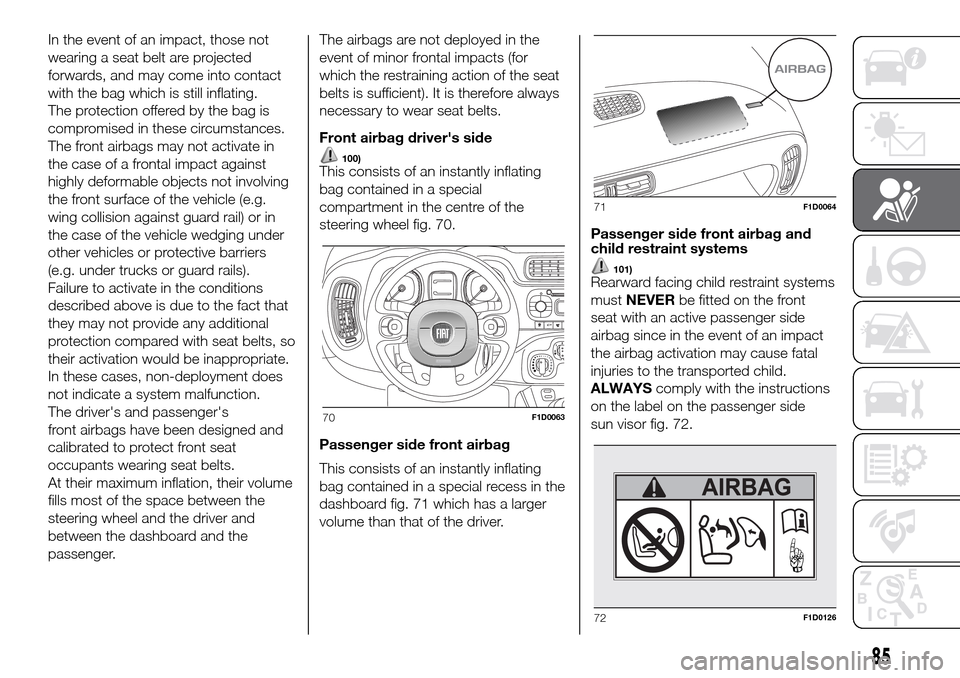
100)This consists of an instantly inflating
bag contained in a special
compartment in the centre of the
steering wheel fig. 70.
Passenger side front airbag
This consists of an instantly inflating
bag contained in a special recess in the
dashboard fig. 71 which has a larger
volume than that of the driver.Passenger side front airbag and
child restraint systems
101)Rearward facing child restraint systems
mustNEVERbe fitted on the front
seat with an active passenger side
airbag since in the event of an impact
the airbag activation may cause fatal
injuries to the transported child.
ALWAYScomply with the instructions
on the label on the passenger side
sun visor fig. 72.
70F1D0063
71F1D0064
72F1D0126
85
Page 92 of 216
110)The airbags may also be deployed
when the car is not moving, if the key is in
the ignition and turned to MAR-ON or
when the engine is off, if the car is hit by
another moving vehicle. Therefore, even if
the vehicle is stationary, when an active
front passenger airbag is fitted, DO NOT
install rearward facing child restraint
systems on the front passenger seat.
Deployment of the airbag following an
impact could cause fatal injuries to the
child. Therefore, always deactivate the
passenger side airbag when a rearward
facing child restraint system is installed on
the front passenger seat. The front
passenger seat must also be positioned
back as far as possible in order to prevent
the child restraint system from coming
into contact with the dashboard.
Immediately reactivate the passenger
airbag as soon as the child restraint system
has been removed. Also remember that, if
the key is turned to STOP, none of the
safety devices (airbags or pretensioners)
will be deployed in the event of collision.
Non-deployment in such cases does
not indicate a system malfunction.111)The airbag warning lightindicates
the passenger protection status. If the
warning light is off, the passenger side
protection is activated. It can be
deactivated from the menu, in this case the
warning light comes on. When the vehicle
is started (ignition key in MAR position), the
warning light comes on for approx. 8
seconds, provided that at least 5 seconds
have elapsed from the previous switching
off. If this does not happen please contact
a Fiat Dealership. If the vehicle is switched
off/on again in less than 5 seconds the
warning light may remain off. In this case,
to check correct warning light operation,
switch the vehicle off, wait at least 5
seconds and switch on again. During the
first 8 seconds, the activation of the
warning light does not actually show the
passenger protection status, but only
checks its correct operation. The warning
light may light up with various intensity
levels depending on the vehicle conditions.
The intensity may also vary during the
same key cycle. (The warning light is tested
also for markets where the passenger
protection deactivation function is
not provided, and the warning light
switches on for less than one second when
the key is turned to MAR, then switches
off again.)
112)The airbag deployment threshold is
higher than that of the pretensioners.
For collisions in the range between the two
thresholds, it is normal for only the
pretensioners to be activated.113)The airbag does not replace seat
belts but increases their efficiency.
Because front airbags are not deployed for
low-speed crashes, side collisions,
rear-end shunts or rollovers, occupants are
protected, in addition to any side bags,
only by their seat belts, which must
therefore always be fastened.
114)If the “red”
warning light does not
switch on for a few seconds when the
key is turned to MAR, there may be a fault
with the “red” warning light. In this case,
after a few seconds, the
warning light
starts flashing. Contact a Fiat Dealership
immediately to have the system checked.
115)To deactivate the airbags using the
instrument panel menu, see the description
in the "Knowing the instrument panel"
chapter, "Setup Menu" paragraph.
90
SAFETY
Page 94 of 216
STARTING THE
ENGINE
116) 117)
38) 39) 40) 41)
Before starting the engine, adjust the
seat, the interior rear view mirrors,
the door mirrors and fasten the seat
belt correctly.
Never press the accelerator pedal for
starting the engine.
VERSIONS WITH MANUAL
GEARBOX
Petrol versions
Proceed as follows:
engage the handbrake and place
the gear lever in neutral.For 0.9
TwinAir and 0.9 TwinAir Turbo
versionsengage the handbrake and
place the gear lever in neutral or fully
press the clutch pedal if a gear other
than neutral is engaged;
for all versions (except 0.9
TwinAir Turbo)fully depress the clutch
pedal, without pressing the accelerator;
turn the ignition key to AVV and
release it as soon as the engine starts.Diesel versions
Proceed as follows:
engage the handbrake, put the gear
lever into neutral and turn the ignition
key to MAR: the warning lights
and
on the instrument panel will turn
on;
wait for the warning lightsand
to turn off and then fully depress
the clutch pedal without pressing the
accelerator;
turn the ignition key to AVV as soon
as warning light
switches off.
Release the ignition key as soon as the
engine starts.
IMPORTANT If the engine does not
start at the first attempt, return the
ignition key to STOP before repeating
the procedure. If, with the ignition
key at MAR, the warning lights
and
(only for petrol versions) stay on
in the instrument panel, the ignition key
must be brought back to STOP and
then to MAR again. If the
warning
light stays on, retry with the other
keys provided. Contact a Fiat
Dealership if you still cannot start the
engine.VERSIONS WITH
DUALOGIC GEARBOX
118)Engine starting is allowed both with a
gear engaged and with the gearbox
in neutral (N).
However, the brake pedal must always
be pressed first if neutral is not
engaged. It is therefore advisable to
place the gear lever in neutral (N) before
starting the engine.
LPG AND NATURAL
POWER VERSIONS
The engine always starts up on petrol
independently of the mode previously
selected.
42)
STOPPING THE ENGINE
43)Turn the ignition key to STOP while the
engine is idling.
IMPORTANT After a demanding drive,
before turning the engine off you should
allow it to idle to allow the temperature
in the engine compartment to
decrease.
92
STARTING AND DRIVING
Page 128 of 216
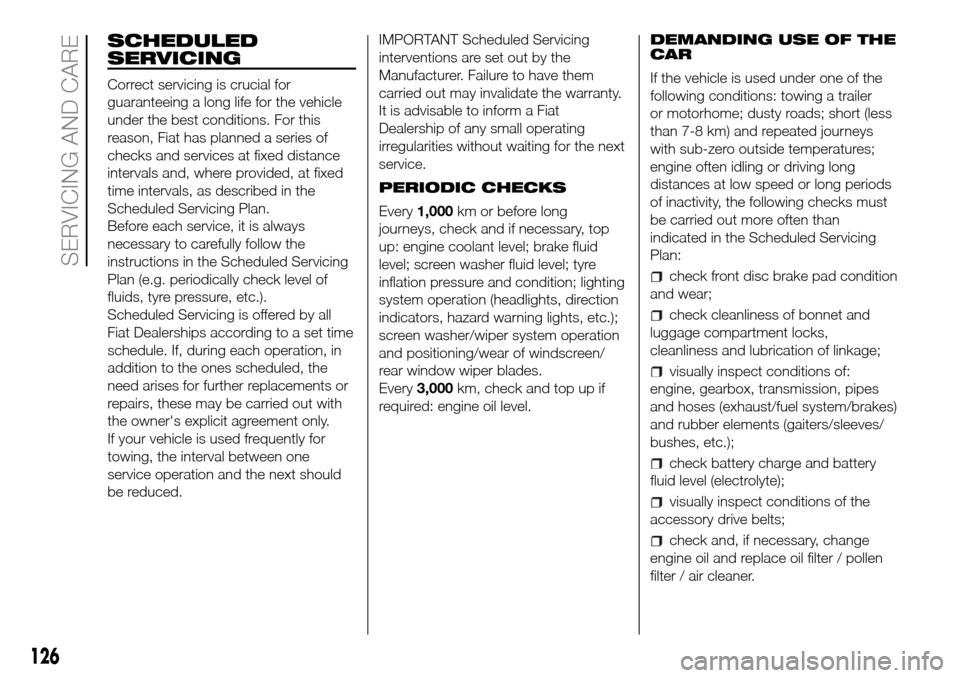
SCHEDULED
SERVICING
Correct servicing is crucial for
guaranteeing a long life for the vehicle
under the best conditions. For this
reason, Fiat has planned a series of
checks and services at fixed distance
intervals and, where provided, at fixed
time intervals, as described in the
Scheduled Servicing Plan.
Before each service, it is always
necessary to carefully follow the
instructions in the Scheduled Servicing
Plan (e.g. periodically check level of
fluids, tyre pressure, etc.).
Scheduled Servicing is offered by all
Fiat Dealerships according to a set time
schedule. If, during each operation, in
addition to the ones scheduled, the
need arises for further replacements or
repairs, these may be carried out with
the owner's explicit agreement only.
If your vehicle is used frequently for
towing, the interval between one
service operation and the next should
be reduced.IMPORTANT Scheduled Servicing
interventions are set out by the
Manufacturer. Failure to have them
carried out may invalidate the warranty.
It is advisable to inform a Fiat
Dealership of any small operating
irregularities without waiting for the next
service.
PERIODIC CHECKS
Every1,000km or before long
journeys, check and if necessary, top
up: engine coolant level; brake fluid
level; screen washer fluid level; tyre
inflation pressure and condition; lighting
system operation (headlights, direction
indicators, hazard warning lights, etc.);
screen washer/wiper system operation
and positioning/wear of windscreen/
rear window wiper blades.
Every3,000km, check and top up if
required: engine oil level.DEMANDING USE OF THE
CAR
If the vehicle is used under one of the
following conditions: towing a trailer
or motorhome; dusty roads; short (less
than 7-8 km) and repeated journeys
with sub-zero outside temperatures;
engine often idling or driving long
distances at low speed or long periods
of inactivity, the following checks must
be carried out more often than
indicated in the Scheduled Servicing
Plan:
check front disc brake pad condition
and wear;
check cleanliness of bonnet and
luggage compartment locks,
cleanliness and lubrication of linkage;
visually inspect conditions of:
engine, gearbox, transmission, pipes
and hoses (exhaust/fuel system/brakes)
and rubber elements (gaiters/sleeves/
bushes, etc.);
check battery charge and battery
fluid level (electrolyte);
visually inspect conditions of the
accessory drive belts;
check and, if necessary, change
engine oil and replace oil filter / pollen
filter / air cleaner.
126
SERVICING AND CARE
Page 130 of 216
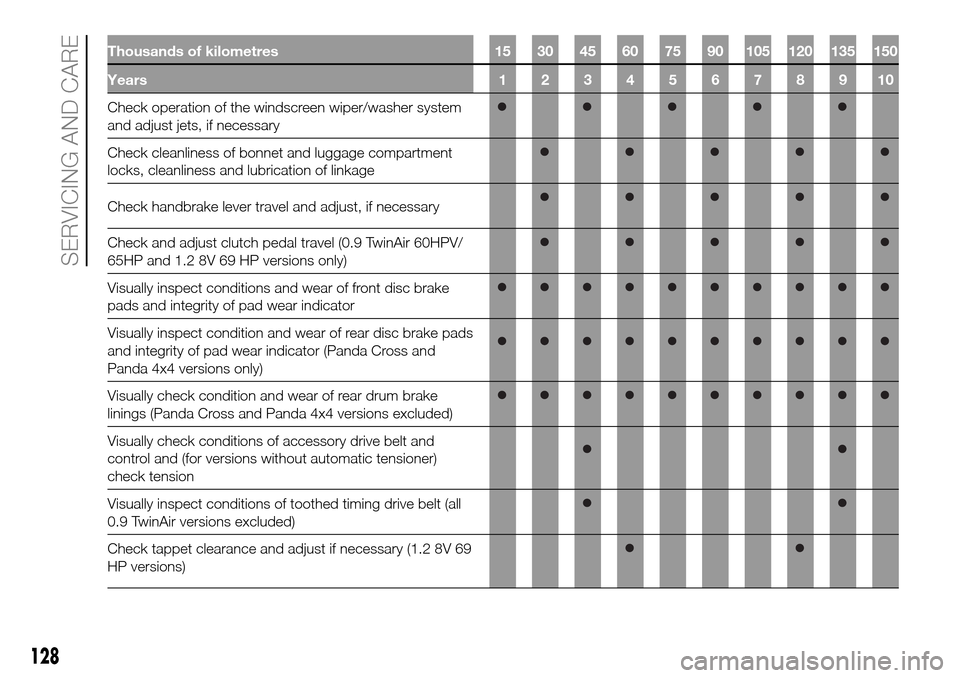
Thousands of kilometres 15 30 45 60 75 90 105 120 135 150
Years12345678910
Check operation of the windscreen wiper/washer system
and adjust jets, if necessary
Check cleanliness of bonnet and luggage compartment
locks, cleanliness and lubrication of linkage
Check handbrake lever travel and adjust, if necessary
Check and adjust clutch pedal travel (0.9 TwinAir 60HPV/
65HP and 1.2 8V 69 HP versions only)
Visually inspect conditions and wear of front disc brake
pads and integrity of pad wear indicator
Visually inspect condition and wear of rear disc brake pads
and integrity of pad wear indicator (Panda Cross and
Panda 4x4 versions only)
Visually check condition and wear of rear drum brake
linings (Panda Cross and Panda 4x4 versions excluded)
Visually check conditions of accessory drive belt and
control and (for versions without automatic tensioner)
check tension
Visually inspect conditions of toothed timing drive belt (all
0.9 TwinAir versions excluded)
Check tappet clearance and adjust if necessary (1.2 8V 69
HP versions)
128
SERVICING AND CARE
Page 132 of 216
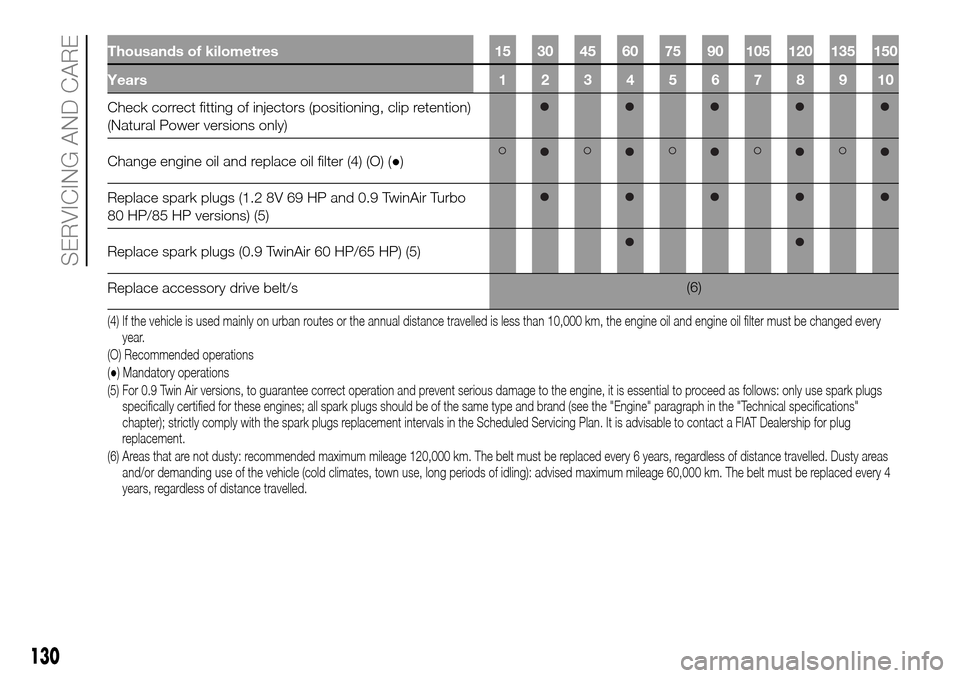
Thousands of kilometres 15 30 45 60 75 90 105 120 135 150
Years12345678910
Check correct fitting of injectors (positioning, clip retention)
(Natural Power versions only)
Change engine oil and replace oil filter (4) (O) (●)
Replace spark plugs (1.2 8V 69 HP and 0.9 TwinAir Turbo
80 HP/85 HP versions) (5)
Replace spark plugs (0.9 TwinAir 60 HP/65 HP) (5)
Replace accessory drive belt/s(6)
(4) If the vehicle is used mainly on urban routes or the annual distance travelled is less than 10,000 km, the engine oil and engine oil filter must be changed every
year.
(O) Recommended operations
(●) Mandatory operations
(5) For 0.9 Twin Air versions, to guarantee correct operation and prevent serious damage to the engine, it is essential to proceed as follows: only use spark plugs
specifically certified for these engines; all spark plugs should be of the same type and brand (see the "Engine" paragraph in the "Technical specifications"
chapter); strictly comply with the spark plugs replacement intervals in the Scheduled Servicing Plan. It is advisable to contact a FIAT Dealership for plug
replacement.
(6) Areas that are not dusty: recommended maximum mileage 120,000 km. The belt must be replaced every 6 years, regardless of distance travelled. Dustyareas
and/or demanding use of the vehicle (cold climates, town use, long periods of idling): advised maximum mileage 60,000 km. The belt must be replaced every 4
years, regardless of distance travelled.
130
SERVICING AND CARE
Page 133 of 216
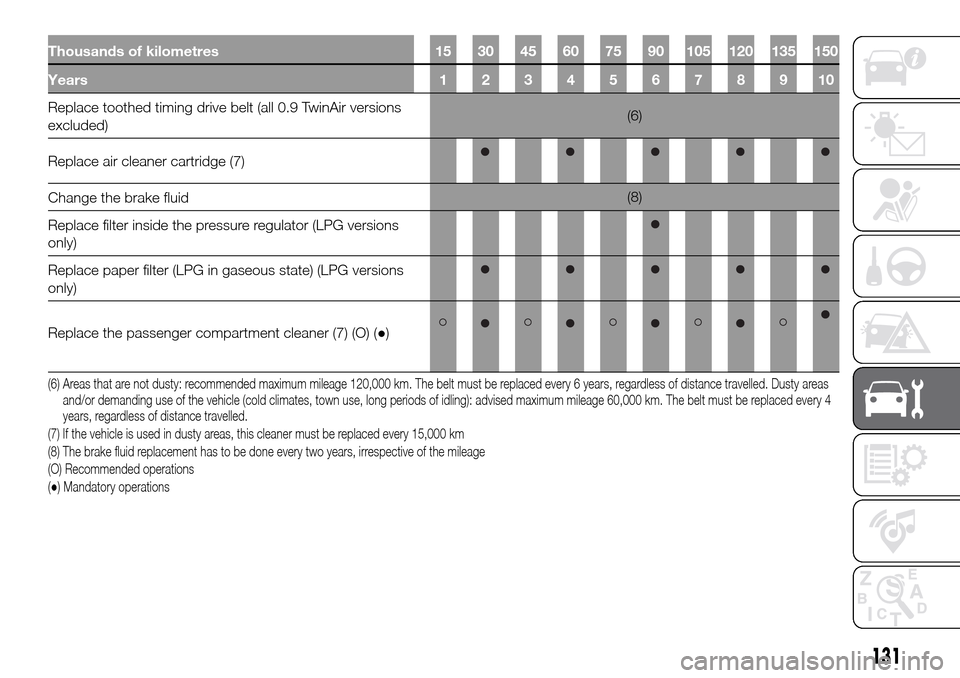
Thousands of kilometres 15 30 45 60 75 90 105 120 135 150
Years12345678910
Replace toothed timing drive belt (all 0.9 TwinAir versions
excluded)(6)
Replace air cleaner cartridge (7)
Change the brake fluid(8)
Replace filter inside the pressure regulator (LPG versions
only)
Replace paper filter (LPG in gaseous state) (LPG versions
only)
Replace the passenger compartment cleaner (7) (O) (●)
(6) Areas that are not dusty: recommended maximum mileage 120,000 km. The belt must be replaced every 6 years, regardless of distance travelled. Dustyareas
and/or demanding use of the vehicle (cold climates, town use, long periods of idling): advised maximum mileage 60,000 km. The belt must be replaced every 4
years, regardless of distance travelled.
(7) If the vehicle is used in dusty areas, this cleaner must be replaced every 15,000 km
(8) The brake fluid replacement has to be done every two years, irrespective of the mileage
(O) Recommended operations
(●) Mandatory operations
131
Page 135 of 216
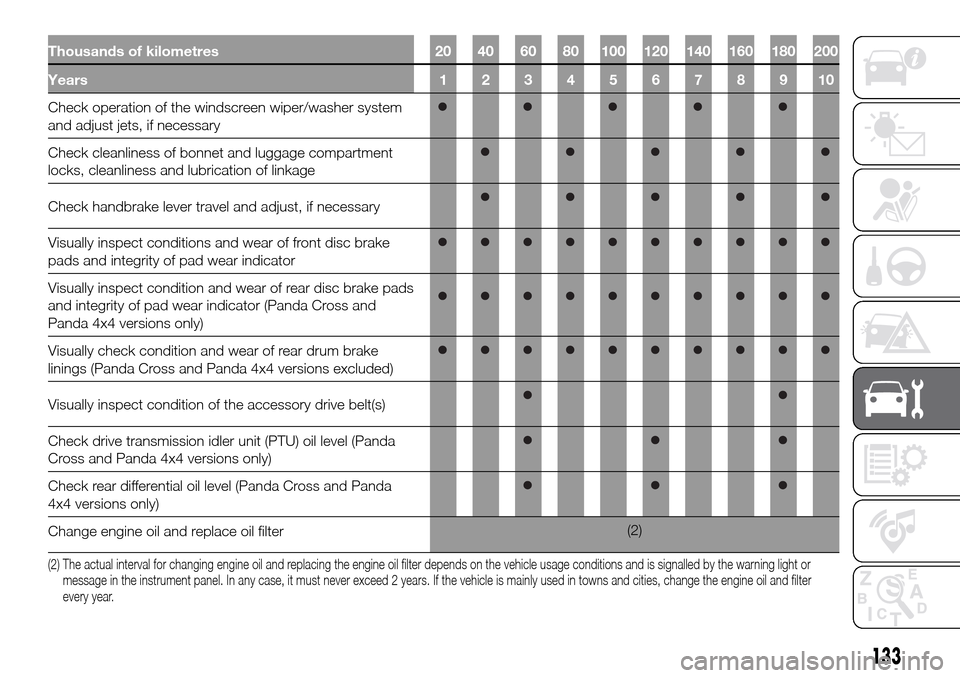
Thousands of kilometres 20 40 60 80 100 120 140 160 180 200
Years12345678910
Check operation of the windscreen wiper/washer system
and adjust jets, if necessary
Check cleanliness of bonnet and luggage compartment
locks, cleanliness and lubrication of linkage
Check handbrake lever travel and adjust, if necessary
Visually inspect conditions and wear of front disc brake
pads and integrity of pad wear indicator
Visually inspect condition and wear of rear disc brake pads
and integrity of pad wear indicator (Panda Cross and
Panda 4x4 versions only)
Visually check condition and wear of rear drum brake
linings (Panda Cross and Panda 4x4 versions excluded)
Visually inspect condition of the accessory drive belt(s)
Check drive transmission idler unit (PTU) oil level (Panda
Cross and Panda 4x4 versions only)
Check rear differential oil level (Panda Cross and Panda
4x4 versions only)
Change engine oil and replace oil filter(2)
(2) The actual interval for changing engine oil and replacing the engine oil filter depends on the vehicle usage conditions and is signalled by the warning light or
message in the instrument panel. In any case, it must never exceed 2 years. If the vehicle is mainly used in towns and cities, change the engine oil and filter
every year.
133
Page 136 of 216
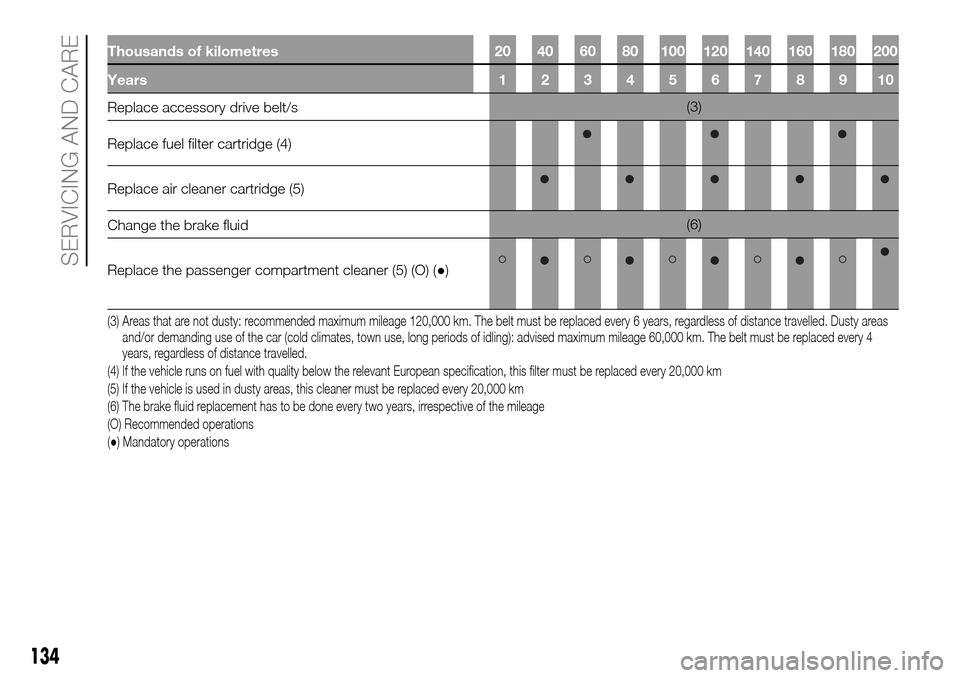
Thousands of kilometres 20 40 60 80 100 120 140 160 180 200
Years12345678910
Replace accessory drive belt/s(3)
Replace fuel filter cartridge (4)
Replace air cleaner cartridge (5)
Change the brake fluid(6)
Replace the passenger compartment cleaner (5) (O) (●)
(3) Areas that are not dusty: recommended maximum mileage 120,000 km. The belt must be replaced every 6 years, regardless of distance travelled. Dustyareas
and/or demanding use of the car (cold climates, town use, long periods of idling): advised maximum mileage 60,000 km. The belt must be replaced every 4
years, regardless of distance travelled.
(4) If the vehicle runs on fuel with quality below the relevant European specification, this filter must be replaced every 20,000 km
(5) If the vehicle is used in dusty areas, this cleaner must be replaced every 20,000 km
(6) The brake fluid replacement has to be done every two years, irrespective of the mileage
(O) Recommended operations
(●) Mandatory operations
134
SERVICING AND CARE