esp FIAT PANDA 2017 319 / 3.G Owner's Manual
[x] Cancel search | Manufacturer: FIAT, Model Year: 2017, Model line: PANDA, Model: FIAT PANDA 2017 319 / 3.GPages: 216, PDF Size: 19.25 MB
Page 108 of 216
HAZARD WARNING
LIGHTS
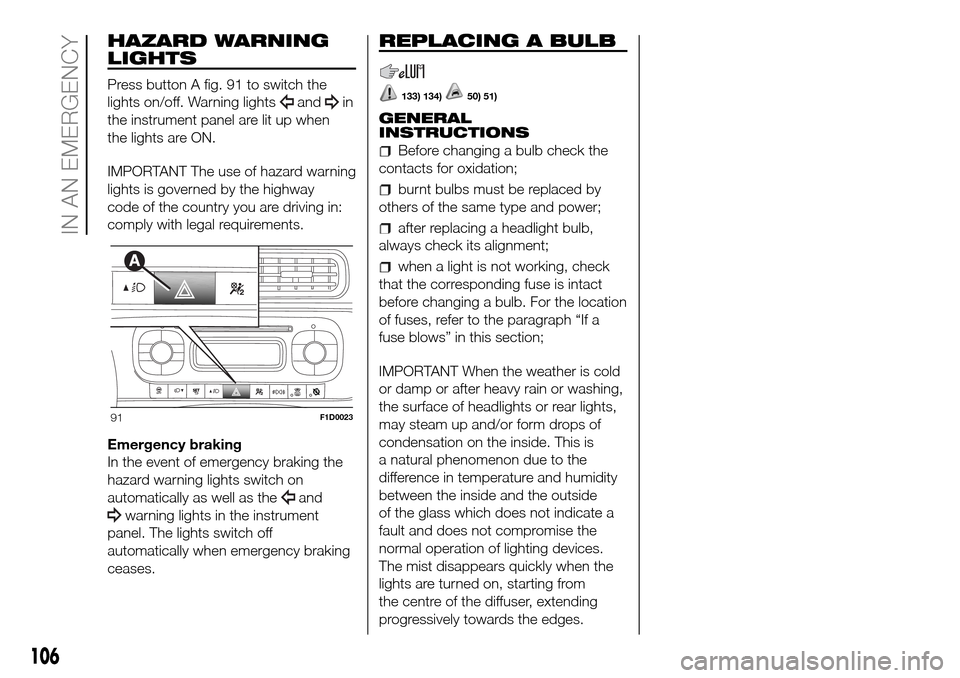
Press button A fig. 91 to switch the
lights on/off. Warning lights
andin
the instrument panel are lit up when
the lights are ON.
IMPORTANT The use of hazard warning
lights is governed by the highway
code of the country you are driving in:
comply with legal requirements.
Emergency braking
In the event of emergency braking the
hazard warning lights switch on
automatically as well as the
and
warning lights in the instrument
panel. The lights switch off
automatically when emergency braking
ceases.
REPLACING A BULB
133) 134)50) 51)
GENERAL
INSTRUCTIONS
Before changing a bulb check the
contacts for oxidation;
burnt bulbs must be replaced by
others of the same type and power;
after replacing a headlight bulb,
always check its alignment;
when a light is not working, check
that the corresponding fuse is intact
before changing a bulb. For the location
of fuses, refer to the paragraph “If a
fuse blows” in this section;
IMPORTANT When the weather is cold
or damp or after heavy rain or washing,
the surface of headlights or rear lights,
may steam up and/or form drops of
condensation on the inside. This is
a natural phenomenon due to the
difference in temperature and humidity
between the inside and the outside
of the glass which does not indicate a
fault and does not compromise the
normal operation of lighting devices.
The mist disappears quickly when the
lights are turned on, starting from
the centre of the diffuser, extending
progressively towards the edges.
91F1D0023
106
IN AN EMERGENCY
Page 113 of 216
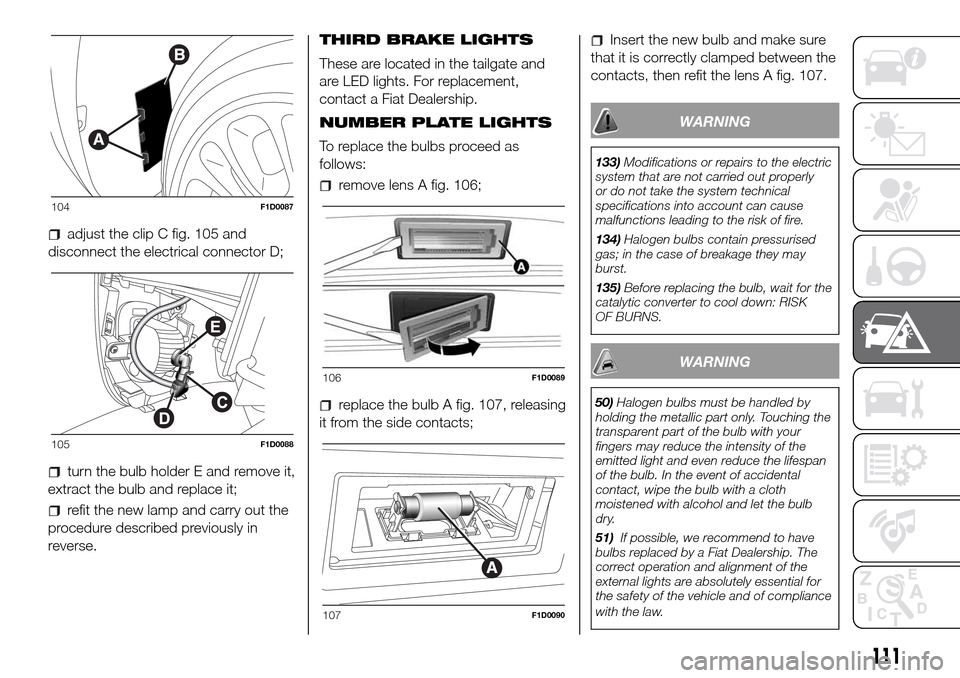
adjust the clip C fig. 105 and
disconnect the electrical connector D;
turn the bulb holder E and remove it,
extract the bulb and replace it;
refit the new lamp and carry out the
procedure described previously in
reverse.THIRD BRAKE LIGHTS
These are located in the tailgate and
are LED lights. For replacement,
contact a Fiat Dealership.
NUMBER PLATE LIGHTS
To replace the bulbs proceed as
follows:
remove lens A fig. 106;
replace the bulb A fig. 107, releasing
it from the side contacts;
Insert the new bulb and make sure
that it is correctly clamped between the
contacts, then refit the lens A fig. 107.
WARNING
133)Modifications or repairs to the electric
system that are not carried out properly
or do not take the system technical
specifications into account can cause
malfunctions leading to the risk of fire.
134)Halogen bulbs contain pressurised
gas; in the case of breakage they may
burst.
135)Before replacing the bulb, wait for the
catalytic converter to cool down: RISK
OF BURNS.
WARNING
50)Halogen bulbs must be handled by
holding the metallic part only. Touching the
transparent part of the bulb with your
fingers may reduce the intensity of the
emitted light and even reduce the lifespan
of the bulb. In the event of accidental
contact, wipe the bulb with a cloth
moistened with alcohol and let the bulb
dry.
51)If possible, we recommend to have
bulbs replaced by a Fiat Dealership. The
correct operation and alignment of the
external lights are absolutely essential for
the safety of the vehicle and of compliance
with the law.
104F1D0087
105F1D0088
106F1D0089
107F1D0090
111
Page 114 of 216
REPLACING FUSES
136) 137) 138) 139) 140) 141)
52)
GENERAL INFORMATION
To facilitate fuse replacement, use the
pliers hooked inside the fuse box lid on
the dashboard left-hand side.
ENGINE COMPARTMENT
JUNCTION BOX
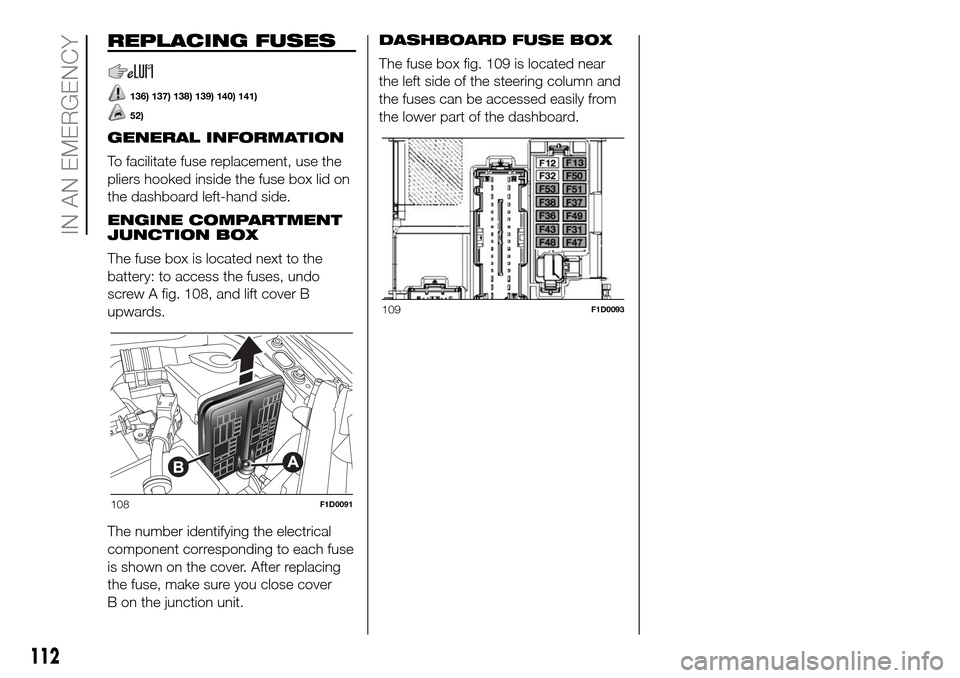
The fuse box is located next to the
battery: to access the fuses, undo
screw A fig. 108, and lift cover B
upwards.
The number identifying the electrical
component corresponding to each fuse
is shown on the cover. After replacing
the fuse, make sure you close cover
B on the junction unit.DASHBOARD FUSE BOX
The fuse box fig. 109 is located near
the left side of the steering column and
the fuses can be accessed easily from
the lower part of the dashboard.
108F1D0091
109F1D0093
112
IN AN EMERGENCY
Page 119 of 216
REFITTING THE
STANDARD WHEEL
54)Following the procedure described
previously, raise the vehicle and remove
the space-saver wheel.
Versions with steel wheels
Proceed as follows:
make sure the contact surfaces
between standard wheel and hub are
clean so that the fastening bolts will not
come loose;
fit the standard wheel by inserting
the first bolt by 2 threads into the hole
closest to the inflation valve;
fit the hub cap, aligning the crescent
hole with the bolt already fitted, then
fit the other bolts;
using the wrench provided, tighten
the fastening bolts;
lower the vehicle and remove the
jack;
use the wrench provided to fully
tighten the bolts, passing alternately
from one bolt to the opposite one.
Versions with alloy wheels
Proceed as follows:
insert the wheel on the hub and
using the wrench provided tighten the
bolts;
lower the vehicle and remove the
jack;
use the wrench provided to fully
tighten the bolts, passing alternately
from one bolt to the opposite one.
reinsert the press-fitted hub cap,
making sure that the reference hole on
the wheel is aligned with the reference
pin on the cap.
IMPORTANT If it is not fitted properly,
the hub cap may detach itself when the
vehicle is running.
At the end of operation
stow the space-saver wheel in the
compartment provided in the luggage
compartment;
insert the jack and the other tools in
the container;
arrange the container and tools on
the space-saver wheel;
correctly reposition the boot mat.
WARNING
142)The space-saver wheel (for
versions/markets where provided) is
specific to your car, do not use it on other
models, or use the space-saver wheel
of other models on your car. The
space-saver wheel must only be used in
the event of an emergency. Never use it for
more than strictly necessary and never
exceed 80 km/h. On the space-saver
wheel there is an orange label,
summarising the main warnings regarding
space-saver wheel usage restrictions.
Never remove or cover the label. The label
contains the following indications in four
languages: "Warning! For temporary use
only! 80 km/h max! Replace with standard
wheel as soon as possible. Never cover
this indication." Never apply a wheel cap
on a space-saver wheel.
143)Alert other drivers that the car is
stationary in compliance with local
regulations: hazard warning lights, warning
triangle, etc. Any passengers on board
should leave the car, especially if it is
heavily laden. Passengers should stay
away from on-coming traffic while the
wheel is being changed. On hills or uneven
roads, use chocks or appropriate objects
to block the wheels of the vehicle.
117
Page 133 of 216
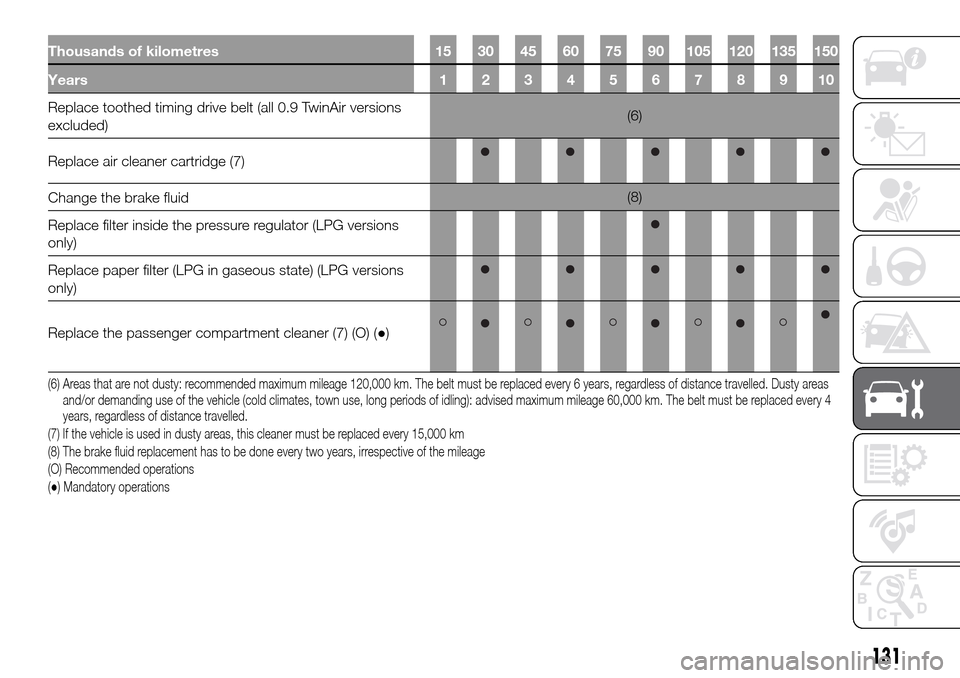
Thousands of kilometres 15 30 45 60 75 90 105 120 135 150
Years12345678910
Replace toothed timing drive belt (all 0.9 TwinAir versions
excluded)(6)
Replace air cleaner cartridge (7)
Change the brake fluid(8)
Replace filter inside the pressure regulator (LPG versions
only)
Replace paper filter (LPG in gaseous state) (LPG versions
only)
Replace the passenger compartment cleaner (7) (O) (●)
(6) Areas that are not dusty: recommended maximum mileage 120,000 km. The belt must be replaced every 6 years, regardless of distance travelled. Dustyareas
and/or demanding use of the vehicle (cold climates, town use, long periods of idling): advised maximum mileage 60,000 km. The belt must be replaced every 4
years, regardless of distance travelled.
(7) If the vehicle is used in dusty areas, this cleaner must be replaced every 15,000 km
(8) The brake fluid replacement has to be done every two years, irrespective of the mileage
(O) Recommended operations
(●) Mandatory operations
131
Page 136 of 216
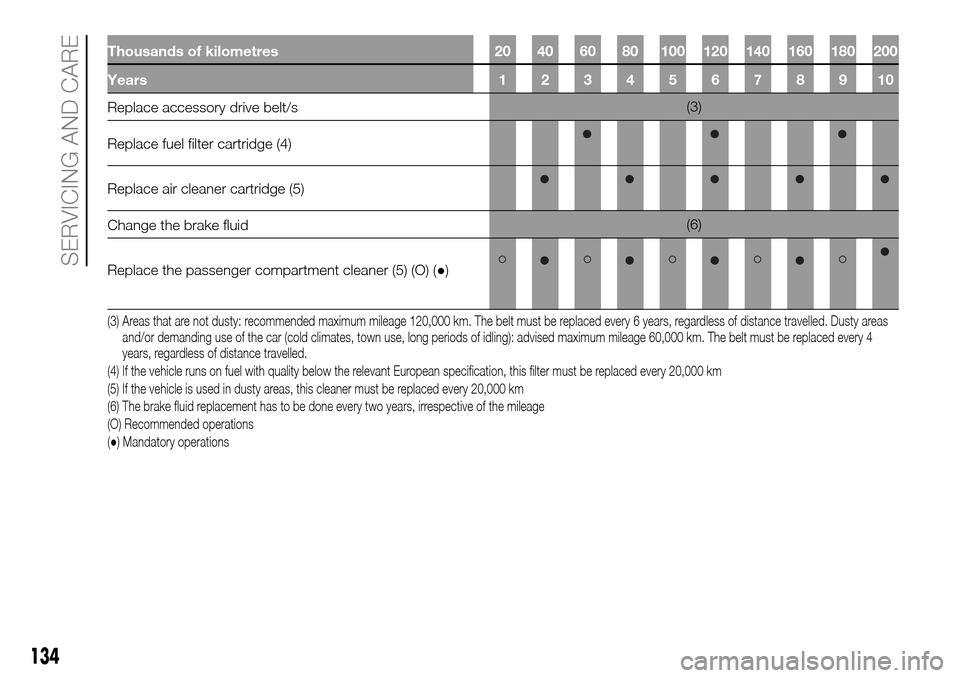
Thousands of kilometres 20 40 60 80 100 120 140 160 180 200
Years12345678910
Replace accessory drive belt/s(3)
Replace fuel filter cartridge (4)
Replace air cleaner cartridge (5)
Change the brake fluid(6)
Replace the passenger compartment cleaner (5) (O) (●)
(3) Areas that are not dusty: recommended maximum mileage 120,000 km. The belt must be replaced every 6 years, regardless of distance travelled. Dustyareas
and/or demanding use of the car (cold climates, town use, long periods of idling): advised maximum mileage 60,000 km. The belt must be replaced every 4
years, regardless of distance travelled.
(4) If the vehicle runs on fuel with quality below the relevant European specification, this filter must be replaced every 20,000 km
(5) If the vehicle is used in dusty areas, this cleaner must be replaced every 20,000 km
(6) The brake fluid replacement has to be done every two years, irrespective of the mileage
(O) Recommended operations
(●) Mandatory operations
134
SERVICING AND CARE
Page 143 of 216
WARNING
158)Never smoke while working in the
engine compartment: gas and inflammable
vapours may be present, with the risk of
fire.
159)Be very careful when working in the
engine compartment when the engine
is hot: you may get burned.
160)The cooling system is pressurised. If
necessary, only replace the plug with
another original or the operation of the
system may be adversely affected. Do not
remove the reservoir plug when the engine
is hot: you risk scalding yourself.
161)Do not travel with the windscreen
washer fluid reservoir empty: the
windscreen washer is essential for
improving visibility. Some commercial
windscreen washer additives are
flammable. The engine compartment
contains hot components which may set it
on fire.
162)Brake fluid is poisonous and highly
corrosive. In the event of accidental
contact, immediately wash the affected
parts with water and mild soap. Then rinse
thoroughly. Call a doctor immediately if
swallowed.
163)The symbol
, on the brake fluid
container indicates if a brake fluid is
synthetic or mineralbased. Use of mineral
type fluids will damage the special rubber
seals of the braking system beyond repair.164)Battery fluid is poisonous and
corrosive. Avoid contact with the skin and
eyes. Keep naked flames and sources
of sparks away from the battery: risk of
explosion and fire.
165)Using the battery with insufficient
fluid irreparably damages the battery and
may cause an explosion.
166)If the car will be unused for an
extended period of time in extremely cold
weather conditions, remove the battery
and store it in a heated area to avoid
it freezing.
167)Always wear appropriate goggles
when working on or near the battery.
WARNING
59)Be careful not to confuse the various
types of fluids while topping up: they
are not compatible with each other!
Topping up with an unsuitable fluid could
severely damage your vehicle.
60)The oil level must never exceed the
MAX reference.
61)Do not add oil with specifications other
than those of the oil already existing in
the engine.
62)PARAFLU
UPantifreeze is used in the
engine cooling system. Use the same fluid
as in the cooling system when topping
up. PARAFLU
UPcannot be mixed with any
other type of fluid. If this occurs, do not
start the engine and contact your Fiat
Dealership immediately.63)Prevent brake fluid, which is highly
corrosive, from coming into contact with
painted parts. Should it happen,
immediately wash with water.
64)Incorrect installation of electric and
electronic devices may cause severe
damage to your car. After purchasing your
vehicle, if you wish to install any
accessories (anti-theft, phone, etc.),
contact a Fiat Dealership, which
will suggest the most appropriate devices
for your vehicle, and will, most importantly,
advise you if a higher capacity battery
needs to be installed.
WARNING
3)Used engine oil and oil filters contain
substances which are harmful to the
environment. To change the oil and filters,
we advise you to contact a Fiat Dealership.
4)Used transmission fluid contains
substances that are harmful to the
environment. It is advisable to have the oil
changed by a Fiat Dealership where it
will be disposed of respecting the
environment and according to legal
requirements.
5)Batteries contain substances which are
very dangerous for the environment. For
battery replacement, contact a Fiat
Dealership.
141
Page 148 of 216
IDENTIFICATION
DATA
VEHICLE IDENTIFICATION
NUMBER (VIN) PLATE
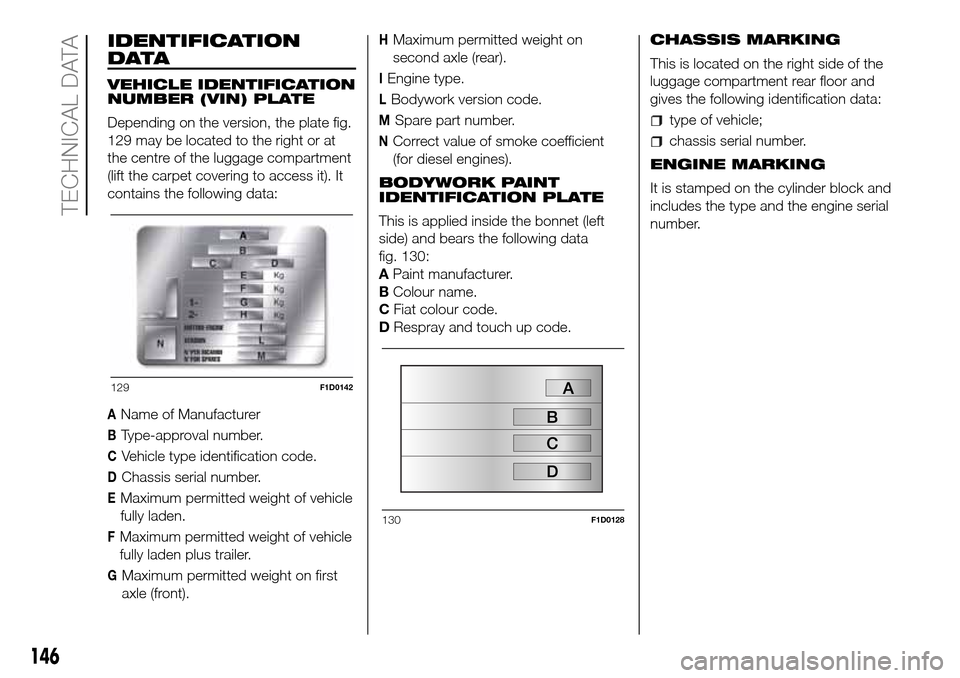
Depending on the version, the plate fig.
129 may be located to the right or at
the centre of the luggage compartment
(lift the carpet covering to access it). It
contains the following data:
AName of Manufacturer
BType-approval number.
CVehicle type identification code.
DChassis serial number.
EMaximum permitted weight of vehicle
fully laden.
FMaximum permitted weight of vehicle
fully laden plus trailer.
GMaximum permitted weight on first
axle (front).
HMaximum permitted weight on
second axle (rear).
IEngine type.
LBodywork version code.
MSpare part number.
NCorrect value of smoke coefficient
(for diesel engines).
BODYWORK PAINT
IDENTIFICATION PLATE
This is applied inside the bonnet (left
side) and bears the following data
fig. 130:
APaint manufacturer.
BColour name.
CFiat colour code.
DRespray and touch up code.CHASSIS MARKING
This is located on the right side of the
luggage compartment rear floor and
gives the following identification data:
type of vehicle;
chassis serial number.
ENGINE MARKING
It is stamped on the cylinder block and
includes the type and the engine serial
number.
129F1D0142
130F1D0128
146
TECHNICAL DATA
Page 149 of 216
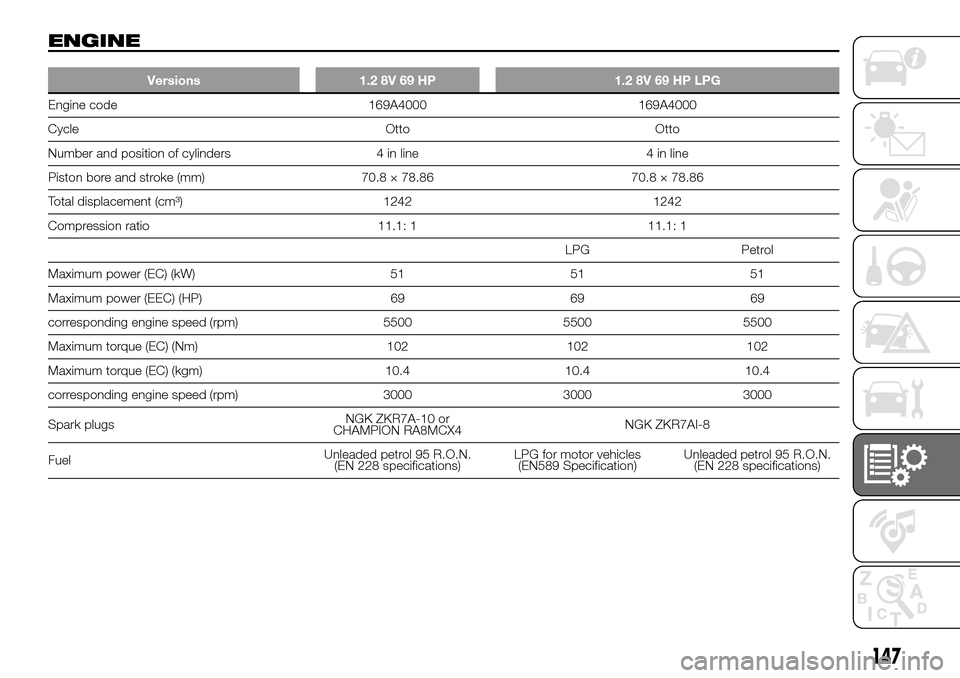
ENGINE
Versions 1.2 8V 69 HP 1.2 8V 69 HP LPG
Engine code 169A4000 169A4000
Cycle Otto Otto
Number and position of cylinders 4 in line 4 in line
Piston bore and stroke (mm) 70.8 × 78.86 70.8 × 78.86
Total displacement (cm³) 1242 1242
Compression ratio 11.1: 1 11.1: 1
LPG Petrol
Maximum power (EC) (kW) 51 51 51
Maximum power (EEC) (HP) 69 69 69
corresponding engine speed (rpm) 5500 5500 5500
Maximum torque (EC) (Nm) 102 102 102
Maximum torque (EC) (kgm) 10.4 10.4 10.4
corresponding engine speed (rpm) 3000 3000 3000
Spark plugsNGK ZKR7A-10 or
CHAMPION RA8MCX4NGK ZKR7AI-8
FuelUnleaded petrol 95 R.O.N.
(EN 228 specifications)LPG for motor vehicles
(EN589 Specification)Unleaded petrol 95 R.O.N.
(EN 228 specifications)
147
Page 150 of 216
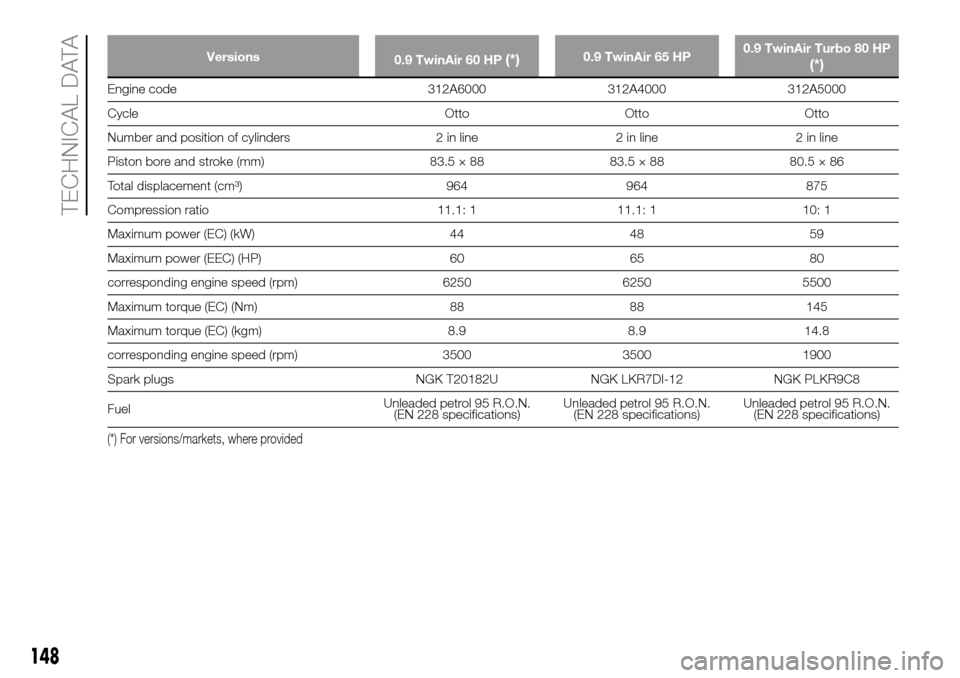
Versions
0.9 TwinAir 60 HP(*)0.9 TwinAir 65 HP0.9 TwinAir Turbo 80 HP(*)
Engine code 312A6000 312A4000 312A5000
Cycle Otto Otto Otto
Number and position of cylinders 2 in line 2 in line 2 in line
Piston bore and stroke (mm) 83.5 × 88 83.5 × 88 80.5 × 86
Total displacement (cm³) 964 964 875
Compression ratio 11.1: 1 11.1: 1 10: 1
Maximum power (EC) (kW) 44 48 59
Maximum power (EEC) (HP) 60 65 80
corresponding engine speed (rpm) 6250 6250 5500
Maximum torque (EC) (Nm) 88 88 145
Maximum torque (EC) (kgm) 8.9 8.9 14.8
corresponding engine speed (rpm) 3500 3500 1900
Spark plugs NGK T20182U NGK LKR7DI-12 NGK PLKR9C8
FuelUnleaded petrol 95 R.O.N.
(EN 228 specifications)Unleaded petrol 95 R.O.N.
(EN 228 specifications)Unleaded petrol 95 R.O.N.
(EN 228 specifications)
(*) For versions/markets, where provided
148
TECHNICAL DATA