seats FIAT PANDA 2018 Owner handbook (in English)
[x] Cancel search | Manufacturer: FIAT, Model Year: 2018, Model line: PANDA, Model: FIAT PANDA 2018Pages: 228, PDF Size: 17.05 MB
Page 80 of 228
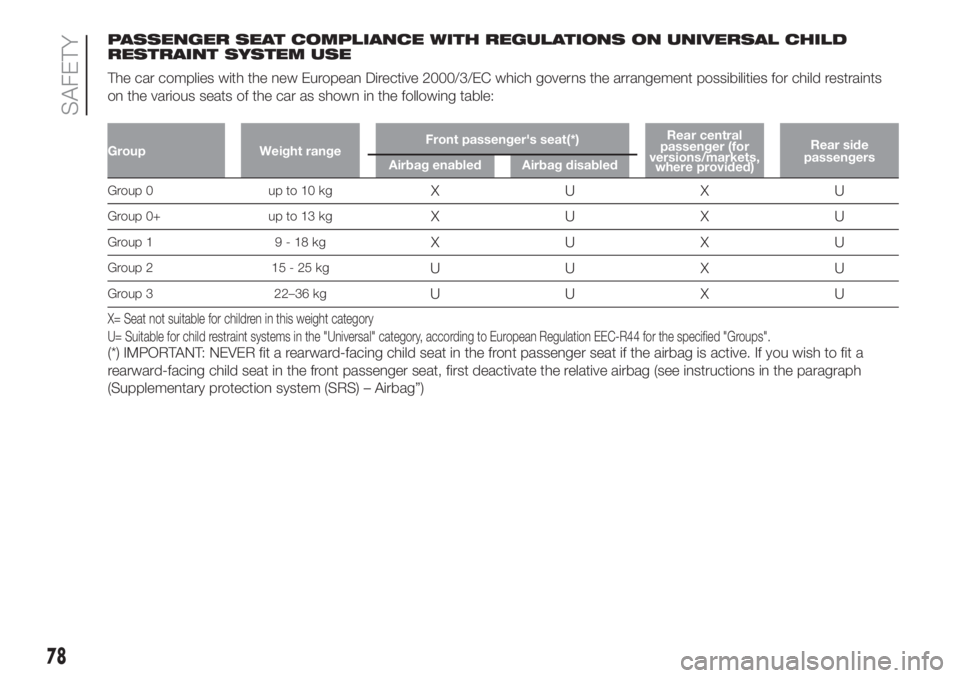
PASSENGER SEAT COMPLIANCE WITH REGULATIONS ON UNIVERSAL CHILD
RESTRAINT SYSTEM USE
The car complies with the new European Directive 2000/3/EC which governs the arrangement possibilities for child restraints
on the various seats of the car as shown in the following table:
Group Weight rangeFront passenger's seat(*)Rear central
passenger (for
versions/markets,
where provided)Rear side
passengers
Airbag enabled Airbag disabled
Group0 upto10kgXUXU
Group 0+ up to 13 kgXUXU
Group 1 9 - 18 kgXUXU
Group 2 15 - 25 kgUUXU
Group 3 22–36 kgUUXU
X= Seat not suitable for children in this weight category
U= Suitable for child restraint systems in the "Universal" category, according to European Regulation EEC-R44 for the specified "Groups".
(*) IMPORTANT: NEVER fit a rearward-facing child seat in the front passenger seat if the airbag is active. If you wish to fit a
rearward-facing child seat in the front passenger seat, first deactivate the relative airbag (see instructions in the paragraph
(Supplementary protection system (SRS) – Airbag”)
78
SAFETY
Page 81 of 228
INSTALLING AN ISOFIX
CHILD CARSEAT
95) 96) 97) 98)
The outer rear seats of the vehicle are
equipped with ISOFIX anchorages,
a European standard which makes
fitting a child restraint system quick,
simple and safe.
The ISOFIX system lets you install the
ISOFIX child restraining system without
using the car seat belts but connecting
them directly to the carseat with three
anchors in the car. Traditional child
restraint systems can be fitted
alongside ISOFIX child restraint systems
on different seats in the same vehicle.
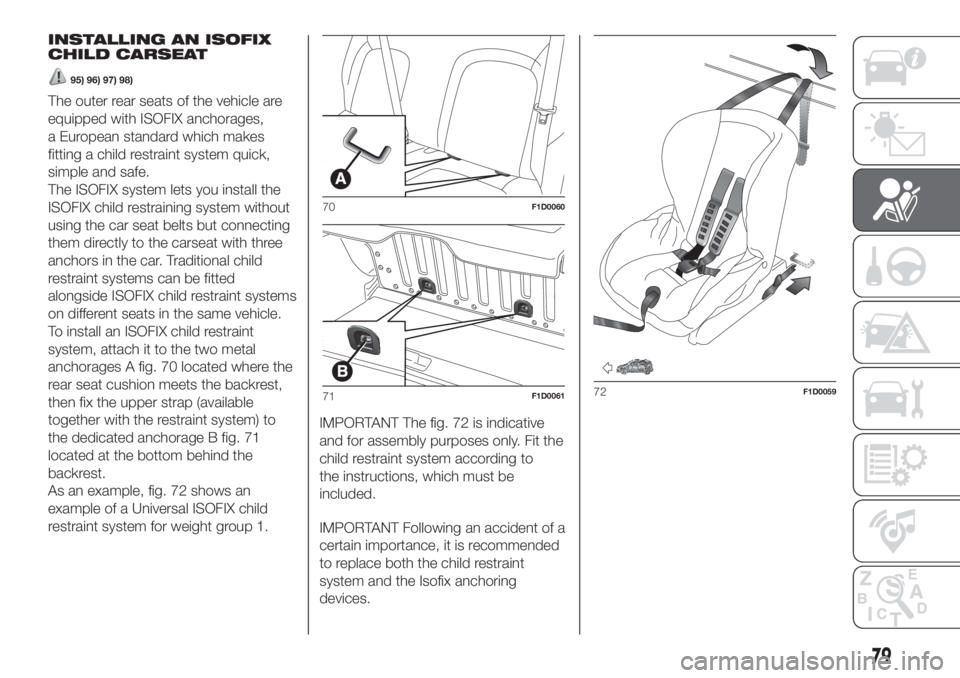
To install an ISOFIX child restraint
system, attach it to the two metal
anchorages A fig. 70 located where the
rear seat cushion meets the backrest,
then fix the upper strap (available
together with the restraint system) to
the dedicated anchorage B fig. 71
located at the bottom behind the
backrest.
As an example, fig. 72 shows an
example of a Universal ISOFIX child
restraint system for weight group 1.IMPORTANT The fig. 72 is indicative
and for assembly purposes only. Fit the
child restraint system according to
the instructions, which must be
included.
IMPORTANT Following an accident of a
certain importance, it is recommended
to replace both the child restraint
system and the Isofix anchoring
devices.
70F1D0060
71F1D006172F1D0059
79
Page 82 of 228
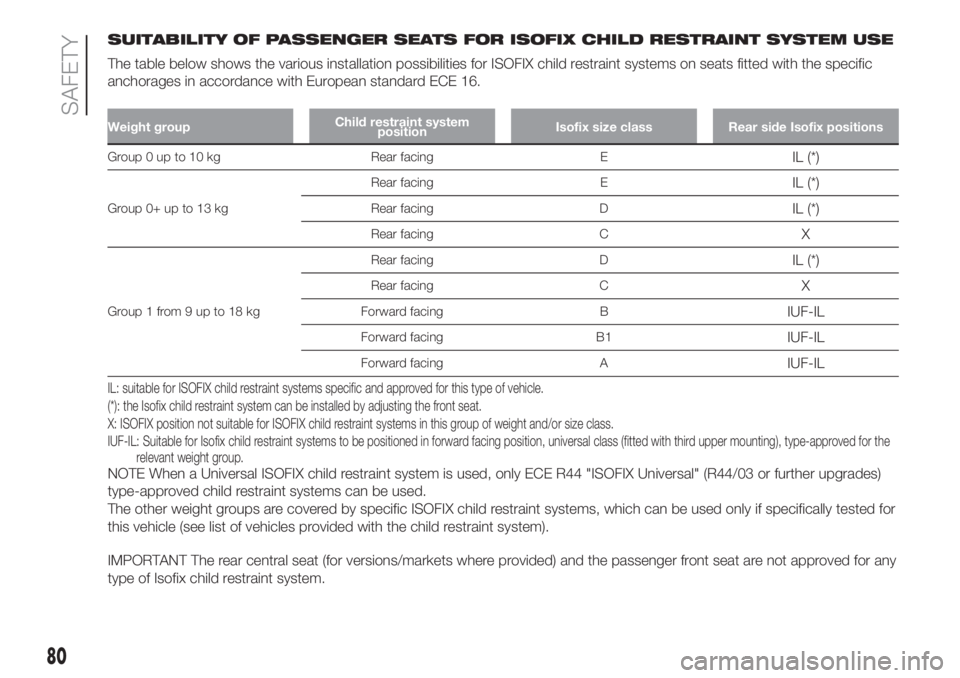
SUITABILITY OF PASSENGER SEATS FOR ISOFIX CHILD RESTRAINT SYSTEM USE
The table below shows the various installation possibilities for ISOFIX child restraint systems on seats fitted with the specific
anchorages in accordance with European standard ECE 16.
Weight groupChild restraint system
positionIsofix size class Rear side Isofix positions
Group 0 up to 10 kg Rear facing EIL (*)
Group 0+ up to 13 kgRear facing E
IL (*)
Rear facing DIL (*)
Rear facing CX
Group1from9upto18kgRear facing D
IL (*)
Rear facing CX
Forward facing BIUF-IL
Forward facing B1IUF-IL
Forward facing AIUF-IL
IL: suitable for ISOFIX child restraint systems specific and approved for this type of vehicle.
(*): the Isofix child restraint system can be installed by adjusting the front seat.
X: ISOFIX position not suitable for ISOFIX child restraint systems in this group of weight and/or size class.
IUF-IL: Suitable for Isofix child restraint systems to be positioned in forward facing position, universal class (fitted with third upper mounting), type-approved for the
relevant weight group.
NOTE When a Universal ISOFIX child restraint system is used, only ECE R44 "ISOFIX Universal" (R44/03 or further upgrades)
type-approved child restraint systems can be used.
The other weight groups are covered by specific ISOFIX child restraint systems, which can be used only if specifically tested for
this vehicle (see list of vehicles provided with the child restraint system).
IMPORTANT The rear central seat (for versions/markets where provided) and the passenger front seat are not approved for any
type of Isofix child restraint system.
80
SAFETY
Page 83 of 228
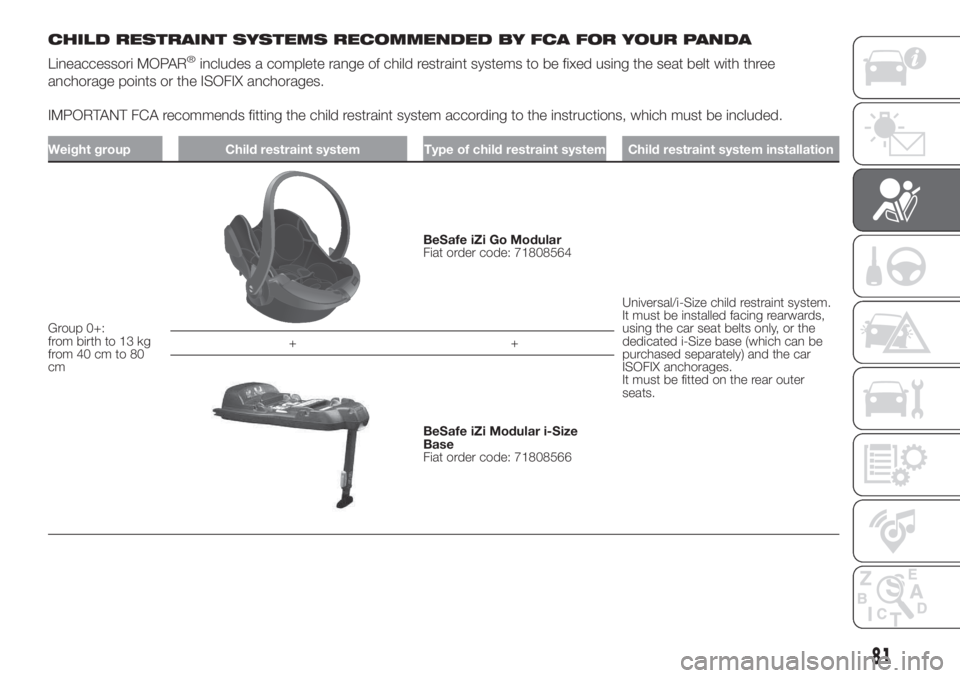
CHILD RESTRAINT SYSTEMS RECOMMENDED BY FCA FOR YOUR PANDA
Lineaccessori MOPAR
®includes a complete range of child restraint systems to be fixed using the seat belt with three
anchorage points or the ISOFIX anchorages.
IMPORTANT FCA recommends fitting the child restraint system according to the instructions, which must be included.
Weight group Child restraint system Type of child restraint system Child restraint system installation
Group 0+:
from birth to 13 kg
from 40 cm to 80
cm
BeSafe iZi Go Modular
Fiat order code: 71808564
Universal/i-Size child restraint system.
It must be installed facing rearwards,
using the car seat belts only, or the
dedicated i-Size base (which can be
purchased separately) and the car
ISOFIX anchorages.
It must be fitted on the rear outer
seats. ++
BeSafe iZi Modular i-Size
Base
Fiat order code: 71808566
81
Page 85 of 228
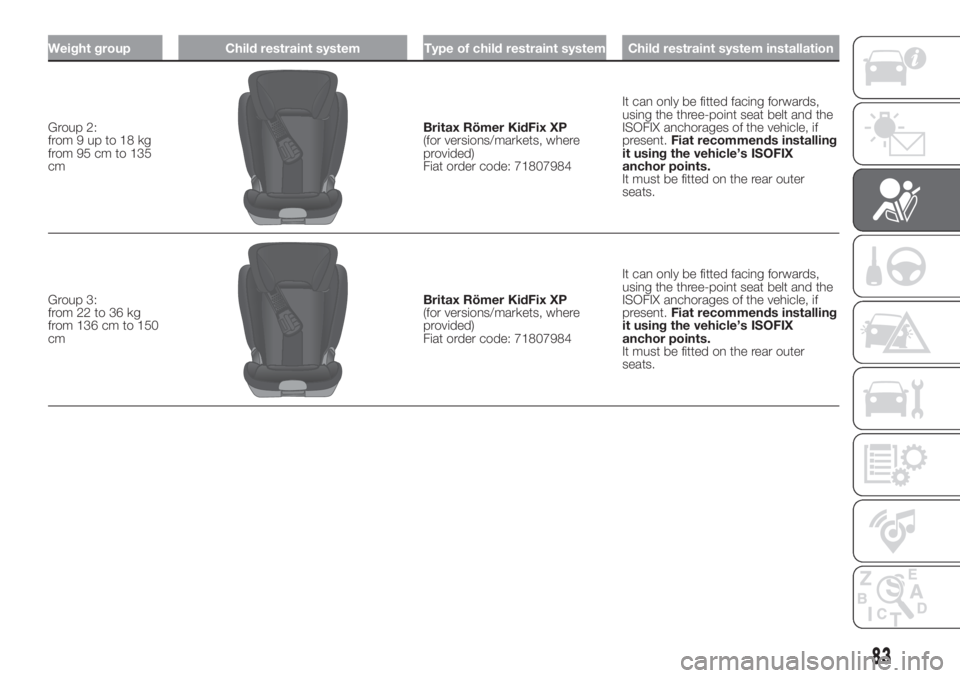
Weight group Child restraint system Type of child restraint system Child restraint system installation
Group 2:
from9upto18kg
from 95 cm to 135
cmBritax Römer KidFix XP
(for versions/markets, where
provided)
Fiat order code: 71807984It can only be fitted facing forwards,
using the three-point seat belt and the
ISOFIX anchorages of the vehicle, if
present.Fiat recommends installing
it using the vehicle’s ISOFIX
anchor points.
It must be fitted on the rear outer
seats.
Group 3:
from 22 to 36 kg
from 136 cm to 150
cm
Britax Römer KidFix XP
(for versions/markets, where
provided)
Fiat order code: 71807984It can only be fitted facing forwards,
using the three-point seat belt and the
ISOFIX anchorages of the vehicle, if
present.Fiat recommends installing
it using the vehicle’s ISOFIX
anchor points.
It must be fitted on the rear outer
seats.
83
Page 86 of 228
Main recommendations to carry
children safely
Install the child restraint systems on
the rear seat, which is the most
protected position in the event of an
impact.
Keep children in rearward facing
child restraint systems for as long as
possible, until 3–4 years old if possible.
Should a rearward facing child
restraint system be installed on the rear
seats, it is advisable to position it as
far forward as the position of the front
seat allows.
If the passenger side front airbag is
deactivated, always check that the
warning light on the central
dashboard is on continuously, to make
sure that it has actually been
deactivated.
Carefully follow the instructions
supplied with the child restraint system.
Keep the instructions in the vehicle
along with the other documents and
this handbook. Do not use second-
hand child seats without instructions.
Only one child is to be strapped into
each restraint system; never carry two
children using one child restraint
system.
Always check that the seat belts do
not rest on the child’s neck.
Always check that the seat belt is
well fastened by pulling on it.
While travelling, do not let the child
sit incorrectly or unfasten the belts.
Never allow a child to put the belt's
diagonal section under an arm or
behind their back.
Never carry children on your lap,
even newborns. No-one can hold
a child in the case of a crash.
If the car has been involved in a
medium-high severity road accident,
replace the child restraint system with a
new one. In addition, and depending
on the type of child restraint system
installed, replace the isofix anchorages
or the seat belt with which the child
restraint system was connected.
Before installing a child restraint
system of any kind on the rear seat
facing in the direction of movement of
the vehicle, it is necessary to remove
the head restraint from the rear seat
position in which the child restraint
system is to be installed. On the other
hand, before installing a child restraint
system composed of only the seat
cushion (without backrest) on the rear
seat, it is necessary to ensure that
the head restraint of the rear seat
position in which the child restraint
system is to be installed is correctly
fitted.
WARNING
88)SEVERE DANGER When a front
passenger airbag is fitted, do not install
rearward facing child restraint systems on
the front passenger seat. Deployment of
the airbag in a crash could cause fatal
injuries to the child regardless of the
severity of the collision. It is advisable to
always carry children in a child restraint
system on the rear seat, which is the most
protected position in the event of a
collision.
89)On the sun visor there is a label with
suitable symbols reminding the user that it
is compulsory to deactivate the airbag if
a rearward facing child restraint system is
fitted. Always comply with the instructions
on the passenger side sun visor (see the
"Supplementary Restraint System (SRS)
- Airbag" paragraph).
90)Should it be necessary to carry a child
on the passenger side front seat in a rear
facing child restraint system, the passenger
side front and side airbags must be
deactivated through the display main
menu, verifying deactivation by checking
that the warning light
located in the
central part of the dashboard has switched
on. Move the passenger's seat as far
back as possible to avoid contact between
the child seat and the dashboard.
91)Do not move the front or rear seat if a
child is seated on it or on the dedicated
child restraint system.
84
SAFETY
Page 91 of 228
SIDE BAGS (Side bag -
Window bag)
To help increase occupants protection
in the event of a side impact, the car
is equipped with front side bags (for
versions/markets, where provided) and
window bag (for versions/markets,
where provided).
Side bags protect occupants from
side-on crashes of medium/high
severity by placing the bag between the
occupant and the internal parts of the
side structure of the vehicle.
Non-activation of side bags in other
types of collisions (front collisions, rear
shunts, roll-overs, etc.) is not a system
malfunction.
Side bags
(for versions/markets, where provided)
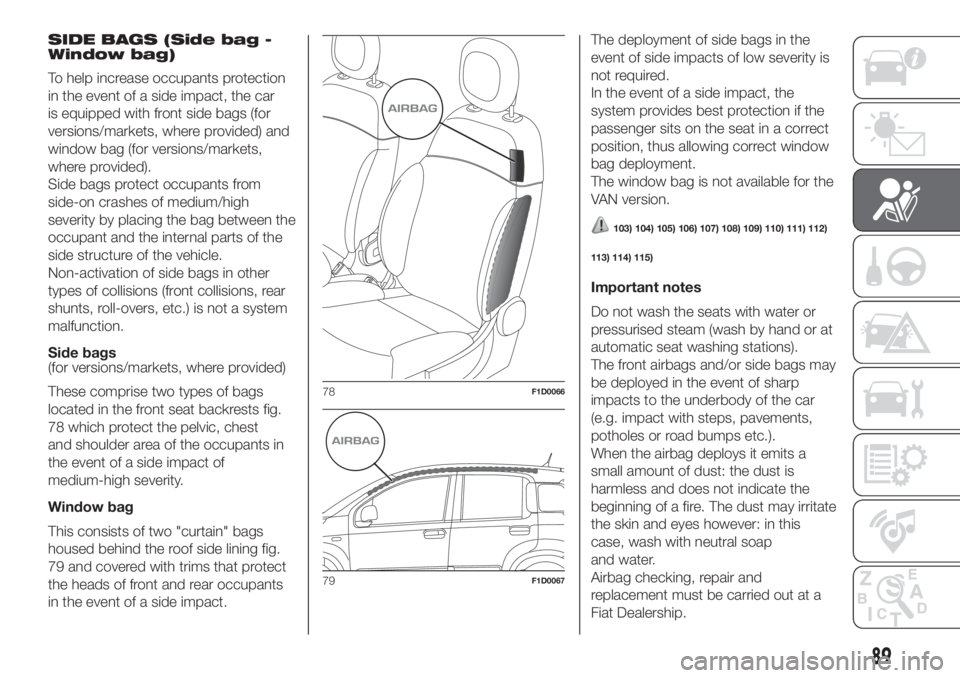
These comprise two types of bags
located in the front seat backrests fig.
78 which protect the pelvic, chest
and shoulder area of the occupants in
the event of a side impact of
medium-high severity.
Window bag
This consists of two "curtain" bags
housed behind the roof side lining fig.
79 and covered with trims that protect
the heads of front and rear occupants
in the event of a side impact.The deployment of side bags in the
event of side impacts of low severity is
not required.
In the event of a side impact, the
system provides best protection if the
passenger sits on the seat in a correct
position, thus allowing correct window
bag deployment.
The window bag is not available for the
VAN version.
103) 104) 105) 106) 107) 108) 109) 110) 111) 112)
113) 114) 115)
Important notes
Do not wash the seats with water or
pressurised steam (wash by hand or at
automatic seat washing stations).
The front airbags and/or side bags may
be deployed in the event of sharp
impacts to the underbody of the car
(e.g. impact with steps, pavements,
potholes or road bumps etc.).
When the airbag deploys it emits a
small amount of dust: the dust is
harmless and does not indicate the
beginning of a fire. The dust may irritate
the skin and eyes however: in this
case, wash with neutral soap
and water.
Airbag checking, repair and
replacement must be carried out at a
Fiat Dealership.
78F1D0066
79F1D0067
89
Page 92 of 228
If the car is scrapped, have the airbag
system deactivated at a Fiat Dealership.
Pretensioners and airbags are
deployed in different ways on the basis
of the type of collision. Failure to
activate one or more of the devices
does not indicate a system malfunction.
WARNING
99)Do not apply stickers or other objects
on the steering wheel, on the dashboard in
the passenger side airbag area, on the
side upholstery on the roof and on the
seats. Never put objects (e.g. mobile
phones) on the passenger's side
dashboard since they could interfere with
correct inflation of the airbag and also
cause serious injury to the passengers.
100)Always drive with your hands on the
rim of the steering wheel so that the airbag
can inflate freely if required. Do not drive
bent over the steering wheel, but rather sit
upright with your back firmly resting against
the seat back.101)When there is an active passenger
airbag, DO NOT install rearward facing
child restraint systems on the front seat.
Deployment of the airbag in a crash could
cause fatal injuries to the child regardless
of the severity of the collision. Therefore,
always deactivate the passenger side
airbag when a rearward facing child
restraint system is installed on the front
passenger seat. The front passenger seat
must also be positioned back as far as
possible in order to prevent the child
restraint system from coming into contact
with the dashboard. Immediately reactivate
the passenger airbag as soon as the child
restraint system has been removed.
102)To deactivate the airbags using the
instrument panel menu, see the description
in the "Knowing the instrument panel"
chapter, "Setup Menu" paragraph.
103)Do not affix rigid objects to the
garment hooks or support handles.
104)Do not rest your head, arms or
elbows on the door, windows or the area in
which the window bag is located to avoid
possible injury during airbag inflation.
105)Never lean your head, arms or
elbows out of the window.
106)If, when the ignition device is turned
to MAR, the
warning light does not
switch on or stays on whilst driving, a fault
may have occurred in the restraint
systems. In this case the airbags or
pretensioners may not be deployed in an
impact or, in a lower number of cases, they
may be deployed accidentally. Contact a
Fiat Dealership immediately to have the
system checked.107)In the event of “yellow”
warning
light failure, the “red”warning light
switches on and, for versions/markets
where provided, the explosive charges of
the passenger airbag and the side bags
are deactivated. When the "red" warning
light is on, before proceeding contact a Fiat
Dealership to have the system immediately
checked (see previous warning).
108)On vehicles with side bags, do not
cover the front seat backrests with extra
covers.
109)Do not travel carrying objects in your
lap, in front of your chest or between
your lips (pipe, pencils, etc.): they could
cause severe injury if the airbag is
deployed.
110)If the car has been stolen or in the
case of attempt to steal it, if it has been
subjected to vandalism or floods, have the
airbag system checked by a Fiat
Dealership.
90
SAFETY
Page 96 of 228
WARNING
116)It is dangerous to run the engine in
enclosed areas. The engine consumes
oxygen and engine exhaust contains
carbon dioxide, carbon monoxide and
other toxic gasses.
117)Remember that the power brake and
electrical power steering are not
operational until the engine is started,
therefore a greater effort will be required to
press the brake pedal or turn the steering
wheel.
118)If the engine fails to start with a gear
engaged, the potentially dangerous
situation due to the fact that the gearbox is
automatically placed in neutral will be
signalled by an acoustic signal.
WARNING
38)If the warning lightflashes for 60
seconds after starting or during an
extended towing period, this indicates a
problem in the glow plug preheating
system. You can use the vehicle as usual if
the engine starts but you should contact
a Fiat Dealership as soon as possible.
39)It is advisable not to demand
maximum performance from your car (e.g.
excessive acceleration, long distances at
maximum rpm, excessively intense braking,
etc.) when it is first used.40)When the engine is switched off never
leave the key turned to MAR-ON to prevent
useless current absorption from draining
the battery.
41)Never bump start the engine by
pushing, towing or coasting downhill. This
could cause fuel to flow into the catalytic
converter and damage it beyond repair.
42)There must therefore always be some
petrol in the tank to protect the petrol
pump and to guarantee temporary
switching from LPG or Methane to petrol
operation, if high performance is required.
43)A quick burst on the accelerator
before turning off the engine serves
absolutely no practical purpose, it wastes
fuel and is especially damaging to
turbocharged engines.
WHEN PARKED
When parking and leaving the car,
proceed as follows:
engage a gear (1stgear if facing
uphill or reverse if facing downhill) and
leave the wheels turned;
stop the engine and engage the
handbrake;
always remove the ignition key.
Block the wheels with a wedge or a
stone if the car is parked on a steep
slope.
On versions equipped with Dualogic
transmission, wait for the letter P to be
displayed before releasing the brake
pedal.
IMPORTANT NEVER leave the car with
the gearbox in neutral (or, on versions
equipped with Dualogic transmission,
before placing the gear lever at P).
Handbrake
199) 200) 201)
The handbrake lever is located between
the front seats.
Handbrake engagement: pull lever A
fig. 80 upwards until the vehicle is
braked.
94
STARTING AND DRIVING
Page 114 of 228
SIDE LIGHTS / DAYTIME
RUNNING LIGHTS (DRL)
(for versions/markets, where provided -
except Panda Cross versions)
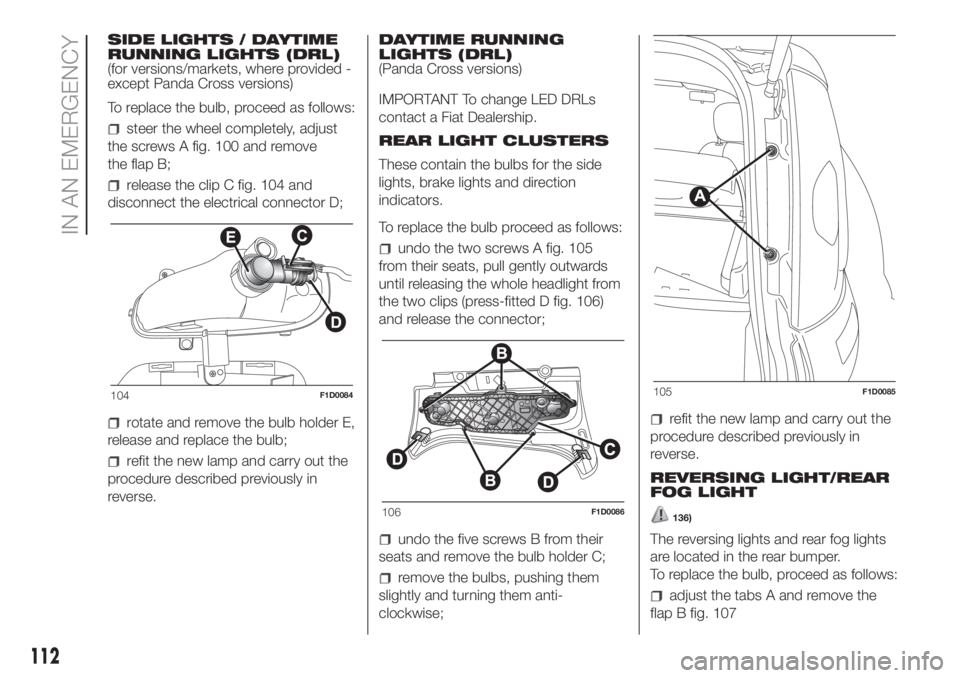
To replace the bulb, proceed as follows:
steer the wheel completely, adjust
the screws A fig. 100 and remove
the flap B;
release the clip C fig. 104 and
disconnect the electrical connector D;
rotate and remove the bulb holder E,
release and replace the bulb;
refit the new lamp and carry out the
procedure described previously in
reverse.DAYTIME RUNNING
LIGHTS (DRL)
(Panda Cross versions)
IMPORTANT To change LED DRLs
contact a Fiat Dealership.
REAR LIGHT CLUSTERS
These contain the bulbs for the side
lights, brake lights and direction
indicators.
To replace the bulb proceed as follows:
undo the two screws A fig. 105
from their seats, pull gently outwards
until releasing the whole headlight from
the two clips (press-fitted D fig. 106)
and release the connector;
undo the five screws B from their
seats and remove the bulb holder C;
remove the bulbs, pushing them
slightly and turning them anti-
clockwise;
refit the new lamp and carry out the
procedure described previously in
reverse.
REVERSING LIGHT/REAR
FOG LIGHT
136)
The reversing lights and rear fog lights
are located in the rear bumper.
To replace the bulb, proceed as follows:
adjust the tabs A and remove the
flap B fig. 107
104F1D0084
106F1D0086
105F1D0085
112
IN AN EMERGENCY