light FIAT PANDA 2018 Owner handbook (in English)
[x] Cancel search | Manufacturer: FIAT, Model Year: 2018, Model line: PANDA, Model: FIAT PANDA 2018Pages: 228, PDF Size: 17.05 MB
Page 112 of 228
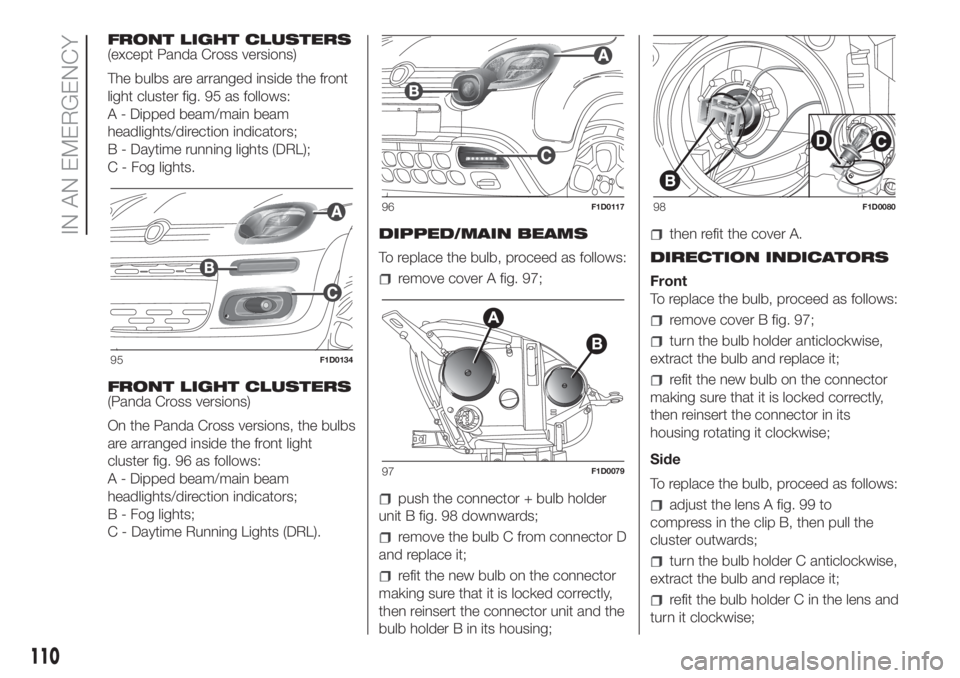
FRONT LIGHT CLUSTERS
(except Panda Cross versions)
The bulbs are arranged inside the front
light cluster fig. 95 as follows:
A - Dipped beam/main beam
headlights/direction indicators;
B - Daytime running lights (DRL);
C - Fog lights.
FRONT LIGHT CLUSTERS
(Panda Cross versions)
On the Panda Cross versions, the bulbs
are arranged inside the front light
cluster fig. 96 as follows:
A - Dipped beam/main beam
headlights/direction indicators;
B - Fog lights;
C - Daytime Running Lights (DRL).DIPPED/MAIN BEAMS
To replace the bulb, proceed as follows:
remove cover A fig. 97;
push the connector + bulb holder
unit B fig. 98 downwards;
remove the bulb C from connector D
and replace it;
refit the new bulb on the connector
making sure that it is locked correctly,
then reinsert the connector unit and the
bulb holder B in its housing;
then refit the cover A.
DIRECTION INDICATORS
Front
To replace the bulb, proceed as follows:
remove cover B fig. 97;
turn the bulb holder anticlockwise,
extract the bulb and replace it;
refit the new bulb on the connector
making sure that it is locked correctly,
then reinsert the connector in its
housing rotating it clockwise;
Side
To replace the bulb, proceed as follows:
adjust the lens A fig. 99 to
compress in the clip B, then pull the
cluster outwards;
turn the bulb holder C anticlockwise,
extract the bulb and replace it;
refit the bulb holder C in the lens and
turn it clockwise;
95F1D0134
96F1D0117
97F1D0079
98F1D0080
110
IN AN EMERGENCY
Page 113 of 228
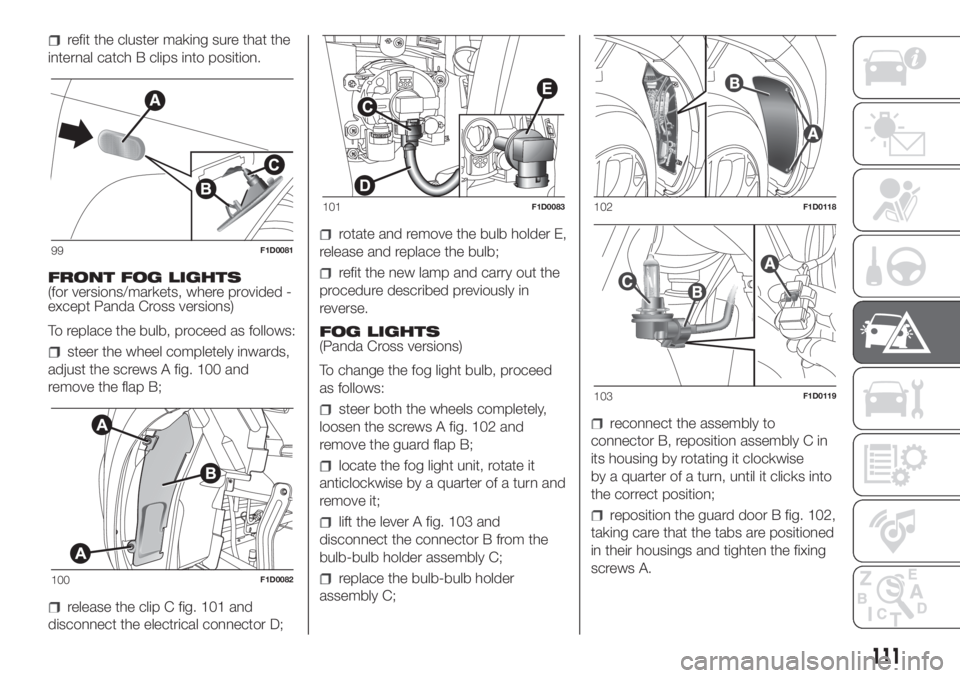
refit the cluster making sure that the
internal catch B clips into position.
FRONT FOG LIGHTS
(for versions/markets, where provided -
except Panda Cross versions)
To replace the bulb, proceed as follows:
steer the wheel completely inwards,
adjust the screws A fig. 100 and
remove the flap B;
release the clip C fig. 101 and
disconnect the electrical connector D;
rotate and remove the bulb holder E,
release and replace the bulb;
refit the new lamp and carry out the
procedure described previously in
reverse.
FOG LIGHTS
(Panda Cross versions)
To change the fog light bulb, proceed
as follows:
steer both the wheels completely,
loosen the screws A fig. 102 and
remove the guard flap B;
locate the fog light unit, rotate it
anticlockwise by a quarter of a turn and
remove it;
lift the lever A fig. 103 and
disconnect the connector B from the
bulb-bulb holder assembly C;
replace the bulb-bulb holder
assembly C;
reconnect the assembly to
connector B, reposition assembly C in
its housing by rotating it clockwise
by a quarter of a turn, until it clicks into
the correct position;
reposition the guard door B fig. 102,
taking care that the tabs are positioned
in their housings and tighten the fixing
screws A.
99F1D0081
100F1D0082
101F1D0083102F1D0118
103F1D0119
111
Page 114 of 228
SIDE LIGHTS / DAYTIME
RUNNING LIGHTS (DRL)
(for versions/markets, where provided -
except Panda Cross versions)
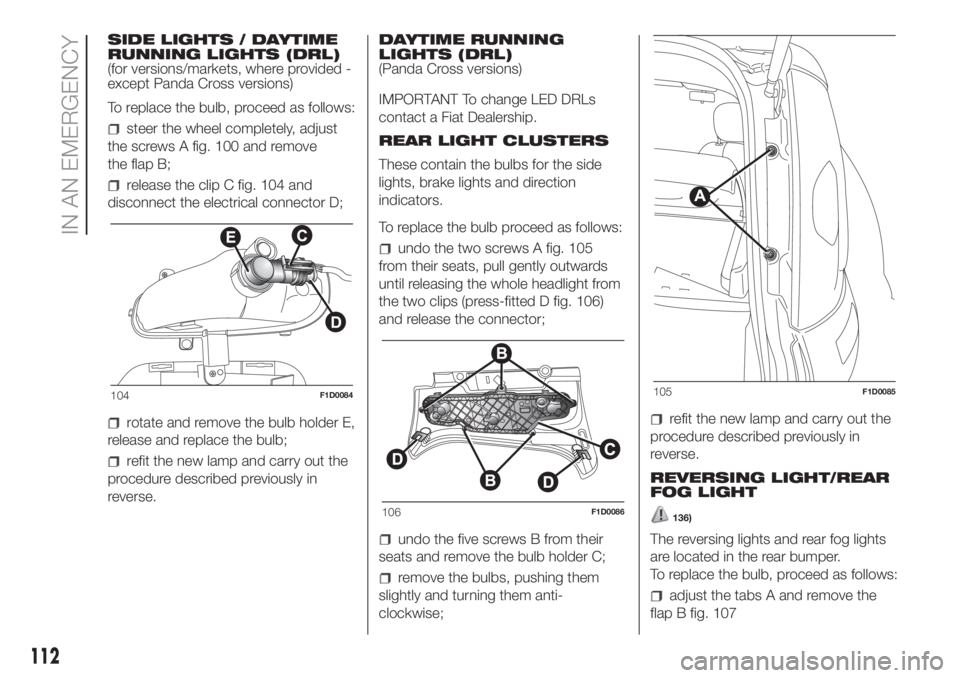
To replace the bulb, proceed as follows:
steer the wheel completely, adjust
the screws A fig. 100 and remove
the flap B;
release the clip C fig. 104 and
disconnect the electrical connector D;
rotate and remove the bulb holder E,
release and replace the bulb;
refit the new lamp and carry out the
procedure described previously in
reverse.DAYTIME RUNNING
LIGHTS (DRL)
(Panda Cross versions)
IMPORTANT To change LED DRLs
contact a Fiat Dealership.
REAR LIGHT CLUSTERS
These contain the bulbs for the side
lights, brake lights and direction
indicators.
To replace the bulb proceed as follows:
undo the two screws A fig. 105
from their seats, pull gently outwards
until releasing the whole headlight from
the two clips (press-fitted D fig. 106)
and release the connector;
undo the five screws B from their
seats and remove the bulb holder C;
remove the bulbs, pushing them
slightly and turning them anti-
clockwise;
refit the new lamp and carry out the
procedure described previously in
reverse.
REVERSING LIGHT/REAR
FOG LIGHT
136)
The reversing lights and rear fog lights
are located in the rear bumper.
To replace the bulb, proceed as follows:
adjust the tabs A and remove the
flap B fig. 107
104F1D0084
106F1D0086
105F1D0085
112
IN AN EMERGENCY
Page 115 of 228
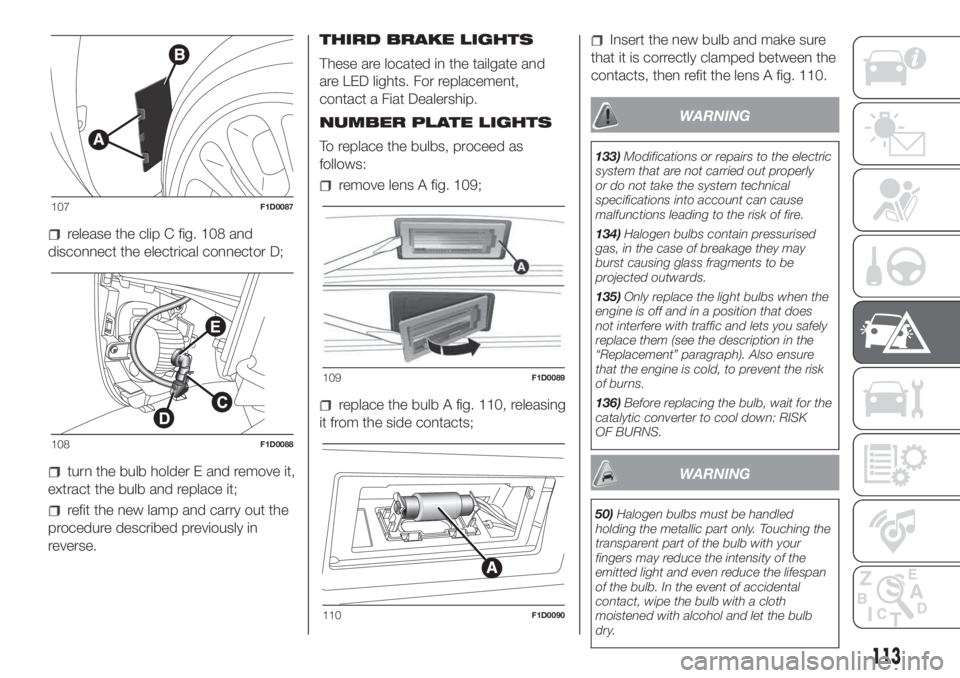
release the clip C fig. 108 and
disconnect the electrical connector D;
turn the bulb holder E and remove it,
extract the bulb and replace it;
refit the new lamp and carry out the
procedure described previously in
reverse.THIRD BRAKE LIGHTS
These are located in the tailgate and
are LED lights. For replacement,
contact a Fiat Dealership.
NUMBER PLATE LIGHTS
To replace the bulbs, proceed as
follows:
remove lens A fig. 109;
replace the bulb A fig. 110, releasing
it from the side contacts;
Insert the new bulb and make sure
that it is correctly clamped between the
contacts, then refit the lens A fig. 110.
WARNING
133)Modifications or repairs to the electric
system that are not carried out properly
or do not take the system technical
specifications into account can cause
malfunctions leading to the risk of fire.
134)Halogen bulbs contain pressurised
gas, in the case of breakage they may
burst causing glass fragments to be
projected outwards.
135)Only replace the light bulbs when the
engine is off and in a position that does
not interfere with traffic and lets you safely
replace them (see the description in the
“Replacement” paragraph). Also ensure
that the engine is cold, to prevent the risk
of burns.
136)Before replacing the bulb, wait for the
catalytic converter to cool down: RISK
OF BURNS.
WARNING
50)Halogen bulbs must be handled
holding the metallic part only. Touching the
transparent part of the bulb with your
fingers may reduce the intensity of the
emitted light and even reduce the lifespan
of the bulb. In the event of accidental
contact, wipe the bulb with a cloth
moistened with alcohol and let the bulb
dry.
107F1D0087
108F1D0088
109F1D0089
110F1D0090
113
Page 116 of 228
51)Where possible, it is advisable to have
bulbs changed at a Fiat Dealership. The
correct operation and direction of the
external lights are absolutely essential for
the safety of the car and of compliance
with the law.REPLACING FUSES
137) 138) 139) 140) 141) 142)
52)
GENERAL INFORMATION
To facilitate fuse replacement, use the
pliers hooked inside the fuse box lid on
the dashboard left-hand side.
ENGINE COMPARTMENT
FUSEBOX
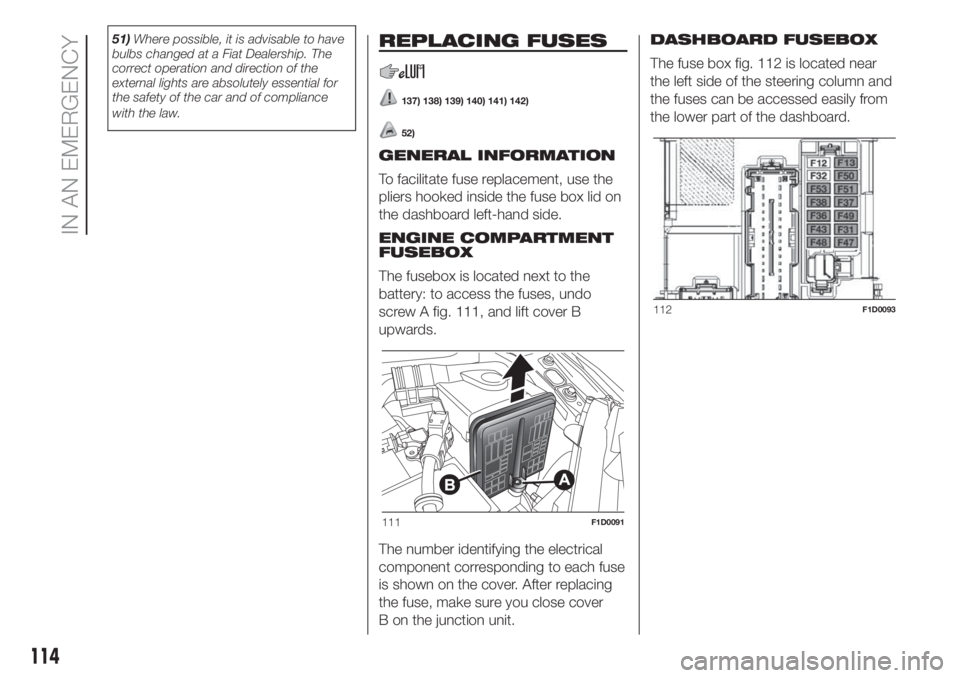
The fusebox is located next to the
battery: to access the fuses, undo
screw A fig. 111, and lift cover B
upwards.
The number identifying the electrical
component corresponding to each fuse
is shown on the cover. After replacing
the fuse, make sure you close cover
B on the junction unit.DASHBOARD FUSEBOX
The fuse box fig. 112 is located near
the left side of the steering column and
the fuses can be accessed easily from
the lower part of the dashboard.
111F1D0091
112F1D0093
114
IN AN EMERGENCY
Page 117 of 228
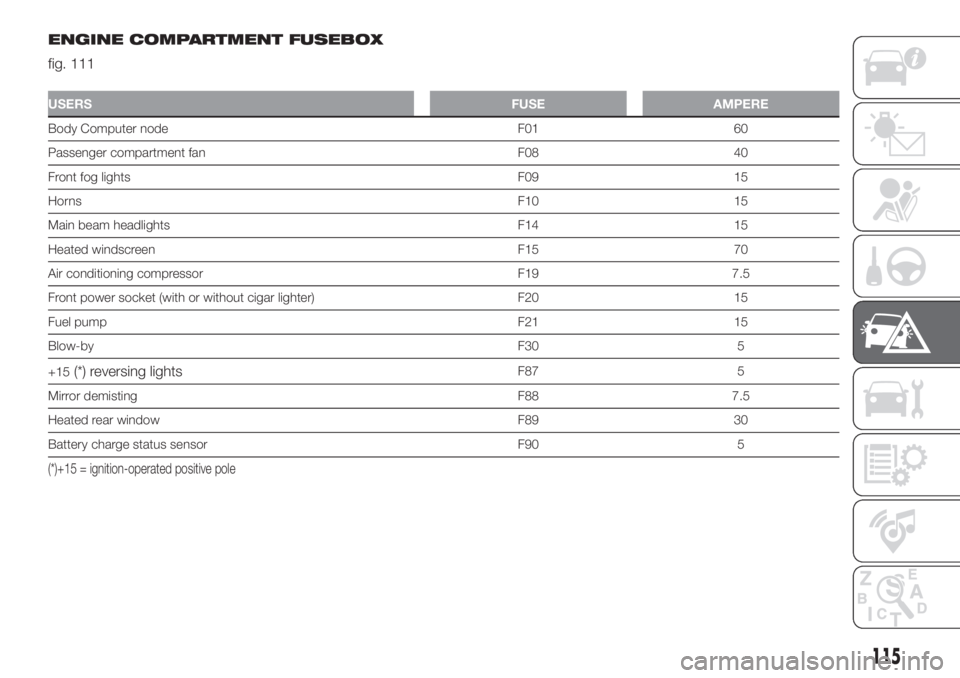
ENGINE COMPARTMENT FUSEBOX
fig. 111
USERSFUSE AMPERE
Body Computer node F01 60
Passenger compartment fan F08 40
Front fog lights F09 15
HornsF10 15
Main beam headlights F14 15
Heated windscreen F15 70
Air conditioning compressor F19 7.5
Front power socket (with or without cigar lighter) F20 15
Fuel pump F21 15
Blow-byF30 5
+15
(*) reversing lightsF87 5
Mirror demisting F88 7.5
Heated rear window F89 30
Battery charge status sensor F90 5
(*)+15 = ignition-operated positive pole
115
Page 118 of 228
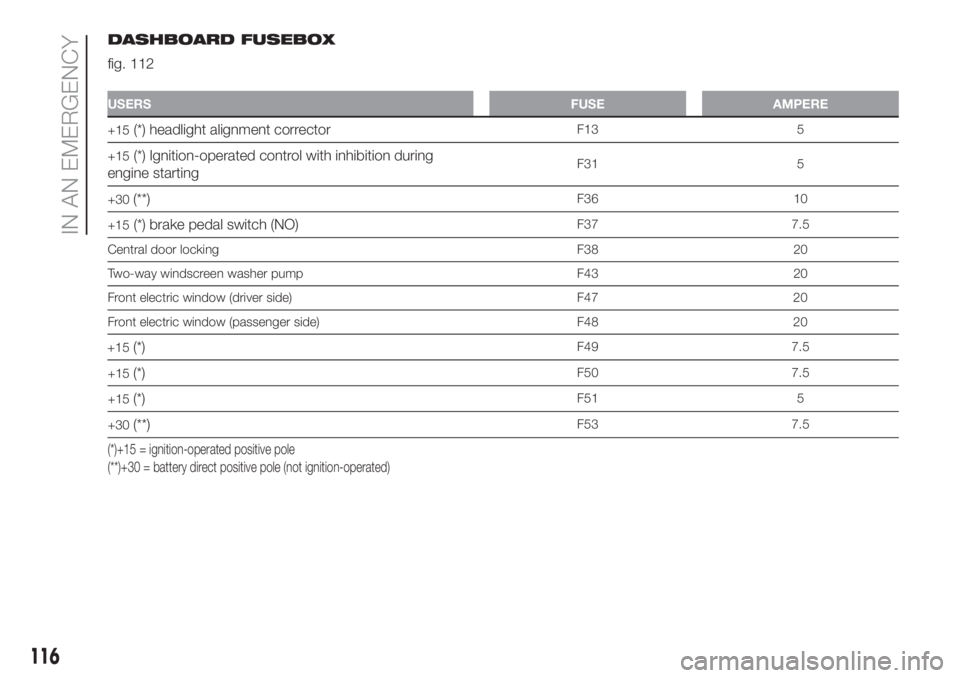
DASHBOARD FUSEBOX
fig. 112
USERSFUSE AMPERE
+15(*) headlight alignment correctorF13 5
+15
(*) Ignition-operated control with inhibition during
engine startingF31 5
+30
(**)F36 10
+15
(*) brake pedal switch (NO)F37 7.5
Central door locking F38 20
Two-way windscreen washer pump F43 20
Front electric window (driver side) F47 20
Front electric window (passenger side) F48 20
+15
(*)F49 7.5
+15
(*)F50 7.5
+15
(*)F51 5
+30
(**)F53 7.5
(*)+15 = ignition-operated positive pole
(**)+30 = battery direct positive pole (not ignition-operated)
116
IN AN EMERGENCY
Page 121 of 228
REFITTING THE
STANDARD WHEEL
54)
Following the procedure described
previously, raise the car and remove the
space-saver wheel.
Versions with steel wheels
Proceed as follows:
make sure the contact surfaces
between standard wheel and hub are
clean so that the fastening bolts will not
come loose;
fit the standard wheel by inserting
the first bolt by 2 threads into the hole
closest to the inflation valve;
fit the hub cap, aligning the crescent
hole with the bolt already fitted, then
fit the other bolts;
using the wrench provided, tighten
the fastening bolts;
lower the vehicle and remove the
jack;
use the wrench provided to fully
tighten the bolts, passing alternately
from one bolt to the opposite one.
Versions with alloy rims
Proceed as follows:
insert the wheel on the hub and use
the spanner provided to tighten the
bolts;
lower the vehicle and remove the
jack;
use the wrench provided to fully
tighten the bolts, passing alternately
from one bolt to the opposite one;
reinsert the press-fitted hub cap,
making sure that the reference hole on
the wheel is aligned with the reference
pin on the cap.
NOTE If it is not fitted correctly, the hub
cap may detach when the vehicle is
running.
At the end of the operation
stow the space-saver wheel in the
compartment provided in the luggage
compartment;
insert the jack and the other tools in
the container;
arrange the container and tools on
the space-saver wheel;
correctly reposition the luggage
compartment mat.
WARNING
143)The space-saver wheel (for
versions/markets where provided) is
specific to your car, do not use it on other
models, or use the space-saver wheel
of other models on your car. The
space-saver wheel must only be used in
the event of an emergency. Never use it for
more than strictly necessary and never
exceed 80 km/h. On the space-saver
wheel there is an orange label,
summarising the main warnings regarding
space-saver wheel usage restrictions.
Never remove or cover the label. The label
contains the following indications in four
languages: "Warning! For temporary use
only! 80 km/h max.! Replace with standard
wheel as soon as possible. Never cover
this indication." Never apply a wheel cap
on a space-saver wheel.
144)It is extremely dangerous to attempt
to change a wheel on the side of the
vehicle next to the driving lane: make sure
that the vehicle is at a sufficient distance
from the road, to avoid being run over.
145)Alert other drivers that the car is
stationary in compliance with local
regulations: hazard warning lights, warning
triangle, etc. Any passengers on board
should leave the car, especially if it is
heavily laden. Passengers should stay
away from on-coming traffic while the
wheel is being changed. On hills or uneven
roads, use chocks or appropriate objects
to block the wheels of the vehicle.
119
Page 123 of 228
REPAIR PROCEDURE
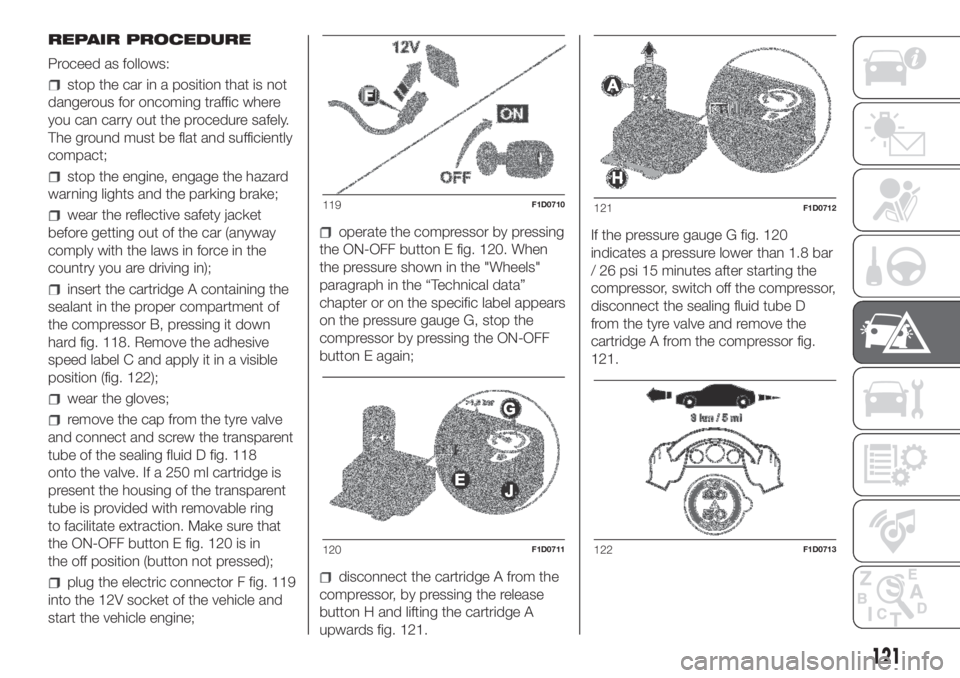
Proceed as follows:
stop the car in a position that is not
dangerous for oncoming traffic where
you can carry out the procedure safely.
The ground must be flat and sufficiently
compact;
stop the engine, engage the hazard
warning lights and the parking brake;
wear the reflective safety jacket
before getting out of the car (anyway
comply with the laws in force in the
country you are driving in);
insert the cartridge A containing the
sealant in the proper compartment of
the compressor B, pressing it down
hard fig. 118. Remove the adhesive
speed label C and apply it in a visible
position (fig. 122);
wear the gloves;
remove the cap from the tyre valve
and connect and screw the transparent
tube of the sealing fluid D fig. 118
onto the valve. If a 250 ml cartridge is
present the housing of the transparent
tube is provided with removable ring
to facilitate extraction. Make sure that
the ON-OFF button E fig. 120 is in
the off position (button not pressed);
plug the electric connector F fig. 119
into the 12V socket of the vehicle and
start the vehicle engine;
operate the compressor by pressing
the ON-OFF button E fig. 120. When
the pressure shown in the "Wheels"
paragraph in the “Technical data”
chapter or on the specific label appears
on the pressure gauge G, stop the
compressor by pressing the ON-OFF
button E again;
disconnect the cartridge A from the
compressor, by pressing the release
button H and lifting the cartridge A
upwards fig. 121.If the pressure gauge G fig. 120
indicates a pressure lower than 1.8 bar
/ 26 psi 15 minutes after starting the
compressor, switch off the compressor,
disconnect the sealing fluid tube D
from the tyre valve and remove the
cartridge A from the compressor fig.
121.
119F1D0710
120F1D0711
121F1D0712
122F1D0713
121
Page 125 of 228
JUMP STARTING
If the battery is flat, a jump starting can
be performed using the battery and
the cables of another vehicle, or using a
booster battery.
If the warning light
remains on
continuously on the instrument panel,
contact the Fiat Dealership immediately.
IMPORTANT NOTES
When a booster battery is used, comply
with the utilisation and precaution
instructions specified by the producer.
Do not use the booster battery or
any other source of external supply with
a voltage above 12 V: the battery, the
starter, the alternator and the electrical
system of the vehicle could be
damaged.
Do not attempt jump starting if the
battery is frozen. The battery could
break and explode!PREPARATION TO JUMP
STARTING
151) 152)
56) 57)
IMPORTANT The positive terminal (+) of
the battery is shielded by a protective
cover. Lift the cover to access the
positive terminal.
Proceed as follows:
engage the handbrake, move the
Dualogic gear lever to P (Park) or,
for versions with manual gearbox, to
neutral and bring the ignition key to
STOP;
switch off all the other electrical
devices in the car;
if another vehicle is ready for jump
starting, park the vehicle within the
reach of the cables to be used for
starting, operate the handbrake and
make sure that the ignition is
deactivated.
IMPORTANT Avoid contact between
the two vehicles since this could cause
a connection to earth and may result
in serious injury to any people nearby.PROCEDURE FOR JUMP
STARTING
IMPORTANT If the procedure below is
carried out incorrectly, it can cause
severe injury to people or damage the
recharging system of one or both
vehicles. Carefully follow the
instructions given below.
Cable connection
Proceed as follows to carry out a jump
starting:
connect one end of the cable used
for positive (+) to the positive terminal
(+) of the car with flat battery;
connect the other end of the cable
used for positive (+) to the positive
terminal (+) of the auxiliary battery;
connect one end of the cable used
for negative (–) to the negative terminal
(–) of the auxiliary battery;
connect the other end of the cable
used for negative (–) to an engine earth
(the visible metal part of the car engine
with flat battery) far from the battery
and the fuel injection system;
start the vehicle engine with the
auxiliary battery, let it run for a few
minutes at idling. Start the engine of the
car with flat battery.
123