airbag FIAT PANDA 2018 Owner handbook (in English)
[x] Cancel search | Manufacturer: FIAT, Model Year: 2018, Model line: PANDA, Model: FIAT PANDA 2018Pages: 228, PDF Size: 17.05 MB
Page 10 of 228

DASHBOARD
The presence and position of controls, instruments and gauges may vary depending on the versions.
1. Adjustable air vents 2. Exterior light control stalk 3. Driver front airbag 4. Windscreen wiper/rear window wiper/trip computer control lever
5. Adjustable and directable central air vents 6. Passenger front airbag 7. Glove compartment (for versions/markets, where provided)
8. Radio (for versions/markets, where applicable) 9. Control buttons 10. Gear lever 11. Heating/ventilation/climate control system controls
12. Ignition device 13. Instrument panel 14. Front electric windows 15. ECO/ASR OFF buttons (for versions/markets, where provided)
1F1D0131
8
KNOWING YOUR CAR
Page 40 of 228

AUTOCLOSE (for versions/markets,
where provided)
MEASUREMENT UNIT
LANGUAGE
BUZZER VOLUME
SEAT BELT BUZZER (for versions/
markets, where provided)
SERVICE
AIRBAG/PASSENGER BAG (for
versions/markets, where provided)
DAYTIME LIGHTS (for
versions/markets, where provided)
RESET TYRE (for versions/markets,
where provided)
CITY BRAKE C. (for versions/
markets, where provided)
OIL LEVEL RESET (for versions/
markets, where provided)
EXIT MENU
Deactivating the passenger front
airbag and side bag
This function is used to activate/
deactivate the front passenger airbag.
Proceed as follows:
press thebutton and, after the
display shows the message "Passenger
Bag: Off to deactivate) or the message
("Passenger Bag: On" to activate) by
pressing
and, pressonce
again;
a confirmation request message will
appear on the display;
by pressing theor
buttons, select "Yes" (to confirm
activation/deactivation) or "No" (to
cancel);
press thebutton briefly; a
message confirming the selection is
displayed and you return to the menu
screen. Hold down the button to return
to the standard screen without storing.
Oil level reset
(for versions/markets, where provided)
24)
This function resets the oil top-up
warning that occurs approximately
every 8,000 km.
Proceed as follows to reset this warning
after topping up the oil:
Press buttonbriefly. The display
will ask you to confirm the reset.
Press theorbutton and
select “YES” to reset the warning or
“NO” to cancel the operation.
TRIP COMPUTER
The Trip computer is used to display
information on car operation when the
key is turned to MAR.Two separate trips, called “Trip A” and
“Trip B”, are provided to monitor the
entire mission (journey) in a reciprocally
independent manner.
“Trip A”can be used to display the
values relating to: "Outside temperature
(for versions/markets, where provided)",
"Range", "Travel Distance", "Average
Fuel consumption", "Current fuel
consumption", "Average speed", "Travel
time (driving time)"
“Trip B”may be used to display the
figures relating to: "Travel Distance B",
"Average fuel consumption B",
"Average speed B", "Travel time B
(driving time)". The “Trip B” function
may be excluded.
Both functions can be reset (reset
means start of a new journey).
To reset, hold the TRIP button on the
right steering wheel stalk pressed.
NOTE “Range” and “Current fuel
consumption" parameters cannot be
reset.
WARNING
24)Failure to top up the engine oil could
result in a low level, which could prevent
normal car operation and even cause it to
stop
38
KNOWING THE INSTRUMENT PANEL
Page 42 of 228

Warning light What it means
red
amber
amberEBD FAILURE
The simultaneous switching on of the
(red),(amber) and(amber) warning lights with the engine
on indicates either an anomaly of the EBD system or that the system is not available. In this case, the rear
wheels may suddenly lock and the vehicle may swerve when braking hard. On certain versions a dedicated
message is displayed.
Drive very carefully to the nearest Fiat Dealership to have the system inspected immediately.
redAIRBAG FAILURE
When the ignition key is turned to MAR, the warning light switches on but should switch off after a few
seconds.
If the warning light turns on continuously, it indicates a fault in the airbag system. On certain versions a
dedicated message is displayed.37) 38)
WARNING
37)If, when turning the key to MAR, thewarning light does not turn on or if it stays on while driving, there could be a fault in the restraint
systems; in this case, the airbags or pretensioners may not be deployed in the event of impact or, in a few cases, they may deploy
accidentally. Contact a Fiat Dealership immediately to have the system checked.
38)A failure of the
warning light is indicated by thewarning light flashing. In this case, any faults of the airbag system might be not
signalled. Before continuing, contact a Fiat Dealership immediately to have the system checked.
40
KNOWING THE INSTRUMENT PANEL
Page 48 of 228
Amber warning lights
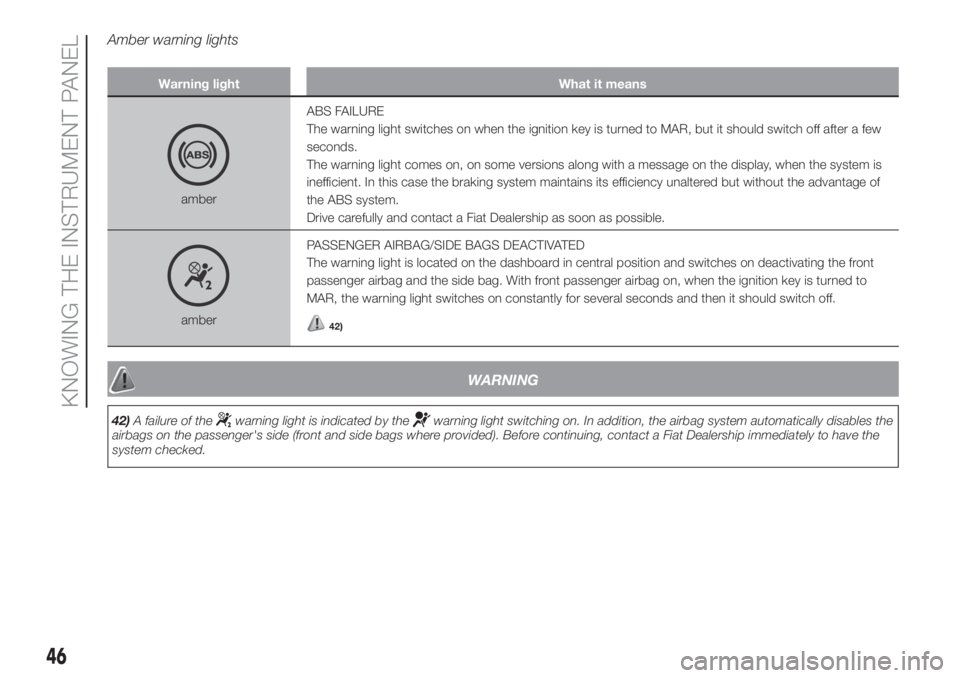
Warning light What it means
amberABS FAILURE
The warning light switches on when the ignition key is turned to MAR, but it should switch off after a few
seconds.
The warning light comes on, on some versions along with a message on the display, when the system is
inefficient. In this case the braking system maintains its efficiency unaltered but without the advantage of
the ABS system.
Drive carefully and contact a Fiat Dealership as soon as possible.
amberPASSENGER AIRBAG/SIDE BAGS DEACTIVATED
The warning light is located on the dashboard in central position and switches on deactivating the front
passenger airbag and the side bag. With front passenger airbag on, when the ignition key is turned to
MAR, the warning light switches on constantly for several seconds and then it should switch off.42)
WARNING
42)A failure of thewarning light is indicated by thewarning light switching on. In addition, the airbag system automatically disables the
airbags on the passenger's side (front and side bags where provided). Before continuing, contact a Fiat Dealership immediately to have the
system checked.
46
KNOWING THE INSTRUMENT PANEL
Page 53 of 228

Warning light What it means
amberGENERAL FAILURE INDICATION
(for versions/markets, where provided)
The warning light turns on in the following circumstances.
Speed limit exceeded
(for versions/markets, where provided)
The warning light switches on when the speed limit set in the Setup Menu is exceeded. When the car
exceeds this value, an acoustic indication is emitted and a dedicated appears on the display on some
versions.
Fuel cut-off system intervention/failure
This warning light switches on, on some versions along with a dedicated message on the display, in the
case of fuel cut-off system activation/failure.
Start&Stop system failure
(for versions/markets, where provided)
The warning light comes on when a fault is detected in the Start&Stop system. In the event of a Start&Stop
system failure, contact a Fiat Dealership.
Temporary or permanent City Brake Control system failure
(for versions/markets, where provided)
The warning light switches on, on some versions along with a message on the display, when a temporary
or permanent City Brake Control system fault is detected. If the fault is permanent: contact a Fiat
Dealership to have the system checked.
Airbag failure
When this warning light starts flashing, for versions/markets where provided, this indicates an airbag
warning light fault. In this case, the airbag may not indicate possible airbag system malfunctions. Contact a
Fiat Dealership immediately.
51
Page 61 of 228

SAFETY
The chapter that you are about to read
is very important: it describes the
safety systems with which the vehicle is
equipped and provides instructions on
how to use them correctlyACTIVE SAFETY SYSTEMS ............ 60
DRIVING ASSISTANCE SYSTEMS .. 66
OCCUPANT PROTECTION
SYSTEMS ....................................... 70
SEAT BELTS ................................... 70
SBR (SEAT BELT REMINDER)
SYSTEM ......................................... 72
PRE-TENSIONERS ......................... 73
CHILD RESTRAINT SYSTEMS ........ 75
SUPPLEMENTARY RESTRAINT
SYSTEM (SRS) - AIRBAG................ 85
59
Page 72 of 228
OCCUPANT
PROTECTION
SYSTEMS
The most important safety equipment
of the vehicle comprises the following
protection systems:
seat belts;
SBR (Seat Belt Reminder) system;
head restraints;
child restraint systems;
front airbags and side bags.
Read the information given the
following pages with the utmost care. It
is of fundamental importance that the
protection systems are used in the
correct way to guarantee the maximum
possible safety level for the driver and
the passengers.
For the description of the headrest
adjustment see the "Headrests"
paragraph in the "Knowing your
vehicle" chapter.
SEAT BELTS
USING THE SEAT BELTS
All vehicle seats are equipped with seat
belts with three anchor points and a
retractor. The reel mechanism operates
locking the belt in the event of sharp
braking or strong deceleration due
to an impact. This allows the belt strap
to slide freely and to adapt to the body
of the occupant. In the event of an
accident, the belt will lock reducing the
risk of impact inside the passenger
compartment and of being projected
outside the car.
The driver is responsible for respecting,
and ensuring that all the other
occupants of the vehicle also respect,
the local laws in force in relation to
the use of the seat belts.
Always fasten the seat belts before
setting off
The belt should be worn keeping the
torso straight and rested against the
backrest.
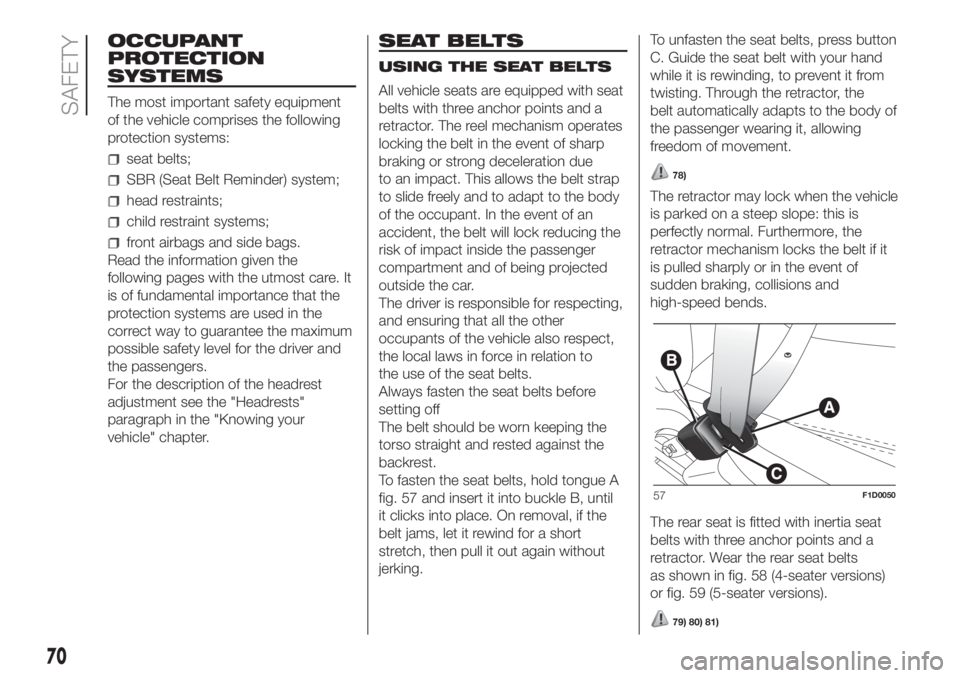
To fasten the seat belts, hold tongue A
fig. 57 and insert it into buckle B, until
it clicks into place. On removal, if the
belt jams, let it rewind for a short
stretch, then pull it out again without
jerking.To unfasten the seat belts, press button
C. Guide the seat belt with your hand
while it is rewinding, to prevent it from
twisting. Through the retractor, the
belt automatically adapts to the body of
the passenger wearing it, allowing
freedom of movement.
78)
The retractor may lock when the vehicle
is parked on a steep slope: this is
perfectly normal. Furthermore, the
retractor mechanism locks the belt if it
is pulled sharply or in the event of
sudden braking, collisions and
high-speed bends.
The rear seat is fitted with inertia seat
belts with three anchor points and a
retractor. Wear the rear seat belts
as shown in fig. 58 (4-seater versions)
or fig. 59 (5-seater versions).
79) 80) 81)
57F1D0050
70
SAFETY
Page 80 of 228
PASSENGER SEAT COMPLIANCE WITH REGULATIONS ON UNIVERSAL CHILD
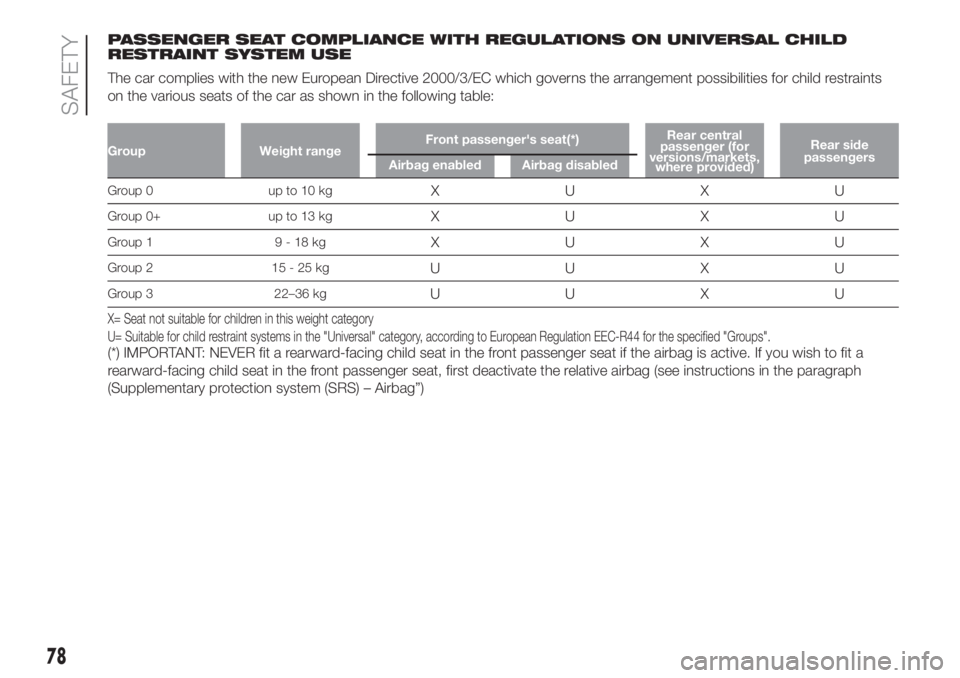
RESTRAINT SYSTEM USE
The car complies with the new European Directive 2000/3/EC which governs the arrangement possibilities for child restraints
on the various seats of the car as shown in the following table:
Group Weight rangeFront passenger's seat(*)Rear central
passenger (for
versions/markets,
where provided)Rear side
passengers
Airbag enabled Airbag disabled
Group0 upto10kgXUXU
Group 0+ up to 13 kgXUXU
Group 1 9 - 18 kgXUXU
Group 2 15 - 25 kgUUXU
Group 3 22–36 kgUUXU
X= Seat not suitable for children in this weight category
U= Suitable for child restraint systems in the "Universal" category, according to European Regulation EEC-R44 for the specified "Groups".
(*) IMPORTANT: NEVER fit a rearward-facing child seat in the front passenger seat if the airbag is active. If you wish to fit a
rearward-facing child seat in the front passenger seat, first deactivate the relative airbag (see instructions in the paragraph
(Supplementary protection system (SRS) – Airbag”)
78
SAFETY
Page 86 of 228
Main recommendations to carry
children safely
Install the child restraint systems on
the rear seat, which is the most
protected position in the event of an
impact.
Keep children in rearward facing
child restraint systems for as long as
possible, until 3–4 years old if possible.
Should a rearward facing child
restraint system be installed on the rear
seats, it is advisable to position it as
far forward as the position of the front
seat allows.
If the passenger side front airbag is
deactivated, always check that the
warning light on the central
dashboard is on continuously, to make
sure that it has actually been
deactivated.
Carefully follow the instructions
supplied with the child restraint system.
Keep the instructions in the vehicle
along with the other documents and
this handbook. Do not use second-
hand child seats without instructions.
Only one child is to be strapped into
each restraint system; never carry two
children using one child restraint
system.
Always check that the seat belts do
not rest on the child’s neck.
Always check that the seat belt is
well fastened by pulling on it.
While travelling, do not let the child
sit incorrectly or unfasten the belts.
Never allow a child to put the belt's
diagonal section under an arm or
behind their back.
Never carry children on your lap,
even newborns. No-one can hold
a child in the case of a crash.
If the car has been involved in a
medium-high severity road accident,
replace the child restraint system with a
new one. In addition, and depending
on the type of child restraint system
installed, replace the isofix anchorages
or the seat belt with which the child
restraint system was connected.
Before installing a child restraint
system of any kind on the rear seat
facing in the direction of movement of
the vehicle, it is necessary to remove
the head restraint from the rear seat
position in which the child restraint
system is to be installed. On the other
hand, before installing a child restraint
system composed of only the seat
cushion (without backrest) on the rear
seat, it is necessary to ensure that
the head restraint of the rear seat
position in which the child restraint
system is to be installed is correctly
fitted.
WARNING
88)SEVERE DANGER When a front
passenger airbag is fitted, do not install
rearward facing child restraint systems on
the front passenger seat. Deployment of
the airbag in a crash could cause fatal
injuries to the child regardless of the
severity of the collision. It is advisable to
always carry children in a child restraint
system on the rear seat, which is the most
protected position in the event of a
collision.
89)On the sun visor there is a label with
suitable symbols reminding the user that it
is compulsory to deactivate the airbag if
a rearward facing child restraint system is
fitted. Always comply with the instructions
on the passenger side sun visor (see the
"Supplementary Restraint System (SRS)
- Airbag" paragraph).
90)Should it be necessary to carry a child
on the passenger side front seat in a rear
facing child restraint system, the passenger
side front and side airbags must be
deactivated through the display main
menu, verifying deactivation by checking
that the warning light
located in the
central part of the dashboard has switched
on. Move the passenger's seat as far
back as possible to avoid contact between
the child seat and the dashboard.
91)Do not move the front or rear seat if a
child is seated on it or on the dedicated
child restraint system.
84
SAFETY
Page 87 of 228

92)Incorrect fitting of the child restraint
system may result in an inefficient
protection system. In the event of an
accident the child restraint system may
become loose and the child may be
injured, even fatally. When fitting a restraint
system for newborns or children, strictly
comply with the instructions provided
by the Manufacturer.
93)When the child restraint system is not
used, secure it with the seat belt or with
the ISOFIX anchorages, or remove it from
the vehicle. Do not leave it unsecured
inside the passenger compartment. This
way, in the case of sudden braking or
an accident, it will not cause injuries to the
occupants.
94)After installing a child restraint system,
do not move the seat: always remove
the child restraint system before making
any adjustment.
95)Always make sure that the chest
section of the seat belt does not pass
under the arms or behind the back of the
child. In the event of an accident the seat
belt will not be able to secure the child,
with the risk of injury, including fatal injury.
Therefore the child must always wear
the seat belt correctly.
96)Do not use the same lower anchoring
to install more than one child restraint
system.
97)If a Universal ISOFIX child seat system
is not fixed to all three anchorages, it will
not be able to protect the child correctly. In
an accident, the child could be seriously
or fatally injured.98)Fit the child restraint system when the
car is stationary. The child restraint system
is correctly fixed to the brackets when
you hear the click. Follow the instructions
for assembly, disassembly and positioning
that the Manufacturer must supply with
the child restraint system.SUPPLEMENTARY
RESTRAINT SYSTEM
(SRS) - AIRBAG
The car is equipped with:
driver front airbag;
front passenger airbag;
front side bags for pelvis, chest and
shoulder protection of driver and
passenger (for versions/markets, where
provided);
side bags for head protection of
front seat passengers and rear side
seat passengers (window bag).
FRONT AIRBAGS
99)
The front (driver and passenger) airbags
protect the front seat occupants in the
event of head-on crashes of medium-
high severity, by placing the cushion
between the occupant and the steering
wheel or dashboard.
Therefore non-activation of airbags in
other types of collisions (side impacts,
rear shunts, roll-overs, etc.) does not
indicate a system malfunction.
Driver and passenger front airbags are
not a replacement of but
complementary to the seat belts, which
should always be worn, as specified
by law in Europe and most non-
European countries.
85