ground clearance FIAT PUNTO 1995 176 / 1.G User Guide
[x] Cancel search | Manufacturer: FIAT, Model Year: 1995, Model line: PUNTO, Model: FIAT PUNTO 1995 176 / 1.GPages: 225, PDF Size: 18.54 MB
Page 183 of 225
Braking system 9®7
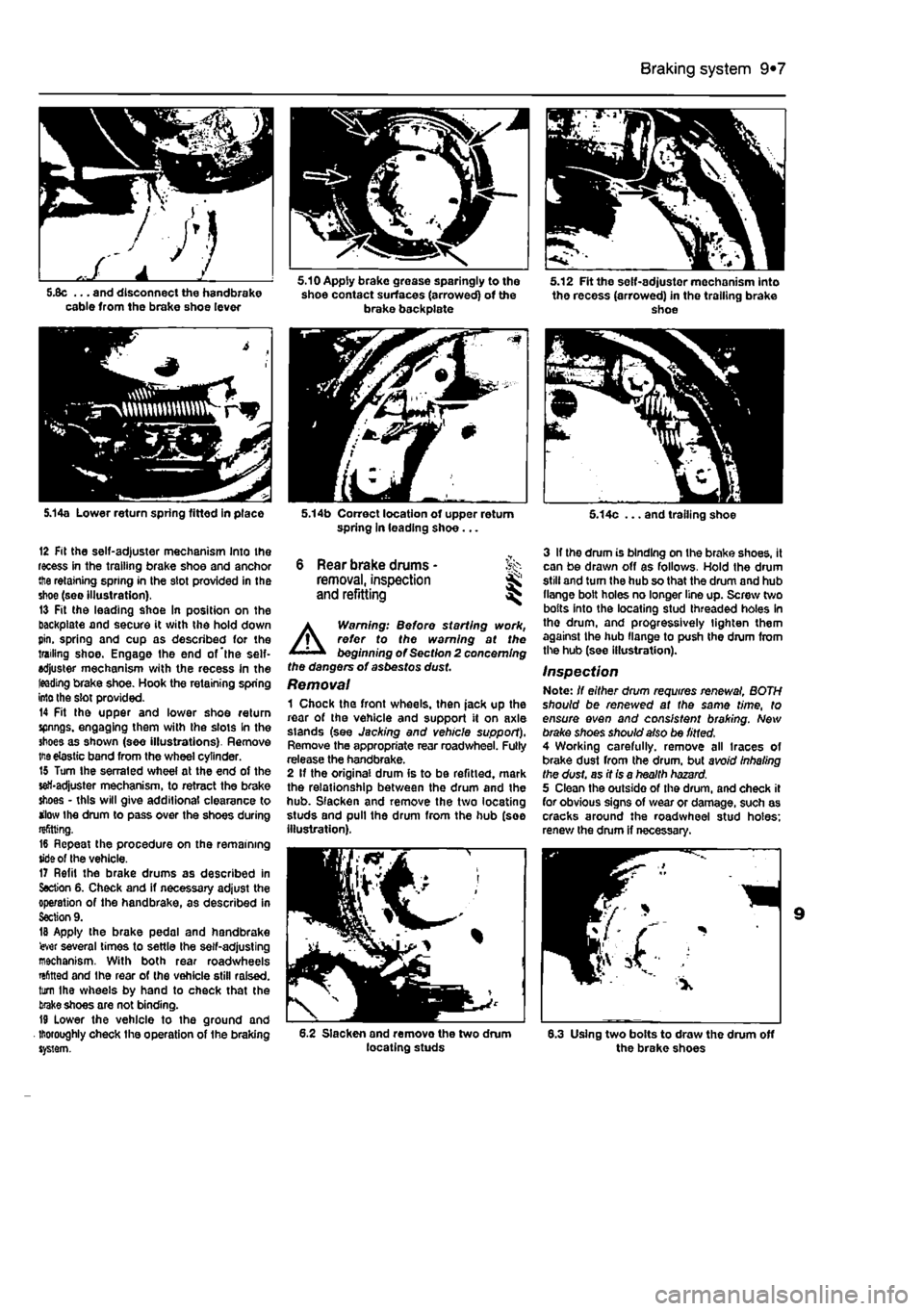
5JJc ... and disconnect the handbrake cable from the brake shoe lever
5.14a Lower return spring fitted in place
12 Fit the self-adjuster mechanism Into the recess in the trailing brake shoe and anchor the retaining spring in the slot provided in the shoe (see Illustration). 13 Fit the leading shoe In position on the backpiste and secure it with the hold down pin. spring and cup as described for the trailing shoe. Engage the end of'the self-adjuster mechanism with the recess In the leading brake shoe. Hook the retaining spring into the slot provided. 14 Fit the upper and lower shoe return spnngs. engaging them with the slots In the shoes as shown (see illustrations). Remove
me
elastic band from the wheel cylinder. 15 Turn Ihe serrated wheel at the end of the self-adjuster mechanism, to retract the brake shoes - this will give additional clearance to ilow Ihe drum to pass over the shoes during refitting. 16 Repeat the procedure on the remaining tide of the vehicle. 17 Refit the brake drums as described in Section 6. Check and if necessary adjust the operation of the handbrake, as described in Section 9. IB Apply the brake pedal and handbrake 'ever several times to settle the self-adjusting mechanism. With both rear roadwheels rsfitted and Ihe rear of the vehicle still raised, turn Ihe wheels by hand to check that the take shoes are not binding. 19 Lower the vehicle to the ground and thoroughly check the operation of the braking system.
5.10 Apply brake grease sparingly to the shoe contact surfaces (arrowed) of the brake backplate
5.14b Correct location of upper return spring In leading shoe...
6 Rear brake drums -removal, inspection and refitting ^
A
Warning: Before starting work, refer to the warning at the beginning of Section 2 concerning the dangers of asbestos dust Removal 1 Chock the front wheels, then jack up the roar of the vehicle and support it on axle stands (see Jacking and vehicle support). Remove the appropriate rear roadwheel. Fully release the handbrake. 2 If the original drum is to be refitted, mark the relationship between the drum and the hub. Slacken and remove the two locating studs and pull the drum from the hub (see illustration).
6.2 Slacken and remove the two drum locating studs
5.12 Fit the self-adjuster mechanism into the recess (arrowed) in the trailing brake shoe
5.14c ... and trailing shoe
3 If the drum is binding on Ihe brake shoes, it can be drawn off as follows. Hold the drum still and turn the hub so that the drum and hub flange bolt holes no longer line up. Screw two bofts into the locating stud threaded holes In tho drum, and progressively lighten them against the hub llange to push the drum from the hub (see illustration).
Inspection Note: If either drum requires renewal, BOTH should be renewed at the same time, to ensure even and consistent braking. New brake shoes should also be fitted. 4 Working carefully, remove all traces of brake dust from the drum, but avoid Inhaling the dust, as it is a health hazard. 5 Clean the outside of the drum, and check it for obvious signs of wear or damage, such as cracks around the roadwheel stud holes; renew the drum if necessary.
6.3 Using two bolts to draw the drum off the brake shoes
Page 199 of 225
Suspension and steering 10*11
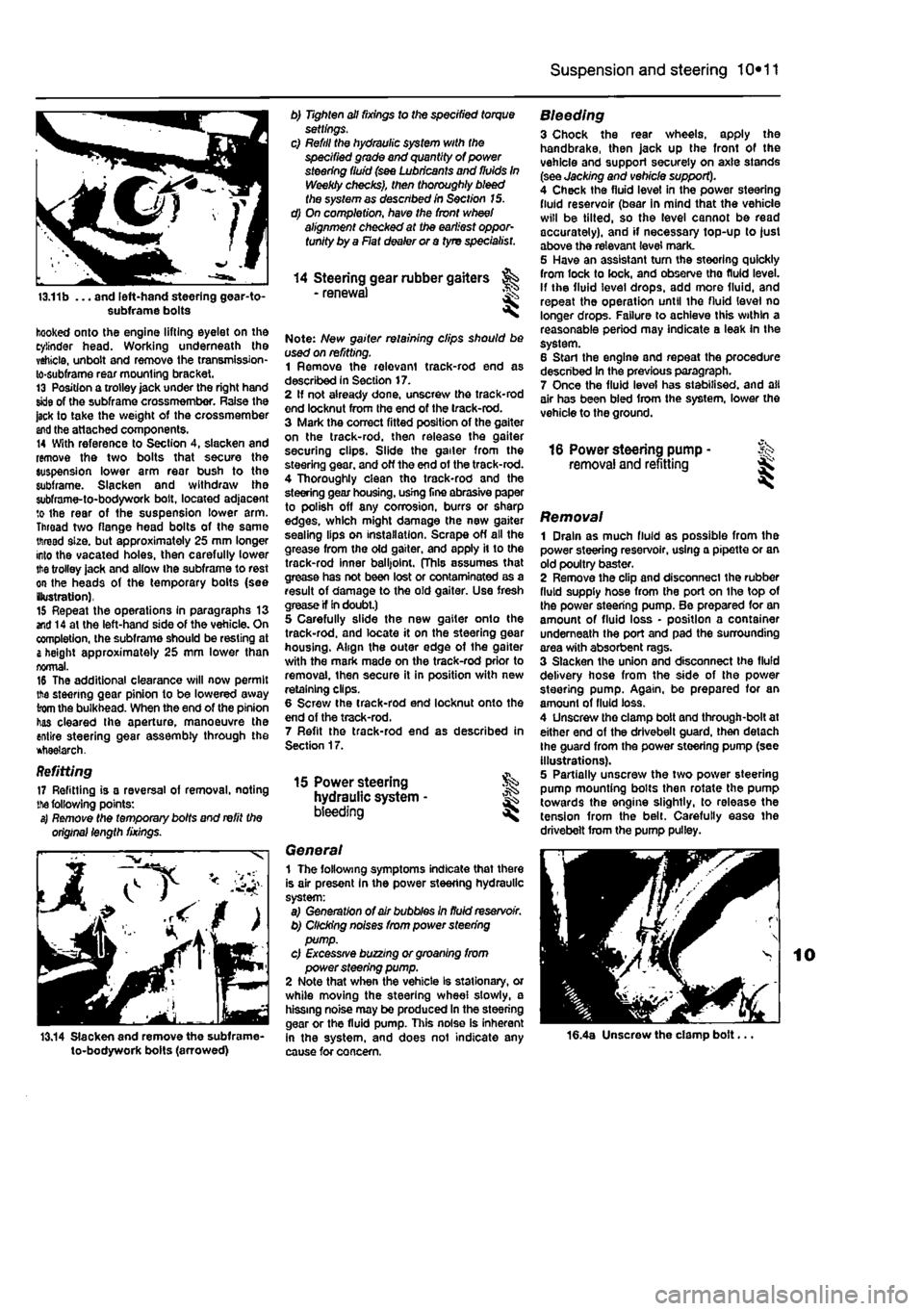
13.11b ... and left-hand steering gear-to-subframe bolts
hooked onto the engine lifting eyelet on the cylinder head. Working underneath the vehicle, unbolt and remove the transmission-lo-subframe rear mounting bracket. 13 Position a trolley jack under the right hand skle of the subframe crossmember. Raise the jack to take the weight of the crossmember
and
the attached components. 14 With reference to Section 4, slacken and remove the two bolts that secure the suspension lower arm rear bush to the subframe. Slacken and withdraw the subframe-to-bodywork bolt, located adjacent to the rear of the suspension lower arm. Throad two flange head bolts of the same thread size, but approximately 25 mm longer into the vacated holes, then carefully lower
the
trolley jack and allow ihe subframe to rest on the heads of the temporary bolts (see (lustration), 15 Repeat the operations in paragraphs 13 end 14 at the left-hand side of the vehicle. On completion, the subframe should be resting at
&
height approximately 25 mm lower than normal. 16 The additional clearance will now permit the steering gear pinion to be lowered away from the bulkhead. When the end of the pinion has cleared Ihe aperture, manoeuvre the entire steering gear assembly through the *tiae?arch.
Refitting 17 Refitting is a reversal of removal, noting
the
following points: s) Remote the temporary bolts and refit the original length fixings.
13.14 Slacken and remove the subframe-to-bodywork bolts (arrowed)
b) Tighten all fixings to the specified torque settings. c) Refill the hydraulic system with the specified grade and quantity of power steering fluid (see Lubricants and fluids In Weekly checks), then thoroughly bleed the system as described in Section 15. d) On completion, have the front wheel alignment checked at the earliest oppor-tunity by a Flat dealer or a tyre specialist.
14 Steering gear rubber gaiters - renewal <
Note: New gaiter retaining clips should be used on refitting. 1 Remove the relevant track-rod end as described in Section 17. 2 If not already done, unscresv the track-rod end locknut from Ihe end of the track-rod. 3 Mark the correct fitted position of the gaiter on the track-rod, then release the gaiter securing clips. Slide the gailer from the steering gear, and off the end of the track-rod. 4 Thoroughly clean tho track-rod and the steering gear housing, usrng fine abrasive paper to polish off any corrosion, burrs or sharp edges, which might damage the new gaiter sealing lips on installation. Scrape off all the grease from the old gaiter, and apply it to the track-rod inner balljoint. (This assumes that grease has not been lost or contaminated as a result of damage to the old gaiter. Use fresh crease if In doubt.) 5 Carefully slide the new gaiter onto the track-rod. and locate it on the steering gear housing. Align the outer edge of the gaiter with the mark made on the track-rod prior to removal, then secure it in position with new retaining clips. 6 Screw the track-rod end locknut onto the end of the track-rod. 7 Refit the track-rod end as described in Section 17.
15 Power steering hydraulic system • bleeding ^
General 1 The following symptoms indicate that there is air present In the power steering hydraulic system: a) Generation of air bubbles in fluid reservoir. b) Clicking noises from power steering pump. c) Excessive buzzing or groaning from power steering pump. 2 Note that when the vehicle Is stationary, or while moving the steering wheel slowly, a hissing noise may be produced In the steering gear or the fluid pump. This noise is inherent in the system, and does not indicate any cause for concern.
Bleeding 3 Chock the rear wheels, apply the handbrake, then jack up the front of the vehicle and support securely on axle stands (see Jacking and vehicle support). 4 Check the fluid level in the power steering fluid reservoir (bear in mind that the vehicle will be tilted, so the level cannot be read accurately), and if necessary top-up to just above the relevant level mark. 5 Have an assistant tum the steering quickly from lock to lock, and observe tho fluid level, if the fluid level drops, add more fluid, and repeat the operation until the fluid level no longer drops. Failure to achieve this within a reasonable period may indicate a leak in the system. 6 Stan the engine and repeat the procedure described In the previous paragraph. 7 Once the fluid level has stabilised, and all air has been bled from the system, lower the vehicle to the ground.
16 Power steering pump - Sk removal and refitting ^
Removal 1 Drain as much fluid as possible from the power steering reservoir, using a pipette or an old poultry baster. 2 Remove the clip and disconnect the rubber fluid supply hose from the port on the top of the power steering pump. Be prepared for an amount of fluid loss • position a container underneath the port and pad the surrounding area with absorbent rags. 3 Slacken the union and disconnect the fluid delivery hose from the side of the power steering pump. Again, be prepared for an amount of fluid loss. 4 Unscrew tho clamp bolt and through-bolt at either end of the drivebelt guard, then detach Ihe guard from the power steering pump (see illustrations). 5 Partially unscresv the two power steering pump mounting bolts then rotate the pump towards the engine slightly, to release the tension from the belt. Carefully ease the drivebelt from the pump pulley.
16.4a Unscrew the clamp bolt...