Valve adjust FIAT PUNTO 1998 176 / 1.G Workshop Manual
[x] Cancel search | Manufacturer: FIAT, Model Year: 1998, Model line: PUNTO, Model: FIAT PUNTO 1998 176 / 1.GPages: 225, PDF Size: 18.54 MB
Page 20 of 225
1A»1
Chapter
1
Part A:
Routine maintenance & servicing - petrol models
Contents
Air
filter renewal 18 Automatic transmission filter and fluid change 2B Auxiliary dr
and filter renewal 3 Evaporative loss system check 27 Exhaust system check 8 From brake pad check 5 Fuel filter renewal 17 Headlight beam adjustment 23 Hinge and lock lubrication 22
Hose and fluid leak check 7 Idle speed and CO content check and adjustment .11 Ignition system check 20 Introduction 1 Lambda/oxygen sensor check 25 Manifold mounting check 16 Manual transmission oil level check 26 Manual transmission oil renewal .32 Pollen filter renewal 10 Rear brake shoe check 29 Regular maintenance 2 Road test 24 Spark plug renewal 19 Steering and suspension check 12 Timing belt renewal 30 Underbody sealant check 6 Valve clearance check and adjustment 15
Degrees of difficulty
Easy, suitable for ^ novice with little experience ^
Fairty easy, suitable for beginner with ^ some experience
FaMy difficult, ^ sitable for competent jj^ DIY mechanic ^
Difficult, suitable for experienced DIY aJ mechanic ^
Very difficult, ^ suitable for expert DIY or professional ^
expert22 fl/ia http://rutracker.org
Page 22 of 225
Maintenance schedule - petrol models 1A.3
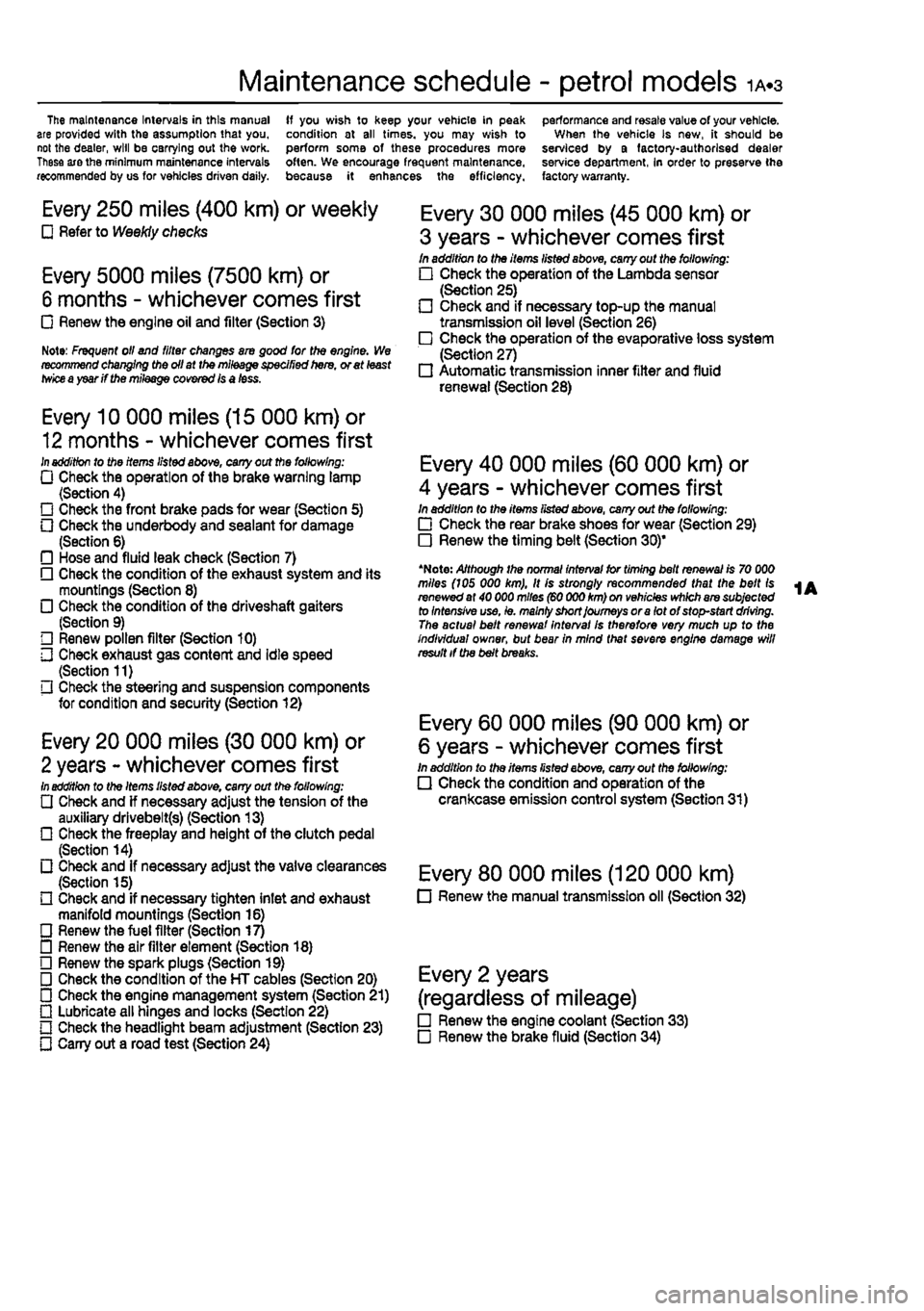
The maintenance Intervals in this manual are provided with the assumption that you, not the dealer, will be carrying out the work. These axe the minimum maintenance intervals recommended by us for vehicles driven daily.
if you wish to keep your vehicle in peak condition at all times, you may wish to perform some of these procedures more often. We encourage frequent maintenance, because it enhances the efficiency.
performance and resale value of your vehicle. When the vehicle Is new, it should be serviced by a factory-authorised dealer service department, In order to preserve the factory warranty.
Every 250 miles (400 km) or weekly Q Refer to Weekly checks
Every 5000 miles (7500 km) or
6 months - whichever comes first • Renew the engine oil and filter (Section 3)
Note: Frequent oil and fitter changes am good tor the engine. We recommend changing the oil at the mileage specified here, or at least
twice
a year if the mileage covered Is a less.
Every 10 000 miles (15 000 km) or
12 months - whichever comes first
In
addition to the items listed above, cany out the following: Q Check the operation of the brake warning lamp (Section 4) • Check the front brake pads for wear (Section 5) • Check the underbody and sealant for damage (Section 6) • Hose and fluid leak check (Section 7) • Check the condition of the exhaust system and its mountings (Section 8) • Check the condition of the driveshaft gaiters (Section 9) • Renew pollen filter (Section 10) • Check exhaust gas content and idle speed (Section 11) • Check the steering and suspension components for condition and security (Section 12)
Every 20 000 miles (30 000 km) or
2 years - whichever comes first
In
addition to the Items listed above, carry out the following: • Check and if necessary adjust the tension of the auxiliary drlvebelt(s) (Section 13) • Check the freeplay and height of the clutch pedal (Section 14) • Check and if necessary adjust the valve clearances (Section 15) HI Check and if necessary tighten inlet and exhaust manifold mountings (Section 16) • Renew the fuel filter (Section 17) D Renew the air filter element (Section 18) O Renew the spark plugs (Section 19) • Check the condition of the HT cables (Section 20) • Check the engine management system (Section 21) Q Lubricate all hinges and locks (Section 22) O Check the headlight beam adjustment (Section 23) • Carry out a road test (Section 24)
Every 30 000 miles (45 000 km) or
3 years - whichever comes first In addition to the items listed above, cany out the following: • Check the operation of the Lambda sensor (Section 25) • Check and if necessary top-up the manual transmission oil level (Section 26) • Check the operation of the evaporative loss system (Section 27) • Automatic transmission inner filter and fluid renewal (Section 28)
Every 40 000 miles (60 000 km) or
4 years - whichever comes first In addition to the items fisted above, carry out the following: • Check the rear brake shoes for wear (Section 29) • Renew the timing belt (Section 30)"
*Noto: Although the normal interval for timing belt renewal is 70 000 miles (105 000 km), It is strongly recommended that the belt Is renewed at 40 000 miles (60 000 km) on vehicles which are subjected to Intensive use, ie. malniy short Journeys or a let of stop-start driving. The actual belt renewal Interval Is therefore very much up to the individual owner, but bear in mind that severe engine damage will result if the belt breaks.
Every 60 000 miles (90 000 km) or
6 years - whichever comes first in addition to the items listed above, cany out the following: • Check the condition and operation of the crankcase emission control system (Section 31)
Every 80 000 miles (120 000 km) • Renew the manual transmission oil (Section 32)
Every 2 years
(regardless of mileage) • Renew the engine coolant (Section 33) • Renew the brake fluid (Section 34)
Page 29 of 225
ia.io Every 20 000 miles - petrol models
the front of the car and support It securely on axle stands (see Jacking and vehicle support}. 4 Remove the nght-hand front wheel. 5 Remove the inner cover from under the right-hand wheeiarch for access to the right-hand side of the engine. 0 Using a socket on the crankshaft sprocket boll, rotate the crankshaft so that the full length of the auxiliary drlvebelt(s) can be examined. Look for cracks, splitting and fraying on the surface of the belt: check also for signs of glazing (shiny patches) and separation of the belt plies. If damage or wear Is visible, the relevant belt should be renewed. 7 If the condition of the belt Is satisfactory, check Ihe drivebeit tension as described below.
Renewal
Alternator drivebeit Note: On certain models with power steering but without air conditioning, it will be necessary to remove the power steering pump drivebeit ffrst, as described below. 8 Where fitted, undo the bolts and remove the belt guard from the alternator. 9 Loosen the pivot and adjustment bolts then swivel the alternator towards the engine and slip off the drivebeit. 10 Unbolt and remove the crankshaft sensor from Ihe front of the engine (refer to Chapter 4A. Section 5, if necessary). 11 Remove the drivebeit from the engine. 12 When renewing a drivebeit. ensure that the correct type is used. Fit the belt around the two pulleys then swivel the alternator outwaids to take up any slack in the betL Adjust the tension correctly as described below. Power steering pump drivebeit 13 Slacken the bolts securing the power steering pump to the mounting bracket. 14 Slacken the adjusting bolt locknut and turn the adjusting boit until all the tension is removed from the drivebeit. 15 Undo the bolts and remove the pultey guard from the power steering pump then slip the drivebeit off (he pulleys. 18 Ensuring that the correct type of drivebeit is used, fit the belt around the pulleys and turn the adjusting bolt to just take up the slack in the belt. Adjust the tension correctly as described below. Air conditioning compressor drivebeit 17 Remove the alternator and power steering pump dnvebelts as described previously. 18 Slacken the bolts securing the compressor to the mounting bracket. 19 Slacken the adjusting bolt locknut and turn the adjusting bolt until alt the tension is removed from the drivebeit, then slip the belt off the pulleys. 20 Ensuring lhat the correct type of drivebeit is used, fit the belt around the pulleys and turn the adjusting bolt to just take up the slack In the belt. Adjust the tension correctly as described below.
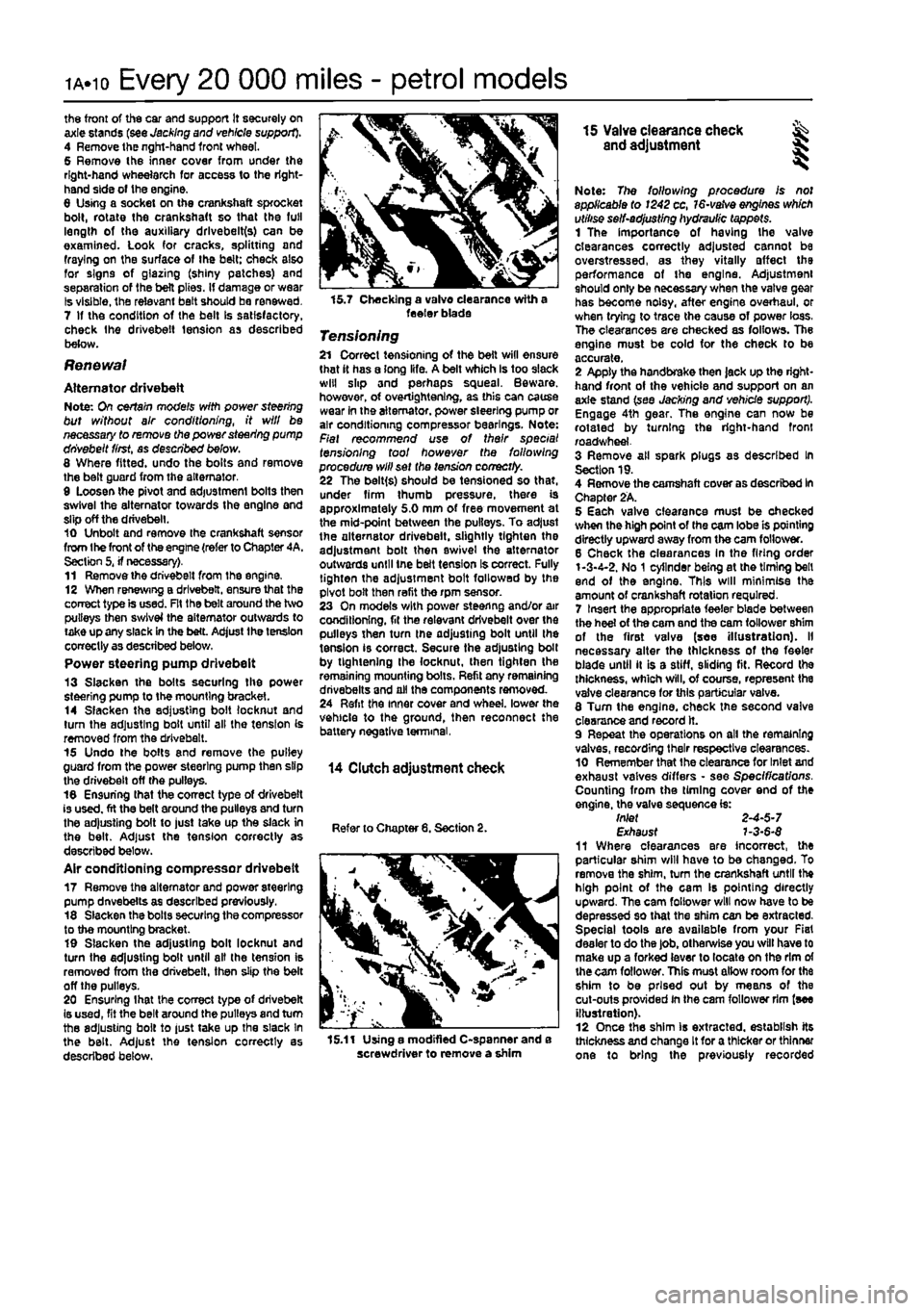
15.7 Checking a valve clearance with a feeler blade
Tensioning 21 Correct tensioning of the belt will ensure that it has a long life. A belt which Is too slack will slip and perhaps squeal. Beware, however, of overtightening, as this can cause wear in the alternator, power steering pump or air conditioning compressor bearings. Note: Fiat recommend use of their special tensioning tool however the fallowing procedure will set the tension correctly. 22 The belt(s) should be tensioned so that, under firm thumb pressure, there is approximately 5.0 mm of free movement at the mid-point between the pulleys. To adjust the alternator drivebeit, slightly tighten the adjustment bolt then swivel the alternator outwards until tne beft tension Is correct. Fully tighten the adjustment bolt followed by the pivot bolt then refit the rpm sensor. 23 On models with power steering and/or air conditioning, fit the relevant drivebeit over the pulleys then turn the adjusting bolt until the tension is correct. Secure the adjusting bolt by tightening Ihe locknut, then tighten the remaining mounting bolts. Refit any remaining dnvebelts and all the components removed. 24 Refit the inner cover and wheel, lower the vehicle to the ground, then reconnect the battery negative terminal,
14 Clutch adjustment check
Refer to Chapter 8. Section 2.
15.11 Using a modified C-spanner and e screwdriver to remove a shim
15 Valve clearance check ^ and adjustment S
Note: The following procedure Is not applicable to 1242 cc,
16-vatve
engines which utilise self-adjusting hydraulic tappets. 1 The importance of having the valve clearances correctly adjusted cannot be overstressed, as they vitally affect the performance of the engine. Adjustment should only be necessary when the valve gear has become noisy, after engine overhaul, or when trying to trace the cause of power loss. The clearances are checked as follows. The engine must be cold for the check to be accurate. 2 Apply the handbrake then jack up the right* hand front of the vehicle and support on an axle stand (see Jacking and vehicle support). Engage 4th gear. The engine can now be rotated by turning the right-hand front road wheel. 3 Remove all spark plugs as described In Section 19. 4 Remove the camshaft cover as described In Chapter 2A. 5 Each valve clearance must be checked when the high point of the cam lobe is pointing directly upward away from the cam follower. 6 Check the clearances In the firing order 1-3-4-2. No
1
cylinder being at the timing bell end of the engine. This will minimise the amount of crankshaft rotation required. 7 Insert the appropriate feeler blade between the heel of the cam and the cam follower shim of the first valve (see illustration). II necessary alter the thickness of the feeler blade until it is a stiff, sliding fit. Record the thickness, which will, of course, represent the valve clearance for this particular valve. 8 Tum the engine, check the second valve clearance and record it. 9 Repeat the operations on all the remaining valves, recording their respective clearances. 10 Remember that the clearance for Inlet and exhaust valves differs • see Specifications. Counting from the timing cover end of the engine, the valve sequence is: tnlet 2-4-5-7 Exhaust 7-3-6-$ 11 Where clearances are incorrect, the particular shim will have to be changed. To remove the shim, turn the crankshaft until the high point of the cam Is pointing directly upward. The cam follower will now have to be depressed so that the shim can be extracted. Special tools are available from your Fiat dealer to do the job, otherwise you will have to make up a forked (ever to locate on the rim of the cam follower. This must allow room for the shim to be prised out by means of the cut-outs provided in the cam follower rim {see illustration). 12 Once the shim is extracted, establish its thickness and change It for a thicker or thinner one to bring the previously recorded
Page 31 of 225
1A.12
Every 20 000 miles - petrol models
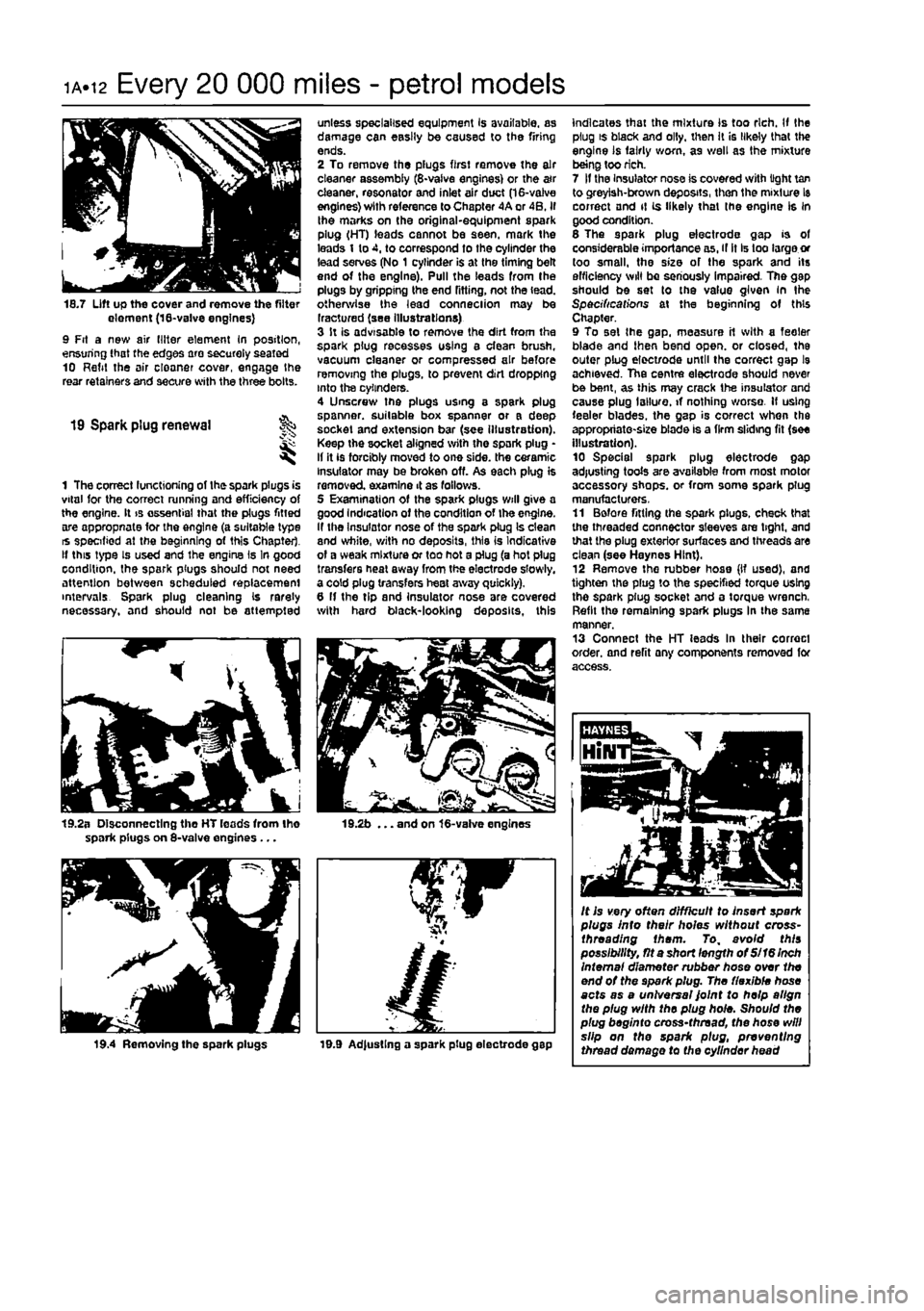
18.7 Lift up the cover and remove the filter element (18-va!ve engines) 9 Fit a new air (liter element In position, ensuring that the edges are securely seated 10 Refit the air cloaner cover, engage the rear retainers and secure with the three bolts.
19 Spark plug renewal
1 The correct functioning of the spark plugs is vital for the correct running and efficiency of the engine. It is essential that the plugs fitted are appropnate for the engine (a suitable type is specified at the beginning of this Chapter. If this type is used and the engine Is In good condition, the spark plugs should not need attention between scheduled replacement intervals Spark plug cleaning Is rarely necessary, and should not be attempted
19.2a Disconnecting tho HT leads from Iho spark plugs on 8-valve engines ...
19.4 Removing the spark plugs
unless specialised equipment Is available, as damage can easily be caused to the firing ends. 2 To remove the plugs first remove the air cleaner assembly (8-vaive engines) or the a»r cleaner, resonator and inlet air duct (16-valve engines) with reference to Chapter 4A or 4B. if the marks on the original-equipment spark plug (HT) leads cannot be seen, mark the leads 1 to 4, to correspond to the cylinder the lead serves (No 1 cylinder is at the timing belt end of the engine). Pull the leads from the plugs by gripping the end fitting, not the lead, otherwise the lead conneciion may be Iractured (see illustrations) 3 It is advisable to remove the dirt from the spark plug recesses using a clean brush, vacuum cleaner or compressed air before removing the plugs, to prevent dirt dropping into the cylinders. 4 Unscrew the plugs using a spark plug spanner, suitable box spanner or a deep socket and extension bar (see illustration). Keep the socket aligned with the spark plug • If it is forcibly moved to one side, the ceramic insulator may be broken off. As each plug is removed examine 4 as fallows. 5 Examination of the spark plugs will give a good Indication of the condition of the engine. If the Insulator nose of the spark plug Is clean and white, with no deposits, this is Indicative of a weak mixture or too hot a plug (a hot plug transfers heal away from the electrode slowly, a cold plug transfers heat away quickly). 6 If the tip and insulator nose are covered with hard black-looking deposits, this
19.2b ... and on 16-valve engines
19.9 Ad|ustlng a spark plug electrode gap
indicates that the mixture Is too rich. If the plug is black and oily, then It is likely that the engine is fairly worn, as well as the mixture being too rich. 7 If the Insulator nose is covered with light tan to greyish-brown deposits, then the mixture Is correct and it is likely that (he engine Is in good condition. 6 The spark plug electrode gap is of considerable importance as, if it Is too large or too small, the size of the spark and its efficiency will be seriously impaired. The gap should be set to the value given in the Specifications at the beginning of this Chapter. 9 To set the gap. measure it with a feeler blade and then bend open, or closed, the outer plug elect/ode until the correct gap l9 achieved. The centre electrode should never be bent, as this may crack the insulator and cause plug I allure, if nothing worse. If using feeler blades, the gap is correct when the appropriate-size blade is a firm sliding fit (see illustration). 10 Special spark plug electrode gap adjusting tools are available from most motor accessory shops, or from some spark plug manufacturers, 11 Before fitting the spark plugs, check that the threaded connector sleeves are tight, and that the plug exterior surfaces and threads are clean (see Haynes Hint). 12 Remove the rubber hose (If used), and tighten the plug to the specified torque using the spark plug socket and a torque wrench, Refit the remaining spark plugs In the same manner. 13 Connect the HT leads In their correct order, and refit any components removed for access.
It is very often difficult to insert spark plugs into their holes without cross-threading them. To, avoid this possibility, fit a short length of Si 16 Inch Internal diameter rubber hose over the end of the spark plug. The flexible hose acts as a universal Joint to help align the plug with the plug hole. Should the plug beginto cross-thread, the hose will slip on the spark plug, preventing thread damage to the cylinder head
Page 37 of 225
1B»1
Chapter
1
Part B:
Routine maintenance & servicing - diesel models
Contents
Air filter renewal 13 Auxiliary drivebelt(s) check and renewal 16 Brake fluid renewal 2d Brake warning lamp operation check 5 Clutch adjustment check 17 Coolant renewal 27 Drtv«shaft gaiter check 10 Emissions control systems check 25
Engage
oil and filter renewal 3 Exhaust system check 9 Front brake pad check 6
Fuel
fitter renewal 12 Fuel Filter water draining 4 Headlight beam adjustment 20
Hinge and lock lubrication 19 Hose and fluid leak check 6 Idle speed check and adjustmenl 11 Introduction ... 1 Manual transmission oil level check 22 Manual transmission oil renewal - 26 Pollen filter renewal 14 Rear brake shoe check 23 Regular maintenance 2 Road test 21 Steering and suspension check 15 Timing belt renewal 24 Underbody sealant check 7 Valve clearance check and adjustment 16
^m
Degrees of difficulty
Easy, sutable for % Fairly easy, suitable FaHycifficult, i'. Difficult, suitable fa Very difficult, novice with irttte % for beginner with suitable for competent experienced DIY
1
suitable for expert DIY * or professional jQ experience some experience DIY mechanic mechanic 1
suitable for expert DIY * or professional jQ
Page 39 of 225
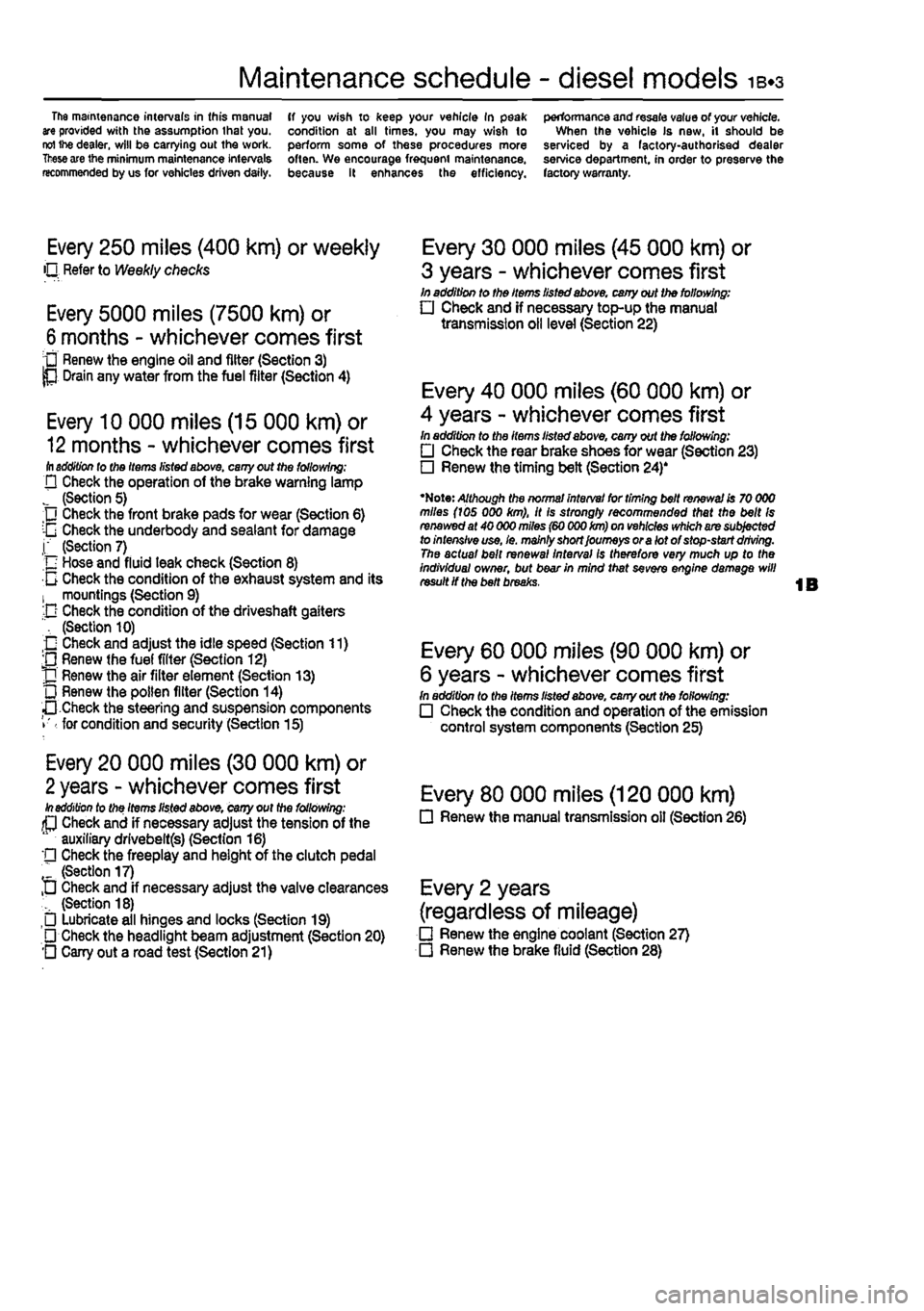
Maintenance schedule - diesel models 1B.3
The mamtenance intervals in this manual are provided with the assumption that you. reI ihe dealer, will be carrying out the work.
These
are the minimum maintenance intervals recommended by us for vehicles driven daily.
ff you wish to keep your vehicle In peak condition at all times, you may wish to perform some of these procedures more often. We encourage frequent maintenance, because it enhances the efficiency.
performance and resale value of your vehicle. When the vehicle Is new, it should be serviced by a factory-authorised dealer service department, in order to preserve the factory warranty.
Every 250 miles (400 km) or weekly O Refer to Weekly checks
Every 5000 miles (7500 km) or
6
months - whichever comes first • Renew the engine oil and filter (Section 3) P Drain any water from the fuel filter (Section 4)
Every 10 000 miles (15 000 km) or
12
months - whichever comes first ill addition lo tho Items listed above, cany out the following; D Check the operation of the brake warning lamp J (Section 5) Check the front brake pads for wear (Section 6) :-G Check the underbody and sealant for damage j" (Section 7) n Hose and fluid leak check (Section 8) 0 Check the condition of the exhaust system and its 1 mountings (Section 9) -D Check the condition of the driveshaft gaiters ", (Section 10) O Check and adjust the idle speed (Section 11) ;0 Renew (he fuel filter (Section 12) J] Renew the air filter element (Section 13) L) Renew the pollen filter (Section 14) •• Check the steering and suspension components • for condition and security (Section 15)
Every 20 000 miles (30 000 km) or
2
years - whichever comes first In addition to the Items listed above, cany out the following: (P Check and if necessary adjust the tension of the auxiliary drlvebeltfs) (Section 16) '• Check the freeplay and height of the clutch pedal " (Section 17) D Check and if necessary adjust the valve clearances (Section 18) Lubricate all hinges and locks (Section 19) • Check the headlight beam adjustment (Section 20) O Cany out a road test (Section 21)
Every 30 000 miles (45 000 km) or
3 years - whichever comes first In addition to the Items listed above, cany out the following: • Check and if necessary top-up the manual transmission oil level (Section 22)
Every 40 000 miles (60 000 km) or
4 years - whichever comes first In addition to the items listed above, cany out the following: • Check the rear brake shoes for wear (Section 23) • Renew the timing belt (Section 24)'
•Note: Although the normal interval for timing belt renewal is 70 000 miles (ids 000 km), it is strongly recommended that the belt Is renewed at 40 000 miles (60 000 km) on vehicles which are subjected to intensive use, le. mainly short Journeys or a lot of stop-start driving. The actual bait renewal interval Is therefore very much up to the Individual owner, but bear in mind that sevefe engine damage will result if the belt breaks.
Every 60 000 miles (90 000 km) or
6 years - whichever comes first In addition to the Items listed above, cany out the following: • Check the condition and operation of the emission control system components (Section 25)
Every 80 000 miles (120 000 km) • Renew the manual transmission oil (Section 26)
Every 2 years
(regardless of mileage) • Renew the engine coolant (Section 27) • Renew the brake fluid (Section 28)
Page 41 of 225
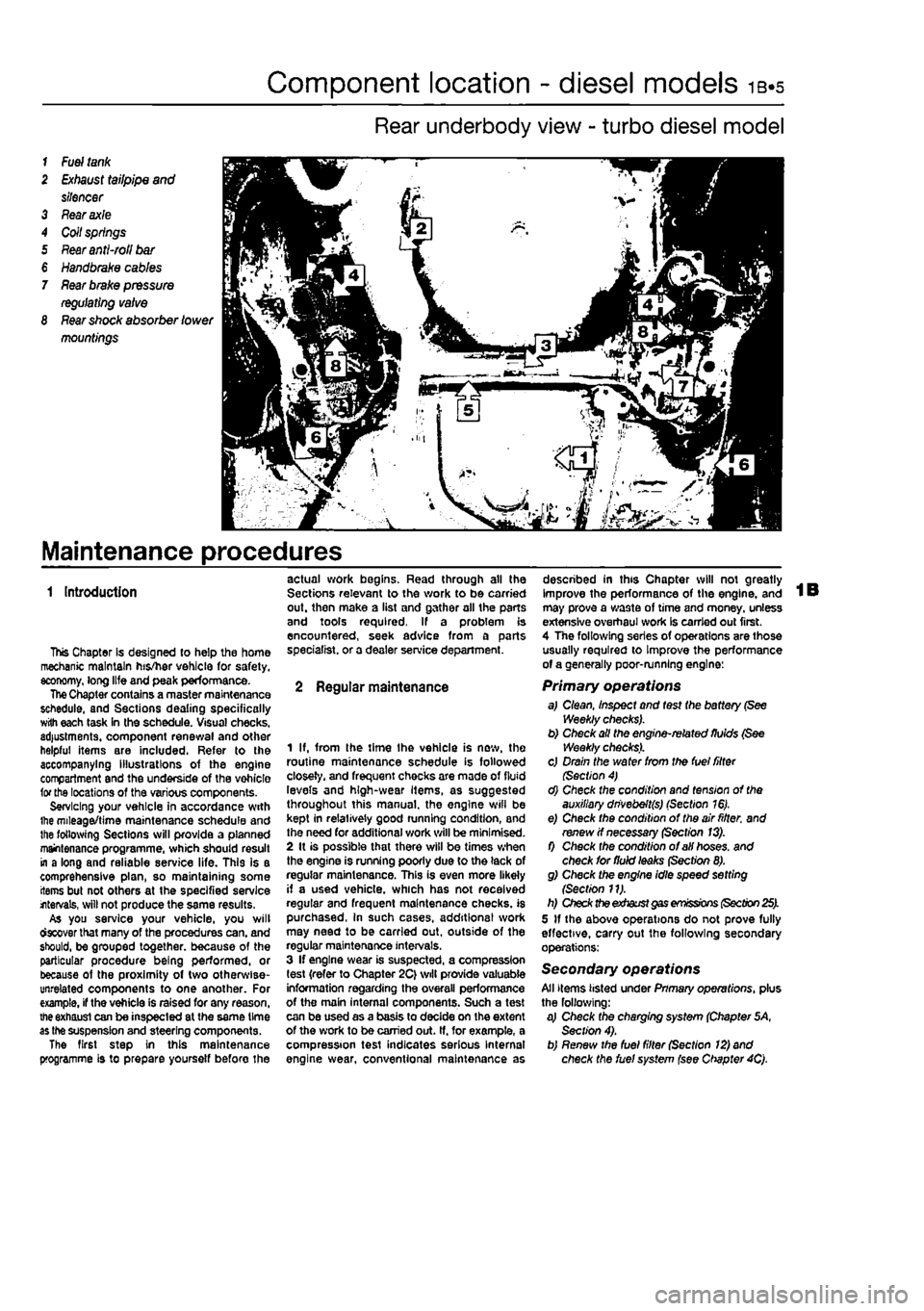
Component location - diesel models ib-s
Rear underbody view - turbo diesel model
1
Fuel tank
2
Exhaust
tailpipe
and
silencer 3 Fear axle 4 Coil springs 5
Rear anti-roll bar
€
Handbrake cables
7
Rear brake pressure regulating valve
8
Rear shock
absorber
lower
mountings
Maintenance procedures
1 Introduction
This Chapter Is designed to help the home mechanic maintain his/her vehicle for safety, economy, long life and peak performance. The Chapter contains a master maintenance schedule, and Sections dealing specifically with each task in the schedule. Visual checks, adjustments, component renewal and other helpful items are included. Refer to the accompanying illustrations of the engine compartment and the underside of the vohicle for the locations of the various components. Servicing your vehicle in accordance with ihe mileage/time maintenance schedule and the following Sections will provide a planned maintenance programme, which should result in a long and reliable service life. This is a comprehensive plan, so maintaining some items but not others at the specified service internals, will not produce the same results. As you service your vehicle, you will ctecover that many of the procedures can. and should, be grouped together, because of the particular procedure being performed, or because of the proximity of two otherwise-unrelated components to one another. For example, if the vehicle is raised for any reason, the exhaust can be inspected at the same time as the suspension and steering components. The first step in this maintenance programme is to prepare yoursetf before the
actual work begins. Read through all the Sections relevant to the work to be carried out. then make a list and gather all the parts and tools required. If a problem is encountered, seek advice from a parts specialist, or a dealer service department.
2 Regular maintenance
1 If, from the time Ihe vehicle is new, the routine maintenance schedule is followed closely, and frequent checks are made of fluid levels and high-wear Items, as suggested throughout this manual, the engine wifl be kept in relatively good running condition, and the need for additional work will be minimised. 2 It is possible that there will be times when the engine is running poorly due to the lack of regular maintenance. This is even more likely if a used vehicle, which has not received regular and frequent maintenance checks, is purchased, in such cases, additions! work may need to be carried out, outside of the regular maintenance intervals. 3 If engine wear is suspected, a compression test {refer to Chapter 2C} will provide valuable information regarding the overall performance of the main internal components. Such a test can be used as a basis to decide on the extent of the work to be carried out. If, for example, a compression test indicates serious Internal engine wear, conventional maintenance as
described in this Chapter will not greatly improve the performance of the engine, and may prove a wa3te of time and money, unless extensive overhaul work Is carried out first. 4 The following series of operations are those usually required to Improve the performance of a generally poor-running engine:
Primary operations a,I Clean, Inspect and test the battery (See Weekly checks). b) Check all the engine-related fluids (See Weekly checks). c) Drain the water from the fuel filter (Section 4) d) Check the condition and tension of the auxiliary dnvebeft(s) (Section 16). e) Check the condition of the air fitter, and renew if necessary (Section 13). f) Check the condition of all hoses, and check for fluid leaks (Section 8). g) Check the engine idle speed setting {Section 11). h) Check the exhaust gas emissions (Section 25). 5 If the above operations do not prove fully effective, carry out the following secondary operations:
Secondary operations All items listed under Pnmary operations, plus the following: a) Check the charging system (Chapter 5A, Section 4). b) Renew the fuel filter (Section 12) and check the fuel system (see Chapter 4Q.
Page 47 of 225
Every 20 000 miles - diesel models ib.h
18
Valve clearance check and
adjustment
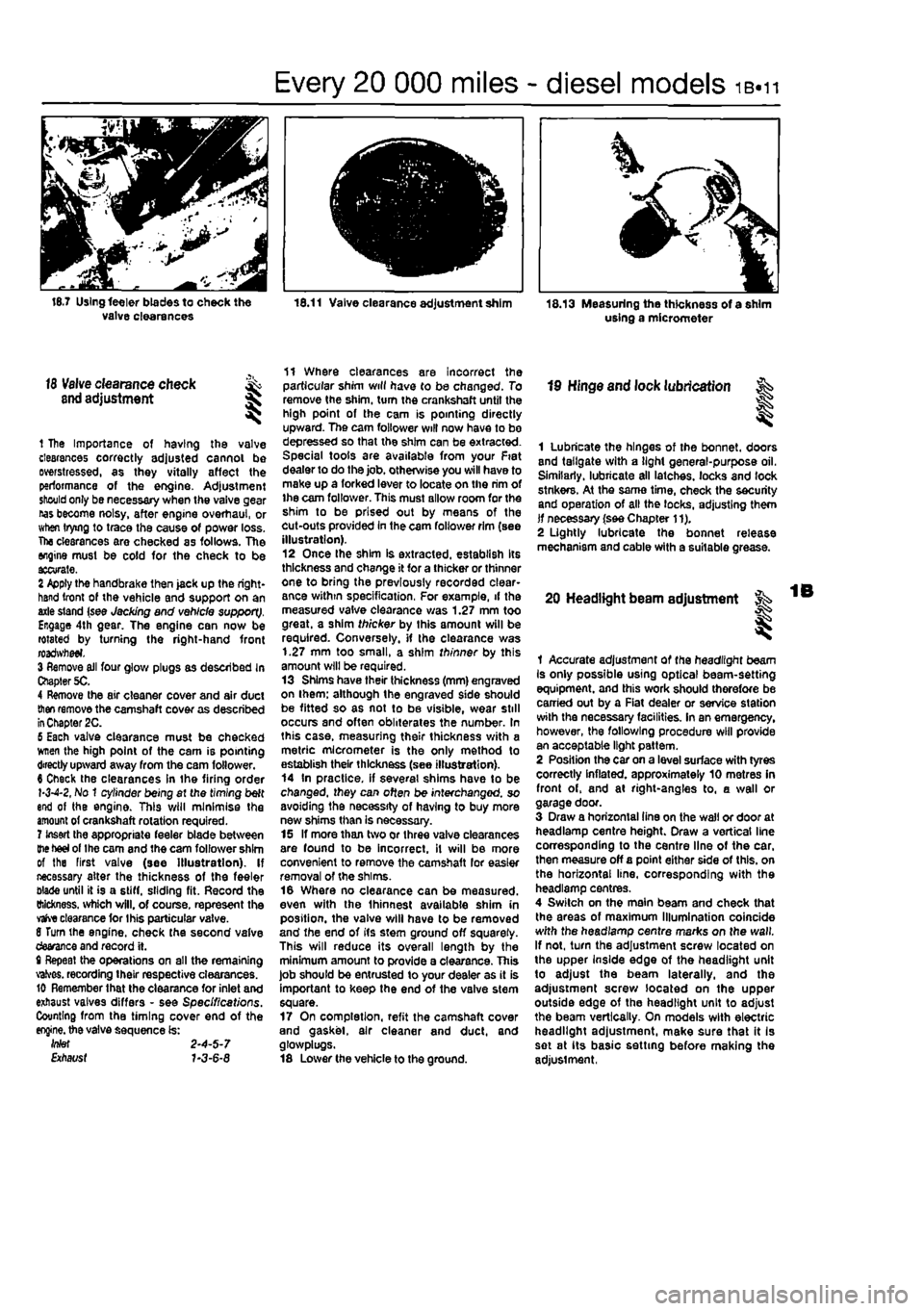
1 The Importance of having the valve clearances correctly adjusted cannot be Distressed, as they vitally affect the performance of the engine. Adjustment should only be necessary when the valve gear nas become noisy, after engine overhaul, or when trying to trace the cause of power loss. The clearances are checked as follows. The engine must be cold for the check to be ttcurate. 2 Apply the handbrake then jack up the right-hand front of the vehicle and support on an axle stand (see Jacking and vehicle support). Engage 4th gear. The engine can now be rotated by turning the right-hand front roadwfteei. 3 Remove ail four glove plugs as described In Chapter 5C. 4 Remove the air cleaner cover and air duct
then
remove the camshaft cover as described
in
Chapter 2C. 6 Each valve clearance must be checked wnen the high point of the cam is pointing directly upward away from the cam follower. 6 Check the clearances in the firing order 1-3-4-2, No 1 cylinder being at the timing belt end of the engine. This will minimise the amount of crankshaft rotation required. 7 Insert the appropriate feeler blade between
the heel
of the cam and the cam follower shim of the First valve (see Illustration). If necessary alter the thickness of the feeler blade until it is a stiff, sliding fit. Record the thickness, which will, of course, represent the
vafve
clearance tor Ihis particular valve. 8 Turn the engine, check the second valve devance and record it. t Repeat the operations on all the remaining valves. recording their respective clearances. 10 Remember that the clearance for inlet and exhaust valves differs - see Specifications. Counting from the timing cover end of the
engine,
the valve sequence is: Wef 2-4-5-7 Etfiat/sf 7-3-6-8
11 Where clearances are incorrect the particular shim will have to be changed. To remove the shim, turn the crankshaft until the high point of the cam is pointing directly upward. The cam follower will now have to bo depressed so that the shim can be extracted. Special tools are available from your Fiat dealer to do the job. otherwise you will have to make up a forked lever to locate on the rim of ihe cam follower. This must allow room for the shim to be prised out by means of the cut-outs provided in the cam follower rim (see illustration). 12 Once Ihe shim is extracted, establish Its thickness and change it for a thicker or thinner one to bring the previously recorded clear-ance within specification, For example, if the measured valve clearance was 1.27 mm too great, a shim thicker by this amount will be required. Conversely, if the clearance was 1.27 mm too small, a shim thinner by this amount will be required. 13 Shims have their thickness (mm) engraved on ihem; although the engraved side should be fitted so as not to be visible, wear still occurs and often obliterates the number. In this case, measuring their thickness with a metric micrometer is the only method to establish their thickness (see illustration). 14 In practice, if several shims have to be changed, they can often be interchanged, so avoiding the necessity of having to buy more new shims than is necessary. 15 If more than two or three valve clearances are found to be incorrect, it will be more convenient to remove the camshaft lor easier removal of the shims. 16 Where no clearance can be measured, even with the Ihinnest available shim in position, the valve will have to be removed and the end of its stem ground off squarely. This will reduce its overall length by the minimum amount to provide a clearance. This job should be entrusted to your dealer as it is important to keep the end of the valve stem square. 17 On completion, refit the camshaft cover and gasket, air cleaner and duct, and glosvplugs. 18 Lower the vehicle to the ground.
19 Hinge and lock lubrication
I
1 Lubricate the hinges of the bonnet, doors and tailgate with a light general-purpose oil. Similarly, lubricate all latches, locks and lock stnkers. At the same time, check the security and operation of all the locks, adjusting them if necessary (see Chapter 11). 2 Lightly lubricate the bonnet release mechanism and cable with a suitable grease.
20 Headlight beam adjustment
I
1 Accurate adjustment of the headlight beam Is only possible using optical beam-setting equipment, and this work should therefore be carried out by a Fiat dealer or service station with the necessary facilities. In an emergency, however, the following procedure will provide an acceptable light pattern. 2 Position the car on a level surface with tyres correctly inflated, approximately 10 metres in front of, and at right-angles to, a wall or garage door. 3 Draw a horizontal tine on the wall or door at headlamp centre height. Draw a vertical line corresponding to the centre line of the car. then measure off a point either side of this, on the horizontal line, corresponding with the headlamp centres. 4 Switch on the main beam and check that the areas of maximum Illumination coincide with the headlamp centre marks on the wall. If not, turn the adjustment screw located on the upper Inside edge of the headlight unit to adjust the beam laterally, and the adjustment screw located on the upper outside edge of the headlight unit to adjust the beam vertically. On models with electric headlight adjustment, make sure that it Is set at its basic setting before making the adjustment,
Page 51 of 225
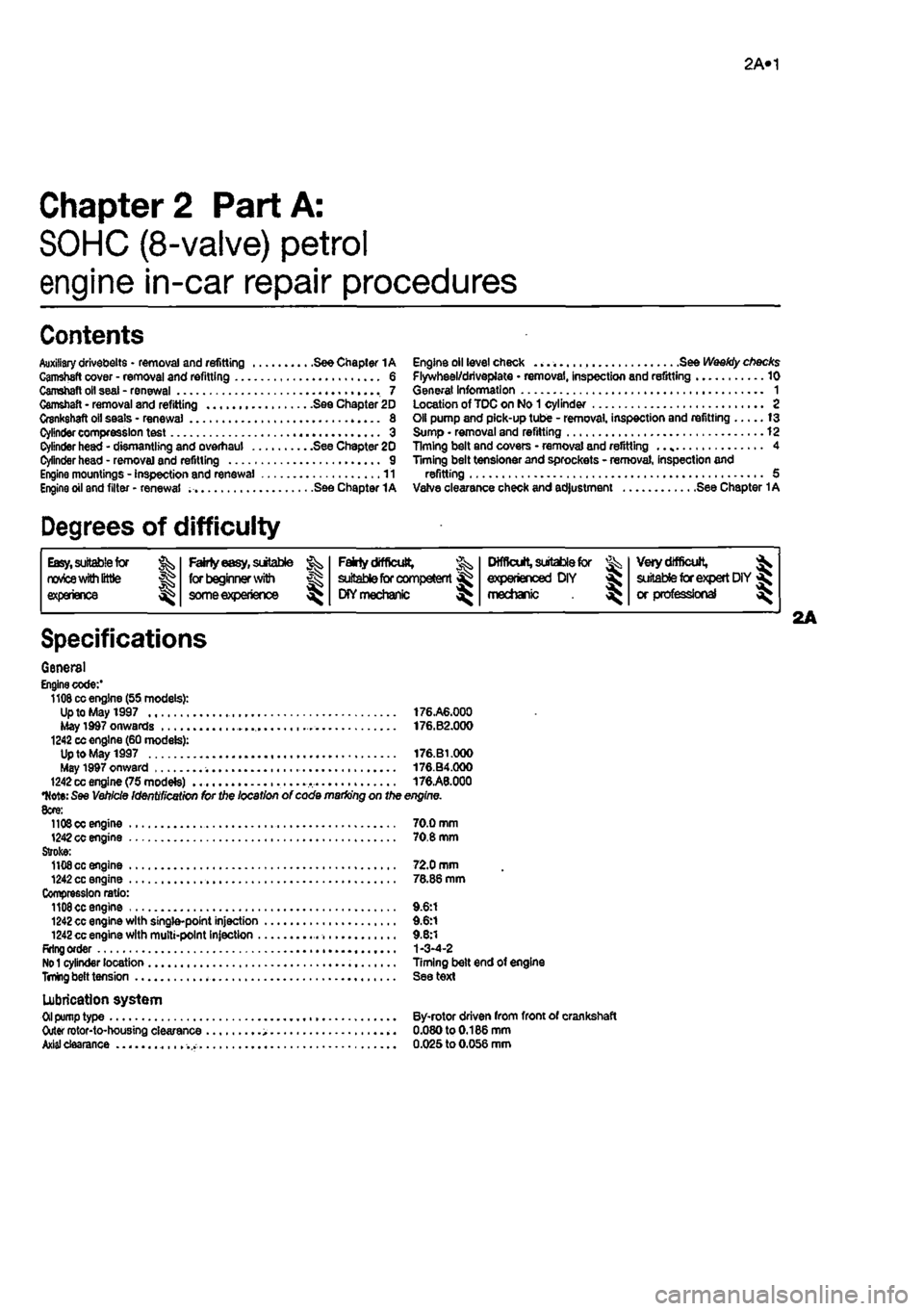
2A«1
Chapter 2 Part A:
SOHC (8-valve) petrol
engine in-car repair procedures
Contents
Auxiliary drivebelts • removal and refitting See Chapter 1A Gamstaft cover - removal and refitting 6 Camshaft oil seal - renewal 7 Camshaft • removal and refitting See Chapter 20 Crankshaft oil seals - renewal 8 Cylinder compression test 3 Cylinder head - dismantling and overhaul See Chapter 20 Cylinder head - remove] and refitting 9 Engine mountings - Inspection and renewal 11 Engine oil and filter • renewal See Chapter 1A
Degrees of difficulty
Engine oil level check See Weekiy checks Flywheel/driveplate • removal, inspection and refitting 10 General Information 1 Location of TOC on No 1 cylinder 2 Oil pump and pick-up tube - removal, inspection and refitting 13 Sump • removal and refitting 12 Timing belt and covers • removal and refitting .. 4 Timing belt tensioner and sprockets - removal, inspection and refitting 5 Vafve clearance check and adjustment See Chapter 1A
Easy, suitable (or twics with little |g experience ^
Fairty easy, suitable jk for beginner with & some experience ^
Fatrty difficult, ^ suitable for competent ^ CKYmechanic ^
Difficult, suitable for ^ experienced DIY « mechanic ^
Veiy difficult, ^ aiitabte for expert DIY « or professional
Specifications
General Engine code:' 1108 cc engine (55 models): Up to May 1997 176.A6.000 May 1d97 onwards • . 176.B2.000 1242 cc engine (60 models): Up to May 1997 176.B1.000 May 1997 onward 176.B4.000 1242 cc engine (75 modete) 176.A8.000
•Note:
See Vehicle Identification for the location of code marking on the engine. 8cre: 11O0OC engine 70.0 mm 1242 cc engine 70.8 mm Stroke: 1108 cc engine 72.0 mm 1242 cc engine 78.86 mm Compression ratio: 1108 cc engine 9.6:1 1242 cc engine with single-point injection 9.6:1 1242 cc engine with multi-point injection 9.8:1 Rrlng order 1-3-4-2
No 1
cylinder location Timing belt end of engine
TnUng
belt tension See text
Lubrication system
Oil
pump type By-rotor driven from front of crankshaft Outer rotor-to-housing clearance 0.080to0.186mm
Axial
clearance 0.025 to 0.056 mm
Page 52 of 225
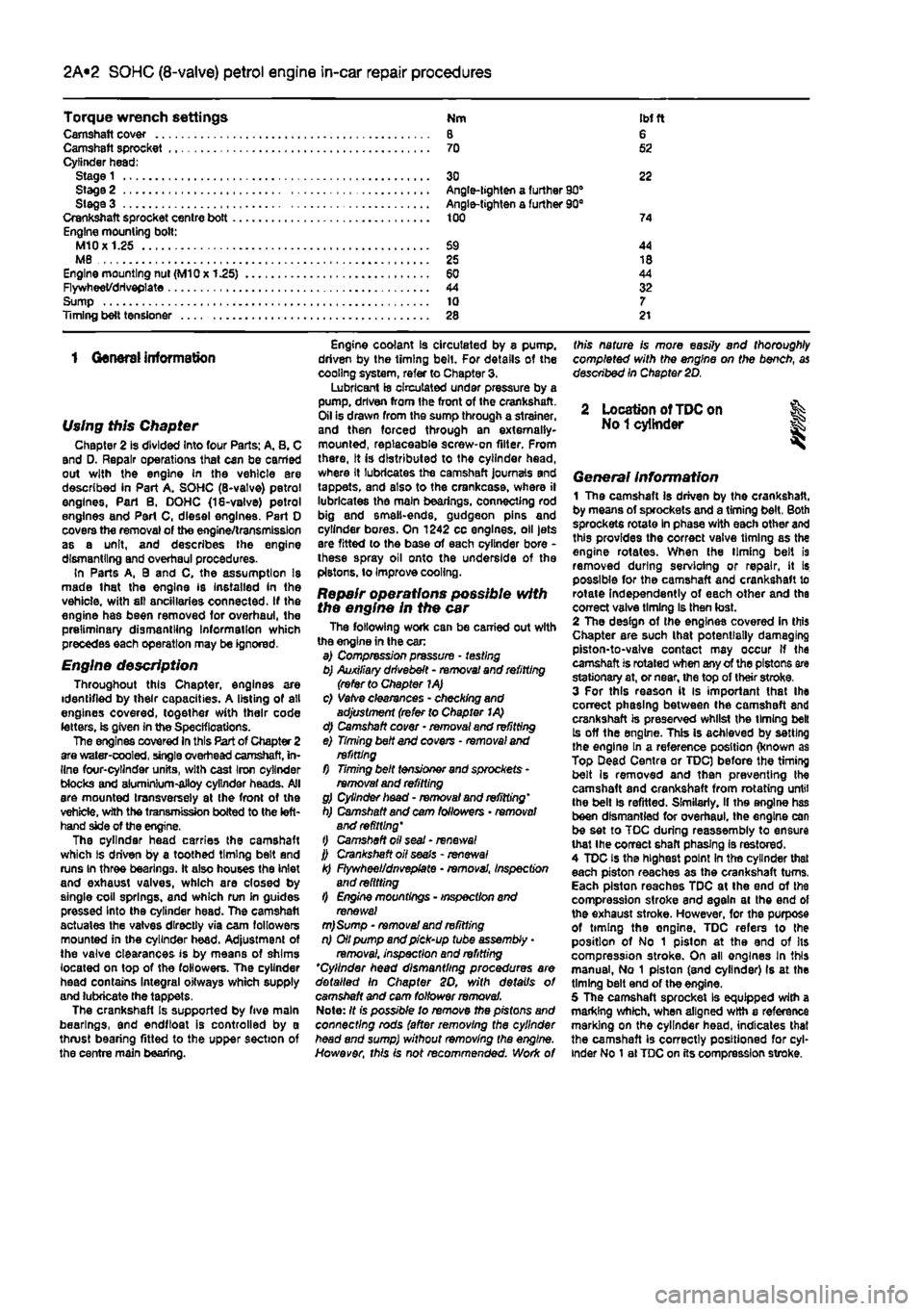
2A*10 SOHC (8-valve) petrol engine in-car repair procedures
Torque wrench settings Nm
IM
ft Camshaft cover 8 6 Camshaft sprocket 70 52 Cylinder head; Stage 1 30 22 Stage 2 Angle-lighten a further 90° Siege 3 Angle-tighten a further 90B Crankshaft sprocket centre bott 100 74 Engine mounting bolt: M10X1.25 69 44 MB 25 18 Engine mounting nut (M10x 1.25) 60 44 Flywheet/driveplate 44 32 Sump 10 7 Timing belt tensJoner 28 21
1 General information
Using this Chapter Chapter 2 is divided Into four Parts: A. 8. C and D. Repair operations that can be carried out with the engine in the vehicle are described in Part A. SOHC (8-valve) petrol engines, Part B. DOHC (18-valve) petrol engines and Part C, diesel engines. Part 0 covers the removal of the engine/transmission as a unit, and describes the engine dismantling and overhaul procedures. In Parts A, 9 and C, the assumption Is made lhat the engine is Installed in the vehicle, with sll ancillaries connected. If the engine has been removed for overhaul, the preliminary dismantling Information which precedes each operation may be ignored.
Engine description Throughout this Chapter, engines are identified by their capacities. A listing of all engines covered, together with their code letters, is given in the Specifications. The engines covered In this Part of Chapter 2 are water-cooled, single overhead camshaft, in-line four-cylinder units, with cast Iron cylinder Mocks and aluminium-alloy cylinder heads. All are mounted transversely at the front ot the vehicle, with the transmission bolted to the left-hand side of the engine, The cylinder head carries the camshaft which is driven by a toothed timing belt and runs In three bearings. It also houses the inlet and exhaust valves, which are closed by single coil springs, and which run in guides pressed Into the cylinder head. The camshaft actuates the vatves directly via cam followers mounted in the cylinder head. Adjustment of the valve clearances is by means of shims located on top of the followers. The cylinder head contains Integral oitways which supply and lubricate the tappets. The crankshafl Is supported by five main bearings, and endftoat is controlled by a thrust bearing fitted to the upper section of the centre main bearing.
Engine coolant is circulated by 8 pump, driven by the timing belt. For details of the cooling system, refer to Chapter 3. Lubricant is circulated under pressure by a pump, driven from ihe front of the crankshaft. Oil Is drawn from the sump through a strainer, and then forced through an externally-mounted, replaceable screw-on filter. From there, It is distributed to the cylinder head, where It lubricates the camshaft journals and tappets, and also to the crankcase, where il lubricates the main bearings, connecting rod big and smell-ends, gudgeon pins and cylinder bores. On 1242 cc engines, oil jets are fitted lo the base of each cylinder bore -these spray oil onto the underside of the pistons, to Improve cooling.
Repair operations possible with the engine in the car The following work can be carried out with the engine in the car a) Compression pressure - testing b) Auxiliary drivebelt - removal and refitting (refer to Chapter 1A) c) Vatve clearances - checking and adjustment (refer to Chapter I A) d) Camshaft cover - removal and refitting e) Timing belt and covens - removal and refitting f) Timing belt tensioner and sprockets -removal and refitting g) Cylinder head - removal and refitting' h) Camshaft and cam followers • removal and refitting' t) Camshaft oil seal - renews/ j) Crankshaft oil seals - renewal k) Flywheel/dnvepfate • removal, inspection and refitting l) Engine mountings - inspection and renewal m)Sump - removal and refitting n) Oil pump and pick-up tube assembly
•
removai. inspection and refitting *Cylinder head dismantling procedures are detailed In Chapter SO, with details of camshaft and cam follower removal. Note: It is possible to remove the pistons and connecting rods (after removing the cylinder head and sump) without removing the engine. However, this is not recommended. Work of
this nature is more easily and thoroughly completed with the engine on the bench, as described In Chapter 2D.
2 Location of
TDC
on % No
1
cylinder
General Information 1 The camshaft Is driven by the crankshaft, by means of sprockets and a timing belt. Both sprockets rotate In phase with each other and this provides the correct valve timing as the engine rotates. When (he liming belt is removed during servioing or repair, it Is possible for the camshaft and crankshaft to rotate Independently of each other and the correct valve timing Is then lost. 2 The design of the engines covered In this Chapter are such lhat potentially damaging piston-to-valve contact may occur if the camshaft is rotated when any of the pistons are stationary at, or near, the top of their stroke. 3 For this reason it is important lhat Ihe correct phasing between the camshaft and crankshaft is preserved whilst the timing belt Is off the engine. This is achieved by setting the engine In a reference position (known as Top Dead Centre or TDC) before the timing belt Is removed and then preventing the camshaft and crankshaft from rotating until the belt is refitted. Similarly, if ths engine has been dismantled for overhaul, the engine can be set to TOC during reassembly to ensure that Ihe correct shaft phasing is restored. 4 TDC is the highest point In the cylinder that each piston reaches as the crankshaft turns. Each piston reaches TDC at Ihe end of the compression stroke and again at the end of the exhaust stroke. However, for the purpose of timing the ongine. TDC refers to the position of No 1 piston at the end of Its compression stroke. On ail engines In this manual, No 1 piston (and cylinder) Is at the timing belt end of the engine. 5 The camshaft sprocket Is equipped with a marking which, when aligned with a reference marking on the cylinder head, indicates that the camshaft is correctly positioned for cyl-inder No 1 al TDC on its compression stroke.