media FIAT PUNTO 2011 Owner handbook (in English)
[x] Cancel search | Manufacturer: FIAT, Model Year: 2011, Model line: PUNTO, Model: FIAT PUNTO 2011Pages: 219, PDF Size: 9.58 MB
Page 23 of 219
19
SAFETY
STARTING
AND DRIVING
WARNING
LIGHTS AND MESSAGES
IN AN
EMERGENCY
SERVICE
AND CARE
TECHNICAL
SPECIFICATIONS
INDEX
CONTROLS
AND DEVICES
Setting the speed limit (SPEEd)
With this function, it is possible to set the
car speed limit (km/h or mph). When this
limit is exceeded, the driver is immediately
alerted (see section “Warning lights and
messages”).
To set the desired speed limit, proceed as
follows:
– briefly press MENU ESC– the mes-
sage (SPEEd) and the previously set unit
(km/h) or (mph) will appear on the display;
– press +or –to activate (On) or deac-
tivate (Off) the speed limit;
– if the function is on, press + or –to se-
lect the required speed limit and then
press MENU ESC to confirm;
NB The speed may be set in the range
from 30 to 200 km/h, or from 20 to
125 mph according to the previously cho-
sen unit (see “Setting the distance unit
(Unit)” below). The setting will in-
crease/decrease by five units each time
+ /– is pressed. Hold down +/– to in-
crease/decrease the setting rapidly. When
you get close to the desired value, finish
the setting with single presses. – briefly press MENU ESC
to return to
the menu screen or hold the button down
to return to the standard screen without
saving.
To cancel the setting, proceed as follows:
– briefly press MENU ESC: (On) will
flash on the display;
– press – : (Off) will flash on the display;
– briefly press MENU ESC to return to
the menu screen or hold the button down
to return to the standard screen without
saving.
Setting the clock (Hour)
With this function, it is possible to set the
time.
To do so, proceed as follows:
– briefly press MENU ESC – the “hours”
will flash on the display;
– press + or –to set the value;
– briefly press MENU ESC – the “min-
utes” will flash on the display;
– press + or –to set the value;
– briefly press MENU ESCto return to
the menu screen or hold the button down
to return to the standard screen without
saving. Adjusting the buzzer volume
(BUZZ)
This function is used to adjust the volume
of the buzzer that sounds in the event
of failure/warning indications and when
the
MENU ESC, +and –buttons are
pressed.
To set the desired volume, proceed as
follows:
– briefly press MENU ESC – the display
will show the wording (bUZZ);
– press + or –to select the required vol-
ume (adjustable over 8 levels).
– briefly press MENU ESC to return to
the menu screen or hold the button down
to return to the standard screen without
saving.
001-032 PUNTO POP 1ed EN.qxd 3-10-2011 11:43 Pagina 19
Page 43 of 219
39
SAFETY
STARTING
AND DRIVING
WARNING
LIGHTS AND MESSAGES
IN AN
EMERGENCY
SERVICE
AND CARE
TECHNICAL
SPECIFICATIONS
INDEX
CONTROLS
AND DEVICES
Knob C adjusts air distribution
¶to direct air to the centre and side
vents;
ßto send air to the feet and direct cool-
er air to the dashboard vents, in in-
termediate temperature conditions;
©for heating when the outside temper-
ature is very low: to direct as much air
as possible to the feet;
®to warm the feet and, at the same
time, demist the windscreen;
-to quickly de-mist the windscreen.
Button D turns air
recirculation on/off
Press the button (button LED on) to turn
the air internal recirculation on.
Press the button (button LED off) to turn
air internal recirculation off. RAPID PASSENGER
COMPARTMENT HEATING
For the rapid heating of the passenger
compartment, proceed as follows:
❒turn knob A
to red section;
❒turn air internal recirculation on by
pressing button D(button LED on);
❒turn knob C to ©;
❒turn knob Bto 4 -(max. fan speed).
Then use the controls to keep the re-
quired comfort conditions and press but-
ton Dto turn air internal recirculation off
(button LED off) and prevent misting up.
IMPORTANT With a cold engine, you
have to wait for a few minutes to let the
system fluid reach optimum operating
temperature.
PASSENGER COMPARTMENT
VENTILATION
To ventilate the passenger compartment
properly, proceed as follows:
❒turn knob A
to blue section;
❒turn air internal recirculation off by
pressing button D(button LED off);
❒turn knob C to ¶;
❒turn knob Bto the required speed.
PASSENGER COMPARTMENT
HEATING
Proceed as follows:
❒turn knob A to red section;
❒turn knob C to the required position;
❒turn knob Bto the required speed.
033-069 PUNTO POP 1ed EN 30-09-2011 10:17 Pagina 39
Page 46 of 219
42
SAFETY
STARTING
AND DRIVING
WARNING
LIGHTS AND MESSAGES
IN AN
EMERGENCY
SERVICE
AND CARE
TECHNICAL
SPECIFICATIONS
INDEX
CONTROLS
AND DEVICES
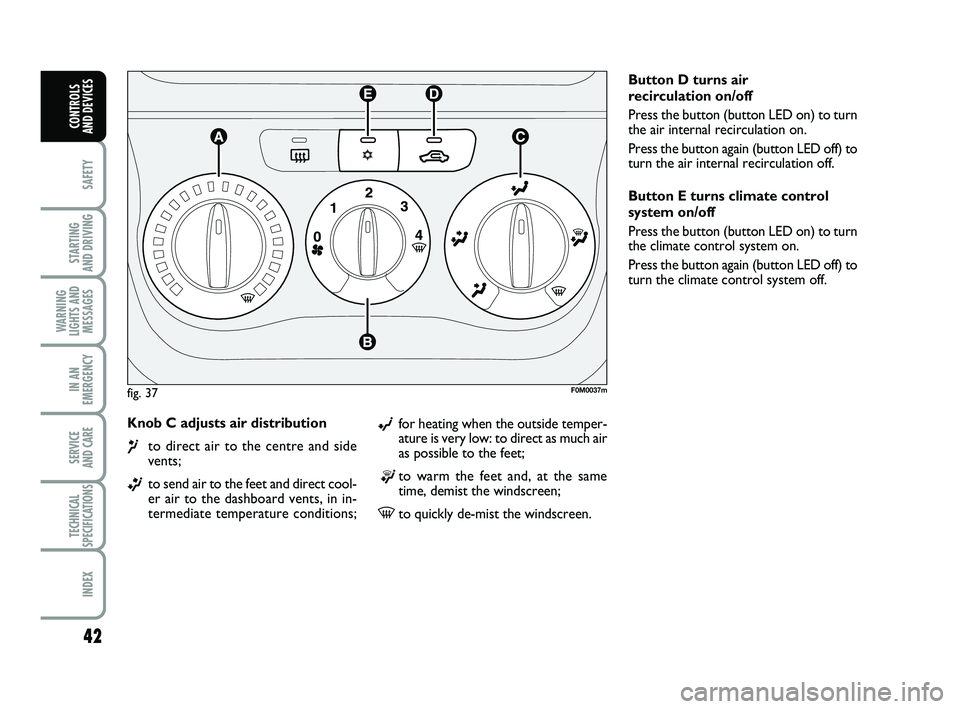
Knob C adjusts air distribution
¶to direct air to the centre and side
vents;
ßto send air to the feet and direct cool-
er air to the dashboard vents, in in-
termediate temperature conditions; Button D turns air
recirculation on/off
Press the button (button LED on) to turn
the air internal recirculation on.
Press the button again (button LED off) to
turn the air internal recirculation off.
Button E turns climate control
system on/off
Press the button (button LED on) to turn
the climate control system on.
Press the button again (button LED off) to
turn the climate control system off.
fig. 37F0M0037m
©for heating when the outside temper-
ature is very low: to direct as much air
as possible to the feet;
®to warm the feet and, at the same
time, demist the windscreen;
-to quickly de-mist the windscreen.
033-069 PUNTO POP 1ed EN 30-09-2011 10:17 Pagina 42
Page 73 of 219

69
SAFETY
STARTING
AND DRIVING
WARNING
LIGHTS AND MESSAGES
IN AN
EMERGENCY
SERVICE
AND CARE
TECHNICAL
SPECIFICATIONS
INDEX
CONTROLS
AND DEVICES
For safety reasons, the bon-
net must always be perfect-
ly closed while travelling. Make sure
that the bonnet is perfectly closed
and that the lock is engaged. If you
discover during travel that the lock
is not fully engaged, stop immediate-
ly and close the bonnet in the correct
manner.
WARNING
If the supporting rod is not
positioned correctly, the
bonnet may fall violently.
WARNING
Perform these operations on-
ly when the car is stationary.
WARNING
ROOF RACK/SKI RACK
3-door versions
The front hooks are located at points
A-fig. 93.
The rear hooks are set at points Bmarked
by the (
O) symbols on the rear side win-
dows.
5-door versions
The front hooks are located at points
A-fig. 93.
The rear hooks are set at points B and are
marked by a groove on the upper part of
the door frame. IMPORTANT Follow the instructions
contained in the assembly kit carefully. As-
sembly must be performed by qualified
personnel.
fig. 93F0M0102m
After travelling for a short
distance, check that the fas-
tening screws are correctly tightened.
WARNING
Strictly adhere to the laws in
force concerning maximum
clearance.
Distribute the load evenly
and, when driving, bear in
mind the increased sensitivity of the
vehicle to side wind.
WARNING
Never exceed the permitted
load (see “Technical data”
section).
033-069 PUNTO POP 1ed EN 30-09-2011 10:17 Pagina 69
Page 77 of 219

73
SAFETY
STARTING
AND DRIVING
WARNING
LIGHTS AND MESSAGES
IN AN
EMERGENCY
SERVICE
AND CARE
TECHNICAL
SPECIFICATIONS
INDEX
CONTROLS
AND DEVICES
ESP SYSTEM (Electronic
Stability Program)
(for versions/markets, where provided)
This is an electronic system that controls
car stability in the event of tyre grip loss,
helping to maintain directional control.
The ESP system is therefore particularly
useful when road surface grip changes.
In addition to the ESP system, ASR system
and Hill Holder, the MSR system (adjusting
the engine braking torque) and the HBA
system (improving the braking force dur-
ing emergency braking) are also provided
(for versions/markets, where provided).
SYSTEM INTERVENTION
This is signalled by the flashing of warn-
ing light
áon the instrument panel, to in-
form the driver that the car is in critical
stability and grip conditions.
When the ABS cuts in and
you feel the brake pedal pul-
sating, do not remove your foot, but
keep the pedal pushed down; in do-
ing so you, will stop in the shortest
distance possible under the road con-
ditions at the time.
WARNINGEBD failure
This is indicated by the
>and xwarn-
ing lights on the instrument panel togeth-
er with the dedicated message on the mul-
tifunction display (for versions/markets,
where provided) coming on (see “Warn-
ing lights and messages” section).
In this case, the rear wheels may sudden-
ly lock and the vehicle may swerve when
braking sharply. Drive carefully to the
nearest Fiat Dealership to have the system
checked.
If only the xwarning light
on the instrument panel
lights up (together with a message in
the multifunction display, for ver-
sions/markets, where provided) stop
the vehicle immediately and contact
the nearest Fiat Dealership. Fluid
leaking from the hydraulic system will
compromise the operation of the
braking system, whether it is of the
conventional type or with ABS.
WARNING
070-090 PUNTO POP 1ed EN 30-09-2011 10:18 Pagina 73
Page 82 of 219

78
SAFETY
STARTING
AND DRIVING
WARNING
LIGHTS AND MESSAGES
IN AN
EMERGENCY
SERVICE
AND CARE
TECHNICAL
SPECIFICATIONS
INDEX
CONTROLS
AND DEVICES
FAILURE INDICATIONS
Any failure of the electric power steering
system is indicated by instrument panel
warning light
gcoming on together with
a message on the multifunction display (for
versions/markets, where provided) (see
section “Warning lights and messages”).
In the event of electric power steering sys-
tem failure, the car can be driven with me-
chanical steering.
IMPORTANT In some circumstances, fac-
tors independent of the electric power
steering could cause the
gwarning light
in the instrument panel to come on.
In this case, stop the car immediately,
switch off the engine for about 20 seconds
and then restart the car. If the warning
light
gis still on, along with the message
on the multifunction display (for ver-
sions/markets, where provided), contact
a Fiat Dealership. IMPORTANT The steering may become
stiffer during parking manoeuvres that re-
quire a lot of turns of the wheel. This is
normal and is caused by the electric con-
trol motor overheating protection system.
No repairs are needed. The power steer-
ing system will start working properly
again the next time the car is used.
It is absolutely forbidden to
carry out any after-market
operation involving steering system or
steering column modifications (e.g. in-
stallation of anti-theft device) that
could badly affect performance and
safety, invalidate the warranty and
also result in the car failing to com-
ply with regulations.
WARNING
Before servicing the car,
switch off the engine and re-
move the key from the ignition to ac-
tivate the steering lock. This is espe-
cially important when the car wheels
are not touching the ground. If this
is not possible (for example if the key
needs to be turned to MAR or the en-
gine must be running), remove the
main fuse that protects the electric
power steering.
WARNING
070-090 PUNTO POP 1ed EN 30-09-2011 10:18 Pagina 78
Page 107 of 219
103
STARTING
AND DRIVING
WARNING
LIGHTS AND MESSAGES
IN AN
EMERGENCY
SERVICE
AND CARE
TECHNICAL
SPECIFICATIONS
INDEX
CONTROLS
AND DEVICES
SAFETY
FRONT AIRBAGS
The car is fitted with front airbags for the
driver and the passenger, and with a knee
bag on the driver’s side (for versions/mar -
kets, where provided).
The front driver/passenger airbags and the
driver’s knee bag (for versions/markets,
where provided) have been designed to
protect the occupants of the front seats
in the event of head-on crashes of medi-
um/high severity, by placing the bag be-
tween the occupant and the steering
wheel or dashboard.
Non-activation in other types of crash
(side-on collisions, rear shunts, roll-overs,
etc.) is therefore not a sign of system mal-
function.
An electronic control unit causes the bag
to inflate in the event of a head-on crash.
The bag will inflate instantaneously, placing
itself between the front occupant’s body
and the structures which could cause in-
jury. It will deflate immediately afterwards.
The front driver/passenger airbags and the
driver’s knee bag (for versions/markets,
where provided) are not a replacement
for, but rather complement the use of,
seat belts, which should always be worn,
as specified by law in Europe and most
non-European countries. The volume of the front airbags at maxi-
mum inflation fills most of the space
between the steering wheel and the dri-
ver and between the dashboard and the
passenger.
In the event of an impact, someone not
wearing a seat belt will move forward and
come into contact with the bag which is
still in the opening stage. The protection
offered by the bag is reduced in such
a case.
Front airbags may not be activated in the
following situations:
❒in collisions against highly strainable ob-
jects that do not affect the front surface
of the car (e.g. bumper collision against
guard rail, piles of gravel etc.);
❒jamming of the car underneath other
vehicles or protective barriers (e.g. un-
derneath a truck or a guard rail); in this
case, the bags would offer no addition-
al protection with respect to the seat
belt and their deployment is unneces-
sary. In these cases, non-deployment of
the airbag does not necessarily indicate
a system malfunction.
Do not apply stickers or oth-
er objects on the steering
wheel, passenger side airbag cover or
upper side upholstery. Do not place
objects (e.g. mobile phones) on the
passenger side dashboard because
these could interfere with the correct
opening of the airbag and cause se-
vere injury to occupants.
WARNING
The airbags are not deployed in the event
of minor collisions (for which the with-
holding action of the seat belts is suffi-
cient). For this reason, the seat belt must
be worn at all times. In the case of side-
on collisions, the seat belts hold occupants
in the correct position and prevent them
from being thrown out of the car by a very
violent collision.
091-108 PUNTO POP 1ed EN 16-08-2011 14:11 Pagina 103
Page 108 of 219

104
STARTING
AND DRIVING
WARNING
LIGHTS AND MESSAGES
IN AN
EMERGENCY
SERVICE
AND CARE
TECHNICAL
SPECIFICATIONS
INDEX
CONTROLS
AND DEVICES
SAFETY
WARNING: Do not put child seats facing backwards on
the front seat if the passen-
ger’s airbag is enabled
(ON). Deployment of the
airbag in an accident could
cause fatal injuries to the baby.
Should it be absolutely necessary to
place a child seat on the front seat,
always deactivate the passenger
airbag. Also, the passenger seat
should be as far back as possible to
avoid contact between the child seat
and the dashboard. Although this is
not mandatory by law, the airbag
should be immediately reactivated
when children are no longer carried
to ensure better protection for adults.
WARNING
FRONT AIRBAG ON
PASSENGER’S SIDE fig. 16
This consists of an instant-inflating bag
contained in a special compartment in the
dashboard: this bag has a larger volume
than that of the driver’s.
fig. 15F0M0627mfig. 16F0M0053m
FRONT AIRBAG ON DRIVER’S
SIDE fig. 15
This consists of an instant-inflating bag
contained in a special compartment in the
centre of the steering wheel.
091-108 PUNTO POP 1ed EN 16-08-2011 14:11 Pagina 104
Page 115 of 219

111
SAFETY
WARNING
LIGHTS AND MESSAGES
IN AN
EMERGENCY
SERVICE
AND CARE
TECHNICAL
SPECIFICATIONS
INDEX
CONTROLS
AND DEVICES
STARTING
AND DRIVING
If, when the ignition key is at MAR, the in-
strument panel warning light
Yremains
lit together with warning light U, turn the
key to STOP and then back to MAR; if
the warning lights remain on, try using the
other keys provided with the car.
IMPORTANT If the instrument panel
warning light
Ystays on permanently,
contact a Fiat Dealership immediately.
IMPORTANT Never leave the ignition key
at MAR when the engine is off. STARTING PROCEDURE
FOR DIESEL VERSIONS
Proceed as follows:
❒ensure that the handbrake is on;
❒put the gear lever into neutral;
❒turn the ignition key to
MAR: the
warning lights
mand Yon the in-
strument panel will turn on;
❒wait for the warning lights Yand mto turn off. The hotter the engine is, the
quicker this will happen;
❒press the clutch pedal all the way down
without touching the accelerator;
❒turn the ignition key to AVV as soon
as the warning light
mturns off. Wait-
ing too long will waste the work done
by the heater plugs. Release the key as
soon as the engine starts. If the engine does not start at the first at-
tempt, return the ignition key to
STOP
before repeating the starting procedure.
If, when the ignition key is at MAR, the in-
strument panel warning light
Yremains
lit together with warning light
m, turn
the key to STOP and then back to MAR;
if the warning lights remain on, try using
the other keys provided with the car.
IMPORTANT If the instrument panel
warning light
Ystays on permanently,
contact a Fiat Dealership immediately.
IMPORTANT Never leave the ignition key
at MAR when the engine is off.
Warning light
mwill blink
for 60 seconds after starting
or during prolonged cranking
to indicate a fault with the
glow plug system. Use the car as nor-
mal if the engine starts, but go to a Fiat
Dealership as soon as possible.
109-120 PUNTO POP 1ed EN 16-08-2011 11:35 Pagina 111
Page 119 of 219

115
SAFETY
WARNING
LIGHTS AND MESSAGES
IN AN
EMERGENCY
SERVICE
AND CARE
TECHNICAL
SPECIFICATIONS
INDEX
CONTROLS
AND DEVICES
STARTING
AND DRIVING
Roof rack/ski rack
Remove the roof rack or ski rack from the
roof after use. These accessories decrease
aerodynamic penetration and have a neg-
ative effect on fuel consumption. It is bet-
ter to use a trailer to transport particu-
larly bulky objects.
Electrical devices
Use electrical devices only for the amount
of time needed. The heated rear window,
auxiliary headlights, windscreen wipers and
fan heater use up a considerable amount
of current, causing increased fuel con-
sumption (up to +25% in the urban cycle).
Air conditioning
Air conditioning leads to higher fuel con-
sumption (on average up to +20%). If the
temperature outside is not too extreme,
try and use the air vents.
Spoilers
The use of non-certified spoilers may ad-
versely affect aerodynamics and fuel con-
sumption. DRIVING STYLE
Starting
Do not warm up the engine at low or high
revs when the vehicle is stationary; this
causes the engine to warm up more slow-
ly, thereby increasing fuel consumption
and emissions. It is advisable to set off im-
mediately and slowly, avoiding high revs:
this allows the engine to warm up more
quickly.
Unnecessary actions
Avoid revving up when stationary at traf-
fic lights or before stopping the engine.
The latter action, like double declutching,
is entirely unnecessary and causes in-
creased fuel consumption and pollution.
Gear selection
Use a higher gear as soon as traffic and
road conditions allow. Using a low gear
for faster acceleration will increase fuel
consumption.
In the same way, improper use of a high
gear increases fuel consumption, emissions
and engine wear.SAVING FUEL
Here are some suggestions which may
help you to save fuel and reduce the
amount of toxic emissions released into
the atmosphere.
GENERAL CONSIDERATIONS
Car maintenance
Have checks and adjustments carried out
in accordance with the “Scheduled Service
Plan”.
Tyres
Check the tyre pressure at least once
every 4 weeks: if the pressure is too low,
consumption levels increase as resistance
to rolling is higher.
Unnecessary loads
Do not travel with an overloaded boot.
The weight of the car (especially when dri-
ving in town) and its arrangement greatly
affect fuel consumption and stability.
109-120 PUNTO POP 1ed EN 16-08-2011 11:35 Pagina 115