fuel FIAT PUNTO 2020 Owner handbook (in English)
[x] Cancel search | Manufacturer: FIAT, Model Year: 2020, Model line: PUNTO, Model: FIAT PUNTO 2020Pages: 219, PDF Size: 9.82 MB
Page 83 of 219
79
SAFETY
STARTING
AND DRIVING
WARNING
LIGHTS AND MESSAGES
IN AN
EMERGENCY
SERVICE
AND CARE
TECHNICAL
SPECIFICATIONS
INDEX
CONTROLS
AND DEVICES
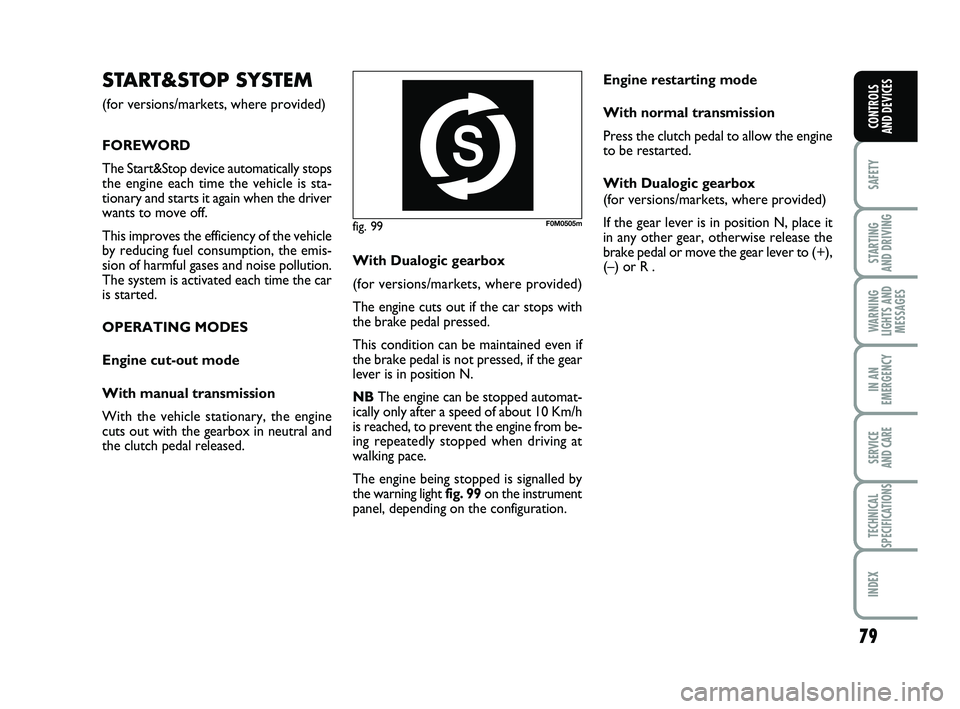
fig. 99F0M0505m
START&STOP SYSTEM
(for versions/markets, where provided)
FOREWORD
The Start&Stop device automatically stops
the engine each time the vehicle is sta-
tionary and starts it again when the driver
wants to move off.
This improves the efficiency of the vehicle
by reducing fuel consumption, the emis-
sion of harmful gases and noise pollution.
The system is activated each time the car
is started.
OPERATING MODES
Engine cut-out mode
With manual transmission
With the vehicle stationary, the engine
cuts out with the gearbox in neutral and
the clutch pedal released. With Dualogic gearbox
(for versions/markets, where provided)
The engine cuts out if the car stops with
the brake pedal pressed.
This condition can be maintained even if
the brake pedal is not pressed, if the gear
lever is in position N.
NB
The engine can be stopped automat-
ically only after a speed of about 10 Km/h
is reached, to prevent the engine from be-
ing repeatedly stopped when driving at
walking pace.
The engine being stopped is signalled by
the warning light fig. 99 on the instrument
panel, depending on the configuration. Engine restarting mode
With normal transmission
Press the clutch pedal to allow the engine
to be restarted.
With Dualogic gearbox
(for versions/markets, where provided)
If the gear lever is in position N, place it
in any other gear, otherwise release the
brake pedal or move the gear lever to (+),
(–) or R .
070-090 PUNTO POP 1ed EN 24/03/14 11:36 Pagina 79
Page 85 of 219
81
SAFETY
STARTING
AND DRIVING
WARNING
LIGHTS AND MESSAGES
IN AN
EMERGENCY
SERVICE
AND CARE
TECHNICAL
SPECIFICATIONS
INDEX
CONTROLS
AND DEVICES
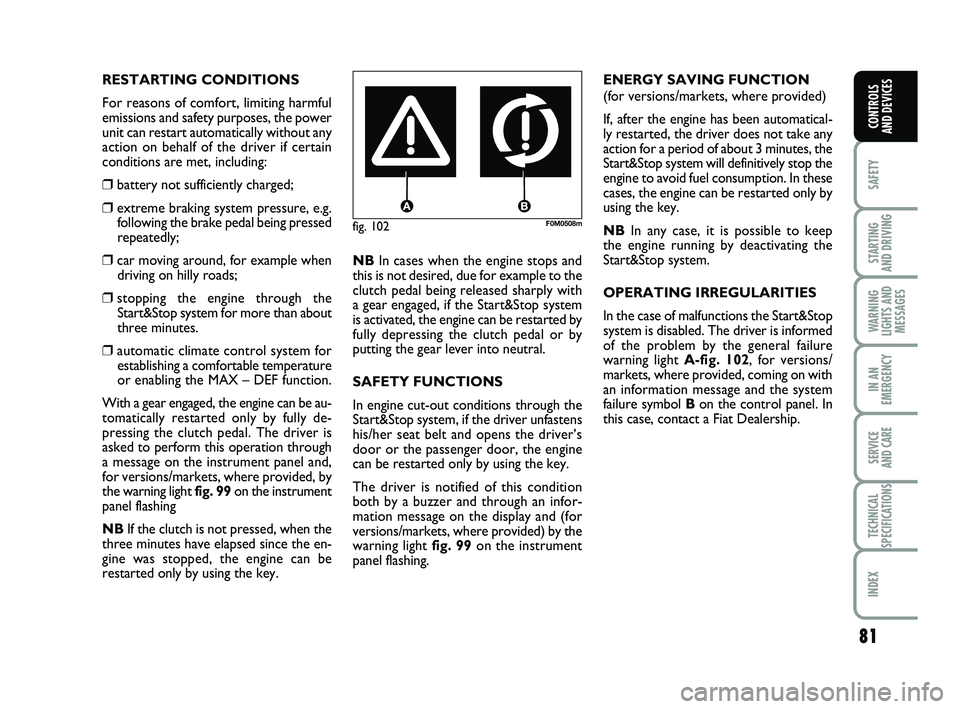
fig. 102F0M0508m
RESTARTING CONDITIONS
For reasons of comfort, limiting harmful
emissions and safety purposes, the power
unit can restart automatically without any
action on behalf of the driver if certain
conditions are met, including:
❒battery not sufficiently charged;
❒extreme braking system pressure, e.g. following the brake pedal being pressed
repeatedly;
❒car moving around, for example whendriving on hilly roads;
❒stopping the engine through theStart&Stop system for more than about
three minutes.
❒automatic climate control system forestablishing a comfortable temperature
or enabling the MAX – DEF function.
With a gear engaged, the engine can be au-
tomatically restarted only by fully de-
pressing the clutch pedal. The driver is
asked to perform this operation through
a message on the instrument panel and,
for versions/markets, where provided, by
the warning light fig. 99 on the instrument
panel flashing
NB If the clutch is not pressed, when the
three minutes have elapsed since the en-
gine was stopped, the engine can be
restarted only by using the key. NB
In cases when the engine stops and
this is not desired, due for example to the
clutch pedal being released sharply with
a gear engaged, if the Start&Stop system
is activated, the engine can be restarted by
fully depressing the clutch pedal or by
putting the gear lever into neutral.
SAFETY FUNCTIONS
In engine cut-out conditions through the
Start&Stop system, if the driver unfastens
his/her seat belt and opens the driver’s
door or the passenger door, the engine
can be restarted only by using the key.
The driver is notified of this condition
both by a buzzer and through an infor-
mation message on the display and (for
versions/markets, where provided) by the
warning light fig. 99 on the instrument
panel flashing. ENERGY SAVING FUNCTION
(for versions/markets, where provided)
If, after the engine has been automatical-
ly restarted, the driver does not take any
action for a period of about 3 minutes, the
Start&Stop system will definitively stop the
engine to avoid fuel consumption. In these
cases, the engine can be restarted only by
using the key.
NB
In any case, it is possible to keep
the engine running by deactivating the
Start&Stop system.
OPERATING IRREGULARITIES
In the case of malfunctions the Start&Stop
system is disabled. The driver is informed
of the problem by the general failure
warning light A-fig. 102, for versions/
markets, where provided, coming on with
an information message and the system
failure symbol B on the control panel. In
this case, contact a Fiat Dealership.
070-090 PUNTO POP 1ed EN 24/03/14 11:36 Pagina 81
Page 87 of 219
83
SAFETY
STARTING
AND DRIVING
WARNING
LIGHTS AND MESSAGES
IN AN
EMERGENCY
SERVICE
AND CARE
TECHNICAL
SPECIFICATIONS
INDEX
CONTROLS
AND DEVICES
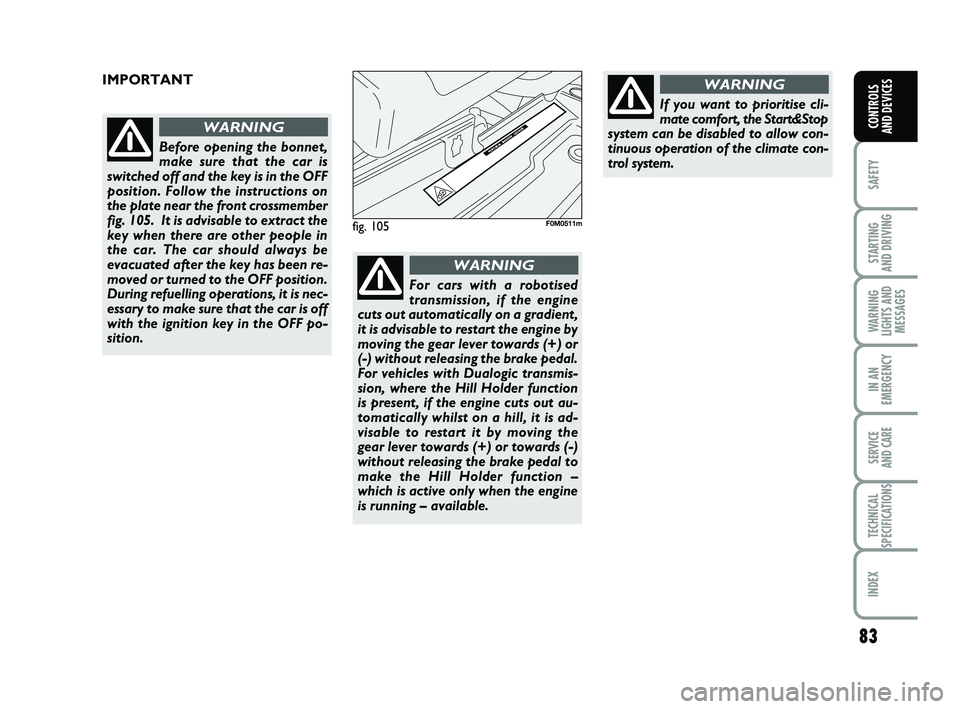
fig. 105F0M0511m
IMPORTANT
Before opening the bonnet,
make sure that the car is
switched off and the key is in the OFF
position. Follow the instructions on
the plate near the front crossmember
fig. 105. It is advisable to extract the
key when there are other people in
the car. The car should always be
evacuated after the key has been re-
moved or turned to the OFF position.
During refuelling operations, it is nec-
essary to make sure that the car is off
with the ignition key in the OFF po-
sition.
WARNING
For cars with a robotised
transmission, if the engine
cuts out automatically on a gradient,
it is advisable to restart the engine by
moving the gear lever towards (+) or
(-) without releasing the brake pedal.
For vehicles with Dualogic transmis-
sion, where the Hill Holder function
is present, if the engine cuts out au-
tomatically whilst on a hill, it is ad-
visable to restart it by moving the
gear lever towards (+) or towards (-)
without releasing the brake pedal to
make the Hill Holder function –
which is active only when the engine
is running – available.
WARNING
If you want to prioritise cli-
mate comfort, the Start&Stop
system can be disabled to allow con-
tinuous operation of the climate con-
trol system.
WARNING
070-090 PUNTO POP 1ed EN 24/03/14 11:36 Pagina 83
Page 88 of 219
84
SAFETY
STARTING
AND DRIVING
WARNING
LIGHTS AND MESSAGES
IN AN
EMERGENCY
SERVICE
AND CARE
TECHNICAL
SPECIFICATIONS
INDEX
CONTROLS
AND DEVICES
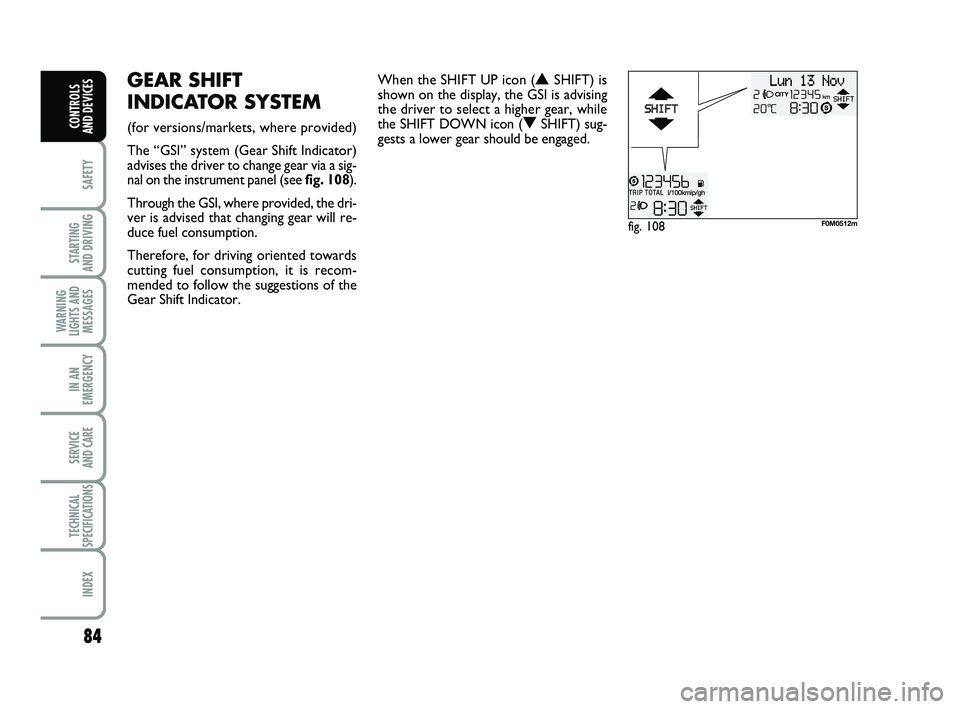
fig. 108F0M0512m
GEAR SHIFT
INDICATOR SYSTEM
(for versions/markets, where provided)
The “GSI” system (Gear Shift Indicator)
advises the driver to change gear via a sig-
nal on the instrument panel (see fig. 108).
Through the GSI, where provided, the dri-
ver is advised that changing gear will re-
duce fuel consumption.
Therefore, for driving oriented towards
cutting fuel consumption, it is recom-
mended to follow the suggestions of the
Gear Shift Indicator. When the SHIFT UP icon (
NSHIFT) is
shown on the display, the GSI is advising
the driver to select a higher gear, while
the SHIFT DOWN icon (
OSHIFT) sug-
gests a lower gear should be engaged.
070-090 PUNTO POP 1ed EN 24/03/14 11:36 Pagina 84
Page 92 of 219
88
SAFETY
STARTING
AND DRIVING
WARNING
LIGHTS AND MESSAGES
IN AN
EMERGENCY
SERVICE
AND CARE
TECHNICAL
SPECIFICATIONS
INDEX
CONTROLS
AND DEVICES
REFUELLING THE CAR
PETROL ENGINES
Use only unleaded petrol.
To avoid mistakes, the diameter of the fu-
el tank opening is too small to insert the
nozzle of a leaded petrol pump. The petrol
octane rating (RON) must not be lower
than 95.
IMPORTANT An inefficient catalytic con-
verter leads to harmful exhaust emissions,
thus contributing to air pollution.
IMPORTANT Never use leaded petrol,
even in small amounts or in an emergency,
as this would damage the catalytic con-
verter beyond repair. DIESEL ENGINES
If the outside temperature is very low, the
diesel thickens due to the formation of
paraffin clots and could clog the diesel fu-
el filter.
In order to avoid these problems, differ-
ent types of diesel are distributed ac-
cording to the season: summer type, win-
ter type and arctic type (cold, mountain
areas).
If refuelling with diesel fuel whose speci-
fications are not suitable for the usage
temperature, it is advisable to mix in the
TUTELA DIESEL ART additive in the pro-
portions shown on the container. Pour
the additive into the tank before the fuel.
When using or parking the vehicle for
a long time in the mountains or cold ar-
eas, it is advisable to refuel using locally
available diesel.
In this case, it is also advisable to keep the
tank over 50% full. For diesel engines, use only
diesel fuel for motor vehicles
in accordance with EN590
European specifications. The
use of other products or mixtures may
damage the engine beyond repair and
consequently invalidate the warranty,
depending on the damage caused. If
you accidentally introduce other types
of fuel into the tank, do not start the
engine. Empty the tank. If the engine
has run, even for a very short time, you
will need to have the entire fuel system
emptied in addition to the tank.
070-090 PUNTO POP 1ed EN 24/03/14 11:36 Pagina 88
Page 93 of 219
89
SAFETY
STARTING
AND DRIVING
WARNING
LIGHTS AND MESSAGES
IN AN
EMERGENCY
SERVICE
AND CARE
TECHNICAL
SPECIFICATIONS
INDEX
CONTROLS
AND DEVICES
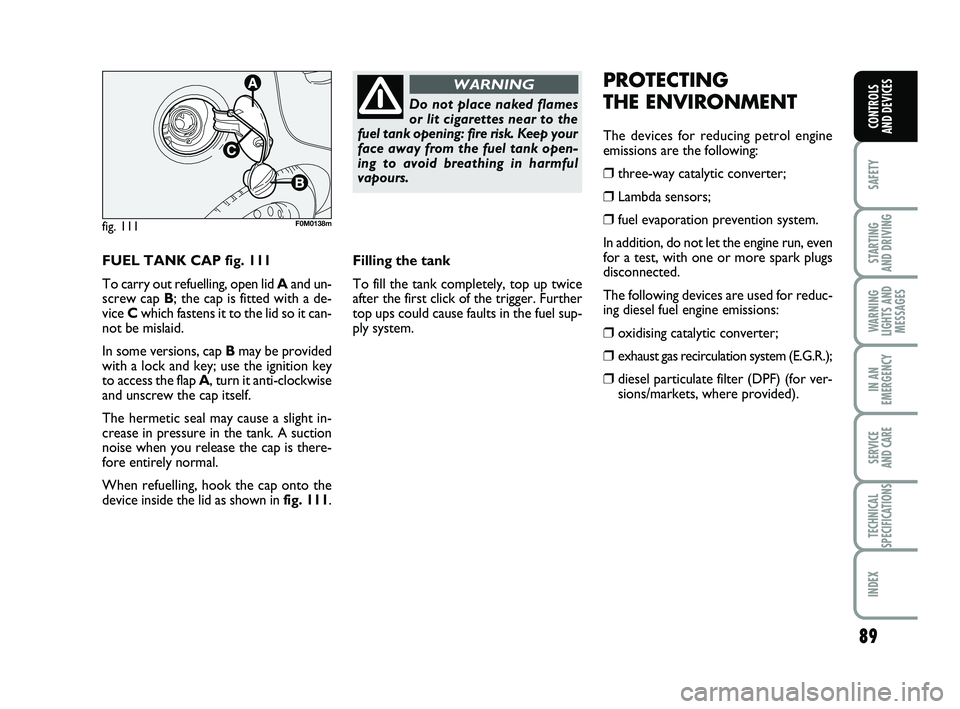
FUEL TANK CAP fig. 111
To carry out refuelling, open lid A and un-
screw cap B ; the cap is fitted with a de-
vice Cwhich fastens it to the lid so it can-
not be mislaid.
In some versions, cap B may be provided
with a lock and key; use the ignition key
to access the flap A, turn it anti-clockwise
and unscrew the cap itself.
The hermetic seal may cause a slight in-
crease in pressure in the tank. A suction
noise when you release the cap is there-
fore entirely normal.
When refuelling, hook the cap onto the
device inside the lid as shown in fig. 111.
fig. 111F0M0138m
Do not place naked flames
or lit cigarettes near to the
fuel tank opening: fire risk. Keep your
face away from the fuel tank open-
ing to avoid breathing in harmful
vapours.
WARNING
Filling the tank
To fill the tank completely, top up twice
after the first click of the trigger. Further
top ups could cause faults in the fuel sup-
ply system.
PROTECTING
THE ENVIRONMENT
The devices for reducing petrol engine
emissions are the following:
❒three-way catalytic converter;
❒Lambda sensors;
❒fuel evaporation prevention system.
In addition, do not let the engine run, even
for a test, with one or more spark plugs
disconnected.
The following devices are used for reduc-
ing diesel fuel engine emissions:
❒oxidising catalytic converter;
❒exhaust gas recirculation system (E.G.R.);
❒diesel particulate filter (DPF) (for ver- sions/markets, where provided).
070-090 PUNTO POP 1ed EN 24/03/14 11:36 Pagina 89
Page 115 of 219
111
SAFETY
WARNING
LIGHTS AND MESSAGES
IN AN
EMERGENCY
SERVICE
AND CARE
TECHNICAL
SPECIFICATIONS
INDEX
CONTROLS
AND DEVICES
STARTING
AND DRIVING
STARTING THE ENGINE ................................................. 112
PARKING THE VEHIC LE ................................................... 114
USING THE MANU AL GEARBOX ................................. 114
SAVING FUEL ....................................................................... 115
SNOW TYRES ......................................................................\
119
SNOW CHAINS .................................................................. 119
CAR INACTIVITY ............................................................... 120
S
S
T
T
A
A
R
R
T
T
I
I
N
N
G
G
A
A
N
N
D
D
D
D
R
R
I
I
V
V
I
I
N
N
G
G
111-120 PUNTO POP 1ed EN 24/09/13 14.29 Pagina 111
Page 117 of 219
113
SAFETY
WARNING
LIGHTS AND MESSAGES
IN AN
EMERGENCY
SERVICE
AND CARE
TECHNICAL
SPECIFICATIONS
INDEX
CONTROLS
AND DEVICES
STARTING
AND DRIVING
❒turn the ignition key to AVV as soon
as the warning light
mturns off. Wait-
ing too long will waste the work done
by the heater plugs. Release the key as
soon as the engine starts.
If the engine does not start at the first at-
tempt, return the ignition key to STOP
before repeating the starting procedure.
If, when the ignition key is at MAR, the in-
strument panel warning light
Yremains
lit together with warning light
m, turn
the key to STOP and then back to MAR;
if the warning lights remain on, try using
the other keys provided with the car.
IMPORTANT If the instrument panel
warning light
Ystays on permanently,
contact a Fiat Dealership immediately.
IMPORTANT Never leave the ignition key
at MAR when the engine is off.
Warning light
mwill blink
for 60 seconds after starting
or during prolonged cranking
to indicate a fault with the
glow plug system. Use the car as nor-
mal if the engine starts, but go to a Fi-
at Dealership as soon as possible.
WARMING UP THE ENGINE
AFTER IT HAS JUST STARTED
(petrol and diesel versions)
Proceed as follows:
❒drive off slowly at medium revs, and ac- celerate smoothly;
❒do not demand maximum performancefor the first few kilometres. Wait until
the engine coolant gauge starts moving.
Remember that the brake
booster and power steering
are not operational until the
engine has been started, so
you need to apply much more force
than usual to the brake pedal and
steering wheel.
Never jump start the engine
by pushing, towing or driving
downhill. This could cause fu-
el to flow into the catalytic
converter and damage it beyond repair.
STOPPING THE ENGINE
Turn the ignition to STOP while the
engine is idling.
IMPORTANT After a long drive, you
should allow the engine to “catch its
breath” before turning it off by letting it
idle to allow the temperature in the en-
gine compartment to fall.
A quick burst on the acceler-
ator before turning off the en-
gine serves absolutely no
practical purpose; it wastes
fuel and is especially damaging to tur-
bocharged engines.
111-120 PUNTO POP 1ed EN 03/10/13 13.21 Pagina 113
Page 119 of 219
115
SAFETY
WARNING
LIGHTS AND MESSAGES
IN AN
EMERGENCY
SERVICE
AND CARE
TECHNICAL
SPECIFICATIONS
INDEX
CONTROLS
AND DEVICES
STARTING
AND DRIVING
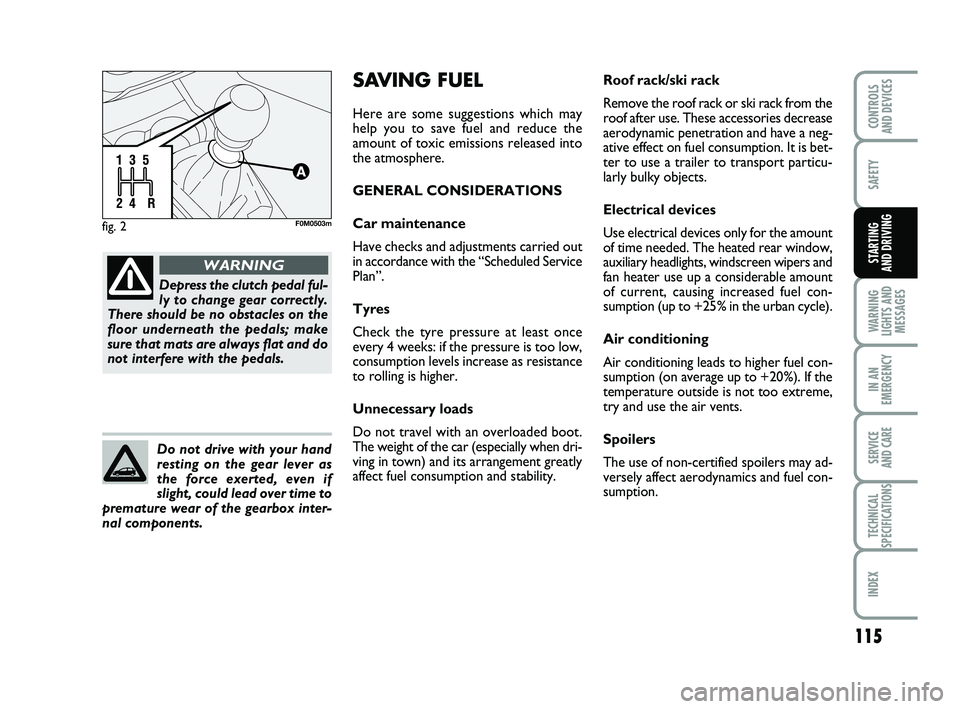
fig. 2F0M0503m
Depress the clutch pedal ful-
ly to change gear correctly.
There should be no obstacles on the
floor underneath the pedals; make
sure that mats are always flat and do
not interfere with the pedals.
WARNING
Do not drive with your hand
resting on the gear lever as
the force exerted, even if
slight, could lead over time to
premature wear of the gearbox inter-
nal components.
Roof rack/ski rack
Remove the roof rack or ski rack from the
roof after use. These accessories decrease
aerodynamic penetration and have a neg-
ative effect on fuel consumption. It is bet-
ter to use a trailer to transport particu-
larly bulky objects.
Electrical devices
Use electrical devices only for the amount
of time needed. The heated rear window,
auxiliary headlights, windscreen wipers and
fan heater use up a considerable amount
of current, causing increased fuel con-
sumption (up to +25% in the urban cycle).
Air conditioning
Air conditioning leads to higher fuel con-
sumption (on average up to +20%). If the
temperature outside is not too extreme,
try and use the air vents.
Spoilers
The use of non-certified spoilers may ad-
versely affect aerodynamics and fuel con-
sumption.SAVING FUEL
Here are some suggestions which may
help you to save fuel and reduce the
amount of toxic emissions released into
the atmosphere.
GENERAL CONSIDERATIONS
Car maintenance
Have checks and adjustments carried out
in accordance with the “Scheduled Service
Plan”.
Tyres
Check the tyre pressure at least once
every 4 weeks: if the pressure is too low,
consumption levels increase as resistance
to rolling is higher.
Unnecessary loads
Do not travel with an overloaded boot.
The weight of the car (especially when dri-
ving in town) and its arrangement greatly
affect fuel consumption and stability.
111-120 PUNTO POP 1ed EN 24/09/13 14.29 Pagina 115
Page 120 of 219
116
SAFETY
WARNING
LIGHTS AND MESSAGES
IN AN
EMERGENCY
SERVICE
AND CARE
TECHNICAL
SPECIFICATIONS
INDEX
CONTROLS
AND DEVICES
STARTING
AND DRIVING
DRIVING STYLE
Starting
Do not warm up the engine at low or high
revs when the vehicle is stationary; this
causes the engine to warm up more slow-
ly, thereby increasing fuel consumption
and emissions. It is advisable to set off im-
mediately and slowly, avoiding high revs:
this allows the engine to warm up more
quickly.
Unnecessary actions
Avoid revving up when stationary at traf-
fic lights or before stopping the engine.
The latter action, like double declutching,
is entirely unnecessary and causes in-
creased fuel consumption and pollution.
Gear selection
Use a higher gear as soon as traffic and
road conditions allow. Using a low gear
for faster acceleration will increase fuel
consumption.
In the same way, improper use of a high
gear increases fuel consumption, emissions
and engine wear. Traffic and road conditions
Heavy traffic, for instance when travelling
in a queue with frequent use of low gears
or in cities with lots of traffic lights, caus-
es fairly high fuel consumption. Mountain
roads and uneven surfaces also have a neg-
ative effect on consumption.
Traffic hold-ups
During prolonged hold-ups (e.g. at level
crossings) the engine should be switched
off.
TOWING TRAILERS
IMPORTANT NOTES
The car must be equipped with an ap-
proved tow hook and adequate electrical
system to tow caravans or trailers. Instal-
lation must be performed by specialised
personnel who will issue the required pa-
pers for travelling on roads.
Install any specific and/or additional rear
view mirrors in accordance with the high-
way code of the country in which you are
travelling.
Top speed
Fuel consumption considerably increases
as speed increases. Keep your speed as
even as possible, avoiding unnecessary
braking and acceleration, which cause ex-
cessive fuel consumption and increased
emissions.
Acceleration
Accelerating violently severely affects con-
sumption and emissions: acceleration
should be gradual and should not exceed
the maximum torque.
CONDITIONS OF USE
Cold starting
Short distances and frequent cold start-
ups will prevent the engine from reach-
ing optimal running temperature. Conse-
quently, both fuel consumption (from +15
to +30% on the urban cycle) and emis-
sions will increase.
111-120 PUNTO POP 1ed EN 24/09/13 14.29 Pagina 116