seats FIAT PUNTO EVO 2010 1.G User Guide
[x] Cancel search | Manufacturer: FIAT, Model Year: 2010, Model line: PUNTO EVO, Model: FIAT PUNTO EVO 2010 1.GPages: 270, PDF Size: 8.34 MB
Page 133 of 270
132
F0U0115mfig. 132F0U0116mfig. 133
GENERAL INSTRUCTIONS FOR USING THE
SEAT BELTS
The driver is responsible for respecting, and ensuring that
all the other occupants of the car also respect, the local
laws in force in relation to the use of the seat belts. Al-
ways fasten the seat belts before setting off.
Seat belts must also be worn by expectant mothers: the
risk of injury in the event of an accident is greatly reduced
for them and the unborn child if they are wearing a seat
belt.
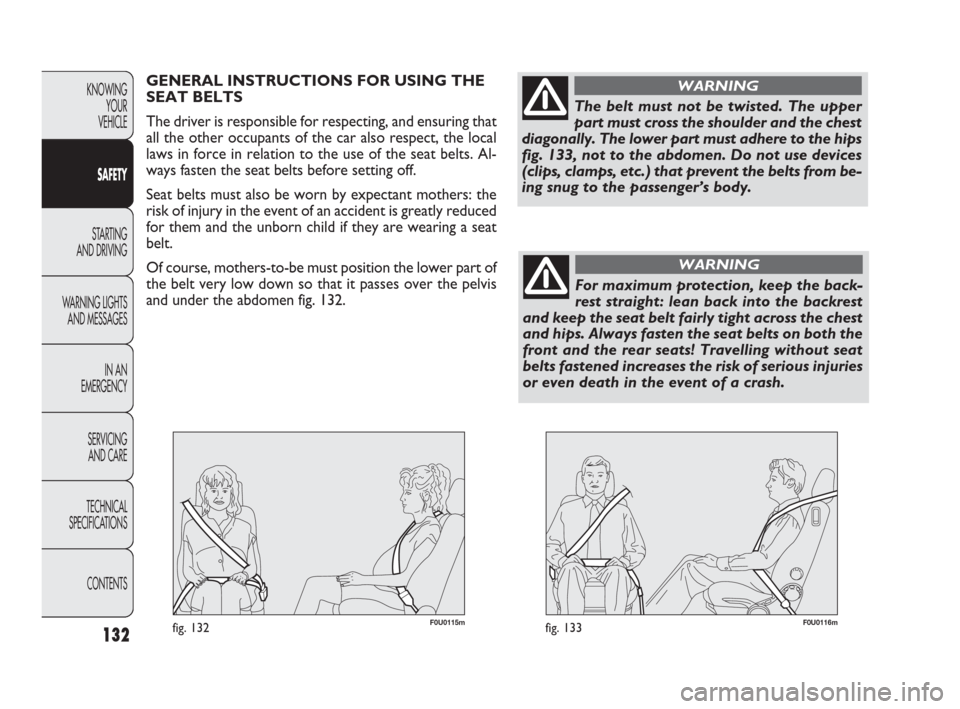
Of course, mothers-to-be must position the lower part of
the belt very low down so that it passes over the pelvis
and under the abdomen fig. 132.KNOWING
YOUR
VEHICLE
SAFETY
STARTING
AND DRIVING
WARNING LIGHTS
AND MESSAGES
IN AN
EMERGENCY
SERVICING
AND CARE
TECHNICAL
SPECIFICATIONS
CONTENTS
The belt must not be twisted. The upper
part must cross the shoulder and the chest
diagonally. The lower part must adhere to the hips
fig. 133, not to the abdomen. Do not use devices
(clips, clamps, etc.) that prevent the belts from be-
ing snug to the passenger’s body.
WARNING
For maximum protection, keep the back-
rest straight: lean back into the backrest
and keep the seat belt fairly tight across the chest
and hips. Always fasten the seat belts on both the
front and the rear seats! Travelling without seat
belts fastened increases the risk of serious injuries
or even death in the event of a crash.
WARNING
129-148 PUNTO FL EN 4ed 18-01-2010 12:25 Pagina 132
Page 135 of 270
134
F0U0118mfig. 135
When over 1.50 m in height, from the point of view of
restraint systems, children are considered as adults and
have to wear the standard seat belts.
Lineaccessori Fiat has child seats for each weight group.
These devices are recommended, having been specifically
designed for Fiat cars.CARRYING CHILDREN
SAFELY
For optimum protection in the event of a crash, all pas-
sengers must be seated and wearing adequate restraint
systems.
This is even more important for children.
This prescription is compulsory in all EU countries pur-
suant to Directive 2003/20/EC.
Compared with an adult, a child’s head is larger and heav-
ier in proportion to his/her body and the child’s muscu-
lar and bone structures are not fully developed. For this
reason, they require restraint systems which are differ-
ent from those used by adults to protect them in the event
of an accident. The result of research in relation to the
best protection for children is illustrated in European Reg-
ulation ECE-R44, which divides the restraint systems in-
to five groups in addition to making their use compulso-
ry:
Group 0 up to 10 kg
Group 0+ up to 13 kg
Group 1 9-18 kg
Group 2 15-25 kg
Group 3 22-36 kg
As you can see, the groups overlap partly and, in fact, there
are devices on sale that cover more than one weight group.
All child restraint devices must bear the certification da-
ta, together with the control brand, on a solidly fixed to
the seat label which must never be removed.
KNOWING
YOUR
VEHICLE
SAFETY
STARTING
AND DRIVING
WARNING LIGHTS
AND MESSAGES
IN AN
EMERGENCY
SERVICING
AND CARE
TECHNICAL
SPECIFICATIONS
CONTENTSGROUPS 0 and 0+
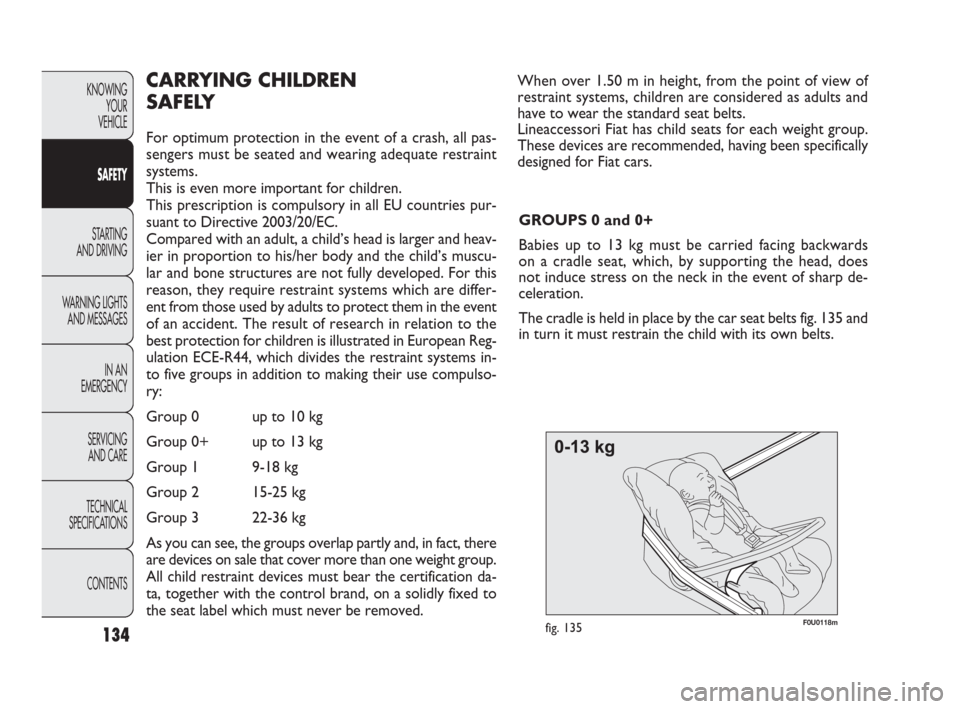
Babies up to 13 kg must be carried facing backwards
on a cradle seat, which, by supporting the head, does
not induce stress on the neck in the event of sharp de-
celeration.
The cradle is held in place by the car seat belts fig. 135 and
in turn it must restrain the child with its own belts.
129-148 PUNTO FL EN 4ed 18-01-2010 12:25 Pagina 134
Page 136 of 270
135
F0U0119mfig. 136
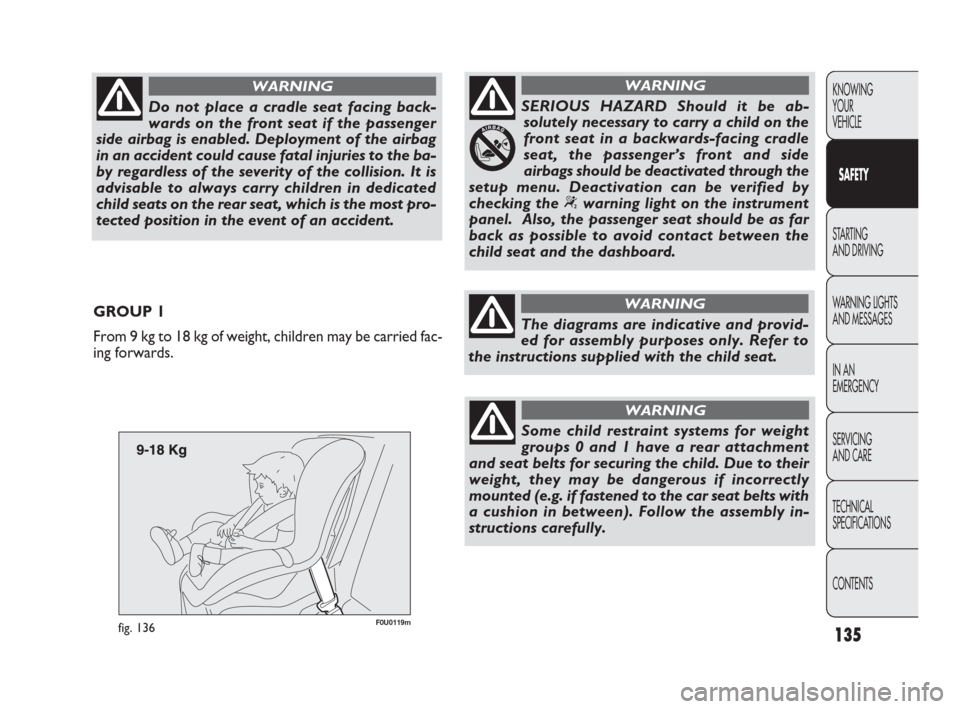
GROUP 1
From 9 kg to 18 kg of weight, children may be carried fac-
ing forwards.
KNOWING
YOUR
VEHICLE
SAFETY
STARTING
AND DRIVING
WARNING LIGHTS
AND MESSAGES
IN AN
EMERGENCY
SERVICING
AND CARE
TECHNICAL
SPECIFICATIONS
CONTENTS
Do not place a cradle seat facing back-
wards on the front seat if the passenger
side airbag is enabled. Deployment of the airbag
in an accident could cause fatal injuries to the ba-
by regardless of the severity of the collision. It is
advisable to always carry children in dedicated
child seats on the rear seat, which is the most pro-
tected position in the event of an accident.
WARNING
SERIOUS HAZARD Should it be ab-
solutely necessary to carry a child on the
front seat in a backwards-facing cradle
seat, the passenger’s front and side
airbags should be deactivated through the
setup menu. Deactivation can be verified by
checking the “warning light on the instrument
panel. Also, the passenger seat should be as far
back as possible to avoid contact between the
child seat and the dashboard.
WARNING
The diagrams are indicative and provid-
ed for assembly purposes only. Refer to
the instructions supplied with the child seat.
WARNING
Some child restraint systems for weight
groups 0 and 1 have a rear attachment
and seat belts for securing the child. Due to their
weight, they may be dangerous if incorrectly
mounted (e.g. if fastened to the car seat belts with
a cushion in between). Follow the assembly in-
structions carefully.
WARNING
129-148 PUNTO FL EN 4ed 18-01-2010 12:25 Pagina 135
Page 138 of 270
137
KNOWING
YOUR
VEHICLE
SAFETY
STARTING
AND DRIVING
WARNING LIGHTS
AND MESSAGES
IN AN
EMERGENCY
SERVICING
AND CARE
TECHNICAL
SPECIFICATIONS
CONTENTS
SUITABILITY OF PASSENGER SEATS FOR CHILD SEAT USE
The car complies with the new European Directive 2000/3/EC which governs the arrangement possibilities for child
seats on the various seats of the car as shown in the following table:
Front Rear Central
Group Weight range passenger passenger rear
passenger
Groups 0, 0+ up to 13 kg U (▼)U *
Group 1 9-18 kg U (▼)U *
Group 2 15-25 kg U (▼)U *
Group 3 22-36 kg U (▼)U *
Key:
U = suitable for child restraint systems in the “Universal” category, according to European Standard ECE-R44 for the
specified “Groups”.
(▼) on cars whose passenger seat is not adjustable in height, the backrest must be perfectly upright.
* Never put any type of child seat on the central rear seat.
129-148 PUNTO FL EN 4ed 18-01-2010 12:26 Pagina 137
Page 139 of 270
138
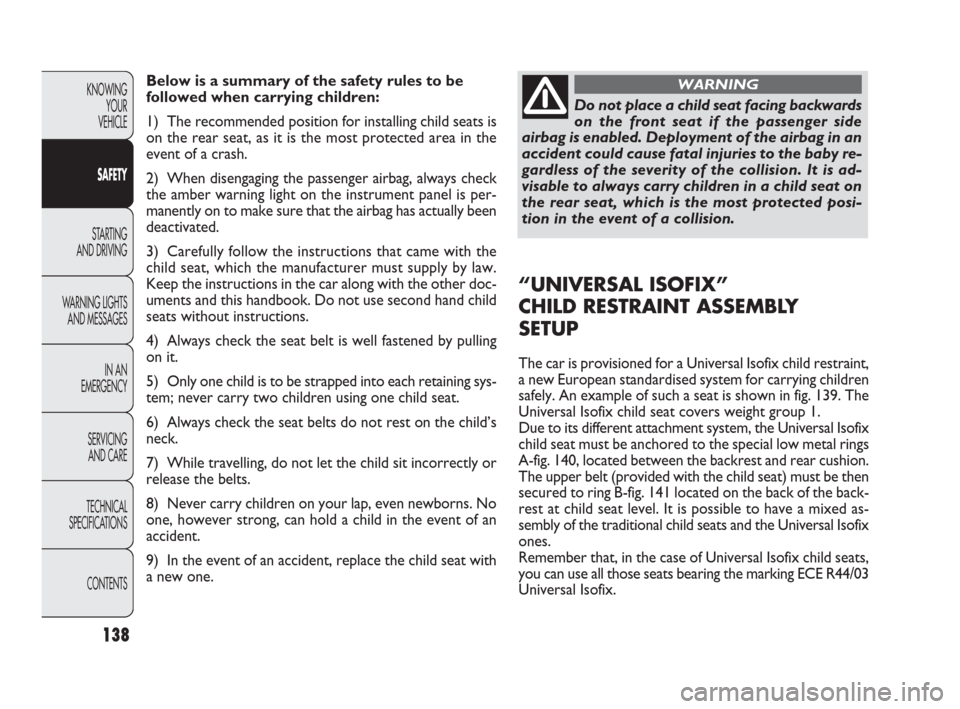
Below is a summary of the safety rules to be
followed when carrying children:
1) The recommended position for installing child seats is
on the rear seat, as it is the most protected area in the
event of a crash.
2) When disengaging the passenger airbag, always check
the amber warning light on the instrument panel is per-
manently on to make sure that the airbag has actually been
deactivated.
3) Carefully follow the instructions that came with the
child seat, which the manufacturer must supply by law.
Keep the instructions in the car along with the other doc-
uments and this handbook. Do not use second hand child
seats without instructions.
4) Always check the seat belt is well fastened by pulling
on it.
5) Only one child is to be strapped into each retaining sys-
tem; never carry two children using one child seat.
6) Always check the seat belts do not rest on the child’s
neck.
7) While travelling, do not let the child sit incorrectly or
release the belts.
8) Never carry children on your lap, even newborns. No
one, however strong, can hold a child in the event of an
accident.
9) In the event of an accident, replace the child seat with
a new one.KNOWING
YOUR
VEHICLE
SAFETY
STARTING
AND DRIVING
WARNING LIGHTS
AND MESSAGES
IN AN
EMERGENCY
SERVICING
AND CARE
TECHNICAL
SPECIFICATIONS
CONTENTS
Do not place a child seat facing backwards
on the front seat if the passenger side
airbag is enabled. Deployment of the airbag in an
accident could cause fatal injuries to the baby re-
gardless of the severity of the collision. It is ad-
visable to always carry children in a child seat on
the rear seat, which is the most protected posi-
tion in the event of a collision.
WARNING
“UNIVERSAL ISOFIX”
CHILD RESTRAINT ASSEMBLY
SETUP
The car is provisioned for a Universal Isofix child restraint,
a new European standardised system for carrying children
safely. An example of such a seat is shown in fig. 139. The
Universal Isofix child seat covers weight group 1.
Due to its different attachment system, the Universal Isofix
child seat must be anchored to the special low metal rings
A-fig. 140, located between the backrest and rear cushion.
The upper belt (provided with the child seat) must be then
secured to ring B-fig. 141 located on the back of the back-
rest at child seat level. It is possible to have a mixed as-
sembly of the traditional child seats and the Universal Isofix
ones.
Remember that, in the case of Universal Isofix child seats,
you can use all those seats bearing the marking ECE R44/03
Universal Isofix.
129-148 PUNTO FL EN 4ed 18-01-2010 12:26 Pagina 138
Page 141 of 270
140
KNOWING
YOUR
VEHICLE
SAFETY
STARTING
AND DRIVING
WARNING LIGHTS
AND MESSAGES
IN AN
EMERGENCY
SERVICING
AND CARE
TECHNICAL
SPECIFICATIONS
CONTENTS
E
E
D
C
D
C
B
B1
A
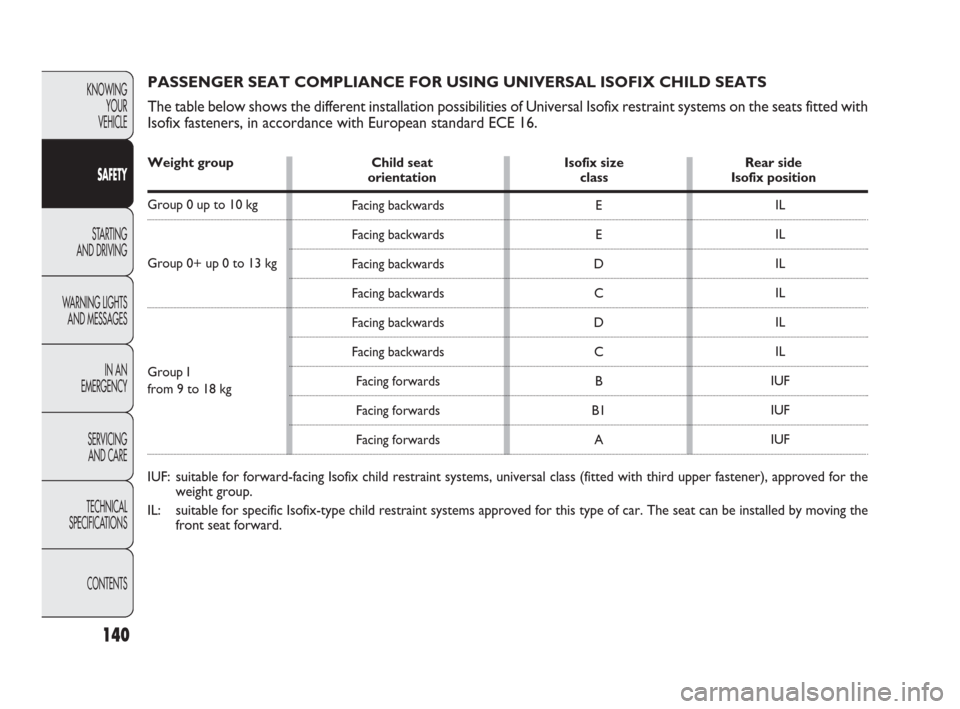
PASSENGER SEAT COMPLIANCE FOR USING UNIVERSAL ISOFIX CHILD SEATS
The table below shows the different installation possibilities of Universal Isofix restraint systems on the seats fitted with
Isofix fasteners, in accordance with European standard ECE 16.
Weight group Child seat Isofix size Rear side orientation class Isofix position
Group 0 up to 10 kg
Group 0+ up 0 to 13 kg
Group I
from 9 to 18 kg
IUF: suitable for forward-facing Isofix child restraint systems, universal class (fitted with third upper fastener), approved for the
weight group.
IL: suitable for specific Isofix-type child restraint systems approved for this type of car. The seat can be installed by moving the
front seat forward.
IL
IL
IL
IL
IL
IL
IUF
IUF
IUF Facing backwards
Facing backwards
Facing backwards
Facing backwards
Facing backwards
Facing backwards
Facing forwards
Facing forwards
Facing forwards
129-148 PUNTO FL EN 4ed 18-01-2010 12:26 Pagina 140
Page 143 of 270
142
F0U0125mfig. 142F0U0126mfig. 143
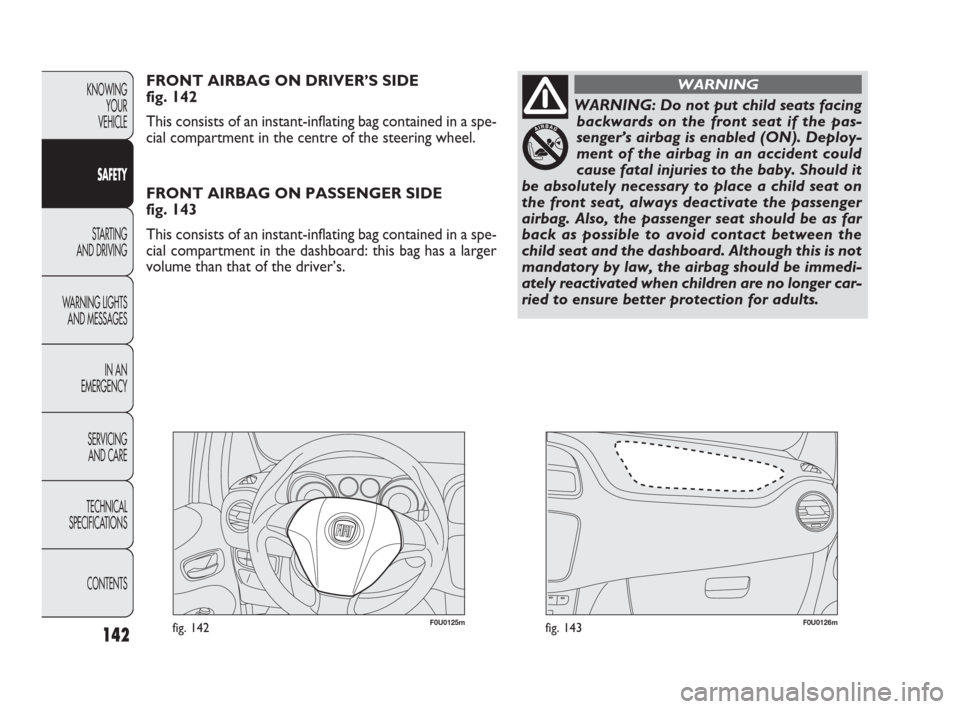
FRONT AIRBAG ON DRIVER’S SIDE
fig. 142
This consists of an instant-inflating bag contained in a spe-
cial compartment in the centre of the steering wheel.
FRONT AIRBAG ON PASSENGER SIDE
fig. 143
This consists of an instant-inflating bag contained in a spe-
cial compartment in the dashboard: this bag has a larger
volume than that of the driver’s.KNOWING
YOUR
VEHICLE
SAFETY
STARTING
AND DRIVING
WARNING LIGHTS
AND MESSAGES
IN AN
EMERGENCY
SERVICING
AND CARE
TECHNICAL
SPECIFICATIONS
CONTENTS
WARNING: Do not put child seats facing
backwards on the front seat if the pas-
senger’s airbag is enabled (ON). Deploy-
ment of the airbag in an accident could
cause fatal injuries to the baby. Should it
be absolutely necessary to place a child seat on
the front seat, always deactivate the passenger
airbag. Also, the passenger seat should be as far
back as possible to avoid contact between the
child seat and the dashboard. Although this is not
mandatory by law, the airbag should be immedi-
ately reactivated when children are no longer car-
ried to ensure better protection for adults.
WARNING
129-148 PUNTO FL EN 4ed 18-01-2010 12:26 Pagina 142
Page 149 of 270
148
KNOWING
YOUR
VEHICLE
SAFETY
STARTING
AND DRIVING
WARNING LIGHTS
AND MESSAGES
IN AN
EMERGENCY
SERVICING
AND CARE
TECHNICAL
SPECIFICATIONS
CONTENTS
If the key is turned to MAR, even if the en-
gine is switched off, airbags may be de-
ployed when the car is stationary and hit by an-
other vehicle. For this reason, young children must
never sit on the front seat, even if the car is not
moving. We remind you that if the key is turned
to the STOP position, no safety device (airbag or
pretensioner) activates following a collision. Non-
deployment in such cases should not be consid-
ered as the sign of a malfunction.
WARNING
If the car has been stolen or has been the
subject of an attempted theft, if it has
been vandalised or flooded, have the airbag sys-
tem checked at a Fiar Dealership.
WARNING
When the ignition key is turned to MAR,
the warning light “turns on (with front
airbag on passenger’s side enabled) and blinks for
a few seconds to remind you that the passenger
airbag will activate in the event of a collision. Then
it turns off.
WARNING
Do not pressure wash the seats with steam
or water (either by hand or at automatic
seat washing stations).
WARNING
The front airbags deploy in the event of
more severe collisions than those required
for deploying the pretensioners. For collisions in
the range between the two activation thresholds,
pretensioner activation alone is normal.
WARNING
Do not hook rigid objects to clothes hang-
ers and support handles.
WARNING
The airbag does not replace seat belts; it
increases their effectiveness. Furthermore,
since front airbags are not deployed in low speed
collisions, side-on collisions, rear-end shunts or
roll-overs, the passengers are protected only by
the seat belts which must therefore be fastened
at all times.
WARNING
129-148 PUNTO FL EN 4ed 18-01-2010 12:26 Pagina 148
Page 235 of 270
234
PLASTIC PARTS
It is advisable to clean interior plastic parts with a damp
cloth and a solution of water and non-abrasive mild soap.
To remove grease and tough stains, use products designed
specifically for cleaning plastics. These have no solvents
and have been designed so that they do not alter the ap-
pearance and colour of the components.
IMPORTANT Never use spirits or petroleum to clean the
instrument panel.
REAL LEATHER STEERING WHEEL/GEAR
LEVER KNOB
These components must be cleaned with mild soap and
water only.
Never use spirits and/or alcohol-based products.
Before using off-the-shelf products designed for cleaning
vehicle interiors, make sure that they do not contain spir-
its and/or alcohol-based substances.
If window cleaner accidentally drips onto the steering
wheel or gear lever knob, wipe away immediately and then
wash the affected area with mild soap and water.
IMPORTANT When arranging a steering wheel locking
device, be careful not to damage the leather upholstery. SEATS AND FABRIC PARTS
Remove dust with a soft brush or a vacuum cleaner. It is
advisable to use a damp brush on velvet upholstery.
Wipe the seats with a sponge soaked in a solution of mild
detergent and water.KNOWING
YOUR
VEHICLE
SAFETY
STARTING
AND DRIVING
WARNING LIGHTS
AND MESSAGES
IN AN
EMERGENCY
SERVICING
AND CARE
TECHNICAL
SPECIFICATIONS
CONTENTS
The fabric upholstery of your car is designed
to withstand normal wear and tear for
a long time. Some precautions are needed
though. Avoid prolonged and/or excessive rubbing
against clothing accessories such as metal buckles
and Velcro strips which, by applying a high pressure
on the fabric in a small area, could cause some
threads to break, thereby damaging the upholstery.
211-234 PUNTO FL EN 4ed 18-01-2010 12:28 Pagina 234
Page 238 of 270
KNOWING
YOUR
VEHICLE
SAFETY
STARTING
AND DRIVING
WARNING LIGHTS
AND MESSAGES
IN AN
EMERGENCY
SERVICING
AND CARE
TECHNICAL
SPECIFICATIONS
CONTENTS
237
199A4000
350A1000
199A7000
350A1000
199A7000
955A6000
955A2000
199B2000
199A2000
199A9000
199A9000
223A9000
199A3000
199B1000
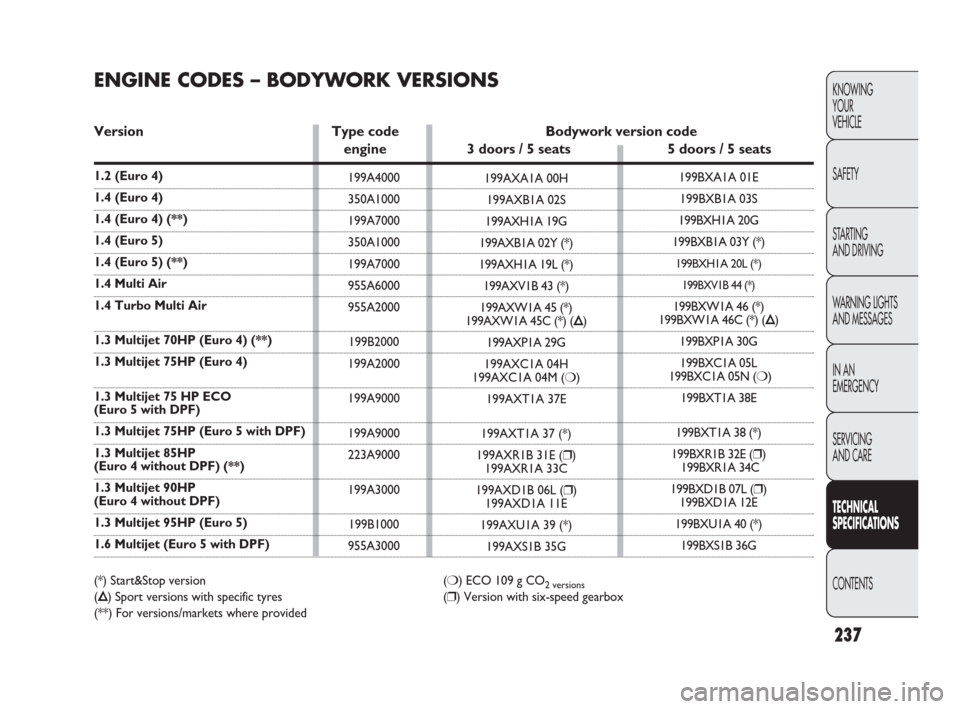
955A3000199AXA1A 00H
199AXB1A 02S
199AXH1A 19G
199AXB1A 02Y (*)
199AXH1A 19L (*)
199AXV1B 43 (*)
199AXW1A 45 (*)
199AXW1A 45C (*) (Õ)
199AXP1A 29G
199AXC1A 04H
199AXC1A 04M (
❍)
199AXT1A 37E
199AXT1A 37 (*)
199AXR1B 31E (❒)
199AXR1A 33C
199AXD1B 06L (❒)
199AXD1A 11E
199AXU1A 39 (*)
199AXS1B 35G199BXA1A 01E
199BXB1A 03S
199BXH1A 20G
199BXB1A 03Y (*)
199BXH1A 20L (*)
199BXV1B 44 (*)
199BXW1A 46 (*)
199BXW1A 46C (*) (Õ)
199BXP1A 30G
199BXC1A 05L
199BXC1A 05N (
❍)
199BXT1A 38E
199BXT1A 38 (*)
199BXR1B 32E (❒)
199BXR1A 34C
199BXD1B 07L (❒)
199BXD1A 12E
199BXU1A 40 (*)
199BXS1B 36G
ENGINE CODES – BODYWORK VERSIONS
Version Type code Bodywork version code
engine 3 doors / 5 seats 5 doors / 5 seats
1.2 (Euro 4)
1.4 (Euro 4)
1.4 (Euro 4) (**)
1.4 (Euro 5)
1.4 (Euro 5) (**)
1.4 Multi Air
1.4 Turbo Multi Air
1.3 Multijet 70HP (Euro 4) (**)
1.3 Multijet 75HP (Euro 4)
1.3 Multijet 75 HP ECO (Euro 5 with DPF)
1.3 Multijet 75HP (Euro 5 with DPF)
1.3 Multijet 85HP
(Euro 4 without DPF) (**)
1.3 Multijet 90HP
(Euro 4 without DPF)
1.3 Multijet 95HP (Euro 5)
1.6 Multijet (Euro 5 with DPF)
(*) Start&Stop version (
❍) ECO 109 g CO2 versions(Õ) Sport versions with specific tyres (❒) Version with six-speed gearbox
(**) For versions/markets where provided
235-258 PUNTO FL EN 4ed 18-01-2010 12:28 Pagina 237