ABS FIAT QUBO 2010 1.G User Guide
[x] Cancel search | Manufacturer: FIAT, Model Year: 2010, Model line: QUBO, Model: FIAT QUBO 2010 1.GPages: 230, PDF Size: 4.38 MB
Page 124 of 230
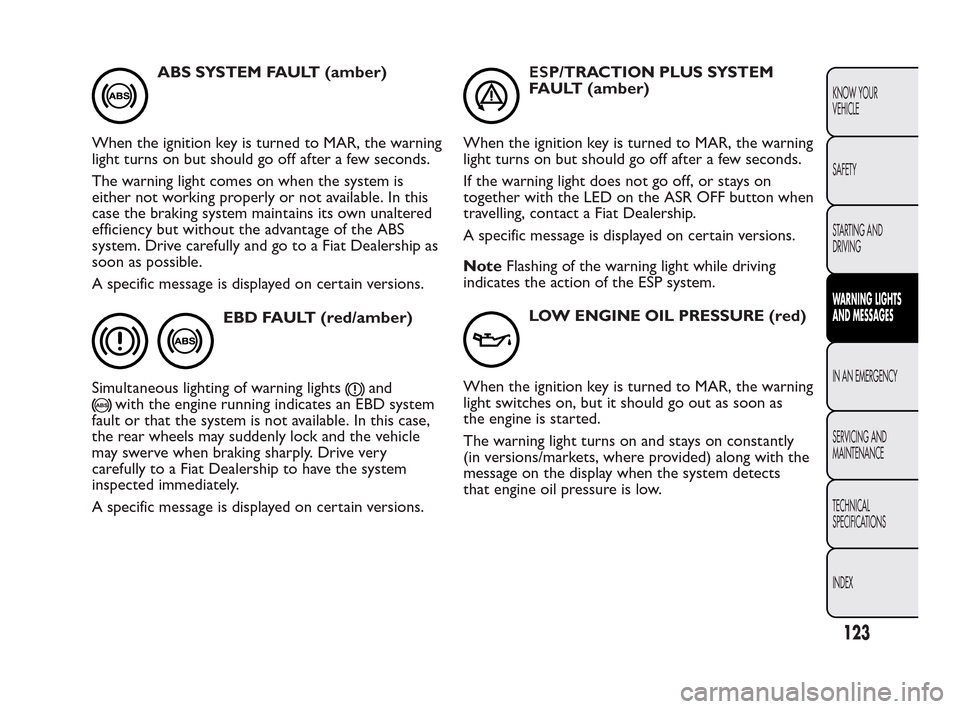
ABS SYSTEM FAULT (amber)
When the ignition key is turned to MAR, the warning
light turns on but should go off after a few seconds.
The warning light comes on when the system is
either not working properly or not available. In this
case the braking system maintains its own unaltered
efficiency but without the advantage of the ABS
system. Drive carefully and go to a Fiat Dealership as
soon as possible.
A specific message is displayed on certain versions.
EBD FAULT (red/amber)
Simultaneous lighting of warning lights
and
with the engine running indicates an EBD system
fault or that the system is not available. In this case,
the rear wheels may suddenly lock and the vehicle
may swerve when braking sharply. Drive very
carefully to a Fiat Dealership to have the system
inspected immediately.
A specific message is displayed on certain versions.
ESP/TRACTION PLUS SYSTEM
FAULT (amber)
When the ignition key is turned to MAR, the warning
light turns on but should go off after a few seconds.
If the warning light does not go off, or stays on
together with the LED on the ASR OFF button when
travelling, contact a Fiat Dealership.
A specific message is displayed on certain versions.
NoteFlashing of the warning light while driving
indicates the action of the ESP system.
LOW ENGINE OIL PRESSURE (red)
When the ignition key is turned to MAR, the warning
light switches on, but it should go out as soon as
the engine is started.
The warning light turns on and stays on constantly
(in versions/markets, where provided) along with the
message on the display when the system detects
that engine oil pressure is low.
123
KNOW YOUR
VEHICLE
SAFETY
STARTING AND
DRIVING
WARNING LIGHTS
AND
MESSAGES
IN AN EMERGENCY
SERVICING
AND
MAINTENANCE
TECHNICAL
SPECIFICATIONS
INDEX
Page 150 of 230
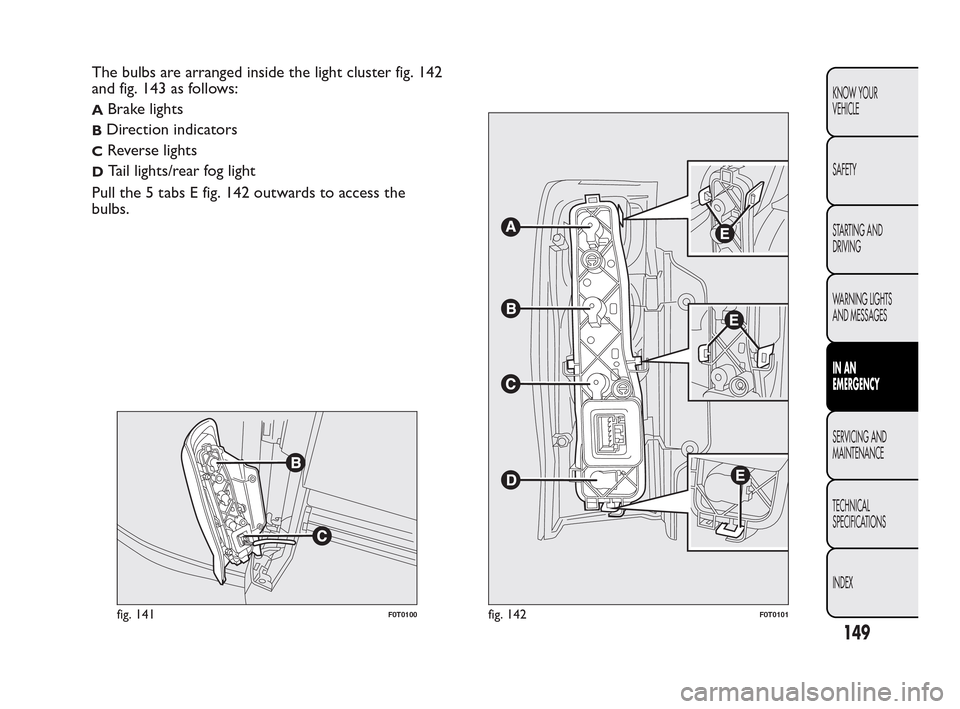
The bulbs are arranged inside the light cluster fig. 142
and fig. 143 as follows:
ABrake lights
BDirection indicators
CReverse lights
DTail lights/rear fog light
Pull the 5 tabs E fig. 142 outwards to access the
bulbs.
fig. 141F0T0100fig. 142F0T0101
149
KNOW YOUR
VEHICLE
SAFETY
STARTING AND
DRIVING
WARNING LIGHTS
AND MESSAGES
IN AN
EMERGENCY
SERVICING AND
MAINTENANCE
TECHNICAL
SPECIFICA
TIONS
INDEX
Page 151 of 230
THIRD BRAKE LIGHTS
Tailgate versions
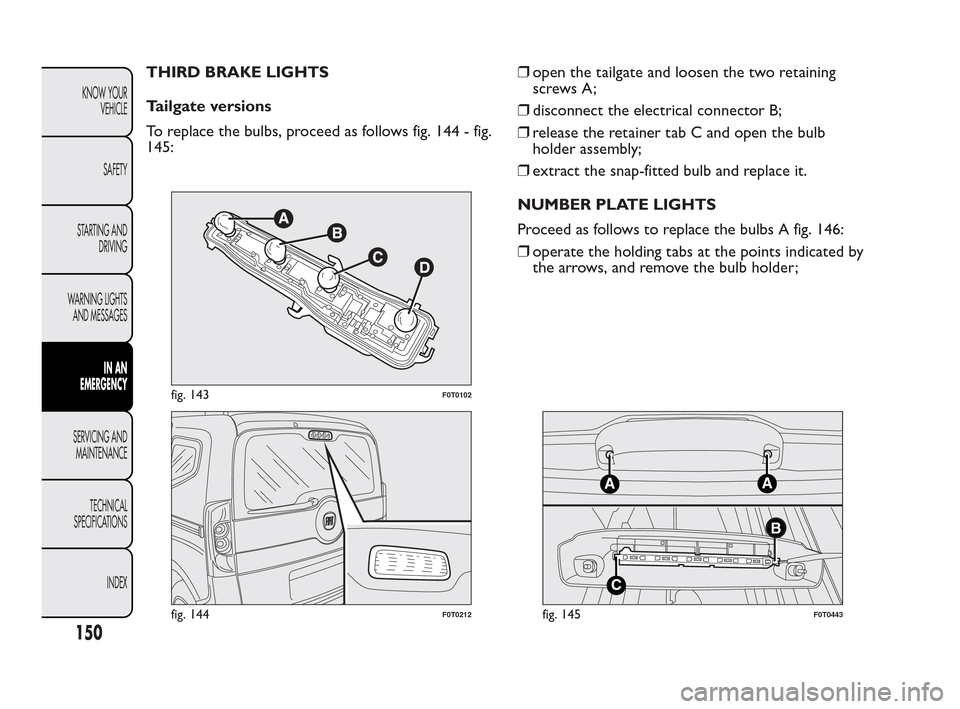
To replace the bulbs, proceed as follows fig. 144 - fig.
145:❒open the tailgate and loosen the two retaining
screws A;
❒disconnect the electrical connector B;
❒release the retainer tab C and open the bulb
holder assembly;
❒extract the snap-fitted bulb and replace it.
NUMBER PLATE LIGHTS
Proceed as follows to replace the bulbs A fig. 146:
❒operate the holding tabs at the points indicated by
the arrows, and remove the bulb holder;
fig. 143F0T0102
fig. 144F0T0212
A
C
A
B
fig. 145F0T0443
150
KNOW YOUR
VEHICLE
SAFETY
STARTING AND
DRIVING
WARNING LIGHTS
AND MESSAGES
IN AN
EMERGENCY
SERVICING AND
MAINTENANCE
TECHNICAL
SPECIFICA
TIONS
INDEX
Page 158 of 230
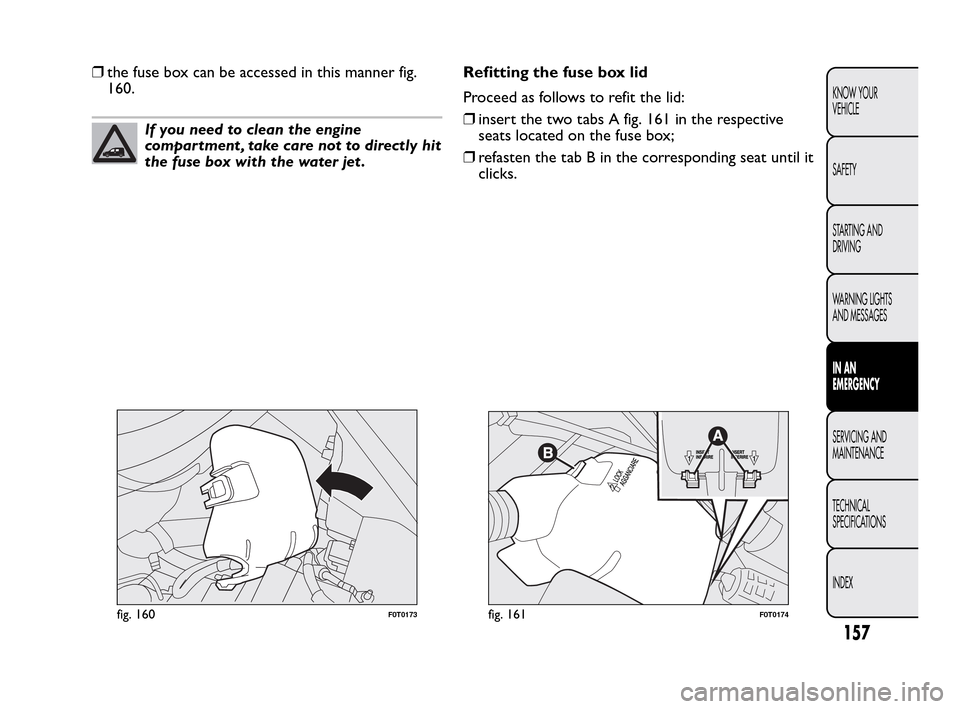
❒the fuse box can be accessed in this manner fig.
160.
If you need to clean the engine
compartment , take care not to directly hit
the fuse box with the water jet .Refitting the fuse box lid
Proceed as follows to refit the lid:
❒insert the two tabs A fig. 161 in the respective
seats located on the fuse box;
❒refasten the tab B in the corresponding seat until it
clicks.
fig. 160F0T0173fig. 161F0T0174
157
KNOW YOUR
VEHICLE
SAFETY
STARTING AND
DRIVING
WARNING LIGHTS
AND MESSAGES
IN AN
EMERGENCY
SERVICING AND
MAINTENANCE
TECHNICAL
SPECIFICA
TIONS
INDEX
Page 177 of 230
IMPORTANT Brake fluid absorbs moisture. For this
reason, if the vehicle is mainly used in areas with a
high degree of atmospheric humidity, the fluid should
be replaced at more frequent intervals than specified
in the “Schedule Servicing Plan”.
Prevent brake fluid, which is highly
corrosive, from coming into contact with
painted parts.Wash with water
immediately if this should happen.
WARNING
Brake fluid is poisonous and highly
c
orrosive. In the event of accidental
contact , wash the parts immediately with water
and mild soap, then rinse with plenty of water.
Call a doctor immediately if swallowed.
WARNING
Symbolon the contain indicates a
synthetic brake fluid, which is different
from a mineral fluid. Using a mineral-type fluid
will damage the special rubber seals of the
braking system beyond repair.POWER STEERING FLUID
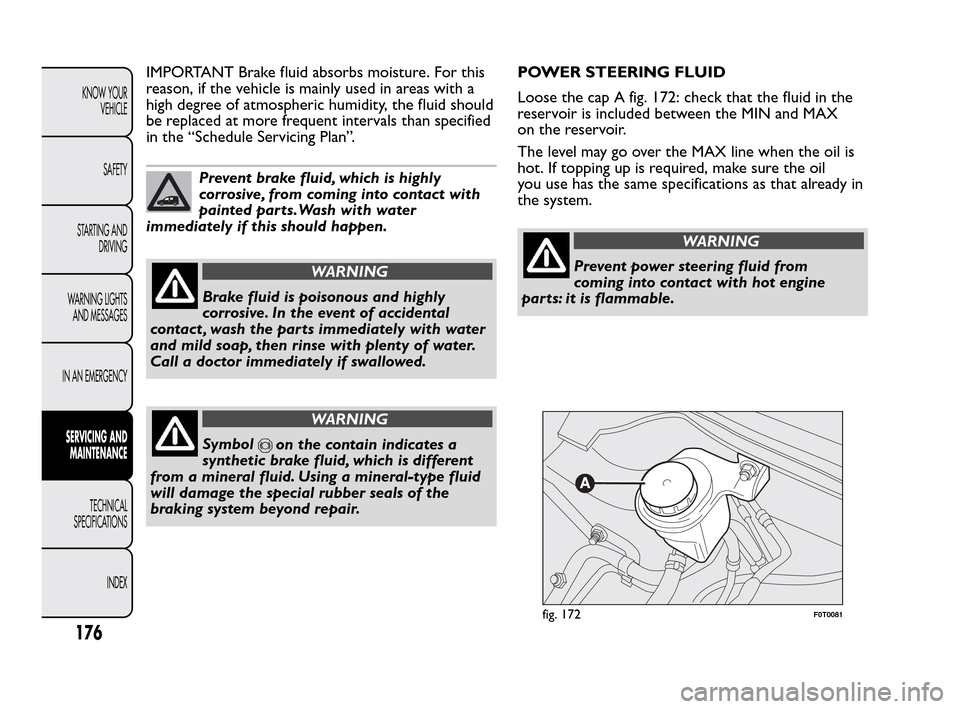
Loose the cap A fig. 172: check that the fluid in the
reservoir is included between the MIN and MAX
on the reservoir.
The level may go over the MAX line when the oil is
hot. If topping up is required, make sure the oil
you use has the same specifications as that already in
the system.
WARNING
Prevent power steering fluid from
c
oming into contact with hot engine
parts: it is flammable.
fig. 172F0T0081
176
KNOW YOUR
VEHICLE
SAFETY
STARTING AND
DRIVING
WARNING LIGHTS
AND MESSAGES
IN AN EMERGENCY
SERVICING AND
MAINTENANCE
TECHNICAL
SPECIFICA
TIONS
INDEX
Page 180 of 230
USEFUL ADVICE FOR EXTENDING THE
LIFE OF YOUR BATTERY
To avoid draining your battery and make it last
longer, follow these instructions closely:
❒when you park the vehicle, ensure the doors, boot
and bonnet are closed properly so that the ceiling
lights do not stay on;
❒turn off the ceiling lights, although the car does
have an automatic system for switching off internal
lights;
❒do not keep accessories (e.g. sound system, hazard
lights, etc.) switched on for a long time when the
engine is not running;
❒before performing any operation on the electrical
system, disconnect the battery negative cable;
❒make sure that battery terminals are always be
perfectly tight.
IMPORTANT If the battery remains with the charge
below 50% for a long time it becomes damaged
through sulphation and its starting capacity is
reduced.
The battery is also more prone to the risk of freezing
(at temperatures as high as -10°C).
Refer to the paragraph "Vehicle inactivity" in "Starting
and driving" if the vehicle is left parked for a long
time.
If, after buying the vehicle, you want to install
electric accessories which require permanent electric
supply (alarm, etc.) contact the Fiat Dealershipwhose qualified personnel, in addition to suggesting
the most suitable devices, will evaluate the overall
electric absorption, checking whether the vehicle
electric system is capable of withstanding the load
required, or whether it should be integrated with
a more powerful battery.
Since these devices continue to use electricity even
when the engine is off, they gradually run down
the battery.
179
KNOW YOUR
VEHICLE
SAFETY
STARTING AND
DRIVING
WARNING LIGHTS
AND MESSAGES
IN AN EMERGENCY
SERVICING AND
MAINTENANCE
TECHNICAL
SPECIFICA
TIONS
INDEX
Page 183 of 230
WINDSCREEN/REAR WINDOW
WIPERS
(for versions/markets, where provided)
BLADES
Regularly clean the rubber part using appropriate
products; TUTELA PROFESSIONAL SC 35 is
recommended.
Replace the blades if the rubber edge is misshapen or
worn. In any event, it is advisable to replace them
approximately once a year.
A few simple precautions can reduce the possibility
of damage to the blades:
❒make sure that the rubber part is not stuck to the
windscreen at sub-zero temperatures. Use an
antifreeze product to release it if required;
❒remove any snow from the glass: in addition to
protecting the blades, this prevents the electric
motor from overheating;
❒do not operate the windscreen and rear window
wipers on dry glass.
WARNING
Driving with worn wiper blades is a
ser
ious hazard, because visibility is
reduced in bad weather.Replacing the windscreen wiper blades
Proceed as follows:
❒lift up the windscreen wiper arm and position the
blade so that it forms a 90° angle with the arm;
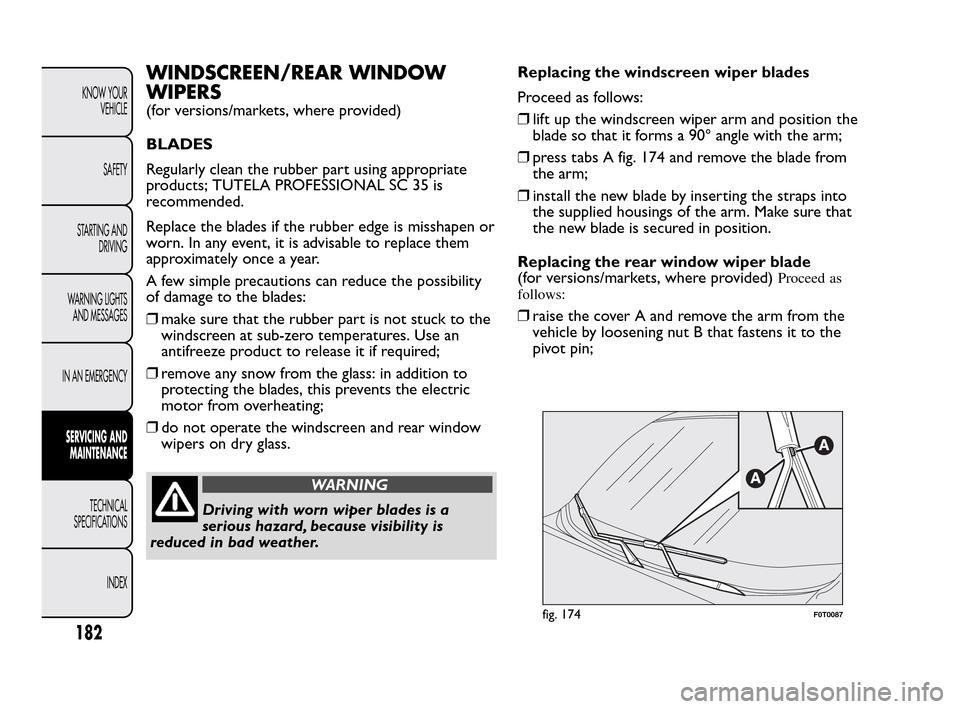
❒press tabs A fig. 174 and remove the blade from
the arm;
❒install the new blade by inserting the straps into
the supplied housings of the arm. Make sure that
the new blade is secured in position.
Replacing the rear window wiper blade
(for versions/markets, where provided)
Proceed as
follows:
❒raise the cover A and remove the arm from the
vehicle by loosening nut B that fastens it to the
pivot pin;
fig. 174F0T0087
182
KNOW YOUR
VEHICLE
SAFETY
STARTING AND
DRIVING
WARNING LIGHTS
AND MESSAGES
IN AN EMERGENCY
SERVICING AND
MAINTENANCE
TECHNICAL
SPECIFICA
TIONS
INDEX
Page 223 of 230
Index
ABS fault warning light ............ 123
ABS (fault warning light) .......... 123
ABS ................................................ 75
Air bag fault warning light ........ 121
Air bag (fault warning light) ..... 121
Airbags (general warnings) ...... 108
Air cleaner ................................... 177
Alarm fault warning light .......... 127
Alarm ............................................. 9
Alarm (warning light) ................ 127
Arrangements for dealing
with the vehicle at the end
of its life ..................................... 211
Ashtray .......................................... 56
ASR
– On/off message..................... 130
ASR system .................................. 78
– On/off message..................... 130
Battery
– Replacement .......................... 178
Battery (low charge warning
light) ............................................ 122
Battery (recharging) .................. 163Body
– Advice for preserving the
bodywork ............................... 184
– Protection from
atmospheric elements......... 184
– Vehicle body and
underbody guarantee .......... 184
Body paintwork
identification plate ................... 189
Bodywork versions.................... 190
Bonnet
– Closing ..................................... 71
– Opening ................................... 70
Boot ............................................... 62
Boot light ............................... 52-153
Brake Assist ................................. 76
Brake fluid/handbrake
warning light.............................. 120
Brake fluid.................................... 175
Brake fluid (warning light)........ 120
Brake lights (changing a
bulb) ............................................ 149
Brake pad wear warning
light ............................................. 129
Brake pad wear (warning
light) ............................................ 129
Brakes
– characteristics ....................... 193Brakes (pad wear warning
light) ............................................ 129
Break-in attempt warning
light ............................................. 127
Bulb types .................................... 144
Bump starting ............................. 132
Capacities.................................... 204
Carrying children safely
– Child seat compliance ......... 100
– Child seats .............................. 96
– Safety rules ............................ 101
Ceiling lights................................. 49
Ceiling light with movable
lens (changing a bulb).............. 151
Central and side vents ............... 38
Changing a bulb.................. 143-144
Changing an exterior
bulb .................... 146-147-148-150
Changing an interior bulb ........ 151
Changing a tyre .................. 132-133
Changing battery - key with
remote control.......................... 8
Chassis marking.......................... 189
Checking fluid levels.................. 171
Cigar lighter ................................. 55
Clutch ........................................... 192
CO
2emissions ........................... 209
222
KNOW YOUR
VEHICLE
SAFETY
STARTING AND
DRIVING
WARNING LIGHTS
AND MESSAGES
IN AN EMERGENCY
SERVICING AND
MAINTENANCE
TECHNICAL
SPECIFICATIONS
INDEX