ECU FIAT QUBO 2010 1.G User Guide
[x] Cancel search | Manufacturer: FIAT, Model Year: 2010, Model line: QUBO, Model: FIAT QUBO 2010 1.GPages: 230, PDF Size: 4.38 MB
Page 99 of 230
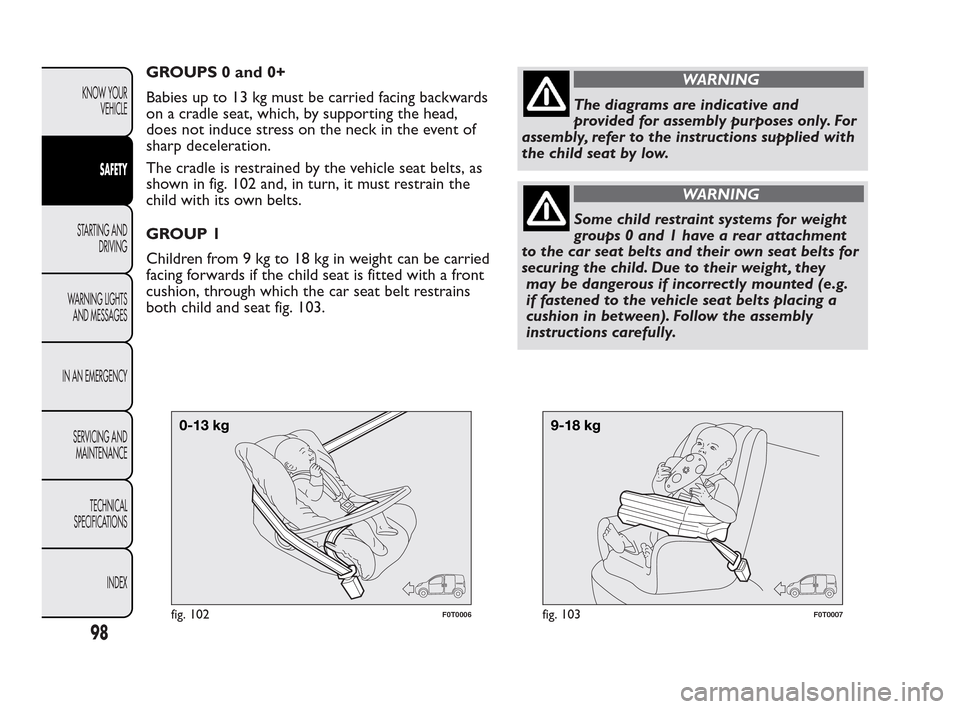
GROUPS 0 and 0+
Babies up to 13 kg must be carried facing backwards
on a cradle seat, which, by supporting the head,
does not induce stress on the neck in the event of
sharp deceleration.
The cradle is restrained by the vehicle seat belts, as
shown in fig. 102 and, in turn, it must restrain the
child with its own belts.
GROUP 1
Children from 9 kg to 18 kg in weight can be carried
facing forwards if the child seat is fitted with a front
cushion, through which the car seat belt restrains
both child and seat fig. 103.WARNING
The diagrams are indicative and
pro
vided for assembly purposes only. For
assembly, refer to the instructions supplied with
the child seat by low.
WARNING
Some child restraint systems for weight
groups
0 and 1 have a rear attachment
to the car seat belts and their own seat belts for
securing the child. Due to their weight , they
may be dangerous if incorrectly mounted (e.g.
if fastened to the vehicle seat belts placing a
cushion in between). Follow the assembly
instructions carefully.
fig. 102F0T0006fig. 103F0T0007
98
KNOW YOUR
VEHICLE
SAFETY
STARTING AND
DRIVING
W
ARNING LIGHTS
AND MESSAGES
IN AN EMERGENCY
SERVICING AND
MAINTENANCE
TECHNICAL
SPECIFICATIONS
INDEX
Page 100 of 230
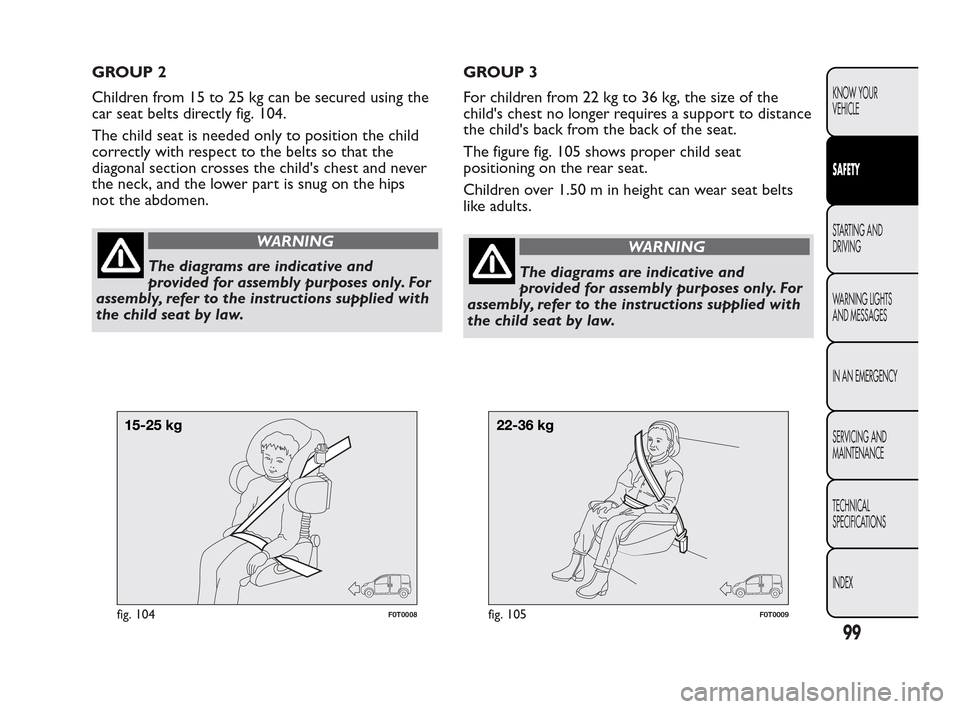
GROUP 2
Children from 15 to 25 kg can be secured using the
car seat belts directly fig. 104.
The child seat is needed only to position the child
correctly with respect to the belts so that the
diagonal section crosses the child's chest and never
the neck, and the lower part is snug on the hips
not the abdomen.
WARNING
The diagrams are indicative and
pro
vided for assembly purposes only. For
assembly, refer to the instructions supplied with
the child seat by law.GROUP 3
For children from 22 kg to 36 kg, the size of the
child's chest no longer requires a support to distance
the child's back from the back of the seat.
The figure fig. 105 shows proper child seat
positioning on the rear seat.
Children over 1.50 m in height can wear seat belts
like adults.
WARNING
The diagrams are indicative and
pro
vided for assembly purposes only. For
assembly, refer to the instructions supplied with
the child seat by law.
fig. 104F0T0008fig. 105F0T0009
99
KNOW YOUR
VEHICLE
SAFETY
STARTING AND
DRIVING
W
ARNING LIGHTS
AND MESSAGES
IN AN EMERGENCY
SERVICING AND
MAINTENANCE
TECHNICAL
SPECIFICATIONS
INDEX
Page 103 of 230
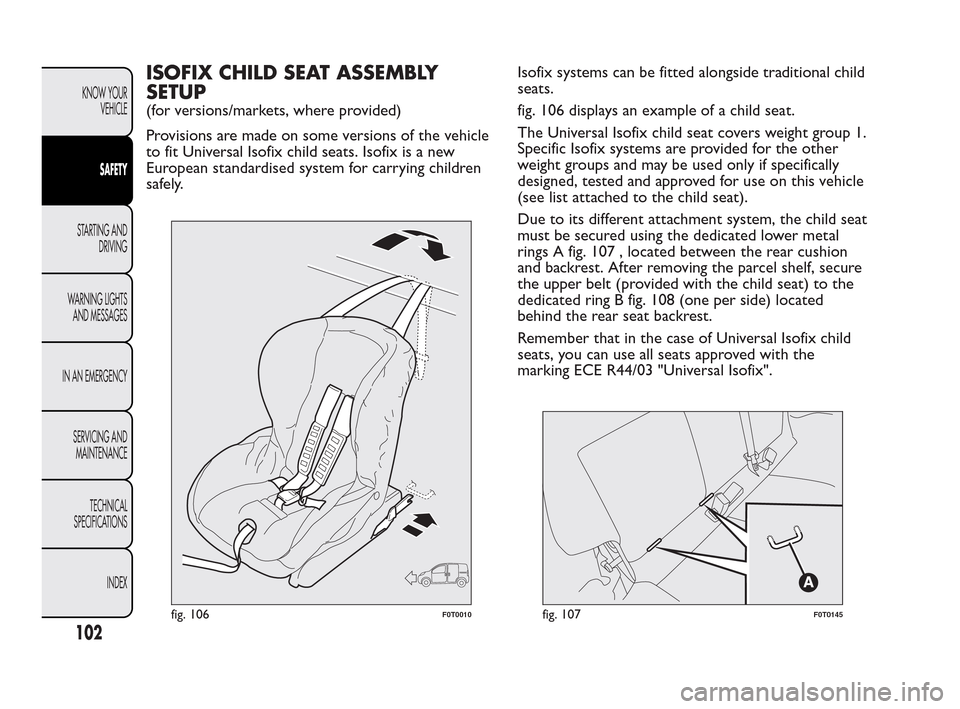
ISOFIX CHILD SEAT ASSEMBLY
SETUP
(for versions/markets, where provided)
Provisions are made on some versions of the vehicle
to fit Universal Isofix child seats. Isofix is a new
European standardised system for carrying children
safely.Isofix systems can be fitted alongside traditional child
seats.
fig. 106 displays an example of a child seat.
The Universal Isofix child seat covers weight group 1.
Specific Isofix systems are provided for the other
weight groups and may be used only if specifically
designed, tested and approved for use on this vehicle
(see list attached to the child seat).
Due to its different attachment system, the child seat
must be secured using the dedicated lower metal
rings A fig. 107 , located between the rear cushion
and backrest. After removing the parcel shelf, secure
the upper belt (provided with the child seat) to the
dedicated ring B fig. 108 (one per side) located
behind the rear seat backrest.
Remember that in the case of Universal Isofix child
seats, you can use all seats approved with the
marking ECE R44/03 "Universal Isofix".
fig. 106F0T0010fig. 107F0T0145
102
KNOW YOUR
VEHICLE
SAFETY
STARTING AND
DRIVING
W
ARNING LIGHTS
AND MESSAGES
IN AN EMERGENCY
SERVICING AND
MAINTENANCE
TECHNICAL
SPECIFICATIONS
INDEX
Page 114 of 230
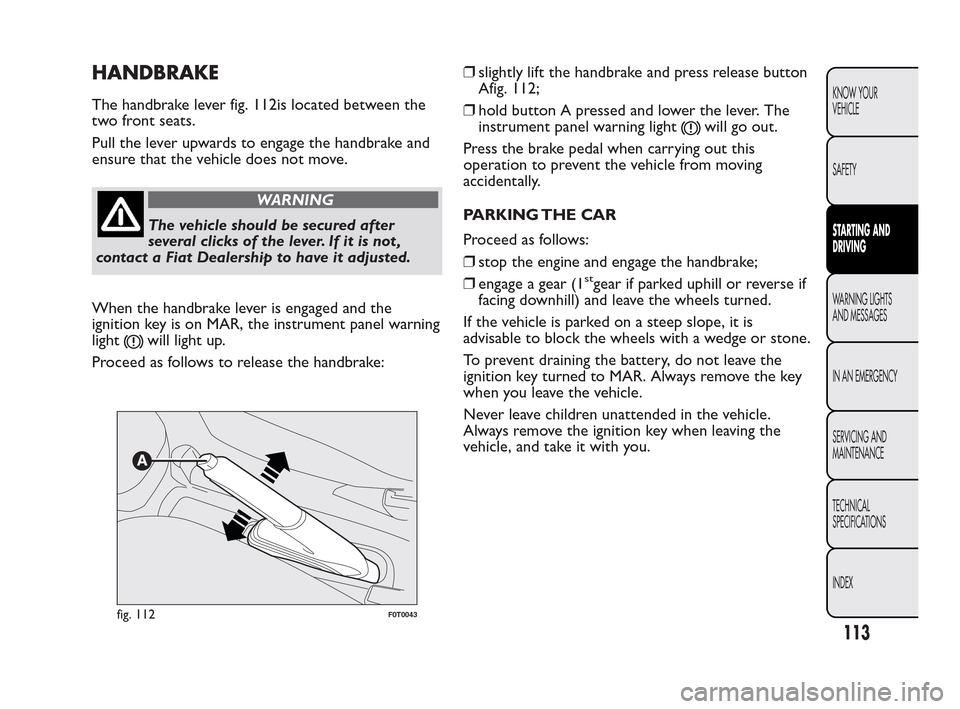
HANDBRAKE
The handbrake lever fig. 112is located between the
two front seats.
Pull the lever upwards to engage the handbrake and
ensure that the vehicle does not move.
WARNING
The vehicle should be secured after
se
veral clicks of the lever. If it is not ,
contact a Fiat Dealership to have it adjusted.
When the handbrake lever is engaged and the
ignition key is on MAR, the instrument panel warning
light
will light up.
Proceed as follows to release the handbrake:❒slightly lift the handbrake and press release button
Afig. 112;
❒hold button A pressed and lower the lever. The
instrument panel warning light
will go out.
Press the brake pedal when carrying out this
operation to prevent the vehicle from moving
accidentally.
PARKING THE CAR
Proceed as follows:
❒stop the engine and engage the handbrake;
❒engage a gear (1
stgear if parked uphill or reverse if
facing downhill) and leave the wheels turned.
If the vehicle is parked on a steep slope, it is
advisable to block the wheels with a wedge or stone.
To prevent draining the battery, do not leave the
ignition key turned to MAR. Always remove the key
when you leave the vehicle.
Never leave children unattended in the vehicle.
Always remove the ignition key when leaving the
vehicle, and take it with you.
fig. 112F0T0043
113
KNOW YOUR
VEHICLE
SAFETY
STARTING AND
DRIVING
WARNING LIGHTS
AND
MESSAGES
IN AN EMERGENCY
SERVICING AND
MAINTENANCE
TECHNICAL
SPECIFICATIONS
INDEX
Page 134 of 230
WARNING
Use your hazard lights, warning triangle,
et
c . to show that your vehicle is
stationary according to the regulations in force.
Passengers should get out of the vehicle,
particularly if it is heavily loaded, and wait for
the wheel to be changed away from the traffic .
If you are on a slope or uneven surface, place
wedges or other suitable objects under the
wheels to secure the vehicle. Have the standard
wheel repaired and refitted as soon as possible.
Do not apply grease to the bolt threads before
fitting: they could unscrew themselves.
WARNING
Use the jack only to replace wheels on
t
he vehicle with which it is supplied
or on other vehicles of the same model. Never
use the jack for other purposes, such as lifting
other models. Never use the jack to carry out
repairs under the vehicle. Incorrect positioning
of the jack may cause the raised vehicle to
fall. Do not use the jack for loads higher than
the one shown on its label.
WARNING
Incorrect hub cap assembly may cause it
to
come off when the car is moving.
Never tamper with the inflation valve. Never
introduce tools of any kind between rim and
tyre. Check tyre and spare wheel pressures
regularly, complying with the values given in the
"Technical specifications" chapter.
Important notes:
❒the jack weighs 1.76 kg;
❒the jack requires no adjustment;
❒the jack cannot be repaired; if it breaks, it must be
replaced with a new one of the same type;
❒no tool other than the cranking handle may be
fitted on the jack.
To change a wheel proceed as follows:
❒stop the vehicle in a position where it is not a
danger for other traffic and where you can replace
the wheel safely. The ground should be flat and
solid;
❒stop the engine off and pull up the handbrake;
❒engage first gear or reverse;
❒wear the reflective safety jacket (compulsory by
law) before getting out of the vehicle;
133
KNOW YOUR
VEHICLE
SAFETY
STARTING AND
DRIVING
WARNING LIGHTS
AND MESSAGES
IN AN
EMERGENCY
SERVICING AND
MAINTENANCE
TECHNICAL
SPECIFICA
TIONS
INDEX
Page 138 of 230
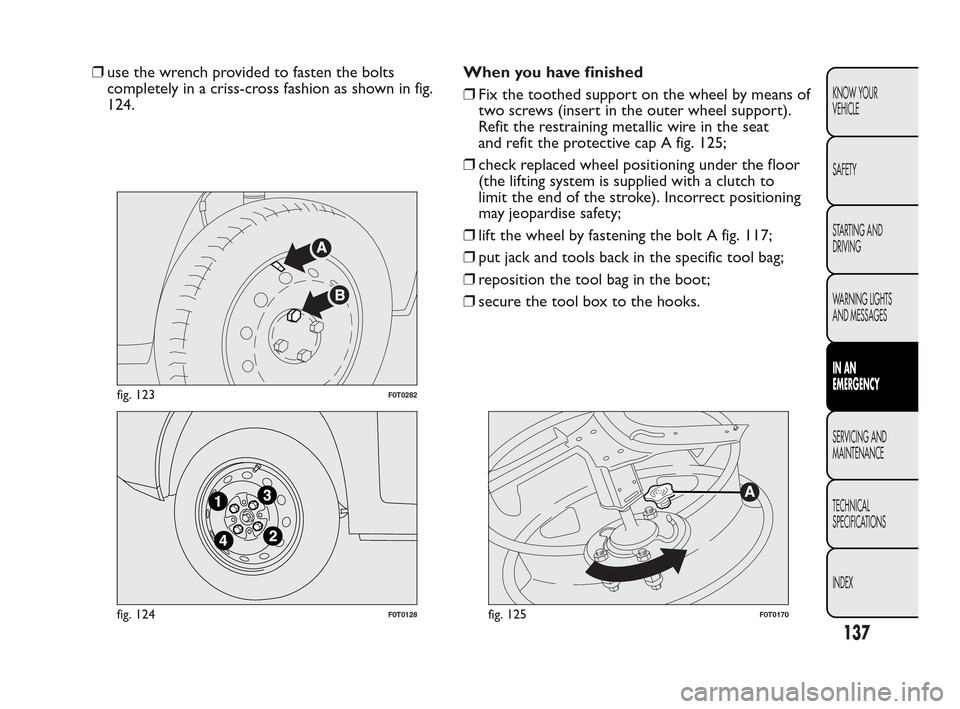
❒use the wrench provided to fasten the bolts
completely in a criss-cross fashion as shown in fig.
124.When you have finished
❒Fix the toothed support on the wheel by means of
two screws (insert in the outer wheel support).
Refit the restraining metallic wire in the seat
and refit the protective cap A fig. 125;
❒check replaced wheel positioning under the floor
(the lifting system is supplied with a clutch to
limit the end of the stroke). Incorrect positioning
may jeopardise safety;
❒lift the wheel by fastening the bolt A fig. 117;
❒put jack and tools back in the specific tool bag;
❒reposition the tool bag in the boot;
❒secure the tool box to the hooks.
fig. 123F0T0282
fig. 124F0T0128fig. 125F0T0170
137
KNOW YOUR
VEHICLE
SAFETY
STARTING AND
DRIVING
WARNING LIGHTS
AND MESSAGES
IN AN
EMERGENCY
SERVICING AND
MAINTENANCE
TECHNICAL
SPECIFICA
TIONS
INDEX
Page 152 of 230
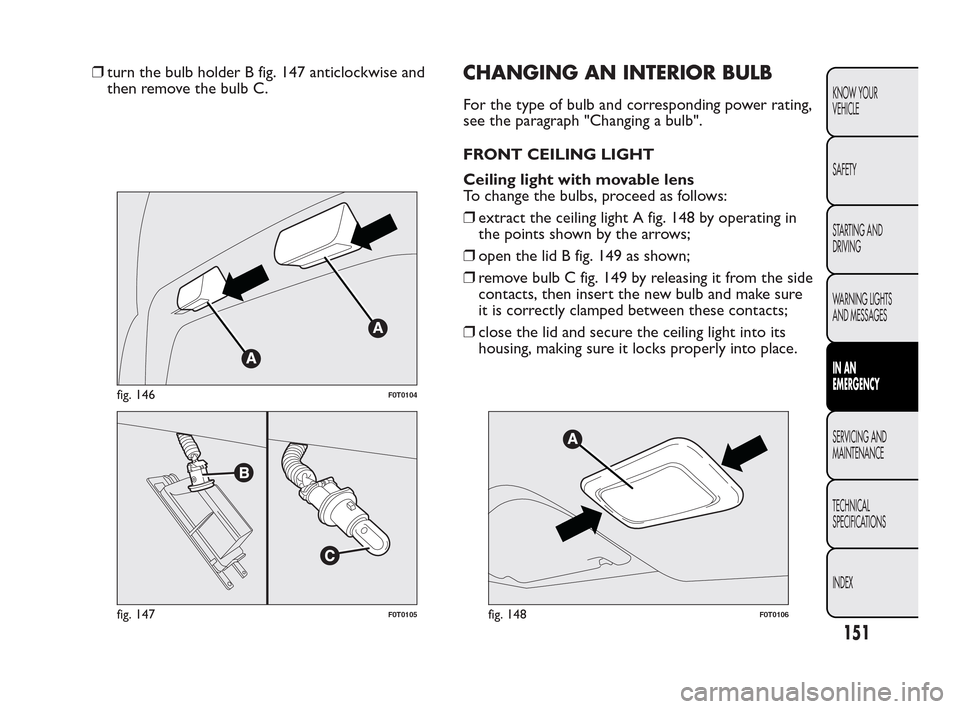
❒turn the bulb holder B fig. 147 anticlockwise and
then remove the bulb C.CHANGING AN INTERIOR BULB
For the type of bulb and corresponding power rating,
see the paragraph "Changing a bulb".
FRONT CEILING LIGHT
Ceiling light with movable lens
To change the bulbs, proceed as follows:
❒extract the ceiling light A fig. 148 by operating in
the points shown by the arrows;
❒open the lid B fig. 149 as shown;
❒remove bulb C fig. 149 by releasing it from the side
contacts, then insert the new bulb and make sure
it is correctly clamped between these contacts;
❒close the lid and secure the ceiling light into its
housing, making sure it locks properly into place.
fig. 146F0T0104
fig. 147F0T0105fig. 148F0T0106
151
KNOW YOUR
VEHICLE
SAFETY
STARTING AND
DRIVING
WARNING LIGHTS
AND MESSAGES
IN AN
EMERGENCY
SERVICING AND
MAINTENANCE
TECHNICAL
SPECIFICA
TIONS
INDEX
Page 153 of 230
Roof light with spot lights
(for versions/markets, where provided)
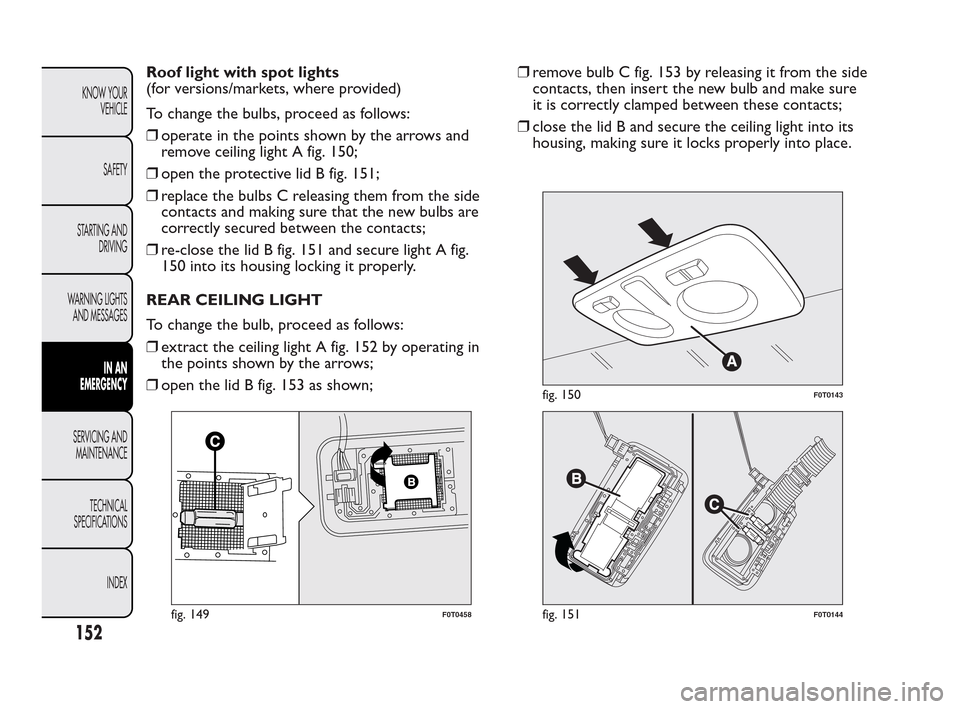
To change the bulbs, proceed as follows:
❒operate in the points shown by the arrows and
remove ceiling light A fig. 150;
❒open the protective lid B fig. 151;
❒replace the bulbs C releasing them from the side
contacts and making sure that the new bulbs are
correctly secured between the contacts;
❒re-close the lid B fig. 151 and secure light A fig.
150 into its housing locking it properly.
REAR CEILING LIGHT
To change the bulb, proceed as follows:
❒extract the ceiling light A fig. 152 by operating in
the points shown by the arrows;
❒open the lid B fig. 153 as shown;❒remove bulb C fig. 153 by releasing it from the side
contacts, then insert the new bulb and make sure
it is correctly clamped between these contacts;
❒close the lid B and secure the ceiling light into its
housing, making sure it locks properly into place.
fig. 149F0T0458
fig. 150F0T0143
fig. 151F0T0144
152
KNOW YOUR
VEHICLE
SAFETY
STARTING AND
DRIVING
WARNING LIGHTS
AND MESSAGES
IN AN
EMERGENCY
SERVICING AND
MAINTENANCE
TECHNICAL
SPECIFICA
TIONS
INDEX
Page 154 of 230
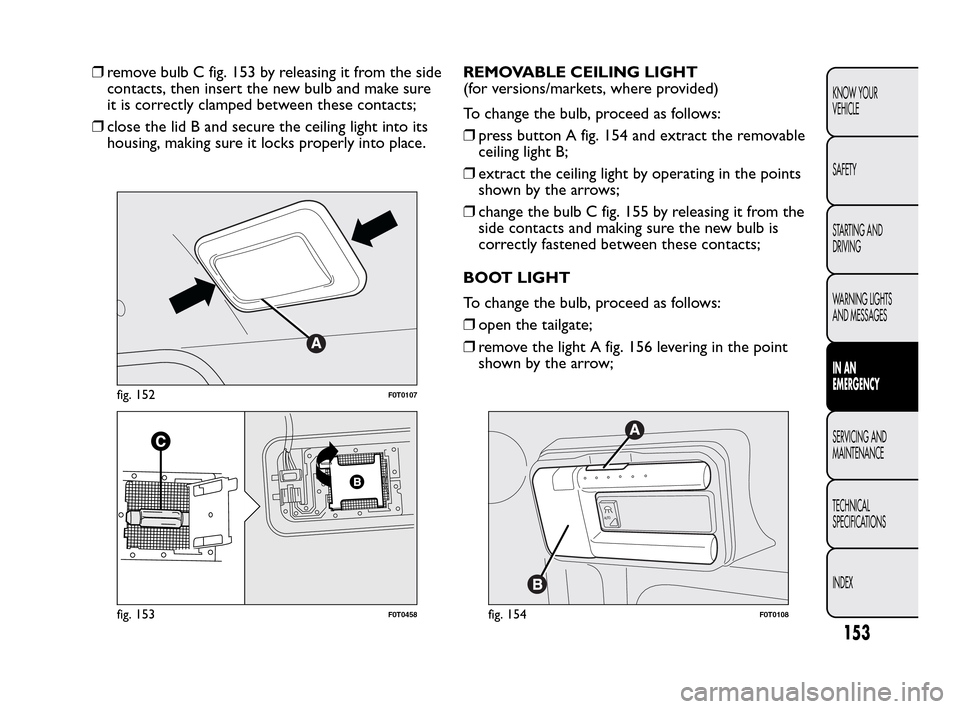
❒remove bulb C fig. 153 by releasing it from the side
contacts, then insert the new bulb and make sure
it is correctly clamped between these contacts;
❒close the lid B and secure the ceiling light into its
housing, making sure it locks properly into place.REMOVABLE CEILING LIGHT
(for versions/markets, where provided)
To change the bulb, proceed as follows:
❒press button A fig. 154 and extract the removable
ceiling light B;
❒extract the ceiling light by operating in the points
shown by the arrows;
❒change the bulb C fig. 155 by releasing it from the
side contacts and making sure the new bulb is
correctly fastened between these contacts;
BOOT LIGHT
To change the bulb, proceed as follows:
❒open the tailgate;
❒remove the light A fig. 156 levering in the point
shown by the arrow;
fig. 152F0T0107
fig. 153F0T0458
A
UT
O
fig. 154F0T0108
153
KNOW YOUR
VEHICLE
SAFETY
STARTING AND
DRIVING
WARNING LIGHTS
AND MESSAGES
IN AN
EMERGENCY
SERVICING AND
MAINTENANCE
TECHNICAL
SPECIFICA
TIONS
INDEX
Page 162 of 230
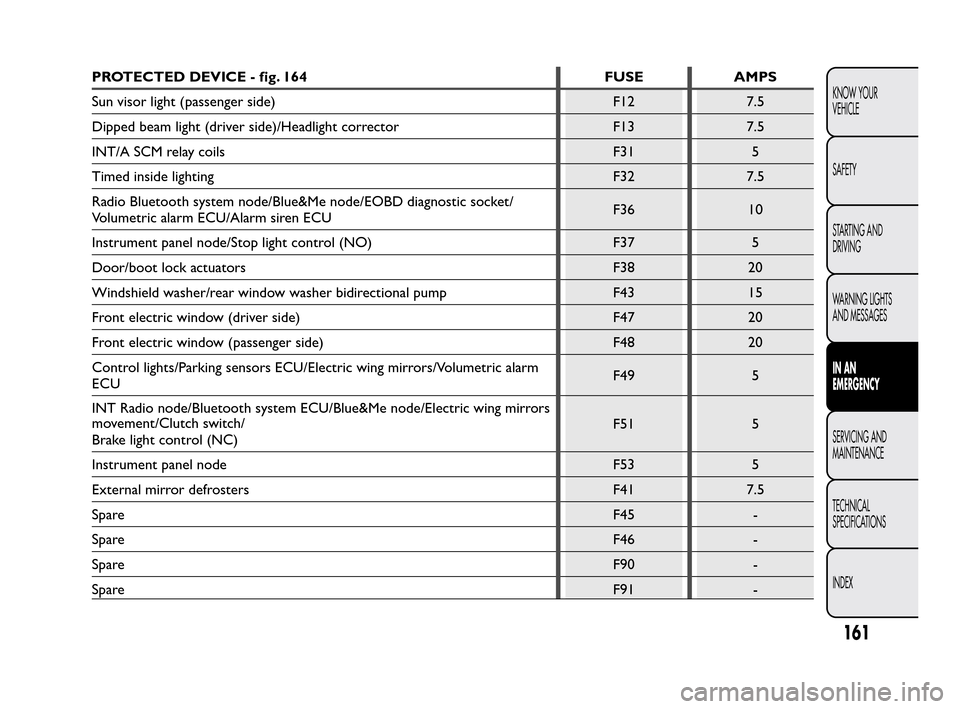
PROTECTED DEVICE - fig. 164 FUSE AMPS
Sun visor light (passenger side) F12 7.5
Dipped beam light (driver side)/Headlight corrector F13 7.5
INT/A SCM relay coils F31 5
Timed inside lighting F32 7.5
Radio Bluetooth system node/Blue&Me node/EOBD diagnostic socket/
Volumetric alarm ECU/Alarm siren ECUF36 10
Instrument panel node/Stop light control (NO) F37 5
Door/boot lock actuators F38 20
Windshield washer/rear window washer bidirectional pump F43 15
Front electric window (driver side) F47 20
Front electric window (passenger side) F48 20
Control lights/Parking sensors ECU/Electric wing mirrors/Volumetric alarm
ECUF49 5
INT Radio node/Bluetooth system ECU/Blue&Me node/Electric wing mirrors
movement/Clutch switch/
Brake light control (NC)F51 5
Instrument panel node F53 5
External mirror defrosters F41 7.5
SpareF45 -
SpareF46 -
SpareF90 -
SpareF91 -
161
KNOW YOUR
VEHICLE
SAFETY
STARTING AND
DRIVING
WARNING LIGHTS
AND MESSAGES
IN AN
EMERGENCY
SERVICING AND
MAINTENANCE
TECHNICAL
SPECIFICA
TIONS
INDEX