wheel FIAT QUBO 2010 1.G User Guide
[x] Cancel search | Manufacturer: FIAT, Model Year: 2010, Model line: QUBO, Model: FIAT QUBO 2010 1.GPages: 230, PDF Size: 4.38 MB
Page 80 of 230
❒acceleration on slippery, snowy or icy road
surfaces;
❒in the case of loss of grip on a wet surface
(aquaplaning).
WARNING
For the correct operation of the ESP and
A
SR systems, the tyres must be the
same make and type on all wheels, in perfect
condition and, above all, of the type, make and
size recommended.
MSR SYSTEM (engine drive regulation)
This is an integral part of the ASR system that, in the
event of a sudden gear down shift, cuts in and
provides torque to the engine thus preventing
excessive drive wheel drive which, especially in poor
grip conditions, can lead to a loss of stability.
Engagement/ disengagement of the ASR
system
The ASR system switches on automatically each time
the engine is started.
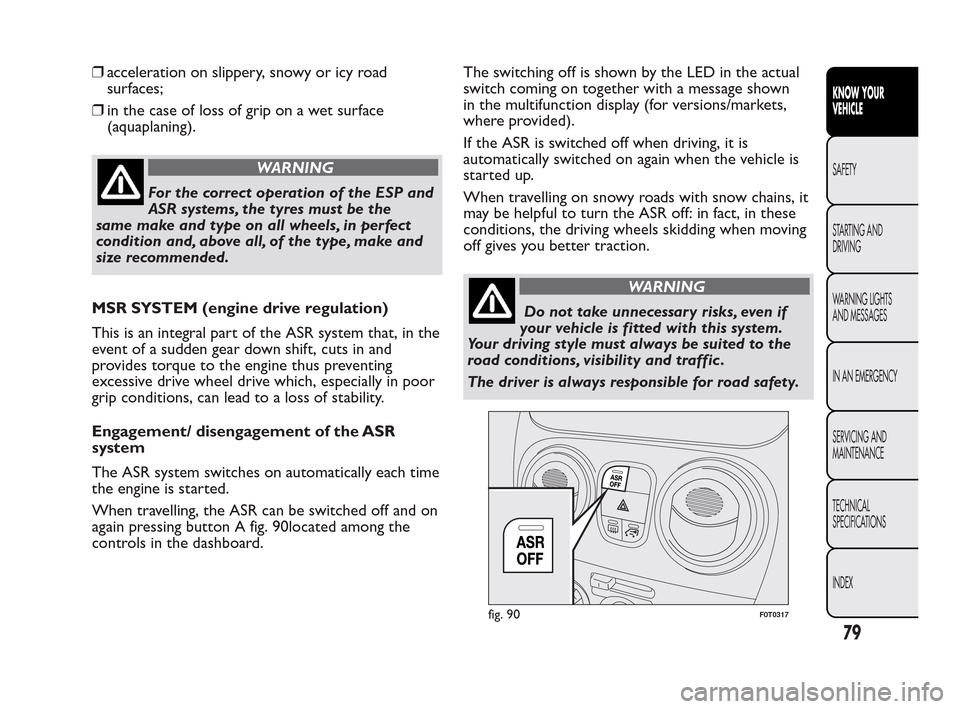
When travelling, the ASR can be switched off and on
again pressing button A fig. 90located among the
controls in the dashboard.The switching off is shown by the LED in the actual
switch coming on together with a message shown
in the multifunction display (for versions/markets,
where provided).
If the ASR is switched off when driving, it is
automatically switched on again when the vehicle is
started up.
When travelling on snowy roads with snow chains, it
may be helpful to turn the ASR off: in fact, in these
conditions, the driving wheels skidding when moving
off gives you better traction.
WARNING
Do not take unnecessary risks, even if
y
our vehicle is fitted with this system.
Your driving style must always be suited to the
road conditions, visibility and traffic .
The driver is always responsible for road safety.
fig. 90F0T0317
79
KNOW YOUR
VEHICLE
SAFETY
ST
ARTING AND
DRIVING
WARNING LIGHTS
AND MESSAGES
IN AN EMERGENCY
SERVICING AND
MAINTENANCE
TECHNICAL
SPECIFICATIONS
INDEX
Page 81 of 230
For the correct operation of the ASR system, the
tyres must absolutely be the same make and type on
all wheels, in perfect condition and, above all, of
the type, make and size specified.
FAILURE INDICATIONS
In the event of a failure, the ASR system will be
automatically switched off and warning light
will
appear permanently on the instrument panel along
with a message on the multifunction display (for
versions/markets where provided) (see “Warning
lights and messages”). In this case, contact a Fiat
Dealership as soon as possible.
TRACTION PLUS SYSTEM
(for versions/markets, where provided)
Traction Plus is a help with driving and setting off in
poor grip conditions (snow, ice, mud, etc.) which
allows the drive force to be evenly distributed over
the same axle when both wheels are slipping.
In effect, Traction Plus acts by braking the wheels
with poor grip (or those slipping more than the
others), thereby transferring the drive force to those
which have more grip on the ground.
This function can be turned on manually by pressing
the T+ button fig. 91 on the dashboard and works
below a level of 30 km/h. Over this speed, it is
automatically deactivated (the LED on the button is
still on) and it is reactivated again when the speed
is below 30 km/h.
80
KNOW YOUR
VEHICLE
SAFETY
ST
ARTING AND
DRIVING
WARNING LIGHTS
AND MESSAGES
IN AN EMERGENCY
SERVICING AND
MAINTENANCE
TECHNICAL
SPECIFICATIONS
INDEX
Page 106 of 230
FRONT AIRBAGS
The vehicle is fitted with front airbags for driver and
passenger (for versions/markets where provided).
The front driver/passenger airbags (for versions/
markets, where provided) are designed to protect
the front-seat occupants in the event of head-on
crashes of medium-high severity, by placing the bag
between the occupant and the steering wheel or
dashboard.
Non-activation in other types of crash (side-on
collisions, rear shunts, roll-overs, etc.) is therefore
not a sign of system malfunction.
An electronic control unit causes the bag to inflate, if
necessary, in the event of a head-on crash.
The bag will inflate instantaneously, placing itself
between the front occupant's body and the
structures which could cause injury. It will deflate
immediately afterwards.
Front driver/passenger airbags (for versions/markets,
where provided) are not a replacement for, but
rather a complement to, the seat belts, which should
be worn at all times as specified by law in Europe
and most non-European countries.
In the event of an impact, someone not wearing a
seat belt will move forward and come into contact
with the bag which is still opening. The protection
offered by the bag is reduced in such a case.
Front airbags may not be activated in the following
situations:❒head-on impacts against highly deformable objects
that do not affect the front surface of the vehicle
(e.g. front wing hitting a guard rail);
❒vehicle getting wedged under other vehicles or
protective barriers (e.g. trucks or guard rails);
they could not provide any additional protection
compared with seat belts, so their activation would
not be worthwhile. In these cases, non-deployment
of the airbag does not necessarily indicate a system
malfunction.
WARNING
Do not apply stickers or other objects to
t
he steering wheel, the dashboard in
the passenger side airbag area and the seats.
Do not place objects (e.g. mobile phones) on the
passenger side dashboard because these could
interfere with the correct opening of the airbag
and cause severe injur y to occupants.
The front driver and passenger airbags are designed
and calibrated to best protect front-seat passengers
wearing seat belts. The volume of the front airbags at
maximum inflation fills most of the space between
the steering wheel and the driver and between
the dashboard and the passenger.
The airbags are not deployed in the event of small
head-on collisions (for which the withholding action
of the seat belts is sufficient). Seat belts must always
105
KNOW YOUR
VEHICLE
SAFETY
STARTING AND
DRIVING
W
ARNING LIGHTS
AND MESSAGES
IN AN EMERGENCY
SERVICING AND
MAINTENANCE
TECHNICAL
SPECIFICATIONS
INDEX
Page 107 of 230
be worn. In the event of head-on collisions, they
ensure the correct positioning of the occupant.
FRONT AIRBAG DRIVER'S SIDE
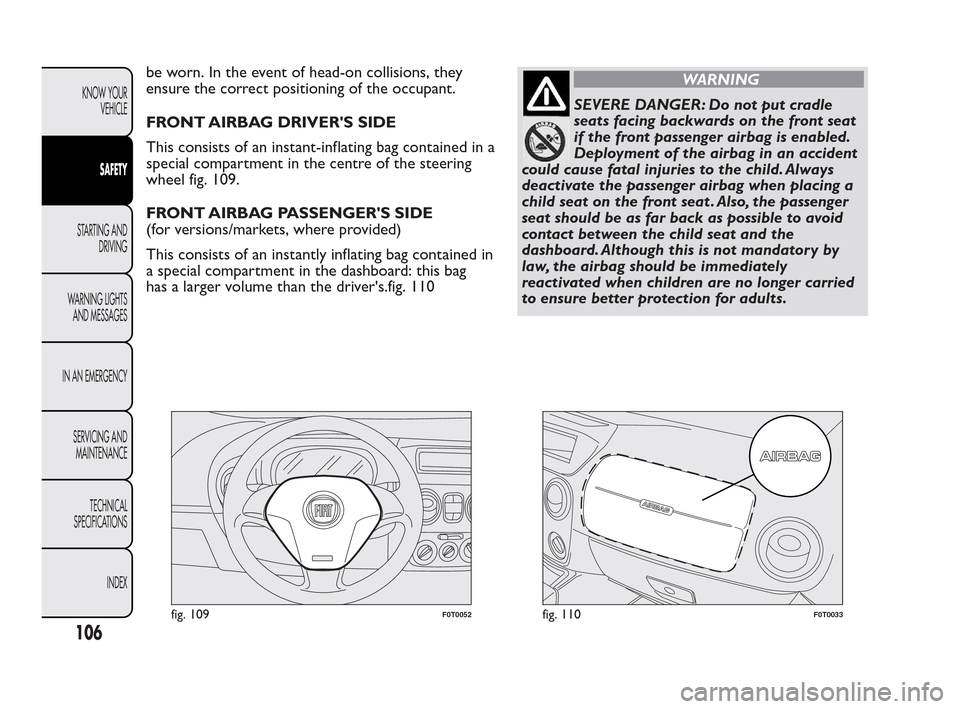
This consists of an instant-inflating bag contained in a
special compartment in the centre of the steering
wheel fig. 109.
FRONT AIRBAG PASSENGER'S SIDE
(for versions/markets, where provided)
This consists of an instantly inflating bag contained in
a special compartment in the dashboard: this bag
has a larger volume than the driver's.fig. 110WARNING
SEVERE DANGER: Do not put cradle
seat
s facing backwards on the front seat
if the front passenger airbag is enabled.
Deployment of the airbag in an accident
could cause fatal injuries to the child. Always
deactivate the passenger airbag when placing a
child seat on the front seat . Also, the passenger
seat should be as far back as possible to avoid
contact between the child seat and the
dashboard. Although this is not mandatory by
law, the airbag should be immediately
reactivated when children are no longer carried
to ensure better protection for adults.
fig. 109F0T0052fig. 110F0T0033
106
KNOW YOUR
VEHICLE
SAFETY
STARTING AND
DRIVING
W
ARNING LIGHTS
AND MESSAGES
IN AN EMERGENCY
SERVICING AND
MAINTENANCE
TECHNICAL
SPECIFICATIONS
INDEX
Page 112 of 230
STARTING AND DRIVING
STARTING THE ENGINE
The vehicle is fitted with an immobiliser: if the engine
fails to start, see the paragraph on “The Fiat CODE
system” in the “Knowing your vehicle” section.
The engine may be noisier during the first few
seconds of operation, particularly after a long period
of inactivity. This is due to the hydraulic tappets,
the timing system chosen for petrol engine versions
to reduce the number of servicing interventions,
and affects neither functionality nor reliability.
It is advisable not to demand maximum
performance from your vehicle (e.g.
excessive acceleration, long distances at
high speeds, excessive intense braking, etc .) during
the initial period of use.
When the engine is switched off never
leave the key on (at MAR) to prevent
unnecessary consumption and draining
the battery.
WARNING
It is dangerous to have the engine
runnin
g indoors.The engine takes in
oxygen and discharges carbon dioxide, carbon
monoxide and other toxic gases.
WARNING
Remember that the brake booster and
elect
ric power steering are not
operational until the engine has been started,
so you need to apply much more force than
usual to the brake pedal and steering wheel.
STARTING PROCEDURE FOR DIESEL
VERSIONS
Proceed as follows:
❒apply the handbrake;
❒put the gear lever into neutral;
❒turn the key on (MAR position): instrument panel
warning light
will light up;
❒wait for the warning lights
andto go out.
The hotter the engine is, the quicker this will
happen;
❒press the clutch pedal down to the floor without
touching the accelerator;
❒turn the ignition key to AVV as soon as the
warning light goes out. Waiting too long will
waste the heating work carried out by the glow
plugs.
Release the key as soon as the engine starts.
111
KNOW YOUR
VEHICLE
SAFETY
STARTING AND
DRIVING
WARNING LIGHTS
AND
MESSAGES
IN AN EMERGENCY
SERVICING AND
MAINTENANCE
TECHNICAL
SPECIFICATIONS
INDEX
Page 114 of 230
HANDBRAKE
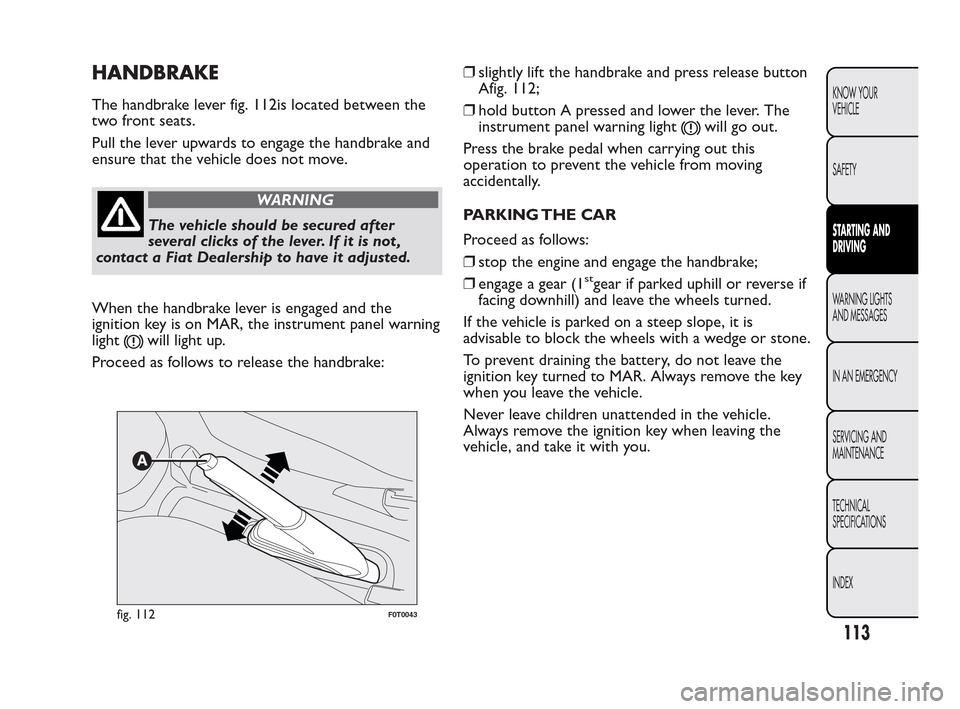
The handbrake lever fig. 112is located between the
two front seats.
Pull the lever upwards to engage the handbrake and
ensure that the vehicle does not move.
WARNING
The vehicle should be secured after
se
veral clicks of the lever. If it is not ,
contact a Fiat Dealership to have it adjusted.
When the handbrake lever is engaged and the
ignition key is on MAR, the instrument panel warning
light
will light up.
Proceed as follows to release the handbrake:❒slightly lift the handbrake and press release button
Afig. 112;
❒hold button A pressed and lower the lever. The
instrument panel warning light
will go out.
Press the brake pedal when carrying out this
operation to prevent the vehicle from moving
accidentally.
PARKING THE CAR
Proceed as follows:
❒stop the engine and engage the handbrake;
❒engage a gear (1
stgear if parked uphill or reverse if
facing downhill) and leave the wheels turned.
If the vehicle is parked on a steep slope, it is
advisable to block the wheels with a wedge or stone.
To prevent draining the battery, do not leave the
ignition key turned to MAR. Always remove the key
when you leave the vehicle.
Never leave children unattended in the vehicle.
Always remove the ignition key when leaving the
vehicle, and take it with you.
fig. 112F0T0043
113
KNOW YOUR
VEHICLE
SAFETY
STARTING AND
DRIVING
WARNING LIGHTS
AND
MESSAGES
IN AN EMERGENCY
SERVICING AND
MAINTENANCE
TECHNICAL
SPECIFICATIONS
INDEX
Page 115 of 230
SNOW TYRES
A Fiat Dealership will be happy to provide advice
concerning the most suitable type of tyre for your
requirements.
For the type, pressures and specifications of the
snow tyre to be used, follow carefully the
instructions given in the “Wheels” paragraph of the
“Technical specifications” section.
The winter performance of these tyres is
considerably reduced when the tread thickness is less
than 4 mm. If this is the case, replace them.
Due to their specific features, the performance of
snow tyres is much lower than that of standard tyres
in normal conditions or on long motorway stretches.
You should therefore use them only in the
conditions for which they were designed.
IMPORTANT When using snow tyres with a
maximum speed index below the one that can be
reached by the vehicle (increased by 5%), place
a notice in the passenger compartment, plainly in
view, which states the maximum speed allowed
by the snow tyres (as per EC Directive).
All four tyres should be the same (brand and profile)
to ensure greater safety when driving and braking
as well as making the car more responsive.
Remember that you should not change the rotation
direction of the tyres.
WARNING
You must not exceed 160 km/h on snow
t
yres with a “Q” mark; in any case, make
sure you stick to the rules of the highway code.
114
KNOW YOUR
VEHICLE
SAFETY
STARTING AND
DRIVING
WARNING LIGHTS
AND
MESSAGES
IN AN EMERGENCY
SERVICING AND
MAINTENANCE
TECHNICAL
SPECIFICATIONS
INDEX
Page 120 of 230
SNOW CHAINS
The use of snow chains should be in compliance with
local regulations.
Snow chains may be fitted only to the front wheel
tyres (drive wheels).
Check the tension of the chains after the first few
metres have been driven.
Keep your speed down when snow chains
are fitted: do not exceed 50 km/h. Avoid
potholes, steps and pavements and also
avoid driving for long distances on roads not
covered with snow to avoid damaging the car and
the road surface.
PROLONGED VEHICLE INACTIVITY
If the vehicle needs to be off the road for longer than
one month, the following precautions must be
taken:
❒park the vehicle indoors in a dry and, if possible,
well-ventilated place;
❒engage a gear and check that the handbrake is not
on;
❒disconnect the battery negative terminal and check
the charge (see “Battery” in the “Maintenance and
care”);
❒clean and protect the painted parts using
protective wax;
❒clean and protect the shiny metal parts using
special compounds readily available;
❒sprinkle talcum powder on the rubber windscreen
and rear window wiper blades and lift them off the
glass;
❒slightly open the windows;
❒cover the vehicle with a piece of fabric or
perforated plastic sheet. Do not use compact
plastic tarpaulins, which prevent humidity from
evaporating from the surface of the vehicle;
❒inflate tyres to +0.5 bar above the normal specified
pressure and check it at intervals;
❒do not drain the engine cooling system.
119
KNOW YOUR
VEHICLE
SAFETY
STARTING AND
DRIVING
WARNING LIGHTS
AND
MESSAGES
IN AN EMERGENCY
SERVICING AND
MAINTENANCE
TECHNICAL
SPECIFICATIONS
INDEX
Page 124 of 230
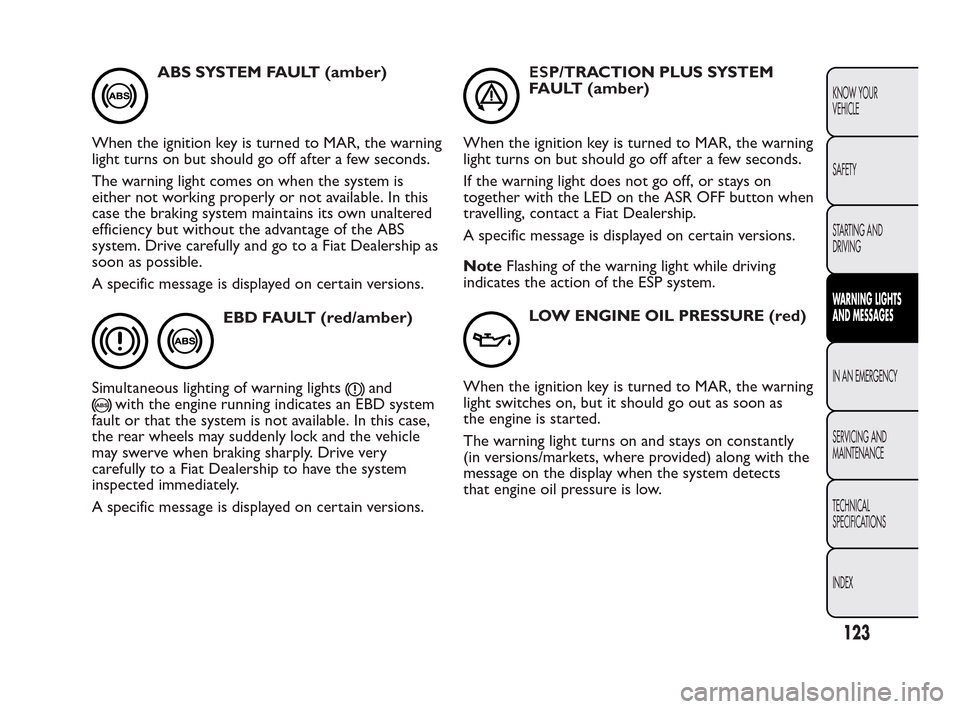
ABS SYSTEM FAULT (amber)
When the ignition key is turned to MAR, the warning
light turns on but should go off after a few seconds.
The warning light comes on when the system is
either not working properly or not available. In this
case the braking system maintains its own unaltered
efficiency but without the advantage of the ABS
system. Drive carefully and go to a Fiat Dealership as
soon as possible.
A specific message is displayed on certain versions.
EBD FAULT (red/amber)
Simultaneous lighting of warning lights
and
with the engine running indicates an EBD system
fault or that the system is not available. In this case,
the rear wheels may suddenly lock and the vehicle
may swerve when braking sharply. Drive very
carefully to a Fiat Dealership to have the system
inspected immediately.
A specific message is displayed on certain versions.
ESP/TRACTION PLUS SYSTEM
FAULT (amber)
When the ignition key is turned to MAR, the warning
light turns on but should go off after a few seconds.
If the warning light does not go off, or stays on
together with the LED on the ASR OFF button when
travelling, contact a Fiat Dealership.
A specific message is displayed on certain versions.
NoteFlashing of the warning light while driving
indicates the action of the ESP system.
LOW ENGINE OIL PRESSURE (red)
When the ignition key is turned to MAR, the warning
light switches on, but it should go out as soon as
the engine is started.
The warning light turns on and stays on constantly
(in versions/markets, where provided) along with the
message on the display when the system detects
that engine oil pressure is low.
123
KNOW YOUR
VEHICLE
SAFETY
STARTING AND
DRIVING
WARNING LIGHTS
AND
MESSAGES
IN AN EMERGENCY
SERVICING
AND
MAINTENANCE
TECHNICAL
SPECIFICATIONS
INDEX
Page 133 of 230
WARNING
This procedure must be performed by
e
xperts because incorrect actions may
cause considerable electrical discharge.
Furthermore, battery fluid is poisonous and
corrosive: avoid contact with skin and eyes.
Keep naked flames and lit cigarettes away from
the battery. Do not create sparks.
BUMP STARTING
Never bump start the engine by pushing, towing or
driving downhill. This could cause fuel to flow into
the catalytic converter and damage it beyond repair.
IMPORTANT Remember that the brake booster
and the power steering system are not active until
the engine is started, so you will need to apply much
more force to the brake pedal or steering wheel.
CHANGING A TYRE
The vehicle is originally equipped with the Fix&Go
automatic quick tyre repair kit (see instructions
in the next chapter). As an alternative, the vehicle
may have a normal-sized spare wheel.
Changing the wheel and correct use of the jack and
spare wheel require some precautions, which are
listed below.
WARNING
The spare wheel (for versions/markets,
w
here provided) is specific for your
vehicle.Therefore, it must not be used on other
models. Do not use spare wheels of other
models on your vehicle.The spare wheel must
be used only in an emergency. Use of the spare
wheel must kept to the minimum necessary.
132
KNOW YOUR
VEHICLE
SAFETY
STARTING AND
DRIVING
WARNING LIGHTS
AND MESSAGES
IN AN
EMERGENCY
SERVICING AND
MAINTENANCE
TECHNICAL
SPECIFICA
TIONS
INDEX