wheel FIAT QUBO 2010 1.G Owner's Manual
[x] Cancel search | Manufacturer: FIAT, Model Year: 2010, Model line: QUBO, Model: FIAT QUBO 2010 1.GPages: 230, PDF Size: 4.38 MB
Page 134 of 230
WARNING
Use your hazard lights, warning triangle,
et
c . to show that your vehicle is
stationary according to the regulations in force.
Passengers should get out of the vehicle,
particularly if it is heavily loaded, and wait for
the wheel to be changed away from the traffic .
If you are on a slope or uneven surface, place
wedges or other suitable objects under the
wheels to secure the vehicle. Have the standard
wheel repaired and refitted as soon as possible.
Do not apply grease to the bolt threads before
fitting: they could unscrew themselves.
WARNING
Use the jack only to replace wheels on
t
he vehicle with which it is supplied
or on other vehicles of the same model. Never
use the jack for other purposes, such as lifting
other models. Never use the jack to carry out
repairs under the vehicle. Incorrect positioning
of the jack may cause the raised vehicle to
fall. Do not use the jack for loads higher than
the one shown on its label.
WARNING
Incorrect hub cap assembly may cause it
to
come off when the car is moving.
Never tamper with the inflation valve. Never
introduce tools of any kind between rim and
tyre. Check tyre and spare wheel pressures
regularly, complying with the values given in the
"Technical specifications" chapter.
Important notes:
❒the jack weighs 1.76 kg;
❒the jack requires no adjustment;
❒the jack cannot be repaired; if it breaks, it must be
replaced with a new one of the same type;
❒no tool other than the cranking handle may be
fitted on the jack.
To change a wheel proceed as follows:
❒stop the vehicle in a position where it is not a
danger for other traffic and where you can replace
the wheel safely. The ground should be flat and
solid;
❒stop the engine off and pull up the handbrake;
❒engage first gear or reverse;
❒wear the reflective safety jacket (compulsory by
law) before getting out of the vehicle;
133
KNOW YOUR
VEHICLE
SAFETY
STARTING AND
DRIVING
WARNING LIGHTS
AND MESSAGES
IN AN
EMERGENCY
SERVICING AND
MAINTENANCE
TECHNICAL
SPECIFICA
TIONS
INDEX
Page 135 of 230
❒indicate that the vehicle is parked up by using the
devices required by law in the country in which
you are travelling (e.g. warning triangle, hazard
lights etc.);
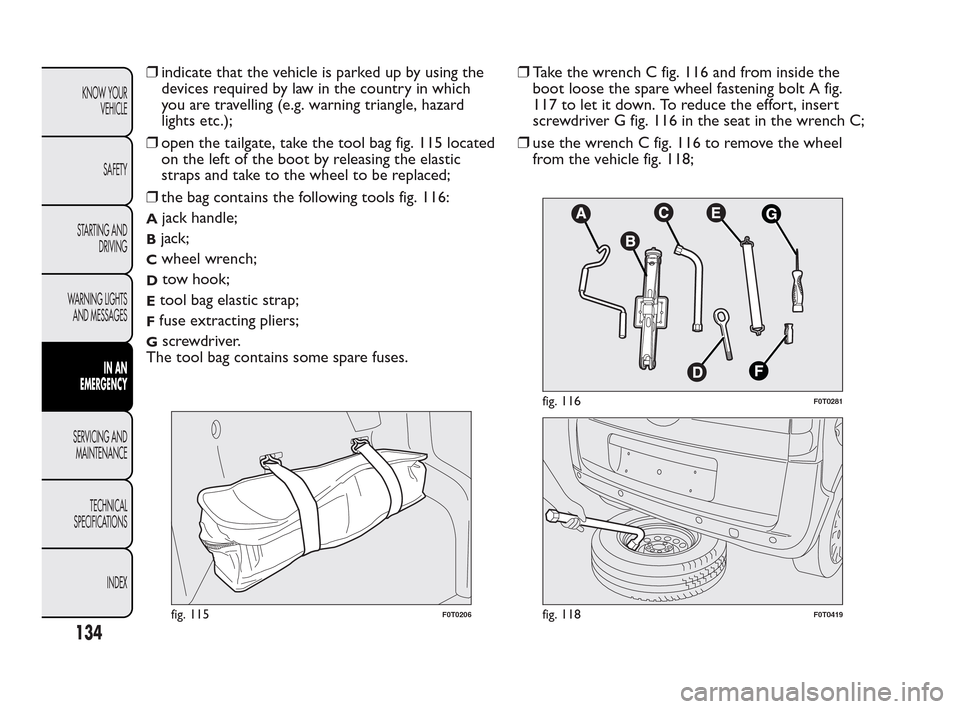
❒open the tailgate, take the tool bag fig. 115 located
on the left of the boot by releasing the elastic
straps and take to the wheel to be replaced;
❒the bag contains the following tools fig. 116:
Ajack handle;
Bjack;
Cwheel wrench;
Dtow hook;
Etool bag elastic strap;
Ffuse extracting pliers;
Gscrewdriver.
The tool bag contains some spare fuses.❒Take the wrench C fig. 116 and from inside the
boot loose the spare wheel fastening bolt A fig.
117 to let it down. To reduce the effort, insert
screwdriver G fig. 116 in the seat in the wrench C;
❒use the wrench C fig. 116 to remove the wheel
from the vehicle fig. 118;
fig. 115F0T0206
fig. 116F0T0281
fig. 118F0T0419
134
KNOW YOUR
VEHICLE
SAFETY
STARTING AND
DRIVING
WARNING LIGHTS
AND MESSAGES
IN AN
EMERGENCY
SERVICING AND
MAINTENANCE
TECHNICAL
SPECIFICA
TIONS
INDEX
Page 136 of 230
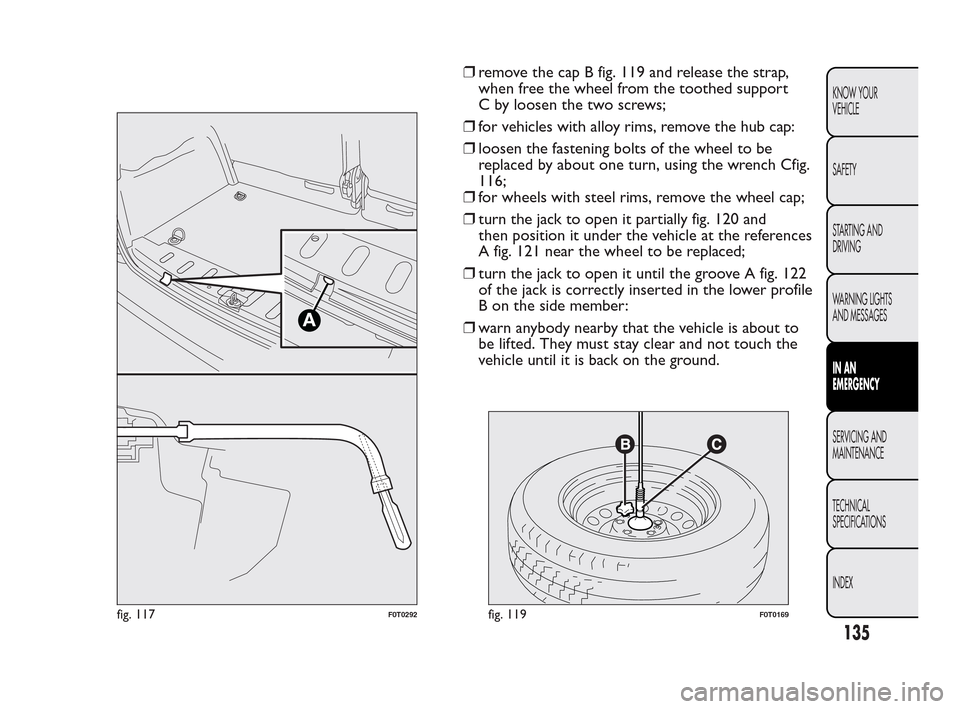
❒remove the cap B fig. 119 and release the strap,
when free the wheel from the toothed support
C by loosen the two screws;
❒for vehicles with alloy rims, remove the hub cap:
❒loosen the fastening bolts of the wheel to be
replaced by about one turn, using the wrench Cfig.
116;
❒for wheels with steel rims, remove the wheel cap;
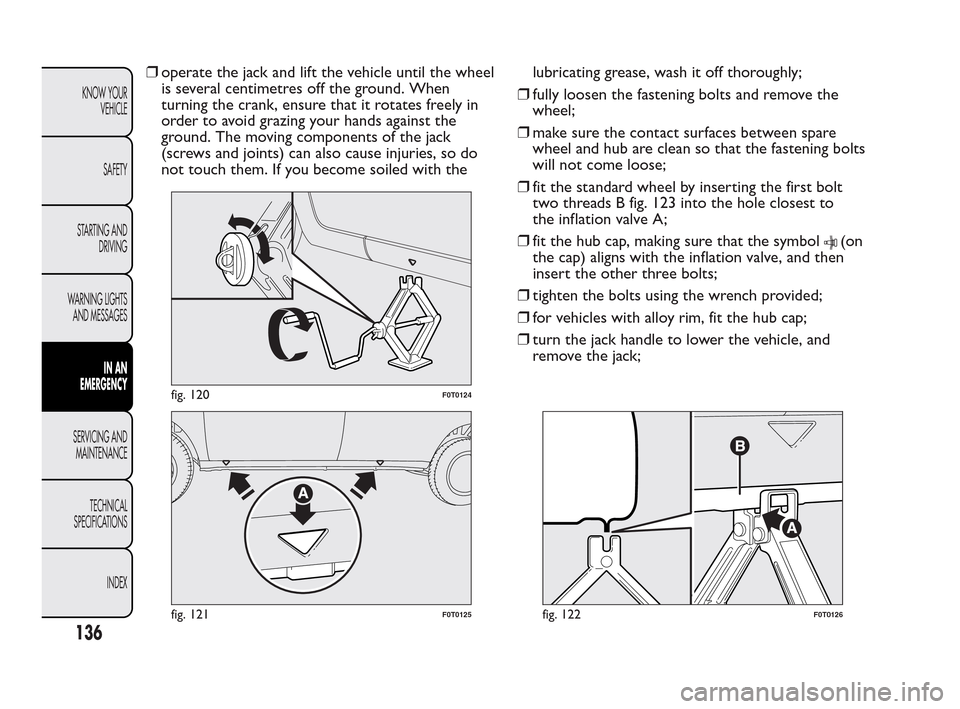
❒turn the jack to open it partially fig. 120 and
then position it under the vehicle at the references
A fig. 121 near the wheel to be replaced;
❒turn the jack to open it until the groove A fig. 122
of the jack is correctly inserted in the lower profile
B on the side member:
❒warn anybody nearby that the vehicle is about to
be lifted. They must stay clear and not touch the
vehicle until it is back on the ground.
A
fig. 117F0T0292fig. 119F0T0169
135
KNOW YOUR
VEHICLE
SAFETY
STARTING AND
DRIVING
WARNING LIGHTS
AND MESSAGES
IN AN
EMERGENCY
SERVICING AND
MAINTENANCE
TECHNICAL
SPECIFICA
TIONS
INDEX
Page 137 of 230
❒operate the jack and lift the vehicle until the wheel
is several centimetres off the ground. When
turning the crank, ensure that it rotates freely in
order to avoid grazing your hands against the
ground. The moving components of the jack
(screws and joints) can also cause injuries, so do
not touch them. If you become soiled with thelubricating grease, wash it off thoroughly;
❒fully loosen the fastening bolts and remove the
wheel;
❒make sure the contact surfaces between spare
wheel and hub are clean so that the fastening bolts
will not come loose;
❒fit the standard wheel by inserting the first bolt
two threads B fig. 123 into the hole closest to
the inflation valve A;
❒fit the hub cap, making sure that the symbol
(on
the cap) aligns with the inflation valve, and then
insert the other three bolts;
❒tighten the bolts using the wrench provided;
❒for vehicles with alloy rim, fit the hub cap;
❒turn the jack handle to lower the vehicle, and
remove the jack;
fig. 120F0T0124
fig. 121F0T0125fig. 122F0T0126
136
KNOW YOUR
VEHICLE
SAFETY
STARTING AND
DRIVING
WARNING LIGHTS
AND MESSAGES
IN AN
EMERGENCY
SERVICING AND
MAINTENANCE
TECHNICAL
SPECIFICA
TIONS
INDEX
Page 138 of 230
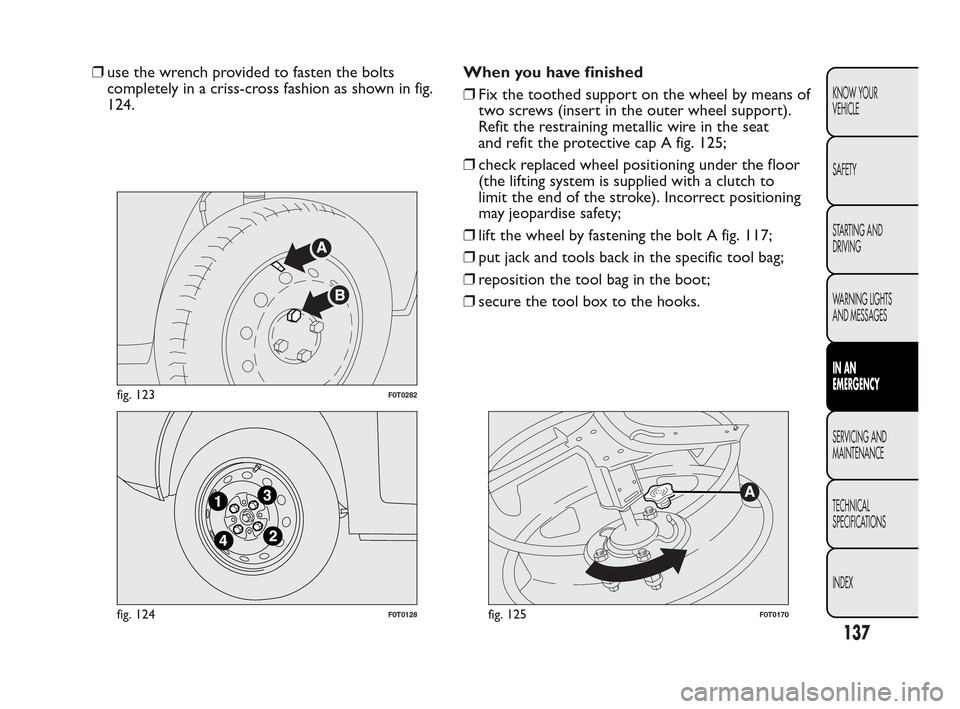
❒use the wrench provided to fasten the bolts
completely in a criss-cross fashion as shown in fig.
124.When you have finished
❒Fix the toothed support on the wheel by means of
two screws (insert in the outer wheel support).
Refit the restraining metallic wire in the seat
and refit the protective cap A fig. 125;
❒check replaced wheel positioning under the floor
(the lifting system is supplied with a clutch to
limit the end of the stroke). Incorrect positioning
may jeopardise safety;
❒lift the wheel by fastening the bolt A fig. 117;
❒put jack and tools back in the specific tool bag;
❒reposition the tool bag in the boot;
❒secure the tool box to the hooks.
fig. 123F0T0282
fig. 124F0T0128fig. 125F0T0170
137
KNOW YOUR
VEHICLE
SAFETY
STARTING AND
DRIVING
WARNING LIGHTS
AND MESSAGES
IN AN
EMERGENCY
SERVICING AND
MAINTENANCE
TECHNICAL
SPECIFICA
TIONS
INDEX
Page 140 of 230
WARNING
It is not possible to repair damage to the
t
yre sidewall. Do not use the quick
repair kit if the tyre was damaged by running
on a flat .
WARNING
Repair is not possible if the wheel rim is
dam
aged (groove is deformed, causing
air to escape). Do not remove foreign bodies
(screws or nails) from the tyre.
IMPORTANT INFORMATION:
The sealing fluid of the quick tyre repair kit is
effective at external temperatures of between -20°C
and +50°C.
WARNING
Do not operate the compressor for
lon
ger than 20 minutes at a time. Risk
of overheating.The quick repair kit is not
suitable for definitive repairs, so the tyres
repaired may be used only temporarily.
Dispose of the cylinder and the sealant
properly. Dispose according to the
national and local laws in force.
WARNING
The cylinder contains ethyl glycol. It
c
ontains latex, which may cause an
allergic reaction. Harmful if swallowed. Eye
irritant .There could be a reaction in the event
of inhalation or contact . Avoid contact with
the eyes, skin and clothes. In the event of
contact , rinse immediately with plenty of water.
Do not induce vomiting if swallowed. Rinse
your mouth out and drink plenty of water. Call
a doctor immediately. Keep out of the reach
of children.The product must not be used by
asthmatics. Do not breathe in the vapours
during insertion and suction. Call a doctor
immediately if allergic reactions are noted.
Store the cylinder in its special compartment ,
away from sources of heat .The sealant has
an expiry date. Replace the cylinder containing
the sealant after the expiry date.
139
KNOW YOUR
VEHICLE
SAFETY
STARTING AND
DRIVING
WARNING LIGHTS
AND MESSAGES
IN AN
EMERGENCY
SERVICING AND
MAINTENANCE
TECHNICAL
SPECIFICA
TIONS
INDEX
Page 166 of 230
WARNING
Before towing, turn the ignition key to
M
ARandthentoSTOPwithout
extracting it .The steering column will
automatically lock when the key is removed and
the wheels cannot be steered.
WARNING
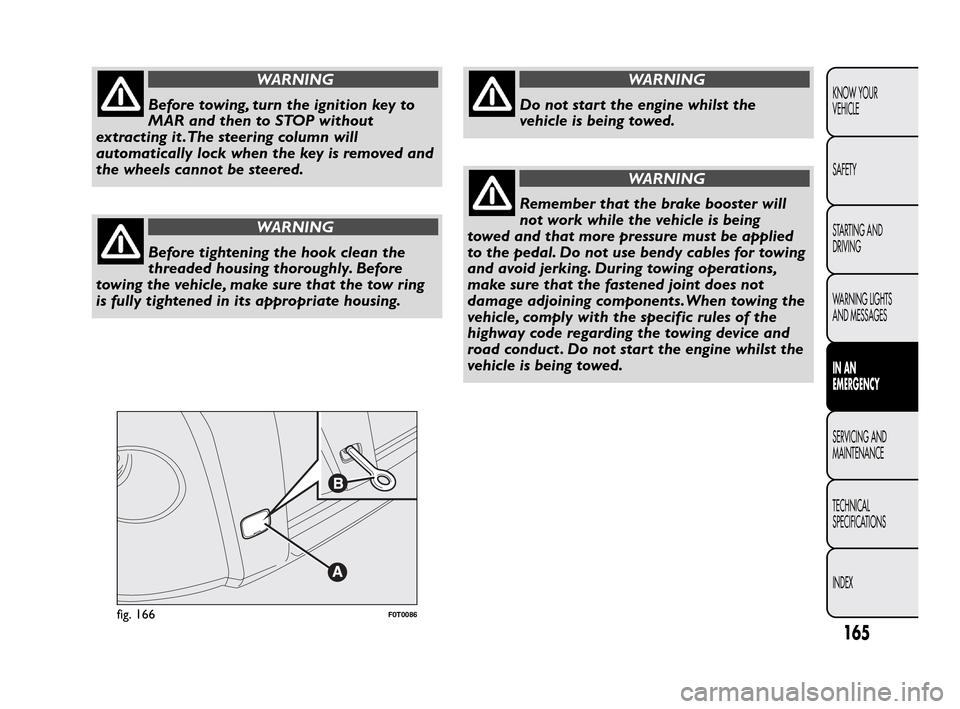
Before tightening the hook clean the
t
hreaded housing thoroughly. Before
towing the vehicle, make sure that the tow ring
is fully tightened in its appropriate housing.
WARNING
Do not start the engine whilst the
v
ehicle is being towed.
WARNING
Remember that the brake booster will
n
ot work while the vehicle is being
towed and that more pressure must be applied
to the pedal. Do not use bendy cables for towing
and avoid jerking. During towing operations,
make sure that the fastened joint does not
damage adjoining components.When towing the
vehicle, comply with the specific rules of the
highway code regarding the towing device and
road conduct . Do not start the engine whilst the
vehicle is being towed.
fig. 166F0T0086
165
KNOW YOUR
VEHICLE
SAFETY
STARTING AND
DRIVING
WARNING LIGHTS
AND MESSAGES
IN AN
EMERGENCY
SERVICING AND
MAINTENANCE
TECHNICAL
SPECIFICA
TIONS
INDEX
Page 181 of 230
WHEELS AND TYRES
Check the pressure of each tyre, including the spare,
every two weeks and before long journeys. The
pressure should be checked with the tyre rested and
cold.
It is normal for the pressure to increase when the
vehicle is used; for the correct tyre inflation
pressure, see “Wheels” in the “Technical
specifications” section.
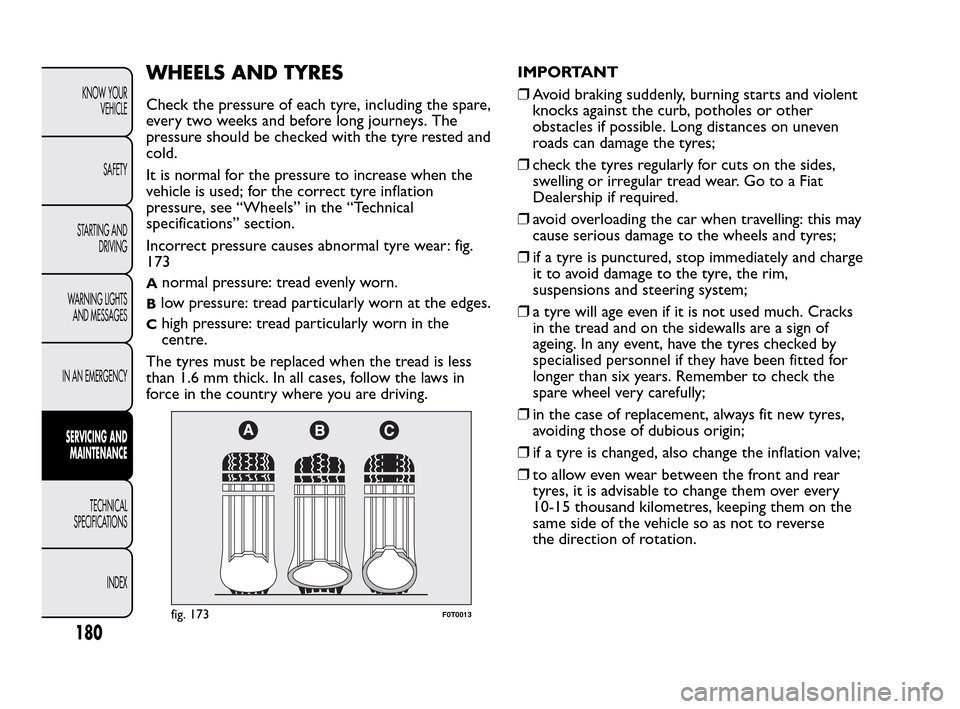
Incorrect pressure causes abnormal tyre wear: fig.
173
Anormal pressure: tread evenly worn.
Blow pressure: tread particularly worn at the edges.
Chigh pressure: tread particularly worn in the
centre.
The tyres must be replaced when the tread is less
than 1.6 mm thick. In all cases, follow the laws in
force in the country where you are driving.IMPORTANT
❒Avoid braking suddenly, burning starts and violent
knocks against the curb, potholes or other
obstacles if possible. Long distances on uneven
roads can damage the tyres;
❒check the tyres regularly for cuts on the sides,
swelling or irregular tread wear. Go to a Fiat
Dealership if required.
❒avoid overloading the car when travelling: this may
cause serious damage to the wheels and tyres;
❒if a tyre is punctured, stop immediately and charge
it to avoid damage to the tyre, the rim,
suspensions and steering system;
❒a tyre will age even if it is not used much. Cracks
in the tread and on the sidewalls are a sign of
ageing. In any event, have the tyres checked by
specialised personnel if they have been fitted for
longer than six years. Remember to check the
spare wheel very carefully;
❒in the case of replacement, always fit new tyres,
avoiding those of dubious origin;
❒if a tyre is changed, also change the inflation valve;
❒to allow even wear between the front and rear
tyres, it is advisable to change them over every
10-15 thousand kilometres, keeping them on the
same side of the vehicle so as not to reverse
the direction of rotation.
fig. 173F0T0013
180
KNOW YOUR
VEHICLE
SAFETY
STARTING AND
DRIVING
WARNING LIGHTS
AND MESSAGES
IN AN EMERGENCY
SERVICING AND
MAINTENANCE
TECHNICAL
SPECIFICA
TIONS
INDEX
Page 182 of 230
WARNING
Remember that the road holding
qu
alities of your vehicle also depend on
the correct inflation pressure of the tyres.
WARNING
Excessively low pressure will cause
o
verheating of the tyre and may cause
severe tyre damage.
WARNING
Do not exchange the tyres from the left
to
the right of the vehicle and vice versa.
WARNING
Do not repaint alloy wheel rims at
temper
atures higher than 150°C.The
mechanical characteristics of the wheels might
be compromised.
RUBBER LINES
Follow the requirements in “Scheduled Servicing
Plan” in this section carefully for brake and fuel
rubber lines.
Ozone, high temperatures and a prolonged lack of
fluid in the system may cause hardening and cracking
of the tubes, which could result in leaks. Careful
inspections are therefore necessary.
181
KNOW YOUR
VEHICLE
SAFETY
STARTING AND
DRIVING
WARNING LIGHTS
AND MESSAGES
IN AN EMERGENCY
SERVICING AND
MAINTENANCE
TECHNICAL
SPECIFICA
TIONS
INDEX
Page 185 of 230
BODY
PROTECTION FROM ATMOSPHERIC
ELEMENTS
The main causes of corrosion are the following:
❒atmospheric pollution
❒salty air and humidity (coastal areas, or hot humid
climates)
❒seasonal environment conditions.
The abrasive action of wind-borne atmospheric dust
and sand, as well as mud and gravel raised by other
cars is also not to be underestimated.
Fiat used the best manufacturing technologies on
your vehicle to effectively protect the bodywork
against corrosion.
These are the most important:
❒painting products and systems which give the
vehicle particular resistance to corrosion and
abrasion;
❒use of galvanised (or pre-treated) steel sheets,
with high resistance to corrosion;
❒spraying the underbody, engine compartment,
wheelhouse internal parts and other parts with
highly protective wax products;❒spraying of plastic materials for protective
purposes in the most exposed points: under the
doors, inside the mudguard, along the edges, etc.
❒use of “open” boxed sections to prevent
condensation and pockets of moisture from
triggering rust inside.
VEHICLE BODY AND UNDERBODY
WARRANTY
Your vehicle is covered by warranty against
perforation due to rust of any original element of the
structure or body.
For the general terms of this warranty, refer to your
Warranty Booklet.
ADVICE FOR PRESERVING THE
BODYWORK
Paint
Paintwork does not only serve an aesthetic purpose,
but also protects the underlying sheet metal.
Touch up abrasions and scratches immediately to
prevent the formation of rust. Use only original paint
products for touch-ups (see “Bodywork paint
identification plate” in the “Technical specifications”
section).
Normal care for paintwork consists of washing the
car; how often depends on the conditions and
environment where the car is used.
184
KNOW YOUR
VEHICLE
SAFETY
STARTING AND
DRIVING
WARNING LIGHTS
AND MESSAGES
IN AN EMERGENCY
SERVICING AND
MAINTENANCE
TECHNICAL
SPECIFICA
TIONS
INDEX