bonnet FIAT QUBO 2010 1.G Owners Manual
[x] Cancel search | Manufacturer: FIAT, Model Year: 2010, Model line: QUBO, Model: FIAT QUBO 2010 1.GPages: 230, PDF Size: 4.38 MB
Page 4 of 230
KNOW YOUR VEHICLE
DASHBOARD
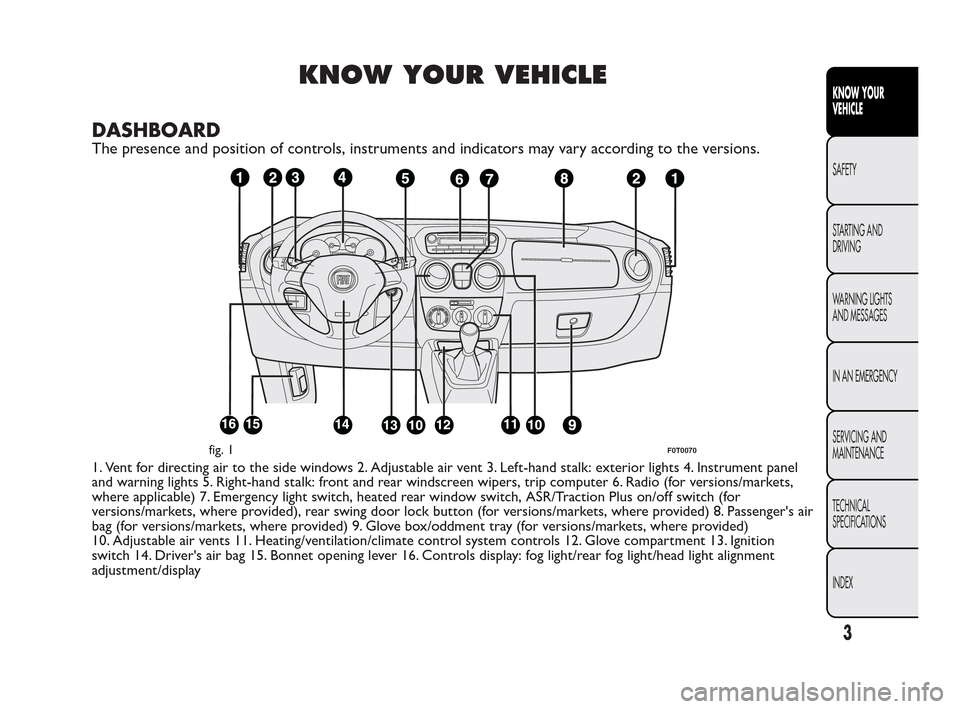
The presence and position of controls, instruments and indicators may vary according to the versions.
1. Vent for directing air to the side windows 2. Adjustable air vent 3. Left-hand stalk: exterior lights 4. Instrument panel
and warning lights 5. Right-hand stalk: front and rear windscreen wipers, trip computer 6. Radio (for versions/markets,
where applicable) 7. Emergency light switch, heated rear window switch, ASR/Traction Plus on/off switch (for
versions/markets, where provided), rear swing door lock button (for versions/markets, where provided) 8. Passenger's air
bag (for versions/markets, where provided) 9. Glove box/oddment tray (for versions/markets, where provided)
10. Adjustable air vents 11. Heating/ventilation/climate control system controls 12. Glove compartment 13. Ignition
switch 14. Driver's air bag 15. Bonnet opening lever 16. Controls display: fog light/rear fog light/head light alignment
adjustment/display
fig. 1F0T0070
3
KNOW YOUR
VEHICLE
SAFETY
ST
ARTING AND
DRIVING
WARNING LIGHTS
AND MESSAGES
IN AN EMERGENCY
SERVICING AND
MAINTENANCE
TECHNICAL
SPECIFICATIONS
INDEX
Page 6 of 230
SYMBOLS
Special coloured labels have been attached near or
on some of the components of your vehicle. These
labels bear symbols that draw your attention to
the precautions required when handling the
component in question.
The inner surface of the engine bonnet includes a
label with the different symbols used.
THE FIAT CODE SYSTEM
This is an electrical engine immobiliser system which
increases protection against attempted theft of the
vehicle. It is automatically activated when the ignition
key is extracted.
Each time the vehicle is started turning the ignition
key toMAR, the Fiat CODE system control unit
sends a recognition code to the engine control unit
to deactivate the inhibitor.
If, during ignition, the code is not correctly
recognized, a warning light
is lit on the
instrument panel.
In this case, turn the key toSTOPand then back to
MAR. Try with the other keys provided if the
problem persists. Contact a Fiat Dealership if you
still cannot start the engine.
IMPORTANT Each key has its own code which must
be stored by the system ECU. Contact the Fiat
Dealership to have new keys (up to eight) stored
with the code.
Warning light
coming on when driving
❒If the
warning light (or symbol in the display)
comes on, this means that the system is running a
self-diagnosis test (caused, for example, by a
voltage drop). When you stop for the first time,
turn the key to STOP and then to MAR: the
warning light
will not light up if no faults are
detected.
5
KNOW YOUR
VEHICLE
SAFETY
ST
ARTING AND
DRIVING
WARNING LIGHTS
AND MESSAGES
IN AN EMERGENCY
SERVICING AND
MAINTENANCE
TECHNICAL
SPECIFICATIONS
INDEX
Page 10 of 230
WARNING
If the remote control battery is flat , the
sys
tem can be engaged by inser ting
the metal key in the door lock as described
previously: in this case, the device only remains
active for the rear doors.
Switching the device on
The system is automatically enabled on all the doors
by pressing button
twice on the key with remote
control.
The direction indicators flash twice to let you know
that the device is active.
If one or more of the doors is not perfectly shut, the
dead lock device will not be activated, thus
preventing a person getting into the car through the
open door and, on shutting, it, remaining stuck
inside the passenger compartment.
Switching the device off
The system is disabled automatically on every door
when:
❒by unlocking the doors;
❒by turning the ignition key to the ON position.
ALARM
(for versions/markets, where provided)
The alarm, in addition to all the previously described
remote control functions, is controlled by the
receiver located under the dashboard near the fuse
box.
ALARM TRIPPING
The alarm trips in the following cases:
❒unauthorised opening of a door, the bonnet, the
tailgate or a sliding side door (if present)
(perimeter protection)
❒unauthorized operation of the starting device (key
turned on using a key that is not enabled)
❒cutting of the battery leads
❒moving presence inside the passenger
compartment (volumetric protection)
❒anomalous lifting/tilting of the vehicle.
Depending on the market, the activation of the alarm
causes the activation of the siren and the direction
indicators (for about 26 seconds). Alarm tripping and
the number of cycles depend on the sales market.
There are a maximum number of acoustic/visual
cycles. When this is reached the system returns to
normal operation.
Volumetric and antilifting protections are disabled by
pressing the control button installed on the front
dashboard (see paragraph "Antilift protections).
9
KNOW YOUR
VEHICLE
SAFETY
ST
ARTING AND
DRIVING
WARNING LIGHTS
AND MESSAGES
IN AN EMERGENCY
SERVICING AND
MAINTENANCE
TECHNICAL
SPECIFICATIONS
INDEX
Page 11 of 230
IMPORTANT The engine immobilizer function is
ensured by the Fiat CODE which is automatically
activated when the key is extracted from the ignition.
TURNING THE ALARM ON
With the doors and bonnet closed and the ignition
key either turned to STOP or removed, point the
key with the remote control towards the vehicle and
press and release button
.
Except for some markets, the system produces an
acoustic warning (beep) and enables door locking.
A self-diagnostic stage precedes the turning on of the
alarm: if a fault is detected, the system produces
another acoustic signal.
In this case switch off the alarm by pressing
,
check that all the doors, bonnet and tailgate are
closed correctly; then switch the alarm back on by
pressing
.
If a door or the bonnet is not properly shut, it will
be excluded from the testing by the alarm system.
A fault has occurred in system operation if the alarm
produces an acoustic signal even when the doors,
bonnet and boot are correctly closed. Go to a
Fiat Dealership.
IMPORTANT The alarm does not come on when the
central locking is activated using the metal insert in
the key.
IMPORTANT The alarm is configured to comply with
the regulations existing in different countries.TURNING THE ALARM OFF
Press button
on the key with the remote control.
The following operations are performed (excluding
specific markets):
❒direction indicators flash briefly twice
❒two short beeps
❒door are unlocked.
IMPORTANT The alarm is not turned off using the
door are opened using the metal insert in the key.
VOLUMETRIC/ANTILIFTING PROTECTION
The side windows must be completely closed for
correct operation of the protection.
If necessary, the function can be turned off (if, for
example, you are leaving a pet in the car) by pressing
button A fig. 6 on the front courtesy light before
activating turning the alarm on.
The LED on the button will flash for several seconds
when the function is turned off. The volumetric/
antitilting protection must be deactivated each time
the instrument panel is switched off.
10
KNOW YOUR
VEHICLE
SAFETY
ST
ARTING AND
DRIVING
WARNING LIGHTS
AND MESSAGES
IN AN EMERGENCY
SERVICING AND
MAINTENANCE
TECHNICAL
SPECIFICATIONS
INDEX
Page 71 of 230
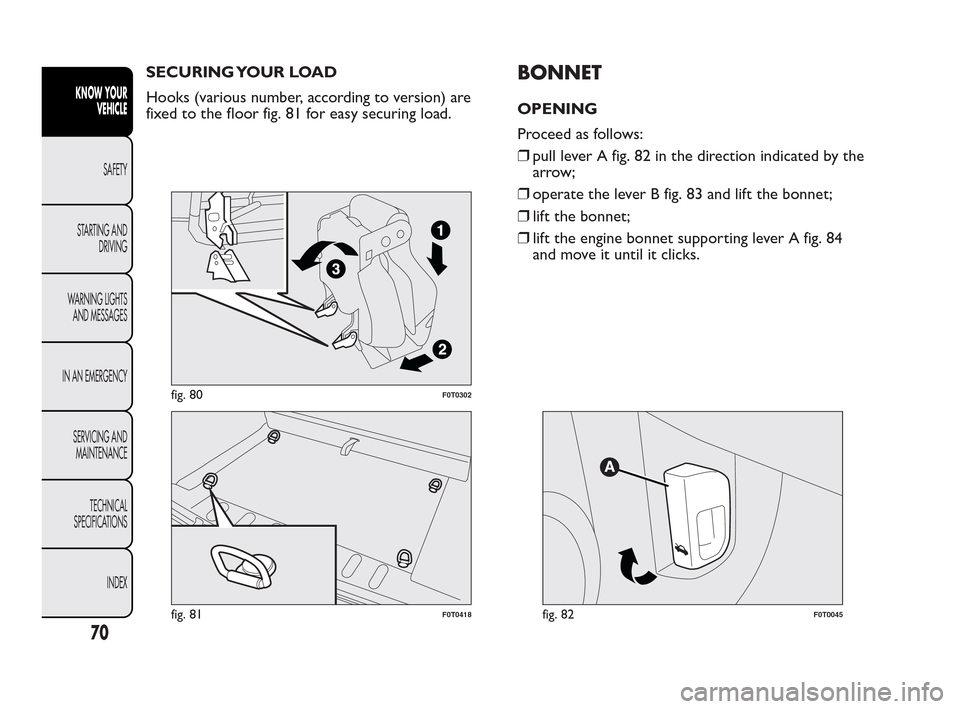
SECURING YOUR LOAD
Hooks (various number, according to version) are
fixed to the floor fig. 81 for easy securing load.BONNET
OPENING
Proceed as follows:
❒pull lever A fig. 82 in the direction indicated by the
arrow;
❒operate the lever B fig. 83 and lift the bonnet;
❒lift the bonnet;
❒lift the engine bonnet supporting lever A fig. 84
and move it until it clicks.
fig. 80F0T0302
fig. 81F0T0418fig. 82F0T0045
70
KNOW YOUR
VEHICLE
SAFETY
ST
ARTING AND
DRIVING
WARNING LIGHTS
AND MESSAGES
IN AN EMERGENCY
SERVICING AND
MAINTENANCE
TECHNICAL
SPECIFICATIONS
INDEX
Page 72 of 230
WARNING
Before opening the bonnet , check that
win
dscreen wiper arm is not lifted from
the windscreen.CLOSING
Proceed as follows:
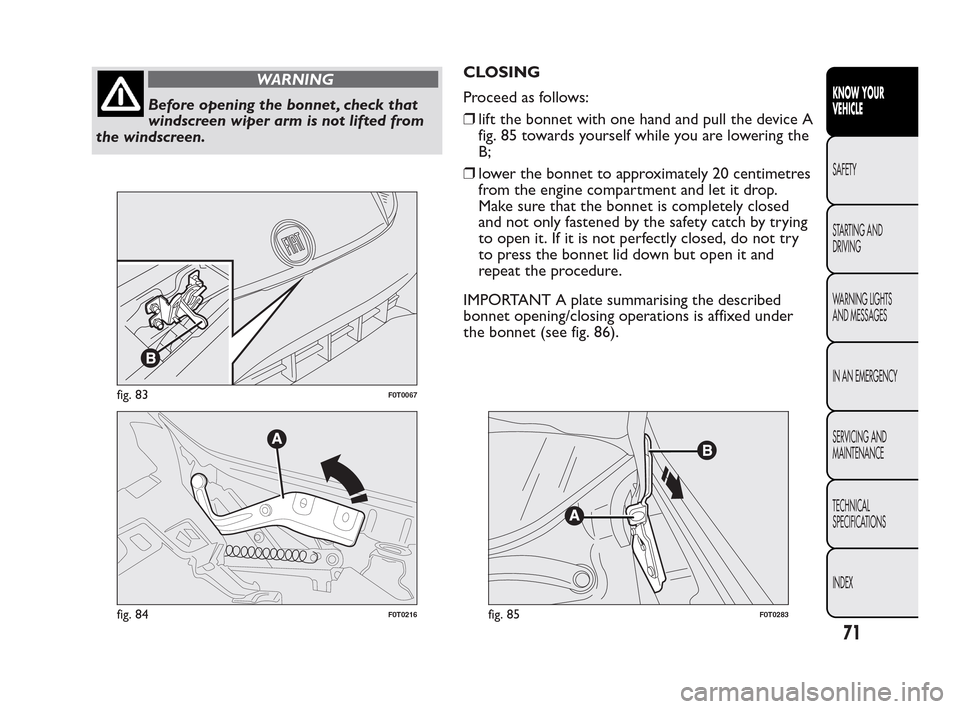
❒lift the bonnet with one hand and pull the device A
fig. 85 towards yourself while you are lowering the
B;
❒lower the bonnet to approximately 20 centimetres
from the engine compartment and let it drop.
Make sure that the bonnet is completely closed
and not only fastened by the safety catch by trying
to open it. If it is not perfectly closed, do not try
to press the bonnet lid down but open it and
repeat the procedure.
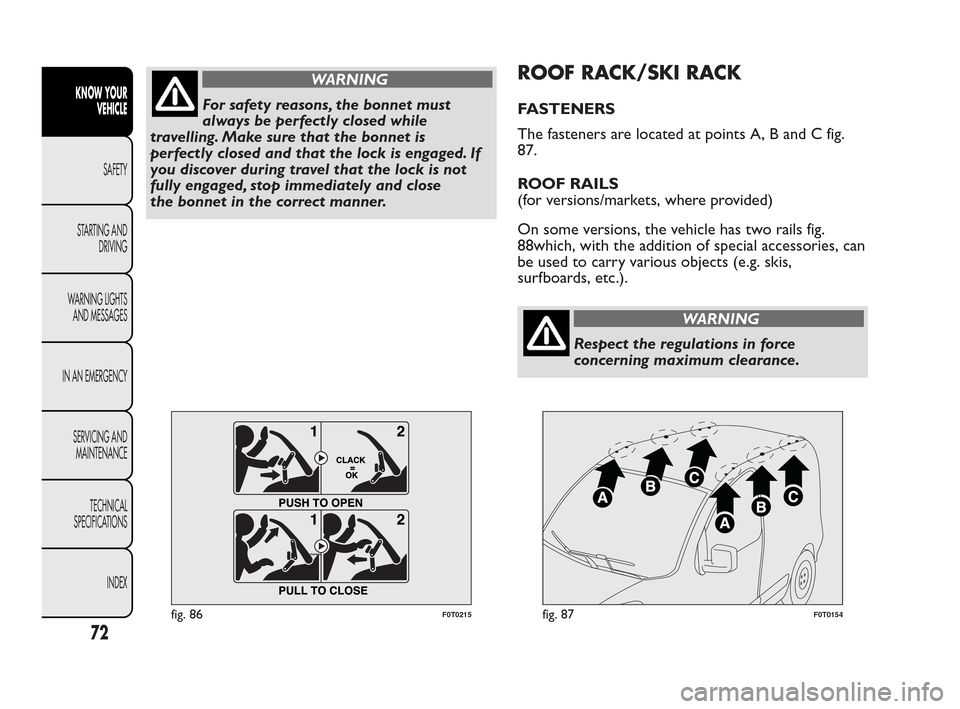
IMPORTANT A plate summarising the described
bonnet opening/closing operations is affixed under
the bonnet (see fig. 86).
fig. 83F0T0067
fig. 84F0T0216fig. 85F0T0283
71
KNOW YOUR
VEHICLE
SAFETY
ST
ARTING AND
DRIVING
WARNING LIGHTS
AND MESSAGES
IN AN EMERGENCY
SERVICING AND
MAINTENANCE
TECHNICAL
SPECIFICATIONS
INDEX
Page 73 of 230
WARNING
For safety reasons, the bonnet must
al
ways be perfectly closed while
travelling. Make sure that the bonnet is
perfectly closed and that the lock is engaged. If
you discover during travel that the lock is not
fully engaged, stop immediately and close
the bonnet in the correct manner.
ROOF RACK/SKI RACK
FASTENERS
The fasteners are located at points A, B and C fig.
87.
ROOF RAILS
(for versions/markets, where provided)
On some versions, the vehicle has two rails fig.
88which, with the addition of special accessories, can
be used to carry various objects (e.g. skis,
surfboards, etc.).
WARNING
Respect the regulations in force
c
oncerning maximum clearance.
fig. 86F0T0215fig. 87F0T0154
72
KNOW YOUR
VEHICLE
SAFETY
ST
ARTING AND
DRIVING
WARNING LIGHTS
AND MESSAGES
IN AN EMERGENCY
SERVICING AND
MAINTENANCE
TECHNICAL
SPECIFICATIONS
INDEX
Page 169 of 230
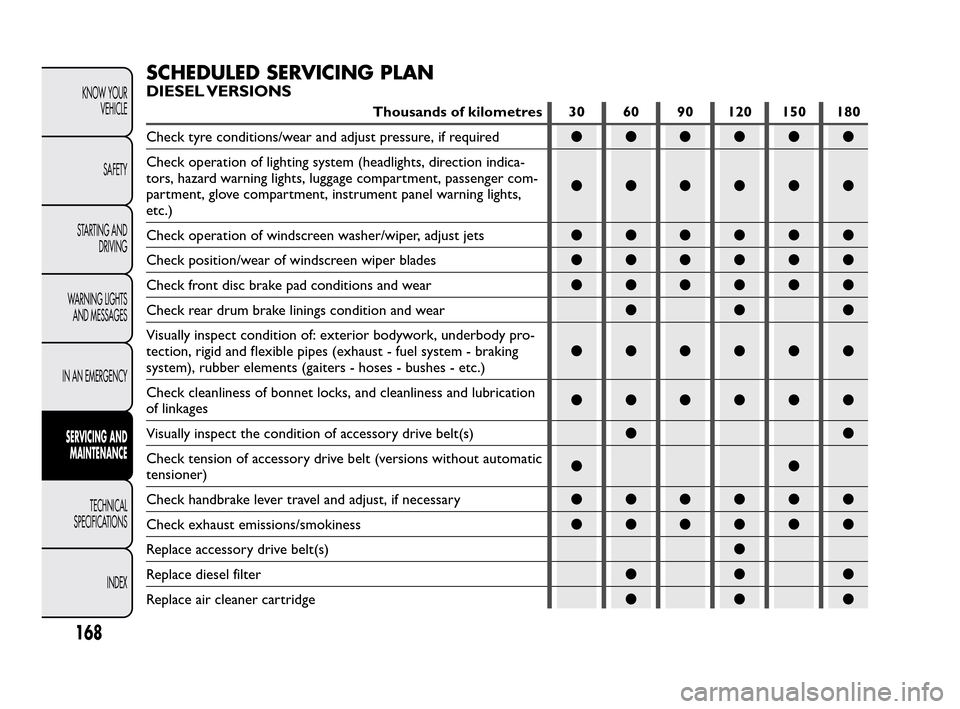
SCHEDULED SERVICING PLAN
DIESEL VERSIONS
Thousands of kilometres 30 60 90 120 150 180
Check tyre conditions/wear and adjust pressure, if required●●●●●●
Check operation of lighting system (headlights, direction indica-
tors, hazard warning lights, luggage compartment, passenger com-
partment, glove compartment, instrument panel warning lights,
etc.)●●●●●●
Check operation of windscreen washer/wiper, adjust jets●●●●●●
Check position/wear of windscreen wiper blades●●●●●●
Check front disc brake pad conditions and wear●●●●●●
Check rear drum brake linings condition and wear●●●
Visually inspect condition of: exterior bodywork, underbody pro-
tection, rigid and flexible pipes (exhaust - fuel system - braking
system), rubber elements (gaiters - hoses - bushes - etc.)●●●●●●
Check cleanliness of bonnet locks, and cleanliness and lubrication
of linkages●●●●●●
Visually inspect the condition of accessory drive belt(s)●●
Check tension of accessory drive belt (versions without automatic
tensioner)●●
Check handbrake lever travel and adjust, if necessary●●●●●●
Check exhaust emissions/smokiness●●●●●●
Replace accessory drive belt(s)●
Replace diesel filter●●●
Replace air cleaner cartridge●●●
168
KNOW YOUR
VEHICLE
SAFETY
STARTING AND
DRIVING
WARNING LIGHTS
AND MESSAGES
IN AN EMERGENCY
SERVICING AND
MAINTENANCE
TECHNICAL
SPECIFICA
TIONS
INDEX
Page 171 of 230
REGULAR CHECKS
Every 1,000 km or before long journeys, check and, if
necessary, top up:
❒engine coolant level;
❒brake fluid level;
❒windscreen washer fluid level;
❒tyre inflation pressure and condition;
❒operation of lighting system (headlamps, direction
indicators, hazard warning lights, etc.);
❒operation of screen wash/wipe system and
positioning/wear of windscreen/rear window wiper
blades.
Check and top up, if required, the engine oil level
every 3,000 km.
You are recommended to use PETRONAS
LUBRICANTS products, which have been designed
and produced specifically for Fiat vehicles (see
“Capacities” table in the “Technical specifications”
section).
HEAVY USAGE OF THE VEHICLE
Should prevailing use of the vehicle be under one of
the following specially heavy conditions:
❒towing a trailer or caravan;
❒dusty roads;
❒short, repeated journeys (less than 7-8 km) at
sub-zero outside temperatures;
❒engine often idling, or driving long distances at low
speed (e.g. door to door deliveries) or long period
of idleness;
❒urban trips;
perform the following inspections more frequently
than shown on the Scheduled Servicing Plan:
❒check front disc brake pad condition and wear;
❒check cleanliness of bonnet and boot locks,
cleanliness and lubrication of linkage;
❒visually inspect the conditions of: engine, gearbox,
transmission, pipes and tubes (exhaust - fuel -
brakes), rubber parts (boots, sleeves, bushes, etc.);
❒check battery charge status and fluid (electrolyte)
level (refer to "Battery - Check state of charge
and electrolyte level" paragraph in this chapter);
❒visually inspect condition of the auxiliary drive
belts;
170
KNOW YOUR
VEHICLE
SAFETY
STARTING AND
DRIVING
WARNING LIGHTS
AND MESSAGES
IN AN EMERGENCY
SERVICING AND
MAINTENANCE
TECHNICAL
SPECIFICA
TIONS
INDEX
Page 180 of 230
USEFUL ADVICE FOR EXTENDING THE
LIFE OF YOUR BATTERY
To avoid draining your battery and make it last
longer, follow these instructions closely:
❒when you park the vehicle, ensure the doors, boot
and bonnet are closed properly so that the ceiling
lights do not stay on;
❒turn off the ceiling lights, although the car does
have an automatic system for switching off internal
lights;
❒do not keep accessories (e.g. sound system, hazard
lights, etc.) switched on for a long time when the
engine is not running;
❒before performing any operation on the electrical
system, disconnect the battery negative cable;
❒make sure that battery terminals are always be
perfectly tight.
IMPORTANT If the battery remains with the charge
below 50% for a long time it becomes damaged
through sulphation and its starting capacity is
reduced.
The battery is also more prone to the risk of freezing
(at temperatures as high as -10°C).
Refer to the paragraph "Vehicle inactivity" in "Starting
and driving" if the vehicle is left parked for a long
time.
If, after buying the vehicle, you want to install
electric accessories which require permanent electric
supply (alarm, etc.) contact the Fiat Dealershipwhose qualified personnel, in addition to suggesting
the most suitable devices, will evaluate the overall
electric absorption, checking whether the vehicle
electric system is capable of withstanding the load
required, or whether it should be integrated with
a more powerful battery.
Since these devices continue to use electricity even
when the engine is off, they gradually run down
the battery.
179
KNOW YOUR
VEHICLE
SAFETY
STARTING AND
DRIVING
WARNING LIGHTS
AND MESSAGES
IN AN EMERGENCY
SERVICING AND
MAINTENANCE
TECHNICAL
SPECIFICA
TIONS
INDEX