brake FIAT QUBO 2014 1.G Owner's Manual
[x] Cancel search | Manufacturer: FIAT, Model Year: 2014, Model line: QUBO, Model: FIAT QUBO 2014 1.GPages: 231, PDF Size: 5.01 MB
Page 154 of 231
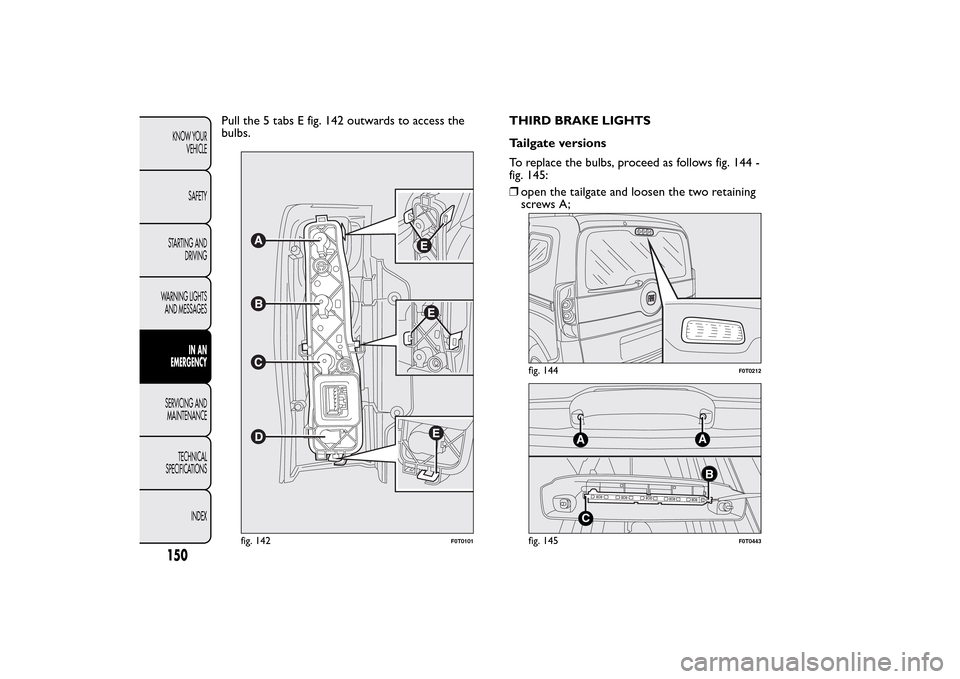
Pull the 5 tabs E fig. 142 outwards to access the
bulbs.THIRD BRAKE LIGHTS
Tailgate versions
To replace the bulbs, proceed as follows fig. 144 -
fig. 145:
fig. 142
F0T0101
fig. 144
F0T0212
AC
AB
fig. 145
F0T0443
150KNOW YOUR
VEHICLE
SAFETY
STARTING AND
DRIVING
WARNING LIGHTS
AND MESSAGES
IN AN
EMERGENCY
SERVICING AND
MAINTENANCE
TECHNICAL
SPECIFICATIONS
INDEX
❒open the tailgate and loosen the two retaining
screws A;
Page 160 of 231
WARNING
If a fuse blows again, contact a Fiat
Dealership.Never replace a blown fuse with metallic
wires or other material.
WARNING
Never replace a fuse with another
having higher amperage; FIRE HAZARD.
WARNING
If a general protection fuse (MEGA-
FUSE, MIDI-FUSE) is activated, contact
a Fiat Dealership.
WARNING
Remove the key from the ignition and
switch off or disable all devices before
replacing a fuse.
WARNING
Contact Fiat Dealership if a safety
system (air bags, brakes), engine system
(engine, gearbox) or steering system general
protection fuse blows.
To identify the protective fuse, see the tables on the
following pages.
156KNOW YOUR
VEHICLE
SAFETY
STARTING AND
DRIVING
WARNING LIGHTS
AND MESSAGES
IN AN
EMERGENCY
SERVICING AND
MAINTENANCE
TECHNICAL
SPECIFICATIONS
INDEX
Page 166 of 231
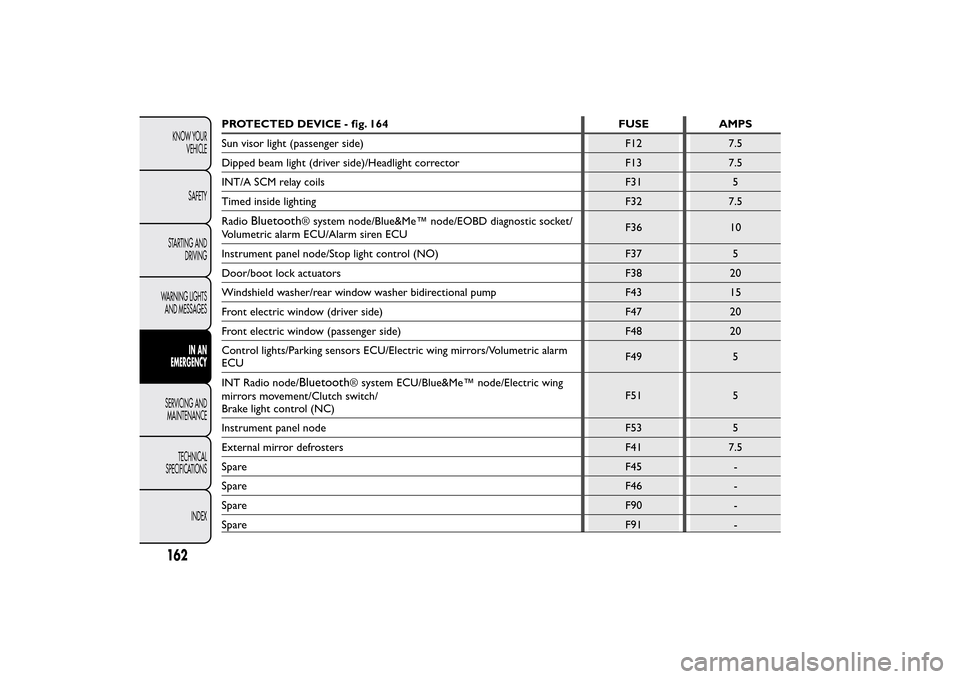
PROTECTED DEVICE - fig. 164 FUSE AMPS
Sun visor light (passenger side) F12 7.5
Dipped beam light (driver side)/Headlight corrector F13 7.5
INT/A SCM relay coils F31 5
Timed inside lighting F32 7.5
Radio
Bluetooth
®system node/Blue&Me™ node/EOBD diagnostic socket/
Volumetric alarm ECU/Alarm siren ECUF36 10
Instrument panel node/Stop light control (NO) F37 5
Door/boot lock actuators F38 20
Windshield washer/rear window washer bidirectional pump F43 15
Front electric window (driver side) F47 20
Front electric window (passenger side) F48 20
Control lights/Parking sensors ECU/Electric wing mirrors/Volumetric alarm
ECUF49 5
INT Radio node/Bluetooth
®system ECU/Blue&Me™ node/Electric wing
mirrors movement/Clutch switch/
Brake light control (NC)F51 5
Instrument panel node F53 5
External mirror defrosters F41 7.5
SpareF45 -
SpareF46 -
SpareF90 -
SpareF91 -
162KNOW YOUR
VEHICLE
SAFETY
STARTING AND
DRIVING
WARNING LIGHTS
AND MESSAGES
IN AN
EMERGENCY
SERVICING AND
MAINTENANCE
TECHNICAL
SPECIFICATIONS
INDEX
Page 170 of 231
WARNING
Before towing, turn the ignition key to
MAR and then to STOP without
extracting it .The steering column will
automatically lock when the key is removed and
the wheels cannot be steered.
WARNING
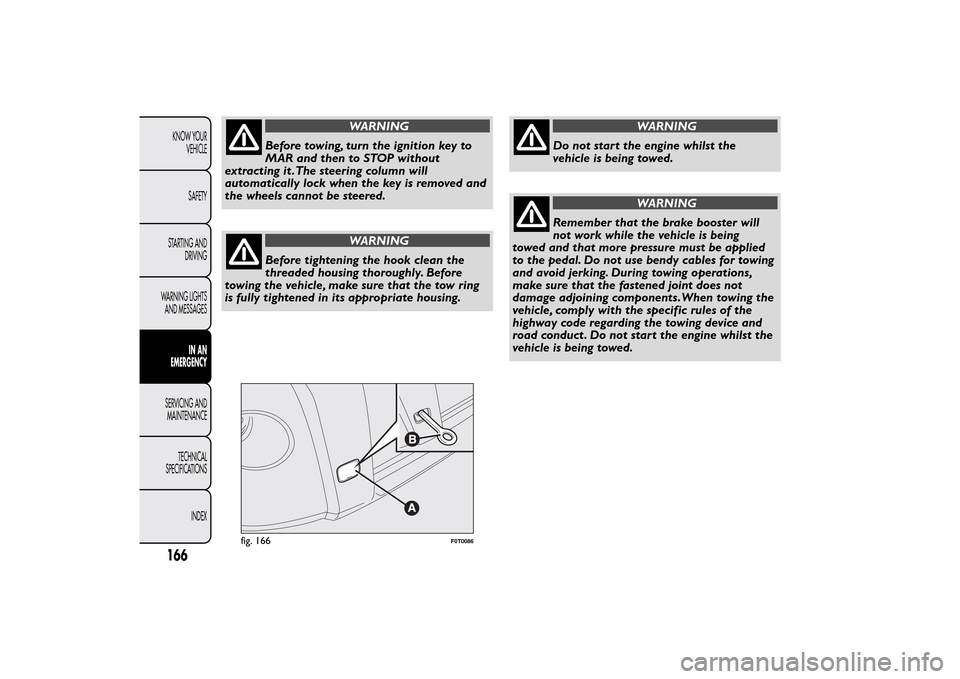
Before tightening the hook clean the
threaded housing thoroughly. Before
towing the vehicle, make sure that the tow ring
is fully tightened in its appropriate housing.
WARNING
Do not start the engine whilst the
vehicle is being towed.
WARNING
Remember that the brake booster will
not work while the vehicle is being
towed and that more pressure must be applied
to the pedal. Do not use bendy cables for towing
and avoid jerking. During towing operations,
make sure that the fastened joint does not
damage adjoining components.When towing the
vehicle, comply with the specific rules of the
highway code regarding the towing device and
road conduct . Do not start the engine whilst the
vehicle is being towed.
fig. 166
F0T0086
166KNOW YOUR
VEHICLE
SAFETY
STARTING AND
DRIVING
WARNING LIGHTS
AND MESSAGES
IN AN
EMERGENCY
SERVICING AND
MAINTENANCE
TECHNICAL
SPECIFICATIONS
INDEX
Page 173 of 231
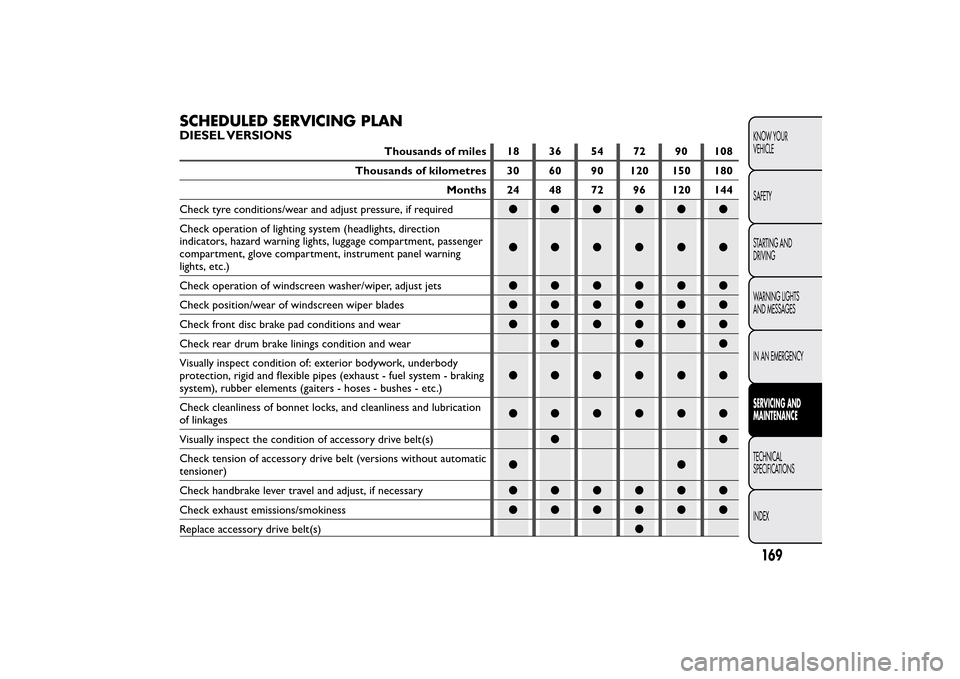
SCHEDULED SERVICING PLANDIESEL VERSIONS
Thousands of miles 18 36 54 72 90 108
Thousands of kilometres 30 60 90 120 150 180
Months 24 48 72 96 120 144
Check tyre conditions/wear and adjust pressure, if required●●●●●●
Check operation of lighting system (headlights, direction
indicators, hazard warning lights, luggage compartment, passenger
compartment, glove compartment, instrument panel warning
lights, etc.)●●●●●●
Check operation of windscreen washer/wiper, adjust jets●●●●●●
Check position/wear of windscreen wiper blades●●●●●●
Check front disc brake pad conditions and wear●●●●●●
Check rear drum brake linings condition and wear●●●
Visually inspect condition of: exterior bodywork, underbody
protection, rigid and flexible pipes (exhaust - fuel system - braking
system), rubber elements (gaiters - hoses - bushes - etc.)●●●●●●
Check cleanliness of bonnet locks, and cleanliness and lubrication
of linkages●●●●●●
Visually inspect the condition of accessory drive belt(s)●●
Check tension of accessory drive belt (versions without automatic
tensioner)●●
Check handbrake lever travel and adjust, if necessary●●●●●●
Check exhaust emissions/smokiness●●●●●●
Replace accessory drive belt(s)●
169KNOW YOUR
VEHICLE
SAFETY
STARTING AND
DRIVING
WARNING LIGHTS
AND MESSAGES
IN AN EMERGENCYSERVICING AND
MAINTENANCETECHNICAL
SPECIFICATIONS
INDEX
Page 174 of 231
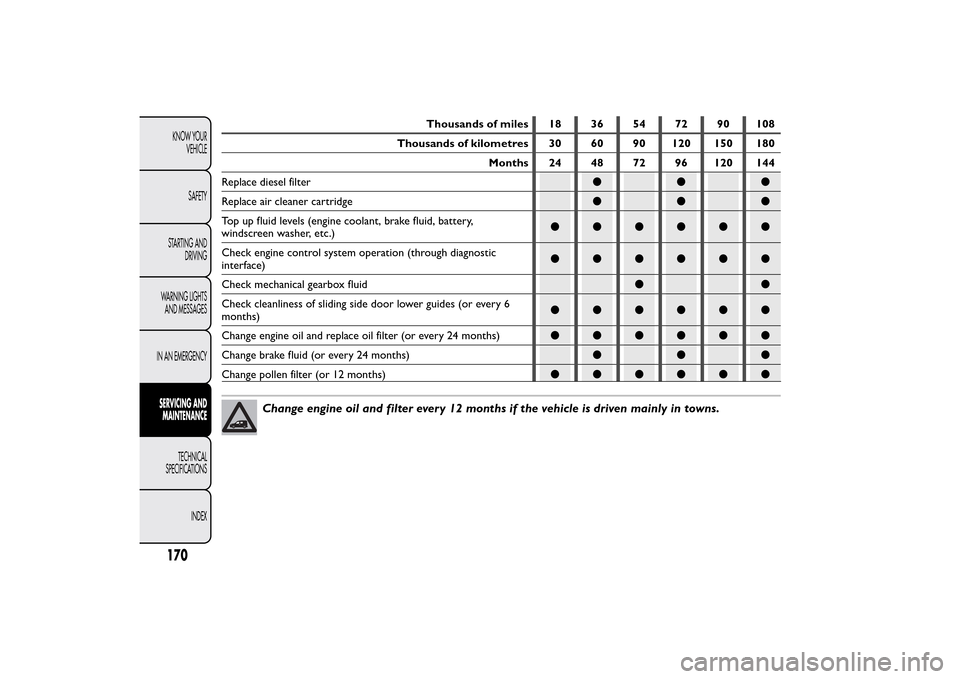
Thousands of miles 18 36 54 72 90 108
Thousands of kilometres 30 60 90 120 150 180
Months 24 48 72 96 120 144
Replace diesel filter●●●
Replace air cleaner cartridge●●●
Top up fluid levels (engine coolant, brake fluid, battery,
windscreen washer, etc.)●●●●●●
Check engine control system operation (through diagnostic
interface)●●●●●●
Check mechanical gearbox fluid●●
Check cleanliness of sliding side door lower guides (or every 6
months)●●●●●●
Change engine oil and replace oil filter (or every 24 months)●●●●●●
Change brake fluid (or every 24 months)●●●
Change pollen filter (or 12 months)●●●●●●
Change engine oil and filter ever y 12 months if the vehicle is driven mainly in towns.
170KNOW YOUR
VEHICLE
SAFETY
STARTING AND
DRIVING
WARNING LIGHTS
AND MESSAGES
IN AN EMERGENCY
SERVICING AND
MAINTENANCE
TECHNICAL
SPECIFICATIONS
INDEX
Page 175 of 231
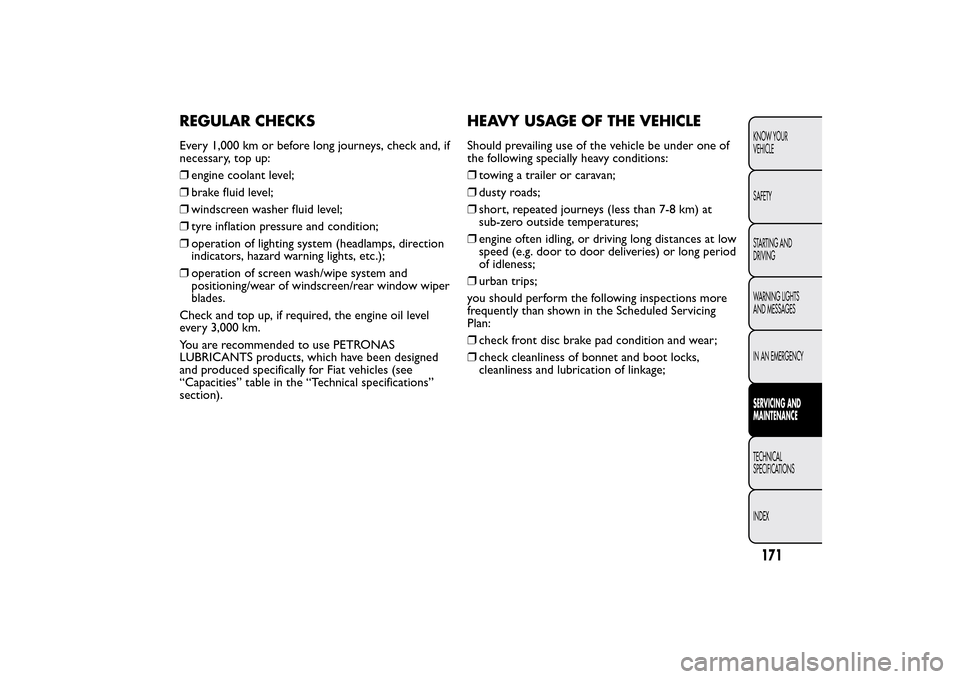
REGULAR CHECKSEvery 1,000 km or before long journeys, check and, if
necessary, top up:
❒engine coolant level;
❒brake fluid level;
❒windscreen washer fluid level;
❒tyre inflation pressure and condition;
❒operation of lighting system (headlamps, direction
indicators, hazard warning lights, etc.);
❒operation of screen wash/wipe system and
positioning/wear of windscreen/rear window wiper
blades.
Check and top up, if required, the engine oil level
every 3,000 km.
You are recommended to use PETRONAS
LUBRICANTS products, which have been designed
and produced specifically for Fiat vehicles (see
“Capacities” table in the “Technical specifications”
section).
HEAVY USAGE OF THE VEHICLEShould prevailing use of the vehicle be under one of
the following specially heavy conditions:
❒towing a trailer or caravan;
❒dusty roads;
❒short, repeated journeys (less than 7-8 km) at
sub-zero outside temperatures;
❒engine often idling, or driving long distances at low
speed (e.g. door to door deliveries) or long period
of idleness;
❒urban trips;
you should perform the following inspections more
frequently than shown in the Scheduled Servicing
Plan:
❒check front disc brake pad condition and wear;
❒check cleanliness of bonnet and boot locks,
cleanliness and lubrication of linkage;
171KNOW YOUR
VEHICLE
SAFETY
STARTING AND
DRIVING
WARNING LIGHTS
AND MESSAGES
IN AN EMERGENCYSERVICING AND
MAINTENANCETECHNICAL
SPECIFICATIONS
INDEX
Page 176 of 231
❒visually inspect conditions of: engine, gearbox,
transmission, pipes and hoses (exhaust - fuel
system - brakes) and rubber elements (boots -
sleeves - bushes - etc.);
❒check battery charge status and fluid (electrolyte)
level (refer to "Battery - Check state of charge
and electrolyte level" paragraph in this chapter);
❒visually inspect condition of the auxiliary drive
belts;
❒check and, if necessary, replace pollen filter, in
particular it should be replaced if there is a
noticeable decrease in the passenger compartment
air intake flow rate.
❒check and, if necessary, replace air filter.
CHECKING LEVELS
When topping up, take care not to mix up
the various types of fluids: they are not
compatible with each other and could
seriously damage the vehicle.
WARNING
Never smoke while working in the
engine compar tment : inflammable gases
and vapours may be present , constituting a fire
risk.
172KNOW YOUR
VEHICLE
SAFETY
STARTING AND
DRIVING
WARNING LIGHTS
AND MESSAGES
IN AN EMERGENCY
SERVICING AND
MAINTENANCE
TECHNICAL
SPECIFICATIONS
INDEX
Page 177 of 231
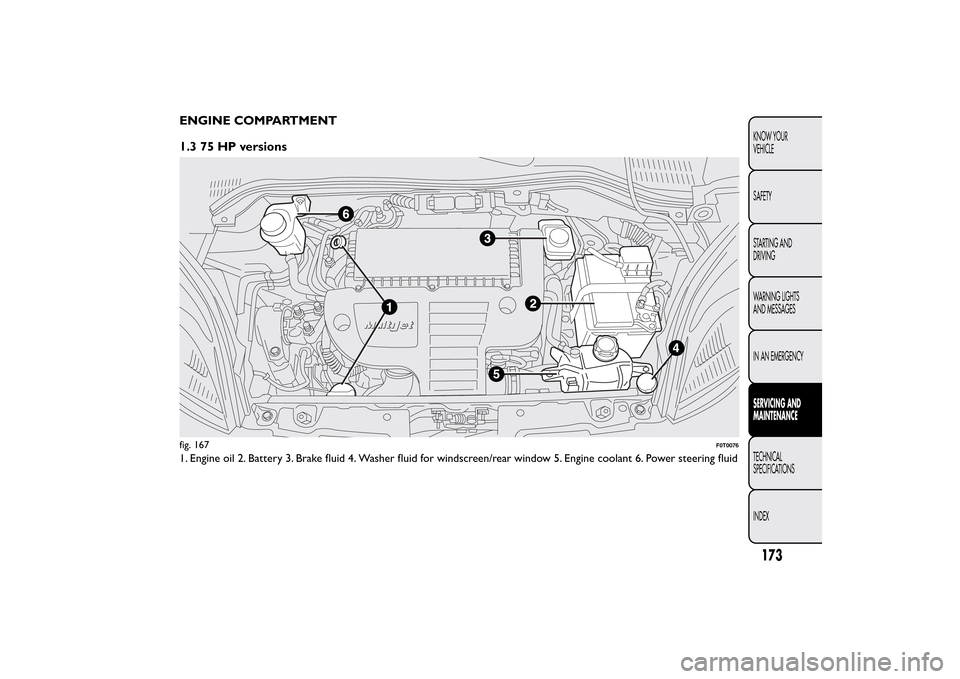
ENGINE COMPARTMENT
1.3 75 HP versions1. Engine oil 2. Battery 3. Brake fluid 4. Washer fluid for windscreen/rear window 5. Engine coolant 6. Power steering fluidfig. 167
F0T0076
173KNOW YOUR
VEHICLE
SAFETY
STARTING AND
DRIVING
WARNING LIGHTS
AND MESSAGES
IN AN EMERGENCYSERVICING AND
MAINTENANCETECHNICAL
SPECIFICATIONS
INDEX
Page 182 of 231
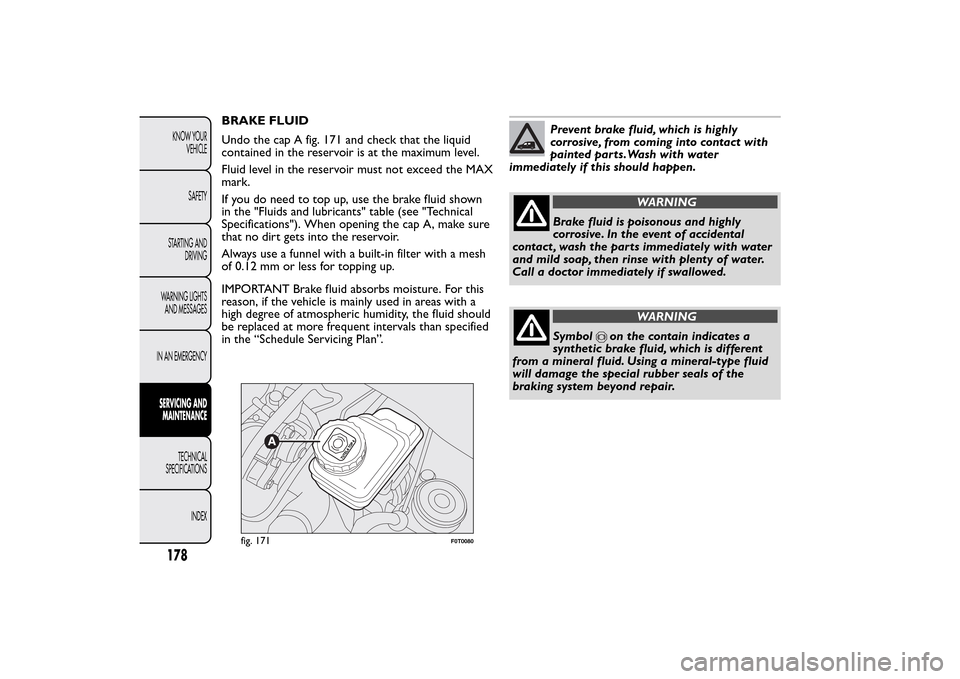
BRAKE FLUID
Undo the cap A fig. 171 and check that the liquid
contained in the reservoir is at the maximum level.
Fluid level in the reservoir must not exceed the MAX
mark.
If you do need to top up, use the brake fluid shown
in the "Fluids and lubricants" table (see "Technical
Specifications"). When opening the cap A, make sure
that no dirt gets into the reservoir.
Always use a funnel with a built-in filter with a mesh
of 0.12 mm or less for topping up.
IMPORTANT Brake fluid absorbs moisture. For this
reason, if the vehicle is mainly used in areas with a
high degree of atmospheric humidity, the fluid should
be replaced at more frequent intervals than specified
in the “Schedule Servicing Plan”.
Prevent brake fluid, which is highly
corrosive, from coming into contact with
painted parts.Wash with water
immediately if this should happen.
WARNING
Brake fluid is poisonous and highly
corrosive. In the event of accidental
contact , wash the parts immediately with water
and mild soap, then rinse with plenty of water.
Call a doctor immediately if swallowed.
WARNING
Symbol
on the contain indicates a
synthetic brake fluid, which is different
from a mineral fluid. Using a mineral-type fluid
will damage the special rubber seals of the
braking system beyond repair.
fig. 171
F0T0080
178KNOW YOUR
VEHICLE
SAFETY
STARTING AND
DRIVING
WARNING LIGHTS
AND MESSAGES
IN AN EMERGENCY
SERVICING AND
MAINTENANCE
TECHNICAL
SPECIFICATIONS
INDEX