engine FIAT QUBO 2016 1.G Owner's Manual
[x] Cancel search | Manufacturer: FIAT, Model Year: 2016, Model line: QUBO, Model: FIAT QUBO 2016 1.GPages: 231, PDF Size: 5.02 MB
Page 79 of 231
TRACTION PLUS SYSTEM(for versions/markets, where provided)
Traction Plus is a help with driving and setting off in
poor grip conditions (snow, ice, mud, etc.) which
allows the drive force to be evenly distributed over
the same axle when both wheels are slipping.
In effect, Traction Plus acts by braking the wheels
with poor grip (or those slipping more than the
others), thereby transferring the drive force to those
which have more grip on the ground.
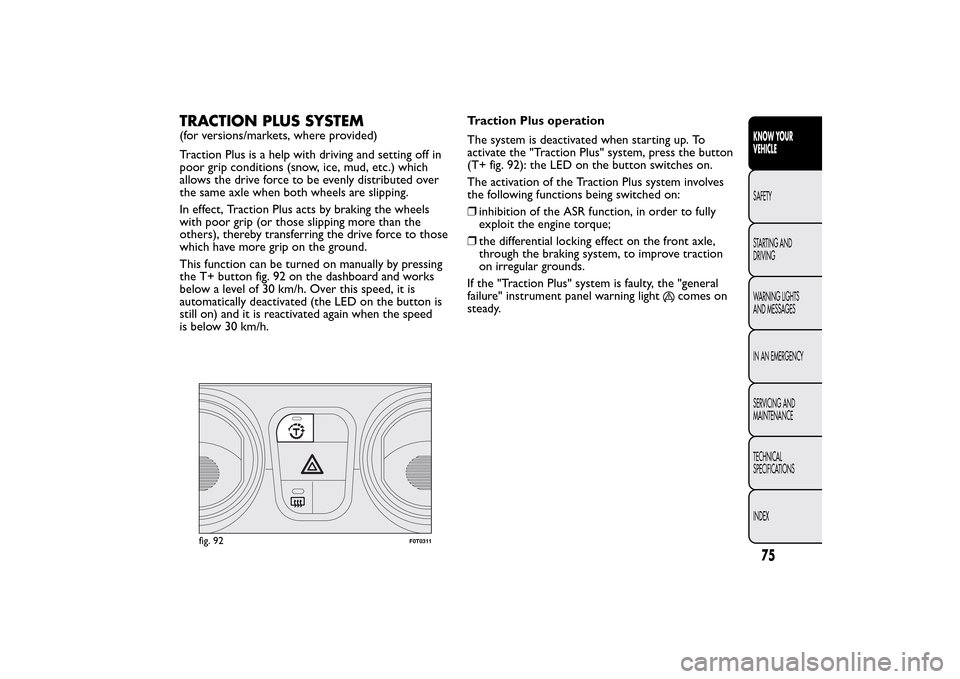
This function can be turned on manually by pressing
the T+ button fig. 92 on the dashboard and works
below a level of 30 km/h. Over this speed, it is
automatically deactivated (the LED on the button is
still on) and it is reactivated again when the speed
is below 30 km/h.Traction Plus operation
The system is deactivated when starting up. To
activate the "Traction Plus" system, press the button
(T+ fig. 92): the LED on the button switches on.
The activation of the Traction Plus system involves
the following functions being switched on:
❒inhibition of the ASR function, in order to fully
exploit the engine torque;
❒the differential locking effect on the front axle,
through the braking system, to improve traction
on irregular grounds.
If the "Traction Plus" system is faulty, the "general
failure" instrument panel warning light
comes on
steady.
fig. 92
F0T0311
75KNOW YOUR
VEHICLESAFETY
STARTING AND
DRIVING
WARNING LIGHTS
AND MESSAGES
IN AN EMERGENCY
SERVICING AND
MAINTENANCE
TECHNICAL
SPECIFICATIONS
INDEX
Page 80 of 231
EOBD SYSTEMThe EOBD system (European On Board Diagnosis)
allows continuous diagnosis of emission-related
components on the vehicle.
It also alerts the driver, by turning on instrument
panel warning light
(together with the relevant
message in the display, on some versions), when
these components are no longer in peak condition
(see “Warning lights and messages” section).
The aim of the system is to:
❒monitor system efficiency;
❒warn about increased emissions due to a vehicle
malfunction;
❒to warn of the need to replace deteriorated
components.
The system also has a connector that can be
interfaced with appropriate equipment, which makes
it possible to read the error codes stored in the
control unit, together with a series of specific
parameters for engine operation and diagnosis.
This check can also be carried out by traffic police.
IMPORTANT After resolving the problem, to check
the system completely, Fiat Dealerships are obliged
to run a bench test and, if necessary, road tests
which may call for a long journey.
WARNING
Go to a Fiat Dealership as soon as
possible if warning light
either does
not light up when the key is turned to MAR to if
while travelling the warning lights comes on
either steady or blinking (along with a message
on the display).The operation of warning light
may be checked by the traffic police using
specific devices. Follow the laws in force in
the country where you are driving.
76KNOW YOUR
VEHICLE
SAFETY
STARTING AND
DRIVING
WARNING LIGHTS
AND MESSAGES
IN AN EMERGENCY
SERVICING AND
MAINTENANCE
TECHNICAL
SPECIFICATIONS
INDEX
Page 84 of 231
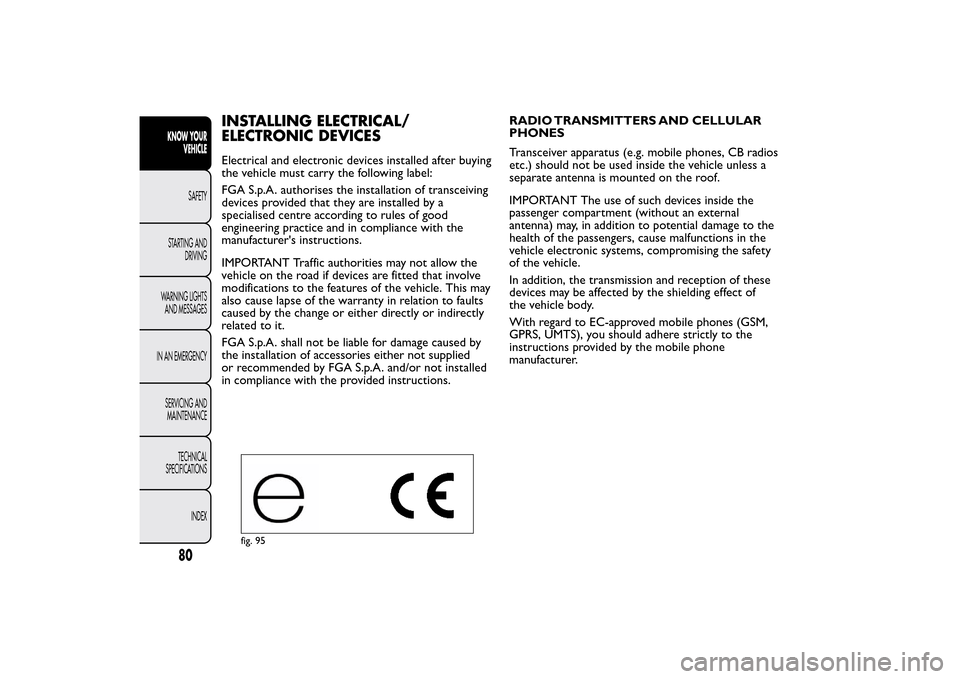
INSTALLING ELECTRICAL/
ELECTRONIC DEVICESElectrical and electronic devices installed after buying
the vehicle must carry the following label:
FGA S.p.A. authorises the installation of transceiving
devices provided that they are installed by a
specialised centre according to rules of good
engineering practice and in compliance with the
manufacturer's instructions.
IMPORTANT Traffic authorities may not allow the
vehicle on the road if devices are fitted that involve
modifications to the features of the vehicle. This may
also cause lapse of the warranty in relation to faults
caused by the change or either directly or indirectly
related to it.
FGA S.p.A. shall not be liable for damage caused by
the installation of accessories either not supplied
or recommended by FGA S.p.A. and/or not installed
in compliance with the provided instructions.RADIO TRANSMITTERS AND CELLULAR
PHONES
Transceiver apparatus (e.g. mobile phones, CB radios
etc.) should not be used inside the vehicle unless a
separate antenna is mounted on the roof.
IMPORTANT The use of such devices inside the
passenger compartment (without an external
antenna) may, in addition to potential damage to the
health of the passengers, cause malfunctions in the
vehicle electronic systems, compromising the safety
of the vehicle.
In addition, the transmission and reception of these
devices may be affected by the shielding effect of
the vehicle body.
With regard to EC-approved mobile phones (GSM,
GPRS, UMTS), you should adhere strictly to the
instructions provided by the mobile phone
manufacturer.
fig. 95
80KNOW YOUR
VEHICLE
SAFETY
STARTING AND
DRIVING
WARNING LIGHTS
AND MESSAGES
IN AN EMERGENCY
SERVICING AND
MAINTENANCE
TECHNICAL
SPECIFICATIONS
INDEX
Page 85 of 231
81KNOW YOUR
VEHICLESAFETY
STARTING AND
DRIVING
WARNING LIGHTS
AND MESSAGES
IN AN EMERGENCY
SERVICING AND
MAINTENANCE
TECHNICAL
SPECIFICATIONS
INDEX
REFUELLING THE VEHICLEDIESEL ENGINES
Operation at low temperatures
If the outside temperature is very low, the diesel
thickens due to the formation of paraffin clots with
consequent defective operation of the fuel supply
system.
In order to avoid these problems, different types of
diesel are distributed according to the season:
summer type, winter type and arctic type
(cold/mountain areas). If refuelling with diesel fuel
whose specifications are not suitable for the usage
temperature, it is advisable to mix TUTELA DIESEL
ART additive in the proportions shown on the
container with the fuel. Pour the additive into the
tank before the fuel.
When using or parking the vehicle for a long time in
the mountains or cold areas, it is advisable to refuel
using locally available diesel.
In this case, it is also advisable to keep the tank over
50% full.
For diesel engines, use only diesel fuel for
motor vehicles in accordance with EN590
European specifications.The use of other
products or mixtures may damage the engine
beyond repair and consequently invalidate the
warranty, due to the damage caused. If you
accidentally introduce other types of fuel into the
tank, do not start the engine. Empty the tank. If
the engine has been run for even an extremely
limited amount of time, you must not only drain
the fuel tank, but the rest of the supply circuit
as well.
Page 87 of 231
FUEL CUT-OFF SYSTEMThis system is triggered after a collision as follows by:
❒the interruption of the fuel supply with the engine
consequently cutting out;
❒automatically unlocking the doors
❒turning on the lights inside the vehicle.
When the system has been triggered, the message
“Fuel cut off, see handbook” is displayed on some
versions.
Check carefully for fuel leaks, for instance in the
engine compartment, under the vehicle or near the
tank area.
After a crash, turn the ignition key to STOP to avoid
draining the battery.
The following procedure should be carried out to
restore the correct operation of the vehicle:
❒turn the ignition key to the ON position;
❒turn on the right direction indicator;
❒turn off the right direction indicator;
❒turn on the left direction indicator;
❒turn off the left direction indicator;
❒turn on the right direction indicator;
❒turn off the right direction indicator;
❒turn on the left direction indicator;
❒turn off the left direction indicator;
❒turn the ignition key to the OFF position.
WARNING
If, after an impact , you smell fuel or
notice leaks from the fuel system, do not
reactivate the system to avoid the risk of fire.
83KNOW YOUR
VEHICLESAFETY
STARTING AND
DRIVING
WARNING LIGHTS
AND MESSAGES
IN AN EMERGENCY
SERVICING AND
MAINTENANCE
TECHNICAL
SPECIFICATIONS
INDEX
Page 88 of 231
PROTECTING THE ENVIRONMENTThe following devices are used for reducing diesel
fuel engine emissions:
❒oxidising catalytic converter
❒exhaust gas recirculation system (EGR)
❒diesel particulate filter (DPF) (for versions/
markets, where provided).
DIESEL PARTICULATE FILTER (DPF)
(for versions/markets, where provided)
The Diesel Particulate Filter is a mechanical filter,
integral to the exhaust system, that physically traps
carbon particulates present in the exhaust gases
of diesel engines.
The diesel particulate filter has been adopted to
eliminate almost all particulates in compliance with
current/future regulations.
During normal use of the vehicle, the engine
management control unit records a set of data
(travel time, type of route, temperatures reached
etc.) and calculates how much particulate has been
trapped by the filter.Since this filter physically traps particulate, it must be
regenerated (cleaned) at regular intervals by burning
the carbon particles.
The regeneration procedure is managed
automatically by the engine management control unit
according to the filter conditions and vehicle use
conditions.
During regeneration, the following may occur: a
limited increase in the engine speed, activation of the
fan, a limited increase in fumes and high
temperatures at the exhaust.
These are not faults; they do not impair vehicle
performance or damage the environment. If
the dedicated message is displayed, refer to the
“Warning lights and messages” section.
84KNOW YOUR
VEHICLE
SAFETY
STARTING AND
DRIVING
WARNING LIGHTS
AND MESSAGES
IN AN EMERGENCY
SERVICING AND
MAINTENANCE
TECHNICAL
SPECIFICATIONS
INDEX
Page 110 of 231
WARNING
Airbags may be deployed if another
vehicle crashes into yours if the key is
inserted and on, even if the engine is not
running and your vehicle is standing. For this
reason, children must never sit on the front
seat , even if when standing. On the other hand,
if the key is inser ted and at STOP, none of the
safety devices (airbag or pretensioners) will
be deployed in a collision. Non-deployment of
the devices in this case does not indicate a
system fault .
WARNING
Have the airbag system checked by a
Fiat Dealership if the car was stolen, if
theft was attempted, or if the car was subjected
to vandalism or flooding.
WARNING
When the ignition key is turned to MAR,
the warning light
(with passenger's
front airbag activated) comes on and flashes for
a few seconds to remind you that the
passenger's airbag will be deployed in a crash,
after which it should go off.
WARNING
The airbag deployment threshold is
higher than that of the pretensioners.
For collisions in the range between the two
thresholds, it is normal for only the
pretensioners to be activated.
WARNING
Airbags do not replace seat belts, but
increase their efficiency. Furthermore,
since front airbags are not deployed in
low-speed head-on collisions, side-on impacts,
rear-end shunts or roll-overs, the passengers are
protected only by the seat belts which must
therefore be fastened at all times.
106KNOW YOUR
VEHICLE
SAFETY
STARTING AND
DRIVING
WARNING LIGHTS
AND MESSAGES
IN AN EMERGENCY
SERVICING AND
MAINTENANCE
TECHNICAL
SPECIFICATIONS
INDEX
Page 111 of 231
STARTING AND DRIVING
STARTING THE ENGINEThe vehicle is fitted with an immobiliser: if the engine
fails to start, see the paragraph on “The Fiat CODE
system” in the “Knowing your vehicle” section.
The engine may be noisier during the first few
seconds of operation, particularly after a long period
of inactivity. This is due to the hydraulic tappets,
the timing system chosen for petrol engine versions
to reduce the number of servicing interventions,
and affects neither functionality nor reliability.
It is advisable not to demand maximum
performance from your vehicle (e.g.
excessive acceleration, long distances at
high speeds, excessive intense braking, etc .) during
the initial period of use.When the engine is switched off never
leave the key on (at MAR) to prevent
unnecessary consumption and draining
the battery.
WARNING
It is dangerous to have the engine
running indoors.The engine takes in
oxygen and discharges carbon dioxide, carbon
monoxide and other toxic gases.
WARNING
Remember that the brake booster and
electric power steering are not
operational until the engine has been started,
so you need to apply much more force than
usual to the brake pedal and steering wheel.
STARTING PROCEDURE FOR DIESEL
VERSIONS
Proceed as follows:
❒apply the handbrake;
❒put the gear lever into neutral;
❒turn the key on (MAR position): instrument panel
warning light
will light up;
❒wait for the warning lights
and
to go out.
The hotter the engine is, the quicker this will
happen;
107KNOW YOUR
VEHICLE
SAFETYSTARTING AND
DRIVINGWARNING LIGHTS
AND MESSAGES
IN AN EMERGENCY
SERVICING AND
MAINTENANCE
TECHNICAL
SPECIFICATIONS
INDEX
Page 112 of 231
❒press the clutch pedal down to the floor without
touching the accelerator;
❒turn the ignition key to AVV as soon as the
warning light goes out. Waiting too long will
waste the heating work carried out by the glow
plugs.
Release the key as soon as the engine starts.
IMPORTANT With the engine cold, the accelerator
pedal must be fully released when you turn the
ignition key to AVV.
If the engine does not start at the first attempt,
return the ignition key to STOP before repeating the
procedure.
If thewarning light stays on when the ignition key
is at MAR, turn the key to STOP and then back to
MAR; if the warning light remains on, try with the
other keys provided with the car.
Contact a Fiat Dealership if the engine still does not
start.
Warning light
will blink for 60
seconds after star ting or during prolonged
cranking to indicate a fault to the glow
plug heating system. Use the vehicle normally if
the engine starts, but go to a Fiat Dealership
as soon as possible.
HOW TO WARM UP THE ENGINE AFTER IT
HAS JUST STARTED
Proceed as follows:
❒drive off slowly, letting the engine turn at medium
revs. Do not accelerate abruptly;
❒do not demand to performance for the first few
kilometres. Wait until the engine coolant gauge
starts moving.
108KNOW YOUR
VEHICLE
SAFETYSTARTING AND
DRIVINGWARNING LIGHTS
AND MESSAGES
IN AN EMERGENCY
SERVICING AND
MAINTENANCE
TECHNICAL
SPECIFICATIONS
INDEX
Page 113 of 231
EMERGENCY STARTING
Go to a Fiat Dealership immediately if warning light
comes on steady on the instrument panel.
Never jump start the engine by pushing,
towing or coasting downhill.This could
cause fuel to flow into the catalytic
conver ter and damage it beyond repair.STOPPING THE ENGINE
Turn the ignition key to STOP while the engine is
idling.
IMPORTANT After a long drive, you should allow
the engine to “catch its breath” before turning it off
by letting it idle to allow the temperature in the
engine compartment to fall.
A quick burst on the accelerator before
stopping the engine serves no practical
purpose; it wastes fuel and is especially
damaging to turbocharged engines.
109KNOW YOUR
VEHICLE
SAFETYSTARTING AND
DRIVINGWARNING LIGHTS
AND MESSAGES
IN AN EMERGENCY
SERVICING AND
MAINTENANCE
TECHNICAL
SPECIFICATIONS
INDEX