tyres FIAT QUBO 2016 1.G Owners Manual
[x] Cancel search | Manufacturer: FIAT, Model Year: 2016, Model line: QUBO, Model: FIAT QUBO 2016 1.GPages: 231, PDF Size: 5.02 MB
Page 76 of 231
HILL HOLDER SYSTEM
(for versions/markets, where provided)
It's integral to the ESP system. It automatically
activates with the following conditions:
❒uphill: vehicle stationary on a road with a gradient
higher than 5%, engine running, brake pedal
pressed and gearbox in neutral or gear other than
reverse;
❒downhill: vehicle stationary on a road with a
gradient higher than 5%, engine running, brake
pedal pressed and reverse gear engaged.
At pickup, the ESP system control unit will keep
braking pressure on the wheels until reaching the
required torque for starting or, in any case, for
a maximum of 2 seconds in order to move easily the
right foot from the brake pedal to the accelerator
pedal. When two seconds have elapsed, without
starting, the system is automatically deactivated,
gradually releasing the braking pressure. During this
release stage, the typical brake disengagement noise
indicating that the vehicle is going to move
imminently will be heard.Failure indications
IMPORTANT The Hill Holder system is not a parking
brake; therefore, never leave the vehicle without
having engaged the handbrake, turned the engine off
and engaged the first gear.
WARNING
For the correct operation of the ESP and
ASR systems, the tyres must be the
same make and type on all wheels, in perfect
condition and, above all, of the type, make and
size recommended.
72KNOW YOUR
VEHICLE
SAFETY
STARTING AND
DRIVING
WARNING LIGHTS
AND MESSAGES
IN AN EMERGENCY
SERVICING AND
MAINTENANCE
TECHNICAL
SPECIFICATIONS
INDEX
Page 77 of 231
ASR SYSTEM (Anti-Slip Regulation)
(for versions/markets, where provided)
This is a traction control system that cuts in
automatically every time one or both drive wheels
slip.
Depending on how slippery the road is, two different
control systems are activated:
❒if slipping involves both driving wheels, the ASR
function intervenes reducing the power
transmitted by the engine;
❒if the slipping only involves one of the drive
wheels, it intervenes automatically braking the
wheel that is slipping.
The action of the ASR system is especially useful in
the following conditions:
❒slipping of the inner wheel round bends due to
dynamic variations in the load of excessive
acceleration;
❒excessive power transmitted to the wheels, also in
relation to road surface conditions;
❒acceleration on slippery, snowy or icy road
surfaces;
❒in the case of loss of grip on a wet surface
(aquaplaning).
WARNING
For the correct operation of the ESP and
ASR systems, the tyres must be the
same make and type on all wheels, in perfect
condition and, above all, of the type, make and
size recommended.
MSR SYSTEM (engine drive regulation)
This is an integral part of the ASR system that, in the
event of a sudden gear down shift, cuts in and
provides torque to the engine thus preventing
excessive drive wheel drive which, especially in poor
grip conditions, can lead to a loss of stability.
73KNOW YOUR
VEHICLESAFETY
STARTING AND
DRIVING
WARNING LIGHTS
AND MESSAGES
IN AN EMERGENCY
SERVICING AND
MAINTENANCE
TECHNICAL
SPECIFICATIONS
INDEX
Page 115 of 231
PARKING THE CAR
Proceed as follows:
❒stop the engine and engage the handbrake;
❒engage a gear (1
stgear if parked uphill or reverse if
facing downhill) and leave the wheels turned.
If the vehicle is parked on a steep slope, it is
advisable to block the wheels with a wedge or stone.
To prevent draining the battery, do not leave the
ignition key turned to MAR. Always remove the key
when you leave the vehicle.
Never leave children unattended in the vehicle.
Always remove the ignition key when leaving the
vehicle, and take it with you.
SNOW TYRESA Fiat Dealership will be happy to provide advice
concerning the most suitable type of tyre for your
requirements.
For the type, pressures and specifications of the
snow tyre to be used, follow carefully the
instructions given in the “Wheels” paragraph of the
“Technical specifications” section.
The winter performance of these tyres is
considerably reduced when the tread thickness is less
than 4 mm. If this is the case, replace them.
Due to their specific features, the performance of
snow tyres is much lower than that of standard tyres
in normal conditions or on long motorway stretches.
You should therefore use them only in the
conditions for which they were designed.
111KNOW YOUR
VEHICLE
SAFETYSTARTING AND
DRIVINGWARNING LIGHTS
AND MESSAGES
IN AN EMERGENCY
SERVICING AND
MAINTENANCE
TECHNICAL
SPECIFICATIONS
INDEX
Page 116 of 231
IMPORTANT When using snow tyres with a
maximum speed index below the one that can be
reached by the vehicle (increased by 5%), place
a notice in the passenger compartment, plainly in
view, which states the maximum speed allowed
by the snow tyres (as per EC Directive).
All four tyres should be the same (brand and profile)
to ensure greater safety when driving and braking
as well as making the car more responsive.
Remember that you should not change the rotation
direction of the tyres.
WARNING
You must not exceed 160 km/h on snow
tyres with a “Q” mark; in any case, make
sure you stick to the rules of the highway code.
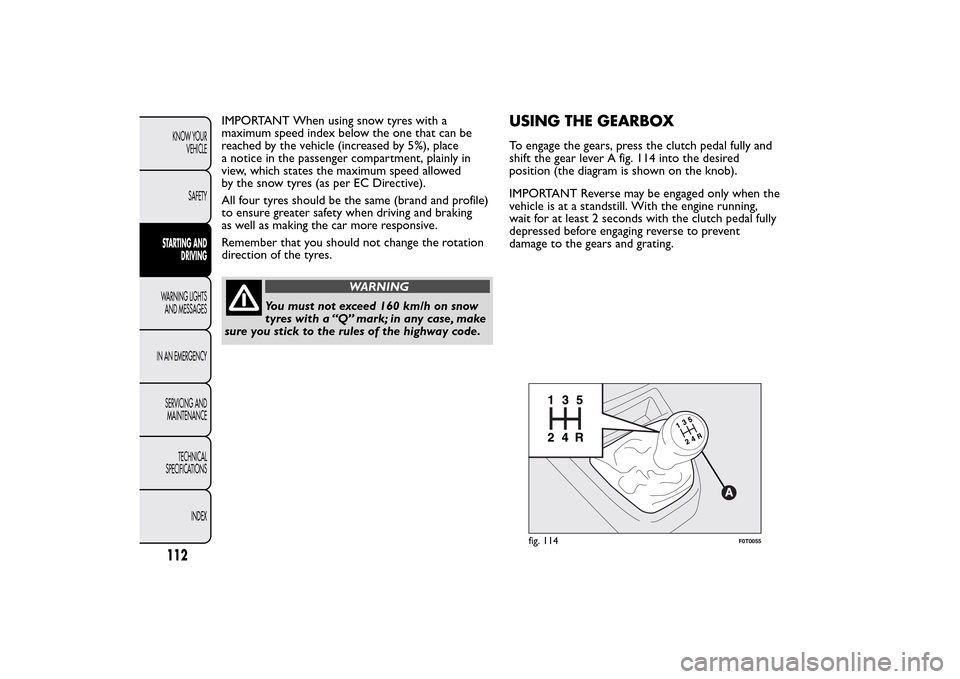
USING THE GEARBOXTo engage the gears, press the clutch pedal fully and
shift the gear lever A fig. 114 into the desired
position (the diagram is shown on the knob).
IMPORTANT Reverse may be engaged only when the
vehicle is at a standstill. With the engine running,
wait for at least 2 seconds with the clutch pedal fully
depressed before engaging reverse to prevent
damage to the gears and grating.
fig. 114
F0T0055
112KNOW YOUR
VEHICLE
SAFETYSTARTING AND
DRIVINGWARNING LIGHTS
AND MESSAGES
IN AN EMERGENCY
SERVICING AND
MAINTENANCE
TECHNICAL
SPECIFICATIONS
INDEX
Page 120 of 231
WARNING
The ABS with which the vehicle may be
equipped will not control the braking
system of the trailer. Particular caution is
therefore required on slippery roads.
WARNING
Never modify the braking system of the
vehicle to control the trailer brake.
The trailer braking system must be fully
independent from the hydraulic system of the
vehicle.
SNOW CHAINSThe use of snow chains should be in compliance with
local regulations.
Snow chains may be fitted only to the front wheel
tyres (drive wheels).
Check the tension of the chains after the first few
metres have been driven.
Keep your speed down when snow chains
are fitted: do not exceed 50 km/h. Avoid
potholes, steps and pavements and also
avoid driving for long distances on roads not
covered with snow to avoid damaging the car and
the road surface.
116KNOW YOUR
VEHICLE
SAFETYSTARTING AND
DRIVINGWARNING LIGHTS
AND MESSAGES
IN AN EMERGENCY
SERVICING AND
MAINTENANCE
TECHNICAL
SPECIFICATIONS
INDEX
Page 121 of 231
PROLONGED VEHICLE INACTIVITYIf the vehicle needs to be off the road for longer than
one month, the following precautions must be
taken:
❒park the vehicle indoors in a dry and, if possible,
well-ventilated place;
❒engage a gear and check that the handbrake is not
on;
❒disconnect the battery negative terminal and check
the charge (see “Battery” in the “Maintenance and
care”);
❒clean and protect the painted parts using
protective wax;
❒clean and protect the shiny metal parts using
special compounds readily available;❒sprinkle talcum powder on the rubber windscreen
and rear window wiper blades and lift them off the
glass;
❒slightly open the windows;
❒cover the vehicle with a piece of fabric or
perforated plastic sheet. Do not use compact
plastic tarpaulins, which prevent humidity from
evaporating from the surface of the vehicle;
❒inflate tyres to +0.5 bar above the normal specified
pressure and check it at intervals;
❒do not drain the engine cooling system.
117KNOW YOUR
VEHICLE
SAFETYSTARTING AND
DRIVINGWARNING LIGHTS
AND MESSAGES
IN AN EMERGENCY
SERVICING AND
MAINTENANCE
TECHNICAL
SPECIFICATIONS
INDEX
Page 142 of 231
WARNING
It is not possible to repair damage to the
tyre sidewall. Do not use the quick
repair kit if the tyre was damaged by running
on a flat .
WARNING
Repair is not possible if the wheel rim is
damaged (groove is deformed, causing
air to escape). Do not remove foreign bodies
(screws or nails) from the tyre.IMPORTANT INFORMATION:
The sealing fluid of the quick tyre repair kit is
effective at external temperatures of between -20°C
and +50°C.
WARNING
Do not operate the compressor for
longer than 20 minutes at a time. Risk
of overheating.The quick repair kit is not
suitable for definitive repairs, so the tyres
repaired may be used only temporarily.Dispose of the cylinder and the sealant
properly. Dispose according to the
national and local laws in force.
138KNOW YOUR
VEHICLE
SAFETY
STARTING AND
DRIVING
WARNING LIGHTS
AND MESSAGES
IN AN
EMERGENCY
SERVICING AND
MAINTENANCE
TECHNICAL
SPECIFICATIONS
INDEX
Page 186 of 231
IMPORTANT If the battery remains with the charge
below 50% for a long time it becomes damaged
through sulphation and its starting capacity is
reduced.
The battery is also more prone to the risk of freezing
(at temperatures as high as -10°C).
Refer to the paragraph "Vehicle inactivity" in "Starting
and driving" if the vehicle is left parked for a long
time.
If, after buying the vehicle, you want to install
electric accessories which require permanent electric
supply (alarm, etc.) contact the Fiat Dealership
whose qualified personnel, in addition to suggesting
the most suitable devices, will evaluate the overall
electric absorption, checking whether the vehicle
electric system is capable of withstanding the load
required, or whether it should be integrated with
a more powerful battery.
Since these devices continue to use electricity even
when the engine is off, they gradually run down
the battery.
WHEELS AND TYRESCheck the pressure of each tyre, including the spare,
every two weeks and before long journeys. The
pressure should be checked with the tyre rested and
cold.
It is normal for the pressure to increase when the
vehicle is used; for the correct tyre inflation
pressure, see “Wheels” in the “Technical
specifications” section.
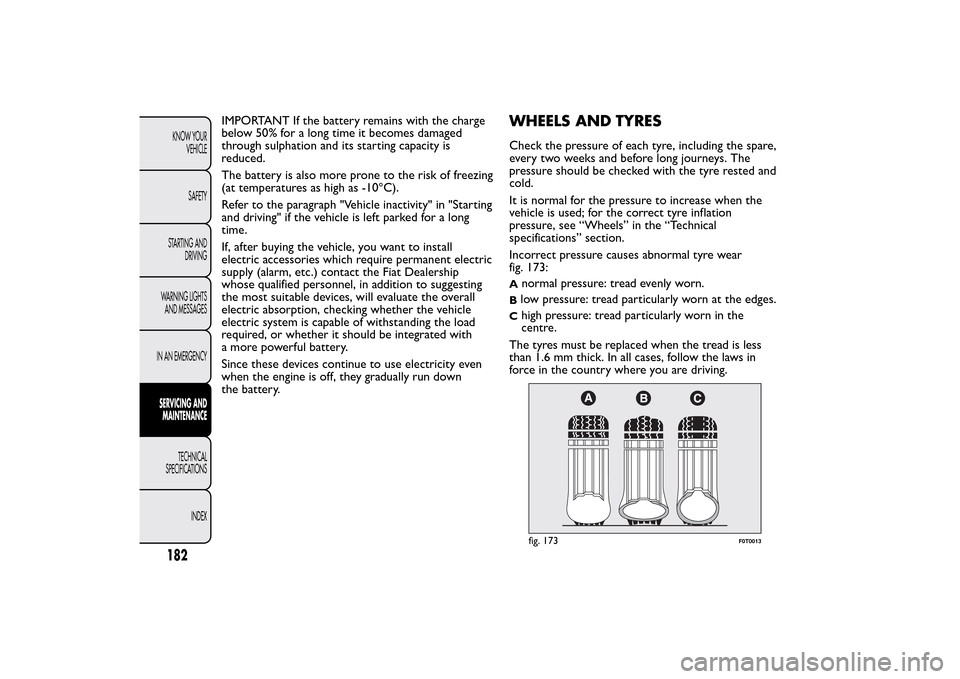
Incorrect pressure causes abnormal tyre wear
fig. 173:A
normal pressure: tread evenly worn.
Blow pressure: tread particularly worn at the edges.C
high pressure: tread particularly worn in the
centre.
The tyres must be replaced when the tread is less
than 1.6 mm thick. In all cases, follow the laws in
force in the country where you are driving.fig. 173
F0T0013
182KNOW YOUR
VEHICLE
SAFETY
STARTING AND
DRIVING
WARNING LIGHTS
AND MESSAGES
IN AN EMERGENCY
SERVICING AND
MAINTENANCE
TECHNICAL
SPECIFICATIONS
INDEX
Page 187 of 231
IMPORTANT
❒Avoid braking suddenly, burning starts and violent
knocks against the curb, potholes or other
obstacles if possible. Long distances on uneven
roads can damage the tyres;
❒check the tyres regularly for cuts on the sides,
swelling or irregular tread wear. Go to a Fiat
Dealership if required.
❒avoid overloading the car when travelling: this may
cause serious damage to the wheels and tyres;
❒if a tyre is punctured, stop immediately and charge
it to avoid damage to the tyre, the rim,
suspensions and steering system;
❒a tyre will age even if it is not used much. Cracks
in the tread and on the sidewalls are a sign of
ageing. In any event, have the tyres checked by
specialised personnel if they have been fitted for
longer than six years. Remember to check the
spare wheel very carefully;
❒in the case of replacement, always fit new tyres,
avoiding those of dubious origin;
❒if a tyre is changed, also change the inflation valve;
❒to allow even wear between the front and rear
tyres, it is advisable to change them over every
10-15 thousand kilometres, keeping them on the
same side of the vehicle so as not to reverse
the direction of rotation.
WARNING
Remember that the road holding
qualities of your vehicle also depend on
the correct inflation pressure of the tyres.
WARNING
Excessively low pressure will cause
overheating of the tyre and may cause
severe tyre damage.
WARNING
Do not exchange the tyres from the left
to the right of the vehicle and vice versa.
WARNING
Do not repaint alloy wheel rims at
temperatures higher than 150°C.The
mechanical characteristics of the wheels might
be compromised.
183KNOW YOUR
VEHICLE
SAFETY
STARTING AND
DRIVING
WARNING LIGHTS
AND MESSAGES
IN AN EMERGENCYSERVICING AND
MAINTENANCETECHNICAL
SPECIFICATIONS
INDEX
Page 201 of 231
WHEELSWHEELS AND TYRES
Pressed steel or alloy wheels. Tubeless radial carcass
tyres. All approved tyres are listed in the Log Book.
IMPORTANT If there are any discrepancies between
the Owner's handbook and the logbook, take the
information from the latter.
Respect the prescribed size to ensure safety of the
vehicle in movement. Fit tyres of the same make and
type on all wheels.
IMPORTANT Do not use air chambers with tubeless
tyres.
SPARE WHEEL
Pressed steel rims. Tubeless tyre.
WHEEL GEOMETRY
Front wheel toe-in measured between rims: -1 ±1
mm
The values refer to the vehicle in running order.
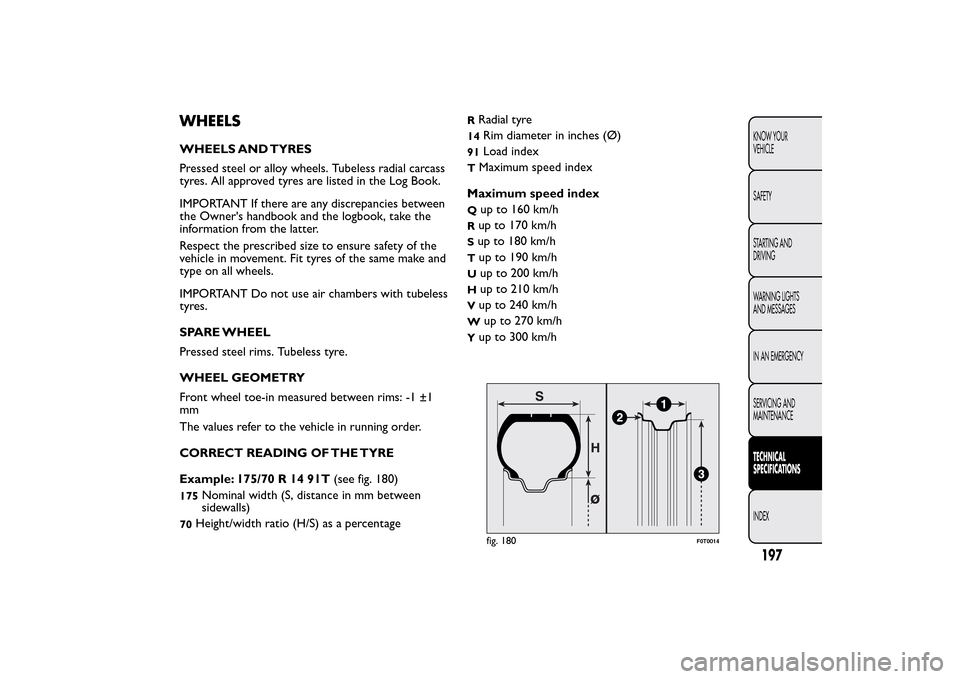
CORRECT READING OF THE TYRE
Example: 175/70 R 14 91T(see fig. 180)175
Nominal width (S, distance in mm between
sidewalls)
70
Height/width ratio (H/S) as a percentage
RRadial tyre14
Rim diameter in inches (Ø)
91
Load index
T
Maximum speed index
Maximum speed index
Q
up to 160 km/h
Rup to 170 km/hSup to 180 km/hT
up to 190 km/h
U
up to 200 km/h
H
up to 210 km/h
V
up to 240 km/h
W
up to 270 km/h
Y
up to 300 km/hfig. 180
F0T0014
197KNOW YOUR
VEHICLE
SAFETY
STARTING AND
DRIVING
WARNING LIGHTS
AND MESSAGES
IN AN EMERGENCY
SERVICING AND
MAINTENANCETECHNICAL
SPECIFICATIONSINDEX