bonnet FIAT QUBO 2017 1.G User Guide
[x] Cancel search | Manufacturer: FIAT, Model Year: 2017, Model line: QUBO, Model: FIAT QUBO 2017 1.GPages: 260, PDF Size: 4.74 MB
Page 189 of 260
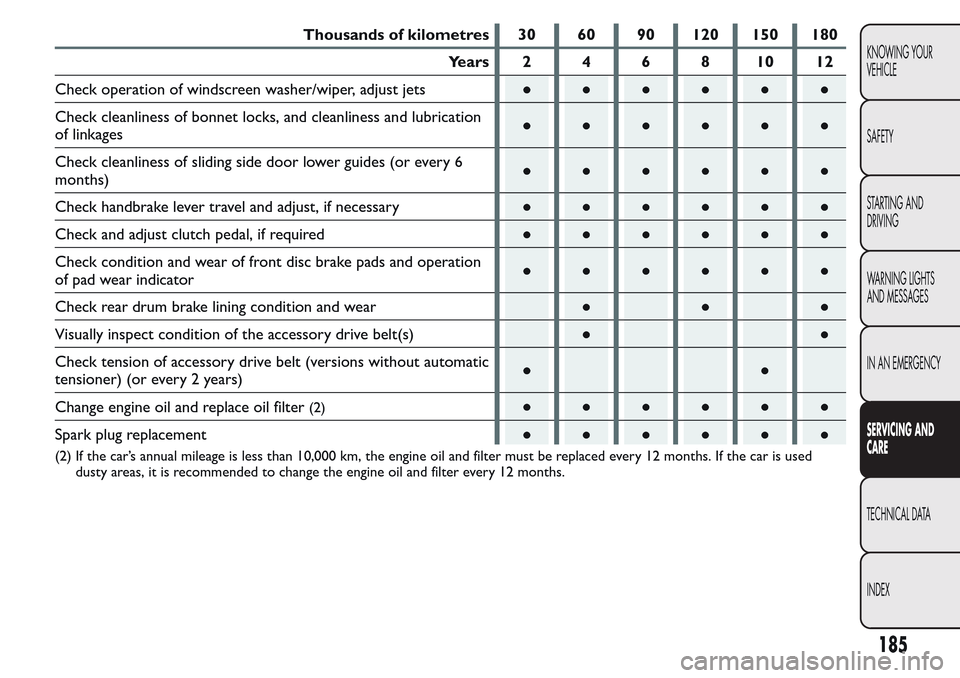
Thousands of kilometres 30 60 90 120 150 180
Years 2 4 6 8 10 12
Check operation of windscreen washer/wiper, adjust jets●●●●●●
Check cleanliness of bonnet locks, and cleanliness and lubrication
of linkages●●●●●●
Check cleanliness of sliding side door lower guides (or every 6
months)●●●●●●
Check handbrake lever travel and adjust, if necessary●●●●●●
Check and adjust clutch pedal, if required●●●●●●
Check condition and wear of front disc brake pads and operation
of pad wear indicator●●●●●●
Check rear drum brake lining condition and wear●●●
Visually inspect condition of the accessory drive belt(s)●●
Check tension of accessory drive belt (versions without automatic
tensioner) (or every 2 years)●●
Change engine oil and replace oil filter
(2)●●●●●●
Spark plug replacement●●●●●●
(2) If the car’s annual mileage is less than 10,000 km, the engine oil and filter must be replaced every 12 months. If the car is used
dusty areas, it is recommended to change the engine oil and filter every 12 months.
185
KNOWING YOUR
VEHICLE
SAFETY
STARTING AND
DRIVING
WARNING LIGHTS
AND MESSAGES
IN AN EMERGENCY
SERVICING AND
CARE
TECHNICAL DATA
INDEX
Page 191 of 260
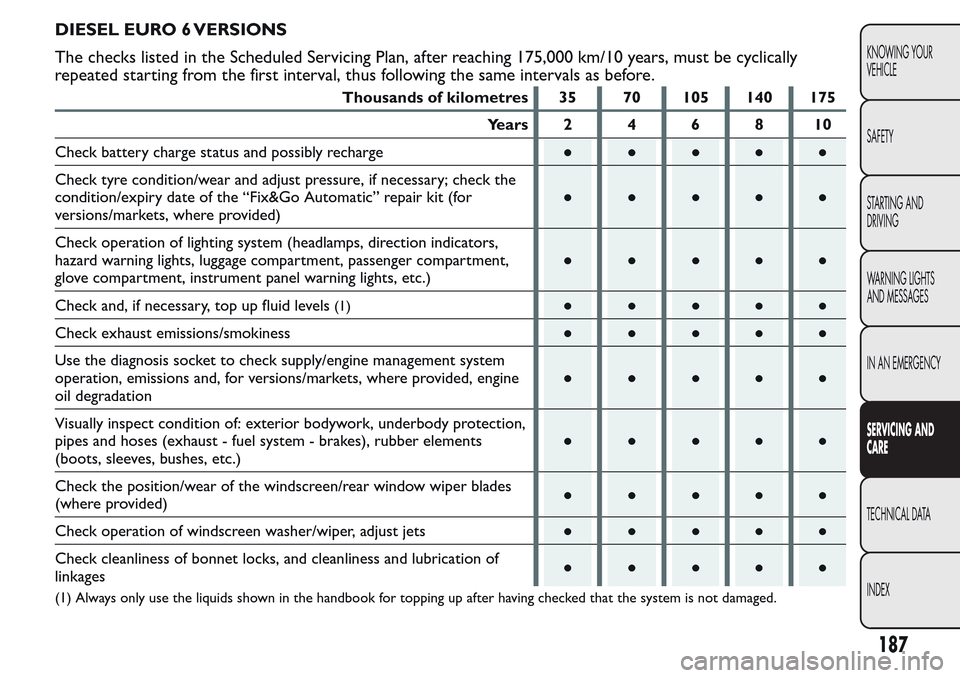
DIESEL EURO 6 VERSIONS
The checks listed in the Scheduled Servicing Plan, after reaching 175,000 km/10 years, must be cyclically
repeated starting from the first interval, thus following the same intervals as before.
Thousands of kilometres 35 70 105 140 175
Years 2 4 6 8 10
Check battery charge status and possibly recharge●●●●●
Check tyre condition/wear and adjust pressure, if necessary; check the
condition/expiry date of the “Fix&Go Automatic” repair kit (for
versions/markets, where provided)●●●●●
Check operation of lighting system (headlamps, direction indicators,
hazard warning lights, luggage compartment, passenger compartment,
glove compartment, instrument panel warning lights, etc.)●●●●●
Check and, if necessary, top up fluid levels
(1)●●●●●
Check exhaust emissions/smokiness●●●●●
Use the diagnosis socket to check supply/engine management system
operation, emissions and, for versions/markets, where provided, engine
oil degradation●●●●●
Visually inspect condition of: exterior bodywork, underbody protection,
pipes and hoses (exhaust - fuel system - brakes), rubber elements
(boots, sleeves, bushes, etc.)●●●●●
Check the position/wear of the windscreen/rear window wiper blades
(where provided)●●●●●
Check operation of windscreen washer/wiper, adjust jets●●●●●
Check cleanliness of bonnet locks, and cleanliness and lubrication of
linkages●●●●●
(1) Always only use the liquids shown in the handbook for topping up after having checked that the system is not damaged.
187
KNOWING YOUR
VEHICLE
SAFETY
STARTING AND
DRIVING
WARNING LIGHTS
AND MESSAGES
IN AN EMERGENCY
SERVICING AND
CARE
TECHNICAL DATA
INDEX
Page 193 of 260
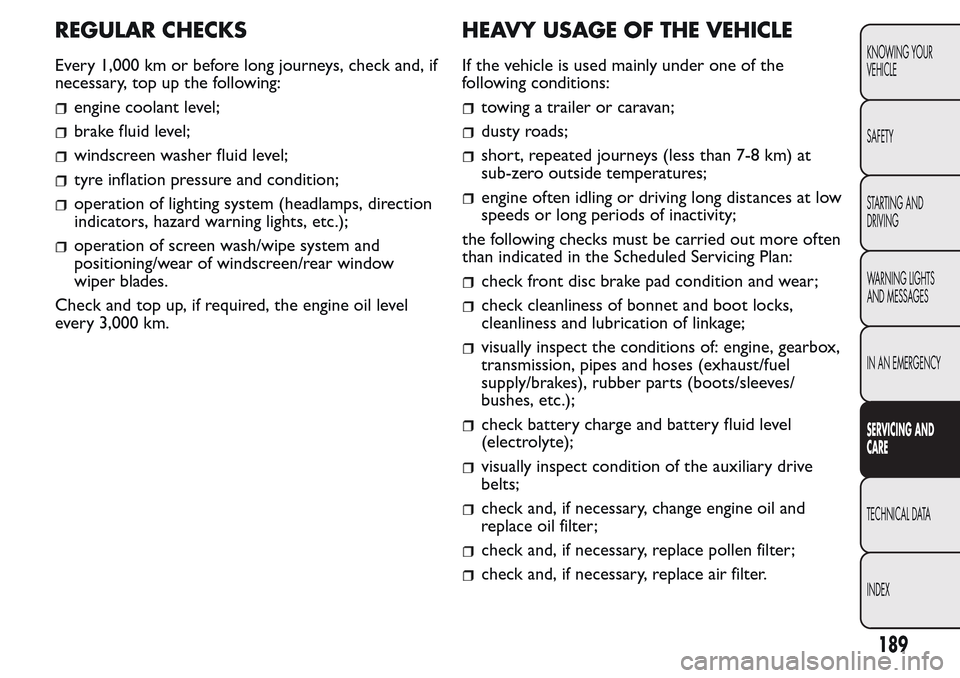
REGULAR CHECKS
Every 1,000 km or before long journeys, check and, if
necessary, top up the following:
engine coolant level;
brake fluid level;
windscreen washer fluid level;
tyre inflation pressure and condition;
operation of lighting system (headlamps, direction
indicators, hazard warning lights, etc.);
operation of screen wash/wipe system and
positioning/wear of windscreen/rear window
wiper blades.
Check and top up, if required, the engine oil level
every 3,000 km.
HEAVY USAGE OF THE VEHICLE
If the vehicle is used mainly under one of the
following conditions:
towing a trailer or caravan;
dusty roads;
short, repeated journeys (less than 7-8 km) at
sub-zero outside temperatures;
engine often idling or driving long distances at low
speeds or long periods of inactivity;
the following checks must be carried out more often
than indicated in the Scheduled Servicing Plan:
check front disc brake pad condition and wear;
check cleanliness of bonnet and boot locks,
cleanliness and lubrication of linkage;
visually inspect the conditions of: engine, gearbox,
transmission, pipes and hoses (exhaust/fuel
supply/brakes), rubber parts (boots/sleeves/
bushes, etc.);
check battery charge and battery fluid level
(electrolyte);
visually inspect condition of the auxiliary drive
belts;
check and, if necessary, change engine oil and
replace oil filter;
check and, if necessary, replace pollen filter;
check and, if necessary, replace air filter.
189
KNOWING YOUR
VEHICLE
SAFETY
STARTING AND
DRIVING
WARNING LIGHTS
AND MESSAGES
IN AN EMERGENCY
SERVICING AND
CARE
TECHNICAL DATA
INDEX
Page 202 of 260
REPLACING THE BATTERY
If required, replace the battery with an original spare
part with the same specifications.
If a battery with different specifications is fitted, the
service intervals given in the “Scheduled Servicing
Plan” will no longer be valid.
Follow the battery manufacturer's instructions for
maintenance.
Incorrect assembly of electric and
electronic devices may cause severe
damage to your vehicle. Go to a Fiat
Dealership if you want to install accessories
(alarms, mobile phone, etc .): they will suggest the
most suitable devices and advise you if a higher
capacity batter y needs to be installed.
Batteries contain substances that are very
harmful to the environment .You are
recommended to go to a Fiat Dealership
to have the batter y replaced where the old
battery will be disposed of respecting both the
environment and the laws in force.
If the vehicle needs to be off the road for
a long period under conditions of intense
cold, remove the battery and take it to
a heated place, otherwise it may freeze.
WARNING
When performing any operation on the
battery or near it , always protect your
eyes with the special goggles.
USEFUL ADVICE FOR EXTENDING THE
LIFE OF YOUR BATTERY
To avoid draining your battery and make it last
longer, follow these instructions closely:
when you park the vehicle, ensure the doors, boot
and bonnet are closed properly so that the ceiling
lights do not stay on;
turn off the ceiling lights, although the car does
have an automatic system for switching off internal
lights;
do not keep accessories (e.g. sound system,
hazard lights, etc.) switched on for a long time
when the engine is not running;
before performing any operation on the electrical
system, disconnect the battery negative cable;
make sure that battery terminals are always be
perfectly tight.
IMPORTANT If the battery remains with the charge
below 50% for a long time it becomes damaged
through sulphation and its starting capacity is
reduced.
The battery is also more prone to the risk of freezing
(at temperatures as high as -10°C).
198
KNOWING YOUR
VEHICLE
SAFETY
STARTING AND
DRIVING
WARNING LIGHTS
AND MESSAGES
IN AN EMERGENCY
SERVICING AND
CARE
TECHNICAL DATA
INDEX
Page 207 of 260
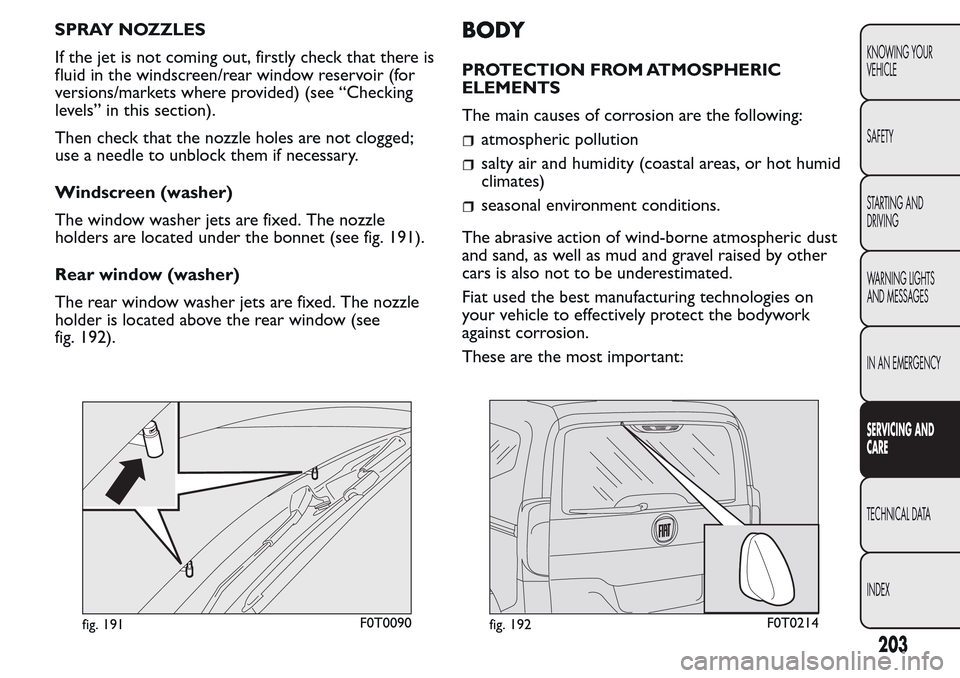
SPRAY NOZZLES
If the jet is not coming out, firstly check that there is
fluid in the windscreen/rear window reservoir (for
versions/markets where provided) (see “Checking
levels” in this section).
Then check that the nozzle holes are not clogged;
use a needle to unblock them if necessary.
Windscreen (washer)
The window washer jets are fixed. The nozzle
holders are located under the bonnet (see fig. 191).
Rear window (washer)
The rear window washer jets are fixed. The nozzle
holder is located above the rear window (see
fig. 192).BODY
PROTECTION FROM ATMOSPHERIC
ELEMENTS
The main causes of corrosion are the following:
atmospheric pollution
salty air and humidity (coastal areas, or hot humid
climates)
seasonal environment conditions.
The abrasive action of wind-borne atmospheric dust
and sand, as well as mud and gravel raised by other
cars is also not to be underestimated.
Fiat used the best manufacturing technologies on
your vehicle to effectively protect the bodywork
against corrosion.
These are the most important:
fig. 191F0T0090fig. 192F0T0214
203
KNOWING YOUR
VEHICLE
SAFETY
STARTING AND
DRIVING
WARNING LIGHTS
AND MESSAGES
IN AN EMERGENCY
SERVICING AND
CARE
TECHNICAL DATA
INDEX
Page 209 of 260
rinse thoroughly to avoid soap marks staying on
the bodywork or less visible parts.
Some car washes with old-style blades
and/or in a poor state of repair can
damage the paintwork, facilitating the
formation of lines that give the paint a dull/misty
appearance, especially on dark colours. If this
happens, lightly polish the paintwork with
appropriate products.
Dry the less visible parts particularly carefully, such
as the door frames, bonnet and the headlight frames,
where water may stagnate more easily. It is a good
idea to leave the vehicle outdoors for a while after
washing it to give water time to evaporate.
Do not wash the vehicle after it has been left in the
sun or with the bonnet hot: this may alter the shine
of the paintwork.
Exterior plastic parts should be cleaned in the same
way as the rest of the vehicle. Where possible, do
not park the vehicle under trees; the resinous
substances released by many species give the paint a
dull appearance and increase the possibility of rust.
IMPORTANT Bird droppings should be washed
off immediately and thoroughly as the acid
they contain is particularly aggressive.
Detergents cause water pollution.The
vehicle should be washed in areas
equipped for collecting and purifying the
liquid used in the washing process.
Windows
Use specific detergents to clean the windows. Also
use clean cloths to avoid scratching the glass or
altering the transparency.
IMPORTANT Wipe the rear window gently with a
cloth in the direction of the filaments to avoid
damaging the heating device.
Engine compartment
At the end of each winter, thoroughly wash the
engine compartment, taking care to avoid spraying
the water jet directly onto the electronic control
units and the relay/fuse box on the left side of the
engine compartment (as you look from behind
the wheel). Have this operation performed at a
specialist garage.
IMPORTANT The washing should take place with the
engine cold and the ignition key in the STOP
position. After the wash, make sure that the various
protective devices (e.g. rubber caps and guards)
have not been removed or damaged.
205
KNOWING YOUR
VEHICLE
SAFETY
STARTING AND
DRIVING
WARNING LIGHTS
AND MESSAGES
IN AN EMERGENCY
SERVICING AND
CARE
TECHNICAL DATA
INDEX
Page 213 of 260
LBodywork version code.
MSpare part number.
NCorrect value of smoke coefficient (for diesel
engines)
CHASSIS MARKING
This is printed on the passenger compartment floor,
near the right front seat.
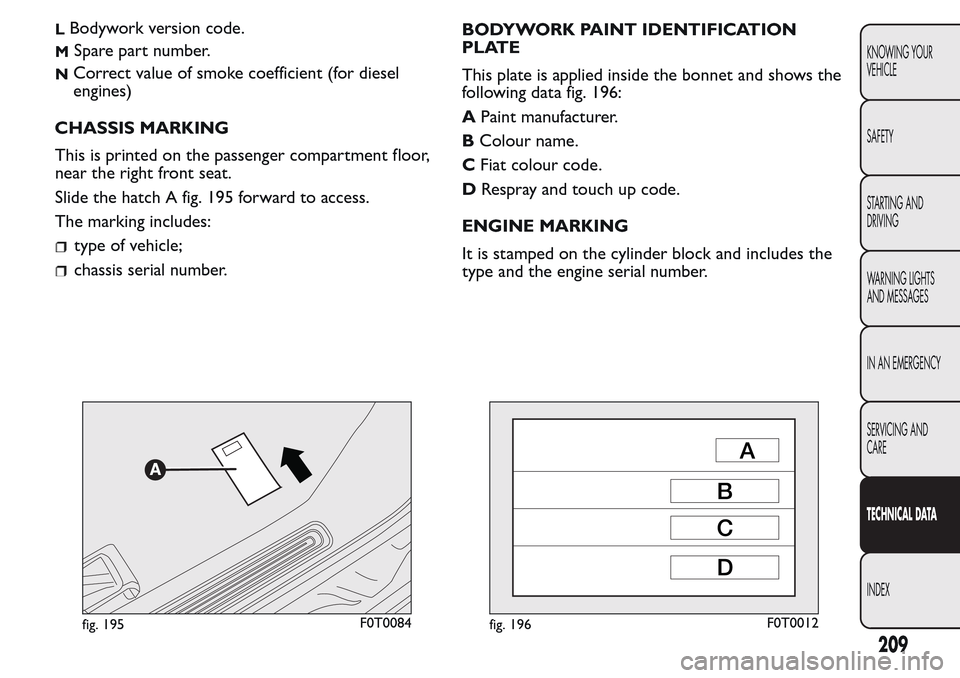
Slide the hatch A fig. 195 forward to access.
The marking includes:
type of vehicle;
chassis serial number.BODYWORK PAINT IDENTIFICATION
PLATE
This plate is applied inside the bonnet and shows the
following data fig. 196:
APaint manufacturer.
BColour name.
CFiat colour code.
DRespray and touch up code.
ENGINE MARKING
It is stamped on the cylinder block and includes the
type and the engine serial number.
fig. 195F0T0084fig. 196F0T0012
209
KNOWING YOUR
VEHICLE
SAFETY
STARTING AND
DRIVING
WARNING LIGHTS
AND MESSAGES
IN AN EMERGENCY
SERVICING AND
CARE
TECHNICAL DATA
INDEX
Page 253 of 260
INDEX
Handbrake .................................. 125
ABS ................................................ 71
ABS (fault warning light) ......... 136
ABS fault warning light ............. 136
Air bag (fault warning light) ..... 134
Air bag fault warning light ........ 134
Air cleaner ................................... 197
Airbags (general warnings) ...... 119
Alarm ............................................. 10
Alarm (warning light) ................ 141
Alarm fault warning light ......... 141
Arrangement possibilities
for Universal Isofix child
restraint system on seats
of vehicle.................................... 111
Arrangements for dealing
with the vehicle at the end
of its life .................................... 237
Ashtray .......................................... 53
ASR system .................................. 75
Battery
– Replacement .......................... 197
Battery (low charge warning
light) ........................................... 135
Battery (recharging) .................. 178
Body– Advice for preserving the
bodywork ............................... 204
– Protection from
atmospheric elements......... 203
– Vehicle body and
underbody guarantee .......... 204
body paintwork
identification plate ................... 209
Bodywork version ..................... 210
Bonnet
– Closing ..................................... 68
– Opening ................................... 67
Boot light ..................................... 169
Bottle replacement .................... 156
Brake fluid.................................... 195
Brake fluid (warning light)........ 133
Brake fluid/handbrake
warning light.............................. 134
Brake lights (changing a
bulb) ............................................ 163
Brake pad wear (warning
light) ............................................ 143
Brake pad wear warning
light ............................................. 143
Brakes
– features ................................... 214
Brakes (pad wear warning
light) ............................................ 143Break-in attempt warning
light ............................................. 141
Bulbs
– types of bulbs ........................ 158
Bump starting ............................. 147
Carrying children safely
– Arrangement possibilities
for child restraint
systems ................................... 108
– Child restraint systems ....... 103
– Safety regulations ................. 112
Ceiling light with movable
lens (changing a bulb).............. 166
Ceiling lights................................. 48
Central and side vents ............... 36
Changing a bulb .......................... 157
Changing a wheel ....................... 147
Changing an exterior bulb ....... 160
Changing an interior bulb ........ 166
Changing battery - key with
remote control.......................... 8
Chassis marking.......................... 209
Checking levels ........................... 190
Cigarette lighter .......................... 53
Clutch ........................................... 213
CO2 emissions ........................... 235
Conditions of use ...................... 129KNOWING YOUR
VEHICLE
SAFETY
STARTING AND
DRIVING
WARNING LIGHTS
AND MESSAGES
IN AN EMERGENCY
SERVICING AND
CARE
TECHNICAL DATA
INDEX