heating FIAT QUBO 2017 1.G User Guide
[x] Cancel search | Manufacturer: FIAT, Model Year: 2017, Model line: QUBO, Model: FIAT QUBO 2017 1.GPages: 260, PDF Size: 4.74 MB
Page 45 of 260
turn knob C to
take the slider B to
turn knob D to
press knob C.
Adjusting cooling
Proceed as follows:
take the slider B to
turn knob A rightwards to increase the
temperature
turn knob C leftwards to reduce the fan speed.
DEMISTING/DEFROSTING OF HEATED
REAR WINDSCREEN AND DOOR MIRRORS
(for versions/markets, where provided)
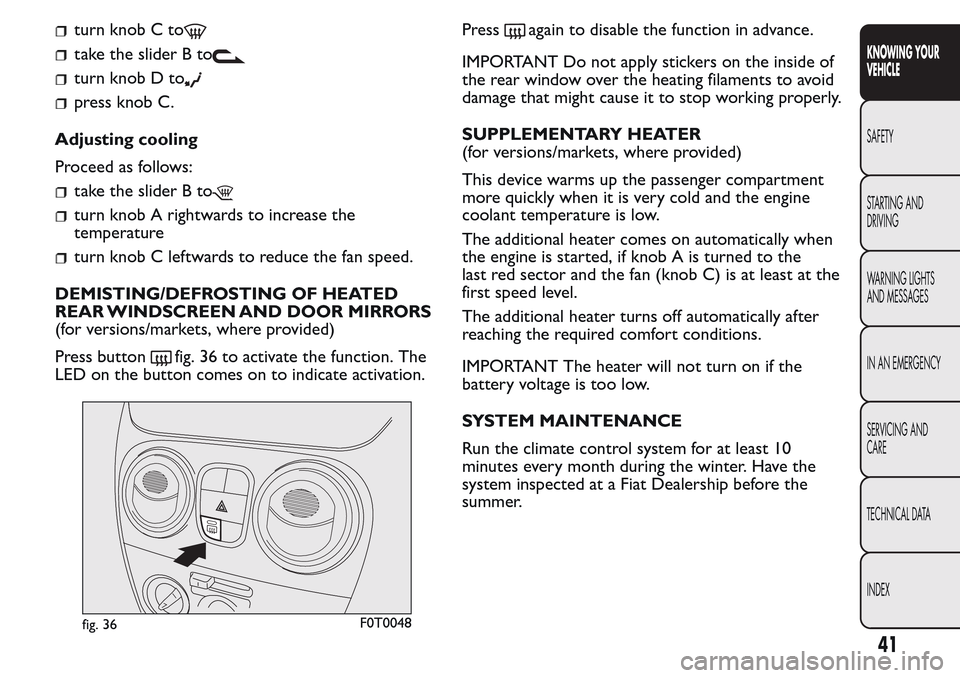
Press button
fig. 36 to activate the function. The
LED on the button comes on to indicate activation.Press
again to disable the function in advance.
IMPORTANT Do not apply stickers on the inside of
the rear window over the heating filaments to avoid
damage that might cause it to stop working properly.
SUPPLEMENTARY HEATER
(for versions/markets, where provided)
This device warms up the passenger compartment
more quickly when it is very cold and the engine
coolant temperature is low.
The additional heater comes on automatically when
the engine is started, if knob A is turned to the
last red sector and the fan (knob C) is at least at the
first speed level.
The additional heater turns off automatically after
reaching the required comfort conditions.
IMPORTANT The heater will not turn on if the
battery voltage is too low.
SYSTEM MAINTENANCE
Run the climate control system for at least 10
minutes every month during the winter. Have the
system inspected at a Fiat Dealership before the
summer.
fig. 36F0T0048
41
KNOWING YOUR
VEHICLE
SAFETY
STARTING AND
DRIVING
WARNING LIGHTS
AND MESSAGES
IN AN EMERGENCY
SERVICING AND
CARE
TECHNICAL DATA
INDEX
Page 105 of 260
Operations which lead to knocks,
vibrations or localised heating (over 100°C
for a maximum of 6 hours) in the area
around the pretensioner may cause damage or
trigger them.This device is not affected by
vibrations caused by irregularities of the road
surface or low obstacles such as kerbs, etc .
Contact a Fiat Dealership for any assistance.
LOAD LIMITERS
(for versions/markets, where provided)
To increase occupant safety in an accident, the front
and rear (for versions/markets where provided)
seat belt reels contain a load limiter which controls
the force acting on the chest and shoulders during
the restraining action of the belts in the event of
a head-on collision.
GENERAL INSTRUCTIONS FOR USING
THE SEAT BELTS
The driver is responsible for respecting, and ensuring
that all the other occupants of the vehicle also
respect, the local laws in force in relation to the use
of the seat belts. Always fasten the seat belts before
setting off.
Seat belts are also to be worn by pregnant women:
the risk of injury in the case of impact is greatly
reduced for them and the unborn child if they are
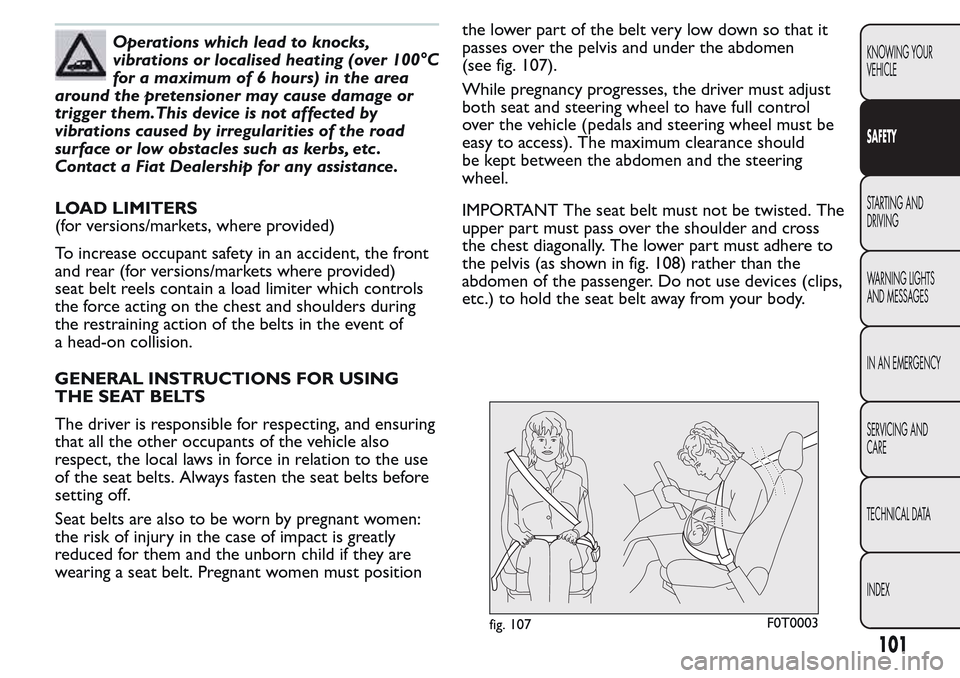
wearing a seat belt. Pregnant women must positionthe lower part of the belt very low down so that it
passes over the pelvis and under the abdomen
(see fig. 107).
While pregnancy progresses, the driver must adjust
both seat and steering wheel to have full control
over the vehicle (pedals and steering wheel must be
easy to access). The maximum clearance should
be kept between the abdomen and the steering
wheel.
IMPORTANT The seat belt must not be twisted. The
upper part must pass over the shoulder and cross
the chest diagonally. The lower part must adhere to
the pelvis (as shown in fig. 108) rather than the
abdomen of the passenger. Do not use devices (clips,
etc.) to hold the seat belt away from your body.
fig. 107F0T0003
101
KNOWING YOUR
VEHICLE
SAFETY
STARTING AND
DRIVING
WARNING LIGHTS
AND MESSAGES
IN AN EMERGENCY
SERVICING AND
CARE
TECHNICAL DATA
INDEX
Page 127 of 260
STARTING PROCEDURE FOR PETROL
VERSIONS
Proceed as follows:
apply the handbrake;
put the gear lever into neutral;
press the clutch pedal down to the floor without
touching the accelerator;
turn the ignition key to AVV and let it go the
moment the engine starts.
If the engine does not start at the first attempt,
return the ignition key to STOP before repeating the
procedure.
If the
warning light remains on together with
warning light
when the ignition key is at MAR,
turn the key to STOP and then back to MAR; if the
warning light stays on, try with the other keys
provided with the car.
If you still cannot start the engine, perform an
emergency start (see “Emergency starting” in the “In
an emergency” section) and go to a Fiat Dealership.STARTING PROCEDURE FOR DIESEL
VERSIONS
Proceed as follows:
apply the handbrake;
put the gear lever into neutral;
turn the key on (MAR position): instrument panel
warning light
will light up;
wait for the warning lightsandto go out.
The hotter the engine is, the quicker this will
happen;
press the clutch pedal down to the floor without
touching the accelerator;
turn the ignition key to AVV as soon as the
warning light goes out. Waiting too long will
waste the heating work carried out by the glow
plugs.
Release the key as soon as the engine starts.
IMPORTANT With the engine cold, the accelerator
pedal must be fully released when you turn the
ignition key to AVV.
If the engine does not start at the first attempt,
return the ignition key to STOP before repeating the
procedure.
If the
warning light stays on when the ignition key
is at MAR, turn the key to STOP and then back to
MAR; if the warning light remains on, try with the
other keys provided with the car.
Contact a Fiat Dealership if the engine still does not
start.
123
KNOWING YOUR
VEHICLE
SAFETY
STARTING AND
DRIVING
WARNING LIGHTS
AND MESSAGES
IN AN EMERGENCY
SERVICING AND
CARE
TECHNICAL DATA
INDEX
Page 128 of 260
Warning lightwill blink for 60 seconds
after starting or during prolonged
cranking to indicate a fault to the glow
plug heating system. Use the vehicle normally if
the engine starts, but go to a Fiat Dealership
as soon as possible.
HOW TO WARM UP THE ENGINE AFTER IT
HAS JUST STARTED
Proceed as follows:
drive off slowly, letting the engine turn at medium
revs. Do not accelerate abruptly;
do not demand to performance for the first few
kilometres. Wait until the engine coolant gauge
starts moving.
EMERGENCY STARTING
Go to a Fiat Dealership immediately if warning light
comes on steady on the instrument panel.
Never jump start the engine by pushing,
towing or coasting downhill.This could
cause fuel to flow into the catalytic
conver ter and damage it beyond repair.STOPPING THE ENGINE
Turn the ignition key to STOP while the engine is
idling.
IMPORTANT After a long drive, you should allow
the engine to “catch its breath” before turning it off
by letting it idle to allow the temperature in the
engine compartment to fall.
A quick burst on the accelerator before
turning off the engine serves absolutely no
practical purpose, it wastes fuel and is
especially damaging to turbocharged engines.
124
KNOWING YOUR
VEHICLE
SAFETY
STARTING AND
DRIVING
WARNING LIGHTS
AND MESSAGES
IN AN EMERGENCY
SERVICING AND
CARE
TECHNICAL DATA
INDEX
Page 139 of 260
If the vehicle is used under demanding conditions
(e.g. towing trailers uphill or fully loaded): slow
down and, if the light stays on, stop the vehicle.
Stop for two or three minutes with the engine
running and slightly accelerated to assist better
coolant circulation. Then switch the engine off.
Check correct fluid level in the vessel as described
above.
IMPORTANT On particularly demanding journeys, it
is advisable to keep the engine on and slightly
accelerated for a few minutes before switching it off.
A specific message is displayed on certain versions.
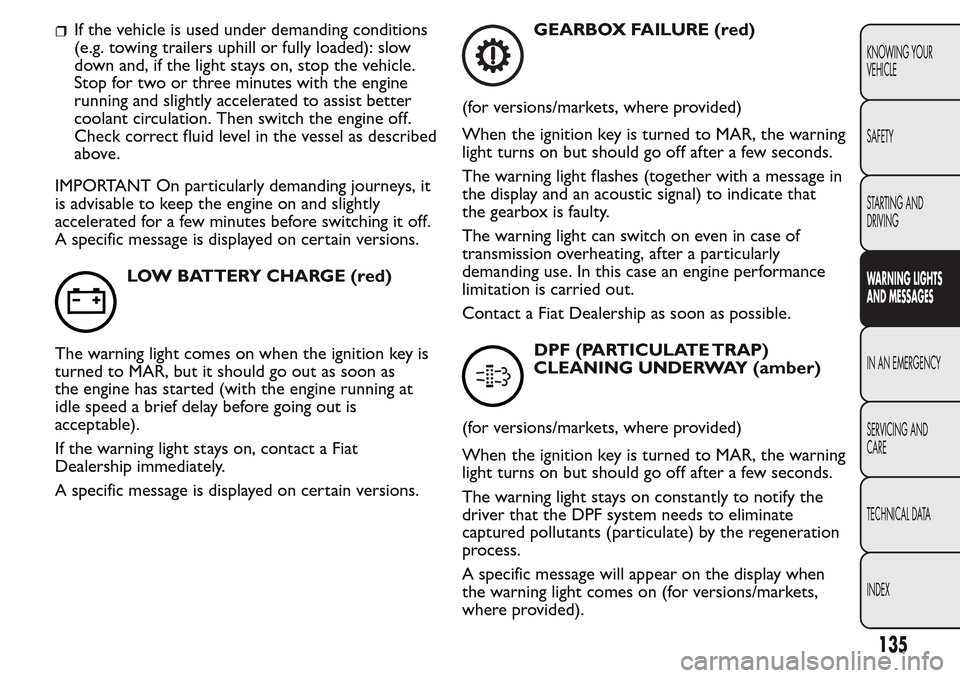
LOW BATTERY CHARGE (red)
The warning light comes on when the ignition key is
turned to MAR, but it should go out as soon as
the engine has started (with the engine running at
idle speed a brief delay before going out is
acceptable).
If the warning light stays on, contact a Fiat
Dealership immediately.
A specific message is displayed on certain versions.
GEARBOX FAILURE (red)
(for versions/markets, where provided)
When the ignition key is turned to MAR, the warning
light turns on but should go off after a few seconds.
The warning light flashes (together with a message in
the display and an acoustic signal) to indicate that
the gearbox is faulty.
The warning light can switch on even in case of
transmission overheating, after a particularly
demanding use. In this case an engine performance
limitation is carried out.
Contact a Fiat Dealership as soon as possible.
DPF (PARTICULATE TRAP)
CLEANING UNDERWAY (amber)
(for versions/markets, where provided)
When the ignition key is turned to MAR, the warning
light turns on but should go off after a few seconds.
The warning light stays on constantly to notify the
driver that the DPF system needs to eliminate
captured pollutants (particulate) by the regeneration
process.
A specific message will appear on the display when
the warning light comes on (for versions/markets,
where provided).
135
KNOWING YOUR
VEHICLE
SAFETY
STARTING AND
DRIVING
WARNING LIGHTS
AND MESSAGES
IN AN EMERGENCY
SERVICING AND
CARE
TECHNICAL DATA
INDEX
Page 144 of 260
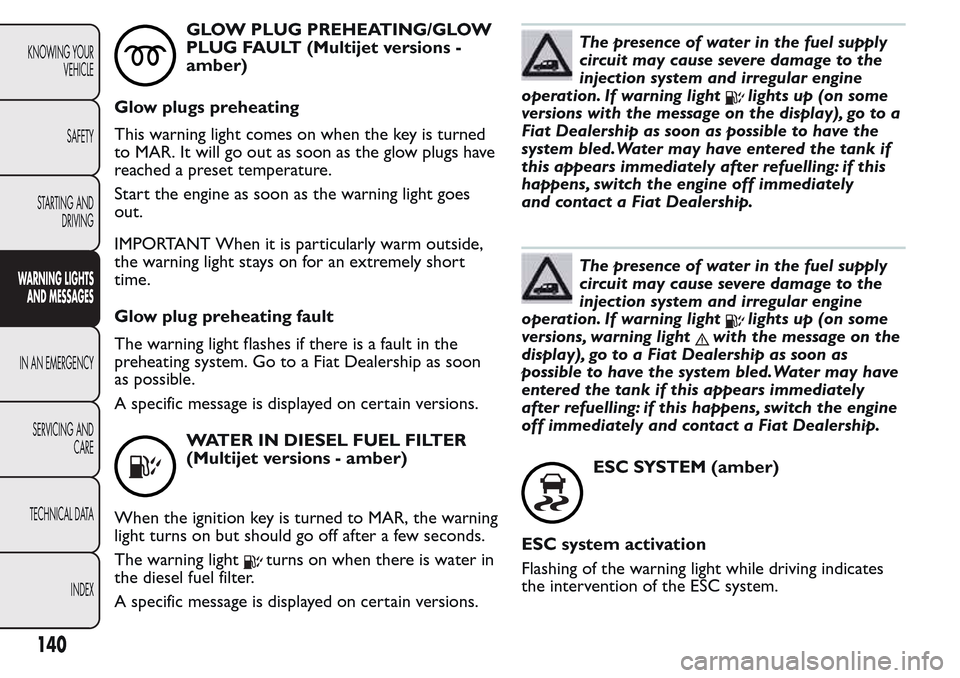
GLOW PLUG PREHEATING/GLOW
PLUG FAULT (Multijet versions -
amber)
Glow plugs preheating
This warning light comes on when the key is turned
to MAR. It will go out as soon as the glow plugs have
reached a preset temperature.
Start the engine as soon as the warning light goes
out.
IMPORTANT When it is particularly warm outside,
the warning light stays on for an extremely short
time.
Glow plug preheating fault
The warning light flashes if there is a fault in the
preheating system. Go to a Fiat Dealership as soon
as possible.
A specific message is displayed on certain versions.
WATER IN DIESEL FUEL FILTER
(Multijet versions - amber)
When the ignition key is turned to MAR, the warning
light turns on but should go off after a few seconds.
The warning light
turns on when there is water in
the diesel fuel filter.
A specific message is displayed on certain versions.
The presence of water in the fuel supply
circuit may cause severe damage to the
injection system and irregular engine
operation. If warning light
lights up (on some
versions with the message on the display), go to a
Fiat Dealership as soon as possible to have the
system bled.Water may have entered the tank if
this appears immediately after refuelling: if this
happens, switch the engine off immediately
and contact a Fiat Dealership.
The presence of water in the fuel supply
circuit may cause severe damage to the
injection system and irregular engine
operation. If warning light
lights up (on some
versions, warning light
with the message on the
display), go to a Fiat Dealership as soon as
possible to have the system bled.Water may have
entered the tank if this appears immediately
after refuelling: if this happens, switch the engine
off immediately and contact a Fiat Dealership.
ESC SYSTEM (amber)
ESC system activation
Flashing of the warning light while driving indicates
the intervention of the ESC system.
140
KNOWING YOUR
VEHICLE
SAFETY
STARTING AND
DRIVING
WARNING LIGHTS
AND MESSAGES
IN AN EMERGENCY
SERVICING AND
CARE
TECHNICAL DATA
INDEX
Page 157 of 260
FIX & GO AUTOMATIC KIT
WARNING
The information required by the
applicable regulation is indicated on the
Fix&Go kit package label. Compliance with the
indications on the label is an essential condition
to ensure the safety and the effectiveness of
the Fix&Go kit . Carefully read the label before
use, avoid improper use. Fix&Go is subject to
expiration and must be replaced periodically.
The kit should be used by adults and cannot be
used by children.
Show the package and the label to the
personnel charged with handling the tyre
treated with the tyre repair kit .
Fix&Go provides a temporary repair,
therefore the tyre must be examined and
repaired by a specialist as soon as
possible.The sealing fluid is effective at
temperatures between -40°C and +50°C. It is
possible to repair tyres which have been damaged
on tread up to a diameter of 4mm; however,
tyres damaged on their side cannot be repaired.
Before using Fix&Go kit , ensure that the tyre isn't
excessively damaged and that the rim is in good
condition, otherwise do not use it and contact
a Fiat Dealership. Do not remove foreign bodies
from the tyre. Do not let the compressor turned
on for more than 20 consecutive minutes -
overheating hazard.
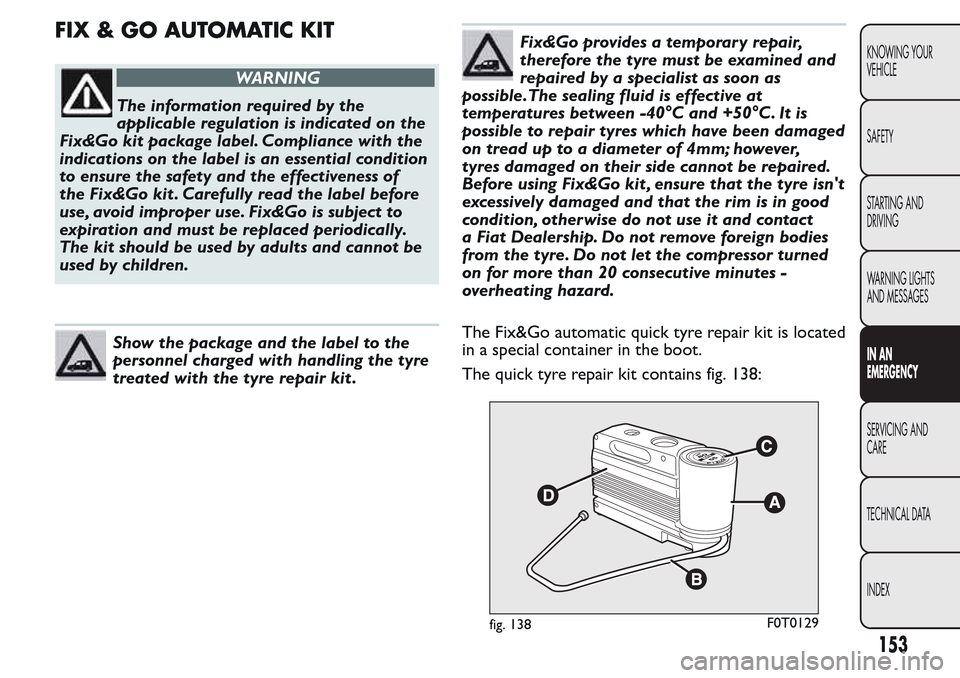
The Fix&Go automatic quick tyre repair kit is located
in a special container in the boot.
The quick tyre repair kit contains fig. 138:
fig. 138F0T0129
153
KNOWING YOUR
VEHICLE
SAFETY
STARTING AND
DRIVING
WARNING LIGHTS
AND MESSAGES
IN AN
EMERGENCY
SERVICING AND
CARE
TECHNICAL DATA
INDEX
Page 205 of 260
RUBBER LINES
Follow the requirements in “Scheduled Servicing
Plan” in this section carefully for brake and fuel
rubber lines.
Ozone, high temperatures and a prolonged lack of
fluid in the system may cause hardening and cracking
of the tubes, which could result in leaks. Careful
inspections are therefore necessary.
WINDSCREEN/REAR WINDOW
WIPERS
(for versions/markets, where provided)
BLADES
Regularly clean the rubber part using appropriate
products; TUTELA PROFESSIONAL SC 35 is
recommended.
Replace the blades if the rubber edge is misshapen or
worn. In any event, it is advisable to replace them
approximately once a year.
A few simple precautions can reduce the possibility
of damage to the blades:
make sure that the rubber part is not stuck to the
windscreen at sub-zero temperatures. Use an
antifreeze product to release it if required;
remove any snow from the glass: in addition to
protecting the blades, this prevents the electric
motor from overheating;
do not operate the windscreen and rear window
wipers on dry glass.
WARNING
Driving with worn wiper blades is a
serious hazard, because visibility is
reduced in bad weather.
201
KNOWING YOUR
VEHICLE
SAFETY
STARTING AND
DRIVING
WARNING LIGHTS
AND MESSAGES
IN AN EMERGENCY
SERVICING AND
CARE
TECHNICAL DATA
INDEX
Page 209 of 260
rinse thoroughly to avoid soap marks staying on
the bodywork or less visible parts.
Some car washes with old-style blades
and/or in a poor state of repair can
damage the paintwork, facilitating the
formation of lines that give the paint a dull/misty
appearance, especially on dark colours. If this
happens, lightly polish the paintwork with
appropriate products.
Dry the less visible parts particularly carefully, such
as the door frames, bonnet and the headlight frames,
where water may stagnate more easily. It is a good
idea to leave the vehicle outdoors for a while after
washing it to give water time to evaporate.
Do not wash the vehicle after it has been left in the
sun or with the bonnet hot: this may alter the shine
of the paintwork.
Exterior plastic parts should be cleaned in the same
way as the rest of the vehicle. Where possible, do
not park the vehicle under trees; the resinous
substances released by many species give the paint a
dull appearance and increase the possibility of rust.
IMPORTANT Bird droppings should be washed
off immediately and thoroughly as the acid
they contain is particularly aggressive.
Detergents cause water pollution.The
vehicle should be washed in areas
equipped for collecting and purifying the
liquid used in the washing process.
Windows
Use specific detergents to clean the windows. Also
use clean cloths to avoid scratching the glass or
altering the transparency.
IMPORTANT Wipe the rear window gently with a
cloth in the direction of the filaments to avoid
damaging the heating device.
Engine compartment
At the end of each winter, thoroughly wash the
engine compartment, taking care to avoid spraying
the water jet directly onto the electronic control
units and the relay/fuse box on the left side of the
engine compartment (as you look from behind
the wheel). Have this operation performed at a
specialist garage.
IMPORTANT The washing should take place with the
engine cold and the ignition key in the STOP
position. After the wash, make sure that the various
protective devices (e.g. rubber caps and guards)
have not been removed or damaged.
205
KNOWING YOUR
VEHICLE
SAFETY
STARTING AND
DRIVING
WARNING LIGHTS
AND MESSAGES
IN AN EMERGENCY
SERVICING AND
CARE
TECHNICAL DATA
INDEX
Page 255 of 260
Front ceiling light with map
reading lights (changing a
bulb) ............................................ 166
Front light clusters .................... 160
Front light clusters
(changing a bulb) ...................... 160
Front power socket ................... 53
Fuel (reserve warning light) ..... 139
Fuel cap ......................................... 94
Fuel consumption ...................... 233
Fuel cut-off system ..................... 95
Fuel filter (water in fuel
warning light) ............................ 140
Fuel level gauge ........................... 14
Fuel reserve warning light........ 139
Fuses (replacement) .................. 169
Gear lever.................................... 127
Gear Shift Indication ................. 145
Generic failure indication
(warning light)........................... 142
Generic failure indication
warning light.............................. 142
Glove compartment................... 52
Glow plug preheating fault
warning light.............................. 140
Glow plugs (preheating/fault
warning light) ........................... 140Glow plugs preheating
warning light.............................. 140
Handbrake (warning light) ....... 133
Handbrake lever ......................... 125
Hazard lights ................................ 51
Headlight alignment
corrector .................................... 70
Headlights
– Headlight alignment
corrector................................. 70
– Light beam direction ............ 70
Headrest
– Front ........................................ 30
– Rear .......................................... 31
Heating and ventilation ............. 36
Heating and ventilation
system; ........................................ 35
Heavy use of the vehicle .......... 189
Hill Holder (system) .................. 74
How to warm up the engine
after it has just started ........... 124
Identification data ...................... 208
Ignition switch
– Ignition .................................... 12
– Steering lock ......................... 12
In an emergency ......................... 146
Inflation pressure ....................... 221Inflation procedure .................... 154
Injection system/EOBD
engine control system
(warning light)........................... 138
Injection system/EOBD
engine control system fault
warning light.............................. 138
Installing
electrical/electronic devices ... 92
Instrument panel ......................... 4
Interior fittings ............................ 52
Interiors ....................................... 206
Isofix child restraint systems
(setup) ........................................ 109
– Arrangement possibilities
for child restraint system
on seats of vehicle ............... 111
Isofix child seat assembly
setup ........................................... 109
iTPMS ............................................ 78
Jack ................................................ 148
Jump starting ............................... 146
Keys
– Key with remote control..... 7
– Key without remote
control .................................... 7
– Ordering additional
remote controls .................... 9
KNOWING YOUR
VEHICLE
SAFETY
STARTING AND
DRIVING
WARNING LIGHTS
AND MESSAGES
IN AN EMERGENCY
SERVICING AND
CARE
TECHNICAL DATA
INDEX