instrument panel FIAT QUBO 2017 1.G User Guide
[x] Cancel search | Manufacturer: FIAT, Model Year: 2017, Model line: QUBO, Model: FIAT QUBO 2017 1.GPages: 260, PDF Size: 4.74 MB
Page 76 of 260
provided by the driver. This allows faster and more
powerful operation of the braking system.
IMPORTANT When the Mechanical Brake Assist is
activated, noises may be heard from the system. This
is normal. In any case, while braking keep the brake
pedal firmly depressed.
WARNING
When the ABS cuts in and you feel the
brake pedal pulsating, do not remove
your foot , but keep the pedal pushed down; in
doing so you, will stop in the shortest distance
possible under the road conditions at the time.
WARNING
If the ABS cuts in, it is a sign that the
grip between tyre and the road surface
has reached the limit : you must slow down to
match the speed to the road grip available.
WARNING
The ABS gets the most from the
available grip, but it cannot improve it ;
you should therefore take every care when
driving on slippery surfaces and not take
unnecessary risks.FAILURE INDICATIONS
ABS failure
ABS failure is indicated by warning light
in the
instrument panel coming on (together with the
appropriate message on the multifunction display on
some versions) (see “Warning lights and messages”).
In this case, the braking system will work as normal,
but without the extra capacity offered by the ABS
system. Drive carefully to the nearest Fiat Dealership
to have the system checked.
EBD failure
ABS failure is indicated by warning light
andin
the instrument panel coming on (together with the
appropriate message on the multifunction display
on some versions) (see “Warning lights and
messages”).
In this case, the rear wheels may suddenly lock and
the vehicle may swerve when braking sharply. Drive
carefully to the nearest Fiat Dealership to have
the system checked.
72
KNOWING YOUR
VEHICLE
SAFETY
STARTING AND
DRIVING
WARNING LIGHTS
AND MESSAGES
IN AN EMERGENCY
SERVICING AND
CARE
TECHNICAL DATA
INDEX
Page 77 of 260
WARNING
If only warning lightlights up in the
instrument panel (with a message in the
multifunction display on some versions), stop
the vehicle immediately and contact the nearest
Fiat Dealership. Fluid leaking from the
hydraulic system will compromise the operation
of the braking system, whether it is of the
conventional type or with ABS.
ESC (Electronic Stability Control)
SYSTEM
(for versions/markets, where provided)
The ESC system improves the directional control and
stability of the vehicle in various driving conditions.
The ESC system corrects the vehicle’s understeer
and oversteer, distributing the brake force on the
appropriate wheels. The torque supplied by the
engine can also be reduced in order to maintain
control of the vehicle.
The ESC system uses the sensors in the vehicle to
determine the trajectory required by the driver
through steering and compares it with the real
trajectory of the vehicle. When the real trajectory
deviates from the desired trajectory, the ESC system
intervenes to counter the car’s understeer or
oversteer.
Oversteer: occurs when the vehicle is turning
more than it should according to the angle of
the steering wheel
Understeer: occurs when the vehicle is turning
less than it should according to the angle of the
steering wheel
The ESC system also includes the following systems:
Hill Holder
ASR
MSR
HBA
73
KNOWING YOUR
VEHICLE
SAFETY
STARTING AND
DRIVING
WARNING LIGHTS
AND MESSAGES
IN AN EMERGENCY
SERVICING AND
CARE
TECHNICAL DATA
INDEX
Page 78 of 260
SYSTEM INTERVENTION
It is signalled by the blinking of the instrument panel
warning light
, to inform the driver that the car
is in critical stability and grip conditions.
Switching the system on
The ESC system is automatically activated when the
vehicle is started and cannot be deactivated.
Failure indications
In the event of a failure, the ESC system will be
automatically switched off and warning light
will
switch on constantly on the instrument panel along
with a message on the multifunction display (for
versions/markets where provided) (see chapter
"Warning lights and messages"). Contact a Fiat
Dealership as soon as possible.
WARNING
The ESC system can’t overrule the
natural laws of physics, and can’t
increase the grip available according to the
condition of the road.
WARNING
The ESC system cannot prevent
accidents, including those due to
excessive speed on corners, driving on low-grip
surfaces or aquaplaning.
WARNING
The capability of the ESC system must
never be tested irresponsibly and
dangerously, in such a way as to compromise
personal safety and the safety of others.
HILL HOLDER SYSTEM
(for versions/markets, where provided)
This system is an integral part of the ESC system and
facilitates starting on slopes.
It is automatically activated in the following
conditions:
uphill: vehicle stationary on a road with a gradient
higher than 5%, engine running, brake pedal
pressed and gearbox in neutral or gear other than
reverse;
downhill: vehicle stationary on a road with a
gradient higher than 5%, engine running, brake
pedal pressed and reverse gear engaged.
When setting off, the ESC system control unit
maintains the braking pressure on the wheels until
the torque necessary for starting is reached, or
in any case for a maximum of 2 seconds, allowing
your right foot to be moved easily from the brake
pedal to the accelerator. When two seconds have
elapsed, without starting, the system is automatically
deactivated, gradually releasing the braking pressure.
During this release stage, the typical brake
disengagement noise indicating that the vehicle is
going to move imminently will be heard.
74
KNOWING YOUR
VEHICLE
SAFETY
STARTING AND
DRIVING
WARNING LIGHTS
AND MESSAGES
IN AN EMERGENCY
SERVICING AND
CARE
TECHNICAL DATA
INDEX
Page 79 of 260
Failure indications
Instrument panel warning light
will light up in the
event of a failure (see “Warning lights and
messages”).
IMPORTANT The Hill Holder system is not a parking
brake; therefore, never leave the vehicle without
having engaged the handbrake, turned the engine off
and engaged the first gear.
WARNING
For the ESC and ASR systems to function
correctly, all four tyres must be the
same brand and type, must be in excellent
condition and, above all, must be of the
prescribed type and size.
ASR SYSTEM (Anti-Slip Regulation)
(for versions/markets, where provided)
This is a traction control system that cuts in
automatically every time one or both drive wheels
slip.
Depending on how slippery the road is, two different
control systems are activated:
if slipping involves both driving wheels, the ASR
function intervenes reducing the power
transmitted by the engine;
if the slipping only involves one of the drive
wheels, the ASR intervenes automatically braking
the wheel that is slipping.
The action of the ASR system is especially useful in
the following conditions:
slipping of the inner wheel round bends due to
dynamic variations in the load of excessive
acceleration;
excessive power transmitted to the wheels, also in
relation to road surface conditions;
acceleration on slippery, snowy or icy road
surfaces;
in the case of loss of grip on a wet surface
(aquaplaning).
WARNING
For the ESC and ASR systems to function
correctly, all four tyres must be the
same brand and type, must be in excellent
condition and, above all, must be of the
prescribed type and size.
WARNING
The ASR system cannot overrule the
natural laws of physics, and cannot
increase the grip available according to the
condition of the road.
75
KNOWING YOUR
VEHICLE
SAFETY
STARTING AND
DRIVING
WARNING LIGHTS
AND MESSAGES
IN AN EMERGENCY
SERVICING AND
CARE
TECHNICAL DATA
INDEX
Page 80 of 260
WARNING
The ASR system cannot prevent
accidents, including those due to
excessive speed on corners, driving on low-grip
surfaces or aquaplaning.
WARNING
The capability of the ASR system must
never be tested irresponsibly and
dangerously, in such a way as to compromise
personal safety and the safety of others.
MSR SYSTEM (engine drive regulation)
This is an integral part of the ESC system that, in the
event of a sudden gear down shift or an ABS braking,
cuts in and provides torque to the engine thus
preventing excessive driving wheel drive which,
especially in poor grip conditions, can lead to a loss
of stability.Engagement/ disengagement of the ASR
system
The ASR system switches on automatically each time
the engine is started.
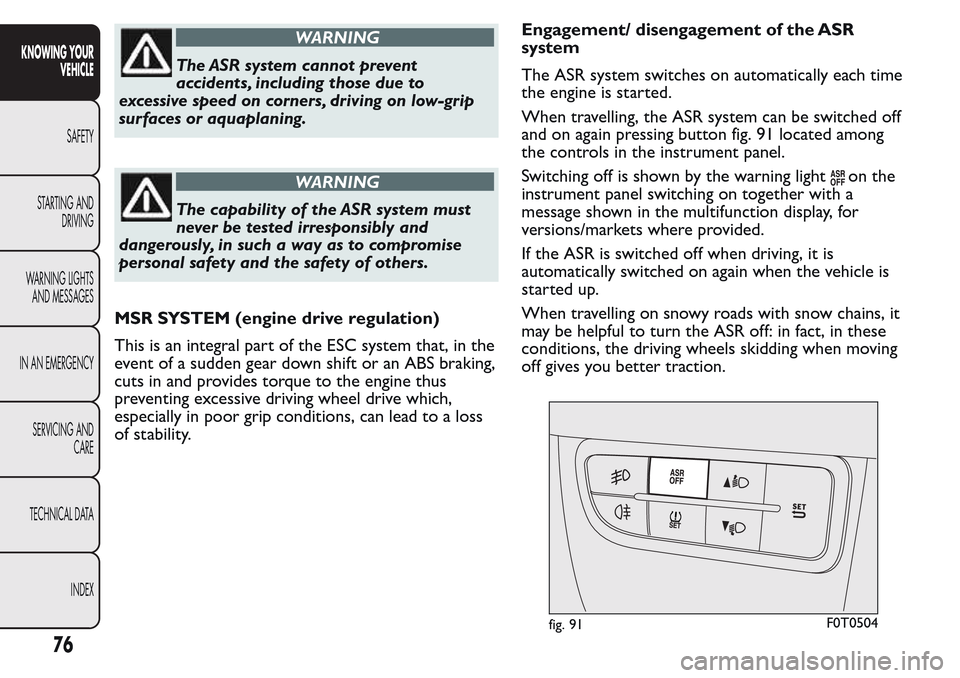
When travelling, the ASR system can be switched off
and on again pressing button fig. 91 located among
the controls in the instrument panel.
Switching off is shown by the warning light
on the
instrument panel switching on together with a
message shown in the multifunction display, for
versions/markets where provided.
If the ASR is switched off when driving, it is
automatically switched on again when the vehicle is
started up.
When travelling on snowy roads with snow chains, it
may be helpful to turn the ASR off: in fact, in these
conditions, the driving wheels skidding when moving
off gives you better traction.
fig. 91F0T0504
76
KNOWING YOUR
VEHICLE
SAFETY
STARTING AND
DRIVING
WARNING LIGHTS
AND MESSAGES
IN AN EMERGENCY
SERVICING AND
CARE
TECHNICAL DATA
INDEX
Page 81 of 260
WARNING
Do not take unnecessary risks, even if
your vehicle is fitted with this system.
Your driving style must always be suited to the
road conditions, visibility and traffic .The driver
is always responsible for road safety.
FAILURE INDICATIONS
In the event of a failure, the ASR system will be
automatically switched off and warning light
will
appear permanently on the instrument panel along
with a message on the multifunction display (for
versions/markets where provided) (see “Warning
lights and messages” section). In this case, contact a
Fiat Dealership as soon as possible.
HYDRAULIC BRAKE ASSIST (assistance
during emergency braking)
(for versions/markets, where provided)
The HBA system is an integral part of the ESC
system and is designed to improve the vehicle’s
braking capacity during emergency braking.
The system detects emergency braking by
monitoring the speed and force with which the brake
pedal is pressed, and consequently applies the
optimal brake pressure. This can reduce the braking
distance: the HBA system therefore completes
the ABS.Maximum assistance of the HBA system is obtained
pressing the brake pedal very quickly; in addition, the
brake pedal should be pressed continuously during
braking, avoiding intermittent presses, to obtain
benefits from the system. Do not reduce pressure on
the brake pedal until braking is no longer necessary.
The HBA system is deactivated when the brake pedal
is released.
WARNING
The HBA system cannot overrule the
natural laws of physics, and cannot
increase the grip available according to the
condition of the road.
WARNING
The HBA system cannot prevent
accidents, including those due
to excessive speed on corners, driving on
low-grip surfaces or aquaplaning.
WARNING
The capability of the HBA must never
be tested irresponsibly and dangerously,
in such a way as to compromise personal safety
and the safety of others.
77
KNOWING YOUR
VEHICLE
SAFETY
STARTING AND
DRIVING
WARNING LIGHTS
AND MESSAGES
IN AN EMERGENCY
SERVICING AND
CARE
TECHNICAL DATA
INDEX
Page 82 of 260
iTPMS System (indirect Tyre
Pressure Monitoring System)
(for versions/markets, where provided)
The indirect Tyre Pressure Monitoring System iTPMS
can monitor the tyre inflation status through the
wheel speed sensors. The system warns the driver if
one or more tyres are flat by switching on the
warning light on the instrument panel and
a warning message on the display, along with an
acoustic signal.
If one tyre only is flat, the system can indicate its
position: it is in any case recommended to check the
pressure on all four tyres. This indication is displayed
also when turning the engine off and on until the
“Reset” procedure is carried out.
“Reset” procedure
The iTPMS needs an initial "self-learning" phase (with
length depending on the driving style and road
conditions: optimal conditions being driving on a
straight road at 80 km/h for at least 20 minutes)
which starts when the “Reset” procedure is carried
out.
The “Reset” procedure must be carried out:
each time tyre pressure is modified;
when even only one tyre is changed;
when tyres are rotated/inverted;
when the space-saver wheel is fitted. Before
carrying out the “Reset” procedure, inflate the
tyres to the rated pressure values specified in the
inflation pressure table (see "Wheels" paragraph in
the "Technical specifications" chapter).
If the “Reset” procedure is not carried out, in all
above cases, the
warning light may give false
indications on one or more tyres.
To carry out the “Reset” procedure, with the vehicle
stopped and the ignition device at MAR, use the
Setup Menu as follows:
briefly press thebutton: the display will show
"Reset";
press thebutton or thebutton to select
("Yes" or "No");
briefly press thebutton: the display will show
"Confirm";
pressbutton orto select ("Yes" to
“Reset” or "No" to exit the video page);
press thebutton again to return to the standard
screen or to the main menu according to where
you are in the menu.
After the “Reset” the display will show the "Reset
saved" message, indicating that the "self-learning" has
been started.
78
KNOWING YOUR
VEHICLE
SAFETY
STARTING AND
DRIVING
WARNING LIGHTS
AND MESSAGES
IN AN EMERGENCY
SERVICING AND
CARE
TECHNICAL DATA
INDEX
Page 86 of 260
Traction Plus operation
The system is deactivated when starting up. To
activate the "Traction Plus" system, press the button
(T+ fig. 92): the LED on the button switches on.
The activation of the Traction Plus system involves
the following functions being switched on:
inhibition of the ASR function, in order to fully
exploit the engine torque;
the differential locking effect on the front axle,
through the braking system, to improve traction
on irregular grounds.
If the "Traction Plus" system is faulty, the "general
failure" instrument panel warning light
comes on
steady.
EOBD SYSTEM
The EOBD system (European On Board Diagnosis)
allows continuous diagnosis of emission-related
components on the vehicle.
It also alerts the driver, by turning on instrument
panel warning light
(together with the relevant
message in the display, on some versions), when
these components are no longer in peak condition
(see “Warning lights and messages” section).
The aim of the system is to:
monitor system efficiency;
warn about increased emissions due to a vehicle
malfunction;
to warn of the need to replace deteriorated
components.
The system also has a connector that can be
interfaced with appropriate equipment, which makes
it possible to read the error codes stored in the
control unit, together with a series of specific
parameters for engine operation and diagnosis.
This check can also be carried out by traffic police.
IMPORTANT After resolving the problem, to check
the system completely, Fiat Dealerships are obliged
to run a bench test and, if necessary, road tests
which may call for a long journey.
82
KNOWING YOUR
VEHICLE
SAFETY
STARTING AND
DRIVING
WARNING LIGHTS
AND MESSAGES
IN AN EMERGENCY
SERVICING AND
CARE
TECHNICAL DATA
INDEX
Page 88 of 260
PARKING SENSORS
(for versions/markets, where provided)
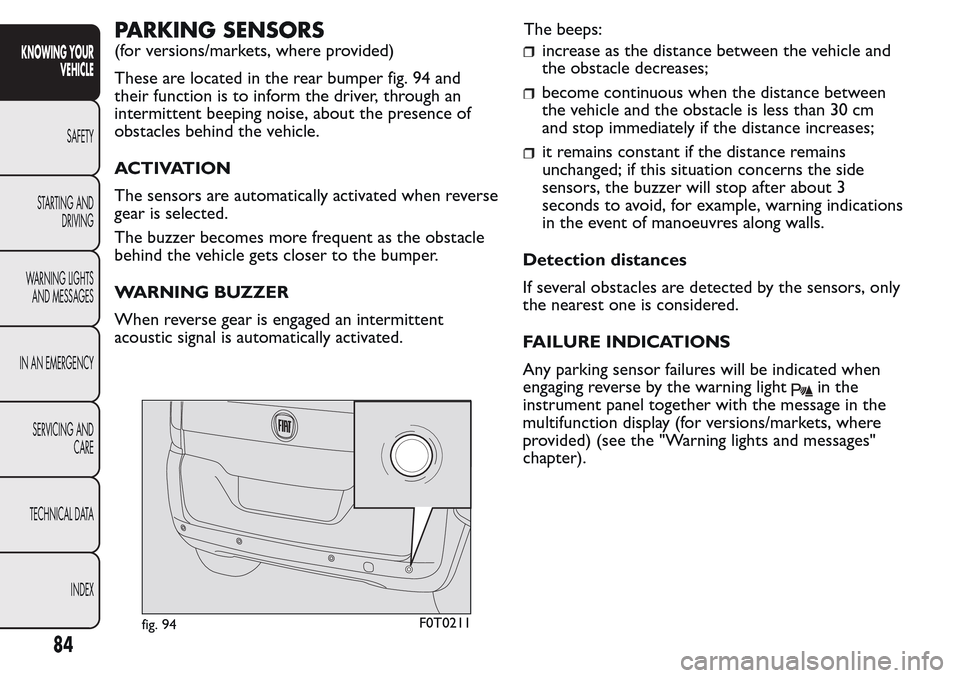
These are located in the rear bumper fig. 94 and
their function is to inform the driver, through an
intermittent beeping noise, about the presence of
obstacles behind the vehicle.
ACTIVATION
The sensors are automatically activated when reverse
gear is selected.
The buzzer becomes more frequent as the obstacle
behind the vehicle gets closer to the bumper.
WARNING BUZZER
When reverse gear is engaged an intermittent
acoustic signal is automatically activated.The beeps:increase as the distance between the vehicle and
the obstacle decreases;
become continuous when the distance between
the vehicle and the obstacle is less than 30 cm
and stop immediately if the distance increases;
it remains constant if the distance remains
unchanged; if this situation concerns the side
sensors, the buzzer will stop after about 3
seconds to avoid, for example, warning indications
in the event of manoeuvres along walls.
Detection distances
If several obstacles are detected by the sensors, only
the nearest one is considered.
FAILURE INDICATIONS
Any parking sensor failures will be indicated when
engaging reverse by the warning light
in the
instrument panel together with the message in the
multifunction display (for versions/markets, where
provided) (see the "Warning lights and messages"
chapter).
fig. 94F0T0211
84
KNOWING YOUR
VEHICLE
SAFETY
STARTING AND
DRIVING
WARNING LIGHTS
AND MESSAGES
IN AN EMERGENCY
SERVICING AND
CARE
TECHNICAL DATA
INDEX
Page 92 of 260
during the first period of use, to initialize the
system.
In the above cases the warning light fig. 95 flashes
and, where provided, an information message is
displayed.
RESTARTING CONDITIONS
For reasons of comfort, limiting pollutant emissions
and safety purposes, the power unit can restart
automatically without any action on behalf of the
driver if certain conditions are met, including:
battery not sufficiently charged;
reduced braking system vacuum, e.g. following the
brake pedal being pressed repeatedly;
vehicle in motion, for example when driving on
hilly roads;
stopping the engine through the Start&Stop
system for more than about three minutes.
automatic climate control system for adjusting the
thermal comfort level or to enable MAX-DEF
function. With a gear engaged, the engine can only
be automatically restarted by fully depressing the
clutch pedal. The driver is asked to perform this
operation through the warning light fig. 95 flashing in
the instrument panel and, where provided, the
message in the display.
NoteIf the clutch is not pressed, when the three
minutes have elapsed since the engine was stopped,
the engine can be restarted only by using the key.NoteIn cases when the engine stops and this is not
desired, due for example to the clutch pedal being
released sharply with a gear engaged, if the
Start&Stop system is active, the engine can be
restarted by fully depressing the clutch pedal or by
placing the gear lever in neutral.
SAFETY FUNCTIONS
In engine cut-out conditions through the Start&Stop
system, if the driver unfastens his/her seat belt and
opens the driver or the passenger door, the engine
can only be restarted using the key. The driver is
notified of this condition both by a buzzer and the
flashing of the fig. 95 warning light on the instrument
panel and, where provided, an information message
on the display.
"ENERGY SAVING" FUNCTION
(for versions/markets, where provided)
If, as a result of automatic engine restarting, the
driver does not carry out any action on the vehicle
for an extended period (about 3 minutes), the
Start&Stop system stops the engine definitively, to
prevent fuel consumption. The engine can only
be started using the key in such cases.
NoteIn any case, it is possible to keep the engine
running by deactivating the Start&Stop system.
88
KNOWING YOUR
VEHICLE
SAFETY
STARTING AND
DRIVING
WARNING LIGHTS
AND MESSAGES
IN AN EMERGENCY
SERVICING AND
CARE
TECHNICAL DATA
INDEX