start stop button FIAT QUBO 2017 1.G User Guide
[x] Cancel search | Manufacturer: FIAT, Model Year: 2017, Model line: QUBO, Model: FIAT QUBO 2017 1.GPages: 260, PDF Size: 4.74 MB
Page 65 of 260
DOUBLE REAR WING DOORS
(for versions/markets, where provided)
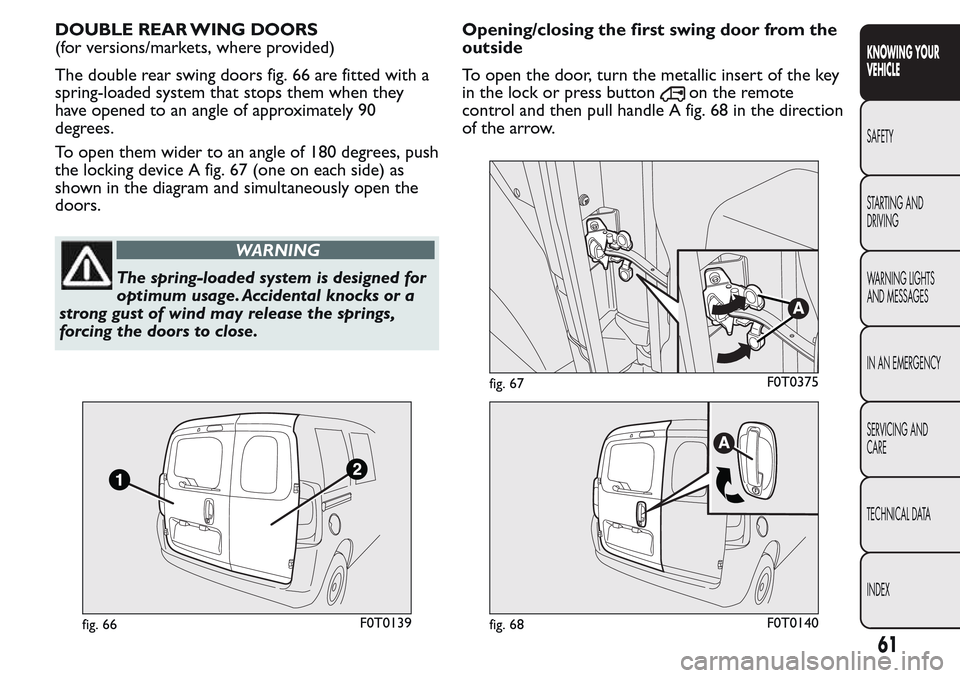
The double rear swing doors fig. 66 are fitted with a
spring-loaded system that stops them when they
have opened to an angle of approximately 90
degrees.
To open them wider to an angle of 180 degrees, push
the locking device A fig. 67 (one on each side) as
shown in the diagram and simultaneously open the
doors.
WARNING
The spring-loaded system is designed for
optimum usage. Accidental knocks or a
strong gust of wind may release the springs,
forcing the doors to close.Opening/closing the first swing door from the
outside
To open the door, turn the metallic insert of the key
in the lock or press button
on the remote
control and then pull handle A fig. 68 in the direction
of the arrow.
fig. 66F0T0139
fig. 67F0T0375
fig. 68F0T0140
61
KNOWING YOUR
VEHICLE
SAFETY
STARTING AND
DRIVING
WARNING LIGHTS
AND MESSAGES
IN AN EMERGENCY
SERVICING AND
CARE
TECHNICAL DATA
INDEX
Page 82 of 260
iTPMS System (indirect Tyre
Pressure Monitoring System)
(for versions/markets, where provided)
The indirect Tyre Pressure Monitoring System iTPMS
can monitor the tyre inflation status through the
wheel speed sensors. The system warns the driver if
one or more tyres are flat by switching on the
warning light on the instrument panel and
a warning message on the display, along with an
acoustic signal.
If one tyre only is flat, the system can indicate its
position: it is in any case recommended to check the
pressure on all four tyres. This indication is displayed
also when turning the engine off and on until the
“Reset” procedure is carried out.
“Reset” procedure
The iTPMS needs an initial "self-learning" phase (with
length depending on the driving style and road
conditions: optimal conditions being driving on a
straight road at 80 km/h for at least 20 minutes)
which starts when the “Reset” procedure is carried
out.
The “Reset” procedure must be carried out:
each time tyre pressure is modified;
when even only one tyre is changed;
when tyres are rotated/inverted;
when the space-saver wheel is fitted. Before
carrying out the “Reset” procedure, inflate the
tyres to the rated pressure values specified in the
inflation pressure table (see "Wheels" paragraph in
the "Technical specifications" chapter).
If the “Reset” procedure is not carried out, in all
above cases, the
warning light may give false
indications on one or more tyres.
To carry out the “Reset” procedure, with the vehicle
stopped and the ignition device at MAR, use the
Setup Menu as follows:
briefly press thebutton: the display will show
"Reset";
press thebutton or thebutton to select
("Yes" or "No");
briefly press thebutton: the display will show
"Confirm";
pressbutton orto select ("Yes" to
“Reset” or "No" to exit the video page);
press thebutton again to return to the standard
screen or to the main menu according to where
you are in the menu.
After the “Reset” the display will show the "Reset
saved" message, indicating that the "self-learning" has
been started.
78
KNOWING YOUR
VEHICLE
SAFETY
STARTING AND
DRIVING
WARNING LIGHTS
AND MESSAGES
IN AN EMERGENCY
SERVICING AND
CARE
TECHNICAL DATA
INDEX
Page 91 of 260
Engine restarting mode
WITH MANUAL GEARBOX
Press the clutch pedal to allow the engine to be
restarted.
WITH ROBOTISED GEARBOX
If the gear lever is in position N, place it in any other
gear, otherwise release the brake pedal or move
the gear lever to(+),(-)orR.
MANUAL ACTIVATION AND
DEACTIVATION
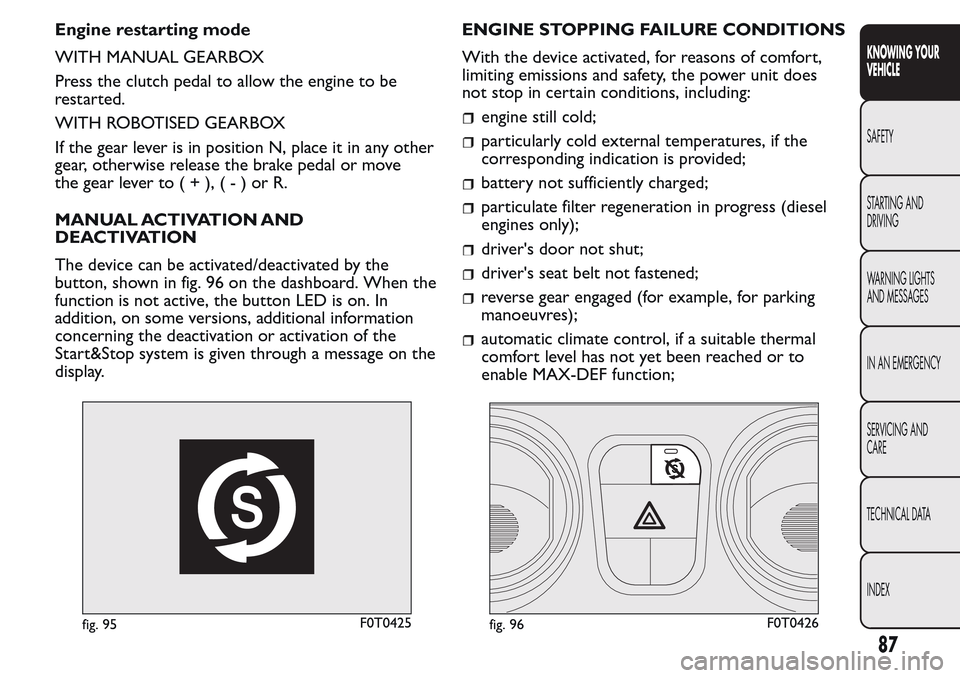
The device can be activated/deactivated by the
button, shown in fig. 96 on the dashboard. When the
function is not active, the button LED is on. In
addition, on some versions, additional information
concerning the deactivation or activation of the
Start&Stop system is given through a message on the
display.ENGINE STOPPING FAILURE CONDITIONS
With the device activated, for reasons of comfort,
limiting emissions and safety, the power unit does
not stop in certain conditions, including:
engine still cold;
particularly cold external temperatures, if the
corresponding indication is provided;
battery not sufficiently charged;
particulate filter regeneration in progress (diesel
engines only);
driver's door not shut;
driver's seat belt not fastened;
reverse gear engaged (for example, for parking
manoeuvres);
automatic climate control, if a suitable thermal
comfort level has not yet been reached or to
enable MAX-DEF function;
fig. 95F0T0425fig. 96F0T0426
87
KNOWING YOUR
VEHICLE
SAFETY
STARTING AND
DRIVING
WARNING LIGHTS
AND MESSAGES
IN AN EMERGENCY
SERVICING AND
CARE
TECHNICAL DATA
INDEX
Page 93 of 260
IRREGULAR OPERATION
In the event of malfunctions the Start&Stop system is
disabled. The driver is informed of the problem by
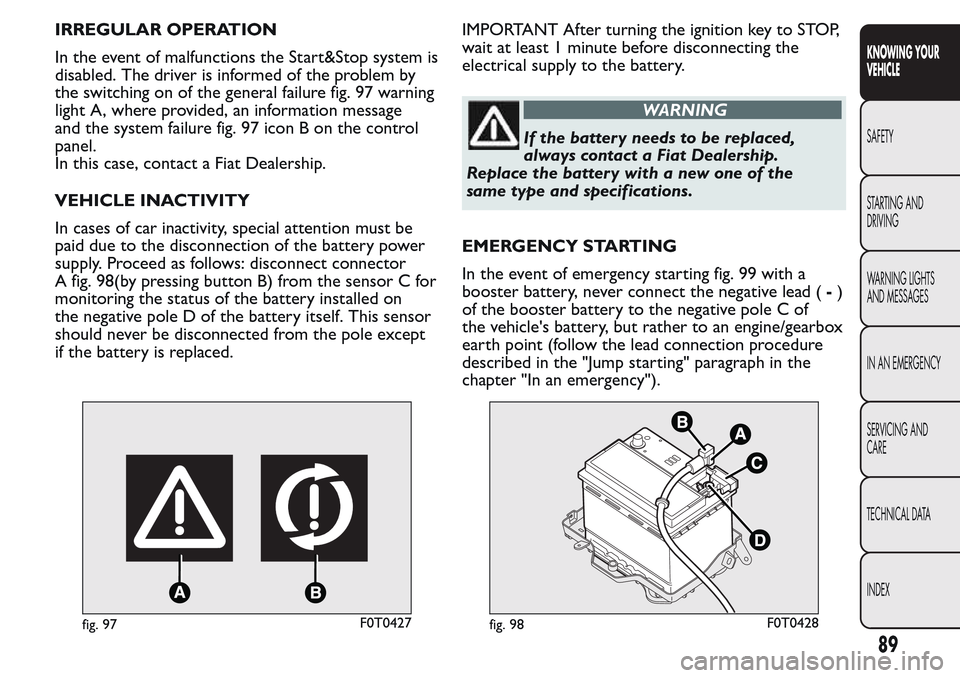
the switching on of the general failure fig. 97 warning
light A, where provided, an information message
and the system failure fig. 97 icon B on the control
panel.
In this case, contact a Fiat Dealership.
VEHICLE INACTIVITY
In cases of car inactivity, special attention must be
paid due to the disconnection of the battery power
supply. Proceed as follows: disconnect connector
A fig. 98(by pressing button B) from the sensor C for
monitoring the status of the battery installed on
the negative pole D of the battery itself. This sensor
should never be disconnected from the pole except
if the battery is replaced.IMPORTANT After turning the ignition key to STOP,
wait at least 1 minute before disconnecting the
electrical supply to the battery.
WARNING
If the batter y needs to be replaced,
always contact a Fiat Dealership.
Replace the battery with a new one of the
same type and specifications.
EMERGENCY STARTING
In the event of emergency starting fig. 99 with a
booster battery, never connect the negative lead (-)
of the booster battery to the negative pole C of
the vehicle's battery, but rather to an engine/gearbox
earth point (follow the lead connection procedure
described in the "Jump starting" paragraph in the
chapter "In an emergency").
fig. 97F0T0427fig. 98F0T0428
89
KNOWING YOUR
VEHICLE
SAFETY
STARTING AND
DRIVING
WARNING LIGHTS
AND MESSAGES
IN AN EMERGENCY
SERVICING AND
CARE
TECHNICAL DATA
INDEX
Page 129 of 260
HANDBRAKE
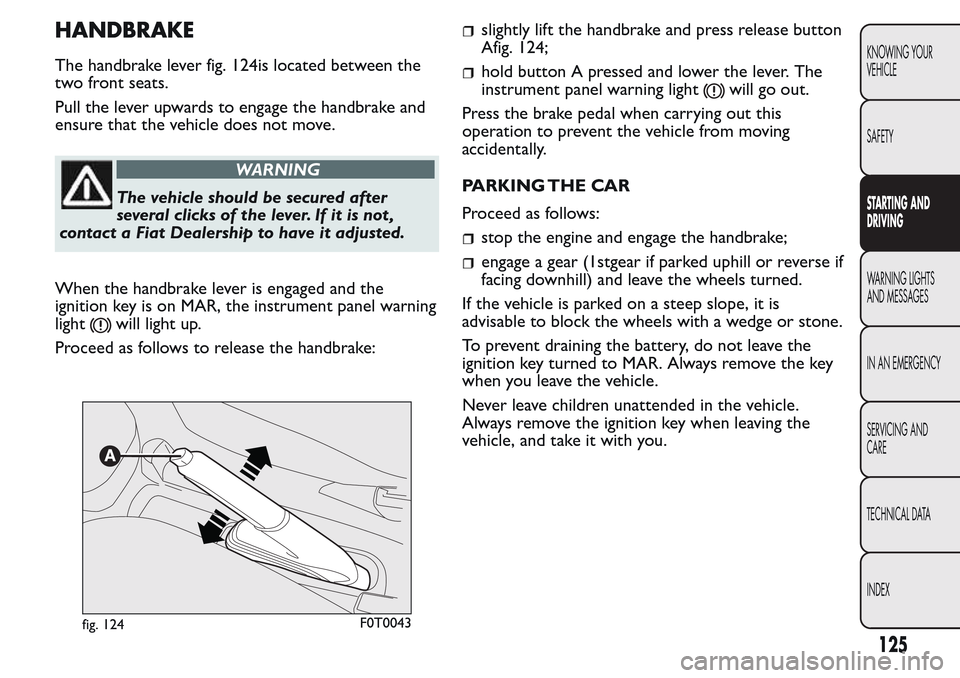
The handbrake lever fig. 124is located between the
two front seats.
Pull the lever upwards to engage the handbrake and
ensure that the vehicle does not move.
WARNING
The vehicle should be secured after
several clicks of the lever. If it is not ,
contact a Fiat Dealership to have it adjusted.
When the handbrake lever is engaged and the
ignition key is on MAR, the instrument panel warning
light
will light up.
Proceed as follows to release the handbrake:
slightly lift the handbrake and press release button
Afig. 124;
hold button A pressed and lower the lever. The
instrument panel warning light
will go out.
Press the brake pedal when carrying out this
operation to prevent the vehicle from moving
accidentally.
PARKING THE CAR
Proceed as follows:
stop the engine and engage the handbrake;
engage a gear (1stgear if parked uphill or reverse if
facing downhill) and leave the wheels turned.
If the vehicle is parked on a steep slope, it is
advisable to block the wheels with a wedge or stone.
To prevent draining the battery, do not leave the
ignition key turned to MAR. Always remove the key
when you leave the vehicle.
Never leave children unattended in the vehicle.
Always remove the ignition key when leaving the
vehicle, and take it with you.
fig. 124F0T0043
125
KNOWING YOUR
VEHICLE
SAFETY
STARTING AND
DRIVING
WARNING LIGHTS
AND MESSAGES
IN AN EMERGENCY
SERVICING AND
CARE
TECHNICAL DATA
INDEX
Page 137 of 260
WARNING LIGHTS AND MESSAGES
WARNING LIGHTS AND MESSAGES
The warning light (where allowed by the instrument
panel) is associated to a specific message and/or
acoustic tone. These indications are brief and
precautionary and as such must not be considered as
exhaustive and/or alternative to the information
contained in the Owner's Handbook, which you are
recommended to read carefully in all cases. Always
refer to the information in this chapter in the event
of a failure indication.
IMPORTANT The fault indicators appearing on the
display are divided into two categories: very serious
and less serious failures.
Serious failures prompt a prolonged cycle of signals.
Less serious failures prompt a shorter cycle of
signals.
The display cycle of both categories can be
interrupted by pressing the SET
button. The
warning light (or the symbol on the display) on the
instrument panel will stay on until the cause of
the failure is eliminated.
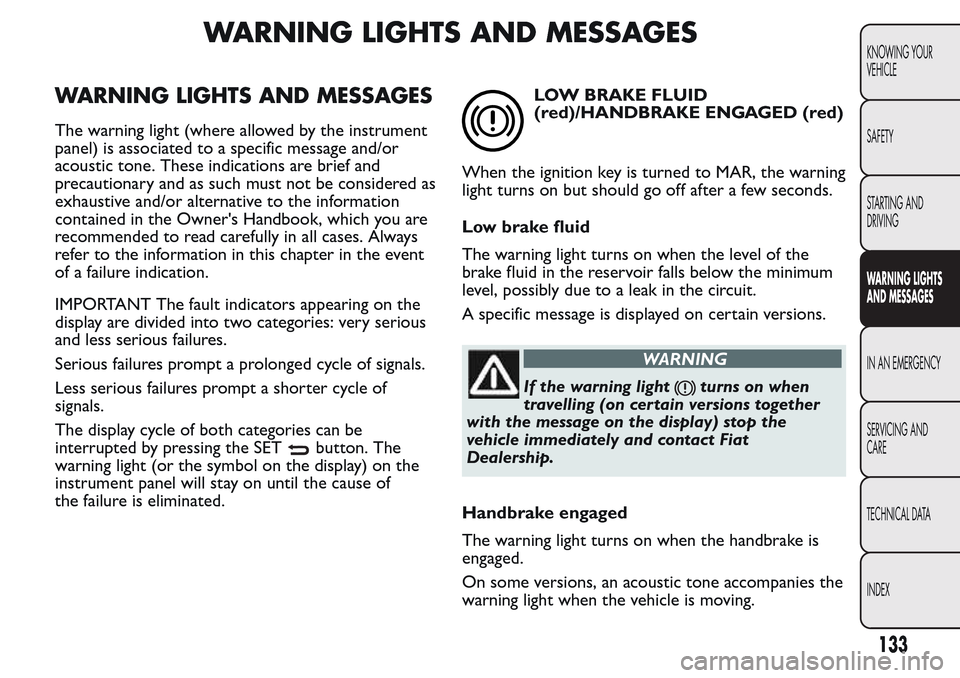
LOW BRAKE FLUID
(red)/HANDBRAKE ENGAGED (red)
When the ignition key is turned to MAR, the warning
light turns on but should go off after a few seconds.
Low brake fluid
The warning light turns on when the level of the
brake fluid in the reservoir falls below the minimum
level, possibly due to a leak in the circuit.
A specific message is displayed on certain versions.
WARNING
If the warning lightturns on when
travelling (on cer tain versions together
with the message on the display) stop the
vehicle immediately and contact Fiat
Dealership.
Handbrake engaged
The warning light turns on when the handbrake is
engaged.
On some versions, an acoustic tone accompanies the
warning light when the vehicle is moving.
133
KNOWING YOUR
VEHICLE
SAFETY
STARTING AND
DRIVING
WARNING LIGHTS
AND MESSAGES
IN AN EMERGENCY
SERVICING AND
CARE
TECHNICAL DATA
INDEX
Page 159 of 260
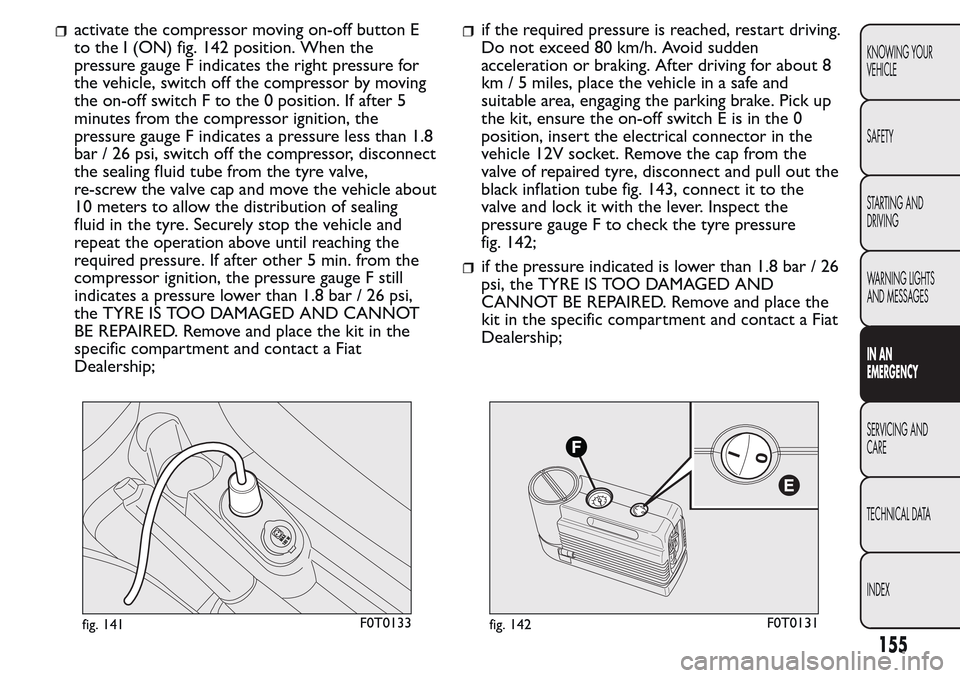
activate the compressor moving on-off button E
to the I (ON) fig. 142 position. When the
pressure gauge F indicates the right pressure for
the vehicle, switch off the compressor by moving
the on-off switch F to the 0 position. If after 5
minutes from the compressor ignition, the
pressure gauge F indicates a pressure less than 1.8
bar / 26 psi, switch off the compressor, disconnect
the sealing fluid tube from the tyre valve,
re-screw the valve cap and move the vehicle about
10 meters to allow the distribution of sealing
fluid in the tyre. Securely stop the vehicle and
repeat the operation above until reaching the
required pressure. If after other 5 min. from the
compressor ignition, the pressure gauge F still
indicates a pressure lower than 1.8 bar / 26 psi,
the TYRE IS TOO DAMAGED AND CANNOT
BE REPAIRED. Remove and place the kit in the
specific compartment and contact a Fiat
Dealership;if the required pressure is reached, restart driving.
Do not exceed 80 km/h. Avoid sudden
acceleration or braking. After driving for about 8
km / 5 miles, place the vehicle in a safe and
suitable area, engaging the parking brake. Pick up
the kit, ensure the on-off switch E is in the 0
position, insert the electrical connector in the
vehicle 12V socket. Remove the cap from the
valve of repaired tyre, disconnect and pull out the
black inflation tube fig. 143, connect it to the
valve and lock it with the lever. Inspect the
pressure gauge F to check the tyre pressure
fig. 142;
if the pressure indicated is lower than 1.8 bar / 26
psi, the TYRE IS TOO DAMAGED AND
CANNOT BE REPAIRED. Remove and place the
kit in the specific compartment and contact a Fiat
Dealership;
fig. 141F0T0133fig. 142F0T0131
155
KNOWING YOUR
VEHICLE
SAFETY
STARTING AND
DRIVING
WARNING LIGHTS
AND MESSAGES
IN AN
EMERGENCY
SERVICING AND
CARE
TECHNICAL DATA
INDEX
Page 183 of 260
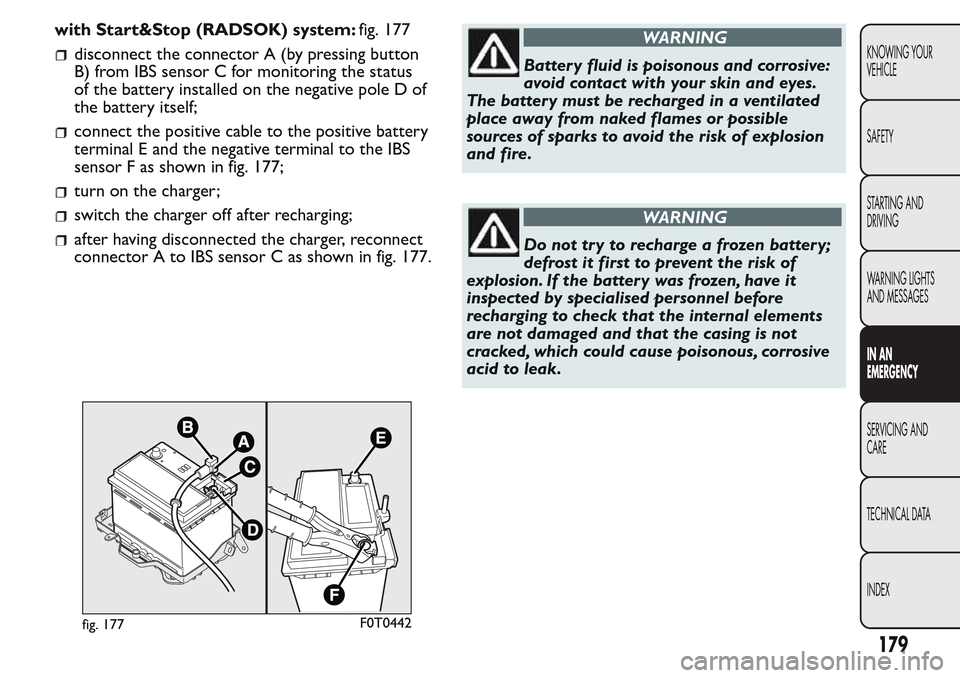
with Start&Stop (RADSOK) system:fig. 177
disconnect the connector A (by pressing button
B) from IBS sensor C for monitoring the status
of the battery installed on the negative pole D of
the battery itself;
connect the positive cable to the positive battery
terminal E and the negative terminal to the IBS
sensor F as shown in fig. 177;
turn on the charger;
switch the charger off after recharging;
after having disconnected the charger, reconnect
connector A to IBS sensor C as shown in fig. 177.
WARNING
Battery fluid is poisonous and corrosive:
avoid contact with your skin and eyes.
The battery must be recharged in a ventilated
place away from naked flames or possible
sources of sparks to avoid the risk of explosion
and fire.
WARNING
Do not tr y to recharge a frozen batter y;
defrost it first to prevent the risk of
explosion. If the battery was frozen, have it
inspected by specialised personnel before
recharging to check that the internal elements
are not damaged and that the casing is not
cracked, which could cause poisonous, corrosive
acid to leak.
fig. 177F0T0442
179
KNOWING YOUR
VEHICLE
SAFETY
STARTING AND
DRIVING
WARNING LIGHTS
AND MESSAGES
IN AN
EMERGENCY
SERVICING AND
CARE
TECHNICAL DATA
INDEX