steering FIAT QUBO 2017 1.G User Guide
[x] Cancel search | Manufacturer: FIAT, Model Year: 2017, Model line: QUBO, Model: FIAT QUBO 2017 1.GPages: 260, PDF Size: 4.74 MB
Page 117 of 260
SUPPLEMENTARY RESTRAINT
SYSTEM (SRS) - AIRBAG
The vehicle may be equipped with:
front driver airbag;
front passenger airbag;
driver and passenger front side bags for pelvis,
chest and shoulder protection (Side bags).
The location of the airbags on the vehicle is marked
by the word "AIRBAG" in the middle of the steering
wheel, on the dashboard, on the side trim or on a
label placed next to the airbag deployment area.
FRONT AIRBAGS
The vehicle is fitted with front airbags for driver and
passenger (for versions/markets where provided).
The front driver/passenger airbags (for versions/
markets, where provided) are designed to protect
the front-seat occupants in the event of head-on
crashes of medium-high severity, by placing the bag
between the occupant and the steering wheel or
dashboard.
Therefore, non-activation in other types of collisions
(side collisions, rear shunts, roll-overs, etc.) is not
a system malfunction.
An electronic control unit will make the bag inflate in
the event of a frontal impact.
The bag will inflate instantaneously placing itself
between the front occupants body and the
structures which could cause injury. It will deflate
immediately afterwards.
Front driver/passenger airbags (for versions/markets,
where provided) are not a replacement for, but
rather a complement to, the seat belts, which should
be worn at all times as specified by law in Europe
and most non-European countries.
In the event of an impact, someone not wearing a
seat belt will move forward and come into contact
with the bag which is still in the opening stage.
The protection offered by the bag is compromised in
these circumstances.
Front airbags may not activate in the following
situations:
113
KNOWING YOUR
VEHICLE
SAFETY
STARTING AND
DRIVING
WARNING LIGHTS
AND MESSAGES
IN AN EMERGENCY
SERVICING AND
CARE
TECHNICAL DATA
INDEX
Page 118 of 260
frontal impacts against highly deformable objects
not involving the front surface of the vehicle (e.g.
wing collision against guard rail, etc.);
vehicle wedging under other vehicles or protective
barriers (e.g. trucks or guard rails);
Failure to activate in the conditions described above
is due to the fact that they may not provide any
additional protection compared with seat belts, so
their activation would be inappropriate. In these
cases, non-deployment does not indicate a system
malfunction.
WARNING
Do not apply stickers or other objects to
the steering wheel, the dashboard in
the passenger side airbag area and the seats.
Never put objects (e.g. mobile phones) on the
passenger side of the dashboard since they
could interfere with correct inflation of the
passenger airbag and also cause serious injur y
to the passengers.
The driver's and passenger's front airbags have been
designed and calibrated to protect front seat
occupants wearing seat belts. At their maximum
inflation, their volume fills most of the space
between the steering wheel and the driver and
between the dashboard and the passenger.
The airbags are not deployed in the event of minor
frontal impacts (for which the restraining actionof the seat belts is sufficient). Seat belts must always
be worn. In the event of frontal impacts they
guarantee correct positioning of the passenger.
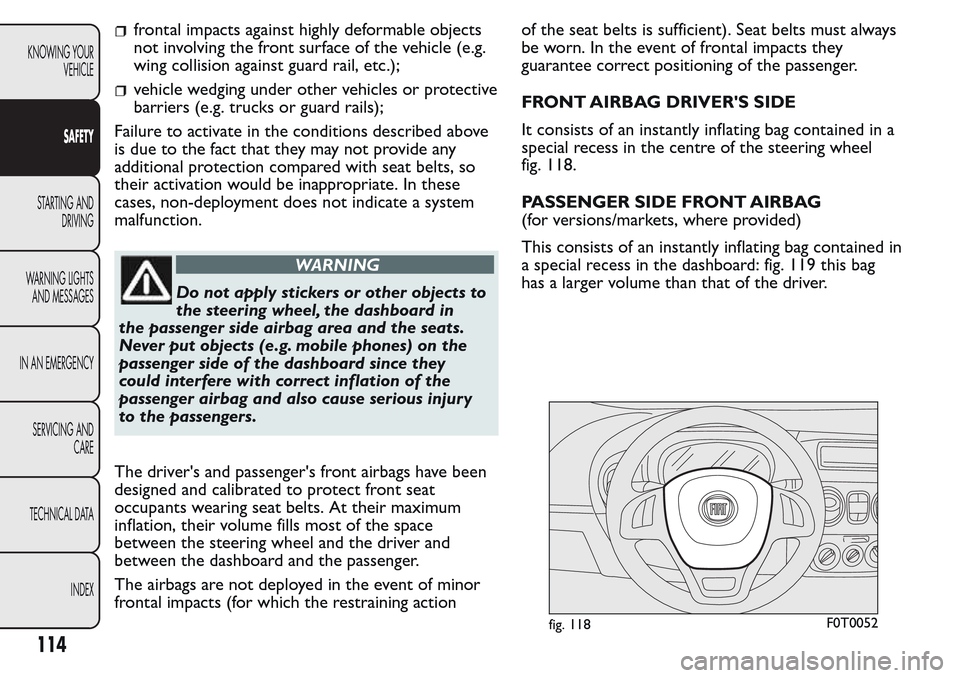
FRONT AIRBAG DRIVER'S SIDE
It consists of an instantly inflating bag contained in a
special recess in the centre of the steering wheel
fig. 118.
PASSENGER SIDE FRONT AIRBAG
(for versions/markets, where provided)
This consists of an instantly inflating bag contained in
a special recess in the dashboard: fig. 119 this bag
has a larger volume than that of the driver.
fig. 118F0T0052
114
KNOWING YOUR
VEHICLE
SAFETY
STARTING AND
DRIVING
WARNING LIGHTS
AND MESSAGES
IN AN EMERGENCY
SERVICING AND
CARE
TECHNICAL DATA
INDEX
Page 123 of 260
IMPORTANT NOTES
The front airbags and/or side bags (for versions/
markets, where provided) may be deployed if the
vehicle is subject to heavy knocks or accidents
involving the underbody area, such as for example
violent shocks against steps, kerbs or low obstacles,
or the vehicle falling into big potholes or depressions
in the road.
A small amount of dust will be released when the
airbags are deployed. The dust is not harmful and
does not indicate the beginning of a fire.
Furthermore, the surface of the deployed bag and
the interior of the vehicle may be covered in a dusty
residue: this may irritate your skin and eyes. Wash
with mild soap and water in the event of exposure.
Should an accident occur in which any of the safety
devices are activated, take the vehicle to a Fiat
Dealership to have the activated devices replaced and
to have the whole system checked.
Every control, repair and replacement operation
concerning the airbags must be carried out only at
Fiat Dealerships.
If you are having the vehicle scrapped, have the airbag
system deactivated at a Fiat Dealership first. If the
vehicle changes ownership, the new owner must be
informed of the method of use of airbags and the
above warnings and also be given this "Owner's
Handbook".
Pretensioners, front airbags and front side bags are
deployed differently according to the type ofcollision. Failure to activate one or more of the
devices does not indicate a system malfunction.
WARNING
There may be a fault in the retaining
systems if the warning light
does not
light up when the key is turn on or remains on
while travelling (on some versions with a
message on the display). In this case, the airbags
or the pretensioners may not be activated in
the case of an accident or (in a lesser number of
cases) they may be activated incorrectly.
Contact a Fiat Dealership immediately to have
the system checked.
WARNING
Always drive with your hands on the rim
of the steering wheel so that the airbag
can inflate freely if required. Do not drive with
your body bent forward. Keep your back
straight against the backrest .
WARNING
In some versions, in case of a LED
failure (located on the plate of the
instrument panel), the
warning light on the
instrument panel turns on and the passenger
side airbags are deactivated.
119
KNOWING YOUR
VEHICLE
SAFETY
STARTING AND
DRIVING
WARNING LIGHTS
AND MESSAGES
IN AN EMERGENCY
SERVICING AND
CARE
TECHNICAL DATA
INDEX
Page 126 of 260
STARTING AND DRIVING
STARTING THE ENGINE
The vehicle is fitted with an immobiliser: if the engine
fails to start, see the paragraph on “The Fiat CODE
system” in the “Knowing your vehicle” section.
The engine may be noisier during the first few
seconds of operation, particularly after a long period
of inactivity. This is due to the hydraulic tappets,
the timing system chosen for petrol engine versions
to reduce the number of servicing interventions,
and affects neither functionality nor reliability.
It is advisable not to demand maximum
performance from your vehicle (e.g.
excessive acceleration, long distances at
high speeds, excessive intense braking, etc .) during
the initial period of use.
When the engine is switched off never
leave the key on (at MAR) to prevent
unnecessary consumption and draining
the battery.
WARNING
It is dangerous to have the engine
running indoors.The engine takes in
oxygen and discharges carbon dioxide, carbon
monoxide and other toxic gases.
WARNING
Remember that the brake booster and
electric power steering are not
operational until the engine has been started,
so you need to apply much more force than
usual to the brake pedal and steering wheel.
122
KNOWING YOUR
VEHICLE
SAFETY
STARTING AND
DRIVING
WARNING LIGHTS
AND MESSAGES
IN AN EMERGENCY
SERVICING AND
CARE
TECHNICAL DATA
INDEX
Page 151 of 260
WARNING
This procedure must be performed by
experts because incorrect actions may
cause considerable electrical discharge.
Furthermore, battery fluid is poisonous and
corrosive: avoid contact with skin and eyes.
Keep naked flames and lit cigarettes away from
the battery. Do not create sparks.
BUMP STARTING
Never bump start the engine by pushing, towing or
driving downhill. This could cause fuel to flow into
the catalytic converter and damage it beyond repair.
IMPORTANT Remember that the brake booster
and the power steering system are not active until
the engine is started, so you will need to apply much
more force to the brake pedal or steering wheel.
CHANGING A WHEEL
The vehicle is originally equipped with the Fix&Go
automatic quick tyre repair kit (see instructions
in the next section). As an alternative, the vehicle
may have a normal-sized spare wheel.
Wheel changing and correct use of the jack and
spare wheel call for some precautions, as listed
below.
WARNING
The spare wheel (for versions/markets,
where provided) is specifically for your
vehicle.Therefore, it must not be used on other
models. Do not use spare wheels of other
models on your vehicle.The spare wheel must
be used only in an emergency. Use of the spare
wheel must be strictly reduced to the necessary
minimum.
147
KNOWING YOUR
VEHICLE
SAFETY
STARTING AND
DRIVING
WARNING LIGHTS
AND MESSAGES
IN AN
EMERGENCY
SERVICING AND
CARE
TECHNICAL DATA
INDEX
Page 174 of 260
WARNING
If a fuse blows again, contact a Fiat
Dealership.
Never replace a blown fuse with metallic
wires or other material.
WARNING
Never replace a fuse with another
having higher amperage; FIRE HAZARD.
WARNING
If a general protection fuse (MEGA-
FUSE, MIDI-FUSE) is activated, contact
a Fiat Dealership.
WARNING
Remove the key from the ignition and
switch off or disable all devices before
replacing a fuse.
WARNING
Contact Fiat Dealership if a safety
system (air bags, brakes), engine system
(engine, gearbox) or steering system general
protection fuse blows.
To identify the protective fuse, see the tables on the
following pages.
ENGINE BAY FUSE BOX
The fuse box is on the right-hand side of the engine.
Removing the fuse box cover
Proceed as follows:
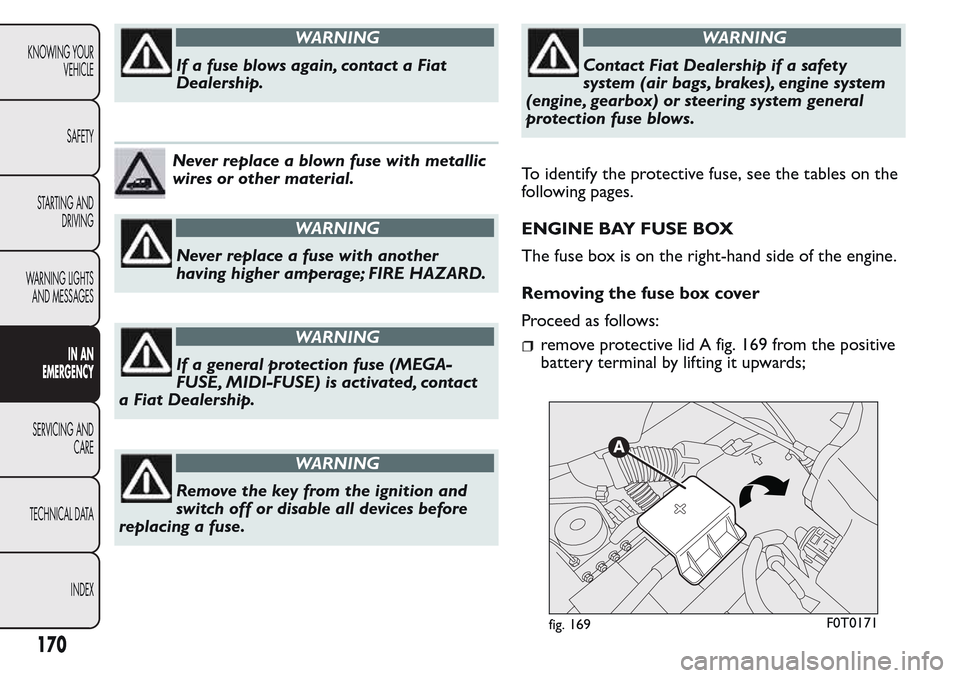
remove protective lid A fig. 169 from the positive
battery terminal by lifting it upwards;
fig. 169F0T0171
170
KNOWING YOUR
VEHICLE
SAFETY
STARTING AND
DRIVING
WARNING LIGHTS
AND MESSAGES
IN AN
EMERGENCY
SERVICING AND
CARE
TECHNICAL DATA
INDEX
Page 185 of 260
WARNING
Before towing, turn the ignition key to
MAR and then to STOP without
extracting it .The steering column will
automatically lock when the key is removed and
the wheels cannot be steered.
WARNING
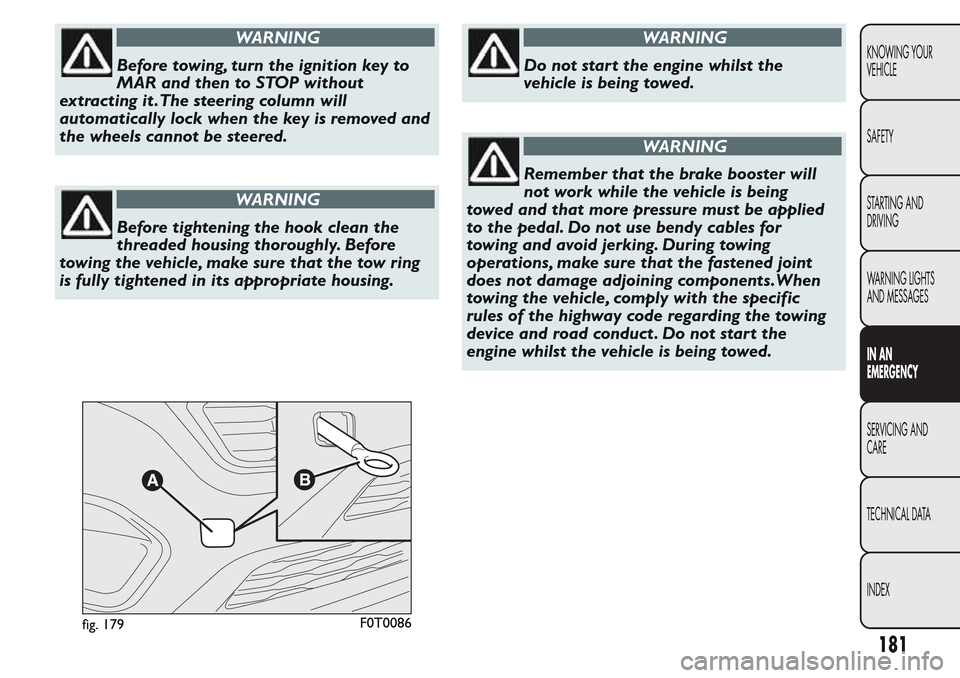
Before tightening the hook clean the
threaded housing thoroughly. Before
towing the vehicle, make sure that the tow ring
is fully tightened in its appropriate housing.
WARNING
Do not start the engine whilst the
vehicle is being towed.
WARNING
Remember that the brake booster will
not work while the vehicle is being
towed and that more pressure must be applied
to the pedal. Do not use bendy cables for
towing and avoid jerking. During towing
operations, make sure that the fastened joint
does not damage adjoining components.When
towing the vehicle, comply with the specific
rules of the highway code regarding the towing
device and road conduct . Do not start the
engine whilst the vehicle is being towed.
fig. 179F0T0086
181
KNOWING YOUR
VEHICLE
SAFETY
STARTING AND
DRIVING
WARNING LIGHTS
AND MESSAGES
IN AN
EMERGENCY
SERVICING AND
CARE
TECHNICAL DATA
INDEX
Page 194 of 260
CHECKING LEVELS
When topping up, take care not to mix up
the various types of fluids: they are not
compatible with each other and could
seriously damage the car.
WARNING
Never smoke while working in the
engine compar tment : inflammable gases
and vapours may be present , constituting a fire
risk.
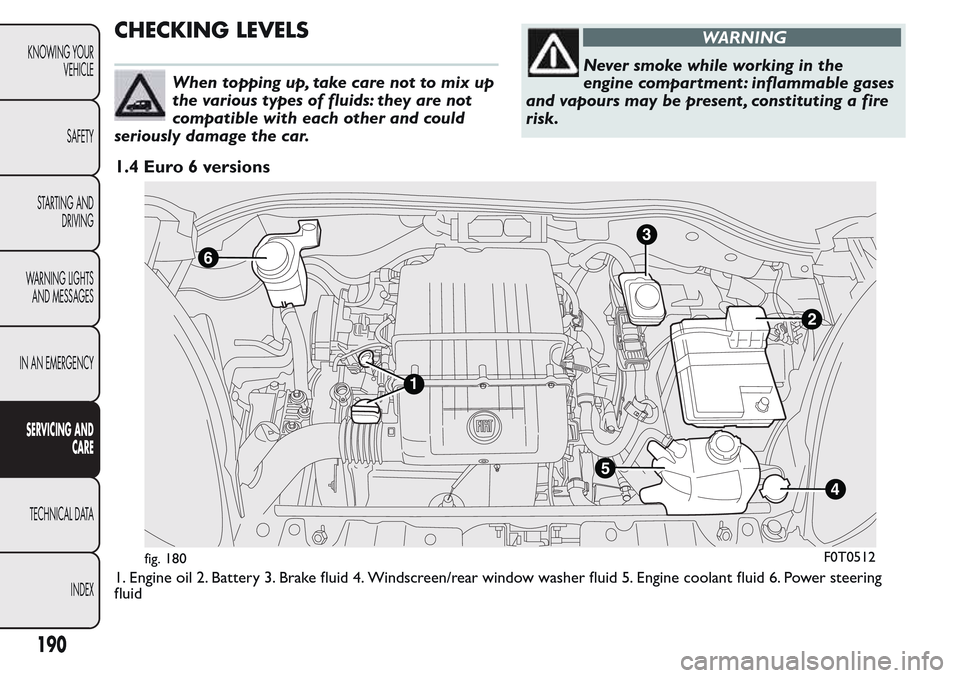
1.4 Euro 6 versions
1. Engine oil 2. Battery 3. Brake fluid 4. Windscreen/rear window washer fluid 5. Engine coolant fluid 6. Power steering
fluid
3
2
4
6
1
5
fig. 180F0T0512
190
KNOWING YOUR
VEHICLE
SAFETY
STARTING AND
DRIVING
WARNING LIGHTS
AND MESSAGES
IN AN EMERGENCY
SERVICING AND
CARE
TECHNICAL DATA
INDEX
Page 200 of 260
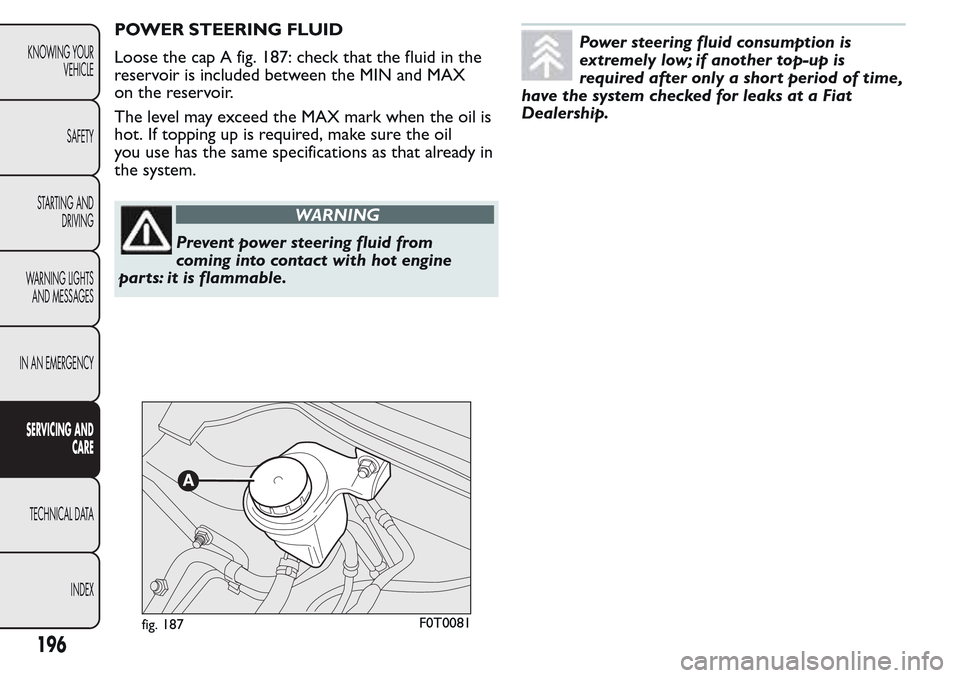
POWER STEERING FLUID
Loose the cap A fig. 187: check that the fluid in the
reservoir is included between the MIN and MAX
on the reservoir.
The level may exceed the MAX mark when the oil is
hot. If topping up is required, make sure the oil
you use has the same specifications as that already in
the system.
WARNING
Prevent power steering fluid from
coming into contact with hot engine
parts: it is flammable.
Power steering fluid consumption is
extremely low; if another top-up is
required after only a short period of time,
have the system checked for leaks at a Fiat
Dealership.
fig. 187F0T0081
196
KNOWING YOUR
VEHICLE
SAFETY
STARTING AND
DRIVING
WARNING LIGHTS
AND MESSAGES
IN AN EMERGENCY
SERVICING AND
CARE
TECHNICAL DATA
INDEX
Page 204 of 260
IMPORTANT
As far as possible, avoid sharp braking, screech
starts and violent shocks against pavements,
potholes or other hard obstacles. Driving for long
stretches over uneven roads can damage the
tyres;
periodically check that the tyres have no cuts in
the side wall, abnormal swelling or irregular tread
wear. Contact a Fiat Dealership if required;
avoid overloading the car when travelling: this may
cause serious damage to the wheels and tyres;
if a tyre is punctured, stop immediately and
replace it to avoid damage to the tyre, the rim,
suspension and steering system;
tyres age even if they are not used much. Cracks
in the tread and on the side walls are a sign of
ageing. In any event, have the tyres checked by
specialised personnel if they have been fitted for
longer than 6 years. Remember to check the spare
wheel very carefully;
in the case of replacement, always fit new tyres,
avoiding those of dubious origin;
if a tyre is replaced, also replace the inflation valve;
to allow even wear between the front and rear
tyres, it is advisable to change them over every
10–15 thousand kilometres, keeping them on the
same side of the vehicle so as not to reverse
the direction of rotation.
WARNING
Remember that the road holding
qualities of your vehicle also depend on
the correct inflation pressure of the tyres.
WARNING
If tyre pressure is too low, the tyre may
overheat and be severely damaged as
a result .
WARNING
Do not switch tyres from the righthand
side of the vehicle to the lefthand
side, and vice versa.
WARNING
Do not repaint alloy wheel rims at
temperatures higher than 150°C.The
mechanical characteristics of the wheels might
be compromised.
200
KNOWING YOUR
VEHICLE
SAFETY
STARTING AND
DRIVING
WARNING LIGHTS
AND MESSAGES
IN AN EMERGENCY
SERVICING AND
CARE
TECHNICAL DATA
INDEX