tow FIAT QUBO 2017 1.G User Guide
[x] Cancel search | Manufacturer: FIAT, Model Year: 2017, Model line: QUBO, Model: FIAT QUBO 2017 1.GPages: 260, PDF Size: 4.74 MB
Page 50 of 260
CRUISE CONTROL
(for versions/markets, where provided)
This is an electronic driving aid that allows you to
drive at a speed of above 30 km/h on long and
straight dry roads with few driving changes (e.g.
motorways) at a preset speed without having to
press the accelerator pedal. Therefore it is not
recommended to use this device on extra-urban
roads with traffic. Do not use it in town.
Switching the device on
When the device is activated, light
comes on
together with the relevant message on the
instrument panel (for versions/markets, where
provided).
The function cannot be turned on in first gear or
reverse. It is advisable to use the function in fourth
gear or higher.
When travelling downhill with the device engaged,
the vehicle speed may exceed the stored setting.
Memorizing vehicle speed
Proceed as follows:
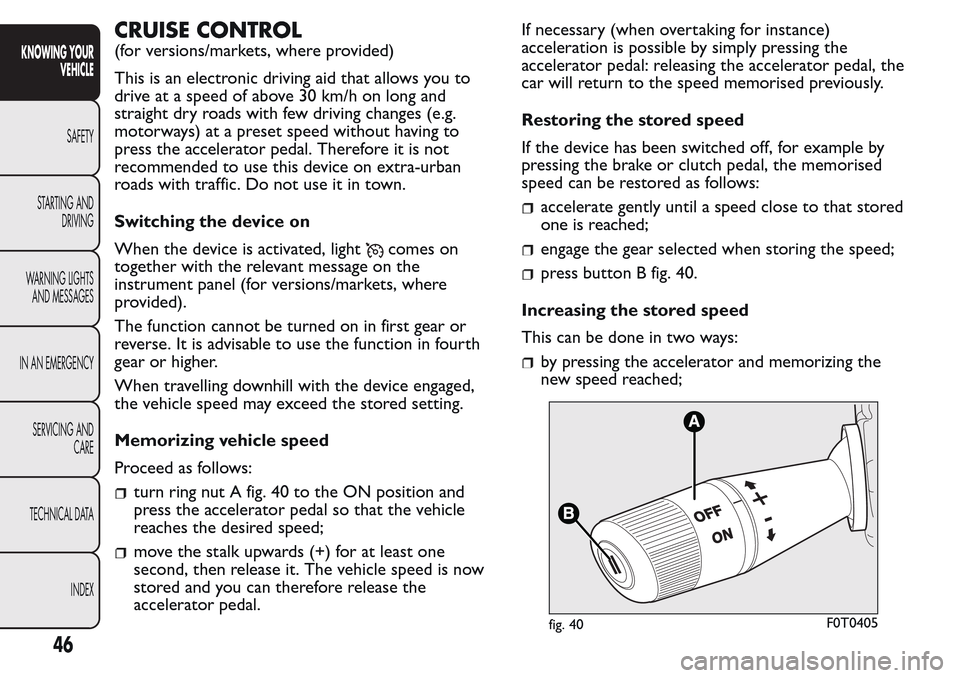
turn ring nut A fig. 40 to the ON position and
press the accelerator pedal so that the vehicle
reaches the desired speed;
move the stalk upwards (+) for at least one
second, then release it. The vehicle speed is now
stored and you can therefore release the
accelerator pedal.If necessary (when overtaking for instance)
acceleration is possible by simply pressing the
accelerator pedal: releasing the accelerator pedal, the
car will return to the speed memorised previously.
Restoring the stored speed
If the device has been switched off, for example by
pressing the brake or clutch pedal, the memorised
speed can be restored as follows:
accelerate gently until a speed close to that stored
one is reached;
engage the gear selected when storing the speed;
press button B fig. 40.
Increasing the stored speed
This can be done in two ways:
by pressing the accelerator and memorizing the
new speed reached;
fig. 40F0T0405
46
KNOWING YOUR
VEHICLE
SAFETY
STARTING AND
DRIVING
WARNING LIGHTS
AND MESSAGES
IN AN EMERGENCY
SERVICING AND
CARE
TECHNICAL DATA
INDEX
Page 60 of 260
WARNING
The right sliding side door cannot be
opened with the fuel flap open during
refuelling.
On Cargo versions, the sliding side door is fitted
with a spring-loaded latch that stops the door from
opening any further. To lock it, simply push the
door as far as it will go; to unlock it, pull forward
firmly.
In any case, make sure that the door is properly
hooked to the system which keeps the door fully
open.
WARNING
Do not leave the sliding side door open
when the vehicle is parked on a
gradient . A knock could release the latch leaving
the door free to move.
WARNING
Before leaving the vehicle parked with
sliding doors open, always check that
the latch is engaged.Opening/closing from the outside
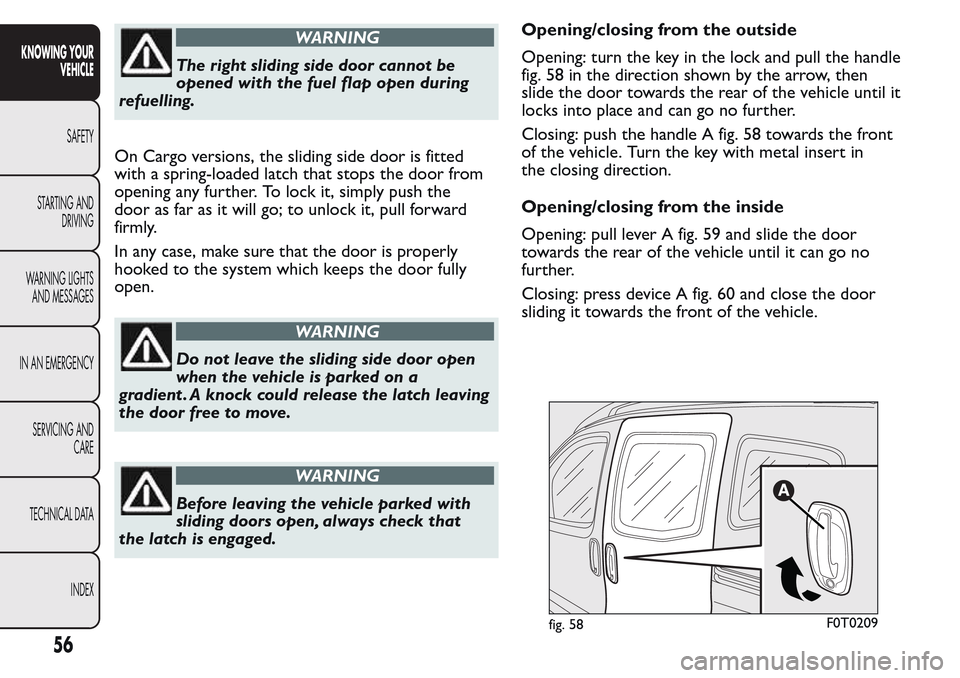
Opening: turn the key in the lock and pull the handle
fig. 58 in the direction shown by the arrow, then
slide the door towards the rear of the vehicle until it
locks into place and can go no further.
Closing: push the handle A fig. 58 towards the front
of the vehicle. Turn the key with metal insert in
the closing direction.
Opening/closing from the inside
Opening: pull lever A fig. 59 and slide the door
towards the rear of the vehicle until it can go no
further.
Closing: press device A fig. 60 and close the door
sliding it towards the front of the vehicle.
fig. 58F0T0209
56
KNOWING YOUR
VEHICLE
SAFETY
STARTING AND
DRIVING
WARNING LIGHTS
AND MESSAGES
IN AN EMERGENCY
SERVICING AND
CARE
TECHNICAL DATA
INDEX
Page 72 of 260
CLOSING
Proceed as follows:
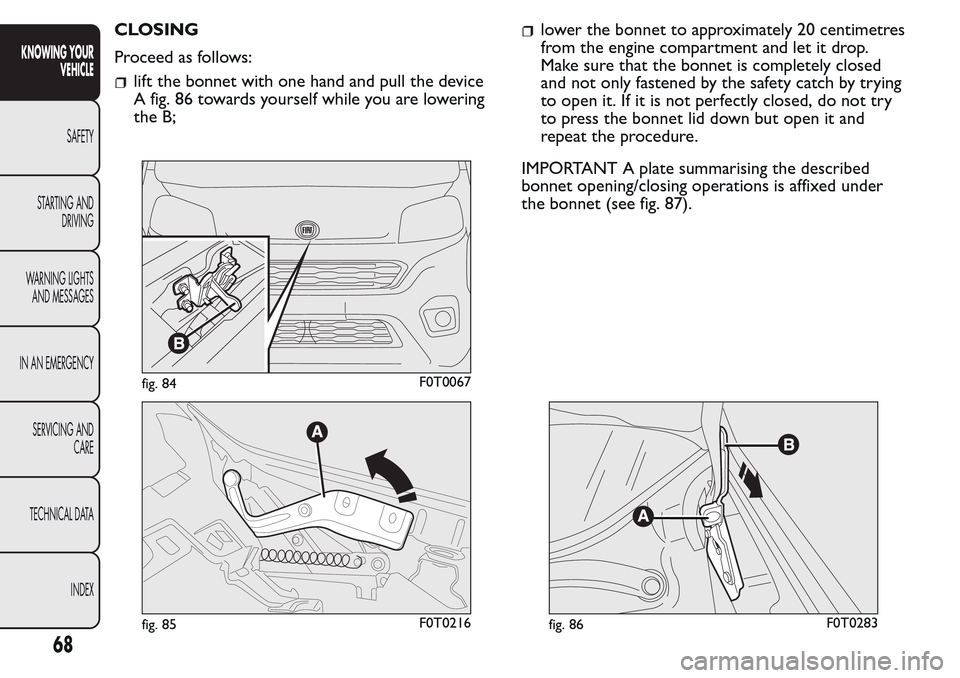
lift the bonnet with one hand and pull the device
A fig. 86 towards yourself while you are lowering
the B;
lower the bonnet to approximately 20 centimetres
from the engine compartment and let it drop.
Make sure that the bonnet is completely closed
and not only fastened by the safety catch by trying
to open it. If it is not perfectly closed, do not try
to press the bonnet lid down but open it and
repeat the procedure.
IMPORTANT A plate summarising the described
bonnet opening/closing operations is affixed under
the bonnet (see fig. 87).
fig. 84F0T0067
fig. 85F0T0216fig. 86F0T0283
68
KNOWING YOUR
VEHICLE
SAFETY
STARTING AND
DRIVING
WARNING LIGHTS
AND MESSAGES
IN AN EMERGENCY
SERVICING AND
CARE
TECHNICAL DATA
INDEX
Page 75 of 260
Adjusting headlight alignment
Press the
orbuttons on the control
panelfig. 90.
The instrument panel display shows the position in
relation to the adjustment set.
Position 0 - one or two people in the front seats.
Position1-fivepeople.
Position2-fivepeople + load in the boot.
Position 3 - driver + maximum permitted load
stowed in the boot.
IMPORTANT Check the alignment of the light beams
each time the weight of the load transported
changes.
FOG LIGHT DIRECTION
(for versions/markets, where provided)
Contact a Fiat Dealership to have the direction
checked and, if necessary, adjusted.
ADJUSTING THE HEADLIGHTS WHEN
ABROAD
The dipped headlights are directed for operation in
the country where the vehicle was originally
purchased. In countries where you drive on the
other side of the road, you need to alter the beam
direction by affixing a specially designed self-adhesive
film in order not to dazzle the vehicles travelling in
the opposite direction.
ABS SYSTEM
This is an integral part of the braking system, which
prevents one or more wheels from locking or
slipping regardless of the road surface conditions and
braking intensity, giving the best control during
emergency braking.
The EBD system (Electronic Braking Force
Distribution) completes the system, allowing the
brake force to be distributed between the front and
rear wheels.
IMPORTANT For maximum efficiency of the braking
system, a bedding-in period of about 500 km is
needed: during this period it is better to avoid sharp,
repeated and prolonged braking.
SYSTEM INTERVENTION
The driver can tell the ABS system has come into
action because the brake pedal pulsates slightly and
the system gets noisier: it means that the vehicle
speed should be altered to suit the type of road
surface.
MECHANICAL BRAKE ASSIST (emergency
braking assistance)
(for versions/markets, where provided)
This system, which cannot be deactivated, recognises
emergency braking conditions (according to the
brake pedal operation speed) and provides an
additional hydraulic braking pressure to support that
71
KNOWING YOUR
VEHICLE
SAFETY
STARTING AND
DRIVING
WARNING LIGHTS
AND MESSAGES
IN AN EMERGENCY
SERVICING AND
CARE
TECHNICAL DATA
INDEX
Page 83 of 260
Operating conditions
The system is active for speeds above 15 km/h. In a
few situations such as sporty driving, particular
conditions of the road surface (e.g. icy, snowy,
unsurfaced roads...) the signalling may be delayed or
partial in detecting the contemporary deflation of
more than one tyre. Under special conditions (e.g.
vehicle loaded asymmetrically on one side, towing
a trailer, damaged or worn tyre, fitting the
space-saver wheel, use of the "Fix&Go Automatic"
kit, fitting snow chains, fitting different tyres on
the axles) the system may give false indications or be
temporarily deactivated.
If the system is temporarily deactivated, the warning
light
flashes for about 75 seconds and then is
continuously on; at the same time, the display shows
a dedicated message. This indication is displayed
also after the engine has been switched off and then
on again if the correct operating conditions are
not restored.
WARNING
The system is an aid for the driver, who
must always pay full attention while
driving.The responsibility always rests with the
driver, who must take into account the traffic
conditions in order to drive in complete safety.
The driver must always maintain a safe distance
from the vehicle in front .
WARNING
If the driver depresses the brake pedal
fully or carries out a fast steering during
system operation, the automatic braking
function may stop (e.g. to allow a possible
manoeuvre to avoid the obstacle).
WARNING
The laser beam is not visible at the
naked eye. Do not look directly, or with
optical instruments (e.g. lenses), at the laser
beam from a distance lower than 10 cm: this
may cause damage to the sight .The laser beam
is also present when the key is at MAR but its
operation is off, not available or manually
deactivated with the display Setup Menu.
WARNING
The system intervenes on vehicles
travelling in the same lane. Small sized
vehicles (e.g. bicycles or motorbikes) or people,
animals and things (e.g. pushchairs) and more in
general all those obstacles with a low reflection
of the light emitted by the laser (e.g. vehicles
soiled with mud) are not taken into
consideration.
79
KNOWING YOUR
VEHICLE
SAFETY
STARTING AND
DRIVING
WARNING LIGHTS
AND MESSAGES
IN AN EMERGENCY
SERVICING AND
CARE
TECHNICAL DATA
INDEX
Page 85 of 260
Do not cover the operating range of the
sensor with stickers or other objects.
Also pay attention to other objects on the
bonnet (e.g. a layer of snow) and make sure they
do not interfere with the light emitted by the
laser.
If a trailer or a vehicle is towed the system
must be deactivated with the display
Setup Menu.
If the system signals a loss of pressure on
a specific tyre, it is recommended to
check the pressure on all four tyres.
TRACTION PLUS SYSTEM
(for versions/markets, where provided)
Traction Plus is a driving aid, useful for setting off in
poor grip conditions (snow, ice, mud, etc.) which
allows the drive force to be distributed in the best
way over the front axle when one wheel is slipping.
In effect, Traction Plus acts by braking the wheels
with poor grip (or those slipping more than the
others), thereby transferring the drive force to those
which have more grip on the ground.
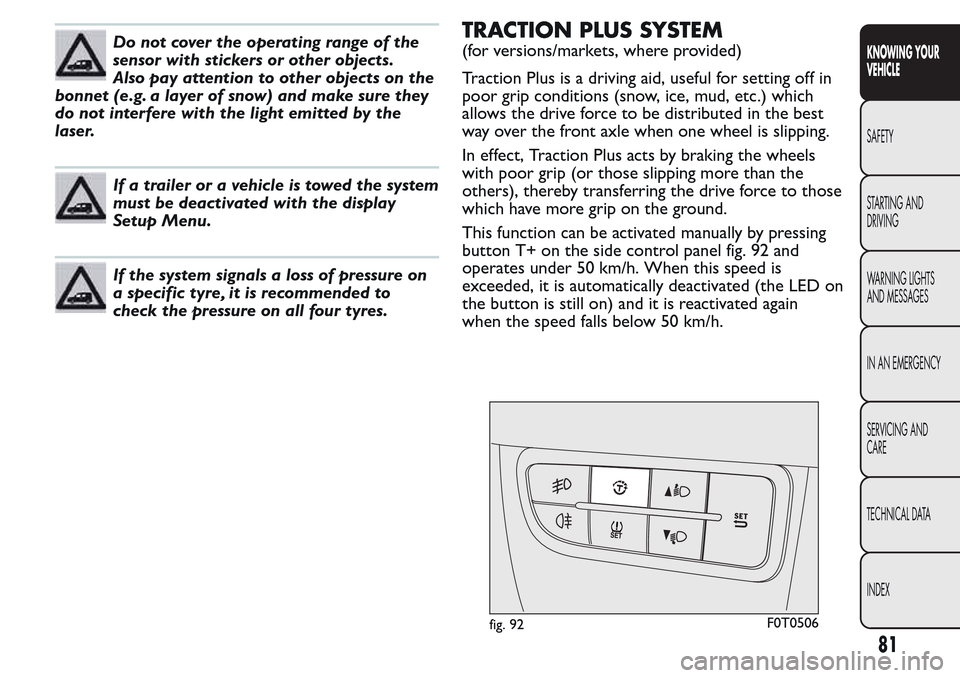
This function can be activated manually by pressing
button T+ on the side control panel fig. 92 and
operates under 50 km/h. When this speed is
exceeded, it is automatically deactivated (the LED on
the button is still on) and it is reactivated again
when the speed falls below 50 km/h.
fig. 92F0T0506
81
KNOWING YOUR
VEHICLE
SAFETY
STARTING AND
DRIVING
WARNING LIGHTS
AND MESSAGES
IN AN EMERGENCY
SERVICING AND
CARE
TECHNICAL DATA
INDEX
Page 89 of 260
The sensor must be free of mud, dirt , snow
or ice in order for the system to work. Be
careful not to scratch or damage the
sensors while cleaning them. Avoid using dr y,
rough or hard cloths.The sensors should be
washed using clean water with the addition of car
shampoo if necessary.When using special
washing equipment such as high pressure jets or
steam cleaning, clean the sensors very quickly
keeping the jet more than 10 cm away.
OPERATION WITH TRAILER
The operation of the sensors is automatically
deactivated when the plug for the electric cable for
the trailer is inserted in the vehicle tow hook socket.
The sensors are automatically enabled again when
the trailer cable plug is removed.
IMPORTANT If you wish to leave the tow hook
fitted without towing a trailer, it is advisable to
contact a Fiat Dealership for the relevant system
update operations because the tow hook could be
detected as an obstacle by the central sensors.
GENERAL WARNINGS
During parking manoeuvres, pay the utmost
attention to any obstacles that could be located
above or below the sensors.
Sometimes, objects located very near the rear of
the vehicle are not detected and could therefore
damage the vehicle or be damaged themselves.
The signals sent out by the sensors can be altered
by dirt, snow or ice deposited on the sensors or
by ultrasound systems (e.g. truck pneumatic
brakes or pneumatic drills) near the vehicle.
The parking sensors work properly with the swing
doors closed. If they are open, they can cause the
system to send false signals: always close the
rear doors.
Also, do not apply stickers to the sensors.
The following conditions may influence the
performance of the parking assistance system:
Reduced sensor sensitivity and a reduction in the
parking assistance system performance could be
due to the presence on the surface of the sensor
of: ice, snow, mud, thick paint.
The sensor may detect a non-existent obstacle
(echo interference) due to mechanical
interference, for example when washing the
vehicle, in rain (strong wind), hail.
The signals sent by the sensors can also be altered
by the presence of ultrasonic systems (e.g.
pneumatic brakes of trucks or pneumatic drills)
near the vehicle.
Detection of obstacles in the upper part of the
vehicle (particularly in the case of vans or chassis
cabs) may not be guaranteed because the system
detects obstacles that could strike the lower
part of the vehicle.
85
KNOWING YOUR
VEHICLE
SAFETY
STARTING AND
DRIVING
WARNING LIGHTS
AND MESSAGES
IN AN EMERGENCY
SERVICING AND
CARE
TECHNICAL DATA
INDEX
Page 94 of 260
IMPORTANT
WARNING
Before opening the bonnet , make sure
that the vehicle is switched off and
the key is in the OFF position. Follow the
instructions on the label on the front
crossmember. It is advisable to extract the key
when there are other people in the vehicle.
WARNING
The vehicle should always be evacuated
after the key has been removed or
turned to the OFF position.When refuelling,
make sure that the car is switched off with the
key in the OFF position.
WARNING
For vehicles with robotised gearbox, in
the event of automatic engine stopping
with the car on a slope, the engine should be
restarted by moving the gear lever towards (+)
or (-) without releasing the brake pedal. For
vehicles with robotised gearbox and Hill Holder
function, in the event of automatic engine
stopping with the car on a slope, the engine
must be restarted by moving the gear lever
towards (+) or (-) without releasing the brake
pedal, so that the Hill Holder function, active
only with the engine running, becomes
available.
WARNING
If climate comfort is to be favoured, the
Star t&Stop system can be disabled,
for a continuous operation of the climate
control system.
fig. 99F0T0429
90
KNOWING YOUR
VEHICLE
SAFETY
STARTING AND
DRIVING
WARNING LIGHTS
AND MESSAGES
IN AN EMERGENCY
SERVICING AND
CARE
TECHNICAL DATA
INDEX
Page 128 of 260
Warning lightwill blink for 60 seconds
after starting or during prolonged
cranking to indicate a fault to the glow
plug heating system. Use the vehicle normally if
the engine starts, but go to a Fiat Dealership
as soon as possible.
HOW TO WARM UP THE ENGINE AFTER IT
HAS JUST STARTED
Proceed as follows:
drive off slowly, letting the engine turn at medium
revs. Do not accelerate abruptly;
do not demand to performance for the first few
kilometres. Wait until the engine coolant gauge
starts moving.
EMERGENCY STARTING
Go to a Fiat Dealership immediately if warning light
comes on steady on the instrument panel.
Never jump start the engine by pushing,
towing or coasting downhill.This could
cause fuel to flow into the catalytic
conver ter and damage it beyond repair.STOPPING THE ENGINE
Turn the ignition key to STOP while the engine is
idling.
IMPORTANT After a long drive, you should allow
the engine to “catch its breath” before turning it off
by letting it idle to allow the temperature in the
engine compartment to fall.
A quick burst on the accelerator before
turning off the engine serves absolutely no
practical purpose, it wastes fuel and is
especially damaging to turbocharged engines.
124
KNOWING YOUR
VEHICLE
SAFETY
STARTING AND
DRIVING
WARNING LIGHTS
AND MESSAGES
IN AN EMERGENCY
SERVICING AND
CARE
TECHNICAL DATA
INDEX
Page 132 of 260
SAVING FUEL
Some useful tips are given below for fuel saving and
reducing harmful emissions of CO2 and other
pollutants (nitrogen oxides, unburnt hydrocarbons,
Particulate Matter (PM) etc.).
GENERAL CONSIDERATIONS
The general factors that affect fuel consumption are
listed below.
Vehicle maintenance
Have checks and adjustments carried out in
accordance with the “Scheduled Servicing Plan”.
Ty r e s
Check the tyre pressure at least once every four
weeks: if the pressure is too low, consumption levels
increase as resistance to rolling is higher.
Unnecessary loads
Do not travel with an overloaded boot. The weight
of the vehicle (especially when driving in town)
and its trim greatly affect fuel consumption
and stability.
Roof rack/ski rack
Remove the roof rack or the ski rack from the roof
after use. These accessories reduce the aerodynamic
coefficient of the vehicle and have a negative effecton fuel consumption. It is better to use a trailer to
transport particularly bulky objects.
Electric devices
Only use electrical devices for the amount of time
needed. The heated rear window, additional
headlights, windscreen/rear window wipers and
heater fan need a considerable amount of energy,
therefore increasing fuel consumption (by up to 25%
in the urban cycle).
Climate control system
The air conditioner leads to higher fuel consumption
(on average up to +20%). If the temperature outside
is not too extreme, try and use the air vents.
Spoilers
The use of non-certified spoilers may adversely affect
aerodynamics and fuel consumption.
128
KNOWING YOUR
VEHICLE
SAFETY
STARTING AND
DRIVING
WARNING LIGHTS
AND MESSAGES
IN AN EMERGENCY
SERVICING AND
CARE
TECHNICAL DATA
INDEX