brake FIAT QUBO 2017 1.G Owner's Manual
[x] Cancel search | Manufacturer: FIAT, Model Year: 2017, Model line: QUBO, Model: FIAT QUBO 2017 1.GPages: 260, PDF Size: 4.74 MB
Page 136 of 260
PROLONGED VEHICLE INACTIVITY
If the vehicle needs to be off the road for longer than
one month, the following precautions must be
taken:
park the vehicle indoors in a dry and, if possible,
well-ventilated place;
engage a gear and check that the handbrake is not
on;
disconnect the battery negative terminal and
check the charge (see “Battery” in the
“Maintenance and care”);
clean and protect the painted parts using
protective wax;
clean and protect the shiny metal parts using
special compounds readily available;
sprinkle talcum powder on the rubber windscreen
and rear window wiper blades and lift them off the
glass;
slightly open the windows;
cover the vehicle with a piece of fabric or
perforated plastic sheet. Do not use compact
plastic tarpaulins, which prevent humidity from
evaporating from the surface of the vehicle;
inflate tyres to +0.5 bar above the normal
specified pressure and check it at intervals;
do not drain the engine cooling system.
132
KNOWING YOUR
VEHICLE
SAFETY
STARTING AND
DRIVING
WARNING LIGHTS
AND MESSAGES
IN AN EMERGENCY
SERVICING AND
CARE
TECHNICAL DATA
INDEX
Page 137 of 260
WARNING LIGHTS AND MESSAGES
WARNING LIGHTS AND MESSAGES
The warning light (where allowed by the instrument
panel) is associated to a specific message and/or
acoustic tone. These indications are brief and
precautionary and as such must not be considered as
exhaustive and/or alternative to the information
contained in the Owner's Handbook, which you are
recommended to read carefully in all cases. Always
refer to the information in this chapter in the event
of a failure indication.
IMPORTANT The fault indicators appearing on the
display are divided into two categories: very serious
and less serious failures.
Serious failures prompt a prolonged cycle of signals.
Less serious failures prompt a shorter cycle of
signals.
The display cycle of both categories can be
interrupted by pressing the SET
button. The
warning light (or the symbol on the display) on the
instrument panel will stay on until the cause of
the failure is eliminated.
LOW BRAKE FLUID
(red)/HANDBRAKE ENGAGED (red)
When the ignition key is turned to MAR, the warning
light turns on but should go off after a few seconds.
Low brake fluid
The warning light turns on when the level of the
brake fluid in the reservoir falls below the minimum
level, possibly due to a leak in the circuit.
A specific message is displayed on certain versions.
WARNING
If the warning lightturns on when
travelling (on cer tain versions together
with the message on the display) stop the
vehicle immediately and contact Fiat
Dealership.
Handbrake engaged
The warning light turns on when the handbrake is
engaged.
On some versions, an acoustic tone accompanies the
warning light when the vehicle is moving.
133
KNOWING YOUR
VEHICLE
SAFETY
STARTING AND
DRIVING
WARNING LIGHTS
AND MESSAGES
IN AN EMERGENCY
SERVICING AND
CARE
TECHNICAL DATA
INDEX
Page 138 of 260
IMPORTANT If the warning light comes on when the
car is in motion, check that the handbrake is not
on.
AIR BAG FAULT (red)
When the ignition key is turned to MAR, the warning
light turns on but should go off after a few seconds.
The warning light stays on constantly if there is a
fault in the air bag system.
A specific message is displayed on certain versions.
WARNING
The warning lightmay not light up
when the key is turned to MAR or stay
on while travelling to indicate a retaining
system fault . In this case, the air bags or the
pretensioners may not be activated in the case
of an accident or (more seldom) they may be
activated incorrectly. Contact a Fiat Dealership
immediately to have the system checked.
WARNING
The failure of thewarning light is
indicated by the
warning light flashing
or, depending on the version, by the
symbol
constantly on in the display. In this case, the
warning light may not indicate a fault in the
restraint systems. Before continuing, contact
a Fiat Dealership immediately to have the
system checked.
EXCESSIVE ENGINE
COOLANT TEMPERATURE
(red)
When the ignition key is turned to MAR, the warning
light turns on but should go off after a few seconds.
The warning light turns on when the engine is
overheated.
If the warning light switches on, proceed as follows:
When driving normally: stop the car, switch off
the engine and check that the coolant level in
the reservoir is not below the MIN mark. If it is,
wait for the engine to cool down, then slowly and
carefully open the reservoir cap. Top up with
coolant, making sure that the level of fluid is
between the MIN and MAX references on the
reservoir. Also check visually for leaks. If, when
restarting, the warning light switches on again,
contact a Fiat Dealership.
134
KNOWING YOUR
VEHICLE
SAFETY
STARTING AND
DRIVING
WARNING LIGHTS
AND MESSAGES
IN AN EMERGENCY
SERVICING AND
CARE
TECHNICAL DATA
INDEX
Page 146 of 260
GENERIC FAILURE INDICATION
(amber)
The warning light turns on in the following
circumstances:
Engine oil pressure sensor failure
The warning light turns on when an engine oil
pressure sensor failure is detected.
Go to a Fiat Dealership to have the fault fixed as
soon as possible.
Exterior lights fault
The warning light comes on (on some versions)
when a failure is detected in one of the following
lights:
side/tail lights
brake lights
rear fog lights
direction indicators
number plate lights.
The failure relating to these lights could be: one or
more blown bulbs, a blown protection fuse or a
break in the electrical connection.
A specific message is displayed on certain versions.Fuel cut-off inertia switch tripped
The warning light switches on when the fuel cut-off
inertia switch is triggered.
The display will show a dedicated message.
Parking sensor failure
(for versions/markets, where provided)
See parking sensor warning light section.
Start&Stop fault
(for versions/markets, where provided)
The warning light comes on when a Start&Stop
system fault is detected.
Warning light failure
The warning lightturns on and flashes to indicate a
failure of the warning light
. In this case, the
warning light may not indicate a fault in the
restraint systems.
Before continuing, contact a Fiat Dealership
immediately to have the system checked.
142
KNOWING YOUR
VEHICLE
SAFETY
STARTING AND
DRIVING
WARNING LIGHTS
AND MESSAGES
IN AN EMERGENCY
SERVICING AND
CARE
TECHNICAL DATA
INDEX
Page 147 of 260
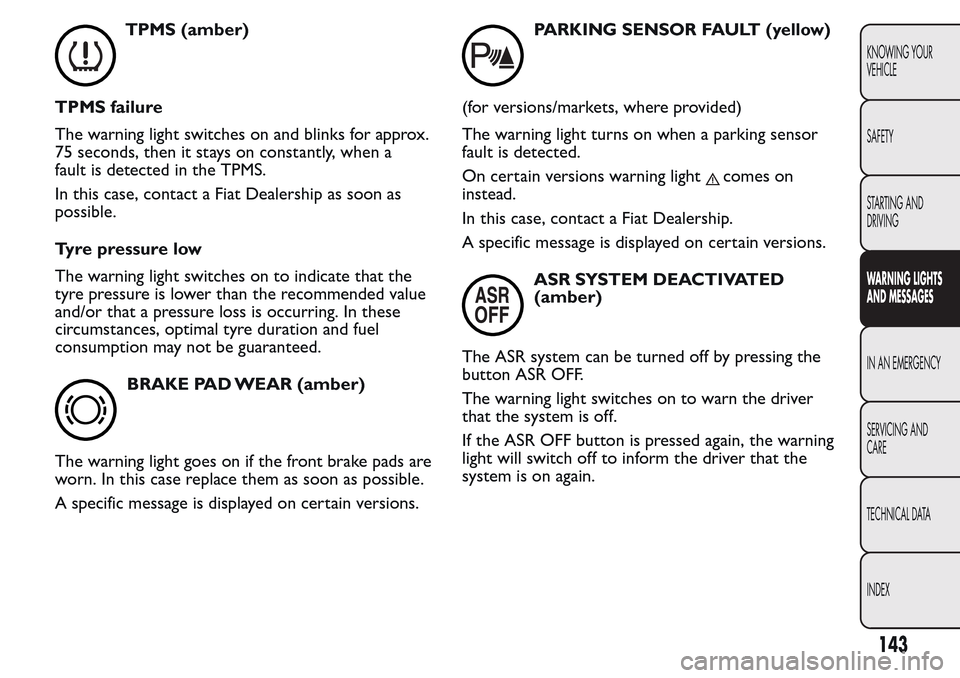
TPMS (amber)
TPMS failure
The warning light switches on and blinks for approx.
75 seconds, then it stays on constantly, when a
fault is detected in the TPMS.
In this case, contact a Fiat Dealership as soon as
possible.
Tyre pressure low
The warning light switches on to indicate that the
tyre pressure is lower than the recommended value
and/or that a pressure loss is occurring. In these
circumstances, optimal tyre duration and fuel
consumption may not be guaranteed.
BRAKE PAD WEAR (amber)
The warning light goes on if the front brake pads are
worn. In this case replace them as soon as possible.
A specific message is displayed on certain versions.
PARKING SENSOR FAULT (yellow)
(for versions/markets, where provided)
The warning light turns on when a parking sensor
fault is detected.
On certain versions warning light
comes on
instead.
In this case, contact a Fiat Dealership.
A specific message is displayed on certain versions.
ASR SYSTEM DEACTIVATED
(amber)
The ASR system can be turned off by pressing the
button ASR OFF.
The warning light switches on to warn the driver
that the system is off.
If the ASR OFF button is pressed again, the warning
light will switch off to inform the driver that the
system is on again.
143
KNOWING YOUR
VEHICLE
SAFETY
STARTING AND
DRIVING
WARNING LIGHTS
AND MESSAGES
IN AN EMERGENCY
SERVICING AND
CARE
TECHNICAL DATA
INDEX
Page 151 of 260
WARNING
This procedure must be performed by
experts because incorrect actions may
cause considerable electrical discharge.
Furthermore, battery fluid is poisonous and
corrosive: avoid contact with skin and eyes.
Keep naked flames and lit cigarettes away from
the battery. Do not create sparks.
BUMP STARTING
Never bump start the engine by pushing, towing or
driving downhill. This could cause fuel to flow into
the catalytic converter and damage it beyond repair.
IMPORTANT Remember that the brake booster
and the power steering system are not active until
the engine is started, so you will need to apply much
more force to the brake pedal or steering wheel.
CHANGING A WHEEL
The vehicle is originally equipped with the Fix&Go
automatic quick tyre repair kit (see instructions
in the next section). As an alternative, the vehicle
may have a normal-sized spare wheel.
Wheel changing and correct use of the jack and
spare wheel call for some precautions, as listed
below.
WARNING
The spare wheel (for versions/markets,
where provided) is specifically for your
vehicle.Therefore, it must not be used on other
models. Do not use spare wheels of other
models on your vehicle.The spare wheel must
be used only in an emergency. Use of the spare
wheel must be strictly reduced to the necessary
minimum.
147
KNOWING YOUR
VEHICLE
SAFETY
STARTING AND
DRIVING
WARNING LIGHTS
AND MESSAGES
IN AN
EMERGENCY
SERVICING AND
CARE
TECHNICAL DATA
INDEX
Page 152 of 260
WARNING
Use your hazard lights, warning triangle,
etc to show that your vehicle is
stationar y. Passengers should get out of the
vehicle, particularly if it is heavily loaded, and
wait for the wheel to be changed away from the
traffic . If you are on a slope or uneven surface,
place wedges or other suitable objects under
the wheels to secure the vehicle. Have the
wheel repaired and refitted as soon as possible.
Do not apply grease to the bolt threads before
fitting: they could come unscrewed.
WARNING
Use the jack only to replace wheels on
the vehicle with which it is supplied
or on other vehicles of the same model. Never
use the jack for other purposes, such as lifting
other models. Never use the jack to carr y out
repairs under the vehicle. Incorrect positioning
of the jack may cause the lifted vehicle to
fall. Do not use the jack for loads higher than
the one shown on its label.
WARNING
Incorrect hub cap assembly may cause it
to come off when the vehicle is moving.
Never tamper with the inflation valve. Never
introduce tools of any kind between rim and
tyre. Check tyre and space-saver wheel
pressures regularly, referring to the values
shown in the "Technical data" chapter.
Please note that:
the jack weight is 1.76 kg;
the jack requires no adjustment;
the jack cannot be repaired and in the event of a
fault it must be replaced by another genuine one;
no tool other than its cranking device may be
fitted on the jack.
To change a wheel, proceed as follows:
stop the vehicle in a position that is not dangerous
for oncoming traffic where you can change the
wheel safely. The ground must be flat and
sufficiently compact;
switch off the engine and pull the handbrake;
engage first gear or reverse;
wear the reflective safety jacket (compulsory by
law in certain countries) before getting out of
the vehicle;
148
KNOWING YOUR
VEHICLE
SAFETY
STARTING AND
DRIVING
WARNING LIGHTS
AND MESSAGES
IN AN
EMERGENCY
SERVICING AND
CARE
TECHNICAL DATA
INDEX
Page 158 of 260
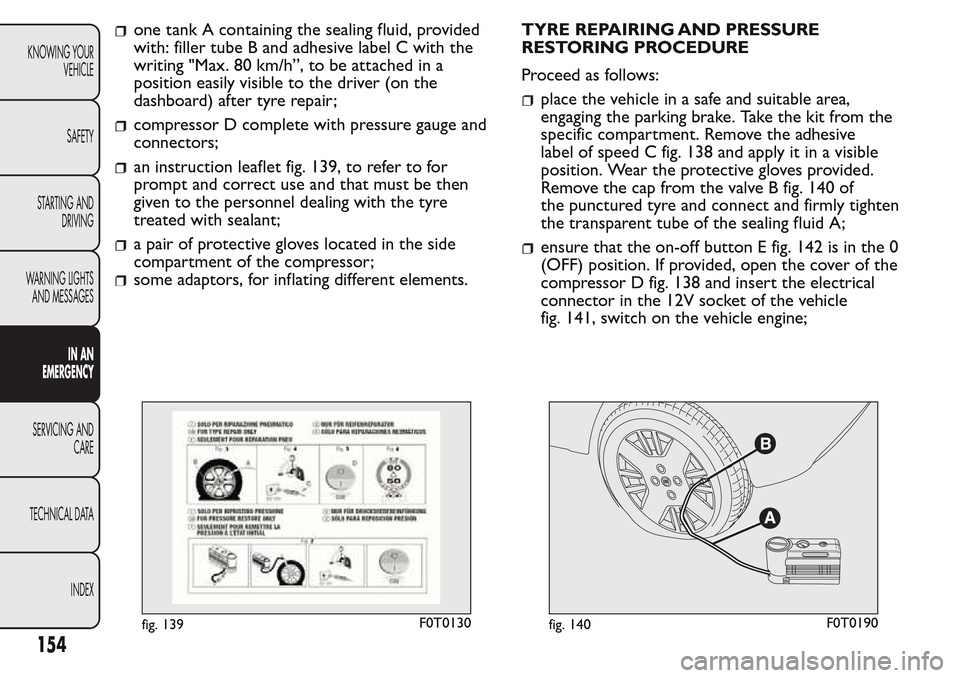
one tank A containing the sealing fluid, provided
with: filler tube B and adhesive label C with the
writing "Max. 80 km/h”, to be attached in a
position easily visible to the driver (on the
dashboard) after tyre repair;
compressor D complete with pressure gauge and
connectors;
an instruction leaflet fig. 139, to refer to for
prompt and correct use and that must be then
given to the personnel dealing with the tyre
treated with sealant;
a pair of protective gloves located in the side
compartment of the compressor;
some adaptors, for inflating different elements.TYRE REPAIRING AND PRESSURE
RESTORING PROCEDURE
Proceed as follows:
place the vehicle in a safe and suitable area,
engaging the parking brake. Take the kit from the
specific compartment. Remove the adhesive
label of speed C fig. 138 and apply it in a visible
position. Wear the protective gloves provided.
Remove the cap from the valve B fig. 140 of
the punctured tyre and connect and firmly tighten
the transparent tube of the sealing fluid A;
ensure that the on-off button E fig. 142 is in the 0
(OFF) position. If provided, open the cover of the
compressor D fig. 138 and insert the electrical
connector in the 12V socket of the vehicle
fig. 141, switch on the vehicle engine;
fig. 139F0T0130fig. 140F0T0190
154
KNOWING YOUR
VEHICLE
SAFETY
STARTING AND
DRIVING
WARNING LIGHTS
AND MESSAGES
IN AN
EMERGENCY
SERVICING AND
CARE
TECHNICAL DATA
INDEX
Page 159 of 260
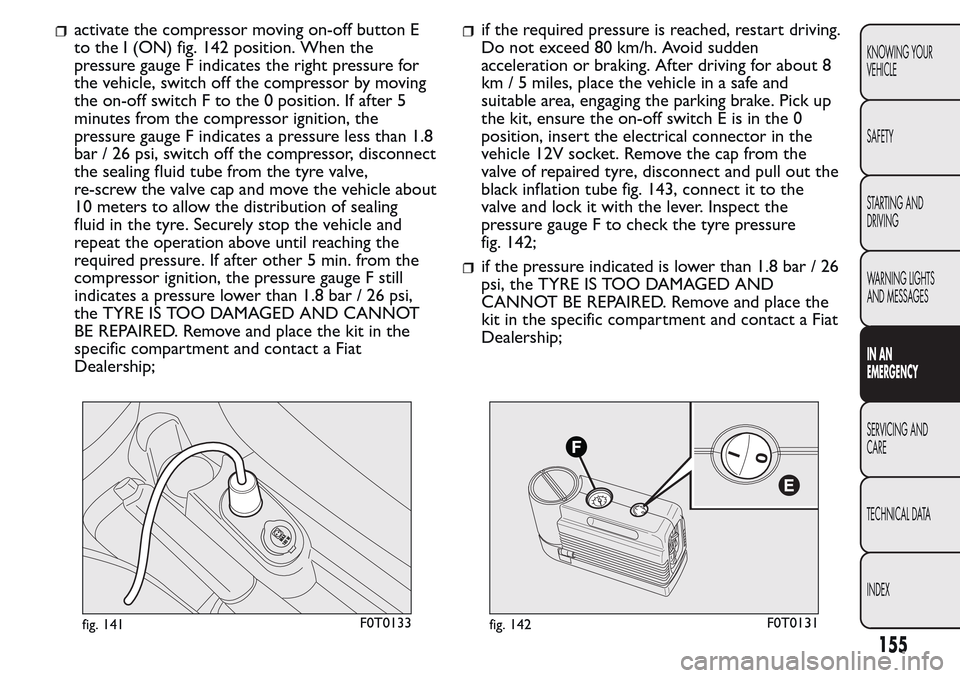
activate the compressor moving on-off button E
to the I (ON) fig. 142 position. When the
pressure gauge F indicates the right pressure for
the vehicle, switch off the compressor by moving
the on-off switch F to the 0 position. If after 5
minutes from the compressor ignition, the
pressure gauge F indicates a pressure less than 1.8
bar / 26 psi, switch off the compressor, disconnect
the sealing fluid tube from the tyre valve,
re-screw the valve cap and move the vehicle about
10 meters to allow the distribution of sealing
fluid in the tyre. Securely stop the vehicle and
repeat the operation above until reaching the
required pressure. If after other 5 min. from the
compressor ignition, the pressure gauge F still
indicates a pressure lower than 1.8 bar / 26 psi,
the TYRE IS TOO DAMAGED AND CANNOT
BE REPAIRED. Remove and place the kit in the
specific compartment and contact a Fiat
Dealership;if the required pressure is reached, restart driving.
Do not exceed 80 km/h. Avoid sudden
acceleration or braking. After driving for about 8
km / 5 miles, place the vehicle in a safe and
suitable area, engaging the parking brake. Pick up
the kit, ensure the on-off switch E is in the 0
position, insert the electrical connector in the
vehicle 12V socket. Remove the cap from the
valve of repaired tyre, disconnect and pull out the
black inflation tube fig. 143, connect it to the
valve and lock it with the lever. Inspect the
pressure gauge F to check the tyre pressure
fig. 142;
if the pressure indicated is lower than 1.8 bar / 26
psi, the TYRE IS TOO DAMAGED AND
CANNOT BE REPAIRED. Remove and place the
kit in the specific compartment and contact a Fiat
Dealership;
fig. 141F0T0133fig. 142F0T0131
155
KNOWING YOUR
VEHICLE
SAFETY
STARTING AND
DRIVING
WARNING LIGHTS
AND MESSAGES
IN AN
EMERGENCY
SERVICING AND
CARE
TECHNICAL DATA
INDEX
Page 163 of 260
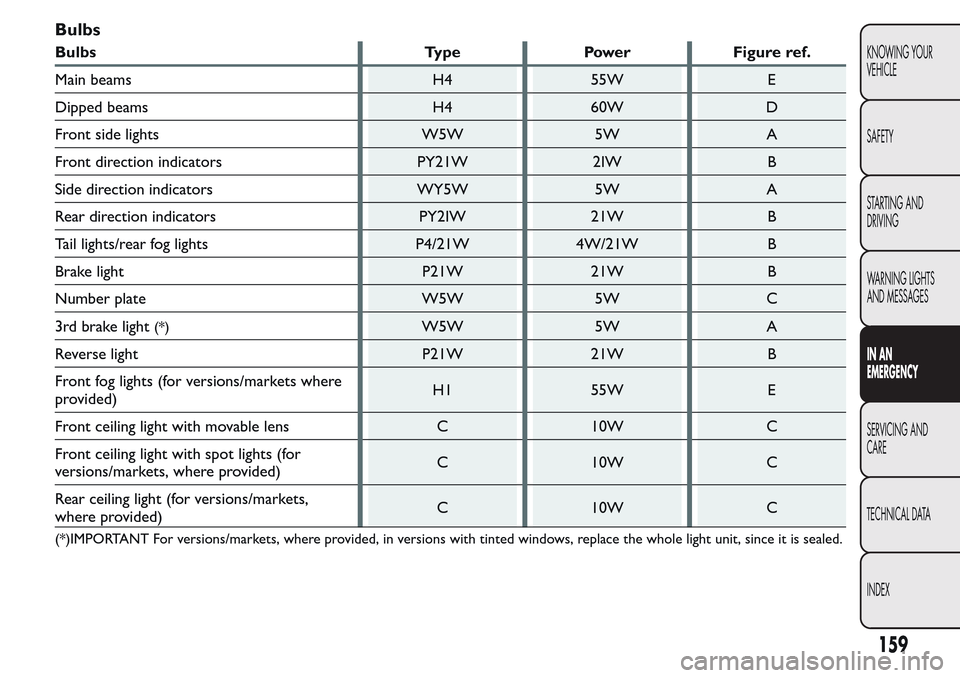
Bulbs
Bulbs Type Power Figure ref.
Main beams H4 55W E
Dipped beams H4 60W D
Front side lights W5W 5W A
Front direction indicators PY21W 2IW B
Side direction indicators WY5W 5W A
Rear direction indicators PY2IW 21W B
Tail lights/rear fog lights P4/21W 4W/21W B
Brake light P21W 21W B
Number plate W5W 5W C
3rd brake light
(*)W5W 5W A
Reverse light P21W 21W B
Front fog lights (for versions/markets where
provided)H1 55W E
Front ceiling light with movable lens C 10W C
Front ceiling light with spot lights (for
versions/markets, where provided)C 10W C
Rear ceiling light (for versions/markets,
where provided)C 10W C
(*)IMPORTANT For versions/markets, where provided, in versions with tinted windows, replace the whole light unit, since it is sealed.
159
KNOWING YOUR
VEHICLE
SAFETY
STARTING AND
DRIVING
WARNING LIGHTS
AND MESSAGES
IN AN
EMERGENCY
SERVICING AND
CARE
TECHNICAL DATA
INDEX