ignition FIAT QUBO 2017 1.G Owner's Manual
[x] Cancel search | Manufacturer: FIAT, Model Year: 2017, Model line: QUBO, Model: FIAT QUBO 2017 1.GPages: 260, PDF Size: 4.74 MB
Page 62 of 260
WINDOWS
FRONT ELECTRIC WINDOWS
(for versions/markets, where provided)
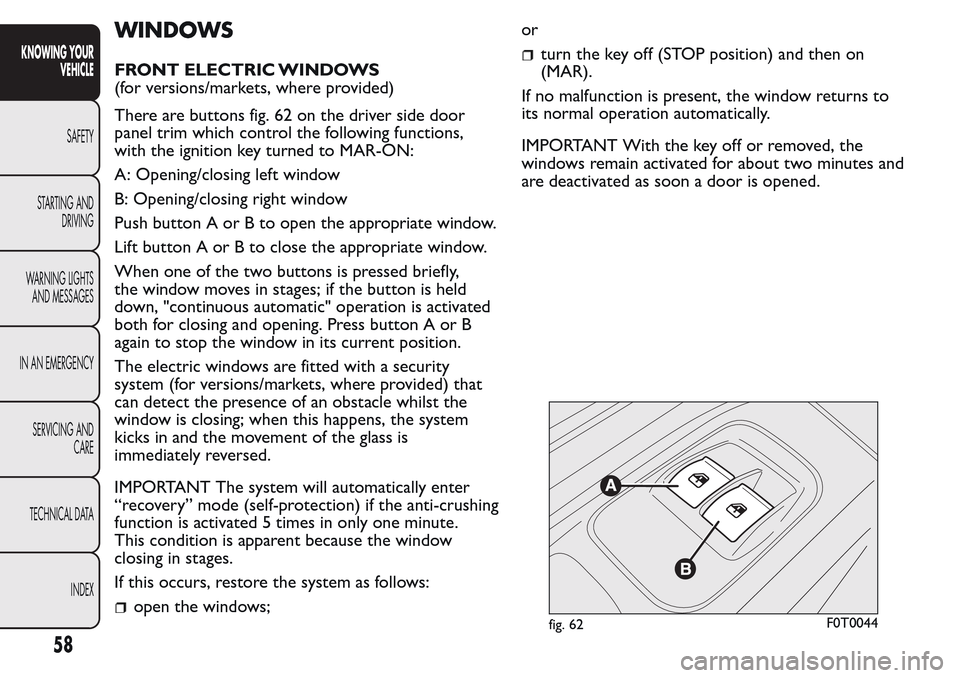
There are buttons fig. 62 on the driver side door
panel trim which control the following functions,
with the ignition key turned to MAR-ON:
A: Opening/closing left window
B: Opening/closing right window
Push button A or B to open the appropriate window.
Lift button A or B to close the appropriate window.
When one of the two buttons is pressed briefly,
the window moves in stages; if the button is held
down, "continuous automatic" operation is activated
both for closing and opening. Press button A or B
again to stop the window in its current position.
The electric windows are fitted with a security
system (for versions/markets, where provided) that
can detect the presence of an obstacle whilst the
window is closing; when this happens, the system
kicks in and the movement of the glass is
immediately reversed.
IMPORTANT The system will automatically enter
“recovery” mode (self-protection) if the anti-crushing
function is activated 5 times in only one minute.
This condition is apparent because the window
closing in stages.
If this occurs, restore the system as follows:
open the windows;or
turn the key off (STOP position) and then on
(MAR).
If no malfunction is present, the window returns to
its normal operation automatically.
IMPORTANT With the key off or removed, the
windows remain activated for about two minutes and
are deactivated as soon a door is opened.
fig. 62F0T0044
58
KNOWING YOUR
VEHICLE
SAFETY
STARTING AND
DRIVING
WARNING LIGHTS
AND MESSAGES
IN AN EMERGENCY
SERVICING AND
CARE
TECHNICAL DATA
INDEX
Page 63 of 260
WARNING
Improper use of the electric windows
can be dangerous. Before and during
their operation ensure that passengers are not
at risk from the moving glass, either by personal
objects caught in the mechanism or struck by
it directly. When leaving the car, always remove
the ignition key to avoid the risk of injury due
to accidental operation of the electric
windows.
MANUAL FRONT WINDOWS
On some versions, the front windows are opened
and closed manually.
Wind the handle to open/close.
LUGGAGE COMPARTMENT
OPENING THE TAILGATE FROM THE
OUTSIDE
fig. 63F0T0250
fig. 64F0T0381
59
KNOWING YOUR
VEHICLE
SAFETY
STARTING AND
DRIVING
WARNING LIGHTS
AND MESSAGES
IN AN EMERGENCY
SERVICING AND
CARE
TECHNICAL DATA
INDEX
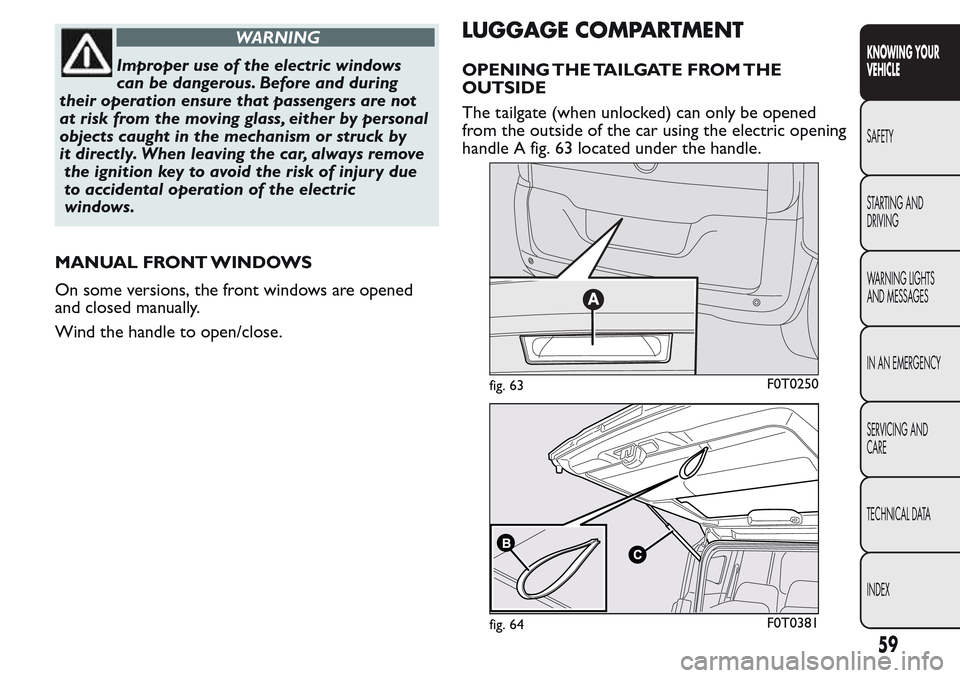
The tailgate (when unlocked) can only be opened
from the outside of the car using the electric opening
handle A fig. 63 located under the handle.
Page 74 of 260
Distribute the load evenly and be careful
to side winds when driving.
WARNING
After travelling for a short distance,
check that the fastening screws are
correctly tightened.
Never exceed the maximum permitted
loads; see chapter "Technical Data".
HEADLIGHTS
LIGHT BEAM DIRECTION
The correct direction of the headlights is essential
for the comfort and safety of the driver and other
road users. To ensure the best visibility when
travelling with the headlights on, the headlight
alignment must be correct. Contact a Fiat Dealership
to have the direction checked and, if necessary,
adjusted.
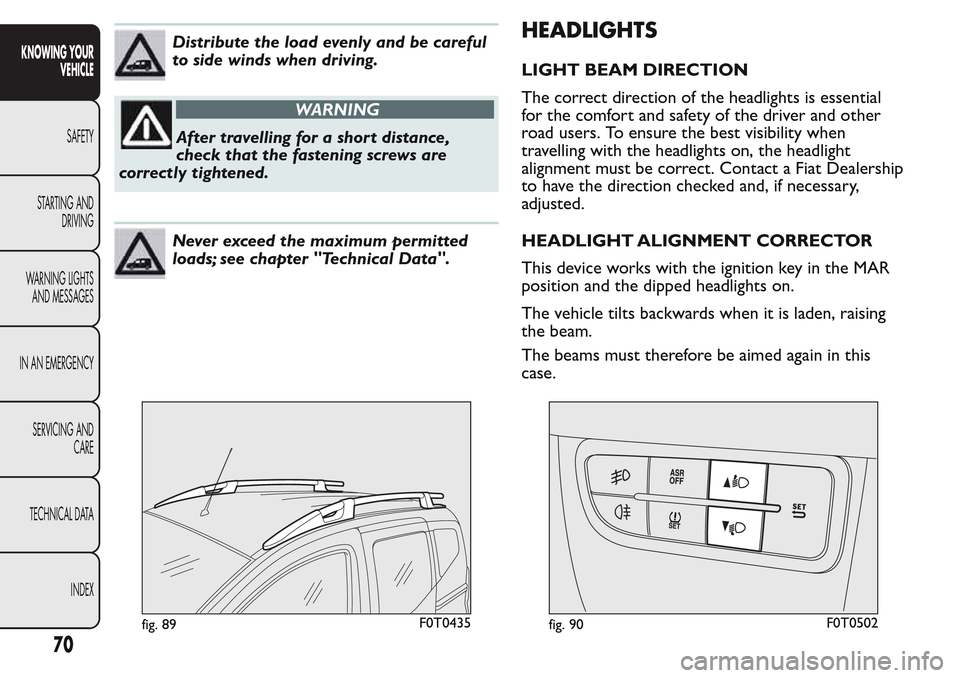
HEADLIGHT ALIGNMENT CORRECTOR
This device works with the ignition key in the MAR
position and the dipped headlights on.
The vehicle tilts backwards when it is laden, raising
the beam.
The beams must therefore be aimed again in this
case.
fig. 89F0T0435fig. 90F0T0502
70
KNOWING YOUR
VEHICLE
SAFETY
STARTING AND
DRIVING
WARNING LIGHTS
AND MESSAGES
IN AN EMERGENCY
SERVICING AND
CARE
TECHNICAL DATA
INDEX
Page 82 of 260
iTPMS System (indirect Tyre
Pressure Monitoring System)
(for versions/markets, where provided)
The indirect Tyre Pressure Monitoring System iTPMS
can monitor the tyre inflation status through the
wheel speed sensors. The system warns the driver if
one or more tyres are flat by switching on the
warning light on the instrument panel and
a warning message on the display, along with an
acoustic signal.
If one tyre only is flat, the system can indicate its
position: it is in any case recommended to check the
pressure on all four tyres. This indication is displayed
also when turning the engine off and on until the
“Reset” procedure is carried out.
“Reset” procedure
The iTPMS needs an initial "self-learning" phase (with
length depending on the driving style and road
conditions: optimal conditions being driving on a
straight road at 80 km/h for at least 20 minutes)
which starts when the “Reset” procedure is carried
out.
The “Reset” procedure must be carried out:
each time tyre pressure is modified;
when even only one tyre is changed;
when tyres are rotated/inverted;
when the space-saver wheel is fitted. Before
carrying out the “Reset” procedure, inflate the
tyres to the rated pressure values specified in the
inflation pressure table (see "Wheels" paragraph in
the "Technical specifications" chapter).
If the “Reset” procedure is not carried out, in all
above cases, the
warning light may give false
indications on one or more tyres.
To carry out the “Reset” procedure, with the vehicle
stopped and the ignition device at MAR, use the
Setup Menu as follows:
briefly press thebutton: the display will show
"Reset";
press thebutton or thebutton to select
("Yes" or "No");
briefly press thebutton: the display will show
"Confirm";
pressbutton orto select ("Yes" to
“Reset” or "No" to exit the video page);
press thebutton again to return to the standard
screen or to the main menu according to where
you are in the menu.
After the “Reset” the display will show the "Reset
saved" message, indicating that the "self-learning" has
been started.
78
KNOWING YOUR
VEHICLE
SAFETY
STARTING AND
DRIVING
WARNING LIGHTS
AND MESSAGES
IN AN EMERGENCY
SERVICING AND
CARE
TECHNICAL DATA
INDEX
Page 93 of 260
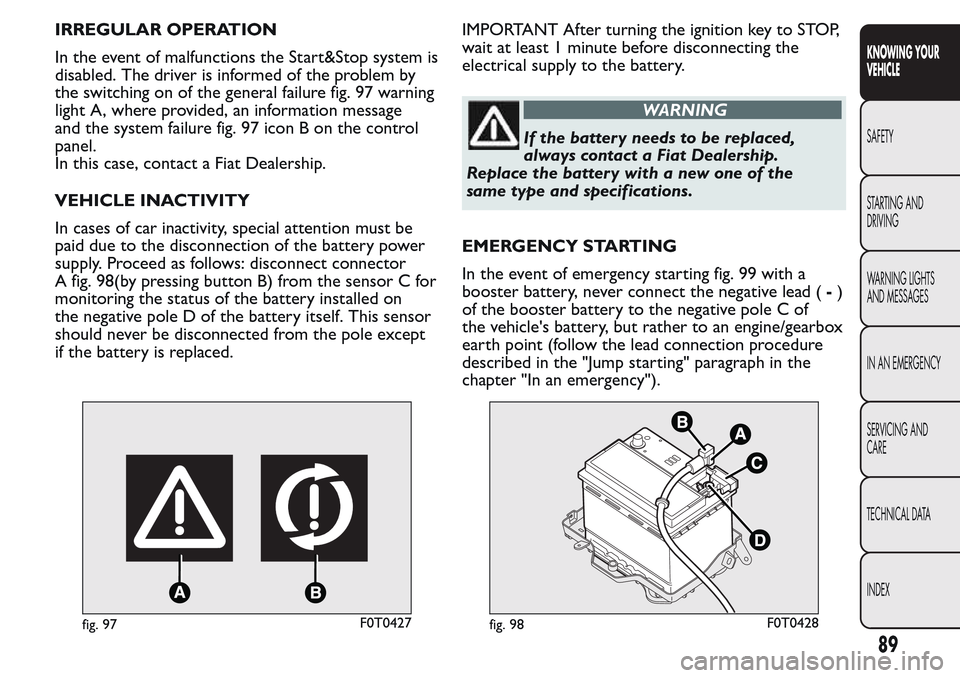
IRREGULAR OPERATION
In the event of malfunctions the Start&Stop system is
disabled. The driver is informed of the problem by
the switching on of the general failure fig. 97 warning
light A, where provided, an information message
and the system failure fig. 97 icon B on the control
panel.
In this case, contact a Fiat Dealership.
VEHICLE INACTIVITY
In cases of car inactivity, special attention must be
paid due to the disconnection of the battery power
supply. Proceed as follows: disconnect connector
A fig. 98(by pressing button B) from the sensor C for
monitoring the status of the battery installed on
the negative pole D of the battery itself. This sensor
should never be disconnected from the pole except
if the battery is replaced.IMPORTANT After turning the ignition key to STOP,
wait at least 1 minute before disconnecting the
electrical supply to the battery.
WARNING
If the batter y needs to be replaced,
always contact a Fiat Dealership.
Replace the battery with a new one of the
same type and specifications.
EMERGENCY STARTING
In the event of emergency starting fig. 99 with a
booster battery, never connect the negative lead (-)
of the booster battery to the negative pole C of
the vehicle's battery, but rather to an engine/gearbox
earth point (follow the lead connection procedure
described in the "Jump starting" paragraph in the
chapter "In an emergency").
fig. 97F0T0427fig. 98F0T0428
89
KNOWING YOUR
VEHICLE
SAFETY
STARTING AND
DRIVING
WARNING LIGHTS
AND MESSAGES
IN AN EMERGENCY
SERVICING AND
CARE
TECHNICAL DATA
INDEX
Page 98 of 260
REFUELLING CAPACITY
To fill the tank completely, top up twice after the
first click of the trigger. Further top-ups could cause
faults in the fuel feeding system.
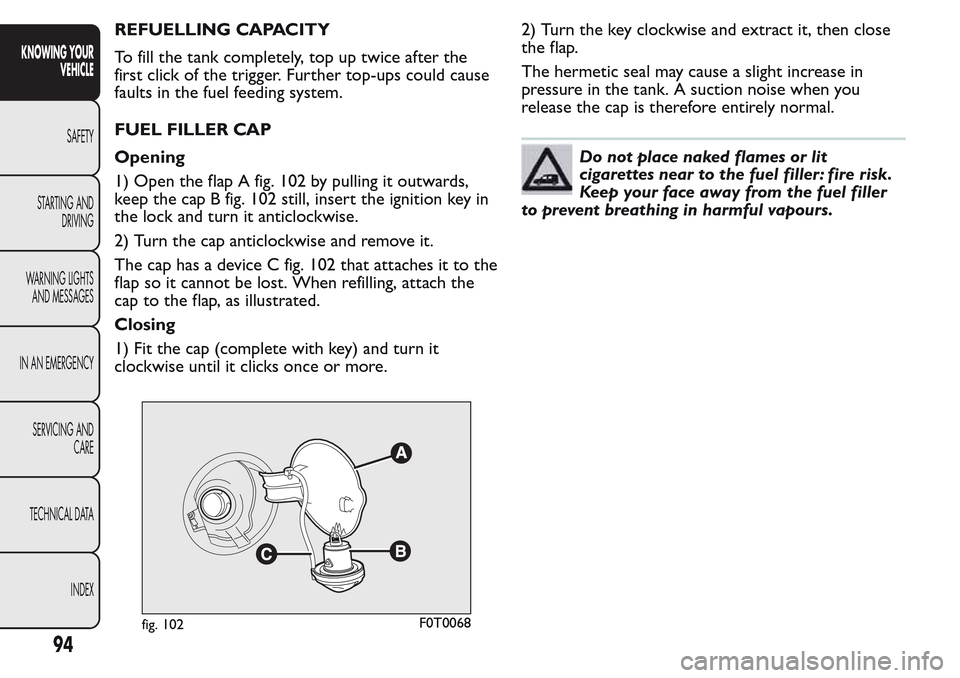
FUEL FILLER CAP
Opening
1) Open the flap A fig. 102 by pulling it outwards,
keep the cap B fig. 102 still, insert the ignition key in
the lock and turn it anticlockwise.
2) Turn the cap anticlockwise and remove it.
The cap has a device C fig. 102 that attaches it to the
flap so it cannot be lost. When refilling, attach the
cap to the flap, as illustrated.
Closing
1) Fit the cap (complete with key) and turn it
clockwise until it clicks once or more.2) Turn the key clockwise and extract it, then close
the flap.
The hermetic seal may cause a slight increase in
pressure in the tank. A suction noise when you
release the cap is therefore entirely normal.
Do not place naked flames or lit
cigarettes near to the fuel filler: fire risk.
Keep your face away from the fuel filler
to prevent breathing in harmful vapours.
fig. 102F0T0068
94
KNOWING YOUR
VEHICLE
SAFETY
STARTING AND
DRIVING
WARNING LIGHTS
AND MESSAGES
IN AN EMERGENCY
SERVICING AND
CARE
TECHNICAL DATA
INDEX
Page 99 of 260
FUEL CUT-OFF SYSTEM
This system is triggered after a collision as follows by:
the interruption of the fuel supply with the engine
consequently cutting out;
automatically unlocking the doors
turning on the lights inside the vehicle.
When the system has been triggered, the message
“Fuel cut off, see handbook” is displayed on some
versions.
Check carefully for fuel leaks, for instance in the
engine compartment, under the vehicle or near the
tank area.
After a crash, turn the ignition key to STOP to avoid
draining the battery.
The following procedure should be carried out to
restore the correct operation of the vehicle:
turn the ignition key to the ON position;
turn on the right direction indicator;
turn off the right direction indicator;
turn on the left direction indicator;
turn off the left direction indicator;
turn on the right direction indicator;
turn off the right direction indicator;
turn on the left direction indicator;
turn off the left direction indicator;
turn the ignition key to the OFF position.
WARNING
If, after an impact , you smell fuel or
notice leaks from the fuel system, do not
reactivate the system to avoid the risk of fire.
95
KNOWING YOUR
VEHICLE
SAFETY
STARTING AND
DRIVING
WARNING LIGHTS
AND MESSAGES
IN AN EMERGENCY
SERVICING AND
CARE
TECHNICAL DATA
INDEX
Page 124 of 260
WARNING
On cars with side bags, do not cover the
front seat backrests with extra covers.
WARNING
Do not travel carrying objects in your
lap, in front of your chest or between
your lips (pipe, pencils, etc .): they could cause
severe injur y if the airbag is deployed.
WARNING
If the ignition device is at MAR, even if
the engine is switched off, airbags may
be deployed when the vehicle is stationary and
hit by another vehicle.Therefore, even if the
car is stationar y, when an active front passenger
airbag is fitted, DO NOT install rear facing
child restraint systems on the front passenger
seat . Deployment of the airbag following an
impact could cause fatal injuries to the child.
Therefore, always deactivate the passenger side
airbag when a rearward facing child restraint
system is installed on the front passenger seat .
The front passenger seat must also be
positioned back as far as possible in order to
prevent the child restraint system from coming
into contact with the dashboard. Immediately
reactivate the passenger airbag as soon as
the child restraint system has been removed.
Also remember that , if the ignition device is set
to STOP, none of the safety devices (airbags
or pretensioners) will be deployed in the event
of collision. Non-deployment in such cases
does not indicate a system malfunction.
WARNING
Have the airbag system checked by a
Fiat Dealership if the car was stolen, if
theft was attempted, or if the car was subjected
to vandalism or flooding.
120
KNOWING YOUR
VEHICLE
SAFETY
STARTING AND
DRIVING
WARNING LIGHTS
AND MESSAGES
IN AN EMERGENCY
SERVICING AND
CARE
TECHNICAL DATA
INDEX
Page 125 of 260
WARNING
When the ignition key is turned to MAR,
the
warning light (with front
passenger side airbag activated) on the central
dashboard switches on and flashes for a few
seconds as a reminder that the passenger airbag
will be deployed in the event of a crash, then it
should switch off.
WARNING
The airbag deployment threshold is
higher than that of the pretensioners.
For collisions in the range between the two
thresholds, it is normal for only the
pretensioners to be activated.
WARNING
The airbag does not replace seat belts
but increases their efficiency.
Furthermore, since front airbags are not
deployed in low-speed frontal impacts, side
impacts, rear shunts or roll-overs, the
passengers are protected only by the seat belts
which must therefore be fastened at all
times.
121
KNOWING YOUR
VEHICLE
SAFETY
STARTING AND
DRIVING
WARNING LIGHTS
AND MESSAGES
IN AN EMERGENCY
SERVICING AND
CARE
TECHNICAL DATA
INDEX
Page 127 of 260
STARTING PROCEDURE FOR PETROL
VERSIONS
Proceed as follows:
apply the handbrake;
put the gear lever into neutral;
press the clutch pedal down to the floor without
touching the accelerator;
turn the ignition key to AVV and let it go the
moment the engine starts.
If the engine does not start at the first attempt,
return the ignition key to STOP before repeating the
procedure.
If the
warning light remains on together with
warning light
when the ignition key is at MAR,
turn the key to STOP and then back to MAR; if the
warning light stays on, try with the other keys
provided with the car.
If you still cannot start the engine, perform an
emergency start (see “Emergency starting” in the “In
an emergency” section) and go to a Fiat Dealership.STARTING PROCEDURE FOR DIESEL
VERSIONS
Proceed as follows:
apply the handbrake;
put the gear lever into neutral;
turn the key on (MAR position): instrument panel
warning light
will light up;
wait for the warning lightsandto go out.
The hotter the engine is, the quicker this will
happen;
press the clutch pedal down to the floor without
touching the accelerator;
turn the ignition key to AVV as soon as the
warning light goes out. Waiting too long will
waste the heating work carried out by the glow
plugs.
Release the key as soon as the engine starts.
IMPORTANT With the engine cold, the accelerator
pedal must be fully released when you turn the
ignition key to AVV.
If the engine does not start at the first attempt,
return the ignition key to STOP before repeating the
procedure.
If the
warning light stays on when the ignition key
is at MAR, turn the key to STOP and then back to
MAR; if the warning light remains on, try with the
other keys provided with the car.
Contact a Fiat Dealership if the engine still does not
start.
123
KNOWING YOUR
VEHICLE
SAFETY
STARTING AND
DRIVING
WARNING LIGHTS
AND MESSAGES
IN AN EMERGENCY
SERVICING AND
CARE
TECHNICAL DATA
INDEX