roof FIAT QUBO 2017 1.G Owners Manual
[x] Cancel search | Manufacturer: FIAT, Model Year: 2017, Model line: QUBO, Model: FIAT QUBO 2017 1.GPages: 260, PDF Size: 4.74 MB
Page 73 of 260
WARNING
For safety reasons, the bonnet must
always be perfectly closed while
travelling. Make sure that the bonnet is
perfectly closed and that the lock is engaged. If
you discover during travel that the lock is not
fully engaged, stop immediately and close
the bonnet in the correct manner.
ROOF RACK/SKI RACK
FASTENERS
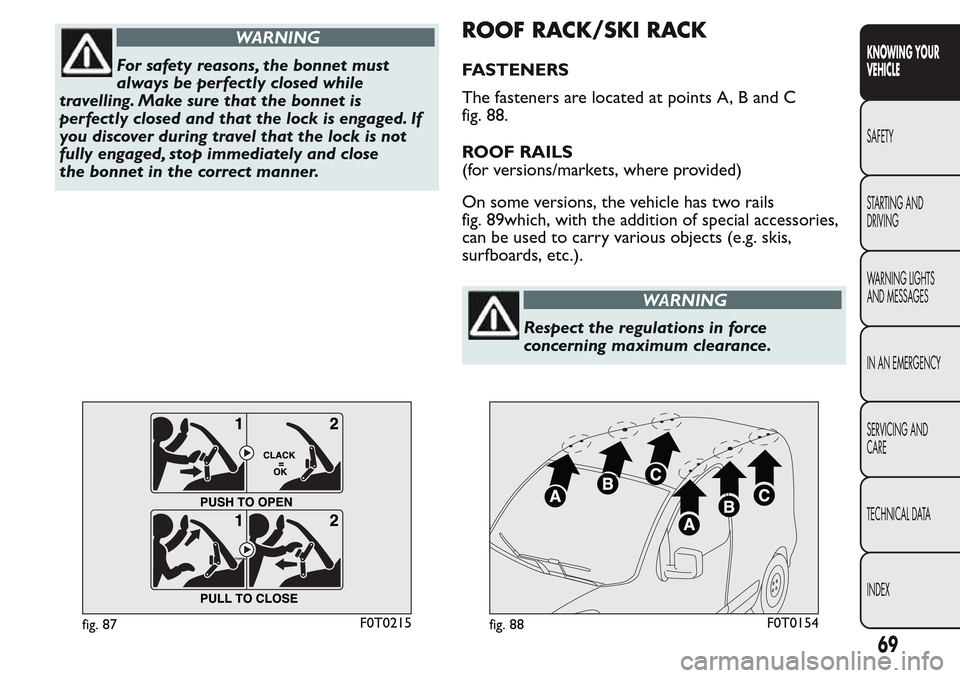
The fasteners are located at points A, B and C
fig. 88.
ROOF RAILS
(for versions/markets, where provided)
On some versions, the vehicle has two rails
fig. 89which, with the addition of special accessories,
can be used to carry various objects (e.g. skis,
surfboards, etc.).
WARNING
Respect the regulations in force
concerning maximum clearance.
fig. 87F0T0215fig. 88F0T0154
69
KNOWING YOUR
VEHICLE
SAFETY
STARTING AND
DRIVING
WARNING LIGHTS
AND MESSAGES
IN AN EMERGENCY
SERVICING AND
CARE
TECHNICAL DATA
INDEX
Page 84 of 260
WARNING
If the car must be placed on a roller
bench (at a speed within 5 and 30 km/h)
for maintenance interventions or if it is washed
in an automatic roller washing tunnel with an
obstacle in the front part (e.g. another car, a
wall or another obstacle), the system may
detect its presence and activate. In this case the
system must be deactivated through the
display Setup Menu.
The laser sensor may have limited or
absent operation due to weather
conditions such as: heavy rain, hail, thick
fog, heavy snow, formation of ice layers on the
windscreen.
Sensor operation may also be
compromised by the presence of dust ,
condensation, dirt or ice on the
windscreen, by traffic conditions (e.g. vehicles
that are driving not aligned with your car, vehicle
driving in a transverse or opposite way on the
same lane, bend with a small radius of curvature),
by road surface conditions and by driving
conditions (e.g. off-road driving). Make sure the
windscreen is always clean. Use specific
detergents and clean cloths to avoid scratching
the windscreen.The sensor operation may also be
limited or absent in some driving, traffic and
road surface conditions.
Projecting loads on the roof of the car
may interfere with the correct operation
of the sensor. Before starting make sure
the load is correctly positioned, in order not to
cover the sensor operating range.
If the windscreen must be replaced due to
scratches, chipping or breakage, contact
exclusively a Fiat Dealership. Do not
replace the windscreen on your own, risk of
malfunction! It is advisable to replace the
windscreen if it is damaged in the laser sensor
area.
Do not tamper nor operate on the laser
sensor. Do not close the openings in the
aesthetic cover located under the interior
rear view mirror. In the event of a sensor failure,
contact a Fiat Dealership.
If you are driving on roads close to trees
with protruding branches it is advisable to
deactivate the system to prevent the
branches at the height of the bonnet or the
windscreen from interfering with the system.
80
KNOWING YOUR
VEHICLE
SAFETY
STARTING AND
DRIVING
WARNING LIGHTS
AND MESSAGES
IN AN EMERGENCY
SERVICING AND
CARE
TECHNICAL DATA
INDEX
Page 96 of 260
INSTALLING ELECTRICAL/
ELECTRONIC DEVICES
Electrical and electronic devices installed after buying
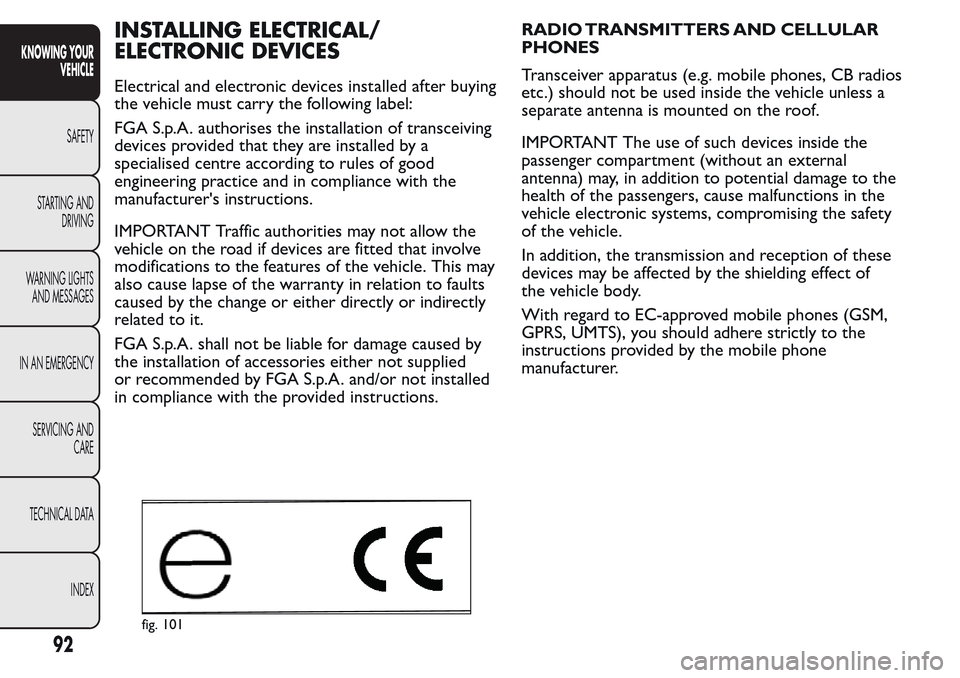
the vehicle must carry the following label:
FGA S.p.A. authorises the installation of transceiving
devices provided that they are installed by a
specialised centre according to rules of good
engineering practice and in compliance with the
manufacturer's instructions.
IMPORTANT Traffic authorities may not allow the
vehicle on the road if devices are fitted that involve
modifications to the features of the vehicle. This may
also cause lapse of the warranty in relation to faults
caused by the change or either directly or indirectly
related to it.
FGA S.p.A. shall not be liable for damage caused by
the installation of accessories either not supplied
or recommended by FGA S.p.A. and/or not installed
in compliance with the provided instructions.RADIO TRANSMITTERS AND CELLULAR
PHONES
Transceiver apparatus (e.g. mobile phones, CB radios
etc.) should not be used inside the vehicle unless a
separate antenna is mounted on the roof.
IMPORTANT The use of such devices inside the
passenger compartment (without an external
antenna) may, in addition to potential damage to the
health of the passengers, cause malfunctions in the
vehicle electronic systems, compromising the safety
of the vehicle.
In addition, the transmission and reception of these
devices may be affected by the shielding effect of
the vehicle body.
With regard to EC-approved mobile phones (GSM,
GPRS, UMTS), you should adhere strictly to the
instructions provided by the mobile phone
manufacturer.
fig. 101
92
KNOWING YOUR
VEHICLE
SAFETY
STARTING AND
DRIVING
WARNING LIGHTS
AND MESSAGES
IN AN EMERGENCY
SERVICING AND
CARE
TECHNICAL DATA
INDEX
Page 132 of 260
SAVING FUEL
Some useful tips are given below for fuel saving and
reducing harmful emissions of CO2 and other
pollutants (nitrogen oxides, unburnt hydrocarbons,
Particulate Matter (PM) etc.).
GENERAL CONSIDERATIONS
The general factors that affect fuel consumption are
listed below.
Vehicle maintenance
Have checks and adjustments carried out in
accordance with the “Scheduled Servicing Plan”.
Ty r e s
Check the tyre pressure at least once every four
weeks: if the pressure is too low, consumption levels
increase as resistance to rolling is higher.
Unnecessary loads
Do not travel with an overloaded boot. The weight
of the vehicle (especially when driving in town)
and its trim greatly affect fuel consumption
and stability.
Roof rack/ski rack
Remove the roof rack or the ski rack from the roof
after use. These accessories reduce the aerodynamic
coefficient of the vehicle and have a negative effecton fuel consumption. It is better to use a trailer to
transport particularly bulky objects.
Electric devices
Only use electrical devices for the amount of time
needed. The heated rear window, additional
headlights, windscreen/rear window wipers and
heater fan need a considerable amount of energy,
therefore increasing fuel consumption (by up to 25%
in the urban cycle).
Climate control system
The air conditioner leads to higher fuel consumption
(on average up to +20%). If the temperature outside
is not too extreme, try and use the air vents.
Spoilers
The use of non-certified spoilers may adversely affect
aerodynamics and fuel consumption.
128
KNOWING YOUR
VEHICLE
SAFETY
STARTING AND
DRIVING
WARNING LIGHTS
AND MESSAGES
IN AN EMERGENCY
SERVICING AND
CARE
TECHNICAL DATA
INDEX
Page 170 of 260
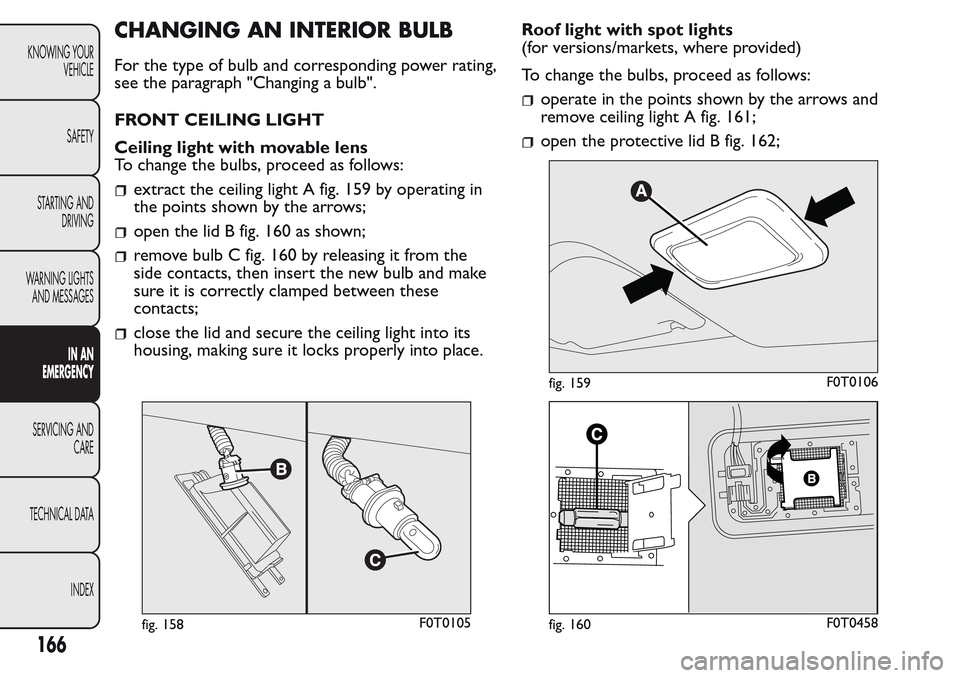
CHANGING AN INTERIOR BULB
For the type of bulb and corresponding power rating,
see the paragraph "Changing a bulb".
FRONT CEILING LIGHT
Ceiling light with movable lens
To change the bulbs, proceed as follows:
extract the ceiling light A fig. 159 by operating in
the points shown by the arrows;
open the lid B fig. 160 as shown;
remove bulb C fig. 160 by releasing it from the
side contacts, then insert the new bulb and make
sure it is correctly clamped between these
contacts;
close the lid and secure the ceiling light into its
housing, making sure it locks properly into place.Roof light with spot lights
(for versions/markets, where provided)
To change the bulbs, proceed as follows:
operate in the points shown by the arrows and
remove ceiling light A fig. 161;
open the protective lid B fig. 162;
fig. 158F0T0105
fig. 159F0T0106
fig. 160F0T0458
166
KNOWING YOUR
VEHICLE
SAFETY
STARTING AND
DRIVING
WARNING LIGHTS
AND MESSAGES
IN AN
EMERGENCY
SERVICING AND
CARE
TECHNICAL DATA
INDEX
Page 208 of 260
painting products and systems which give the
vehicle particular resistance to corrosion and
abrasion;
use of galvanised (or pre-treated) steel sheets,
with high resistance to corrosion;
spraying the underbody, engine compartment,
wheelhouse internal parts and other parts with
highly protective wax products;
spraying of plastic materials for protective
purposes in the most exposed points: under the
doors, inside the mudguard, along the edges, etc.
use of “open” boxed sections to prevent
condensation and pockets of moisture from
triggering rust inside.
VEHICLE BODY AND UNDERBODY
WARRANTY
Your vehicle is covered by warranty against
perforation due to rust of any original element of the
structure or body.
For the general terms of this warranty, refer to your
Warranty Booklet.ADVICE FOR PRESERVING THE
BODYWORK
Paint
Paintwork does not only serve an aesthetic purpose,
but also protects the underlying sheet metal.
Touch up abrasions and scratches immediately to
prevent the formation of rust. Use only original paint
products for touch-ups (see “Bodywork paint
identification plate” in the “Technical specifications”
section).
Normal care for paintwork consists of washing the
car; how often depends on the conditions and
environment where the car is used.
For example, it is advisable to wash the vehicle more
often in areas with high atmospheric pollution or if
you are travelling on roads sprinkled with salt.
To wash the vehicle properly, proceed as follows:
wash the body using a low pressure jet of water;
wipe a sponge with a slightly soapy solution over
the bodywork, frequently rinsing with the sponge;
rinse well with water and dry with a jet of air or a
chamois leather.
If you put the vehicle through a car wash, follow
these recommendations:
remove the antenna from the roof so it does not
get damaged;
the car wash should use water added to a soapy
solution;
204
KNOWING YOUR
VEHICLE
SAFETY
STARTING AND
DRIVING
WARNING LIGHTS
AND MESSAGES
IN AN EMERGENCY
SERVICING AND
CARE
TECHNICAL DATA
INDEX
Page 226 of 260
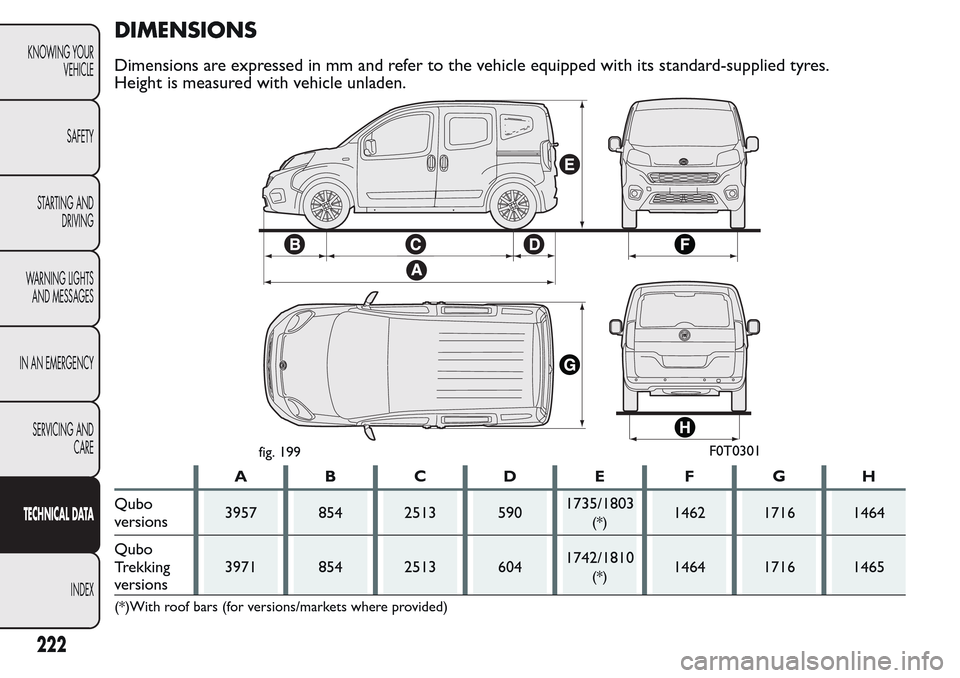
DIMENSIONS
Dimensions are expressed in mm and refer to the vehicle equipped with its standard-supplied tyres.
Height is measured with vehicle unladen.
ABCDE FGH
Qubo
versions3957 854 2513 5901735/1803
(*)1462 1716 1464
Qubo
Trekking
versions3971 854 2513 6041742/1810
(*)1464 1716 1465
(*)With roof bars (for versions/markets where provided)
fig. 199F0T0301
222
KNOWING YOUR
VEHICLE
SAFETY
STARTING AND
DRIVING
WARNING LIGHTS
AND MESSAGES
IN AN EMERGENCY
SERVICING AND
CARE
TECHNICAL DATA
INDEX
Page 228 of 260
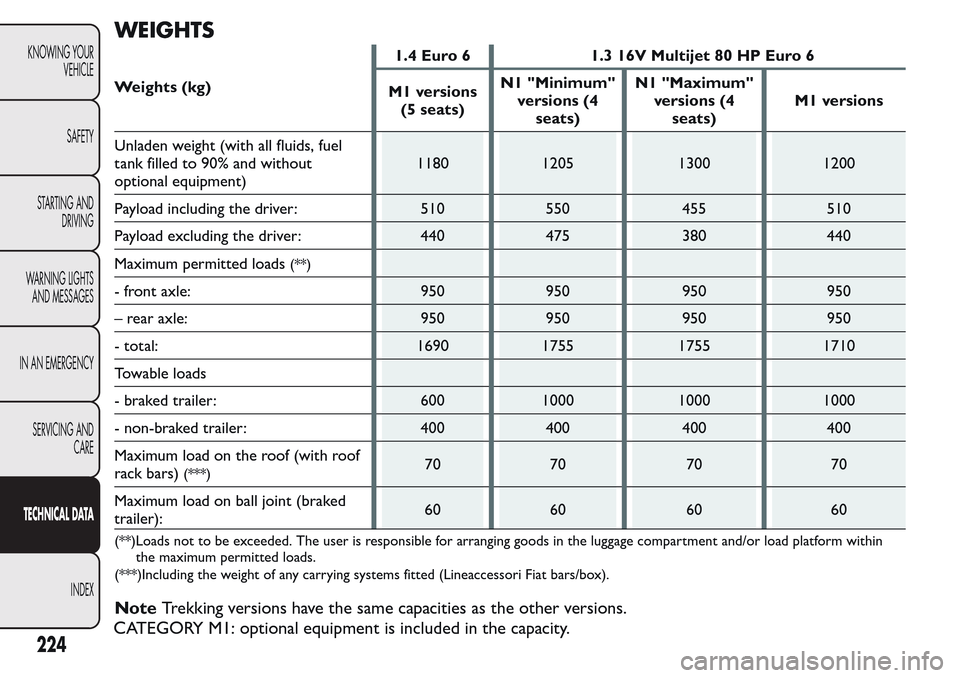
WEIGHTS
Weights (kg)1.4 Euro 6 1.3 16V Multijet 80 HP Euro 6
M1 versions
(5 seats)N1 "Minimum"
versions (4
seats)N1 "Maximum"
versions (4
seats)M1 versions
Unladen weight (with all fluids, fuel
tank filled to 90% and without
optional equipment)1180 1205 1300 1200
Payload including the driver: 510 550 455 510
Payload excluding the driver: 440 475 380 440
Maximum permitted loads
(**)
- front axle: 950 950 950 950
– rear axle: 950 950 950 950
- total: 1690 1755 1755 1710
Towable loads
- braked trailer: 600 1000 1000 1000
- non-braked trailer: 400 400 400 400
Maximum load on the roof (with roof
rack bars)
(***)70 70 70 70
Maximum load on ball joint (braked
trailer):60 60 60 60
(**)Loads not to be exceeded. The user is responsible for arranging goods in the luggage compartment and/or load platform within
the maximum permitted loads.
(***)Including the weight of any carrying systems fitted (Lineaccessori Fiat bars/box).
NoteTrekking versions have the same capacities as the other versions.
224
KNOWING YOUR
VEHICLE
SAFETY
STARTING AND
DRIVING
WARNING LIGHTS
AND MESSAGES
IN AN EMERGENCY
SERVICING AND
CARE
TECHNICAL DATA
INDEX
CATEGORY M1: optional equipment is included in the capacity.
Page 229 of 260
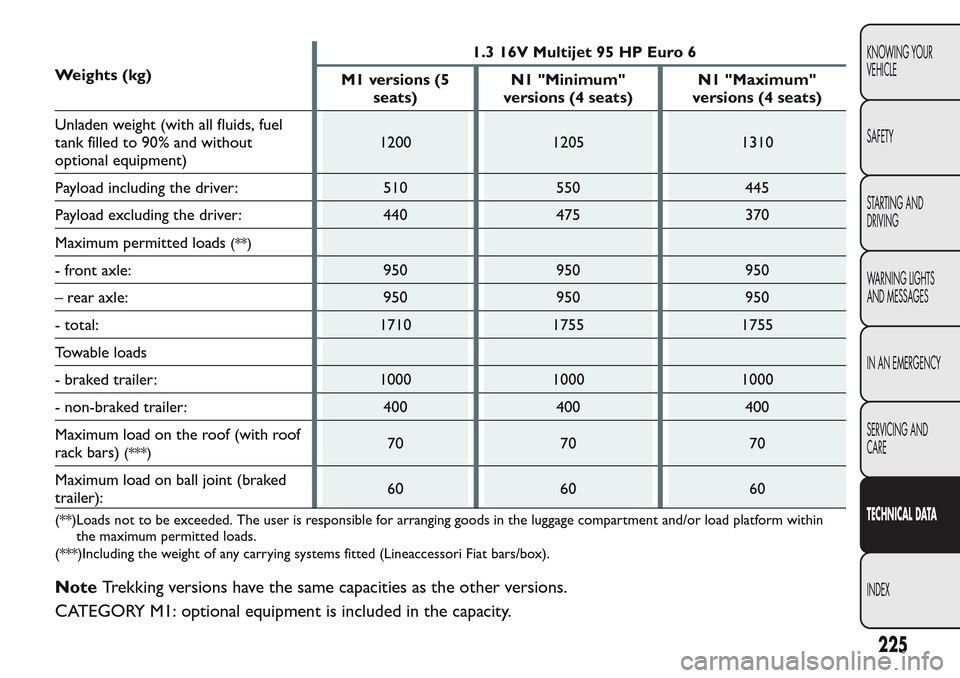
Weights (kg)1.3 16V Multijet 95 HP Euro 6
M1 versions (5
seats)N1 "Minimum"
versions (4 seats)N1 "Maximum"
versions (4 seats)
Unladen weight (with all fluids, fuel
tank filled to 90% and without
optional equipment)1200 1205 1310
Payload including the driver: 510 550 445
Payload excluding the driver: 440 475 370
Maximum permitted loads
(**)
- front axle: 950 950 950
– rear axle: 950 950 950
- total: 1710 1755 1755
Towable loads
- braked trailer: 1000 1000 1000
- non-braked trailer: 400 400 400
Maximum load on the roof (with roof
rack bars)
(***)70 70 70
Maximum load on ball joint (braked
trailer):60 60 60
(**)Loads not to be exceeded. The user is responsible for arranging goods in the luggage compartment and/or load platform within
the maximum permitted loads.
(***)Including the weight of any carrying systems fitted (Lineaccessori Fiat bars/box).
NoteTrekking versions have the same capacities as the other versions.
CATEGORY M1: optional equipment is included in the capacity.
225
KNOWING YOUR
VEHICLE
SAFETY
STARTING AND
DRIVING
WARNING LIGHTS
AND MESSAGES
IN AN EMERGENCY
SERVICING AND
CARE
TECHNICAL DATA
INDEX
Page 237 of 260
FUEL CONSUMPTION
The fuel consumption figures given in the table below are determined on the basis of the type-approval tests
laid down by specific European Directives.
The following procedures are used to measure the fuel consumption:
urban cycle: cold starting followed by driving that simulates urban use of the car;
extra-urban cycle: frequent accelerating in all gears, simulating extra-urban use of the car: speed varies
between 0 and 120 km/h;
combined fuel consumption: calculated with a weighting of approximately 37% of the urban cycle and 63%
of the extra-urban cycle.
IMPORTANT The type of route, traffic conditions, weather conditions, driving style, general condition of the
vehicle, trim level/equipment/accessories, use of the climate control system, vehicle load, presence of roof
racks and other situations that adversely affect the aerodynamics or wind resistance lead to different fuel
consumption values than those measured.
233
KNOWING YOUR
VEHICLE
SAFETY
STARTING AND
DRIVING
WARNING LIGHTS
AND MESSAGES
IN AN EMERGENCY
SERVICING AND
CARE
TECHNICAL DATA
INDEX