RAIN FIAT SCUDO 2007 2.G User Guide
[x] Cancel search | Manufacturer: FIAT, Model Year: 2007, Model line: SCUDO, Model: FIAT SCUDO 2007 2.GPages: 210, PDF Size: 3.29 MB
Page 43 of 210
42
SAFETY
DEVICES
CORRECT USE
OF THE
VEHICLE
WARNING
LIGHTS AND
MESSAGES
IN AN
EMERGENCY
VEHICLE
MAINTENANCE
TECHNICAL
SPECIFICATIONS
INDEX
DASHBOARD
AND
CONTROLS
When outside temperature is cold, recir-
culation is forced to off (outside air inlet)
to prevent window misting up.
In automatic operation inside air recircu-
lation will be controlled automatically by
the system according to outside environ-
mental conditions.Climate control compressor on/off
button A
Pressing button A/Cwill activate the com-
pressor and the display may show the
same wording A/Cto confirm activation.
With compressor on, pressing button
A/Cagain will deactivate the climate con-
trol compressor and therefore the word-
ing will disappear from the display.
When turning the compressor off, the sys-
tem will deactivate air recirculation to pre-
vent window misting up. If the system is
no longer able to keep the required tem-
perature, temperature value will flash and
the wording AUTOwill disappear from
the display.IMPORTANT With the climate control
compressor off, it is not possible to admit
air to the passenger compartment with a
temperature below the outside tempera-
ture; moreover, under certain environ-
mental conditions, windows could mist up
fastly since air is not dehumidified.
The switching off of the climate control
compressor remains in storage even when
the engine has been stopped. To restore
automatic control for switching on the cli-
mate control compressor, press again but-
ton A/Cor press button AUTO.
With climate control compressor off, the
fan speed can be set to zero manually.
With compressor on and engine running,
the fan speed cannot be lower that one
bar on the display.
It is inadvisable to use air re-
circulation on rainy/cold
days as it would considerably increase
the possibility of windows misting up
inside.
WARNING
Page 52 of 210
51
SAFETY
DEVICES
CORRECT USE
OF THE
VEHICLE
WARNING
LIGHTS AND
MESSAGES
IN AN
EMERGENCY
VEHICLE
MAINTENANCE
TECHNICAL
SPECIFICATIONS
INDEX
DASHBOARD
AND CONTROLS
The rain sensor (fitted on certain versions
only), is an electronic device coupled to
the windscreen wiper with the purpose of
adjusting automatically, during the inter-
mittent operation, the frequency of the
windscreen wiper strokes as to the rain
intensity.
The rain sensor will activate automatical-
ly when moving the stalk to AUTO; its
range varies gradually from windscreen
wiper off (no wipe) when the windscreen
is dry, to wiper at first continuous speed
with heavy rain.
The activation of the rain sensor is sig-
nalled by a control acquisition “stroke”. RAIN SENSOR
(where provided)
The rain sensor is located behind the dri-
ving mirror in contact with the windscreen
and has the purpose of adjusting auto-
matically, during the intermittent opera-
tion, the frequency of the windscreen
wiper strokes as to the rain intensity.
IMPORTANT Keep clean the glass in the
sensor area.
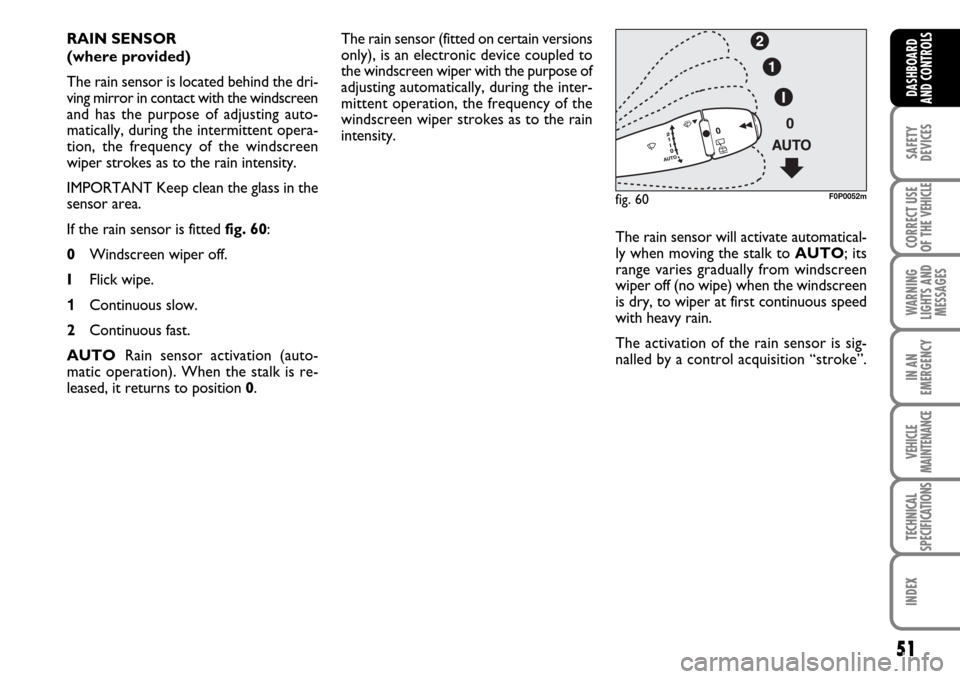
If the rain sensor is fitted fig. 60:
0Windscreen wiper off.
IFlick wipe.
1Continuous slow.
2Continuous fast.
AUTORain sensor activation (auto-
matic operation). When the stalk is re-
leased, it returns to position 0.
fig. 60F0P0052m
Page 53 of 210
52
SAFETY
DEVICES
CORRECT USE
OF THE
VEHICLE
WARNING
LIGHTS AND
MESSAGES
IN AN
EMERGENCY
VEHICLE
MAINTENANCE
TECHNICAL
SPECIFICATIONS
INDEX
DASHBOARD
AND
CONTROLS
Operating the windscreen washer with
the rain sensor activated the normal wash-
ing cycle is performed at the end of which
the rain sensor resumes its normal auto-
matic function.
So as to deactivate the rain sensor, put the
windscreen wiper command in the I, 1or
2positions. The deactivation is accompa-
nied by a message on the display.
To activate the rain sensor you have to
move the stalk to another position and
then back to AUTO.The rain sensor is able to recognize and
automatically adjust itself in the presence
of the following particular conditions:
❒impurities on the controlled surface
(salt, dirt, etc...);
❒streaks of water produced by worn
wiper blades;
❒difference between day and night (hu-
man eye is more bothered by wet glass
at night).Pulling the stalk towards the steering
wheel (unstable position), regardless of
the position of the knurled ring, operates
the windscreen washer and if the dipped
or high beams are on, also the headlight
washer (where provided).
Windscreen wiper will then perform three
wiping strokes.
Do not activate the rain sen-
sor when washing the vehi-
cle at automatic car-wash stations.
WARNING
When cleaning or washing
the windscreen make sure the
rain sensor is off.
WARNING
Do not activate the rain sen-
sor if the windscreen is icy.
WARNING
Page 61 of 210
60
SAFETY
DEVICES
CORRECT USE
OF THE
VEHICLE
WARNING
LIGHTS AND
MESSAGES
IN AN
EMERGENCY
VEHICLE
MAINTENANCE
TECHNICAL
SPECIFICATIONS
INDEX
DASHBOARD
AND
CONTROLS
CEILING LIGHTS
FRONT CEILING LIGHT
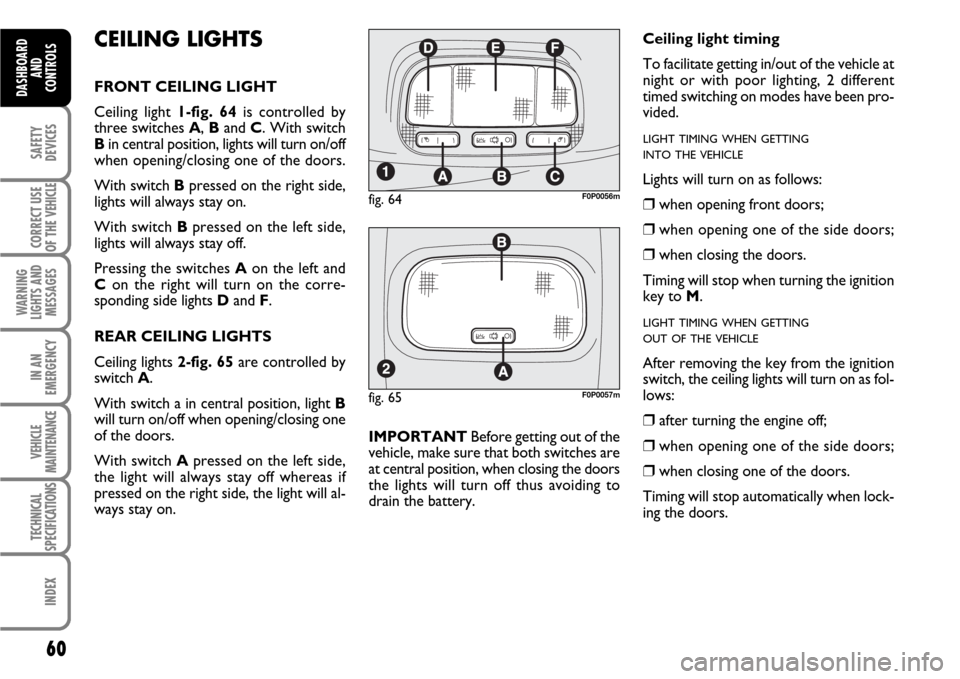
Ceiling light 1-fig. 64is controlled by
three switches A, Band C. With switch
Bin central position, lights will turn on/off
when opening/closing one of the doors.
With switch Bpressed on the right side,
lights will always stay on.
With switch Bpressed on the left side,
lights will always stay off.
Pressing the switches Aon the left and
Con the right will turn on the corre-
sponding side lights Dand F.
REAR CEILING LIGHTS
Ceiling lights 2-fig. 65are controlled by
switch A.
With switch a in central position, light B
will turn on/off when opening/closing one
of the doors.
With switch Apressed on the left side,
the light will always stay off whereas if
pressed on the right side, the light will al-
ways stay on.IMPORTANTBefore getting out of the
vehicle, make sure that both switches are
at central position, when closing the doors
the lights will turn off thus avoiding to
drain the battery.
fig. 65F0P0057m
Ceiling light timing
To facilitate getting in/out of the vehicle at
night or with poor lighting, 2 different
timed switching on modes have been pro-
vided.
LIGHT TIMING WHEN GETTING
INTO THE VEHICLE
Lights will turn on as follows:
❒when opening front doors;
❒when opening one of the side doors;
❒when closing the doors.
Timing will stop when turning the ignition
key to M.
LIGHT TIMING WHEN GETTING
OUT OF THE VEHICLE
After removing the key from the ignition
switch, the ceiling lights will turn on as fol-
lows:
❒after turning the engine off;
❒when opening one of the side doors;
❒when closing one of the doors.
Timing will stop automatically when lock-
ing the doors.
fig. 64F0P0056m
Page 80 of 210
79
SAFETY
DEVICES
CORRECT USE
OF THE
VEHICLE
WARNING
LIGHTS AND
MESSAGES
IN AN
EMERGENCY
VEHICLE
MAINTENANCE
TECHNICAL
SPECIFICATIONS
INDEX
DASHBOARD
AND CONTROLS
AUTOMATIC ADJUSTMENT
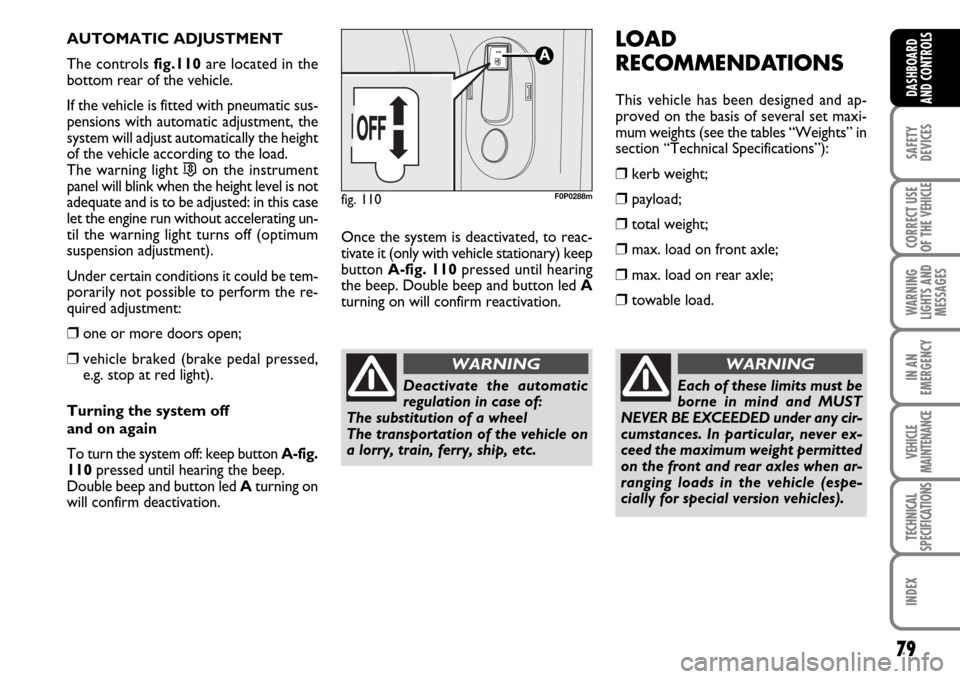
The controls fig.110are located in the
bottom rear of the vehicle.
If the vehicle is fitted with pneumatic sus-
pensions with automatic adjustment, the
system will adjust automatically the height
of the vehicle according to the load.
The warning light
…on the instrument
panel will blink when the height level is not
adequate and is to be adjusted: in this case
let the engine run without accelerating un-
til the warning light turns off (optimum
suspension adjustment).
Under certain conditions it could be tem-
porarily not possible to perform the re-
quired adjustment:
❒one or more doors open;
❒vehicle braked (brake pedal pressed,
e.g. stop at red light).
Turning the system off
and on again
To turn the system off: keep button A-fig.
110pressed until hearing the beep.
Double beep and button led Aturning on
will confirm deactivation.Once the system is deactivated, to reac-
tivate it (only with vehicle stationary) keep
button A-fig. 110pressed until hearing
the beep. Double beep and button led A
turning on will confirm reactivation.
fig. 110F0P0288m
LOAD
RECOMMENDATIONS
This vehicle has been designed and ap-
proved on the basis of several set maxi-
mum weights (see the tables “Weights” in
section “Technical Specifications”):
❒kerb weight;
❒payload;
❒total weight;
❒max. load on front axle;
❒max. load on rear axle;
❒towable load.
Each of these limits must be
borne in mind and MUST
NEVER BE EXCEEDED under any cir-
cumstances. In particular, never ex-
ceed the maximum weight permitted
on the front and rear axles when ar-
ranging loads in the vehicle (espe-
cially for special version vehicles).
WARNING
Deactivate the automatic
regulation in case of:
The substitution of a wheel
The transportation of the vehicle on
a lorry, train, ferry, ship, etc.
WARNING
Page 83 of 210
82
SAFETY
DEVICES
CORRECT USE
OF THE
VEHICLE
WARNING
LIGHTS AND
MESSAGES
IN AN
EMERGENCY
VEHICLE
MAINTENANCE
TECHNICAL
SPECIFICATIONS
INDEX
DASHBOARD
AND CONTROLS
ADJUSTING THE
HEADLIGHT BEAM
Proper adjustment of the headlight beams
is of vital importance for your safety and
comfort and also for the other road users.
In addition it is the subject of a precise reg-
ulation of the traffic code.
To ensure you and other drivers have the
best visibility conditions when travelling
with the headlights on, the headlights must
be set properly.
Contact Fiat Dealership to have the head-
lights properly adjusted.ABS SYSTEM
If you have never driven a vehicle with ABS
before, you should practice using the sys-
tem on slippery terrain, obviously with the
necessary safety precautions and keeping
to the Highway Code of the country you
are in. It is also a good idea to read the fol-
lowing information carefully.
The ABS system, integral with the braking
system, prevents the wheels from locking
when braking, makes the most of road grip
and gives the best control when emergency
braking under difficult road conditions.
System is completed by EBD (Electronic
Braking force Distribution), which dis-
tributes the braking action between front
and rear wheels.
IMPORTANT To have the maximum ef-
ficiency of the braking system, it is neces-
sary a setting period of about 500 km
(with new vehicle or after replacing brake
pads/discs): during this period it is better
to avoid sharp, repeated and prolonged
brakes.The ABS exploits the tyre-
road grip at the best, but it
cannot improve it; you should there-
fore take every care when driving on
slippery surfaces without taking un-
necessary risks.
WARNING
ABS SYSTEM INTERVENTION
The driver can tell the ABS system has
come into action because the brake pedal
pulsates slightly and the system gets noisi-
er: it means that the vehicle speed should
be altered to fit the type of road surface.
If the ABS system cuts in, it
is a sign that the grip be-
tween tyre and the road surface has
reached the limit: you must slow
down to match the speed to the road
grip available.
WARNING
Page 92 of 210
91
SAFETY
DEVICES
CORRECT USE
OF THE
VEHICLE
WARNING
LIGHTS AND
MESSAGES
IN AN
EMERGENCY
VEHICLE
MAINTENANCE
TECHNICAL
SPECIFICATIONS
INDEX
DASHBOARD
AND CONTROLS
Refuelling
To guarantee full tank filling, carry out two
refuelling operations after the first click of
the fuel delivery gun. Avoid further top-
ping up operations that could cause dam-
ages to the fuel system.
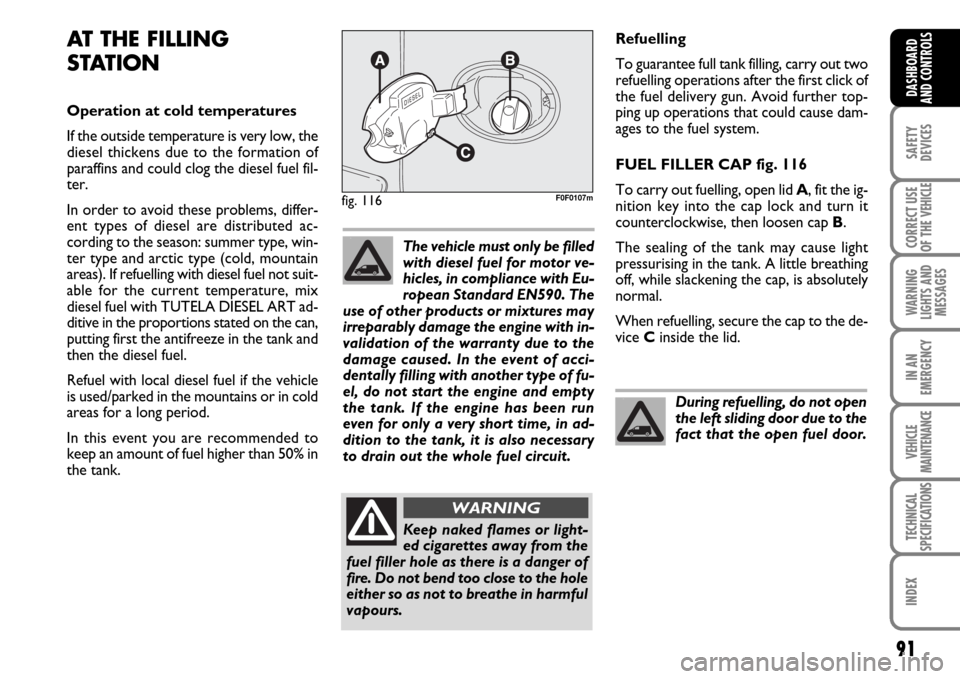
FUEL FILLER CAP fig. 116
To carry out fuelling, open lid A, fit the ig-
nition key into the cap lock and turn it
counterclockwise, then loosen cap B.
The sealing of the tank may cause light
pressurising in the tank. A little breathing
off, while slackening the cap, is absolutely
normal.
When refuelling, secure the cap to the de-
vice Cinside the lid.
fig. 116F0F0107m
AT THE FILLING
STATION
Operation at cold temperatures
If the outside temperature is very low, the
diesel thickens due to the formation of
paraffins and could clog the diesel fuel fil-
ter.
In order to avoid these problems, differ-
ent types of diesel are distributed ac-
cording to the season: summer type, win-
ter type and arctic type (cold, mountain
areas). If refuelling with diesel fuel not suit-
able for the current temperature, mix
diesel fuel with TUTELA DIESEL ART ad-
ditive in the proportions stated on the can,
putting first the antifreeze in the tank and
then the diesel fuel.
Refuel with local diesel fuel if the vehicle
is used/parked in the mountains or in cold
areas for a long period.
In this event you are recommended to
keep an amount of fuel higher than 50% in
the tank.The vehicle must only be filled
with diesel fuel for motor ve-
hicles, in compliance with Eu-
ropean Standard EN590. The
use of other products or mixtures may
irreparably damage the engine with in-
validation of the warranty due to the
damage caused. In the event of acci-
dentally filling with another type of fu-
el, do not start the engine and empty
the tank. If the engine has been run
even for only a very short time, in ad-
dition to the tank, it is also necessary
to drain out the whole fuel circuit.
Keep naked flames or light-
ed cigarettes away from the
fuel filler hole as there is a danger of
fire. Do not bend too close to the hole
either so as not to breathe in harmful
vapours.
WARNING
During refuelling, do not open
the left sliding door due to the
fact that the open fuel door.
Page 94 of 210
93
CORRECT USE
OF THE
VEHICLE
WARNING
LIGHTS AND
MESSAGES
IN AN
EMERGENCY
VEHICLE
MAINTENANCE
TECHNICAL
SPECIFICATIONS
INDEX
DASHBOARD
AND CONTROLS
SAFETY
DEVICES
SEAT BELTS .......................................................................... 94
S.B.R. SYSTEM ...................................................................... 96
PRETENSIONERS ................................................................ 96
CARRYING CHILDREN SAFELY .................................... 99
PRESETTING FOR MOUNTING THE
“UNIVERSAL ISOFIX” CHILD RESTRAINT
SYSTEM .................................................................................. 105
FRONT AIR BAGS .............................................................. 106
SIDE AIR BAGS .................................................................... 109
S S
A A
F F
E E
T T
Y Y
D D
E E
V V
I I
C C
E E
S S
Page 97 of 210
96
CORRECT USE
OF THE
VEHICLE
WARNING
LIGHTS AND
MESSAGES
IN AN
EMERGENCY
VEHICLE
MAINTENANCE
TECHNICAL
SPECIFICATIONS
IINDEX
DASHBOARD
AND CONTROLS
SAFETY
DEVICES
PRETENSIONERS
To increase the efficiency of the seat belts,
the vehicle is fitted with pretensioners.
These devices, in the event of a violent
front crash, rewind the seat belts a few
centimetres. In this way they ensure that
the seat belt adheres perfectly to the
wearer before the restraining action be-
gins.
The seat belt locks to indicate that the de-
vice has intervened; the seat belt cannot
be drawn back up even when guiding it
manually.
IMPORTANT To obtain the highest de-
gree of protection from the action of the
pretensioning device, wear the seat belt
keeping it firmly close to the chest and
pelvis.
A small amount of smoke may be pro-
duced. This smoke is in no way toxic and
presents no fire hazard.
The pretensioner does not require any
maintenance or greasing.
Anything that modifies its original condi-
tions invalidates its efficiency.
If due to unusual natural events (floods,
seas storm, etc.) the device has been af-
fected by water and mud, it must neces-
sarily be replaced.LOAD LIMITERS
To increase passenger’s safety, the front
seat belt reels contain a load limiter which
allows controlled sag in such a way as to
dose the force acting on the chest and
shoulders during the belt restraining ac-
tion in case of front crash.The pretensioner can only
be used once. After a colli-
sion that has triggered it, have it re-
placed at a Fiat Dealership.
Pretensioner validity is indicated on
the label in the glove compartment:
the pretensioners should be replaced
at a Fiat Dealership as this date ap-
proaches.
WARNING
Operations which lead to
knocks, vibrations or localised
heating (over 100°C for a
maximum of 6 hours) in the
area around the pretensioners may
cause damage or trigger them.
These devices are not affected by vi-
brations caused by irregularities of the
road surface or low obstacles such as
kerbs, etc. Contact a Fiat Dealership
for any assistance.
S.B.R. SYSTEM
The vehicle is fitted with the S.B.R. system
(Seat Belt Reminder), consisting of a
buzzer which, together with the turning
on of warning light
senger to fasten the seat belt.
The buzzer can be deactivated (until the
next engine stop) as follows:
❒fasten the driver’s and passenger’s seat
belt;
❒turn the ignition key to M;
❒wait for over 20 seconds and then re-
lease one of the seat belts.
For permanent deactivation, contact Fiat
Dealership.
Page 100 of 210

99
CORRECT USE
OF THE
VEHICLE
WARNING
LIGHTS AND
MESSAGES
IN AN
EMERGENCY
VEHICLE
MAINTENANCE
TECHNICAL
SPECIFICATIONS
INDEX
DASHBOARD
AND CONTROLS
SAFETY
DEVICES
HOW TO KEEP THE SEAT
BELTS ALWAYS IN EFFICIENT
CONDITIONS
Observe the following:
❒always use the belt with the tap taut and
never twisted; make sure that it is free
to run without impediments;
❒after a serious accident, replace the belt
being worn at that time, even if it does
not appear damaged. Always replace
the seat belt if pretensioners have been
activated;
❒to clean the belts, wash by hand with
neutral soap, rinse and leave to dry in
the shade. Never use strong deter-
gents, bleach or dyes or other chemi-
cal substance that might weaken the fi-
bres;
❒prevent the reels from getting wet:
their correct operation is only guaran-
teed if water does not get inside;
❒replace the seat belt when showing sig-
nificant wear or cut signs.For optimal protection in the event of a
crash, all passengers must be seated and
wearing adequate restraint systems.
This is even more important for children.
This prescription is compulsory in all EC
countries according to EC Directive
2003/20/EC.
Compared with adults, their head is pro-
portionally larger and heavier than the rest
of the body, while the muscles and bone
structure are not completely developed.
Therefore, correct restraint systems are
necessary, other than adult seat belts.
The results of research on the best child
restraint systems are contained in the Eu-
ropean Standard EEC-R44. This Standard
enforces the use of restraint systems clas-
sified in five groups: Group 0 0-10 kg in weight
Group 0+ 0-13 kg in weight
Group 1 9-18 kg in weight
Group 2 15-25 kg in weight
Group 3 22-36 kg in weight
As it may be noted, the groups overlap
partly and in fact, in commerce it is pos-
sible to find devices that cover more than
one weight group.
All restraint devices must bear the certi-
fication data, together with the control
brand, on a solidly fixed label which must
absolutely never be removed.
CARRYING CHILDREN SAFELY