ABS FIAT SCUDO 2011 Owner handbook (in English)
[x] Cancel search | Manufacturer: FIAT, Model Year: 2011, Model line: SCUDO, Model: FIAT SCUDO 2011Pages: 210, PDF Size: 3.29 MB
Page 166 of 210
165
WARNING
LIGHTS AND
MESSAGES
TECHNICAL
SPECIFICATIONS
INDEX
DASHBOARD
AND CONTROLS
SAFETY
DEVICES
CORRECT USE
OF THE
VEHICLE
IN AN
EMERGENCY
VEHICLE
MAINTENANCEIMPORTANTThe charge in the battery
should be checked every year, preferably
at the start of winter to limit the risk of
electrolyte freezing. This check should be
carried out more frequently if the vehi-
cle is used mainly for short trips, or if it
is fitted with accessories that permanent-
ly absorb electricity even with the ignition
key removed, especially in the case of af-
ter market accessories.
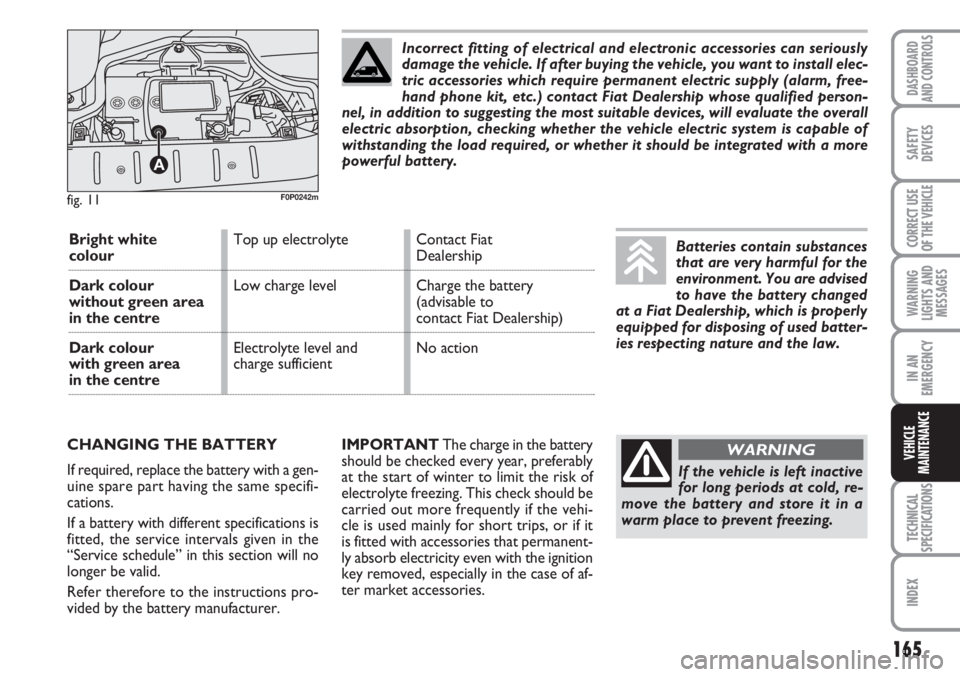
fig. 11
A
F0P0242m
Bright whiteTop up electrolyte Contact Fiat colourDealership
Dark colourLow charge level Charge the battery
without green area (advisable to
in the centrecontact Fiat Dealership)
Dark colour Electrolyte level and No action
with green area charge sufficient
in the centre
CHANGING THE BATTERY
If required, replace the battery with a gen-
uine spare part having the same specifi-
cations.
If a battery with different specifications is
fitted, the service intervals given in the
“Service schedule” in this section will no
longer be valid.
Refer therefore to the instructions pro-
vided by the battery manufacturer.Incorrect fitting of electrical and electronic accessories can seriously
damage the vehicle. If after buying the vehicle, you want to install elec-
tric accessories which require permanent electric supply (alarm, free-
hand phone kit, etc.) contact Fiat Dealership whose qualified person-
nel, in addition to suggesting the most suitable devices, will evaluate the overall
electric absorption, checking whether the vehicle electric system is capable of
withstanding the load required, or whether it should be integrated with a more
powerful battery.
Batteries contain substances
that are very harmful for the
environment. You are advised
to have the battery changed
at a Fiat Dealership, which is properly
equipped for disposing of used batter-
ies respecting nature and the law.
If the vehicle is left inactive
for long periods at cold, re-
move the battery and store it in a
warm place to prevent freezing.
WARNING
Page 167 of 210
166
WARNING
LIGHTS AND
MESSAGES
TECHNICAL
SPECIFICATIONS
INDEX
DASHBOARD
AND CONTROLS
SAFETY
DEVICES
CORRECT USE
OF THE
VEHICLE
IN AN
EMERGENCY
VEHICLE
MAINTENANCE
IMPORTANT A battery which is kept at
a charge of less than 50% (optical indica-
tor with dark colour without green area
in the middle) for any length of time will
be damaged by sulphation leading to a re-
duction in cranking power.
Moreover, this might lead to a higher risk
of the battery electrolyte freezing (this
may even occur at -10° C). If the vehicle
is inactive for a long period of time, refer
to “Vehicle inactivity”, in section “Correct
use of the vehicle”.
If after buying the vehicle, you want to in-
stall electric accessories which require
permanent electric supply (alarm, etc.)
contact Fiat Dealership whose qualified
personnel, in addition to suggesting the
most suitable devices, will evaluate the
overall electric absorption, checking
whether the vehicle’s electric system is ca-
pable of withstanding the load required,
or whether it should be integrated with
a more powerful battery. USEFUL ADVICE FOR
LENGTHENING THE LIFE OF
YOUR BATTERY
To avoid draining your battery and length-
en its life, observe the following indica-
tions:
❒when you park the vehicle, ensure the
doors, tailgate and bonnet are closed
properly, the ceiling lights must be off;
❒turn the ceiling lights off. The vehicle
however, is provided with an automat-
ic system for switching off internal
lights;
❒do not keep accessories (e.g. sound sys-
tem, hazard lights, etc.) switched on for
a long time when the engine is not run-
ning;
❒ before performing any operation on the
electrical system, disconnect the bat-
tery negative cable;
❒battery terminals shall always be per-
fectly tightened.
When working on the bat-
tery or near it, always wear
the proper goggles.
WARNINGIn fact, since these devices continue ab-
sorbing energy even when the ignition key
is off, they gradually run down the battery.
Page 173 of 210
172
WARNING
LIGHTS AND
MESSAGES
TECHNICAL
SPECIFICATIONS
INDEX
DASHBOARD
AND CONTROLS
SAFETY
DEVICES
CORRECT USE
OF THE
VEHICLE
IN AN
EMERGENCY
VEHICLE
MAINTENANCE
Fabric upholstery of your ve-
hicle is purpose-made to
withstand common wear re-
sulting from normal use of the
vehicle. It is however absolutely neces-
sary to prevent hard and/or prolonged
scratching/scraping caused by clothing
accessories like metallic buckles, studs,
“Velcro” fixings, etc. that stressing lo-
cally the fabric could break yarns and
damage the upholstery as a conse-
quence. CLEANING SEATS
AND FABRICS
Remove dust with a soft brush and vacu-
um cleaner. For velvet seats use a damp
brush.
Rub the seats with a sponge moistened
with a solution of water and neutral de-
tergent.Never use flammable prod-
ucts like oil ether or rectified
petrol for cleaning vehicle interiors.
Electrostatic discharges generated by
rubbing during cleaning operations
could cause fire.
WARNING
Do not keep aerosol cans in
the vehicle: they might ex-
plode. Aerosol cans must never be ex-
posed to a temperature above 50° C.
The temperature inside the vehicle
exposed to the sun may go well be-
yond that figure.
WARNING
INTERIORS
Periodically check that water is not trapped
under the mats (due to water dripping off
shoes, umbrellas, etc.) which could cause
oxidisation of the sheet metal.STEERING WHEEL/GEAR LEVER
KNOB WITH GENUINE
LEATHER COVERING
These components shall only be cleaned
with water and neutral soap.
Never use spirit or alcohol-based prod-
ucts.
Before using special products for clean-
ing interiors, read carefully label instruc-
tions and indications to make sure they
are free from spirit and/or alcohol-based
substances.
If when cleaning the windscreen with spe-
cial glass products, some drops fall on the
leather covering of the steering wheel/gear
lever knob remove them immediately and
then clean with water and neutral soap.
IMPORTANT Take the utmost care when
engaging the steering lock to prevent
scratching the leather covering.
INTERIOR PLASTIC PARTS
For routine cleaning of interior plastic parts
use a soft cloth moistened with water and
neutral soap. Remove grease or persisting
stains using appropriate solvent-free prod-
ucts designed to preserve appearance and
colour of plastic components.
IMPORTANT Never use spirit or petro-
leum to clean the instrument panel.
Page 197 of 210
196
WARNING
LIGHTS AND
MESSAGES
INDEX
DASHBOARD
AND CONTROLS
SAFETY
DEVICES
CORRECT USE
OF THE
VEHICLE
IN AN
EMERGENCY
VEHICLE
MAINTENANCE
TECHNICAL
SPECIFICATIONS
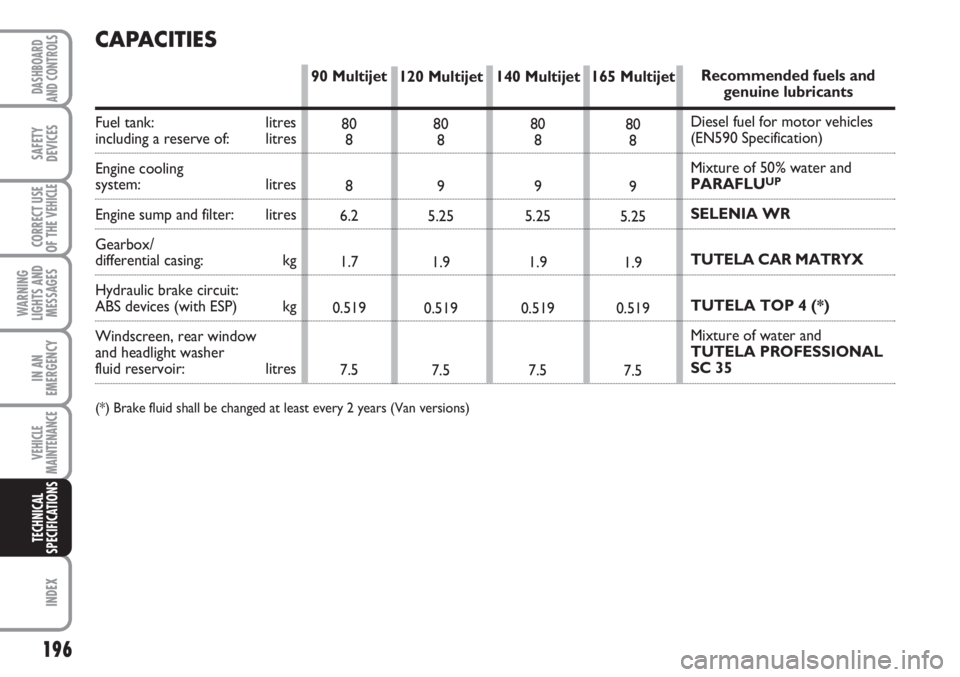
120 Multijet
80
8
9
5.25
1.9
0.519
7.5140 Multijet
80
8
9
5.25
1.9
0.519
7.5 90 Multijet
80
8
8
6.2
1.7
0.519
7.5
CAPACITIES
Fuel tank: litresincluding a reserve of: litres
Engine cooling
system: litres
Engine sump and filter: litres
Gearbox/
differential casing: kg
Hydraulic brake circuit:
ABS devices (with ESP) kg
Windscreen, rear window
and headlight washer
fluid reservoir: litres
(*) Brake fluid shall be changed at least every 2 years (Van versions)
Recommended fuels and
genuine lubricants
Diesel fuel for motor vehicles
(EN590 Specification)
Mixture of 50% water and
PARAFLU
UP
SELENIA WR
TUTELA CAR MATRYX
TUTELA TOP 4 (*)
Mixture of water and
TUTELA PROFESSIONAL
SC 35 165 Multijet
80
8
9
5.25
1.9
0.519
7.5
Page 203 of 210
202
WARNING
LIGHTS AND
MESSAGES
DASHBOARD
AND CONTROLS
SAFETY
DEVICES
CORRECT USE
OF THE
VEHICLE
IN AN
EMERGENCY
VEHICLE
MAINTENANCE
TECHNICAL
SPECIFICATIONS
INDEX
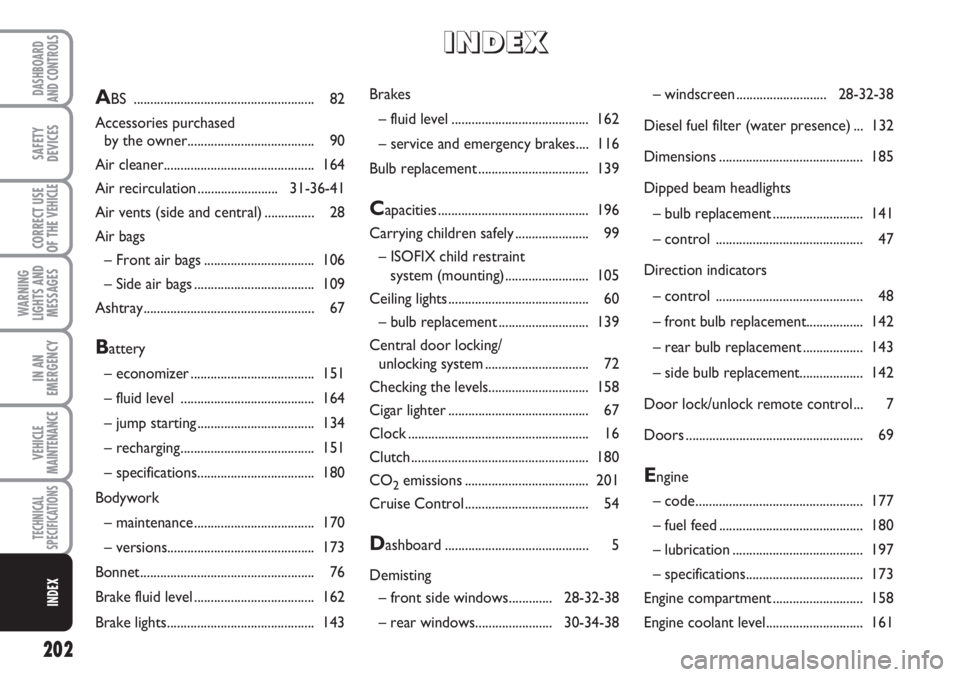
Brakes
– fluid level ......................................... 162
– service and emergency brakes.... 116
Bulb replacement................................. 139
Capacities ............................................. 196
Carrying children safely...................... 99
– ISOFIX child restraint
system (mounting)......................... 105
Ceiling lights.......................................... 60
– bulb replacement ........................... 139
Central door locking/
unlocking system............................... 72
Checking the levels.............................. 158
Cigar lighter .......................................... 67
Clock ...................................................... 16
Clutch..................................................... 180
CO
2emissions ..................................... 201
Cruise Control ..................................... 54
Dashboard ........................................... 5
Demisting
– front side windows.............28-32-38
– rear windows.......................30-34-38– windscreen...........................28-32-38
Diesel fuel filter (water presence) ... 132
Dimensions........................................... 185
Dipped beam headlights
– bulb replacement ........................... 141
– control ............................................ 47
Direction indicators
– control ............................................ 48
– front bulb replacement................. 142
– rear bulb replacement.................. 143
– side bulb replacement................... 142
Door lock/unlock remote control ... 7
Doors ..................................................... 69
Engine
– code.................................................. 177
– fuel feed ........................................... 180
– lubrication....................................... 197
– specifications................................... 173
Engine compartment........................... 158
Engine coolant level............................. 161
ABS ...................................................... 82
Accessories purchased
by the owner...................................... 90
Air cleaner............................................. 164
Air recirculation........................31-36-41
Air vents (side and central) ............... 28
Air bags
– Front air bags................................. 106
– Side air bags .................................... 109
Ashtray................................................... 67
Battery
– economizer..................................... 151
– fluid level ........................................ 164
– jump starting ................................... 134
– recharging........................................ 151
– specifications................................... 180
Bodywork
– maintenance.................................... 170
– versions............................................ 173
Bonnet.................................................... 76
Brake fluid level .................................... 162
Brake lights............................................ 143
I I
N N
D D
E E
X X