brake FIAT SCUDO 2011 Owner handbook (in English)
[x] Cancel search | Manufacturer: FIAT, Model Year: 2011, Model line: SCUDO, Model: FIAT SCUDO 2011Pages: 210, PDF Size: 3.29 MB
Page 141 of 210
140
WARNING
LIGHTS AND
MESSAGES
VEHICLE
MAINTENANCE
TECHNICAL
SPECIFICATIONS
INDEX
DASHBOARD
AND CONTROLS
SAFETY
DEVICES
CORRECT USE
OF THE
VEHICLE
IN AN
EMERGENCY
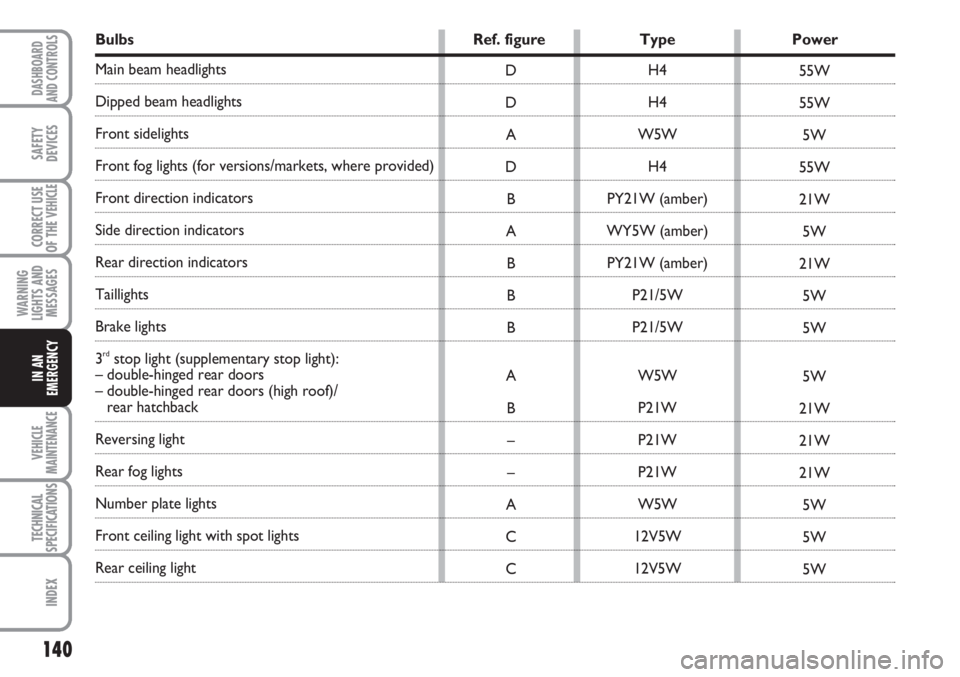
Bulbs Ref. figure Type Power
Main beam headlights
Dipped beam headlights
Front sidelights
Front fog lights (for versions/markets, where provided)
Front direction indicators
Side direction indicators
Rear direction indicators
Taillights
Brake lights
3
rdstop light (supplementary stop light):
– double-hinged rear doors
– double-hinged rear doors (high roof)/
rear hatchback
Reversing light
Rear fog lights
Number plate lights
Front ceiling light with spot lights
Rear ceiling lightH4
H4
W5W
H4
PY21W (amber)
WY5W (amber)
PY21W (amber)
P21/5W
P21/5W
W5W
P21W
P21W
P21W
W5W
12V5W
12V5W D
D
A
D
B
A
B
B
B
A
B
–
–
A
C
C55W
55W
5W
55W
21W
5W
21W
5W
5W
5W
21W
21W
21W
5W
5W
5W
Page 144 of 210
143
WARNING
LIGHTS AND
MESSAGES
VEHICLE
MAINTENANCE
TECHNICAL
SPECIFICATIONS
INDEX
DASHBOARD
AND CONTROLS
SAFETY
DEVICES
CORRECT USE
OF THE
VEHICLE
IN AN
EMERGENCY
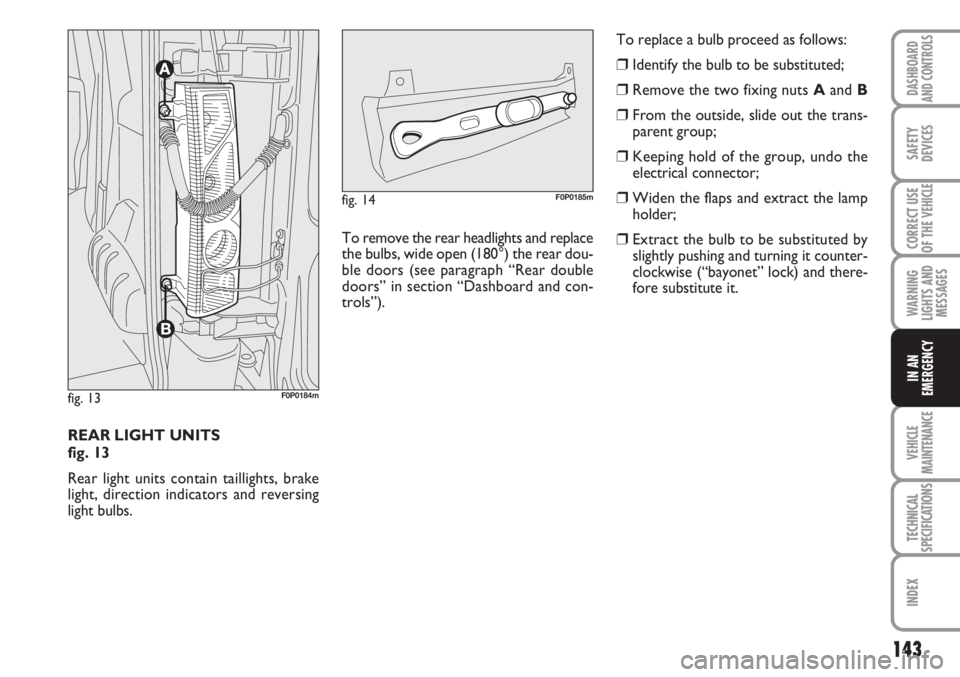
REAR LIGHT UNITS
fig. 13
Rear light units contain taillights, brake
light, direction indicators and reversing
light bulbs.
fig. 13F0P0184m
To remove the rear headlights and replace
the bulbs, wide open (180°) the rear dou-
ble doors (see paragraph “Rear double
doors” in section “Dashboard and con-
trols”).
fig. 14F0P0185m
To replace a bulb proceed as follows:
❒Identify the bulb to be substituted;
❒Remove the two fixing nuts Aand B
❒From the outside, slide out the trans-
parent group;
❒Keeping hold of the group, undo the
electrical connector;
❒Widen the flaps and extract the lamp
holder;
❒Extract the bulb to be substituted by
slightly pushing and turning it counter-
clockwise (“bayonet” lock) and there-
fore substitute it.
Page 145 of 210
144
WARNING
LIGHTS AND
MESSAGES
VEHICLE
MAINTENANCE
TECHNICAL
SPECIFICATIONS
INDEX
DASHBOARD
AND CONTROLS
SAFETY
DEVICES
CORRECT USE
OF THE
VEHICLE
IN AN
EMERGENCY
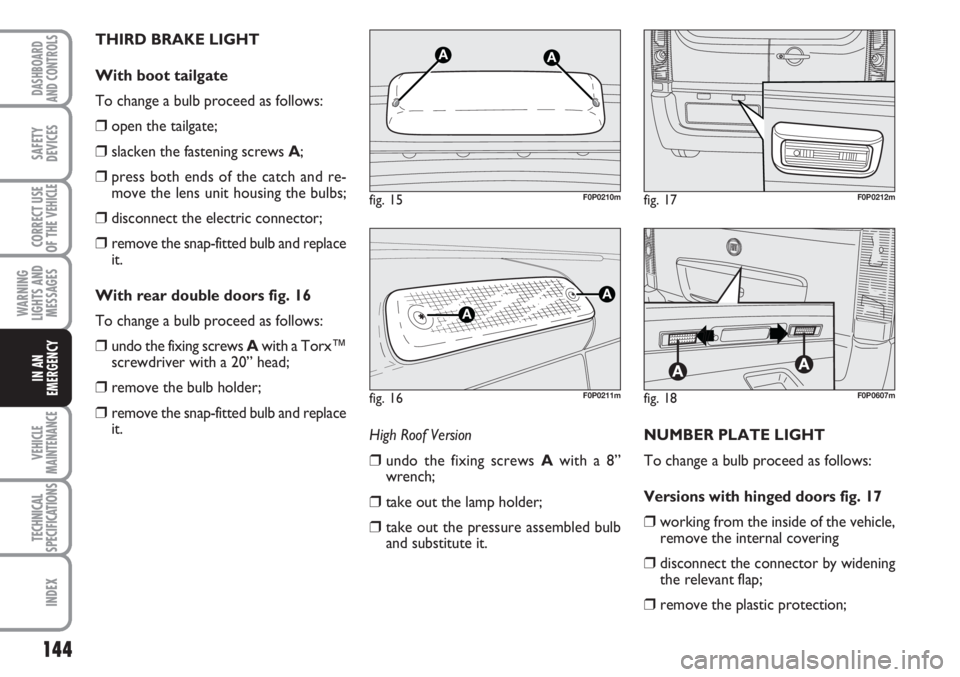
THIRD BRAKE LIGHT
With boot tailgate
To change a bulb proceed as follows:
❒open the tailgate;
❒slacken the fastening screws A;
❒press both ends of the catch and re-
move the lens unit housing the bulbs;
❒disconnect the electric connector;
❒remove the snap-fitted bulb and replace
it.
With rear double doors fig. 16
To change a bulb proceed as follows:
❒undo the fixing screws Awith a Torx™
screwdriver with a 20” head;
❒remove the bulb holder;
❒remove the snap-fitted bulb and replace
it.
NUMBER PLATE LIGHT
To change a bulb proceed as follows:
Versions with hinged doors fig. 17
❒working from the inside of the vehicle,
remove the internal covering
❒disconnect the connector by widening
the relevant flap;
❒remove the plastic protection;
fig. 15
AA
F0P0210m
fig. 16
A
A
F0P0211m
fig. 17F0P0212m
fig. 18F0P0607m
High Roof Version
❒undo the fixing screws Awith a 8”
wrench;
❒take out the lamp holder;
❒take out the pressure assembled bulb
and substitute it.
Page 149 of 210
148
WARNING
LIGHTS AND
MESSAGES
VEHICLE
MAINTENANCE
TECHNICAL
SPECIFICATIONS
INDEX
DASHBOARD
AND CONTROLS
SAFETY
DEVICES
CORRECT USE
OF THE
VEHICLE
IN AN
EMERGENCY
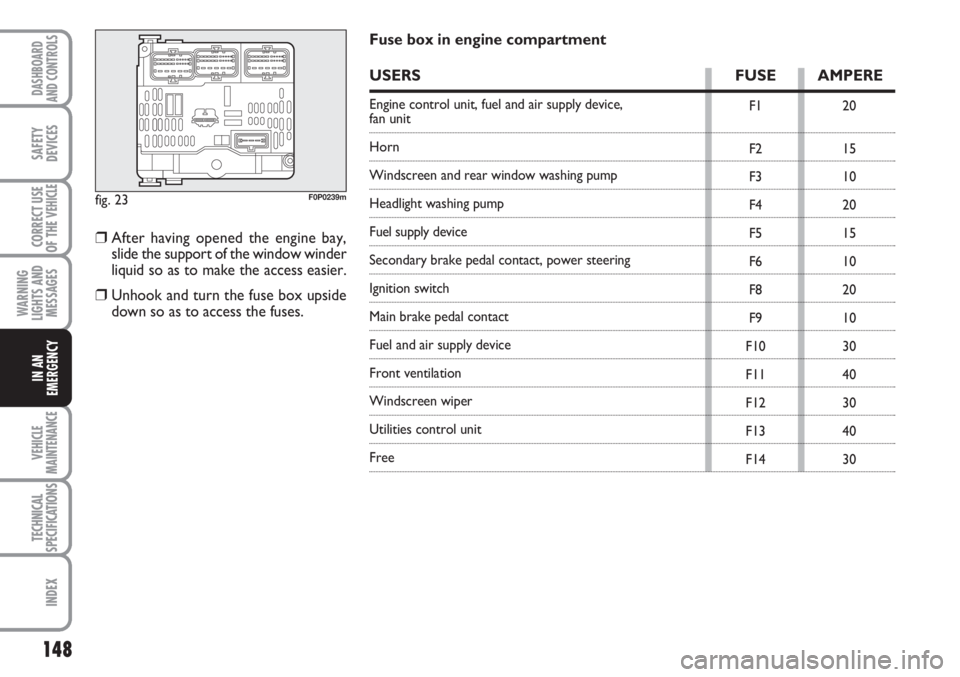
fig. 23F0P0239m
F1
F2
F3
F4
F5
F6
F8
F9
F10
F11
F12
F13
F1420
15
10
20
15
10
20
10
30
40
30
40
30
Fuse box in engine compartment
USERS FUSE AMPERE
Engine control unit, fuel and air supply device, fan unit
Horn
Windscreen and rear window washing pump
Headlight washing pump
Fuel supply device
Secondary brake pedal contact, power steering
Ignition switch
Main brake pedal contact
Fuel and air supply device
Front ventilation
Windscreen wiper
Utilities control unit
Free
❒After having opened the engine bay,
slide the support of the window winder
liquid so as to make the access easier.
❒Unhook and turn the fuse box upside
down so as to access the fuses.
Page 153 of 210
152
WARNING
LIGHTS AND
MESSAGES
VEHICLE
MAINTENANCE
TECHNICAL
SPECIFICATIONS
INDEX
DASHBOARD
AND CONTROLS
SAFETY
DEVICES
CORRECT USE
OF THE
VEHICLE
IN AN
EMERGENCY
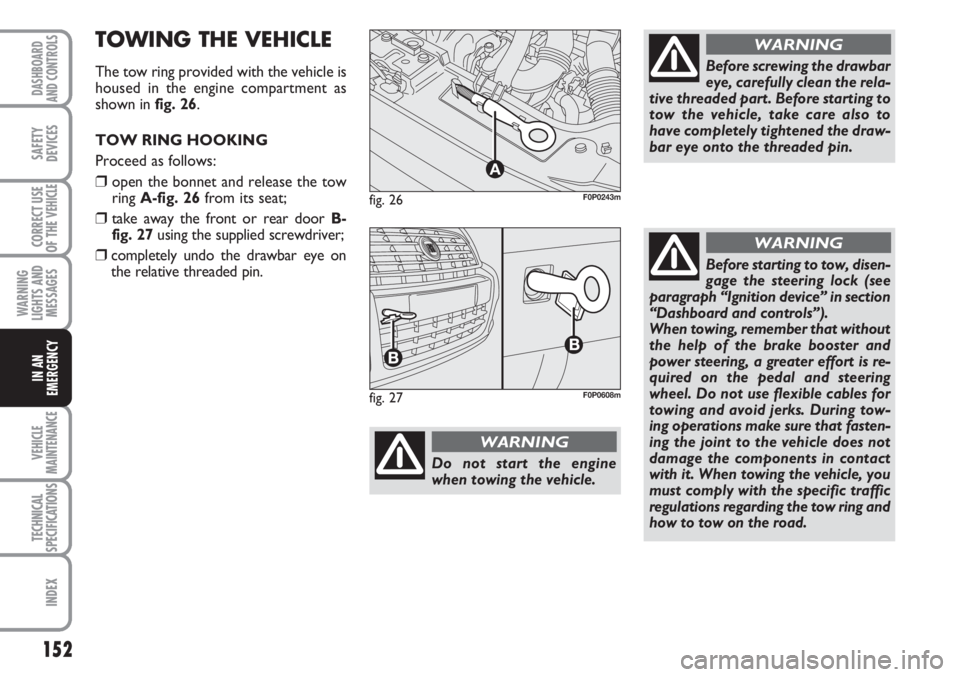
fig. 26
A
F0P0243m
Do not start the engine
when towing the vehicle.
WARNING
Before screwing the drawbar
eye, carefully clean the rela-
tive threaded part. Before starting to
tow the vehicle, take care also to
have completely tightened the draw-
bar eye onto the threaded pin.
WARNING
Before starting to tow, disen-
gage the steering lock (see
paragraph “Ignition device” in section
“Dashboard and controls”).
When towing, remember that without
the help of the brake booster and
power steering, a greater effort is re-
quired on the pedal and steering
wheel. Do not use flexible cables for
towing and avoid jerks. During tow-
ing operations make sure that fasten-
ing the joint to the vehicle does not
damage the components in contact
with it. When towing the vehicle, you
must comply with the specific traffic
regulations regarding the tow ring and
how to tow on the road.
WARNING
fig. 27F0P0608m
TOWING THE VEHICLE
The tow ring provided with the vehicle is
housed in the engine compartment as
shown in fig. 26.
TOW RING HOOKING
Proceed as follows:
❒open the bonnet and release the tow
ring A-fig. 26from its seat;
❒take away the front or rear door B-
fig. 27using the supplied screwdriver;
❒completely undo the drawbar eye on
the relative threaded pin.
Page 156 of 210
155
WARNING
LIGHTS AND
MESSAGES
TECHNICAL
SPECIFICATIONS
INDEX
DASHBOARD
AND CONTROLS
SAFETY
DEVICES
CORRECT USE
OF THE
VEHICLE
IN AN
EMERGENCY
VEHICLE
MAINTENANCE
30 60 90 120 150 180
●●●●● ●
●●●●● ●
●●●●● ●
●●●●● ●
●●●●● ●
●● ●
●●●●● ●
●●
●●●●● ●
●●●●● ●
●●●●● ●
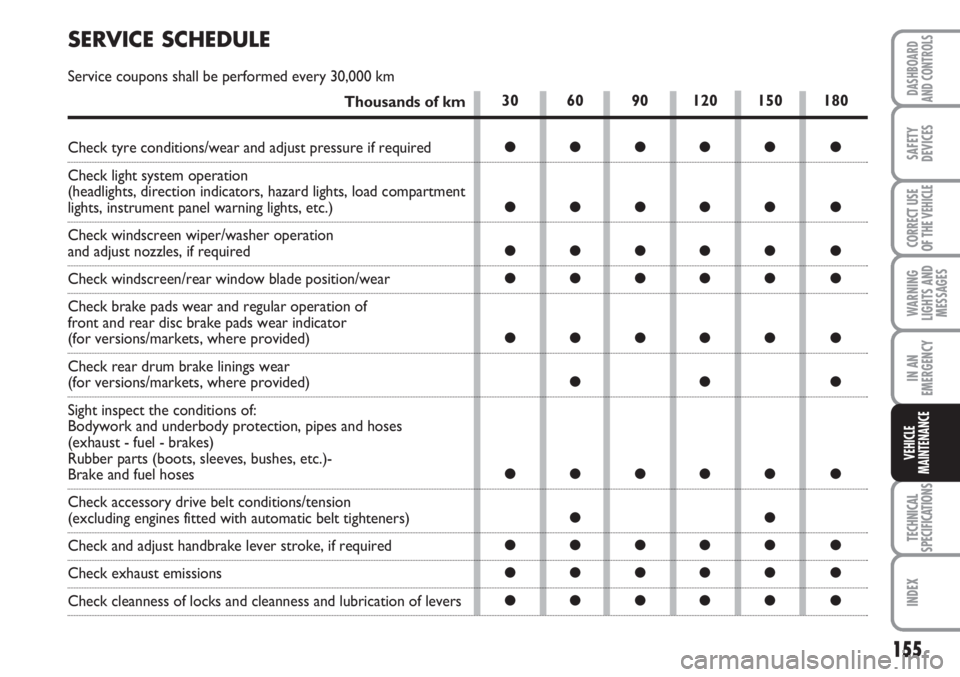
SERVICE SCHEDULE
Service coupons shall be performed every 30,000 km
Thousands of km
Check tyre conditions/wear and adjust pressure if required
Check light system operation
(headlights, direction indicators, hazard lights, load compartment
lights, instrument panel warning lights, etc.)
Check windscreen wiper/washer operation
and adjust nozzles, if required
Check windscreen/rear window blade position/wear
Check brake pads wear and regular operation of
front and rear disc brake pads wear indicator
(for versions/markets, where provided)
Check rear drum brake linings wear
(for versions/markets, where provided)
Sight inspect the conditions of:
Bodywork and underbody protection, pipes and hoses
(exhaust - fuel - brakes)
Rubber parts (boots, sleeves, bushes, etc.)-
Brake and fuel hoses
Check accessory drive belt conditions/tension
(excluding engines fitted with automatic belt tighteners)
Check and adjust handbrake lever stroke, if required
Check exhaust emissions
Check cleanness of locks and cleanness and lubrication of levers
Page 157 of 210
156
WARNING
LIGHTS AND
MESSAGES
TECHNICAL
SPECIFICATIONS
INDEX
DASHBOARD
AND CONTROLS
SAFETY
DEVICES
CORRECT USE
OF THE
VEHICLE
IN AN
EMERGENCY
VEHICLE
MAINTENANCE
30 60 90 120 150 180
●●●●● ●
●●●
●● ●
●● ●
●●●●● ●
●●●●● ●
●
●
●●●●● ●
●● ●
●●●●● ●
●
●
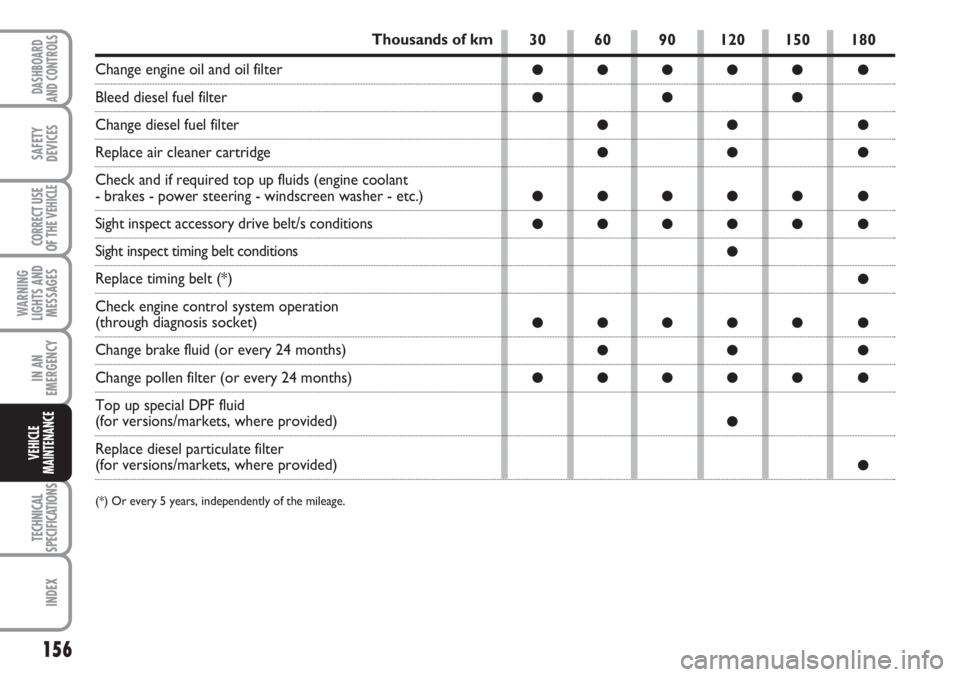
Thousands of km
Change engine oil and oil filter
Bleed diesel fuel filter
Change diesel fuel filter
Replace air cleaner cartridge
Check and if required top up fluids (engine coolant
- brakes - power steering - windscreen washer - etc.)
Sight inspect accessory drive belt/s conditions
Sight inspect timing belt conditions
Replace timing belt (*)
Check engine control system operation
(through diagnosis socket)
Change brake fluid (or every 24 months)
Change pollen filter (or every 24 months)
Top up special DPF fluid
(for versions/markets, where provided)
Replace diesel particulate filter
(for versions/markets, where provided)
(*) Or every 5 years, independently of the mileage.
Page 158 of 210
157
WARNING
LIGHTS AND
MESSAGES
TECHNICAL
SPECIFICATIONS
INDEX
DASHBOARD
AND CONTROLS
SAFETY
DEVICES
CORRECT USE
OF THE
VEHICLE
IN AN
EMERGENCY
VEHICLE
MAINTENANCE
HEAVY-DUTY
Should prevailing use of the vehicle be un-
der one of the following specially heavy
conditions:
❒trailer or caravan towing;
❒dusty roads;
❒short distances (less than 7-8 km) re-
peated and with external tempera-
tures below zero;
❒frequently idling engines or long dis-
tance low speed driving (e.g. door-to-
door deliveries) or in case of a long
term inactivity;
❒driving in the city;
carry out the following checks more fre-
quently than required in the Service
Schedule:
❒check front disk brake pad conditions
and wear;
❒check cleanness of locks, bonnet and
boot and lever cleanness and lubrica-
tion;
❒sight inspect the conditions of: engine,
gearbox, transmission, pipes and hoses
(exhaust - fuel - brakes), rubber parts
(boots, sleeves, bushes, etc.);
❒check battery charge and fluid level
(electrolyte);
❒visual check on various drive belt con-
ditions;
❒check and replace pollen filter, if re-
quired;
❒check and replace air cleaner, if re-
quired.
ROUTINE
MAINTENANCE
Every 1,000 km or before long journeys,
check and top up if required:
❒engine coolant fluid level;
❒brake fluid level;
❒windscreen washer fluid level;
❒tyre pressure and conditions;
❒light system operation (headlights, di-
rection indicators, hazard lights, etc.);
❒windscreen wiper/washer operation
and windscreen/rear window blade
position/wear;
Every 3,000 km check and top up if re-
quired: engine oil level.
You are recommended to use PETRO-
NAS LUBRICANTS, products, designed
and produced specifically for Fiat vehicles
(see table “Capacities” in section “Tech-
nical specifications”).
Page 159 of 210
158
WARNING
LIGHTS AND
MESSAGES
TECHNICAL
SPECIFICATIONS
INDEX
DASHBOARD
AND CONTROLS
SAFETY
DEVICES
CORRECT USE
OF THE
VEHICLE
IN AN
EMERGENCY
VEHICLE
MAINTENANCE
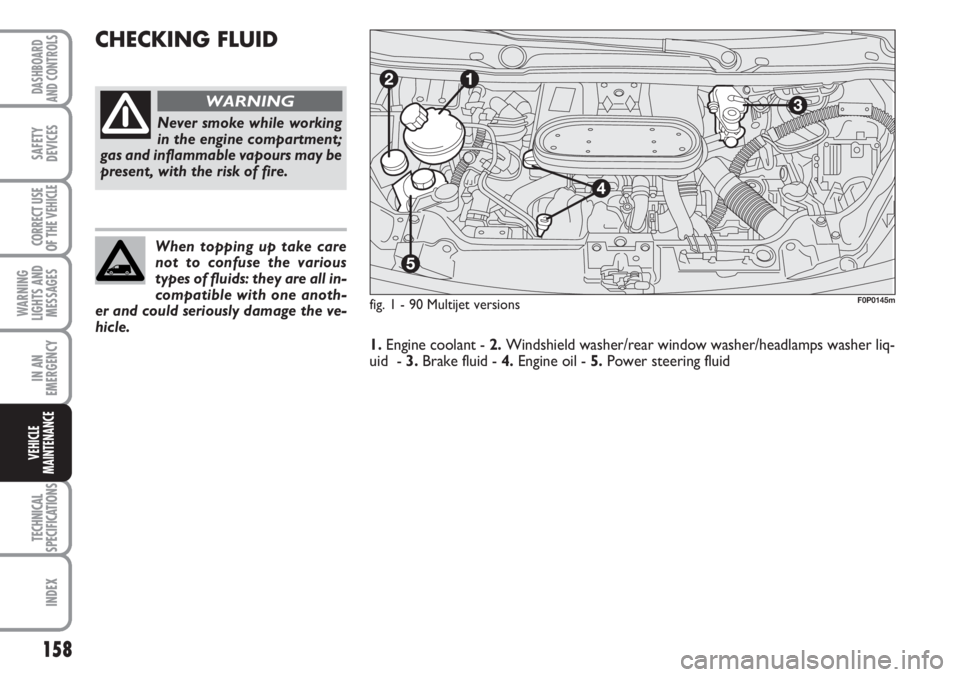
CHECKING FLUID
fig. 1 - 90 Multijet versions
Never smoke while working
in the engine compartment;
gas and inflammable vapours may be
present, with the risk of fire.
WARNING
When topping up take care
not to confuse the various
types of fluids: they are all in-
compatible with one anoth-
er and could seriously damage the ve-
hicle.
F0P0145m
1.Engine coolant - 2.Windshield washer/rear window washer/headlamps washer liq-
uid - 3.Brake fluid - 4.Engine oil - 5.Power steering fluid
Page 160 of 210
159
WARNING
LIGHTS AND
MESSAGES
TECHNICAL
SPECIFICATIONS
INDEX
DASHBOARD
AND CONTROLS
SAFETY
DEVICES
CORRECT USE
OF THE
VEHICLE
IN AN
EMERGENCY
VEHICLE
MAINTENANCE
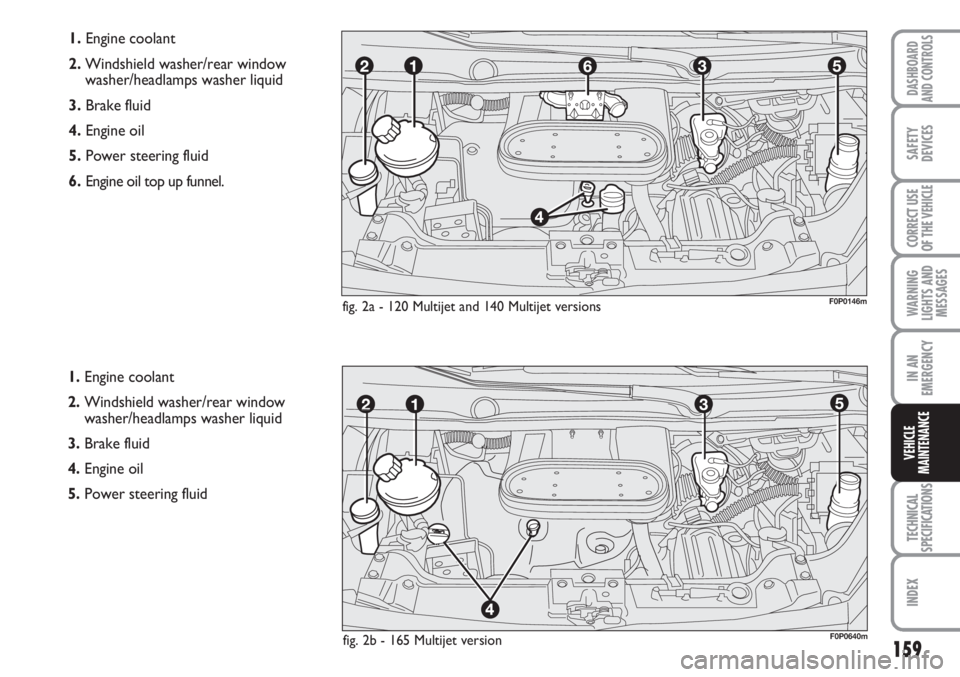
1.Engine coolant
2.Windshield washer/rear window
washer/headlamps washer liquid
3.Brake fluid
4.Engine oil
5.Power steering fluid
6.Engine oil top up funnel.
1.Engine coolant
2.Windshield washer/rear window
washer/headlamps washer liquid
3.Brake fluid
4.Engine oil
5.Power steering fluid
F0P0146mfig. 2a - 120 Multijet and 140 Multijet versions
F0P0640mfig. 2b - 165 Multijet version