wheel FIAT SCUDO 2015 Owner handbook (in English)
[x] Cancel search | Manufacturer: FIAT, Model Year: 2015, Model line: SCUDO, Model: FIAT SCUDO 2015Pages: 227, PDF Size: 4.46 MB
Page 85 of 227
81
SAFETY
DEVICESCORRECT USE
OF THE VEHICLE WARNING
LIGHTS AND
MESSAGESIN AN
EMERGENCYVEHICLE
MAINTENANCETECHNICAL
SPECIFICATIONSINDEX DASHBOARD
AND CONTROLS
AUTOMATIC ADJUSTMENT
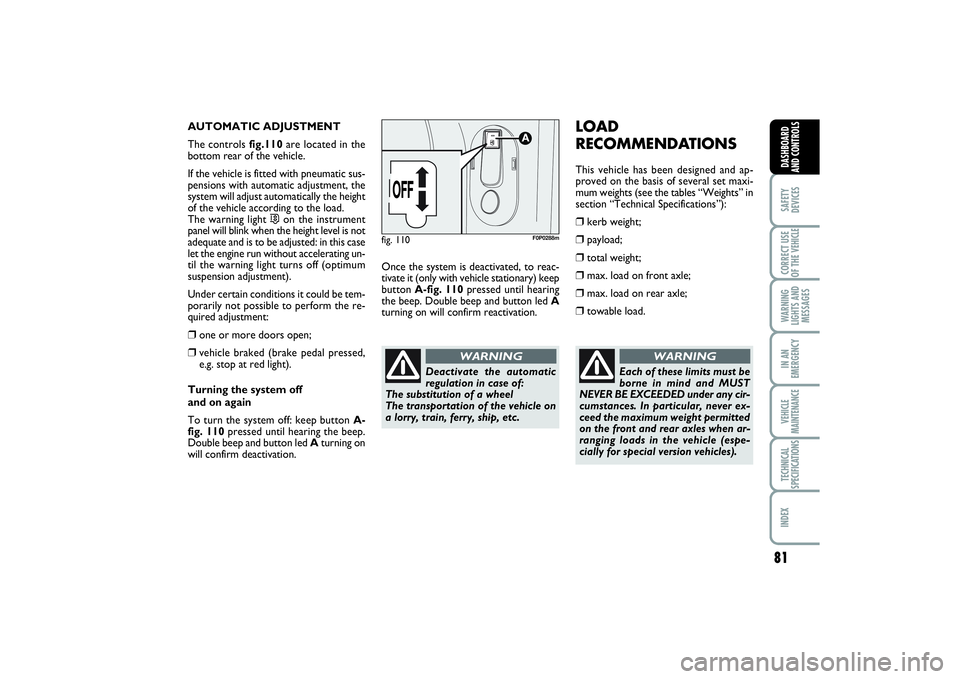
The controls fig.110are located in the
bottom rear of the vehicle.
If the vehicle is fitted with pneumatic sus-
pensions with automatic adjustment, the
system will adjust automatically the height
of the vehicle according to the load.
The warning light
…
on the instrument
panel will blink when the height level is not
adequate and is to be adjusted: in this case
let the engine run without accelerating un-
til the warning light turns off (optimum
suspension adjustment).
Under certain conditions it could be tem-
porarily not possible to perform the re-
quired adjustment:
❒
one or more doors open;
❒
vehicle braked (brake pedal pressed,
e.g. stop at red light).
Turning the system off
and on again
To turn the system off: keep button A-
fig. 110pressed until hearing the beep.
Double beep and button led Aturning on
will confirm deactivation.Once the system is deactivated, to reac-
tivate it (only with vehicle stationary) keep
button A-fig. 110pressed until hearing
the beep. Double beep and button led A
turning on will confirm reactivation.
fig. 110
F0P0288m
LOAD
RECOMMENDATIONSThis vehicle has been designed and ap-
proved on the basis of several set maxi-
mum weights (see the tables “Weights” in
section “Technical Specifications”):❒
kerb weight;
❒
payload;
❒
total weight;
❒
max. load on front axle;
❒
max. load on rear axle;
❒
towable load.
Each of these limits must be
borne in mind and MUST
NEVER BE EXCEEDED under any cir-
cumstances. In particular, never ex-
ceed the maximum weight permitted
on the front and rear axles when ar-
ranging loads in the vehicle (espe-
cially for special version vehicles).
WARNING
Deactivate the automatic
regulation in case of:
The substitution of a wheel
The transportation of the vehicle on
a lorry, train, ferry, ship, etc.
WARNING
020-082 SCUDO LUM GB 19/11/13 09.54 Pagina 81
Page 88 of 227

84SAFETY
DEVICESCORRECT USE
OF THE VEHICLE
WARNING
LIGHTS AND
MESSAGESIN AN
EMERGENCYVEHICLE
MAINTENANCETECHNICAL
SPECIFICATIONSINDEXDASHBOARD
AND CONTROLS
ADJUSTING THE
HEADLIGHT BEAM
Proper adjustment of the headlight beams
is of vital importance for your safety and
comfort and also for the other road users.
In addition it is the subject of a precise reg-
ulation of the traffic code.
To ensure you and other drivers have the
best visibility conditions when travelling
with the headlights on, the headlights must
be set properly.
Contact Fiat Dealership to have the head-
lights properly adjusted.
ABS SYSTEM If you have never driven a vehicle with ABS
before, you should practice using the sys-
tem on slippery terrain, obviously with the
necessary safety precautions and keeping
to the Highway Code of the country you
are in. It is also a good idea to read the fol-
lowing information carefully.
The ABS system, integral with the braking
system, prevents the wheels from locking
when braking, makes the most of road grip
and gives the best control when emergency
braking under difficult road conditions.
System is completed by EBD (Electronic
Braking force Distribution), which dis-
tributes the braking action between front
and rear wheels.
IMPORTANT To have the maximum ef-
ficiency of the braking system, it is neces-
sary a setting period of about 500 km
(with new vehicle or after replacing brake
pads/discs): during this period it is better
to avoid sharp, repeated and prolonged
brakes.
The ABS exploits the tyre-
road grip at the best, but it
cannot improve it; you should there-
fore take every care when driving on
slippery surfaces without taking un-
necessary risks.
WARNING
ABS SYSTEM INTERVENTION
The driver can tell the ABS system has
come into action because the brake pedal
pulsates slightly and the system gets noisi-
er: it means that the vehicle speed should
be altered to fit the type of road surface.
If the ABS system cuts in, it
is a sign that the grip be-
tween tyre and the road surface has
reached the limit: you must slow
down to match the speed to the road
grip available.
WARNING
083-096 SCUDO LUM GB 27/03/14 10:22 Pagina 84
Page 89 of 227

85
SAFETY
DEVICESCORRECT USE
OF THE VEHICLE WARNING
LIGHTS AND
MESSAGESIN AN
EMERGENCYVEHICLE
MAINTENANCETECHNICAL
SPECIFICATIONSINDEX DASHBOARD
AND CONTROLS
FAILURE INDICATIONS
ABS failure
ABS failure is indicated by the turning on
of warning light
>
on the instrument pan-
el together with the message on the mul-
tifunction display (for versions/markets,
where provided), (see section “Warning
lights and messages”).
In this case the braking system is still effi-
cient, though without the aid of the ABS
system. Drive carefully to the closest Fiat
Dealership to have the system checked.BRAKE ASSIST
(emergency braking assistance
integral with ESC)
(for versions/markets, where provided)
The system, which cannot be cut out, rec-
ognizes emergency braking (on the ground
of the brake pedal operation speed) and
considerably increases the pressure in the
brake circuit.
Brake Assist is deactivated on vehicles
equipped with ESC, in the event of ESC
system failure (indicated by the switching
on of warning light
™
).
When the ABS cuts in, and
you feel the brake pedal pul-
sating, do not remove your foot, but
keep it pressed; in doing so you will
stop in the shortest amount of space
possible under the current road con-
ditions.
WARNING
EBD failure
EBD failure is indicated by the turning on
of warning lights
>
, x
and STOP on the
instrument panel together with the mes-
sage on the multifunction display (for ver-
sions/markets, where provided), (see sec-
tion “Warning lights and messages”).
In this case with sharp braking the rear
wheels might lock too early, with the pos-
sibility of skidding. Drive extremely care-
fully to the nearest Fiat Dealership to have
the system checked.
If warning light
x
alone
comes on (together with the
message on the multifunction display,
for versions/markets, where provid-
ed), stop the vehicle immediately and
contact the nearest Fiat Dealership.
Fluid leaks from the hydraulic system,
in fact, can compromise the braking
system, both traditional systems and
systems with ABS.
WARNING
083-096 SCUDO LUM GB 27/03/14 10:22 Pagina 85
Page 91 of 227
87
SAFETY
DEVICESCORRECT USE
OF THE VEHICLE WARNING
LIGHTS AND
MESSAGESIN AN
EMERGENCYVEHICLE
MAINTENANCETECHNICAL
SPECIFICATIONSINDEX DASHBOARD
AND CONTROLS
fig. 113/a
F0F0701m
ASR SYSTEM (Antislip Regulator)
The ASR system controls the vehicle
drive and cuts in automatically every
time one or both driving wheels slip.
In slipping conditions, two different con-
trol systems are activated:❒
if slipping involves both driving wheels,
the ASR function intervenes reducing
the power transmitted by the engine;
❒
if the slipping involves only one driving
wheel, the ASR system cuts in auto-
matically braking the wheel that is slip-
ping. The action of the ASR system is particu-
larly helpful in the following circumstances:
❒
slipping of the inner wheel due to the
effect of dynamic load changes or ex-
cessive acceleration;
❒
too much power transmitted to the
wheels also in relation to the conditions
of the road surface;
❒
acceleration on slippery, snowy or
frozen surfaces;
❒
in the case of loss of grip on a wet sur-
face (aquaplaning).
Do not take unnecessary
risks, even if your vehicle is
fitted with the ESC and ASR sys-
tems.Your driving style must always
be suited to the road conditions, vis-
ibility and traffic.The driver is always
responsible for road safety.
WARNING
Switching the system on/off
The ASR system switches on automatically
each time the engine is started.
Switching the ESC system off will auto-
matically switch off the ASR system too.
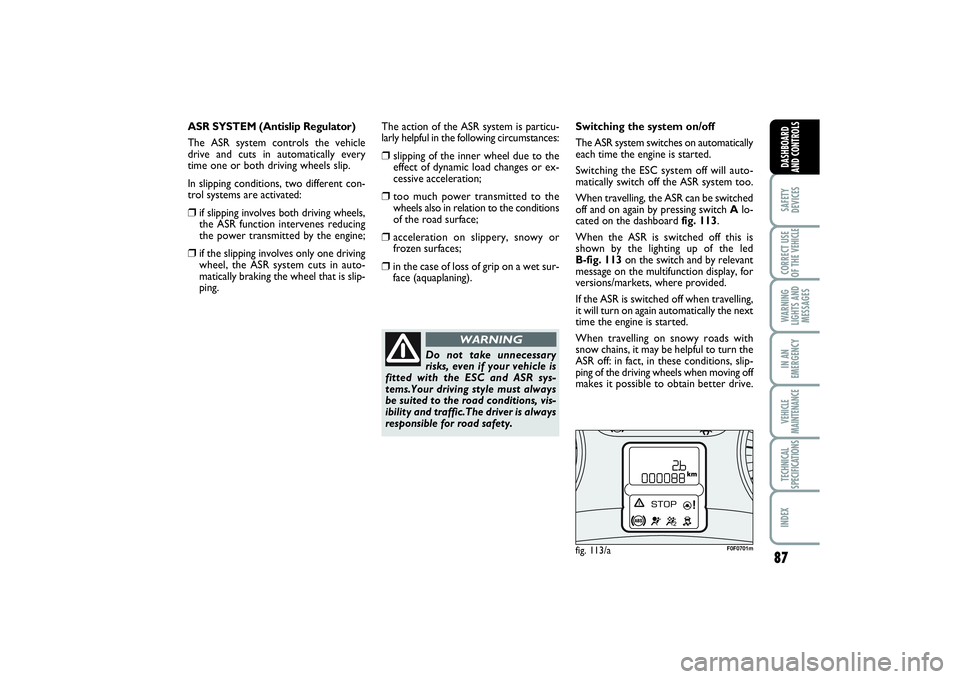
When travelling, the ASR can be switched
off and on again by pressing switch Alo-
cated on the dashboard fig. 113.
When the ASR is switched off this is
shown by the lighting up of the led
B-fig. 113on the switch and by relevant
message on the multifunction display, for
versions/markets, where provided.
If the ASR is switched off when travelling,
it will turn on again automatically the next
time the engine is started.
When travelling on snowy roads with
snow chains, it may be helpful to turn the
ASR off: in fact, in these conditions, slip-
ping of the driving wheels when moving off
makes it possible to obtain better drive.
083-096 SCUDO LUM GB 27/03/14 10:22 Pagina 87
Page 92 of 227
88SAFETY
DEVICESCORRECT USE
OF THE VEHICLE
WARNING
LIGHTS AND
MESSAGESIN AN
EMERGENCYVEHICLE
MAINTENANCETECHNICAL
SPECIFICATIONSINDEXDASHBOARD
AND CONTROLS
MSR system
(engine braking torque control)
It is an integral part of the ASR system that
in case of sudden gear shifting, cuts in pro-
viding torque to the engine thus prevent-
ing excessive driving wheel drive that, spe-
cially in poor grip conditions, can lead to
loss of stability.
GRIP CONTROLThis system increases the traction in poor
road grip conditions (e.g. snow, mud,
sand).
The accelerator pedal must be pressed
sufficiently for the engine power to man-
age the various parameters in the best
way.
The vehicle is designed mainly for as-
phalted roads but can occasionally be dri-
ven on rough roads.
If the vehicle is heavily loaded, it cannot be
used for off-road activities, such as:❒
crossing and driving grounds that
could damage the underbody or de-
tach parts such as fuel pipes, fuel cool-
er, etc., because of obstacles or
stones;
❒
travelling on steep gradients with re-
duced grip;
❒
fording a stream.
The performance of the sys-
tem, in terms of active safe-
ty should not induce the driver to take
pointless and unnecessary risks.
The style of driving must in any case
always be adapted to the conditions
of the road surface, visibility and traf-
fic. Road safety is always the driver’s
responsibility.
WARNING
For correct operation of the ASR system,
the tyres must absolutely be of the same
brand and type on all wheels, in perfect
conditions and, above all, of type, brand
and size specified.
FAILURE INDICATIONS
In the event of malfunctioning, the ASR
system is automatically disconnected and
the warning light will come with fixed
light on the instrument panel, (see section
“Warning lights and messages”).
In this case contact Fiat Dealership as soon
as possible.
083-096 SCUDO LUM GB 27/03/14 10:22 Pagina 88
Page 94 of 227
90SAFETY
DEVICESCORRECT USE
OF THE VEHICLE
WARNING
LIGHTS AND
MESSAGESIN AN
EMERGENCYVEHICLE
MAINTENANCETECHNICAL
SPECIFICATIONSINDEXDASHBOARD
AND CONTROLS
iTPMS SYSTEM(for versions/markets
where provided)
DESCRIPTION
The vehicle can be equipped with the
iTPMS (indirect Tire Pressure Monitor-
ing System) which monitors the tyre in-
flation status thanks to wheel speed sen-
sors.
The system comprises a radio-frequency
transmitter sensor fitted to each wheel
(on the rim inside the tyre), which is able
to send information on the inflation pres-
sure of each tyre to the control unit.
The system warns the driver if one or
more tyres are flat by switching on the
dedicated warning light
n
and a warning
message on the display.
If one tyre only is flat, the system can in-
dicate its position: it is in any case rec-
ommended to check the pressure on all
four tyres.
WARNING
If the system signals a pres-
sure decrease on a specific
tyre, it is recommended to check the
pressure on all four tyres.
WARNING
iTPMS does not relieve the
driver from the obligation to
check the tyre pressure every month;
it is not to be considered a system to
replace maintenance or a safety sys-
tem.
WARNING
Tyre pressure must be
checked with tyres cold.
Should it become necessary for what-
ever reason to check pressure with
warm tyres, do not reduce pressure
even if it is higher than the prescribed
value, but repeat the check when tyres
are cold.
WARNING
The iTPMS cannot indicate
sudden tyre pressure drops
(for example when a tyre bursts). In
this event, brake the vehicle cautious-
ly and avoid sudden steering.
WARNING
The system only warns that
the tyre pressure is low: it is
not able to inflate them.
WARNING
Insufficient tyre inflation in-
creases fuel consumption, re-
duces the tread duration and may af-
fect the capacity to drive safely.
083-096 SCUDO LUM GB 27/03/14 10:22 Pagina 90
Page 95 of 227
91
SAFETY
DEVICESCORRECT USE
OF THE VEHICLE WARNING
LIGHTS AND
MESSAGESIN AN
EMERGENCYVEHICLE
MAINTENANCETECHNICAL
SPECIFICATIONSINDEX DASHBOARD
AND CONTROLS
Insufficient tyre pressure
The warning light
n
switches on, to-
gether with a dedicated message on the
display, to indicate that the tyre pressure
is lower than the recommended value
and/or that slow pressure loss is occur-
ring. In these circumstances, optimal tyre
duration and fuel consumption may not be
guaranteed.
Should two or more tyres be in the con-
dition mentioned above, the display will
show the indications corresponding to each
tyre in sequence.
❒
Slow down immediately, avoid sudden
braking and steering.
❒
Stop as soon as traffic conditions al-
low.
❒
In the event of a puncture, use the
quick tyre repair kit or fit the spare
wheel (for versions/markets, where
provided);
or
❒
if you have a compressor, for example
the one of the quick tyre repair kit,
check the pressure of the four tyres
when cold;or
❒
if you cannot check the pressure im-
mediately, drive very carefully and slow-
ly.
The alarm is active until the next inflation,
repair or replacement of the tyre involved.
The spare wheel (space-saver wheel or
steel rim) does not have sensors.
The detected pressure loss does not al-
ways involve visible deformation of the
tyre. Therefore, do not rely on the visual
check only.iTPMS failure
When a fault in the iT.P.M.S. is detected,
the warning light
n
switches on and flash-
es, the warning light è
switches on as
well and a dedicated message is displayed.
In this case, the monitoring of the tyre
pressure is no longer guaranteed.
This alarm is displayed also when at least
one of the wheels is not equipped with
sensor (e.g. with spare wheel, space-saver
or steel type).
Contact a Fiat Dealership to have the sys-
tem checked or, after a puncture, refit a
tyre equipped with sensor on the origi-
nal rim.
083-096 SCUDO LUM GB 27/03/14 10:22 Pagina 91
Page 116 of 227
112CORRECT USE
OF THE VEHICLE
WARNING
LIGHTS AND
MESSAGESIN AN
EMERGENCYVEHICLE
MAINTENANCETECHNICAL
SPECIFICATIONSIINDEXDASHBOARD
AND CONTROLSSAFETY
DEVICES
FRONT AIRBAGS
The front driver and passenger airbags
(for versions/markets where provided)
protect the front seat occupants in the
event of head-on impacts of medium-high
severity, by placing the bag between the
occupant and the steering wheel or dash-
board. Therefore non-deployment in
other types of impacts (side impacts, rear
shunts, roll-overs, etc.) does not indicate
a system malfunction. Front driver and passenger airbags (for ver-
sions/markets where provided) are not a
replacement for, but are complementary
to, the seat belts, which you are recom-
mended to always wear, as specified by law
in Europe and most non-European coun-
tries.
An electronic control unit will inflate the
bag, when necessary, in the event of a
frontal impact. The bag will inflate instan-
taneously placing itself between the front
occupant’s body and the structures which
could cause injury. It will deflate immedi-
ately afterwards. The volume of front
airbags at max. inflation fills most of the
space between the steering wheel and the
driver and between the dashboard and the
passenger.
AIRBAGThe car is equipped with front airbags for
driver and passenger (for versions/markets,
where provided), seat-mounted side airbags
for driver’s and passenger pelvis-chest-
shoulder protection (for versions/ markets,
where provided), and window airbags for
protecting the heads of front and rear out-
er occupants (for versions/markets where
provided).
The location of the airbags on the car is
marked by the writing “AIRBAG” in the
middle of the steering wheel, on the dash-
board, on the side trim or on a label placed
next to the airbag deployment area.In the event of impact, those not wearing
a seat belt are projected forwards and may
come into contact with the bag which is still
inflating. The protection offered by the bag
is compromised in these circumstances.
Front airbags may not activate in the fol-
lowing situations:
❒frontal impacts against highly deformable
objects not involving the front surface of
the vehicle (e.g. wing collision against
guard rail, heaps of gravel, etc.);❒underride impacts with other vehicles;
Failure to activate in the conditions de-
scribed above is due to the fact that they
may not provide any additional protection
compared with seat belts, so their activa-
tion would be inappropriate. In these cas-
es, non-deployment of the airbag does not
necessarily indicate a system malfunction.
097-118 SCUDO LUM GB 02/04/14 10:40 Pagina 112
Page 117 of 227
113
CORRECT USE
OF THE VEHICLEWARNING
LIGHTS AND
MESSAGESIN AN
EMERGENCYVEHICLE
MAINTENANCETECHNICAL
SPECIFICATIONSINDEXDASHBOARD
AND CONTROLSSAFETY
DEVICES
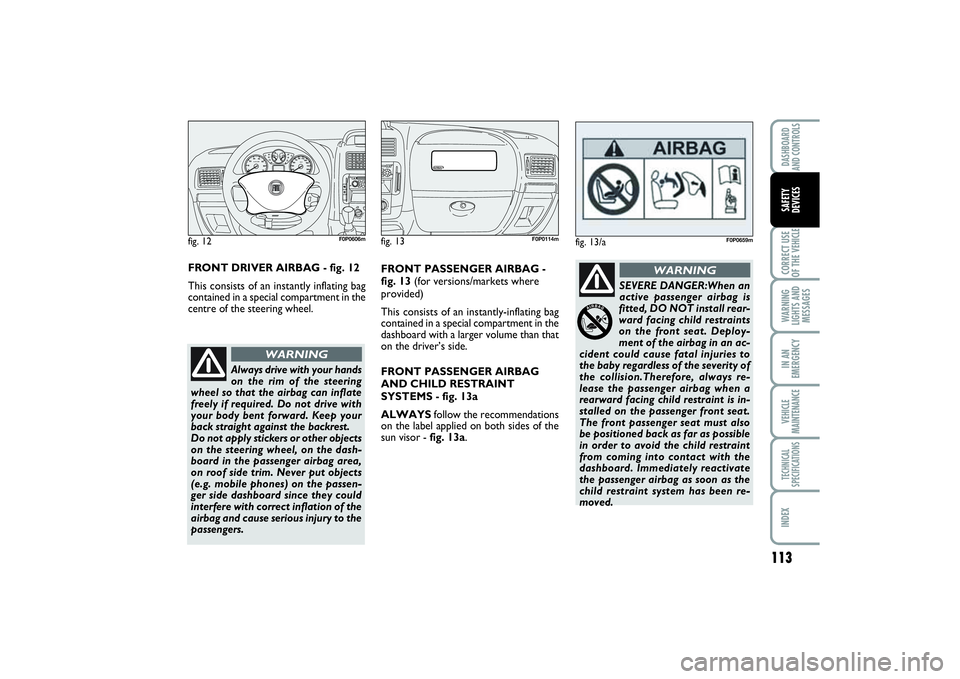
FRONT PASSENGER AIRBAG -
fig. 13(for versions/markets where
provided)
This consists of an instantly-inflating bag
contained in a special compartment in the
dashboard with a larger volume than that
on the driver’s side.
FRONT PASSENGER AIRBAG
AND CHILD RESTRAINT
SYSTEMS - fig. 13a
ALWAYSfollow the recommendations
on the label applied on both sides of the
sun visor - fig. 13a.fig. 13
F0P0114m
fig. 12
F0P0606m
Always drive with your hands
on the rim of the steering
wheel so that the airbag can inflate
freely if required. Do not drive with
your body bent forward. Keep your
back straight against the backrest.
Do not apply stickers or other objects
on the steering wheel, on the dash-
board in the passenger airbag area,
on roof side trim. Never put objects
(e.g. mobile phones) on the passen-
ger side dashboard since they could
interfere with correct inflation of the
airbag and cause serious injury to the
passengers.
WARNING
FRONT DRIVER AIRBAG - fig. 12
This consists of an instantly inflating bag
contained in a special compartment in the
centre of the steering wheel.
fig. 13/a
F0P0659m
SEVERE DANGER:When an
active passenger airbag is
fitted, DO NOT install rear-
ward facing child restraints
on the front seat. Deploy-
ment of the airbag in an ac-
cident could cause fatal injuries to
the baby regardless of the severity of
the collision.Therefore, always re-
lease the passenger airbag when a
rearward facing child restraint is in-
stalled on the passenger front seat.
The front passenger seat must also
be positioned back as far as possible
in order to avoid the child restraint
from coming into contact with the
dashboard. Immediately reactivate
the passenger airbag as soon as the
child restraint system has been re-
moved.
WARNING
097-118 SCUDO LUM GB 02/04/14 10:40 Pagina 113
Page 124 of 227

120WARNING
LIGHTS AND
MESSAGESIN AN
EMERGENCYVEHICLE
MAINTENANCETECHNICAL
SPECIFICATIONSINDEXDASHBOARD
AND CONTROLSSAFETY
DEVICESCORRECT USE
OF THE VEHICLE
ENGINE STARTINGThe vehicle is fitted with an electronic en-
gine lock device: if the engine fails to start,
see the paragraph “The Fiat CODE sys-
tem” in section “Dashboard and controls”.
The engine may be noisier than usual dur-
ing the first seconds of operation, espe-
cially after it has not been used for a while.
This characteristic feature does not com-
promise functionality or reliability of the
hydraulic tappets: the timing system de-
vised to limit servicing.
We recommend that during
the initial period you do not
drive to full vehicle perfor-
mance (e.g.: excessive accel-
eration, long journeys at top speed,
sharp braking, etc.).
When the engine is switched
off never leave the key into
the ignition switch to prevent
pointless current absorption
from draining the battery.Running the engine in con-
fined areas is extremely dan-
gerous. The engine consumes oxygen
and produces carbon monoxide
which is a highly toxic and lethal gas.
WARNING
Remember that the servo-
brake and power steering
are not operational until the engine
has been started, therefore much ef-
fort than usual is required on the
brake pedal and steering wheel.
WARNING
Dashboard and controls
Proceed as follows:❒
Ensure that the handbrake is up;
❒
Put the gear lever into neutral;
❒
Turn the ignition key to M: the warn-
ing light
m
on the instrument panel
display will turn on;
❒
Wait for the warning light
m
to turn
off. The hotter the engine is, the quick-
er this will happen;
❒
Press the clutch pedal down to the
floor without touching the accelerator;
❒
Turn the ignition key to Das soon as
warning light
m
goes out. If you wait
too long you will lose the benefit of the
work done by the glow plugs. Release
the key as soon as the engine starts.
119-128 SCUDO LUM GB 18/11/13 14.26 Pagina 120