airbag FIAT SCUDO 2015 Owner handbook (in English)
[x] Cancel search | Manufacturer: FIAT, Model Year: 2015, Model line: SCUDO, Model: FIAT SCUDO 2015Pages: 227, PDF Size: 4.46 MB
Page 74 of 227
70SAFETY
DEVICESCORRECT USE
OF THE VEHICLE
WARNING
LIGHTS AND
MESSAGESIN AN
EMERGENCYVEHICLE
MAINTENANCETECHNICAL
SPECIFICATIONSINDEX
DASHBOARD
AND
CONTROLS
IMPORTANT Do not use the ashtray as
waste paper basket: it might set on fire in
contact with cigarette stubs.
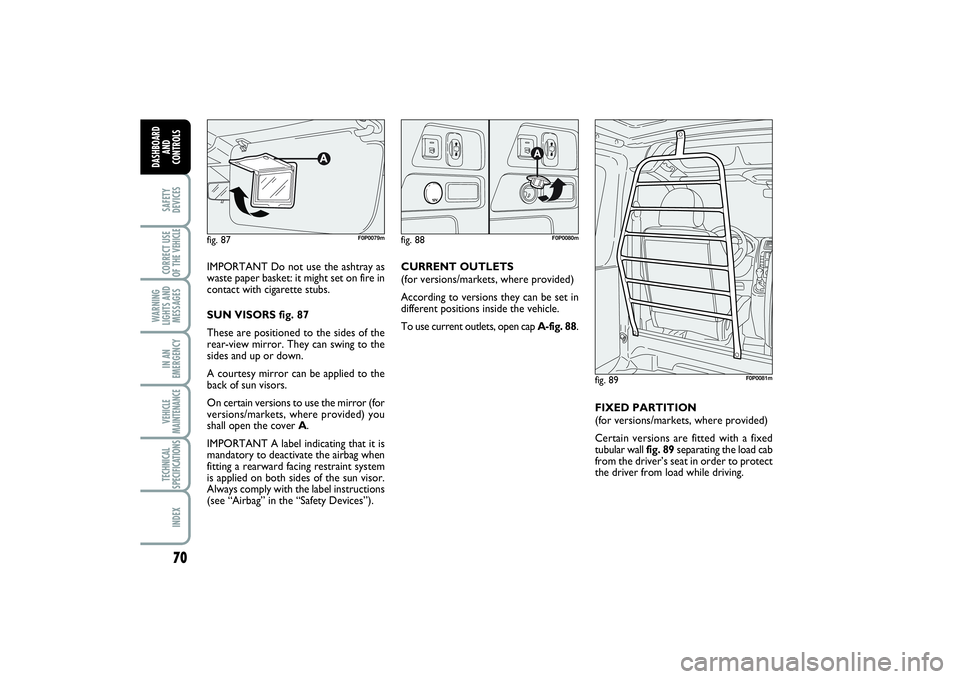
SUN VISORS fig. 87
These are positioned to the sides of the
rear-view mirror. They can swing to the
sides and up or down.
A courtesy mirror can be applied to the
back of sun visors.
On certain versions to use the mirror (for
versions/markets, where provided) you
shall open the cover A.
IMPORTANT A label indicating that it is
mandatory to deactivate the airbag when
fitting a rearward facing restraint system
is applied on both sides of the sun visor.
Always comply with the label instructions
(see “Airbag” in the “Safety Devices”).fig. 87
F0P0079m
fig. 88
F0P0080m
fig. 89
F0P0081m
CURRENT OUTLETS
(for versions/markets, where provided)
According to versions they can be set in
different positions inside the vehicle.
To use current outlets, open cap A-fig. 88.
FIXED PARTITION
(for versions/markets, where provided)
Certain versions are fitted with a fixed
tubular wall fig. 89separating the load cab
from the driver’s seat in order to protect
the driver from load while driving.
020-082 SCUDO LUM GB 19/11/13 09.54 Pagina 70
Page 101 of 227
97
CORRECT USE
OF THE VEHICLEWARNING
LIGHTS AND
MESSAGESIN AN
EMERGENCYVEHICLE
MAINTENANCETECHNICAL
SPECIFICATIONSINDEXDASHBOARD
AND CONTROLSSAFETY
DEVICES
SEAT BELTS ........................................................................... 98
SBR SYSTEM .......................................................................... 100
PRETENSIONERS ................................................................ 100
CARRYING CHILDREN SAFELY ..................................... 103
FITTING THE “UNIVERSAL”
CHILD RESTRAINT SYSTEM............................................. 104
FITTING THE “ISOFIX UNIVERSAL”
CHILD RESTRAINT SYSTEM ............................................ 107
AIRBAG .................................................................................. 112
SIDE BAGS ............................................................................. 115
S S
A A
F F
E E
T T
Y Y
D D
E E
V V
I I
C C
E E
S S
097-118 SCUDO LUM GB 02/04/14 10:40 Pagina 97
Page 102 of 227
98CORRECT USE
OF THE VEHICLE
WARNING
LIGHTS AND
MESSAGESIN AN
EMERGENCYVEHICLE
MAINTENANCETECHNICAL
SPECIFICATIONSIINDEXDASHBOARD
AND CONTROLSSAFETY
DEVICES
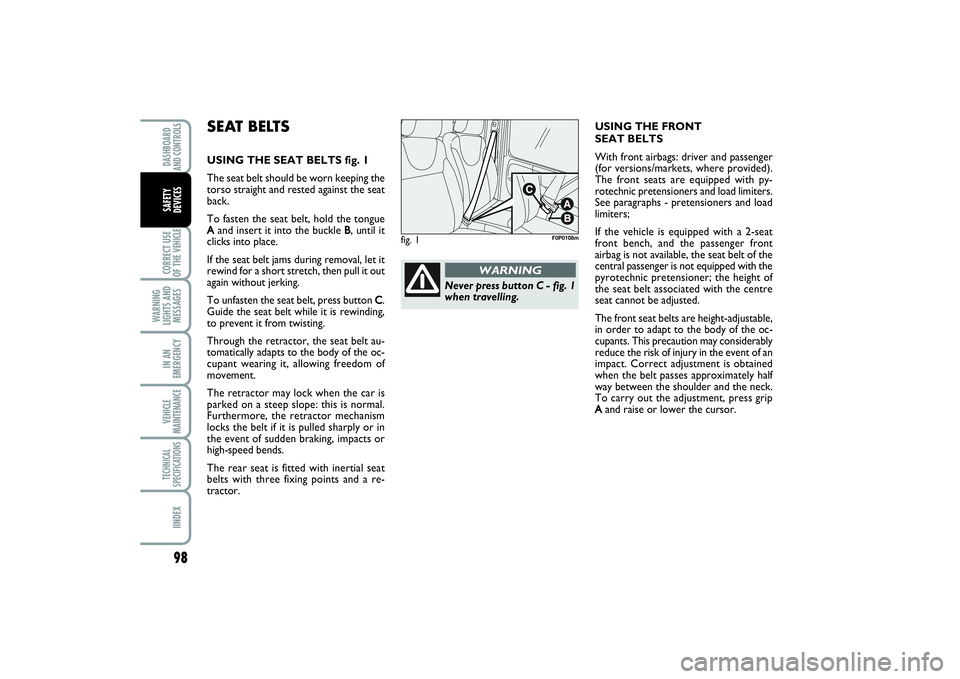
SEAT BELTSUSING THE SEAT BELTS fig. 1
The seat belt should be worn keeping the
torso straight and rested against the seat
back.
To fasten the seat belt, hold the tongueAand insert it into the buckle B
B, until it
clicks into place.
If the seat belt jams during removal, let it
rewind for a short stretch, then pull it out
again without jerking.
To unfasten the seat belt, press button C
C.
Guide the seat belt while it is rewinding,
to prevent it from twisting.
Through the retractor, the seat belt au-
tomatically adapts to the body of the oc-
cupant wearing it, allowing freedom of
movement.
The retractor may lock when the car is
parked on a steep slope: this is normal.
Furthermore, the retractor mechanism
locks the belt if it is pulled sharply or in
the event of sudden braking, impacts or
high-speed bends.
The rear seat is fitted with inertial seat
belts with three fixing points and a re-
tractor.
fig. 1
F0P0108m
Never press button C - fig. 1
when travelling.
WARNING
USING THE FRONT
SEAT BELTS
With front airbags: driver and passenger
(for versions/markets, where provided).
The front seats are equipped with py-
rotechnic pretensioners and load limiters.
See paragraphs - pretensioners and load
limiters;
If the vehicle is equipped with a 2-seat
front bench, and the passenger front
airbag is not available, the seat belt of the
central passenger is not equipped with the
pyrotechnic pretensioner; the height of
the seat belt associated with the centre
seat cannot be adjusted.
The front seat belts are height-adjustable,
in order to adapt to the body of the oc-
cupants. This precaution may considerably
reduce the risk of injury in the event of an
impact. Correct adjustment is obtained
when the belt passes approximately half
way between the shoulder and the neck.
To carry out the adjustment, press gripAand raise or lower the cursor.
097-118 SCUDO LUM GB 02/04/14 10:40 Pagina 98
Page 107 of 227
103
CORRECT USE
OF THE VEHICLEWARNING
LIGHTS AND
MESSAGESIN AN
EMERGENCYVEHICLE
MAINTENANCETECHNICAL
SPECIFICATIONSINDEXDASHBOARD
AND CONTROLSSAFETY
DEVICES
For optimal protection in the event of an
impact, all occupants must be seated and
wearing adequate restraint systems, in-
cluding infants and other children. This pre-
scription is compulsory in all EC countries
according to EC Directive 2003/20/EC.
Compared with an adult, a child’s head is
larger and heavier in proportion to his/her
body and the child’s muscular and bone
structures are not fully developed. There-
fore, correct restraint systems other than
adult seat belts are necessary to reduce as
much as possible the risk of injuries in case
of accident, braking or sudden manoeu-
vre.
Children must be seated safely and com-
fortably. As far as the characteristics of the
child restraint systems used, you are ad-
vised to keep children in rearward facing
restraint systems for as long as possible;
this is the most protected position in the
event of an impact.
The choice of the most suitable child re-
straint system depends on the weight of
the child; there are various types of child
restraint systems and you are advised al-
ways to choose the one that is most suit-
able for the child. When over 1.50 m in height, from the
point of view of restraint systems, children
are considered as adults and wear seat
belts normally.
In Europe the characteristics of child re-
straint systems are ruled by regulation
ECE-R44, making them compulsory and
dividing them into five weight groups:
Group 0 up to 10 kg
Group 0+ up to 13 kg
Group 1 9-18 kg
Group 2 15-25 kg
Group 3 22-36 kg
All child restraint systems must bear the
type-approval data along with the control
mark on a label firmly secured to the child
restraint system which must never be re-
moved. Lineaccessori Fiat offers child re-
straint systems for each weight group.
These devices are recommended having
been specifically designed and tested for
Fiat cars.CARRYING CHILDREN SAFELY
A label with the dedicated
symbol indicating that it is
mandatory to deactivate the airbag
for rearward facing child restraint sys-
tems is applied on the sun visor. Al-
ways comply with the instructions on
the sun visor (see the “Airbag” section
in this paragraph).
WARNING
097-118 SCUDO LUM GB 02/04/14 10:40 Pagina 103
Page 110 of 227
106CORRECT USE
OF THE VEHICLE
WARNING
LIGHTS AND
MESSAGESIN AN
EMERGENCYVEHICLE
MAINTENANCETECHNICAL
SPECIFICATIONSIINDEXDASHBOARD
AND CONTROLSSAFETY
DEVICES
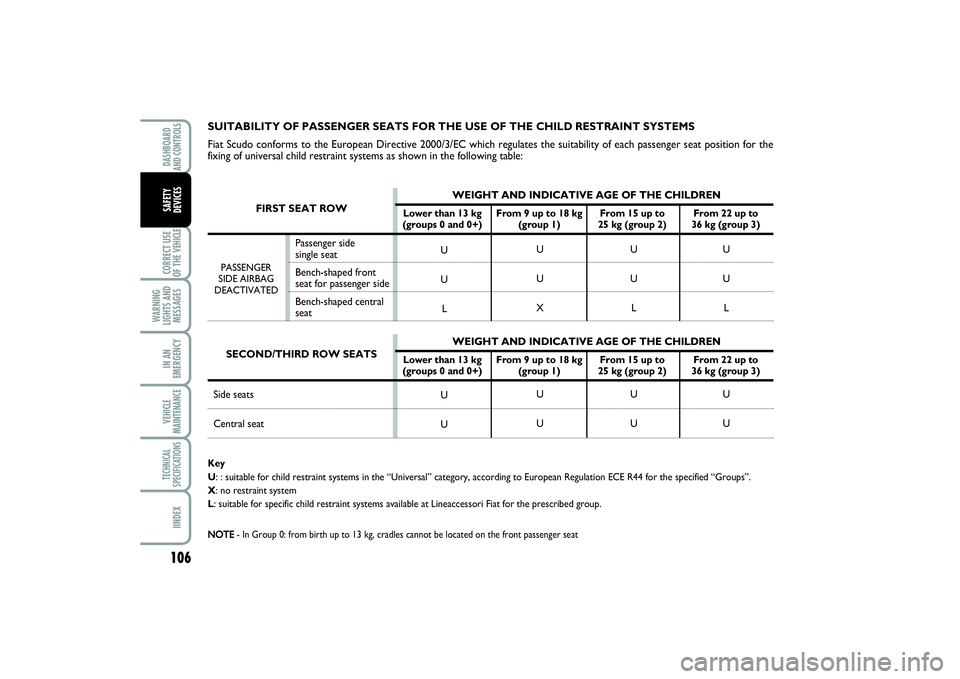
SUITABILITY OF PASSENGER SEATS FOR THE USE OF THE CHILD RESTRAINT SYSTEMS
Fiat Scudo conforms to the European Directive 2000/3/EC which regulates the suitability of each passenger seat position for the
fixing of universal child restraint systems as shown in the following table:Key
U: : suitable for child restraint systems in the “Universal” category, according to European Regulation ECE R44 for the specified “Groups”.
X: no restraint system
L: suitable for specific child restraint systems available at Lineaccessori Fiat for the prescribed group. NOTE
- In Group 0: from birth up to 13 kg, cradles cannot be located on the front passenger seat
U
U
L
U
UU
U
X
U
UU
U
L
U
UU
U
L
U
U
FIRST SEAT ROW
Side seats
Central seat
WEIGHT AND INDICATIVE AGE OF THE CHILDREN
Lower than 13 kg From 9 up to 18 kg From 15 up to From 22 up to (groups 0 and 0+) (group 1) 25 kg (group 2) 36 kg (group 3)
WEIGHT AND INDICATIVE AGE OF THE CHILDREN
Lower than 13 kg From 9 up to 18 kg From 15 up to From 22 up to (groups 0 and 0+) (group 1) 25 kg (group 2) 36 kg (group 3)
Passenger side
single seat
Bench-shaped front
seat for passenger side
Bench-shaped central
seat
SECOND/THIRD ROW SEATSPASSENGER
SIDE AIRBAG
DEACTIVATED
097-118 SCUDO LUM GB 02/04/14 10:40 Pagina 106
Page 113 of 227
109
CORRECT USE
OF THE VEHICLEWARNING
LIGHTS AND
MESSAGESIN AN
EMERGENCYVEHICLE
MAINTENANCETECHNICAL
SPECIFICATIONSINDEXDASHBOARD
AND CONTROLSSAFETY
DEVICES
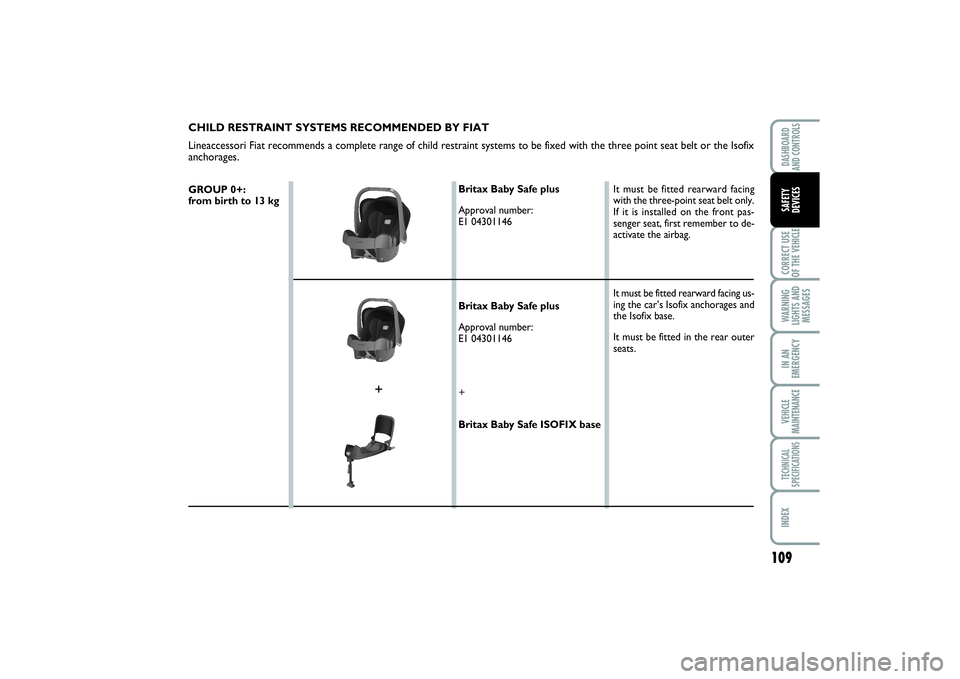
CHILD RESTRAINT SYSTEMS RECOMMENDED BY FIAT
Lineaccessori Fiat recommends a complete range of child restraint systems to be fixed with the three point seat belt or the Isofix
anchorages. GROUP 0+:
from birth to 13 kg
Britax Baby Safe plus
Approval number:
E1 04301146
Britax Baby Safe plus
Approval number:
E1 04301146
+
Britax Baby Safe ISOFIX baseIt must be fitted rearward facing
with the three-point seat belt only.
If it is installed on the front pas-
senger seat, first remember to de-
activate the airbag.
It must be fitted rearward facing us-
ing the car’s Isofix anchorages and
the Isofix base.
It must be fitted in the rear outer
seats.
+
097-118 SCUDO LUM GB 02/04/14 10:40 Pagina 109
Page 115 of 227
111
CORRECT USE
OF THE VEHICLEWARNING
LIGHTS AND
MESSAGESIN AN
EMERGENCYVEHICLE
MAINTENANCETECHNICAL
SPECIFICATIONSINDEXDASHBOARD
AND CONTROLSSAFETY
DEVICES
MAIN RECOMMENDATIONS TO CARRY CHILDREN SAFELY:
1) The recommended position for installing child restraint systems, is on the rear seat, as it is the most protected area in the event
of an impact.
2) If the passenger airbag is deactivated, always check that the amber warning light on the instrument panel switches on constantly
to make sure that it has actually been deactivated.
3) Carefully follow the instructions provided with the child restraint system which are mandatory by law. Keep the instructions in
the vehicle along with the other documents and this handbook. Do not use second-hand child restraint systems without in-
structions.
4) Always check that the seat belts are well fastened with a traction test.
5) Only one child is to be secured into each restraint system; never carry two children using one child restraint system.
6) Always check that the seat belts do not interfere with the child’s throat.
7) While travelling, do not let the child sit incorrectly or unfasten the belts.
8) Never allow a child to put the seat belt’s diagonal section under an arm or behind their back.
9) Never carry children on your lap, not even newborns. No-one, regardless of his/her strength, can restrain a child in the event of
an accident.
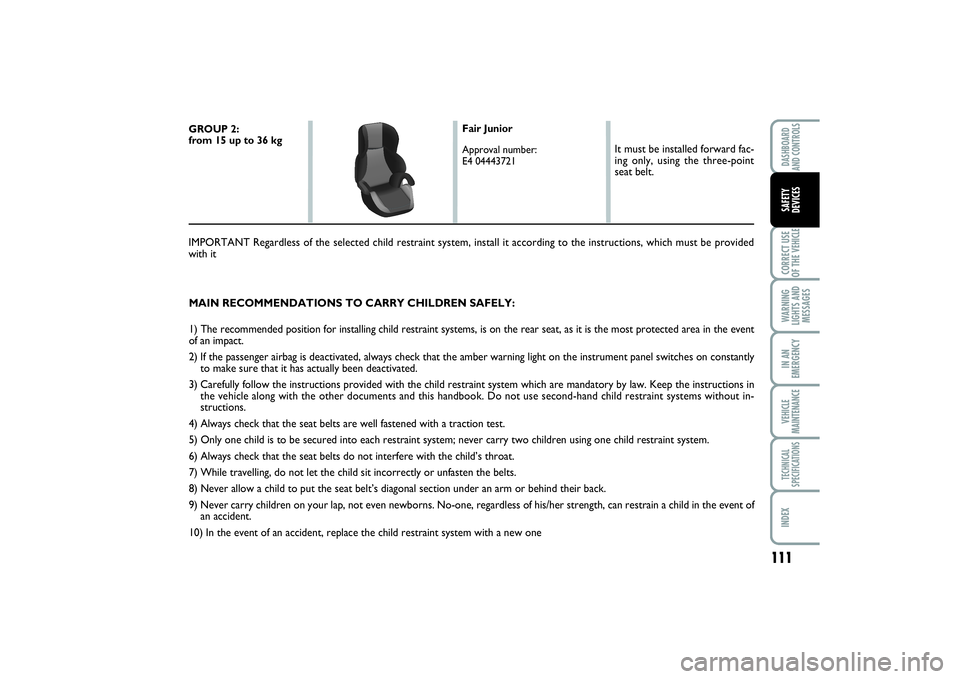
10) In the event of an accident, replace the child restraint system with a new oneGROUP 2:
from 15 up to 36 kg
Fair Junior
Approval number:
E4 04443721
It must be installed forward fac-
ing only, using the three-point
seat belt.
IMPORTANT Regardless of the selected child restraint system, install it according to the instructions, which must be provided
with it
097-118 SCUDO LUM GB 02/04/14 10:40 Pagina 111
Page 116 of 227
112CORRECT USE
OF THE VEHICLE
WARNING
LIGHTS AND
MESSAGESIN AN
EMERGENCYVEHICLE
MAINTENANCETECHNICAL
SPECIFICATIONSIINDEXDASHBOARD
AND CONTROLSSAFETY
DEVICES
FRONT AIRBAGS
The front driver and passenger airbags
(for versions/markets where provided)
protect the front seat occupants in the
event of head-on impacts of medium-high
severity, by placing the bag between the
occupant and the steering wheel or dash-
board. Therefore non-deployment in
other types of impacts (side impacts, rear
shunts, roll-overs, etc.) does not indicate
a system malfunction. Front driver and passenger airbags (for ver-
sions/markets where provided) are not a
replacement for, but are complementary
to, the seat belts, which you are recom-
mended to always wear, as specified by law
in Europe and most non-European coun-
tries.
An electronic control unit will inflate the
bag, when necessary, in the event of a
frontal impact. The bag will inflate instan-
taneously placing itself between the front
occupant’s body and the structures which
could cause injury. It will deflate immedi-
ately afterwards. The volume of front
airbags at max. inflation fills most of the
space between the steering wheel and the
driver and between the dashboard and the
passenger.
AIRBAGThe car is equipped with front airbags for
driver and passenger (for versions/markets,
where provided), seat-mounted side airbags
for driver’s and passenger pelvis-chest-
shoulder protection (for versions/ markets,
where provided), and window airbags for
protecting the heads of front and rear out-
er occupants (for versions/markets where
provided).
The location of the airbags on the car is
marked by the writing “AIRBAG” in the
middle of the steering wheel, on the dash-
board, on the side trim or on a label placed
next to the airbag deployment area.In the event of impact, those not wearing
a seat belt are projected forwards and may
come into contact with the bag which is still
inflating. The protection offered by the bag
is compromised in these circumstances.
Front airbags may not activate in the fol-
lowing situations:
❒frontal impacts against highly deformable
objects not involving the front surface of
the vehicle (e.g. wing collision against
guard rail, heaps of gravel, etc.);❒underride impacts with other vehicles;
Failure to activate in the conditions de-
scribed above is due to the fact that they
may not provide any additional protection
compared with seat belts, so their activa-
tion would be inappropriate. In these cas-
es, non-deployment of the airbag does not
necessarily indicate a system malfunction.
097-118 SCUDO LUM GB 02/04/14 10:40 Pagina 112
Page 117 of 227
113
CORRECT USE
OF THE VEHICLEWARNING
LIGHTS AND
MESSAGESIN AN
EMERGENCYVEHICLE
MAINTENANCETECHNICAL
SPECIFICATIONSINDEXDASHBOARD
AND CONTROLSSAFETY
DEVICES
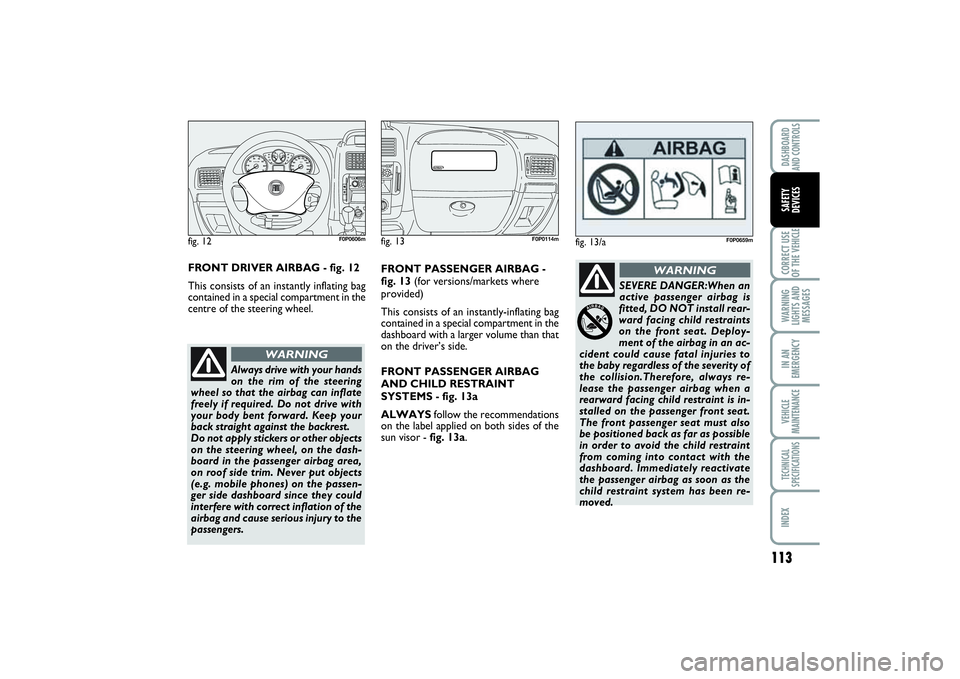
FRONT PASSENGER AIRBAG -
fig. 13(for versions/markets where
provided)
This consists of an instantly-inflating bag
contained in a special compartment in the
dashboard with a larger volume than that
on the driver’s side.
FRONT PASSENGER AIRBAG
AND CHILD RESTRAINT
SYSTEMS - fig. 13a
ALWAYSfollow the recommendations
on the label applied on both sides of the
sun visor - fig. 13a.fig. 13
F0P0114m
fig. 12
F0P0606m
Always drive with your hands
on the rim of the steering
wheel so that the airbag can inflate
freely if required. Do not drive with
your body bent forward. Keep your
back straight against the backrest.
Do not apply stickers or other objects
on the steering wheel, on the dash-
board in the passenger airbag area,
on roof side trim. Never put objects
(e.g. mobile phones) on the passen-
ger side dashboard since they could
interfere with correct inflation of the
airbag and cause serious injury to the
passengers.
WARNING
FRONT DRIVER AIRBAG - fig. 12
This consists of an instantly inflating bag
contained in a special compartment in the
centre of the steering wheel.
fig. 13/a
F0P0659m
SEVERE DANGER:When an
active passenger airbag is
fitted, DO NOT install rear-
ward facing child restraints
on the front seat. Deploy-
ment of the airbag in an ac-
cident could cause fatal injuries to
the baby regardless of the severity of
the collision.Therefore, always re-
lease the passenger airbag when a
rearward facing child restraint is in-
stalled on the passenger front seat.
The front passenger seat must also
be positioned back as far as possible
in order to avoid the child restraint
from coming into contact with the
dashboard. Immediately reactivate
the passenger airbag as soon as the
child restraint system has been re-
moved.
WARNING
097-118 SCUDO LUM GB 02/04/14 10:40 Pagina 113
Page 118 of 227
114CORRECT USE
OF THE VEHICLE
WARNING
LIGHTS AND
MESSAGESIN AN
EMERGENCYVEHICLE
MAINTENANCETECHNICAL
SPECIFICATIONSIINDEXDASHBOARD
AND CONTROLSSAFETY
DEVICES
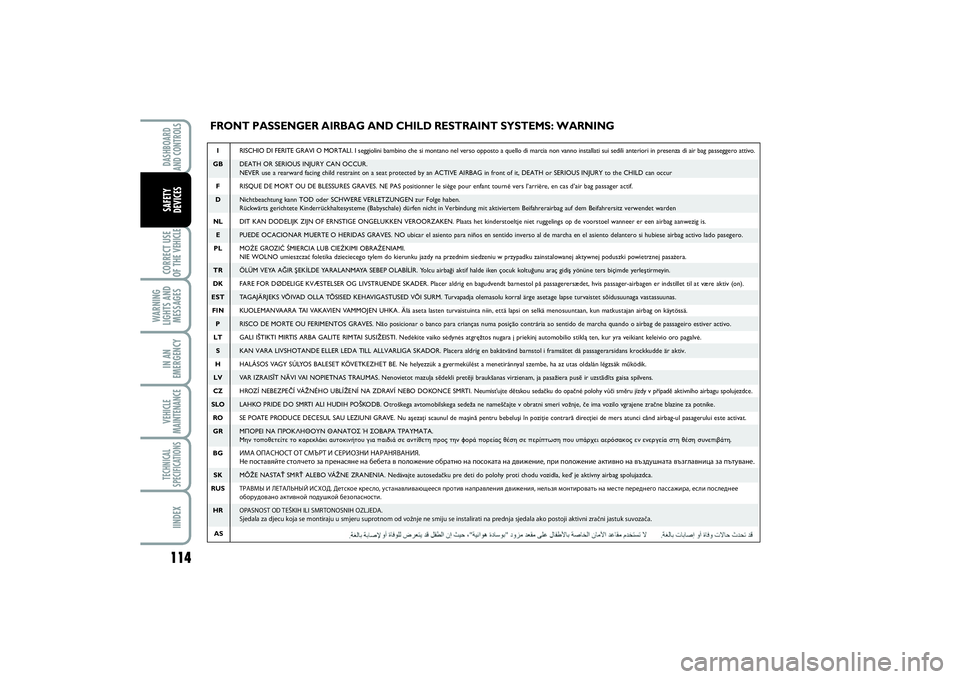
FRONT PASSENGER AIRBAG AND CHILD RESTRAINT SYSTEMS: WARNINGIRISCHIO DI FERITE GRAVI O MORTALI. I seggiolini bambino che si montano nel verso opposto a quello di marcia non vanno installati sui sedili anteriori in presenza di air bag passeggero attivo.
GBDEATH OR SERIOUS INJURY CAN OCCUR.
NEVER use a rearward facing child restraint on a seat protected by an ACTIVE AIRBAG in front of it, DEATH or SERIOUS INJURY to the CHILD can occur
FRISQUE DE MORT OU DE BLESSURES GRAVES. NE PAS positionner le siège pour enfant tourné vers l’arrière, en cas d’air bag passager actif.
DNichtbeachtung kann TOD oder SCHWERE VERLETZUNGEN zur Folge haben.
Rückwärts gerichtete Kinderrückhaltesysteme (Babyschale) dürfen nicht in Verbindung mit aktiviertem Beifahrerairbag auf dem Beifahrersitz verwendet warden
NLDIT KAN DODELIJK ZIJN OF ERNSTIGE ONGELUKKEN VEROORZAKEN. Plaats het kinderstoeltje niet ruggelings op de voorstoel wanneer er een airbag aanwezig is.
EPUEDE OCACIONAR MUERTE O HERIDAS GRAVES. NO ubicar el asiento para niños en sentido inverso al de marcha en el asiento delantero si hubiese airbag activo lado pasegero.
PLMOŹE GROZIĆ ŚMIERCIA LUB CIEŹKIMI OBRAŹENIAMI.
NIE WOLNO umieszczać foletika dzieciecego tylem do kierunku jazdy na przednim siedzeniu w przypadku zainstalowanej aktywnej poduszki powietrznej pasażera.
TRÖLÜM VEYA AĞIR ŞEKİLDE YARALANMAYA SEBEP OLABİLİR. Yolcu airbaği aktif halde iken çocuk koltuğunu araç gidiş yönüne ters biçimde yerleştirmeyin.
DKFARE FOR DØDELIGE KVÆSTELSER OG LIVSTRUENDE SKADER. Placer aldrig en bagudvendt barnestol på passagerersædet, hvis passager-airbagen er indstillet til at være aktiv (on).
ESTTAGAJÄRJEKS VÕIVAD OLLA TÕSISED KEHAVIGASTUSED VÕI SURM. Turvapadja olemasolu korral ärge asetage lapse turvaistet sõidusuunaga vastassuunas.
FINKUOLEMANVAARA TAI VAKAVIEN VAMMOJEN UHKA. Älä aseta lasten turvaistuinta niin, että lapsi on selkä menosuuntaan, kun matkustajan airbag on käytössä.
PRISCO DE MORTE OU FERIMENTOS GRAVES. Não posicionar o banco para crianças numa posição contrária ao sentido de marcha quando o airbag de passageiro estiver activo.
LTGALI IŠTIKTI MIRTIS ARBA GALITE RIMTAI SUSIŽEISTI. Nedėkite vaiko sėdynės atgręžtos nugara į priekinį automobilio stiklą ten, kur yra veikiant keleivio oro pagalvė.
SKAN VARA LIVSHOTANDE ELLER LEDA TILL ALLVARLIGA SKADOR. Placera aldrig en bakåtvänd barnstol i framsätet då passagerarsidans krockkudde är aktiv.
HHALÁSOS VAGY SÚLYOS BALESET KÖVETKEZHET BE. Ne helyezzük a gyermekülést a menetiránnyal szembe, ha az utas oldalán légzsák működik.
LVVAR IZRAISĪT NĀVI VAI NOPIETNAS TRAUMAS. Nenovietot mazuļa sēdekli pretēji braukšanas virzienam, ja pasažiera pusē ir uzstādīts gaisa spilvens.
CZHROZÍ NEBEZPEČÍ VÁŽNÉHO UBLÍŽENÍ NA ZDRAVÍ NEBO DOKONCE SMRTI. Neumísťujte dětskou sedačku do opačné polohy vůči směru jízdy v případě aktivního airbagu spolujezdce.
SLOLAHKO PRIDE DO SMRTI ALI HUDIH POŠKODB. Otroškega avtomobilskega sedeža ne nameščajte v obratni smeri vožnje, če ima vozilo vgrajene zračne blazine za potnike.
ROSE POATE PRODUCE DECESUL SAU LEZIUNI GRAVE. Nu aşezaţi scaunul de maşină pentru bebeluşi în poziţie contrară direcţiei de mers atunci când airbag-ul pasagerului este activat.
GRΜΠΟΡEI ΝΑ ΠΡΟΚΛΗΘΟΥΝ ΘΑΝΑΤΟΣ Ή ΣΟΒΑΡΑ ΤΡΑΥΜΑΤΑ.
Μην τοποθετείτε το καρεκλάκι αυτοκινήτου για παιδιά σε αντίθετη προς την φορά πορείας θέση σε περίπτωση που υπάρχει αερόσακος εν ενεργεία στη θέση συνεπιβάτη.
BG
ИМА ОПАСНОСТ ОТ СМЪРТ И СЕРИОЗНИ НАРАНЯВАНИЯ.
Не поставяйте столчето за пренасяне на бебета в положение обратно на посоката на движение, при положение активно на въздушната възглавница за пътуване.
SKMÔŽE NASTAŤ SMRŤ ALEBO VÁŽNE ZRANENIA. Nedávajte autosedačku pre deti do polohy proti chodu vozidla, keď je aktívny airbag spolujazdca.
RUSТРАВМЫ И ЛЕТАЛЬНЫЙ ИСХОД. Детское кресло, устанавливающееся против направления движения, нельзя монтировать на месте переднего пассажира, если последнее
оборудовано активной подушкой безопасности.
HROPASNOST OD TEŠKIH ILI SMRTONOSNIH OZLJEDA.
Sjedala za djecu koja se montiraju u smjeru suprotnom od vožnje ne smiju se instalirati na prednja sjedala ako postoji aktivni zračni jastuk suvozača.AS
097-118 SCUDO LUM GB 02/04/14 10:40 Pagina 114