steering FIAT SEDICI 2007 2.G User Guide
[x] Cancel search | Manufacturer: FIAT, Model Year: 2007, Model line: SEDICI, Model: FIAT SEDICI 2007 2.GPages: 266, PDF Size: 3.24 MB
Page 69 of 266

68
HORN
Press the horn button of the steering
wheel to sound the horn. The horn will
sound with the ignition switch in any po-
sition.
79J060
REMOTE AUDIO
CONTROLS
(if equipped)
You can control basic functions of the au-
dio system with the switches on the steer-
ing wheel.
For details, refer to “Audio Systems” in
the “INSTRUMENT PANEL” section.
79J073
057-068 Fiat16 New GB 27-11-2007 11:25 Pagina 68
Page 79 of 266

78
79J039
This light comes on when the ignition
switch is turned to the “ON” position, and
goes out when the engine is started.
If this light comes on while driving, the
power steering system may not work
properly. Have the system inspected by
your Fiat Dealership.
NOTE If the power steering system does
not work properly, you will feel heavier
to steer but you still will be able to steer. ELECTRIC POWER STEERING
LIGHT (if equipped)KEYLESS START SYSTEM
INDICATOR LIGHT (if equipped)
62J041
When you push the ignition switch for ve-
hicle with the keyless start system, this
light will come on in blue or red. If this
light comes on in blue, you can turn the
ignition switch without using an ignition
key. If this light comes on in red, you can
not turn the ignition switch without us-
ing an ignition key. For details, refer to “Ig-
nition Switch” in the “STEERING COL-
UMN CONTROLS” section.
If this light blinks in red, it reminds you that
the remote controller is not in the vehi-
cle. For details, refer to “Keyless Start Sys-
tem” in the “BEFORE DRIVING” section.REAR FOG LIGHT INDICATOR
LIGHT (if equipped)
54G491
The rear fog light indicator light comes on
when the rear fog light operates.
069-128 Fiat16 New GB 27-11-2007 11:26 Pagina 78
Page 109 of 266

108
Be careful not to cover the interior tem-
perature sensor (F) between the steering
wheel and the climate control panel, or
the solar sensor (G) located at the top of
the driver’s side dashboard. These sensors
are used by the automatic system to reg-
ulate temperature.
Manual operation
You can manually control the climate con-
trol system. Set the selectors to your de-
sired position.NOTE If you need maximum defrosting:
❒set the air flow selector to “DEFROST”
(the air conditioning system will come
on and the “FRESH AIR” mode will be
selected automatically),
❒set the blower speed selector to HIGH,
❒adjust the temperature selector to the
HOT end, and
❒adjust the side outlets so the air blows
on the side windows.
❒If your vehicle has been left in the sun
with the windows closed, it will cool
faster if you open the windows briefly.
❒Even under the automatic operation,
you can set some of the blower speed
selector/ air intake selector (2) and air
flow selector (3) into manual mode.
Then the manually selected function is
maintained preferentially, and the oth-
er functions remain under automatic
operation.
❒To return the air intake selector (2) to
automatic operation when both the
blower speed selector (2) and the air
flow selector (3) are in the “AUTO”
position, turn either the selector (2) or
(3) to a position other than “AUTO”,
then turn to the “AUTO” position
again.
(G)
(F)
79J07179J070
069-128 Fiat16 New GB 27-11-2007 11:26 Pagina 108
Page 127 of 266

126
To change the radio station:
To advance to the next preset station,
push the switch (5) briefly (only MP3 ver-
sion)
To select the previous preset station, push
the switch (6) briefly (only MP3 version)To scan the higher frequency radio sta-
tion, push and hold the switch (5)
To scan the lower frequency radio station,
push and hold the switch (6)
To scan the selection on a CD:
To advance to the next track on a CD,
push the switch (5)
To select the previous track on a CD,
push the switch (6).
For vehicle with navigation system
Refer to the chart below how to use the
switches on the steering wheel. REMOTE AUDIO CONTROLS
(if equipped)
You can control basic functions of the au-
dio system with the switches on the steer-
ing wheel. How to use the switches is dif-
ferent if the navigation system is equipped
or not.
For vehicle without navigation
system
To control the volume:
To increase the volume, push the switch
(1).
To decrease the volume, push the switch
(2).
To mute, push the switch (3).
To select the mode, push the switch (4).
You can also turn on the audio system by
pushing the switch (4).
(3)
(1)
(2)(4)
(5)
(6)
79J117
069-128 Fiat16 New GB 27-11-2007 11:26 Pagina 126
Page 152 of 266

151
Once a week, or each time you fill your
fuel tank, perform the following under-
hood checks:
❒Engine oil level
❒Coolant level
❒Brake fluid level
❒Power steering (if equipped) fluid level
❒Windshield washer fluid level
❒Battery solution level
❒Hood latch operation
Pull the hood release handle inside the
vehicle. Make sure that you cannot
open the hood all the way without re-
leasing the secondary latch. Be sure to
close the hood securely after check-
ing for proper latch operation. See “All
latches, hinges & locks” of “CHASSIS
AND BODY” in the “Periodic Main-
tenance Schedule” in the “INSPEC-
TION AND MAINTENANCE” section
for lubrication schedule.Once a month, or each time you fill your
fuel tank, check the tire pressure using a
tire pressure gauge. Also check the tire
pressure of the spare tire.❒Adjust the seat and adjustable head re-
straint (if equipped).
❒Check the brake pedal and the park-
ing brake lever.
❒Adjust the mirrors.
❒Make sure that you and all passengers
have properly fastened your seat belts.
❒Make sure that all warning lights come
on as the key is turned to the “ON” or
“START” position.
❒Check all gauges.
❒Make sure that the BRAKE SYSTEM
WARNING light turns off when the
parking brake is released.
60A187S
Make sure the hood is fully
closed and latched before
driving. If it is not, it can fly up un-
expectedly during driving, obstructing
your view and resulting in an acci-
dent.
WARNING
149-166 Fiat16 New GB 27-11-2007 11:27 Pagina 151
Page 161 of 266
160
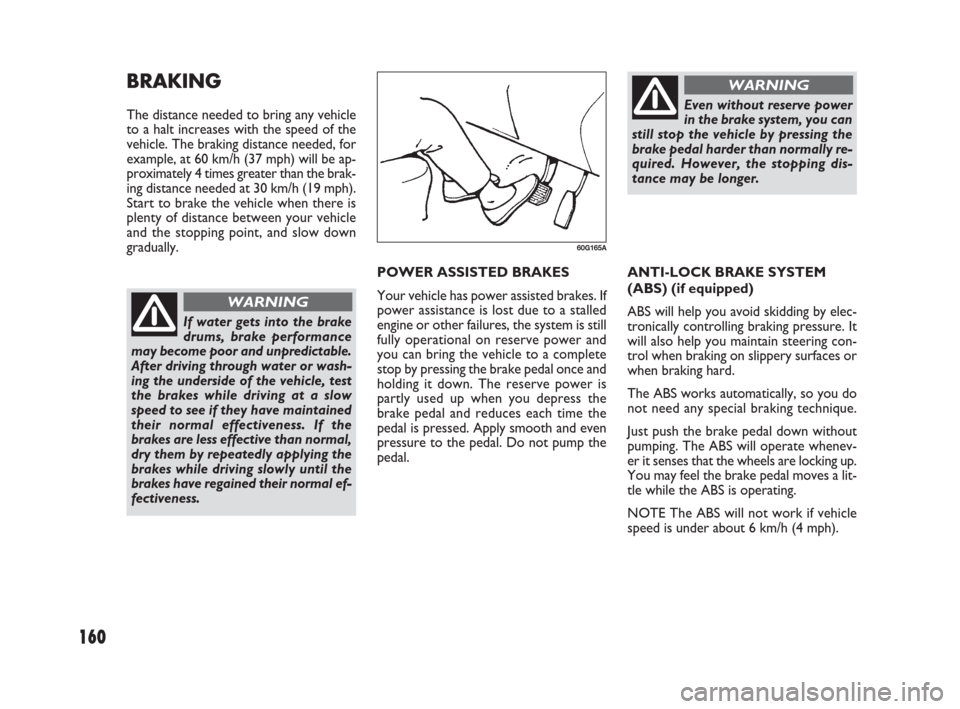
POWER ASSISTED BRAKES
Your vehicle has power assisted brakes. If
power assistance is lost due to a stalled
engine or other failures, the system is still
fully operational on reserve power and
you can bring the vehicle to a complete
stop by pressing the brake pedal once and
holding it down. The reserve power is
partly used up when you depress the
brake pedal and reduces each time the
pedal is pressed. Apply smooth and even
pressure to the pedal. Do not pump the
pedal.ANTI-LOCK BRAKE SYSTEM
(ABS) (if equipped)
ABS will help you avoid skidding by elec-
tronically controlling braking pressure. It
will also help you maintain steering con-
trol when braking on slippery surfaces or
when braking hard.
The ABS works automatically, so you do
not need any special braking technique.
Just push the brake pedal down without
pumping. The ABS will operate whenev-
er it senses that the wheels are locking up.
You may feel the brake pedal moves a lit-
tle while the ABS is operating.
NOTE The ABS will not work if vehicle
speed is under about 6 km/h (4 mph).
BRAKING
The distance needed to bring any vehicle
to a halt increases with the speed of the
vehicle. The braking distance needed, for
example, at 60 km/h (37 mph) will be ap-
proximately 4 times greater than the brak-
ing distance needed at 30 km/h (19 mph).
Start to brake the vehicle when there is
plenty of distance between your vehicle
and the stopping point, and slow down
gradually.
60G165A
If water gets into the brake
drums, brake performance
may become poor and unpredictable.
After driving through water or wash-
ing the underside of the vehicle, test
the brakes while driving at a slow
speed to see if they have maintained
their normal effectiveness. If the
brakes are less effective than normal,
dry them by repeatedly applying the
brakes while driving slowly until the
brakes have regained their normal ef-
fectiveness.
WARNING
Even without reserve power
in the brake system, you can
still stop the vehicle by pressing the
brake pedal harder than normally re-
quired. However, the stopping dis-
tance may be longer.
WARNING
149-166 Fiat16 New GB 27-11-2007 11:27 Pagina 160
Page 163 of 266
162
HOW THE ABS WORKS
A computer continuously monitors wheel
speed. The computer compares the
changes in wheel speed when braking. If
the wheels slow suddenly, indicating a
skidding situation, the computer will
change braking pressure several times
each second to prevent the wheels from
locking. When you start your vehicle af-
ter a stop you may hear a momentary mo-
tor noise as the system checks itself.
The ABS may not work
properly if tires or wheels
other than those specified in the own-
er’s manual are used. This is because
the ABS works by comparing changes
in wheel speed. When replacing tires
or wheels, use only the size and type
specified in this owner’s manual.
WARNING
ELECTRONIC STABILITY
PROGRAM (ESP®)
(if equipped)
ESP®is a registered trademark of Daim-
lerChrysler AG.
The Electronic Stability Program (ESP
®)
helps to control the vehicle during cor-
nering if the vehicle is understeering or
oversteering. It also assists you in main-
taining traction while accelerating on loose
or slippery road surfaces. It does this by
regulating the engine’s output, and by se-
lectively applying the brakes. In addition,
ESP
®helps to avoid skidding by controlling
braking pressure.
The ESP®cannot enhance
the vehicle’s driving stabili-
ty in all situations and does not con-
trol your vehicle’s entire braking sys-
tem. The ESP
®cannot prevent acci-
dents, including those resulting from
excessive speed in turns, or hy-
droplaning. Only a safe and attentive
driver can prevent accidents. The ca-
pabilities of an ESP
®- equipped ve-
hicle must never be used as a substi-
tute for careful driving.
WARNING
The ESP®has the following three systems:
STABILITY CONTROL SYSTEM
The vehicle stability control system helps
provide integrated control of systems such
as anti- lock brakes, traction control, en-
gine control, etc. This system automati-
cally controls the brakes and engine to
help prevent the vehicle from skidding
when cornering on a slippery road surface
or when turning the steering wheel
abruptly.
TRACTION CONTROL SYSTEM
The traction control system automatical-
ly helps prevent the spinning of wheels
when the vehicle is started or accelerated
on slippery road surfaces. The system op-
erates only if it senses that some of the
wheels are spinning or beginning to lose
traction. When this happens, the system
operates the front or rear brakes and re-
duces engine power to limit wheel spin.
NOTE You may hear a clicking sound in
the engine compartment for a few seconds
when you start the engine or just after the
vehicle begins to move. This means that
the above systems are in the self-check
mode. This sound does not indicate a mal-
function.
149-166 Fiat16 New GB 27-11-2007 11:27 Pagina 162
Page 164 of 266
163
The ESP may not work prop-
erly if tires or wheels other
than those specified in the Owner’s
Manual are used. When replacing
tires or wheels, use only the size and
type specified in this Owner’s Man-
ual.
The ESP
®may not work properly if
tires are not inflated to the recom-
mended tire inflation pressure.
The ESP
®may not work properly if
tires are fitted with tire chains.
The ESP
®may not work properly if
the tires are excessively worn. Be sure
to replace tires when the tread wear
indicators in the grooves appear on
the tread surface.
The ESP
®is not a substitute for win-
ter tires or tire chains on a snow cov-
ered road.
WARNING
The ESP®may not work
properly if engine related
parts such as the muffler are not
equivalent to standard equipment or
are extremely deteriorated.
Do not modify the vehicle’s suspen-
sion since the ESP
®may not operate
correctly.
WARNING
ANTI-LOCK BRAKING SYSTEM
(ABS)
ABS will help you avoid skidding by elec-
tronically controlling braking pressure. It
will also help you maintain steering con-
trol when braking on slippery surfaces or
when braking hard. The ABS works au-
tomatically, so you do not have to use any
special braking technique. Just push the
brake pedal down without pumping. The
ABS will operate whenever it senses that
wheels are locking up. You may feel the
brake pedal pulsate while the ABS is op-
erating.
(For more information on ABS, see “Brak-
ing” in the “OPERATING YOUR VEHI-
CLE” section.)
NOTE If the ABS system is activated, you
may hear a clunking noise and/ or feel pul-
sating in the brake pedal. This is normal
and indicates that the brake fluid pressure
is being controlled properly.The ESP®indicator lights are described be-
low:
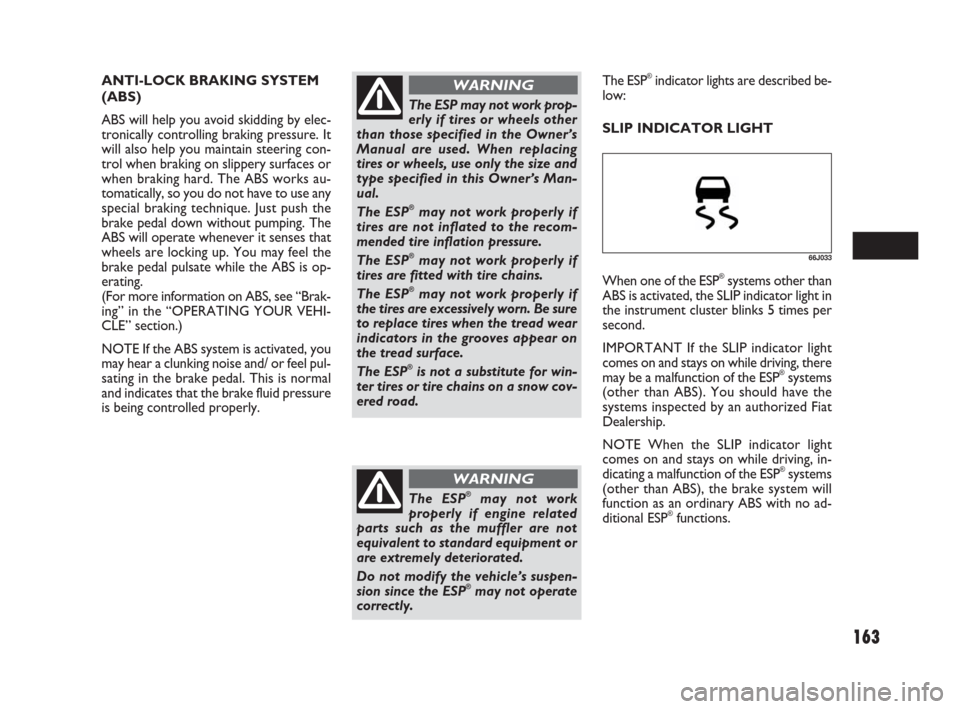
SLIP INDICATOR LIGHT
66J033
When one of the ESP®systems other than
ABS is activated, the SLIP indicator light in
the instrument cluster blinks 5 times per
second.
IMPORTANT If the SLIP indicator light
comes on and stays on while driving, there
may be a malfunction of the ESP
®systems
(other than ABS). You should have the
systems inspected by an authorized Fiat
Dealership.
NOTE When the SLIP indicator light
comes on and stays on while driving, in-
dicating a malfunction of the ESP
®systems
(other than ABS), the brake system will
function as an ordinary ABS with no ad-
ditional ESP
®functions.
149-166 Fiat16 New GB 27-11-2007 11:27 Pagina 163
Page 169 of 266

168
HIGHWAY DRIVING
When driving at high-speed, pay attention
to the following:
❒Stopping distance progressively in-
creases with vehicle speed. Apply the
brakes far enough ahead of the stopping
point to allow for the extra stopping
distance.
❒On rainy days, “Aquaplaning” can occur.
“Aquaplaning” is the loss of direct con-
tact between the road surface and the
vehicle’s tires due to a water film form-
ing between them. Steering or braking
the vehicle while “Aquaplaning” can be
very difficult, and loss of control can oc-
cur. Keep speed down when the road
surface is wet.
❒At high speeds, the vehicle may be af-
fected by side winds. Therefore, reduce
speed and be prepared for unexpect-
ed buffeting, which can occur at the ex-
its of tunnels, when passing by a cut of
a hill, or when being overtaken by large
vehicles, etc.
DRIVING ON HILLS
❒When climbing steep hills, the vehicle
may begin to slow down and show a
lack of power. If this happens, you
should shift to a lower gear so that the
engine will again be operating in its nor-
mal power range. Shift rapidly to pre-
vent the vehicle from losing momen-
tum.
❒When driving down a hill, the engine
should be used for braking by moving
to next lower gear.
52D078
Wear Your Seat Belts at All
Times. Even though air bags
are equipped at the front seating po-
sitions, the driver and all passengers
should be properly restrained at all
times, using the seat belts provided.
Refer to the “Seat Belts and Child Re-
straint Systems” section for instruc-
tions on proper use of the seat belts.
Never drive while under the influence
of alcohol or other drugs. Alcohol and
drugs can seriously impair your abili-
ty to drive safely, greatly increasing
the risk of injury to yourself and oth-
ers. You should also avoid driving
when you are tired, sick, irritated, or
under stress.
WARNING
Try not to hold the brake
pedal down too long or too
often while going down a steep or
long hill. This could cause the brakes
to overheat, resulting in reduced
braking efficiency. Failure to take this
precaution could result in loss of ve-
hicle control.
WARNING
167-170 Fiat16 New GB 27-11-2007 11:28 Pagina 168
Page 170 of 266

169
DRIVING ON SLIPPERY
ROADS
Under wet road conditions you should
drive at a lower speed than on dry roads
due to possible slippage of tires during
braking. When driving on icy, snow-cov-
ered, or muddy roads, reduce your speed
and avoid sudden acceleration, abrupt
braking, or sharp steering movements.
FOR 4-WHEEL DRIVE (4WD)
MODELS
Your 4WD is designed to get better trac-
tion on slippery roads than 2-wheel drive
models. However, your 4WD will not
have as much traction in deep snow, mud
or sand as multipurpose 4WD vehicles.
You should not attempt to drive your
4WD in deep snow, mud or sand.
SNOW CHAINS
Snow chains should only be used if they
are needed to increase traction or are re-
quired by law. Make sure that the chains
you use are the correct size for your ve-
hicle’s tires. Also make sure that there is
enough clearance between the fenders
and the chains as installed on the tires.Install the chains on the front tires tight-
ly, according to the chain manufacturer’s
instructions. Retighten the chains after dri-
ving about 1. 0 km (1/ 2 mile) if necessary.
With the chains installed, drive slowly.
IMPORTANT
❒If you hear the chains hitting against the
vehicle body while driving, stop and
tighten them.
❒If you vehicle is equipped with full wheel
caps, remove the wheel caps before in-
stalling the chains or the wheel caps can
be damaged by the chain bands. IMPORTANT When descending a down
hill, NEVER turn the ignition key to the
“OFF” position. Emission control system
damage may result.
79J00360G089A
167-170 Fiat16 New GB 27-11-2007 11:28 Pagina 169