engine FIAT SEDICI 2007 2.G Service Manual
[x] Cancel search | Manufacturer: FIAT, Model Year: 2007, Model line: SEDICI, Model: FIAT SEDICI 2007 2.GPages: 266, PDF Size: 3.24 MB
Page 156 of 266
155
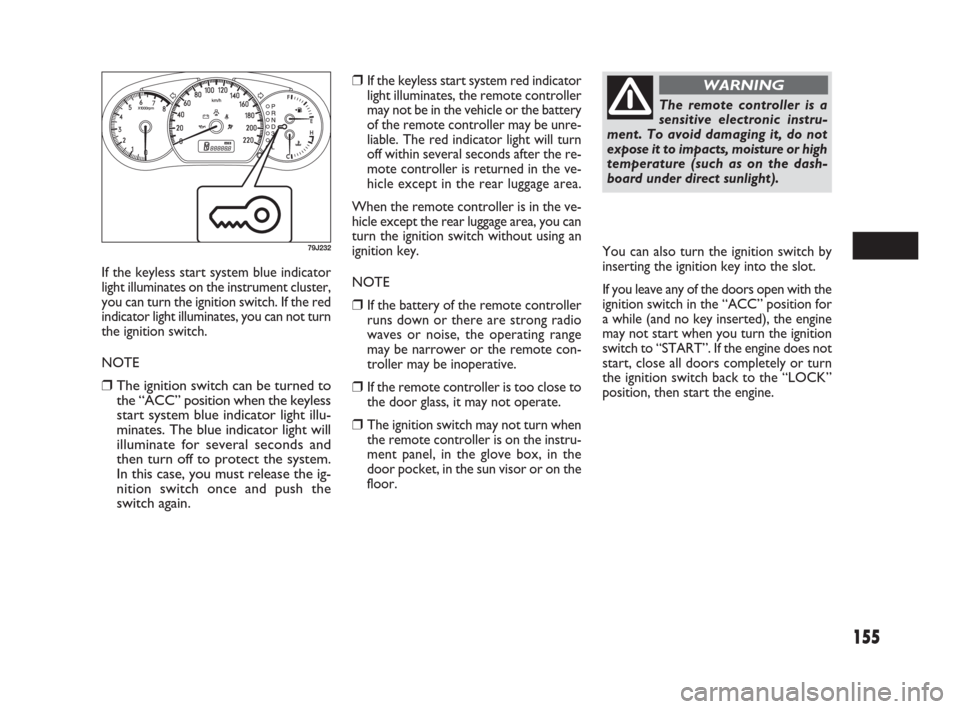
If the keyless start system blue indicator
light illuminates on the instrument cluster,
you can turn the ignition switch. If the red
indicator light illuminates, you can not turn
the ignition switch.
NOTE
❒The ignition switch can be turned to
the “ACC” position when the keyless
start system blue indicator light illu-
minates. The blue indicator light will
illuminate for several seconds and
then turn off to protect the system.
In this case, you must release the ig-
nition switch once and push the
switch again.
79J232
❒If the keyless start system red indicator
light illuminates, the remote controller
may not be in the vehicle or the battery
of the remote controller may be unre-
liable. The red indicator light will turn
off within several seconds after the re-
mote controller is returned in the ve-
hicle except in the rear luggage area.
When the remote controller is in the ve-
hicle except the rear luggage area, you can
turn the ignition switch without using an
ignition key.
NOTE
❒If the battery of the remote controller
runs down or there are strong radio
waves or noise, the operating range
may be narrower or the remote con-
troller may be inoperative.
❒If the remote controller is too close to
the door glass, it may not operate.
❒The ignition switch may not turn when
the remote controller is on the instru-
ment panel, in the glove box, in the
door pocket, in the sun visor or on the
floor.
The remote controller is a
sensitive electronic instru-
ment. To avoid damaging it, do not
expose it to impacts, moisture or high
temperature (such as on the dash-
board under direct sunlight).
WARNING
You can also turn the ignition switch by
inserting the ignition key into the slot.
If you leave any of the doors open with the
ignition switch in the “ACC” position for
a while (and no key inserted), the engine
may not start when you turn the ignition
switch to “START”. If the engine does not
start, close all doors completely or turn
the ignition switch back to the “LOCK”
position, then start the engine.
149-166 Fiat16 New GB 27-11-2007 11:27 Pagina 155
Page 157 of 266
156
79J002
Reduce your speed and
downshift to a lower gear
before going down a long or steep hill.
A lower gear will allow the engine to
provide braking. Avoid riding the
brakes or they may overheat, result-
ing in brake failure.
When driving on slippery roads, be
sure to slow down before downshift-
ing. Excessive and or sudden changes
in engine speed may cause loss of
traction, which could cause you to
lose control.
Make sure that the vehicle is com-
pletely stationary before you shift in-
to reverse.
WARNING
79J140
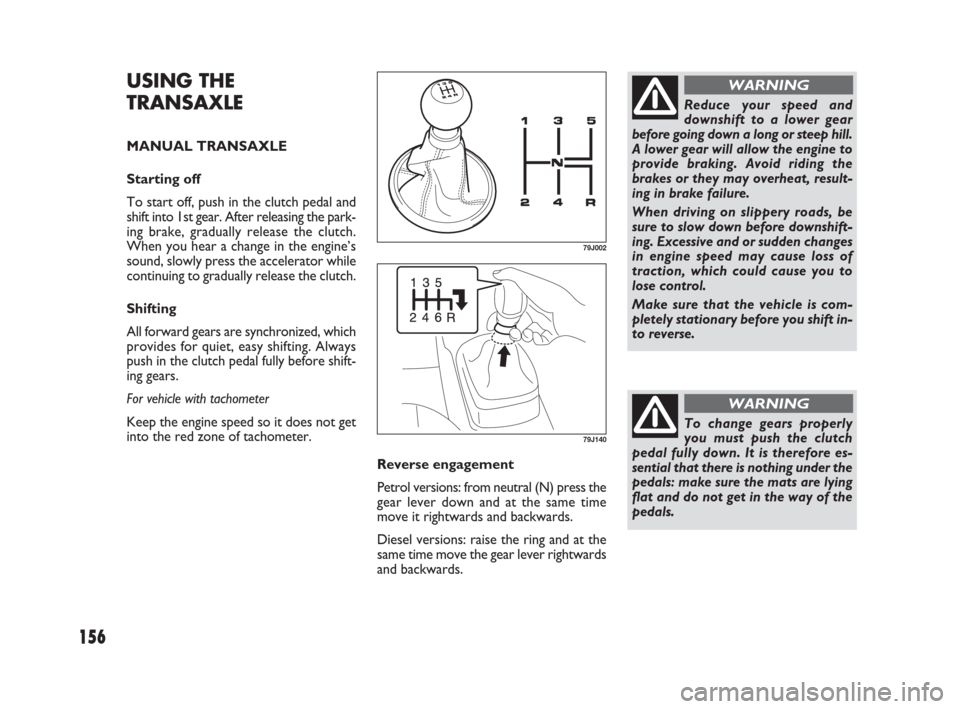
Reverse engagement
Petrol versions: from neutral (N) press the
gear lever down and at the same time
move it rightwards and backwards.
Diesel versions: raise the ring and at the
same time move the gear lever rightwards
and backwards.
To change gears properly
you must push the clutch
pedal fully down. It is therefore es-
sential that there is nothing under the
pedals: make sure the mats are lying
flat and do not get in the way of the
pedals.
WARNING
USING THE
TRANSAXLE
MANUAL TRANSAXLE
Starting off
To start off, push in the clutch pedal and
shift into 1st gear. After releasing the park-
ing brake, gradually release the clutch.
When you hear a change in the engine’s
sound, slowly press the accelerator while
continuing to gradually release the clutch.
Shifting
All forward gears are synchronized, which
provides for quiet, easy shifting. Always
push in the clutch pedal fully before shift-
ing gears.
For vehicle with tachometer
Keep the engine speed so it does not get
into the red zone of tachometer.
149-166 Fiat16 New GB 27-11-2007 11:27 Pagina 156
Page 158 of 266
157
IMPORTANT Do not drive with your
hand resting on the gear lever as the force
exerted, even if slight, could lead over time
to premature wear on the gearbox inter-
nal components.
IMPORTANT
❒To help avoid clutch damage, do not
use the clutch pedal as a footrest while
driving or use the clutch to keep the ve-
hicle stationary on a hill. Depress the
clutch fully when shifting.
❒When shifting or starting off, do not
race the engine. Racing the engine can
shorten engine life and prevent smooth
shifting.
USING THE 2WD/
4WD SWITCH
(if equipped)
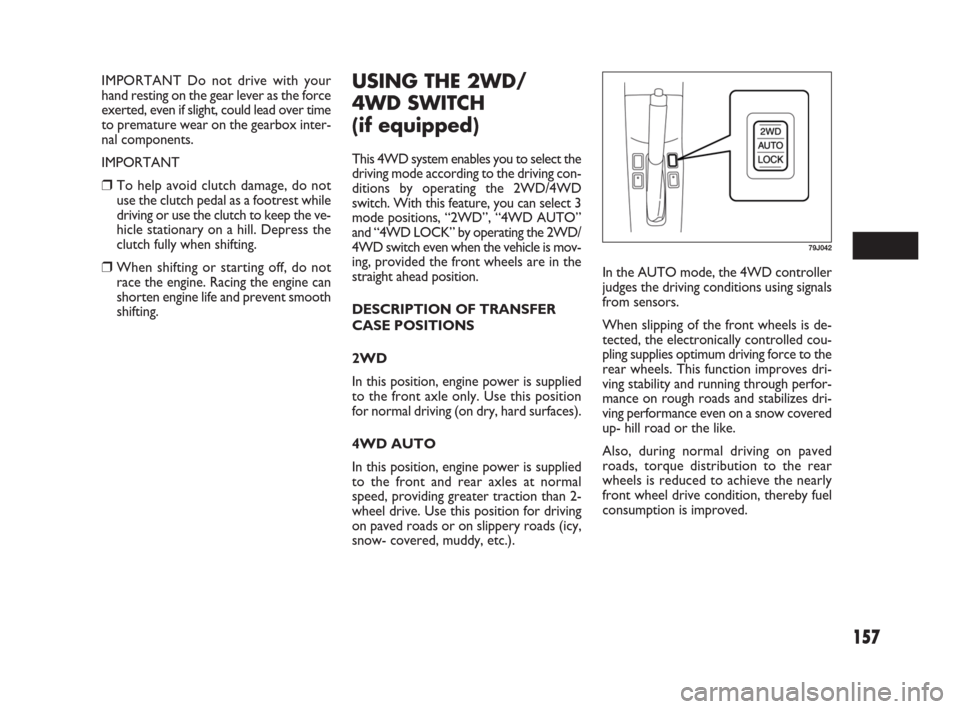
This 4WD system enables you to select the
driving mode according to the driving con-
ditions by operating the 2WD/4WD
switch. With this feature, you can select 3
mode positions, “2WD”, “4WD AUTO”
and “4WD LOCK” by operating the 2WD/
4WD switch even when the vehicle is mov-
ing, provided the front wheels are in the
straight ahead position.
DESCRIPTION OF TRANSFER
CASE POSITIONS
2WD
In this position, engine power is supplied
to the front axle only. Use this position
for normal driving (on dry, hard surfaces).
4WD AUTO
In this position, engine power is supplied
to the front and rear axles at normal
speed, providing greater traction than 2-
wheel drive. Use this position for driving
on paved roads or on slippery roads (icy,
snow- covered, muddy, etc.).In the AUTO mode, the 4WD controller
judges the driving conditions using signals
from sensors.
When slipping of the front wheels is de-
tected, the electronically controlled cou-
pling supplies optimum driving force to the
rear wheels. This function improves dri-
ving stability and running through perfor-
mance on rough roads and stabilizes dri-
ving performance even on a snow covered
up- hill road or the like.
Also, during normal driving on paved
roads, torque distribution to the rear
wheels is reduced to achieve the nearly
front wheel drive condition, thereby fuel
consumption is improved.
79J042
149-166 Fiat16 New GB 27-11-2007 11:27 Pagina 157
Page 159 of 266
158
2WD/4WD SWITCH
OPERATION
Operate the 2WD/4WD switch accord-
ing to the appropriate procedure de-
scribed below:
How to turn on 2WD/4WD switch
2WD/4WD switch will activate when the
ignition switch is turned on.
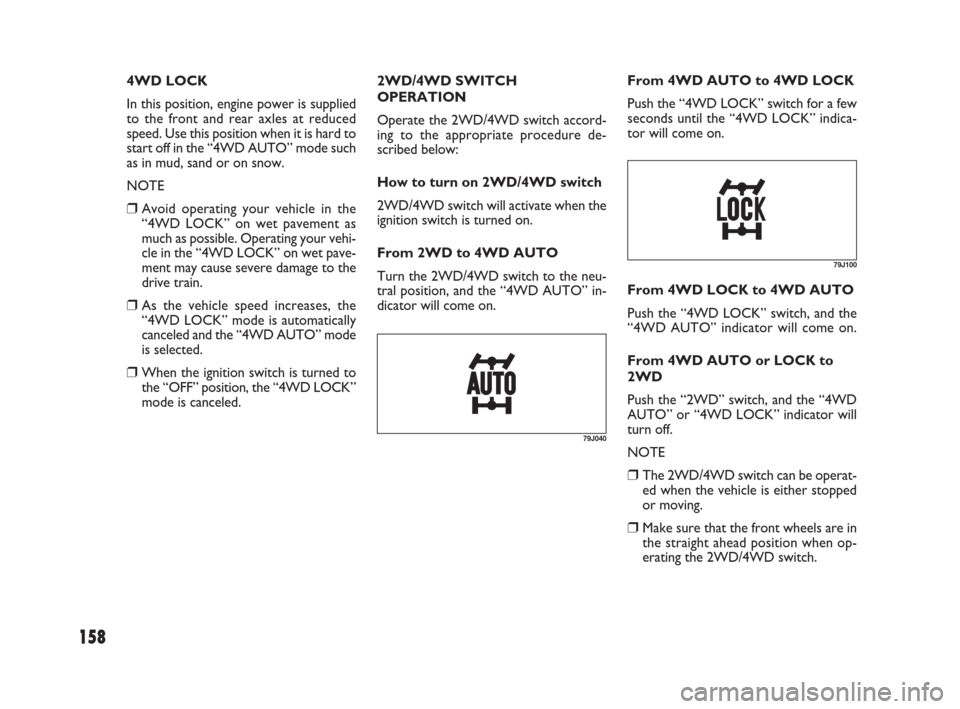
From 2WD to 4WD AUTO
Turn the 2WD/4WD switch to the neu-
tral position, and the “4WD AUTO” in-
dicator will come on.From 4WD AUTO to 4WD LOCK
Push the “4WD LOCK” switch for a few
seconds until the “4WD LOCK” indica-
tor will come on. 4WD LOCK
In this position, engine power is supplied
to the front and rear axles at reduced
speed. Use this position when it is hard to
start off in the “4WD AUTO” mode such
as in mud, sand or on snow.
NOTE
❒Avoid operating your vehicle in the
“4WD LOCK” on wet pavement as
much as possible. Operating your vehi-
cle in the “4WD LOCK” on wet pave-
ment may cause severe damage to the
drive train.
❒As the vehicle speed increases, the
“4WD LOCK” mode is automatically
canceled and the “4WD AUTO” mode
is selected.
❒When the ignition switch is turned to
the “OFF” position, the “4WD LOCK”
mode is canceled.
79J040
79J100
From 4WD LOCK to 4WD AUTO
Push the “4WD LOCK” switch, and the
“4WD AUTO” indicator will come on.
From 4WD AUTO or LOCK to
2WD
Push the “2WD” switch, and the “4WD
AUTO” or “4WD LOCK” indicator will
turn off.
NOTE
❒The 2WD/4WD switch can be operat-
ed when the vehicle is either stopped
or moving.
❒Make sure that the front wheels are in
the straight ahead position when op-
erating the 2WD/4WD switch.
149-166 Fiat16 New GB 27-11-2007 11:27 Pagina 158
Page 160 of 266
159
IMPORTANT
❒Never use the “4WD LOCK” mode
when driving on dry paved roads.
Avoid using the “4WD LOCK” mode
when driving on wet paved roads as
much as possible. Use of the “4WD
LOCK” mode in above conditions will
apply excessive force to the driving
system and may cause a critical failure.
Also, the tires may wear faster and fu-
el consumption may be affected ad-
versely.
❒Note that 4WD vehicles are not al-
laround vehicles. Be sure to observe
following instructions when driving
your vehicle.
– Do not drive through water like
crossing a river.
– Do not drive continuously where
front wheels tend to race such as in
the sand and mud.
– When any wheel is in the air for such
reason as running off the road, do
not race it needlessly.
❒If the “4WD AUTO” and the “4WD
LOCK” indicator lights stay on and
come on simultaneously when driving,
there may be something wrong the
4WD system. Have the system in-
spected by an authorized Fiat Dealer-
ship.IMPORTANT Unevenly worn tires can
cause problems in the operation of the
2WD/4WD switch. Be sure to rotate the
tires according to the maintenance sched-
ule. Refer to “Tires” and “Maintenance
Schedule” in the “INSPECTION AND
MAINTENANCE” section for proper tire
rotation procedures.
❒While making turns or accelerating and
decelerating, operating the 2WD/
4WD switch or turning off the key
switch in the “4WD AUTO” or “4WD
LOCK” mode may cause a shock, but
this is not a system malfunction.
❒While driving in the “4WD LOCK”
mode, as the vehicle speed increases,
the driving mode changes to the “4WD
AUTO” mode automatically. Even
when the vehicle speed reduces, on the
other hand, the driving mode does not
return to the “4WD LOCK” mode au-
tomatically. You should press the
“4WD LOCK” switch according to the
driving conditions.
❒Any forcible operation while driving of-
froad in the sand or water or when a
wheel has run off the road, the differ-
ence of the revolution between front
wheels and rear wheels increases
(wheels run idle). If this state continues,
the oil temperature of the driving sys-
tem parts rises.
In such case, the “4WD AUTO” indi-
cator light blinks and the driving mode
changes to the 2WD mode to protect
the driving system parts.
When you operate your vehicle in the
4WD mode continuously, park the ve-
hicle at a safe place and run the engine
idle. After some time, the “4WD AU-
TO” indicator light turns on again and
the driving mode returns to the “4WD
AUTO” mode.
149-166 Fiat16 New GB 27-11-2007 11:27 Pagina 159
Page 161 of 266
160
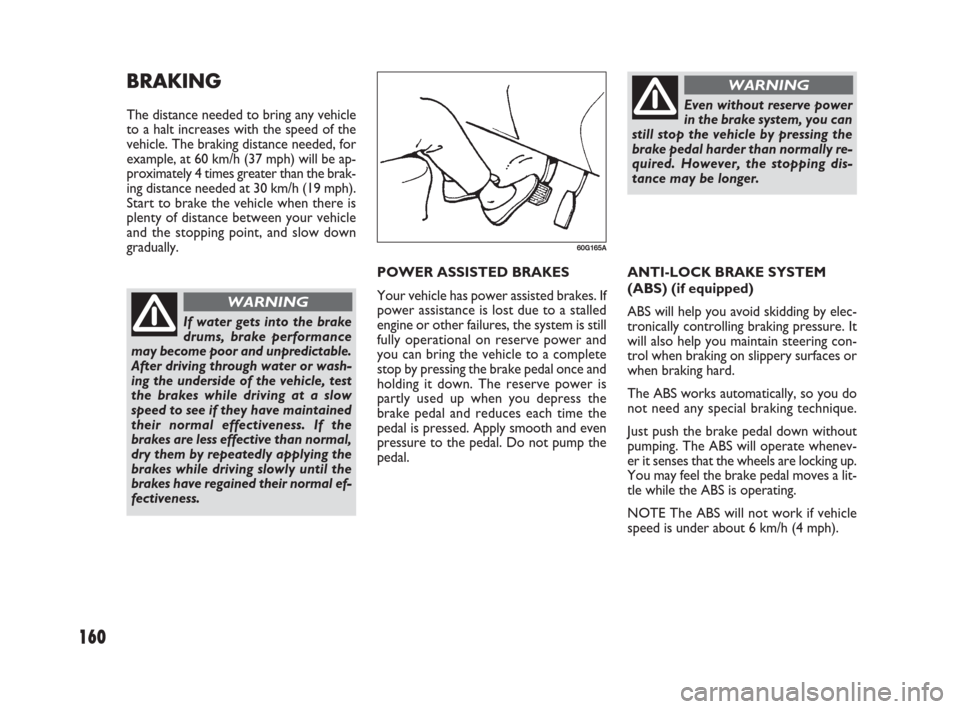
POWER ASSISTED BRAKES
Your vehicle has power assisted brakes. If
power assistance is lost due to a stalled
engine or other failures, the system is still
fully operational on reserve power and
you can bring the vehicle to a complete
stop by pressing the brake pedal once and
holding it down. The reserve power is
partly used up when you depress the
brake pedal and reduces each time the
pedal is pressed. Apply smooth and even
pressure to the pedal. Do not pump the
pedal.ANTI-LOCK BRAKE SYSTEM
(ABS) (if equipped)
ABS will help you avoid skidding by elec-
tronically controlling braking pressure. It
will also help you maintain steering con-
trol when braking on slippery surfaces or
when braking hard.
The ABS works automatically, so you do
not need any special braking technique.
Just push the brake pedal down without
pumping. The ABS will operate whenev-
er it senses that the wheels are locking up.
You may feel the brake pedal moves a lit-
tle while the ABS is operating.
NOTE The ABS will not work if vehicle
speed is under about 6 km/h (4 mph).
BRAKING
The distance needed to bring any vehicle
to a halt increases with the speed of the
vehicle. The braking distance needed, for
example, at 60 km/h (37 mph) will be ap-
proximately 4 times greater than the brak-
ing distance needed at 30 km/h (19 mph).
Start to brake the vehicle when there is
plenty of distance between your vehicle
and the stopping point, and slow down
gradually.
60G165A
If water gets into the brake
drums, brake performance
may become poor and unpredictable.
After driving through water or wash-
ing the underside of the vehicle, test
the brakes while driving at a slow
speed to see if they have maintained
their normal effectiveness. If the
brakes are less effective than normal,
dry them by repeatedly applying the
brakes while driving slowly until the
brakes have regained their normal ef-
fectiveness.
WARNING
Even without reserve power
in the brake system, you can
still stop the vehicle by pressing the
brake pedal harder than normally re-
quired. However, the stopping dis-
tance may be longer.
WARNING
149-166 Fiat16 New GB 27-11-2007 11:27 Pagina 160
Page 163 of 266
162
HOW THE ABS WORKS
A computer continuously monitors wheel
speed. The computer compares the
changes in wheel speed when braking. If
the wheels slow suddenly, indicating a
skidding situation, the computer will
change braking pressure several times
each second to prevent the wheels from
locking. When you start your vehicle af-
ter a stop you may hear a momentary mo-
tor noise as the system checks itself.
The ABS may not work
properly if tires or wheels
other than those specified in the own-
er’s manual are used. This is because
the ABS works by comparing changes
in wheel speed. When replacing tires
or wheels, use only the size and type
specified in this owner’s manual.
WARNING
ELECTRONIC STABILITY
PROGRAM (ESP®)
(if equipped)
ESP®is a registered trademark of Daim-
lerChrysler AG.
The Electronic Stability Program (ESP
®)
helps to control the vehicle during cor-
nering if the vehicle is understeering or
oversteering. It also assists you in main-
taining traction while accelerating on loose
or slippery road surfaces. It does this by
regulating the engine’s output, and by se-
lectively applying the brakes. In addition,
ESP
®helps to avoid skidding by controlling
braking pressure.
The ESP®cannot enhance
the vehicle’s driving stabili-
ty in all situations and does not con-
trol your vehicle’s entire braking sys-
tem. The ESP
®cannot prevent acci-
dents, including those resulting from
excessive speed in turns, or hy-
droplaning. Only a safe and attentive
driver can prevent accidents. The ca-
pabilities of an ESP
®- equipped ve-
hicle must never be used as a substi-
tute for careful driving.
WARNING
The ESP®has the following three systems:
STABILITY CONTROL SYSTEM
The vehicle stability control system helps
provide integrated control of systems such
as anti- lock brakes, traction control, en-
gine control, etc. This system automati-
cally controls the brakes and engine to
help prevent the vehicle from skidding
when cornering on a slippery road surface
or when turning the steering wheel
abruptly.
TRACTION CONTROL SYSTEM
The traction control system automatical-
ly helps prevent the spinning of wheels
when the vehicle is started or accelerated
on slippery road surfaces. The system op-
erates only if it senses that some of the
wheels are spinning or beginning to lose
traction. When this happens, the system
operates the front or rear brakes and re-
duces engine power to limit wheel spin.
NOTE You may hear a clicking sound in
the engine compartment for a few seconds
when you start the engine or just after the
vehicle begins to move. This means that
the above systems are in the self-check
mode. This sound does not indicate a mal-
function.
149-166 Fiat16 New GB 27-11-2007 11:27 Pagina 162
Page 164 of 266
163
The ESP may not work prop-
erly if tires or wheels other
than those specified in the Owner’s
Manual are used. When replacing
tires or wheels, use only the size and
type specified in this Owner’s Man-
ual.
The ESP
®may not work properly if
tires are not inflated to the recom-
mended tire inflation pressure.
The ESP
®may not work properly if
tires are fitted with tire chains.
The ESP
®may not work properly if
the tires are excessively worn. Be sure
to replace tires when the tread wear
indicators in the grooves appear on
the tread surface.
The ESP
®is not a substitute for win-
ter tires or tire chains on a snow cov-
ered road.
WARNING
The ESP®may not work
properly if engine related
parts such as the muffler are not
equivalent to standard equipment or
are extremely deteriorated.
Do not modify the vehicle’s suspen-
sion since the ESP
®may not operate
correctly.
WARNING
ANTI-LOCK BRAKING SYSTEM
(ABS)
ABS will help you avoid skidding by elec-
tronically controlling braking pressure. It
will also help you maintain steering con-
trol when braking on slippery surfaces or
when braking hard. The ABS works au-
tomatically, so you do not have to use any
special braking technique. Just push the
brake pedal down without pumping. The
ABS will operate whenever it senses that
wheels are locking up. You may feel the
brake pedal pulsate while the ABS is op-
erating.
(For more information on ABS, see “Brak-
ing” in the “OPERATING YOUR VEHI-
CLE” section.)
NOTE If the ABS system is activated, you
may hear a clunking noise and/ or feel pul-
sating in the brake pedal. This is normal
and indicates that the brake fluid pressure
is being controlled properly.The ESP®indicator lights are described be-
low:
SLIP INDICATOR LIGHT
66J033
When one of the ESP®systems other than
ABS is activated, the SLIP indicator light in
the instrument cluster blinks 5 times per
second.
IMPORTANT If the SLIP indicator light
comes on and stays on while driving, there
may be a malfunction of the ESP
®systems
(other than ABS). You should have the
systems inspected by an authorized Fiat
Dealership.
NOTE When the SLIP indicator light
comes on and stays on while driving, in-
dicating a malfunction of the ESP
®systems
(other than ABS), the brake system will
function as an ordinary ABS with no ad-
ditional ESP
®functions.
149-166 Fiat16 New GB 27-11-2007 11:27 Pagina 163
Page 166 of 266
165
IMPORTANT To minimize the possibili-
ty of catalyst or other vehicle damage:
❒Maintain the engine in the proper op-
erating condition.
❒In the event of an engine malfunction,
particularly one involving engine misfire
or other apparent loss of performance,
have the vehicle serviced promptly.
❒Do not turn off the engine or interrupt
the ignition when the transaxle is in
gear and the vehicle is in motion.
❒Do not try to start the engine by push-
ing or towing the vehicle, or coasting
down a hill.
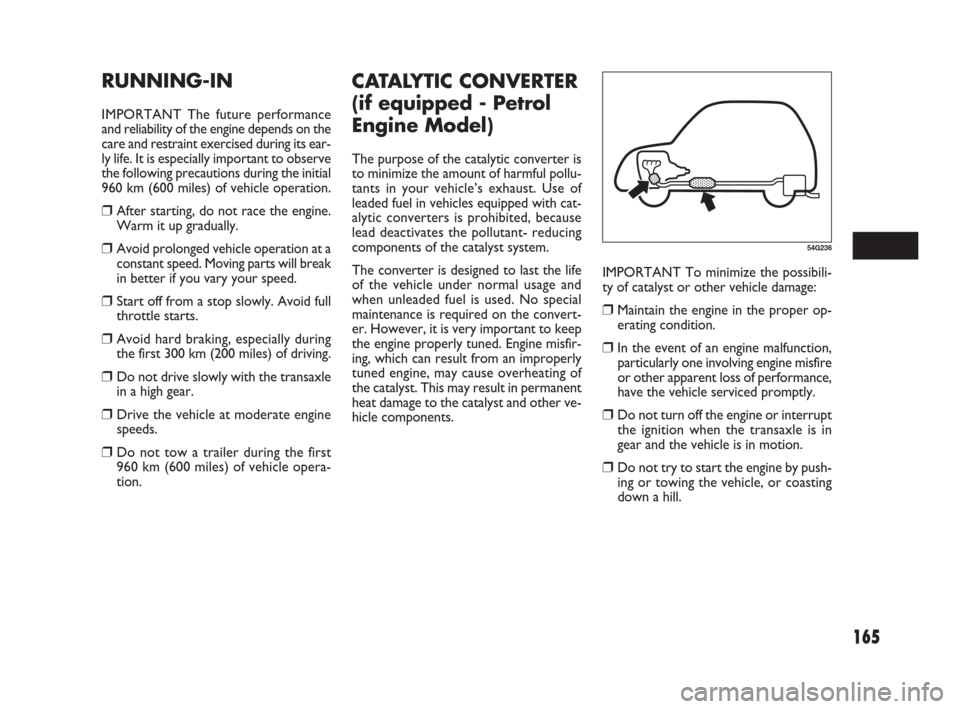
CATALYTIC CONVERTER
(if equipped - Petrol
Engine Model)
The purpose of the catalytic converter is
to minimize the amount of harmful pollu-
tants in your vehicle’s exhaust. Use of
leaded fuel in vehicles equipped with cat-
alytic converters is prohibited, because
lead deactivates the pollutant- reducing
components of the catalyst system.
The converter is designed to last the life
of the vehicle under normal usage and
when unleaded fuel is used. No special
maintenance is required on the convert-
er. However, it is very important to keep
the engine properly tuned. Engine misfir-
ing, which can result from an improperly
tuned engine, may cause overheating of
the catalyst. This may result in permanent
heat damage to the catalyst and other ve-
hicle components.
54G236
RUNNING-IN
IMPORTANT The future performance
and reliability of the engine depends on the
care and restraint exercised during its ear-
ly life. It is especially important to observe
the following precautions during the initial
960 km (600 miles) of vehicle operation.
❒After starting, do not race the engine.
Warm it up gradually.
❒Avoid prolonged vehicle operation at a
constant speed. Moving parts will break
in better if you vary your speed.
❒Start off from a stop slowly. Avoid full
throttle starts.
❒Avoid hard braking, especially during
the first 300 km (200 miles) of driving.
❒Do not drive slowly with the transaxle
in a high gear.
❒Drive the vehicle at moderate engine
speeds.
❒Do not tow a trailer during the first
960 km (600 miles) of vehicle opera-
tion.
149-166 Fiat16 New GB 27-11-2007 11:27 Pagina 165
Page 167 of 266
166
IMPROVING FUEL
ECONOMY
The following instructions will help you
improve fuel economy.
Avoid excessive idling
If you are to wait for more than a minute
while you are parked, stop the engine and
start it again later. When warming up a
cold engine, allow the engine to idle until
the temperature gauge pointer comes up
to the “C” position (if the idling is not pro-
hibited). In this position, the engine is suf-
ficiently warm for starting off.
Avoid “fast” starts
Fast starts away from lights or stop signs
will consume fuel unnecessarily and short-
en engine life. Start off slowly.
Avoid unnecessary stops
Avoid unnecessary deceleration and stop-
ping. Try to maintain a slow, steady speed
whenever possible. Slowing down and
then accelerating again uses more fuel.
Keep a steady cruising speed
Keep as constant a speed as road and traf-
fic conditions will permit.Keep the air cleaner clean
A dirty air cleaner will cause the carbu-
retion system to supply too much fuel to
the engine for the amount of air being sup-
plied. The result is waste of fuel due to in-
complete combustion.
Keep weight to a minimum
The heavier the load, the more fuel the
vehicle consumes. Take out any luggage or
cargo when it is not necessary.
Keep tire pressures correct
Underinflation of the tires can waste fuel
due to increased running resistance of the
tires. Keep your tires inflated to the cor-
rect pressure shown on the label on the
driver’s side door or the driver’s door
lock pillar.
60A183
❒Do not idle the engine with any spark
plug wires disconnected or removed,
such as during diagnostic testing.
❒Do not idle the vehicle for prolonged
periods if idling seems rough or there
are other malfunctions.
❒Do not allow the fuel tank to get near
the empty level.
54G071S
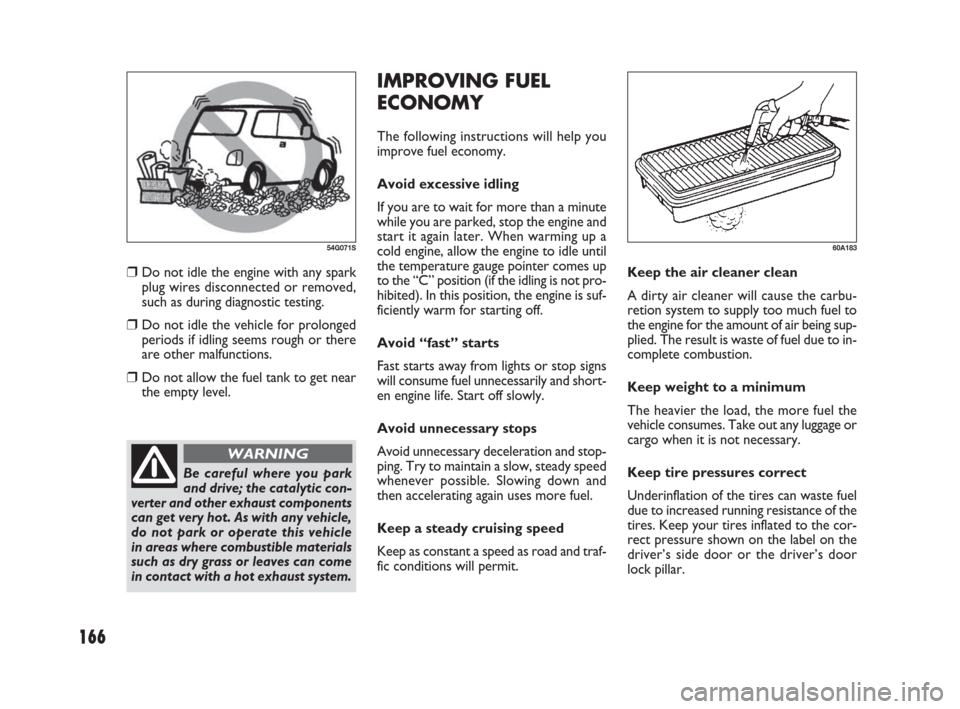
Be careful where you park
and drive; the catalytic con-
verter and other exhaust components
can get very hot. As with any vehicle,
do not park or operate this vehicle
in areas where combustible materials
such as dry grass or leaves can come
in contact with a hot exhaust system.
WARNING
149-166 Fiat16 New GB 27-11-2007 11:27 Pagina 166