lock FIAT SEDICI 2007 2.G Repair Manual
[x] Cancel search | Manufacturer: FIAT, Model Year: 2007, Model line: SEDICI, Model: FIAT SEDICI 2007 2.GPages: 266, PDF Size: 3.24 MB
Page 163 of 266
162
HOW THE ABS WORKS
A computer continuously monitors wheel
speed. The computer compares the
changes in wheel speed when braking. If
the wheels slow suddenly, indicating a
skidding situation, the computer will
change braking pressure several times
each second to prevent the wheels from
locking. When you start your vehicle af-
ter a stop you may hear a momentary mo-
tor noise as the system checks itself.
The ABS may not work
properly if tires or wheels
other than those specified in the own-
er’s manual are used. This is because
the ABS works by comparing changes
in wheel speed. When replacing tires
or wheels, use only the size and type
specified in this owner’s manual.
WARNING
ELECTRONIC STABILITY
PROGRAM (ESP®)
(if equipped)
ESP®is a registered trademark of Daim-
lerChrysler AG.
The Electronic Stability Program (ESP
®)
helps to control the vehicle during cor-
nering if the vehicle is understeering or
oversteering. It also assists you in main-
taining traction while accelerating on loose
or slippery road surfaces. It does this by
regulating the engine’s output, and by se-
lectively applying the brakes. In addition,
ESP
®helps to avoid skidding by controlling
braking pressure.
The ESP®cannot enhance
the vehicle’s driving stabili-
ty in all situations and does not con-
trol your vehicle’s entire braking sys-
tem. The ESP
®cannot prevent acci-
dents, including those resulting from
excessive speed in turns, or hy-
droplaning. Only a safe and attentive
driver can prevent accidents. The ca-
pabilities of an ESP
®- equipped ve-
hicle must never be used as a substi-
tute for careful driving.
WARNING
The ESP®has the following three systems:
STABILITY CONTROL SYSTEM
The vehicle stability control system helps
provide integrated control of systems such
as anti- lock brakes, traction control, en-
gine control, etc. This system automati-
cally controls the brakes and engine to
help prevent the vehicle from skidding
when cornering on a slippery road surface
or when turning the steering wheel
abruptly.
TRACTION CONTROL SYSTEM
The traction control system automatical-
ly helps prevent the spinning of wheels
when the vehicle is started or accelerated
on slippery road surfaces. The system op-
erates only if it senses that some of the
wheels are spinning or beginning to lose
traction. When this happens, the system
operates the front or rear brakes and re-
duces engine power to limit wheel spin.
NOTE You may hear a clicking sound in
the engine compartment for a few seconds
when you start the engine or just after the
vehicle begins to move. This means that
the above systems are in the self-check
mode. This sound does not indicate a mal-
function.
149-166 Fiat16 New GB 27-11-2007 11:27 Pagina 162
Page 164 of 266
163
The ESP may not work prop-
erly if tires or wheels other
than those specified in the Owner’s
Manual are used. When replacing
tires or wheels, use only the size and
type specified in this Owner’s Man-
ual.
The ESP
®may not work properly if
tires are not inflated to the recom-
mended tire inflation pressure.
The ESP
®may not work properly if
tires are fitted with tire chains.
The ESP
®may not work properly if
the tires are excessively worn. Be sure
to replace tires when the tread wear
indicators in the grooves appear on
the tread surface.
The ESP
®is not a substitute for win-
ter tires or tire chains on a snow cov-
ered road.
WARNING
The ESP®may not work
properly if engine related
parts such as the muffler are not
equivalent to standard equipment or
are extremely deteriorated.
Do not modify the vehicle’s suspen-
sion since the ESP
®may not operate
correctly.
WARNING
ANTI-LOCK BRAKING SYSTEM
(ABS)
ABS will help you avoid skidding by elec-
tronically controlling braking pressure. It
will also help you maintain steering con-
trol when braking on slippery surfaces or
when braking hard. The ABS works au-
tomatically, so you do not have to use any
special braking technique. Just push the
brake pedal down without pumping. The
ABS will operate whenever it senses that
wheels are locking up. You may feel the
brake pedal pulsate while the ABS is op-
erating.
(For more information on ABS, see “Brak-
ing” in the “OPERATING YOUR VEHI-
CLE” section.)
NOTE If the ABS system is activated, you
may hear a clunking noise and/ or feel pul-
sating in the brake pedal. This is normal
and indicates that the brake fluid pressure
is being controlled properly.The ESP®indicator lights are described be-
low:
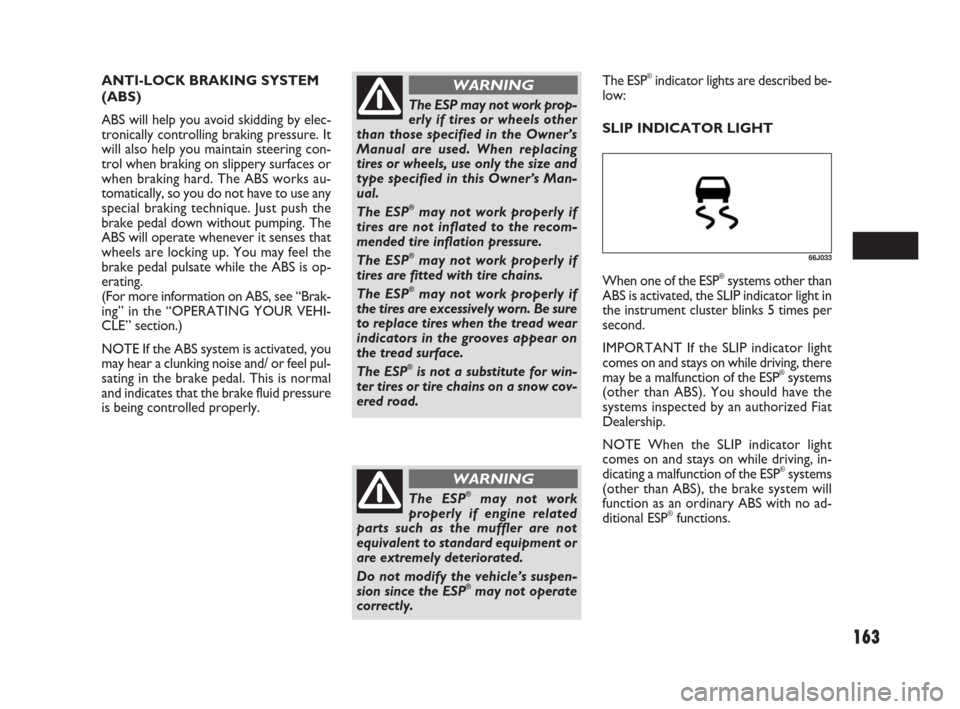
SLIP INDICATOR LIGHT
66J033
When one of the ESP®systems other than
ABS is activated, the SLIP indicator light in
the instrument cluster blinks 5 times per
second.
IMPORTANT If the SLIP indicator light
comes on and stays on while driving, there
may be a malfunction of the ESP
®systems
(other than ABS). You should have the
systems inspected by an authorized Fiat
Dealership.
NOTE When the SLIP indicator light
comes on and stays on while driving, in-
dicating a malfunction of the ESP
®systems
(other than ABS), the brake system will
function as an ordinary ABS with no ad-
ditional ESP
®functions.
149-166 Fiat16 New GB 27-11-2007 11:27 Pagina 163
Page 167 of 266
166
IMPROVING FUEL
ECONOMY
The following instructions will help you
improve fuel economy.
Avoid excessive idling
If you are to wait for more than a minute
while you are parked, stop the engine and
start it again later. When warming up a
cold engine, allow the engine to idle until
the temperature gauge pointer comes up
to the “C” position (if the idling is not pro-
hibited). In this position, the engine is suf-
ficiently warm for starting off.
Avoid “fast” starts
Fast starts away from lights or stop signs
will consume fuel unnecessarily and short-
en engine life. Start off slowly.
Avoid unnecessary stops
Avoid unnecessary deceleration and stop-
ping. Try to maintain a slow, steady speed
whenever possible. Slowing down and
then accelerating again uses more fuel.
Keep a steady cruising speed
Keep as constant a speed as road and traf-
fic conditions will permit.Keep the air cleaner clean
A dirty air cleaner will cause the carbu-
retion system to supply too much fuel to
the engine for the amount of air being sup-
plied. The result is waste of fuel due to in-
complete combustion.
Keep weight to a minimum
The heavier the load, the more fuel the
vehicle consumes. Take out any luggage or
cargo when it is not necessary.
Keep tire pressures correct
Underinflation of the tires can waste fuel
due to increased running resistance of the
tires. Keep your tires inflated to the cor-
rect pressure shown on the label on the
driver’s side door or the driver’s door
lock pillar.
60A183
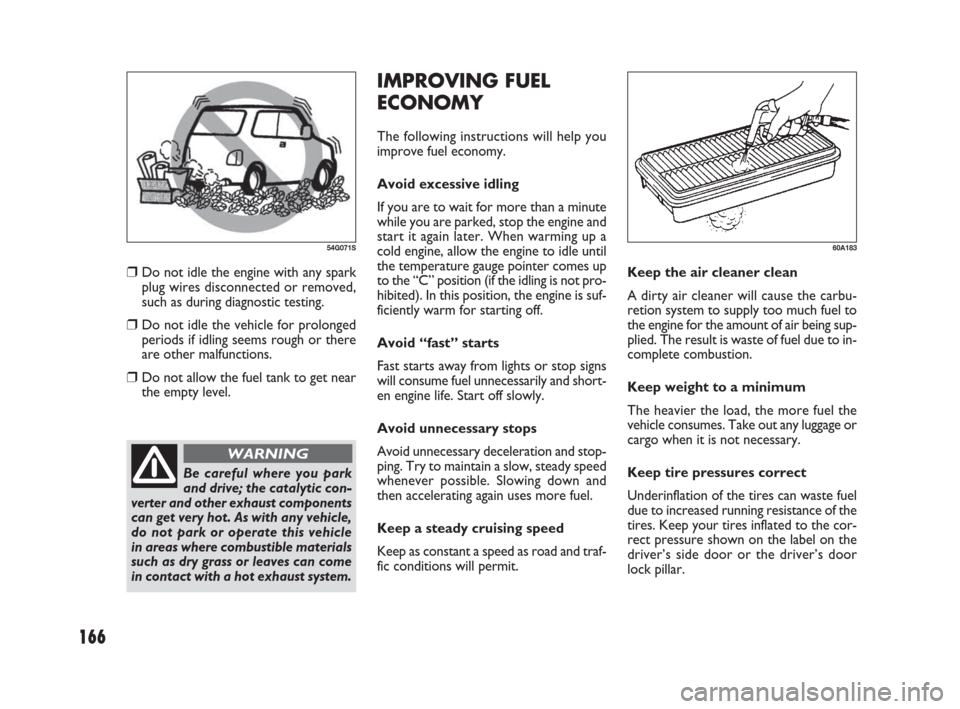
❒Do not idle the engine with any spark
plug wires disconnected or removed,
such as during diagnostic testing.
❒Do not idle the vehicle for prolonged
periods if idling seems rough or there
are other malfunctions.
❒Do not allow the fuel tank to get near
the empty level.
54G071S
Be careful where you park
and drive; the catalytic con-
verter and other exhaust components
can get very hot. As with any vehicle,
do not park or operate this vehicle
in areas where combustible materials
such as dry grass or leaves can come
in contact with a hot exhaust system.
WARNING
149-166 Fiat16 New GB 27-11-2007 11:27 Pagina 166
Page 171 of 266
170
IMPORTANT Do not continue rocking
the vehicle for more than a few minutes.
Prolonged rocking can cause engine over-
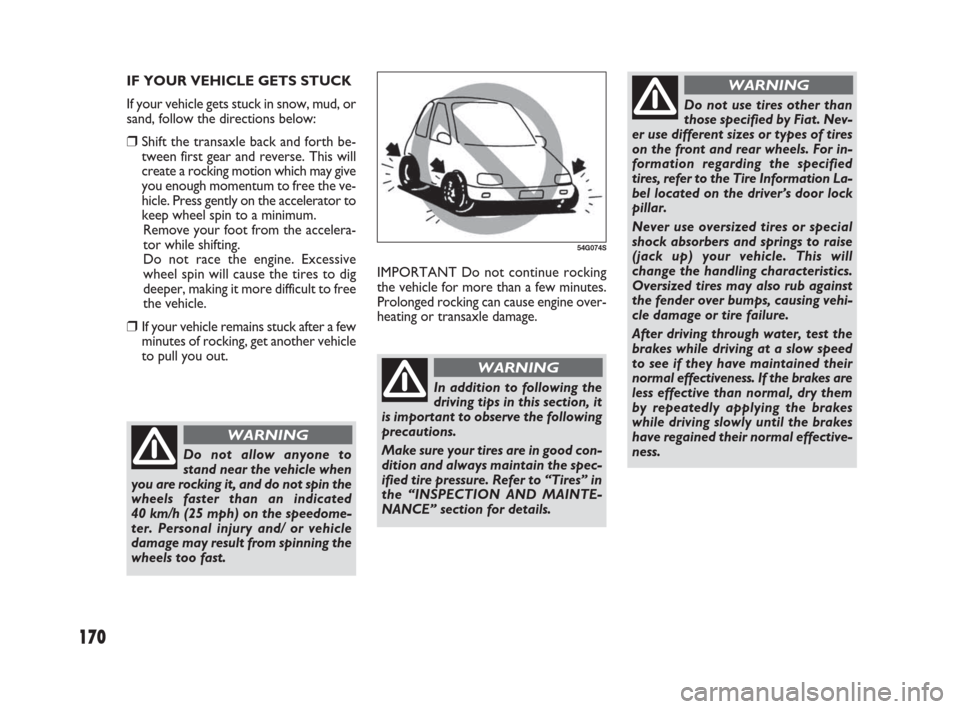
heating or transaxle damage. IF YOUR VEHICLE GETS STUCK
If your vehicle gets stuck in snow, mud, or
sand, follow the directions below:
❒Shift the transaxle back and forth be-
tween first gear and reverse. This will
create a rocking motion which may give
you enough momentum to free the ve-
hicle. Press gently on the accelerator to
keep wheel spin to a minimum.
Remove your foot from the accelera-
tor while shifting.
Do not race the engine. Excessive
wheel spin will cause the tires to dig
deeper, making it more difficult to free
the vehicle.
❒If your vehicle remains stuck after a few
minutes of rocking, get another vehicle
to pull you out.
Do not allow anyone to
stand near the vehicle when
you are rocking it, and do not spin the
wheels faster than an indicated
40 km/h (25 mph) on the speedome-
ter. Personal injury and/ or vehicle
damage may result from spinning the
wheels too fast.
WARNING
54G074S
In addition to following the
driving tips in this section, it
is important to observe the following
precautions.
Make sure your tires are in good con-
dition and always maintain the spec-
ified tire pressure. Refer to “Tires” in
the “INSPECTION AND MAINTE-
NANCE” section for details.
WARNING
Do not use tires other than
those specified by Fiat. Nev-
er use different sizes or types of tires
on the front and rear wheels. For in-
formation regarding the specified
tires, refer to the Tire Information La-
bel located on the driver’s door lock
pillar.
Never use oversized tires or special
shock absorbers and springs to raise
(jack up) your vehicle. This will
change the handling characteristics.
Oversized tires may also rub against
the fender over bumps, causing vehi-
cle damage or tire failure.
After driving through water, test the
brakes while driving at a slow speed
to see if they have maintained their
normal effectiveness. If the brakes are
less effective than normal, dry them
by repeatedly applying the brakes
while driving slowly until the brakes
have regained their normal effective-
ness.
WARNING
167-170 Fiat16 New GB 27-11-2007 11:28 Pagina 170
Page 176 of 266
175
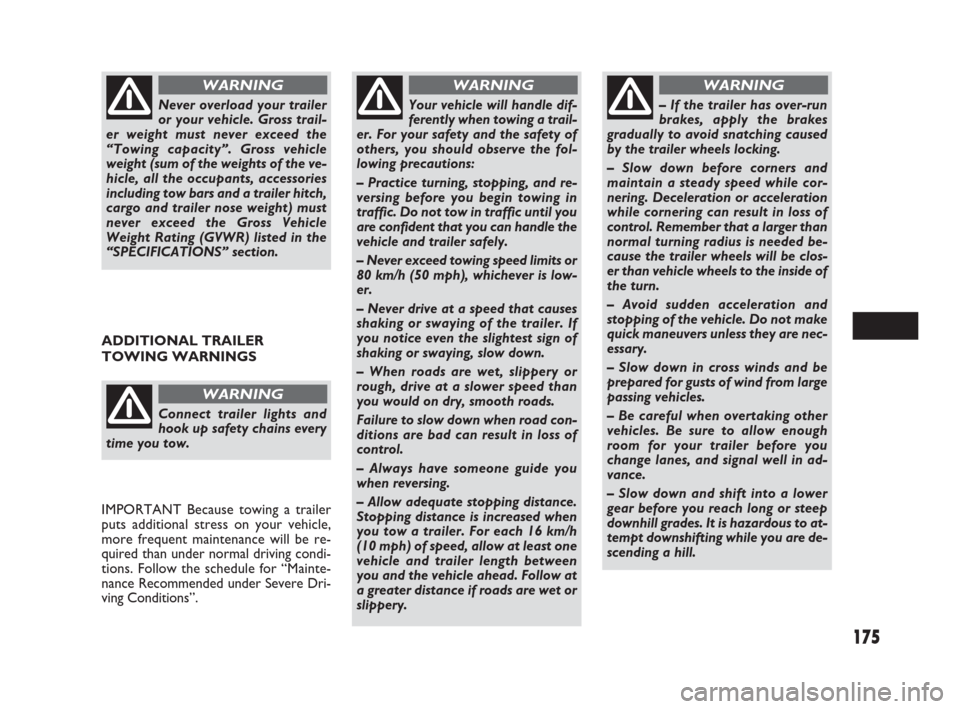
ADDITIONAL TRAILER
TOWING WARNINGS
Never overload your trailer
or your vehicle. Gross trail-
er weight must never exceed the
“Towing capacity”. Gross vehicle
weight (sum of the weights of the ve-
hicle, all the occupants, accessories
including tow bars and a trailer hitch,
cargo and trailer nose weight) must
never exceed the Gross Vehicle
Weight Rating (GVWR) listed in the
“SPECIFICATIONS” section.
WARNING
Connect trailer lights and
hook up safety chains every
time you tow.
WARNING
IMPORTANT Because towing a trailer
puts additional stress on your vehicle,
more frequent maintenance will be re-
quired than under normal driving condi-
tions. Follow the schedule for “Mainte-
nance Recommended under Severe Dri-
ving Conditions”.
Your vehicle will handle dif-
ferently when towing a trail-
er. For your safety and the safety of
others, you should observe the fol-
lowing precautions:
– Practice turning, stopping, and re-
versing before you begin towing in
traffic. Do not tow in traffic until you
are confident that you can handle the
vehicle and trailer safely.
– Never exceed towing speed limits or
80 km/h (50 mph), whichever is low-
er.
– Never drive at a speed that causes
shaking or swaying of the trailer. If
you notice even the slightest sign of
shaking or swaying, slow down.
– When roads are wet, slippery or
rough, drive at a slower speed than
you would on dry, smooth roads.
Failure to slow down when road con-
ditions are bad can result in loss of
control.
– Always have someone guide you
when reversing.
– Allow adequate stopping distance.
Stopping distance is increased when
you tow a trailer. For each 16 km/h
(10 mph) of speed, allow at least one
vehicle and trailer length between
you and the vehicle ahead. Follow at
a greater distance if roads are wet or
slippery.
WARNING
– If the trailer has over-run
brakes, apply the brakes
gradually to avoid snatching caused
by the trailer wheels locking.
– Slow down before corners and
maintain a steady speed while cor-
nering. Deceleration or acceleration
while cornering can result in loss of
control. Remember that a larger than
normal turning radius is needed be-
cause the trailer wheels will be clos-
er than vehicle wheels to the inside of
the turn.
– Avoid sudden acceleration and
stopping of the vehicle. Do not make
quick maneuvers unless they are nec-
essary.
– Slow down in cross winds and be
prepared for gusts of wind from large
passing vehicles.
– Be careful when overtaking other
vehicles. Be sure to allow enough
room for your trailer before you
change lanes, and signal well in ad-
vance.
– Slow down and shift into a lower
gear before you reach long or steep
downhill grades. It is hazardous to at-
tempt downshifting while you are de-
scending a hill.
WARNING
171-180 Fiat16 New GB 27-11-2007 11:29 Pagina 175
Page 180 of 266
179
79J130
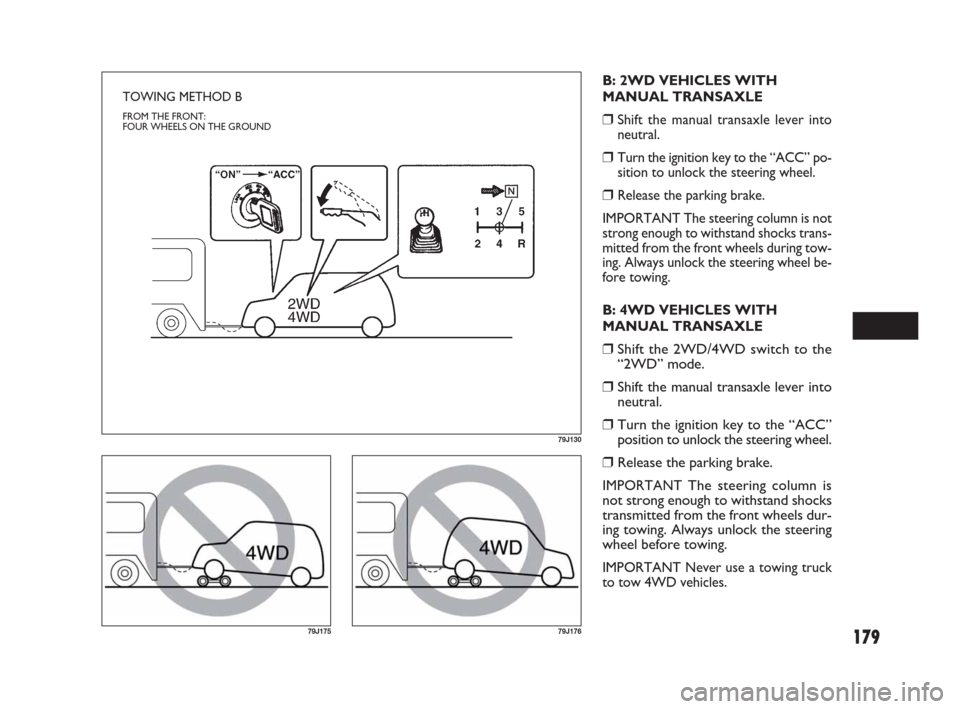
TOWING METHOD B
FROM THE FRONT:
FOUR WHEELS ON THE GROUND
B: 2WD VEHICLES WITH
MANUAL TRANSAXLE
❒Shift the manual transaxle lever into
neutral.
❒Turn the ignition key to the “ACC” po-
sition to unlock the steering wheel.
❒Release the parking brake.
IMPORTANT The steering column is not
strong enough to withstand shocks trans-
mitted from the front wheels during tow-
ing. Always unlock the steering wheel be-
fore towing.
B: 4WD VEHICLES WITH
MANUAL TRANSAXLE
❒Shift the 2WD/4WD switch to the
“2WD” mode.
❒Shift the manual transaxle lever into
neutral.
❒Turn the ignition key to the “ACC”
position to unlock the steering wheel.
❒Release the parking brake.
IMPORTANT The steering column is
not strong enough to withstand shocks
transmitted from the front wheels dur-
ing towing. Always unlock the steering
wheel before towing.
IMPORTANT Never use a towing truck
to tow 4WD vehicles.
79J17579J176
171-180 Fiat16 New GB 27-11-2007 11:29 Pagina 179
Page 183 of 266
182
60B128
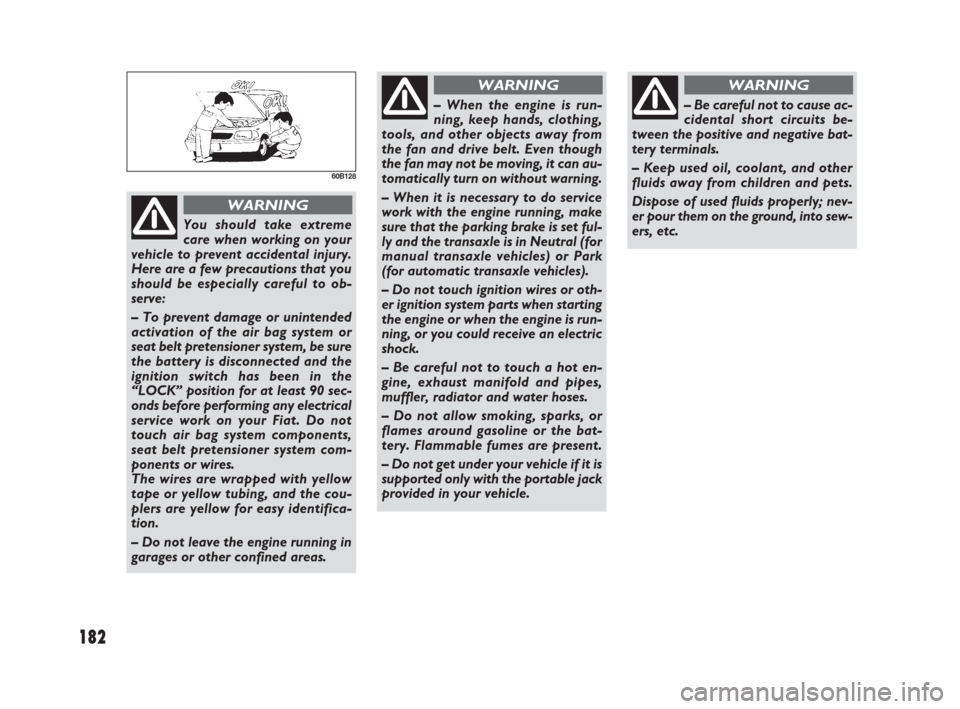
You should take extreme
care when working on your
vehicle to prevent accidental injury.
Here are a few precautions that you
should be especially careful to ob-
serve:
– To prevent damage or unintended
activation of the air bag system or
seat belt pretensioner system, be sure
the battery is disconnected and the
ignition switch has been in the
“LOCK” position for at least 90 sec-
onds before performing any electrical
service work on your Fiat. Do not
touch air bag system components,
seat belt pretensioner system com-
ponents or wires.
The wires are wrapped with yellow
tape or yellow tubing, and the cou-
plers are yellow for easy identifica-
tion.
– Do not leave the engine running in
garages or other confined areas.
WARNING
– When the engine is run-
ning, keep hands, clothing,
tools, and other objects away from
the fan and drive belt. Even though
the fan may not be moving, it can au-
tomatically turn on without warning.
– When it is necessary to do service
work with the engine running, make
sure that the parking brake is set ful-
ly and the transaxle is in Neutral (for
manual transaxle vehicles) or Park
(for automatic transaxle vehicles).
– Do not touch ignition wires or oth-
er ignition system parts when starting
the engine or when the engine is run-
ning, or you could receive an electric
shock.
– Be careful not to touch a hot en-
gine, exhaust manifold and pipes,
muffler, radiator and water hoses.
– Do not allow smoking, sparks, or
flames around gasoline or the bat-
tery. Flammable fumes are present.
– Do not get under your vehicle if it is
supported only with the portable jack
provided in your vehicle.
WARNING
– Be careful not to cause ac-
cidental short circuits be-
tween the positive and negative bat-
tery terminals.
– Keep used oil, coolant, and other
fluids away from children and pets.
Dispose of used fluids properly; nev-
er pour them on the ground, into sew-
ers, etc.
WARNING
181-224 Fiat16 New GB 27-11-2007 11:29 Pagina 182
Page 186 of 266
185
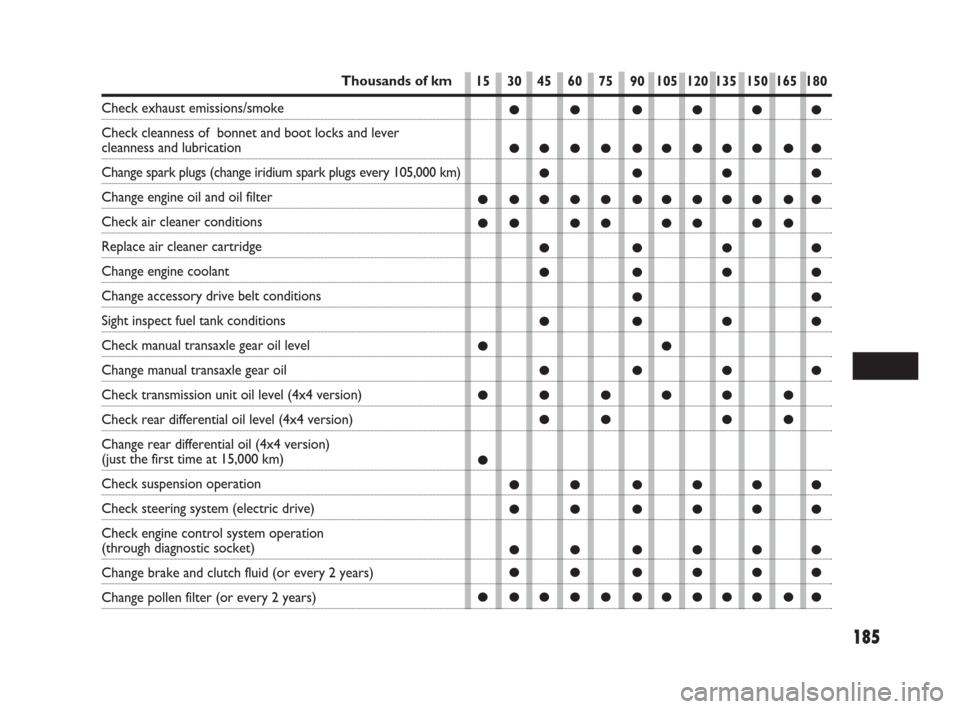
15 30 45 60 75 90 105 120 135 150 165 180
●● ●●●●
●●●● ●●●●●●●
●●●●
● ●●●● ●●●●●●●
●● ●● ●● ●●
●●●●
●●●●
●●
●●●●
●●
●●●●
●●●●●●
●● ●●
●
●● ●●●●
●● ●●●●
●● ●●●●
●● ●●●●
● ●●●● ●●●●●●●
Thousands of km
Check exhaust emissions/smoke
Check cleanness of bonnet and boot locks and lever
cleanness and lubrication
Change spark plugs (change iridium spark plugs every 105,000 km)
Change engine oil and oil filter
Check air cleaner conditions
Replace air cleaner cartridge
Change engine coolant
Change accessory drive belt conditions
Sight inspect fuel tank conditions
Check manual transaxle gear oil level
Change manual transaxle gear oil
Check transmission unit oil level (4x4 version)
Check rear differential oil level (4x4 version)
Change rear differential oil (4x4 version)
(just the first time at 15,000 km)
Check suspension operation
Check steering system (electric drive)
Check engine control system operation
(through diagnostic socket)
Change brake and clutch fluid (or every 2 years)
Change pollen filter (or every 2 years)
181-224 Fiat16 New GB 27-11-2007 11:29 Pagina 185
Page 187 of 266
186
15 30 45 60 75 90 105 120 135 150 165 180
●●●●●●●●●●●●
●●●●●●●●●●●●
●●●●●●●●●●●●
●●●●●●●●●●●●
●●●●●●●●●●●●
●● ●●●●
●●●●●●●●●●●●
●●●●●●●●●●●●
●●
●●●●●●
●●●
●● ●●●●
●●●●●●●●●●●●
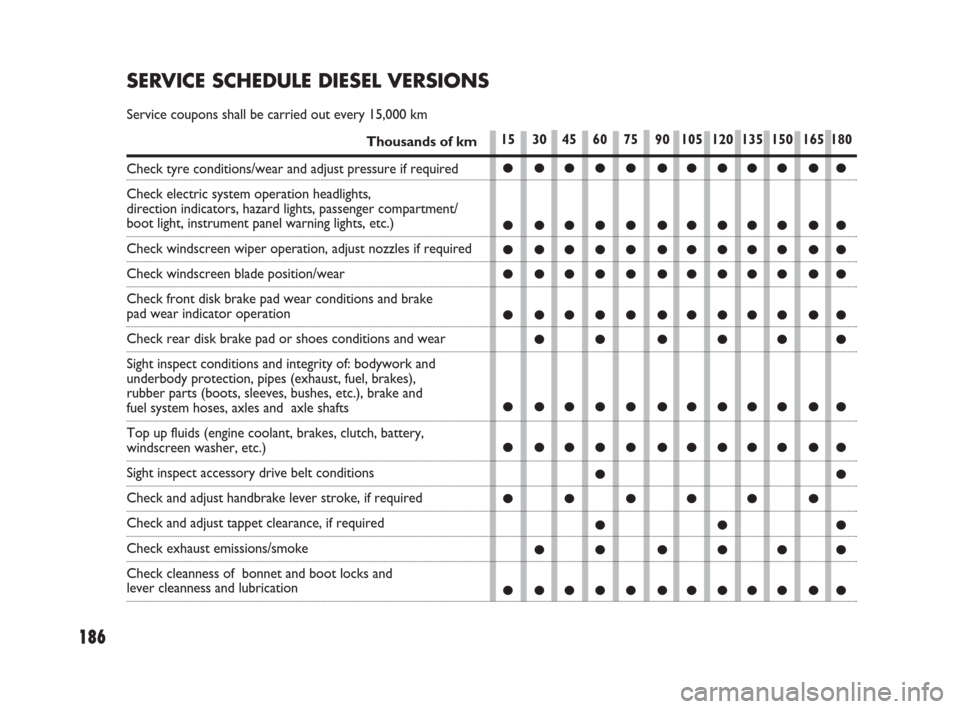
SERVICE SCHEDULE DIESEL VERSIONS
Service coupons shall be carried out every 15,000 km
Thousands of km
Check tyre conditions/wear and adjust pressure if required
Check electric system operation headlights,
direction indicators, hazard lights, passenger compartment/
boot light, instrument panel warning lights, etc.)
Check windscreen wiper operation, adjust nozzles if required
Check windscreen blade position/wear
Check front disk brake pad wear conditions and brake
pad wear indicator operation
Check rear disk brake pad or shoes conditions and wear
Sight inspect conditions and integrity of: bodywork and
underbody protection, pipes (exhaust, fuel, brakes),
rubber parts (boots, sleeves, bushes, etc.), brake and
fuel system hoses, axles and axle shafts
Top up fluids (engine coolant, brakes, clutch, battery,
windscreen washer, etc.)
Sight inspect accessory drive belt conditions
Check and adjust handbrake lever stroke, if required
Check and adjust tappet clearance, if required
Check exhaust emissions/smoke
Check cleanness of bonnet and boot locks and
lever cleanness and lubrication
181-224 Fiat16 New GB 27-11-2007 11:29 Pagina 186
Page 193 of 266
192
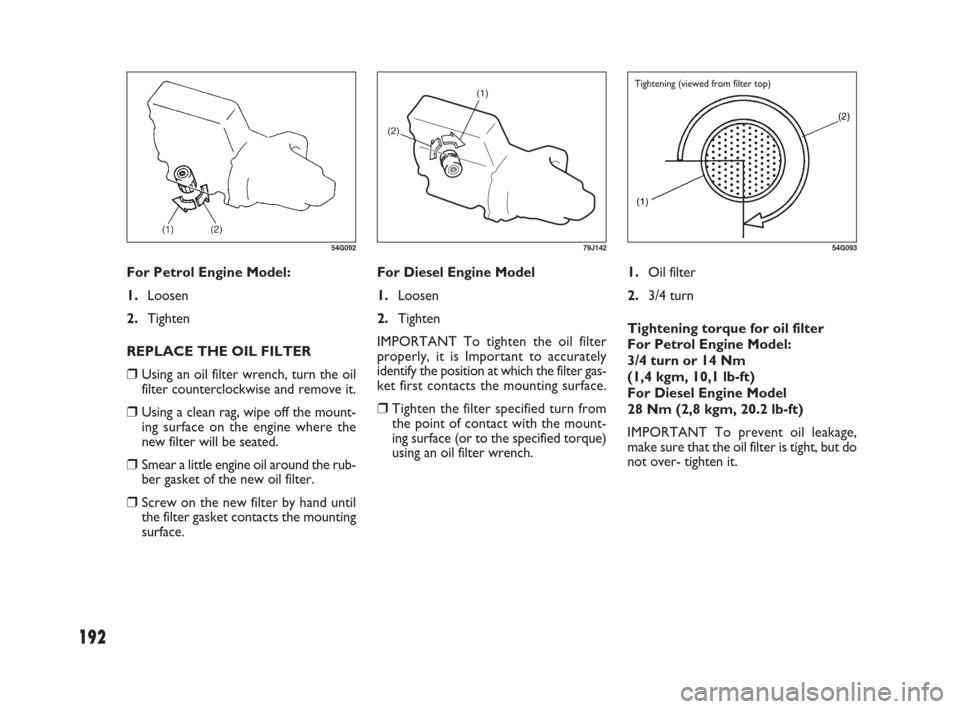
1.Oil filter
2.3/4 turn
Tightening torque for oil filter
For Petrol Engine Model:
3/4 turn or 14 Nm
(1,4 kgm, 10,1 lb-ft)
For Diesel Engine Model
28 Nm (2,8 kgm, 20.2 lb-ft)
IMPORTANT To prevent oil leakage,
make sure that the oil filter is tight, but do
not over- tighten it. For Petrol Engine Model:
1.Loosen
2.Tighten
REPLACE THE OIL FILTER
❒Using an oil filter wrench, turn the oil
filter counterclockwise and remove it.
❒Using a clean rag, wipe off the mount-
ing surface on the engine where the
new filter will be seated.
❒Smear a little engine oil around the rub-
ber gasket of the new oil filter.
❒Screw on the new filter by hand until
the filter gasket contacts the mounting
surface.
54G09254G093
Tightening (viewed from filter top)
For Diesel Engine Model
1.Loosen
2.Tighten
IMPORTANT To tighten the oil filter
properly, it is Important to accurately
identify the position at which the filter gas-
ket first contacts the mounting surface.
❒Tighten the filter specified turn from
the point of contact with the mount-
ing surface (or to the specified torque)
using an oil filter wrench.
(1)
(2)
79J142
181-224 Fiat16 New GB 27-11-2007 11:30 Pagina 192