Fuel FIAT SEICENTO 2007 1.G User Guide
[x] Cancel search | Manufacturer: FIAT, Model Year: 2007, Model line: SEICENTO, Model: FIAT SEICENTO 2007 1.GPages: 154, PDF Size: 3.68 MB
Page 68 of 154
67GETTING TO KNOW YOUR CAR
AT THE FILLING
STATION
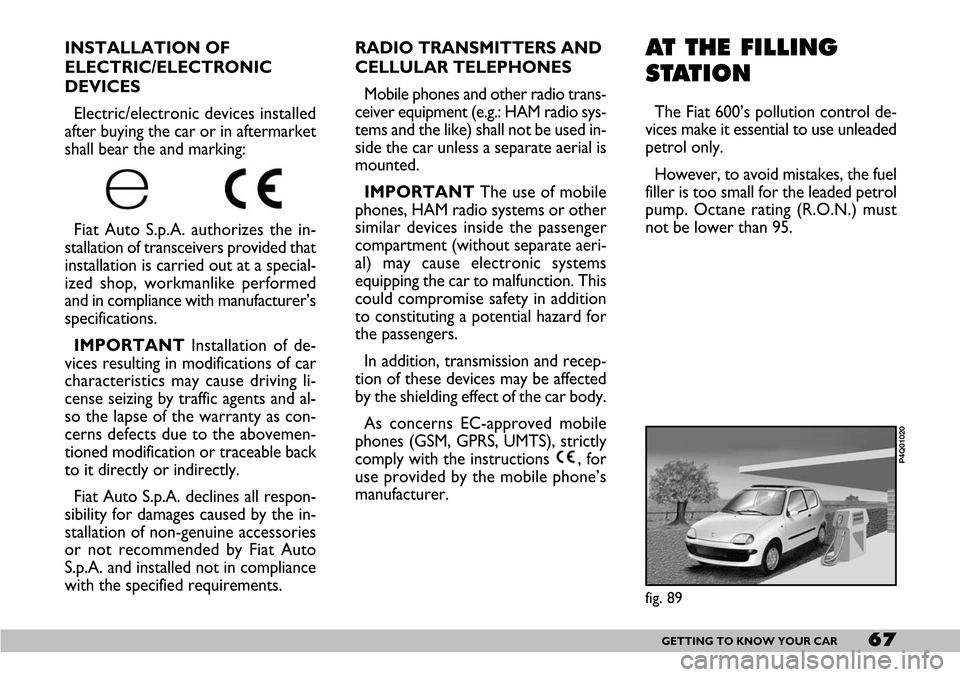
The Fiat 600’s pollution control de-
vices make it essential to use unleaded
petrol only.
However, to avoid mistakes, the fuel
filler is too small for the leaded petrol
pump. Octane rating (R.O.N.) must
not be lower than 95.
fig. 89
P4Q01020
INSTALLATION OF
ELECTRIC/ELECTRONIC
DEVICES
Electric/electronic devices installed
after buying the car or in aftermarket
shall bear the and marking:
Fiat Auto S.p.A. authorizes the in-
stallation of transceivers provided that
installation is carried out at a special-
ized shop, workmanlike performed
and in compliance with manufacturer’s
specifications.
IMPORTANTInstallation of de-
vices resulting in modifications of car
characteristics may cause driving li-
cense seizing by traffic agents and al-
so the lapse of the warranty as con-
cerns defects due to the abovemen-
tioned modification or traceable back
to it directly or indirectly.
Fiat Auto S.p.A. declines all respon-
sibility for damages caused by the in-
stallation of non-genuine accessories
or not recommended by Fiat Auto
S.p.A. and installed not in compliance
with the specified requirements. RADIO TRANSMITTERS AND
CELLULAR TELEPHONES
Mobile phones and other radio trans-
ceiver equipment (e.g.: HAM radio sys-
tems and the like) shall not be used in-
side the car unless a separate aerial is
mounted.
IMPORTANTThe use of mobile
phones, HAM radio systems or other
similar devices inside the passenger
compartment (without separate aeri-
al) may cause electronic systems
equipping the car to malfunction. This
could compromise safety in addition
to constituting a potential hazard for
the passengers.
In addition, transmission and recep-
tion of these devices may be affected
by the shielding effect of the car body.
As concerns EC-approved mobile
phones (GSM, GPRS, UMTS), strictly
comply with the instructions , for
use provided by the mobile phone’s
manufacturer.
Page 69 of 154
68GETTING TO KNOW YOUR CAR
IMPORTANTThe hermetic clo-
sure may cause a slight pressure in the
tank: a slight hissing when turning the
cap is quite normal.
To close:
1)the cap coupling is “bayonet”
type. Insert the cap (with the key) and
turn it clockwise until it clicks;
2)keeping the cap still, turn the key
clockwise and remove it; close the
flap.
fig. 92
P4Q01051
Never pour even the
tiniest amount of leaded
petrol in the tank, not
even in an emergency; this would
damage the catalytic exhaust be-
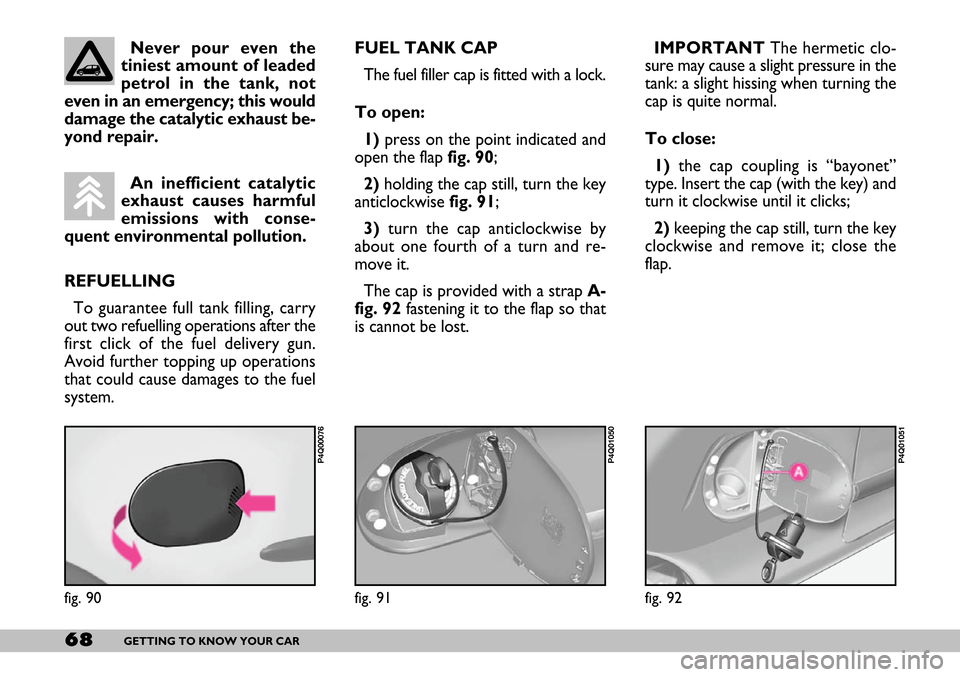
yond repair. FUEL TANK CAP
The fuel filler cap is fitted with a lock.
To open:
1)press on the point indicated and
open the flap fig. 90;
2) holding the cap still, turn the key
anticlockwise fig. 91;
3) turn the cap anticlockwise by
about one fourth of a turn and re-
move it.
The cap is provided with a strap A-
fig. 92fastening it to the flap so that
is cannot be lost.
fig. 90
P4Q00076
fig. 91
P4Q01050
An inefficient catalytic
exhaust causes harmful
emissions with conse-
quent environmental pollution.
REFUELLING
To guarantee full tank filling, carry
out two refuelling operations after the
first click of the fuel delivery gun.
Avoid further topping up operations
that could cause damages to the fuel
system.
Page 70 of 154
69GETTING TO KNOW YOUR CAR
IMPORTANTIf required, replace
the fuel cap with another genuine cap
to avoid affecting the efficiency of the
fuel vapour recovery system. PROTECTING
THE ENVIRONMENT
Protecting the environment has been
the guiding principle in the design of
the Fiat 600 right from the start. The
result is the use of materials and cre-
ation of devices that can reduce or
considerably curtail harmful influences
on the environment.
Keep naked flames or
lighted cigarettes away
from the fuel filler hole as
there is a danger of fire. Do not
bend too close to the hole either
so as not to breathe in harmful
vapours.
The devices for curtailing petrol en-
gine emissions are:
– a three-way catalytic converter;
– a lambda sensor;
– a fuel evaporation system.
Consequently, the Fiat 600 is ready
to travel well ahead of the most strin-
gent international pollution control
standards.
Page 72 of 154
71DRIVING YOUR CAR
EMERGENCY START-UP
If the Fiat CODE system fails to
recognise that code transmitted by
the ignition key (instrument panel
warning light ¢on) the emergency
start-up can be performed by using
the CODE card code.
See the
INANEMERGENCY. A quick burst on the ac-
celerator before turning
off the engine serves ab-
solutely no practical purpose and
wastes fuel.
IMPORTANTAfter a taxing drive
it is better to allow the engine to
“catch its breath” before turning it off,
by letting it idle to allow the temper-
ature in the engine compartment to
fall.
PARKING
Switch off the engine, pull up the
handbrake and put the car in 1st gear
if the car is pointing uphill, reverse if
downhill.
If the car is parked on a steep gradi-
ent it is a good idea to use a stone or
wedge to block the wheels.
Do not leave the ignition key at
MARbecause it drains the battery.
Always remove the key when you
leave the car. Bump starting by push-
ing, towing or rolling
downhill must be avoided
at all costs. This way of starting
could cause a rush of fuel into the
catalytic exhaust pipe and dam-
age it beyond repair.
Remember that as long
as the engine is not run-
ning, the power brakes
and power steering do not work.
You therefore have to use con-
siderably more effort on both the
brake pedal and the steering
wheel. SWITCHING OFF
THE ENGINE
Turn the key to STOPwhile the
engine is idling.
Never leave unsuper-
vised children in the car.
Page 78 of 154
77DRIVING YOUR CAR
– do not remain stationary in deep
snow with the engine running: the
snow could deviate the exhaust gas
into the passenger compartment.
DRIVING WITH ABS
ABS is a braking system that essen-
tially offers two advantages:
1)it prevents wheel lock-up and
consequent skidding in emergency
stops, particularly when the road does
not offer much grip;
2)it makes it possible to brake and
steer at the same time so you can
avoid unexpected obstacles and direct
the car where you want while braking.
The extent to which this can be done
will depend on the physical limits of
the tyre’s sideways grip.To get the most out of ABS:
– during emergency conditions or
when grip conditions are poor, you
will feel a slight pulsation on the brake
pedal. This is the sign that the ABS is
working. Do not release the brake
pedal but continue to press so as not
to interrupt the braking action;
– ABS prevents the wheels from
locking, but it does not increase actual
grip conditions between tyre and
road. Therefore, even if your car is fit-
ted with ABS, respect the safety dis-
tance from the car in front of you and
keep your speed down when driving
into bends;
– ABS serves to increase the con-
trollability of the car, not to enable
you to go faster.CONTAINING
RUNNING COSTS
AND POLLUTION
Some suggestions which may help
you to keep the running costs of the
vehicle down and lower the amount
of toxic emissions released into the
atmosphere are given below.
GENERAL
CONSIDERATIONS
Car maintenance
The overall state of the car is an im-
portant factor which has a marked in-
fluence over fuel consumption and
driving comfort and on the life span of
your car. For this reason care should
be taken to maintain your car by car-
rying out the necessary checks and
regulations in accordance with the
specifications given in the
SERVICE
SCHEDULE
(see sections: SPARK PLUGS,
IDLING, AIR CLEANERS, TIMING).
Page 79 of 154
78DRIVING YOUR CAR
Tyres
Tyre pressure should be checked at
least once every four weeks: if the
pressure is too low fuel consumption
increases as the resistance to the
rolling movement of the tyre is
greater. In this state, tyre wear is in-
creased and vehicle handling suffers
which will effect safety.
Unnecessary loads
Do not travel with too much luggage
stowed in the boot. The weight of the
vehicle and its trim greatly effects con-
sumption and stability.
Roof rack/ski rack
Remove roof racks and ski racks
from the roof of the car as soon as
they are no longer needed. These ac-
cessories reduce the aerodynamic
penetration of the vehicle and will in-
crease consumption. When having to
transport particularly large loads it is
better to use a trailer.Electric devices
Use electric devices for the neces-
sary time only. The heated rear win-
dow, fog lights, windscreen wipers,
heating system blower require large
amounts of electricity, and as a con-
sequence, the fuel consumption in-
creases (up to +25% in town).
Climate control system
The climate control system is a fur-
ther drag on the engine causing higher
fuel consumption (on average, up to
20%). When outside temperatures
permit, use the vents.
Aerodynamic accessories
The use of aerodynamic accessories
not certified for that specific purpose
can diminish the car’s aerodynamic
penetration and increase consump-
tion.BEHIND THE WHEEL
Starting-up
Do not warm up the engine when
the car is stationary, neither by idling
nor revving up. If you do, the engine
will warm up much more slowly and
increase fuel consumption and emis-
sions. It is therefore better to start
slowly and to keep the engine speed
down.
Unnecessary manoeuvres
Do not give quick bursts on the ac-
celerator when waiting at the traffic
lights or before turning off the engine.
This type of action, like the “double
clutch” are absolutely useless on mod-
ern cars. They only increase fuel con-
sumption and pollution.
Gear selection
As soon as traffic conditions allow,
shift up to a higher gear. Using a low
gear to have a sharp acceleration in-
creases the consumption. Likewise,
using a high gear when this is not
called for increases consumption,
emissions and wear on the engine.
Page 80 of 154
79DRIVING YOUR CAR
Top speed
As speed increases, so does the fuel
consumption: note that passing from
90 to 120 km/h increases consump-
tion by about +30%. Keep your speed
as steady as possible and avoid un-
necessary braking and accelerations
that cost fuel and increase emissions
considerably. It is better to drive
“smoothly” trying to foresee the ma-
noeuvres to avoid imminent dangers
and always respect the safety distance
to avoid the need to slow down sud-
denly.
Acceleration
Sudden and sharp accelerations
revving up the engine increase con-
sumption and emissions; accelerate
gradually and do not exceed the max-
imum torque.USE
Cold start
Short journeys and frequent cold
start-ups do not allow the engine to
reach the best running temperature.
As a result, consumption rises (from
+15 to +30% in town) and so do the
harmful emissions.
Traffic situations and road
conditions
Consumption rises in heavy traffic, in
traffic jams where it is constantly nec-
essary to shift to low gears or in big
cities with many traffic lights.
Also twisting roads, mountain roads
and rough road surfaces pay a heavy
toll on consumption.
Hold-ups in traffic
During hold-ups (e.g.: level crossings)
switch off the engine.CHEAP RUNNING
THAT RESPECTS
THE ENVIRONMENT
Environmental protection has been
one of the guiding principles in the
production of Fiat 600. It is no acci-
dent that its pollution control equip-
ment is much more effective than that
required by current legislation.
Nonetheless, the environment can-
not get by without a concerted effort
from everyone.
By following a few simple rules you
can avoid harming the environment
and often cut down fuel consumption
at the same time.
On this subject, a few useful tips
have been given below to supplement
those marked by symbol #, at various
points of the handbook.
You are asked to read both the for-
mer and the latter carefully.
Page 81 of 154
80DRIVING YOUR CAR
LOOKING AFTER EMISSION
CONTROL DEVICES
The correct use of pollution control
devices not only ensures respect for
the environment but also has an effect
on the car’s performance. Keeping
these devices in good condition is
therefore a fundamental rule for dri-
ving that is easy on your pocket and
on the environment too.
The first step to take is to follow the
Service Schedule to the letter.
If your car has a petrol engine use
only unleaded petrol.
If you have trouble starting, do not
keep turning the ignition key for long
periods. Be especially careful to avoid
bump starting the car by pushing, tow-
ing or rolling down hill: these are all
manoeuvres that can damage the cat-
alytic exhaust. For emergency starts
use only an auxiliary battery.If the engine begins to “lose its
smoothness” when travelling, con-
tinue your journey but reduce the de-
mands you are making on the engine
and go to a Fiat Dealershipas soon
as you can.
When the instrument panel fuel re-
serve warning light comes on, fill up as
soon as possible. A low level of fuel
can cause an uneven supply of fuel to
the engine with the inevitable increase
in the temperature of the exhaust gas
and serious damage to the catalytic
converter.
Never run the engine with one or
more spark plugs disconnected, even
for testing purposes.
Do not warm up the engine by let-
ting it idle for a while before moving
off unless the outside temperature is
very low and, even in this case, only
do so for less than 30 seconds.Do not install other heat shields
and do not remove those already fit-
ted to the catalytic converter and
exhaust pipe.
When functioning nor-
mally the catalytic con-
verter reaches high tem-
peratures. For this reason do not
park the car over flammable ma-
terial (grass, dry leaves, pine nee-
dles etc.): fire hazard.
Ignoring the above rules
may lead to fire.
Do not allow anything to
be sprayed onto the cat-
alytic converter, Lambda
sensor or exhaust pipe.
Page 90 of 154
89IN AN EMERGENCY
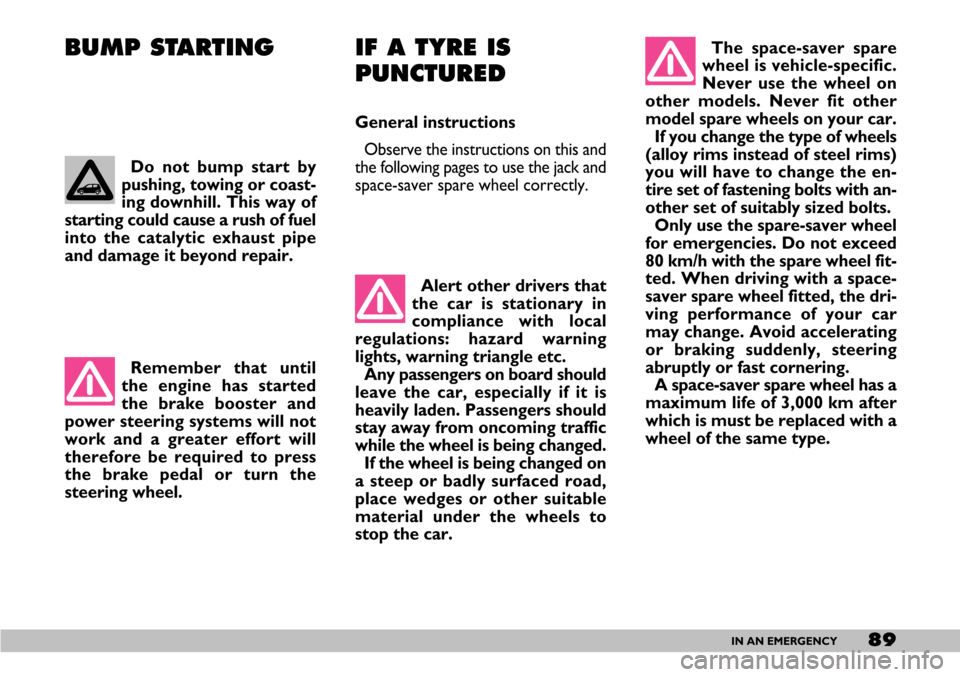
BUMP STARTING IF A TYRE IS
PUNCTURED
General instructions
Observe the instructions on this and
the following pages to use the jack and
space-saver spare wheel correctly. The space-saver spare
wheel is vehicle-specific.
Never use the wheel on
other models. Never fit other
model spare wheels on your car.
If you change the type of wheels
(alloy rims instead of steel rims)
you will have to change the en-
tire set of fastening bolts with an-
other set of suitably sized bolts.
Only use the spare-saver wheel
for emergencies. Do not exceed
80 km/h with the spare wheel fit-
ted. When driving with a space-
saver spare wheel fitted, the dri-
ving performance of your car
may change. Avoid accelerating
or braking suddenly, steering
abruptly or fast cornering.
A space-saver spare wheel has a
maximum life of 3,000 km after
which is must be replaced with a
wheel of the same type. Do not bump start by
pushing, towing or coast-
ing downhill. This way of
starting could cause a rush of fuel
into the catalytic exhaust pipe
and damage it beyond repair.
Remember that until
the engine has started
the brake booster and
power steering systems will not
work and a greater effort will
therefore be required to press
the brake pedal or turn the
steering wheel.
Alert other drivers that
the car is stationary in
compliance with local
regulations: hazard warning
lights, warning triangle etc.
Any passengers on board should
leave the car, especially if it is
heavily laden. Passengers should
stay away from oncoming traffic
while the wheel is being changed.
If the wheel is being changed on
a steep or badly surfaced road,
place wedges or other suitable
material under the wheels to
stop the car.
Page 111 of 154
110CAR MAINTENANCE
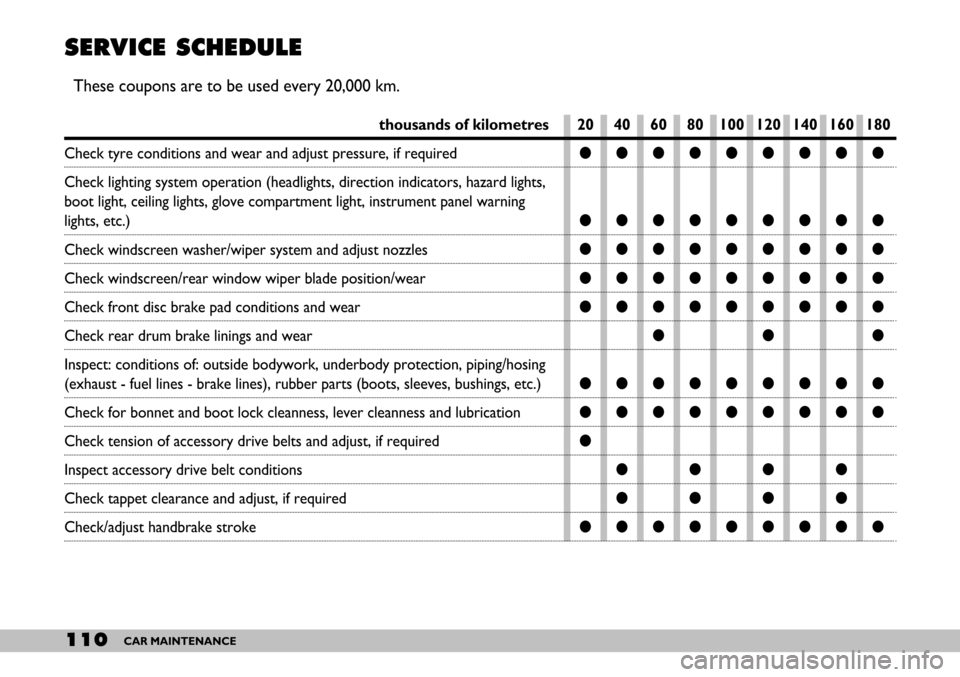
SERVICE SCHEDULE
These coupons are to be used every 20,000 km.
thousands of kilometres
Check tyre conditions and wear and adjust pressure, if required
Check lighting system operation (headlights, direction indicators, hazard lights,
boot light, ceiling lights, glove compartment light, instrument panel warning
lights, etc.)
Check windscreen washer/wiper system and adjust nozzles
Check windscreen/rear window wiper blade position/wear
Check front disc brake pad conditions and wear
Check rear drum brake linings and wear
Inspect: conditions of: outside bodywork, underbody protection, piping/hosing
(exhaust - fuel lines - brake lines), rubber parts (boots, sleeves, bushings, etc.)
Check for bonnet and boot lock cleanness, lever cleanness and lubrication
Check tension of accessory drive belts and adjust, if required
Inspect accessory drive belt conditions
Check tappet clearance and adjust, if required
Check/adjust handbrake stroke20 40 60 80 100 120 140 160 180
●●●●●●●●●
●●●●●●●●●
●●●●●●●●●
●●●●●●●●●
●●●●●●●●●
●●●
●●●●●●●●●
●●●●●●●●●
●
●●●●
●●●●
●●●●●●●●●