lights FIAT SEICENTO 2007 1.G User Guide
[x] Cancel search | Manufacturer: FIAT, Model Year: 2007, Model line: SEICENTO, Model: FIAT SEICENTO 2007 1.GPages: 154, PDF Size: 3.68 MB
Page 55 of 154
54GETTING TO KNOW YOUR CAR
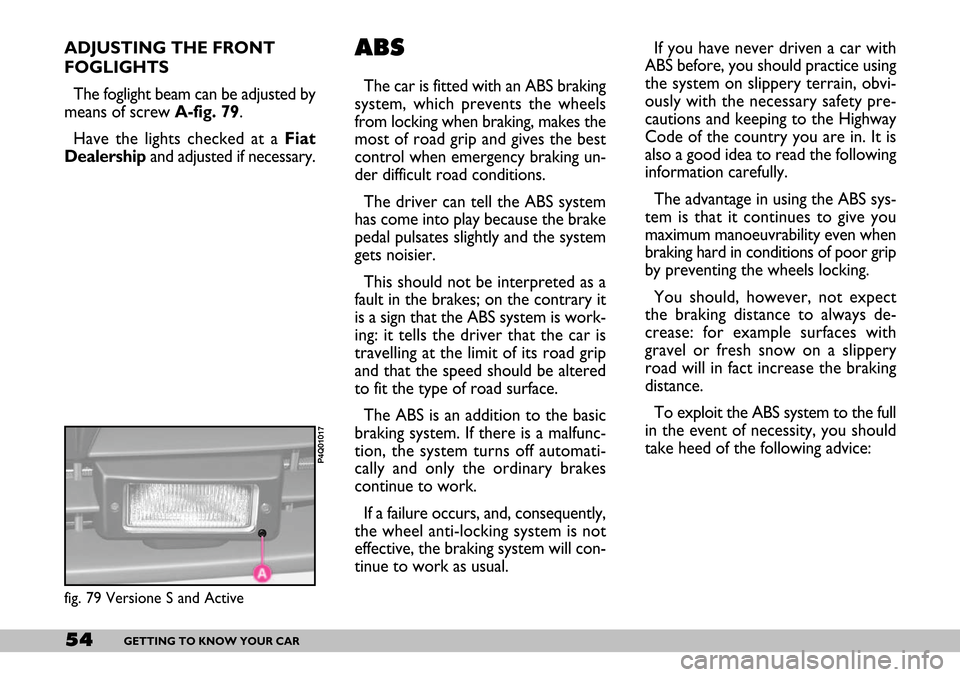
ADJUSTING THE FRONT
FOGLIGHTS
The foglight beam can be adjusted by
means of screw A-fig. 79.
Have the lights checked at a Fiat
Dealershipand adjusted if necessary. If you have never driven a car with
ABS before, you should practice using
the system on slippery terrain, obvi-
ously with the necessary safety pre-
cautions and keeping to the Highway
Code of the country you are in. It is
also a good idea to read the following
information carefully.
The advantage in using the ABS sys-
tem is that it continues to give you
maximum manoeuvrability even when
braking hard in conditions of poor grip
by preventing the wheels locking.
You should, however, not expect
the braking distance to always de-
crease: for example surfaces with
gravel or fresh snow on a slippery
road will in fact increase the braking
distance.
To exploit the ABS system to the full
in the event of necessity, you should
take heed of the following advice:ABS
The car is fitted with an ABS braking
system, which prevents the wheels
from locking when braking, makes the
most of road grip and gives the best
control when emergency braking un-
der difficult road conditions.
The driver can tell the ABS system
has come into play because the brake
pedal pulsates slightly and the system
gets noisier.
This should not be interpreted as a
fault in the brakes; on the contrary it
is a sign that the ABS system is work-
ing: it tells the driver that the car is
travelling at the limit of its road grip
and that the speed should be altered
to fit the type of road surface.
The ABS is an addition to the basic
braking system. If there is a malfunc-
tion, the system turns off automati-
cally and only the ordinary brakes
continue to work.
If a failure occurs, and, consequently,
the wheel anti-locking system is not
effective, the braking system will con-
tinue to work as usual.
fig. 79 Versione S and Active
P4Q01017
Page 63 of 154
62GETTING TO KNOW YOUR CAR
The system is programmed at the
factory to ensure variable degrees of
assistance according to the require-
ments. In other words, power is in-
creased for parking and reduced as
the car’s speed increases.
The EPAS system only works when
the engine is running to avoid deploy-
ing the battery accidentally. Further-
more, it is equipped with a self-test
function to detect faults and incorrect
signals.
IMPORTANTThe steering wheel
may stiffen slightly in parking manoeu-
vres requiring a great deal of steering:
this is normal and caused by the
power steering motor overheat pro-
tection system tripping. The problem
does not require servicing and the
electric power steering system will
work normally the next time the car
is used.If the warning light comes on, see
chapter
GETTING TO KNOW YOUR CAR,
paragraph
WARNING LIGHTS.
FIAT 600 VAN
The version herein illustrated differs
from Fiat 600 saloon described in this
handbook for the different size of the
boot and the availability of two front
seats only.
Load recommendations
Fiat 600 Van has been designed and
approved on the basis of several set
maximum values:
– kerb weight
– payload
– gross vehicle weight
– total weight on the front axle
– total weight on the rear axle
– towable weight.
Each of these limits must be borne
in mind and must never be exceeded
under any circumstances. It is absolutely forbidden
to carry out whatever af-
ter-market operation in-
volving steering system or steer-
ing column modifications (e.g.: in-
stallation of anti-theft Device)
that could badly affect perfor-
mance and safety, cause the lapse
of warranty and also result in
non-compliance of the car with
homologation requirements.
Page 71 of 154
70DRIVING YOUR CAR
STARTING
THE ENGINE1)Ensure that the handbrake is up.
2)Put the gear lever into neutral.
3)Press the clutch pedal fully down,
without pressing the accelerator.
4) Turn the ignition key to AVV and
let it go the moment the engine starts.
If warning lights ¢stay on when the
key is turned to MARturn the key to
STOPand then back to MAR. If the
light does not go off, try with the
other keys.If you are still unable to start the en-
gine, perform the emergency start-up
procedure (see
INANEMERGENCY) and
call your Fiat Dealership.
IMPORTANTDo not leave the ig-
nition key at MARwhen the engine is
off.
HOW TO WARM UP
THE ENGINE AFTER IT
HAS JUST STARTED
– Begin to move forward slowly let-
ting the engine turn at medium revs.
Do not accelerate abruptly.
– Do not push the engine to its limit
for the first few kilometres.
D D D D
R R R R
I I I I
V V V V
I I I I
N N N N
G G G G
Y Y Y Y
O O O O
U U U U
R R R R
C C C C
A A A A
R R R R
It is dangerous to let the
engine run in a garage or
other closed area. The
engine consumes oxygen and
gives off carbon dioxide, carbon
monoxide and other poisonous
fumes.
Do not touch the high
voltage cables (spark plug
leads) when the engine is
running.
IMPORTANT Do not press down
the accelerator before starting the en-
gine.
Page 74 of 154
73DRIVING YOUR CAR
IMPORTANT Reverse gear can
only be engaged when the car is com-
pletely stationary. With the engine
running, before engaging the reverse
gear, wait for at least two seconds
with the clutch pedal pressed fully
down to avoid damaging or grating the
gears. SAFE DRIVING
In designing the Fiat 600, Fiat has
made every effort to come up with a
car able to provide driver and pas-
sengers with top-class levels of safety.
Nevertheless it is always the behav-
iour of the person at the wheel that
determines road safety.
Below you will find some simple tips
to help you travel in safety under dif-
ferent conditions. You will no doubt
be familiar with many of them already
but it will be useful to read them all
carefully.
BEFORE GETTING BEHIND
THE WHEEL
– Make sure all lights including the
headlights are working properly.
– Adjust the position of the seats,
steering wheel, inside and outside rear
view mirrors properly for the best
driving position.
– Carefully adjust the head restraints
so the back of the head and not the
nape of the neck is supported. – Make sure that nothing (mats etc.)
gets in the way of the pedals when
they are pushed down.
– Make sure that any child restraint
systems (child seats, carriers etc.) are
properly fixed preferably on the back
seat.
– Place any objects in the boot in
such a way that they cannot be
thrown forwards in the event of an
accident.
– Do not eat a heavy meal before
travelling. Light eating will help keep
your reflexes prompt. Above all, do
not have anything alcoholic to drink.
Periodically, remember to check:
– tyre pressure and condition
– level of battery electrolyte
– engine oil level
– coolant level and condition of the
system
– brake fluid level
– windscreen washer fluid level. To change the gear
properly (with mechani-
cal clutch) you must push
the clutch pedal fully down. It is
therefore essential that there is
nothing under the pedals. Make
sure mats are lying flat and do
not get in the way of the pedals.
Page 76 of 154
75DRIVING YOUR CAR
DRIVING AT NIGHT
If you are driving at night these are
the main rules to follow.
– Drive especially carefully: it is
harder to drive at night.
– Slow down especially if the road is
not lit.
– At the first signs of sleepiness,
stop: continuing would be a risk for
yourself and everybody else. Only
start driving again when you have had
enough rest.
– Keep a greater safety distance
from the cars in front of you than dur-
ing daylight hours: it is hard to judge
how fast other cars are going when all
you can see are their lights.
– Make sure the headlight beams are
properly positioned: if they are too
low, they reduce visibility and strain
your eyes. If they are too high they
can dazzle other drivers.
– Only use main beam headlights
when you are driving outside town
and when you are sure they do not
annoy other drivers. – Dip main-beam headlights (if on) as
soon as you see cars coming in the
other direction and pass them with
the headlights dipped.
– Keep all lights clean.
– Be careful of animals crossing the
road when driving in the country.
DRIVING IN THE RAIN
Rain and wet road surfaces spell dan-
ger.
All manoeuvres are more difficult on
a wet road because the grip of the
wheels on the tarmac is greatly re-
duced. This is why braking distances
are much longer and road-holding is
lower.
Here is some advice for driving in
the rain:
– Reduce speed and maintain a
greater safety distance from the cars
in front.
– If it is raining particularly heavily,
visibility is also reduced. In these
cases, switch on the dipped headlightseven if it is still daylight so you can be
seen more easily.
– Do not drive through puddles at
speed and hold on tightly to the wheel
if you do: a puddle taken at high speed
might cause you to lose control of the
car (“aquaplaning”).
– Move the ventilation controls to
the position for demisting the win-
dows (see
GETTING TO KNOW YOUR
CAR
), to avoid visibility problems.
– Periodically check the condition of
the windscreen wiper blades.
DRIVING IN FOG
– If the fog is thick, do not start out
on a journey unless you absolutely
have to.
If driving in mist, blanket fog or when
there is the danger of fog patches:
– keep your speed down;
– turn on the dipped headlights, rear
fog lights and front fog lights, if fitted,
even during the day. Do not drive
with your headlights at full-beam.
Page 77 of 154
76DRIVING YOUR CAR
IMPORTANT On stretches of
road with good visibility, switch off
your rear fog lights; the brightness of
these lights could annoy the people
travelling in the cars behind
– Remember that fog also means the
tarmac is wet and therefore manoeu-
vres of all kinds are more difficult and
stopping distances are longer.
– Keep a good distance from the
cars in front of you.
– As far as possible, avoid spurts of
speed or sudden deceleration.
– Do not overtake other vehicles if
you can help it.
– If you are forced to stop your car
(breakdown, limited visibility etc.) try
to stop off the road. Turn on the haz-
ard lights and, if possible, the dipped-
beam headlights. Rhythmically sound
the horn if you realise another car is
coming.DRIVING IN
THE MOUNTAINS
– When driving downhill use the en-
gine braking effect by engaging a low
gear so as not to overheat the brakes.
– Under no circumstances should
you drive downhill with the engine off
or with the car in neutral, let alone
with the ignition key out.
– Drive at a moderate speed with-
out cutting corners.
– Remember that overtaking while
going uphill is slower and therefore
requires more free road. If you are
being overtaken while driving uphill,
make it easier for the other vehicle to
pass. DRIVING ON SNOW
AND ICE
Here are some tips for driving in
these conditions:
– keep your speed down;
– use chains if the roads are covered
in snow: see paragraph
SNOW TYRESin
this chapter;
– mainly use the braking effect of the
engine and under all circumstances
avoid braking sharply;
– when braking in a car not fitted
with ABS, reduce the possibility of the
wheels locking by varying the pressure
you exert on the brake pedal;
– do not accelerate suddenly and
avoid swerving;
– in the winter, even apparently dry
roads may have icy patches. Be care-
ful therefore when driving over
stretches that do not get much expo-
sure to the sun or are lined with trees
or rock where ice might not have
melted;
– keep a good distance from the ve-
hicles in front;
Page 79 of 154
78DRIVING YOUR CAR
Tyres
Tyre pressure should be checked at
least once every four weeks: if the
pressure is too low fuel consumption
increases as the resistance to the
rolling movement of the tyre is
greater. In this state, tyre wear is in-
creased and vehicle handling suffers
which will effect safety.
Unnecessary loads
Do not travel with too much luggage
stowed in the boot. The weight of the
vehicle and its trim greatly effects con-
sumption and stability.
Roof rack/ski rack
Remove roof racks and ski racks
from the roof of the car as soon as
they are no longer needed. These ac-
cessories reduce the aerodynamic
penetration of the vehicle and will in-
crease consumption. When having to
transport particularly large loads it is
better to use a trailer.Electric devices
Use electric devices for the neces-
sary time only. The heated rear win-
dow, fog lights, windscreen wipers,
heating system blower require large
amounts of electricity, and as a con-
sequence, the fuel consumption in-
creases (up to +25% in town).
Climate control system
The climate control system is a fur-
ther drag on the engine causing higher
fuel consumption (on average, up to
20%). When outside temperatures
permit, use the vents.
Aerodynamic accessories
The use of aerodynamic accessories
not certified for that specific purpose
can diminish the car’s aerodynamic
penetration and increase consump-
tion.BEHIND THE WHEEL
Starting-up
Do not warm up the engine when
the car is stationary, neither by idling
nor revving up. If you do, the engine
will warm up much more slowly and
increase fuel consumption and emis-
sions. It is therefore better to start
slowly and to keep the engine speed
down.
Unnecessary manoeuvres
Do not give quick bursts on the ac-
celerator when waiting at the traffic
lights or before turning off the engine.
This type of action, like the “double
clutch” are absolutely useless on mod-
ern cars. They only increase fuel con-
sumption and pollution.
Gear selection
As soon as traffic conditions allow,
shift up to a higher gear. Using a low
gear to have a sharp acceleration in-
creases the consumption. Likewise,
using a high gear when this is not
called for increases consumption,
emissions and wear on the engine.
Page 80 of 154
79DRIVING YOUR CAR
Top speed
As speed increases, so does the fuel
consumption: note that passing from
90 to 120 km/h increases consump-
tion by about +30%. Keep your speed
as steady as possible and avoid un-
necessary braking and accelerations
that cost fuel and increase emissions
considerably. It is better to drive
“smoothly” trying to foresee the ma-
noeuvres to avoid imminent dangers
and always respect the safety distance
to avoid the need to slow down sud-
denly.
Acceleration
Sudden and sharp accelerations
revving up the engine increase con-
sumption and emissions; accelerate
gradually and do not exceed the max-
imum torque.USE
Cold start
Short journeys and frequent cold
start-ups do not allow the engine to
reach the best running temperature.
As a result, consumption rises (from
+15 to +30% in town) and so do the
harmful emissions.
Traffic situations and road
conditions
Consumption rises in heavy traffic, in
traffic jams where it is constantly nec-
essary to shift to low gears or in big
cities with many traffic lights.
Also twisting roads, mountain roads
and rough road surfaces pay a heavy
toll on consumption.
Hold-ups in traffic
During hold-ups (e.g.: level crossings)
switch off the engine.CHEAP RUNNING
THAT RESPECTS
THE ENVIRONMENT
Environmental protection has been
one of the guiding principles in the
production of Fiat 600. It is no acci-
dent that its pollution control equip-
ment is much more effective than that
required by current legislation.
Nonetheless, the environment can-
not get by without a concerted effort
from everyone.
By following a few simple rules you
can avoid harming the environment
and often cut down fuel consumption
at the same time.
On this subject, a few useful tips
have been given below to supplement
those marked by symbol #, at various
points of the handbook.
You are asked to read both the for-
mer and the latter carefully.
Page 88 of 154
87IN AN EMERGENCY
I I I I
N N N N
A A A A
N N N N
E E E E
M M M M
E E E E
R R R R
G G G G
E E E E
N N N N
C C C C
Y Y Y Y
EMERGENCY
START-UP
If the Fiat CODE cannot deactivate
the engine immobilising system, the
¢and
Uwarning lights stay on and
the engine will not start. Follow the
emergency start-up procedure to
start the engine.
Read the whole procedure care-
fully before trying to carry it out.
If you make a mistake, you must turn
the ignition key back to STOPand
repeat the whole operation from the
beginning (step 1).
1)Read the 5-figure electronic code
given on the CODE card.
2)Turn the ignition key to MAR.3)Press and hold down the acceler-
ator pedal. The injection system warn-
ing light
Uwill come on for about 8
seconds, and then go out. At this
point release the accelerator pedal
and get ready to count the flashes of
warning light
U.
4) Count the number of flashes that
corresponds to the first figure of the
code on the CODE card, then press
the accelerator pedal and keep it there
until the
Uwarning light comes on
for four seconds and then goes out;
release the accelerator pedal.
5) The
Uwarning light will start
flashing again: after it has flashed the
number of times that corresponds to
the second figure on the CODE card,
press the accelerator pedal to the
floor and keep it there.
6) Do the same for the remaining
figures on the CODE card. 7) Once the final figure has been en-
tered, keep the accelerator pedal
pressed. The injection warning light
Uwill light up for four seconds and
then go out; release the accelerator
pedal.
8)The
Uwarning light will flash
rapidly for about 4 seconds to indicate
that the operation has been com-
pleted correctly.
9) Start the engine by turning the ig-
nition key from MARto AVV.
If, however, the
Uwarning light
stays on, turn the ignition key to
STOPand repeat the procedure
from step 1.
IMPORTANTAfter an emergency
start, you should contact a Fiat Deal-
ership, otherwise you will have to re-
peat the procedure described each
time you want to start the engine.
Page 90 of 154
89IN AN EMERGENCY
BUMP STARTING IF A TYRE IS
PUNCTURED
General instructions
Observe the instructions on this and
the following pages to use the jack and
space-saver spare wheel correctly. The space-saver spare
wheel is vehicle-specific.
Never use the wheel on
other models. Never fit other
model spare wheels on your car.
If you change the type of wheels
(alloy rims instead of steel rims)
you will have to change the en-
tire set of fastening bolts with an-
other set of suitably sized bolts.
Only use the spare-saver wheel
for emergencies. Do not exceed
80 km/h with the spare wheel fit-
ted. When driving with a space-
saver spare wheel fitted, the dri-
ving performance of your car
may change. Avoid accelerating
or braking suddenly, steering
abruptly or fast cornering.
A space-saver spare wheel has a
maximum life of 3,000 km after
which is must be replaced with a
wheel of the same type. Do not bump start by
pushing, towing or coast-
ing downhill. This way of
starting could cause a rush of fuel
into the catalytic exhaust pipe
and damage it beyond repair.
Remember that until
the engine has started
the brake booster and
power steering systems will not
work and a greater effort will
therefore be required to press
the brake pedal or turn the
steering wheel.
Alert other drivers that
the car is stationary in
compliance with local
regulations: hazard warning
lights, warning triangle etc.
Any passengers on board should
leave the car, especially if it is
heavily laden. Passengers should
stay away from oncoming traffic
while the wheel is being changed.
If the wheel is being changed on
a steep or badly surfaced road,
place wedges or other suitable
material under the wheels to
stop the car.