seats FIAT SEICENTO 2007 1.G User Guide
[x] Cancel search | Manufacturer: FIAT, Model Year: 2007, Model line: SEICENTO, Model: FIAT SEICENTO 2007 1.GPages: 154, PDF Size: 3.68 MB
Page 53 of 154
52GETTING TO KNOW YOUR CAR
Take care that scarves,
ties or loose clothing do
not accidentally come
near moving parts; they could
become entangled with serious
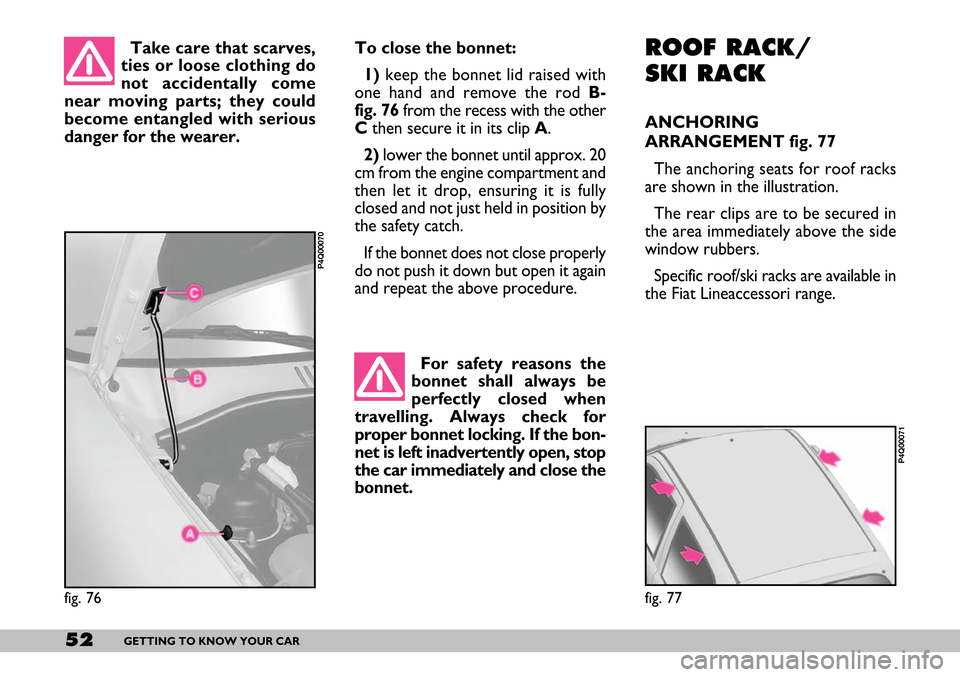
danger for the wearer. To close the bonnet:
1)keep the bonnet lid raised with
one hand and remove the rod B-
fig. 76from the recess with the other
Cthen secure it in its clip A.
2) lower the bonnet until approx. 20
cm from the engine compartment and
then let it drop, ensuring it is fully
closed and not just held in position by
the safety catch.
If the bonnet does not close properly
do not push it down but open it again
and repeat the above procedure.ROOF RACK/
SKI RACK
ANCHORING
ARRANGEMENT fig. 77
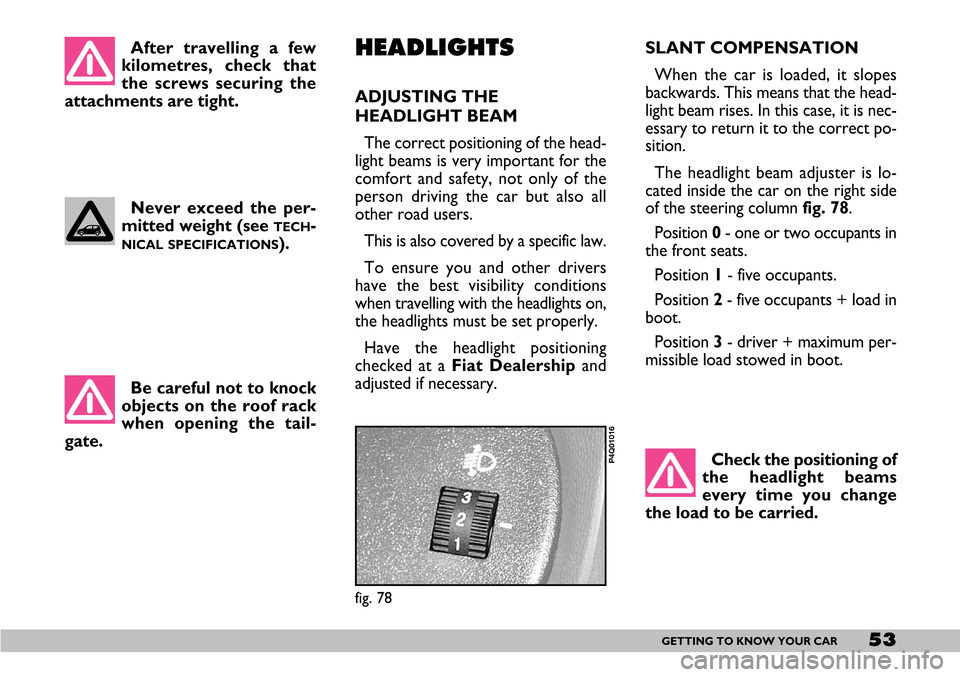
The anchoring seats for roof racks
are shown in the illustration.
The rear clips are to be secured in
the area immediately above the side
window rubbers.
Specific roof/ski racks are available in
the Fiat Lineaccessori range.
For safety reasons the
bonnet shall always be
perfectly closed when
travelling. Always check for
proper bonnet locking. If the bon-
net is left inadvertently open, stop
the car immediately and close the
bonnet.
fig. 76
P4Q00070
fig. 77
P4Q00071
Page 54 of 154
53GETTING TO KNOW YOUR CAR
After travelling a few
kilometres, check that
the screws securing the
attachments are tight.
Never exceed the per-
mitted weight (see
TECH-
NICAL SPECIFICATIONS). SLANT COMPENSATION
When the car is loaded, it slopes
backwards. This means that the head-
light beam rises. In this case, it is nec-
essary to return it to the correct po-
sition.
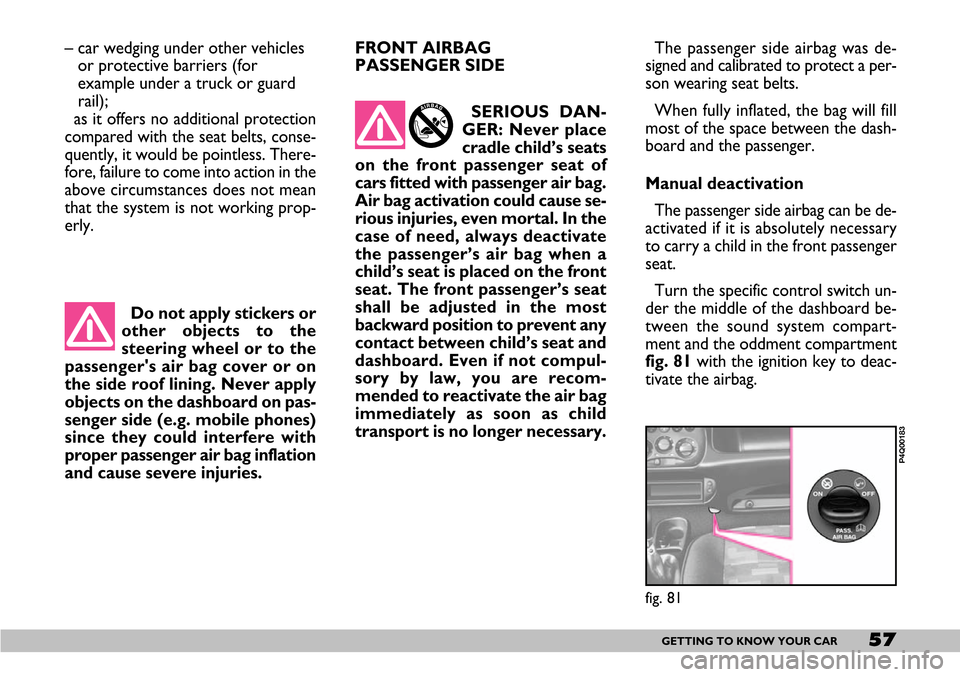
The headlight beam adjuster is lo-
cated inside the car on the right side
of the steering column fig. 78.
Position 0- one or two occupants in
the front seats.
Position 1- five occupants.
Position 2- five occupants + load in
boot.
Position 3- driver + maximum per-
missible load stowed in boot.
Be careful not to knock
objects on the roof rack
when opening the tail-
gate.
HEADLIGHTS
ADJUSTING THE
HEADLIGHT BEAM
The correct positioning of the head-
light beams is very important for the
comfort and safety, not only of the
person driving the car but also all
other road users.
This is also covered by a specific law.
To ensure you and other drivers
have the best visibility conditions
when travelling with the headlights on,
the headlights must be set properly.
Have the headlight positioning
checked at a Fiat Dealershipand
adjusted if necessary.
fig. 78
P4Q01016Check the positioning of
the headlight beams
every time you change
the load to be carried.
Page 58 of 154
57GETTING TO KNOW YOUR CAR
Do not apply stickers or
other objects to the
steering wheel or to the
passenger's air bag cover or on
the side roof lining. Never apply
objects on the dashboard on pas-
senger side (e.g. mobile phones)
since they could interfere with
proper passenger air bag inflation
and cause severe injuries. – car wedging under other vehicles
or protective barriers (for
example under a truck or guard
rail);
as it offers no additional protection
compared with the seat belts, conse-
quently, it would be pointless. There-
fore, failure to come into action in the
above circumstances does not mean
that the system is not working prop-
erly.FRONT AIRBAG
PASSENGER SIDEThe passenger side airbag was de-
signed and calibrated to protect a per-
son wearing seat belts.
When fully inflated, the bag will fill
most of the space between the dash-
board and the passenger.
Manual deactivation
The passenger side airbag can be de-
activated if it is absolutely necessary
to carry a child in the front passenger
seat.
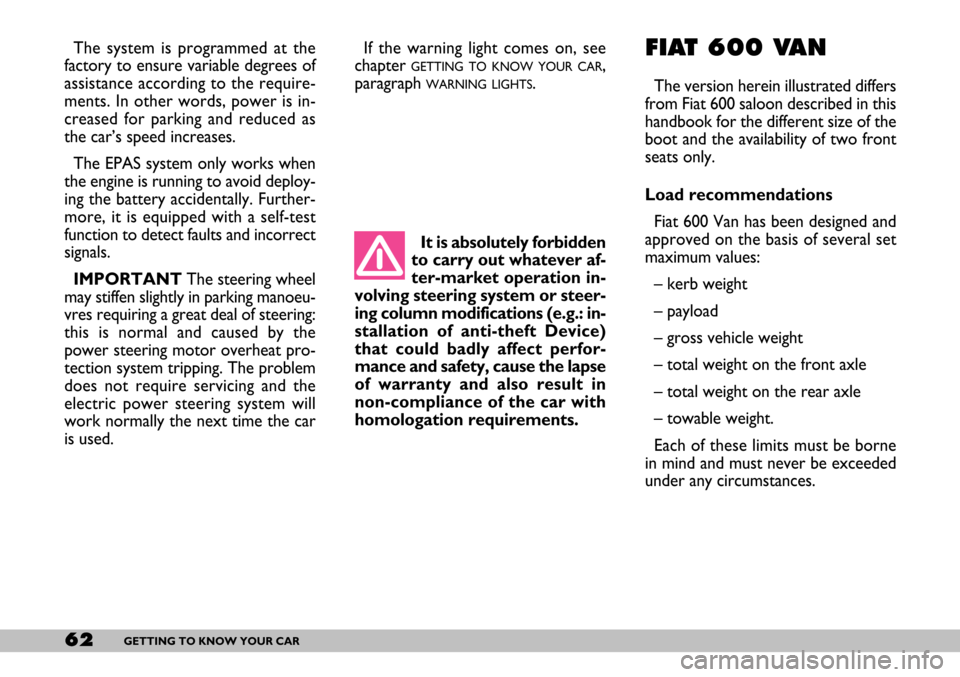
Turn the specific control switch un-
der the middle of the dashboard be-
tween the sound system compart-
ment and the oddment compartment
fig. 81with the ignition key to deac-
tivate the airbag. SERIOUS DAN-
GER: Never place
cradle child’s seats
on the front passenger seat of
cars fitted with passenger air bag.
Air bag activation could cause se-
rious injuries, even mortal. In the
case of need, always deactivate
the passenger’s air bag when a
child’s seat is placed on the front
seat. The front passenger’s seat
shall be adjusted in the most
backward position to prevent any
contact between child’s seat and
dashboard. Even if not compul-
sory by law, you are recom-
mended to reactivate the air bag
immediately as soon as child
transport is no longer necessary.
fig. 81
P4Q00183
Page 63 of 154
62GETTING TO KNOW YOUR CAR
The system is programmed at the
factory to ensure variable degrees of
assistance according to the require-
ments. In other words, power is in-
creased for parking and reduced as
the car’s speed increases.
The EPAS system only works when
the engine is running to avoid deploy-
ing the battery accidentally. Further-
more, it is equipped with a self-test
function to detect faults and incorrect
signals.
IMPORTANTThe steering wheel
may stiffen slightly in parking manoeu-
vres requiring a great deal of steering:
this is normal and caused by the
power steering motor overheat pro-
tection system tripping. The problem
does not require servicing and the
electric power steering system will
work normally the next time the car
is used.If the warning light comes on, see
chapter
GETTING TO KNOW YOUR CAR,
paragraph
WARNING LIGHTS.
FIAT 600 VAN
The version herein illustrated differs
from Fiat 600 saloon described in this
handbook for the different size of the
boot and the availability of two front
seats only.
Load recommendations
Fiat 600 Van has been designed and
approved on the basis of several set
maximum values:
– kerb weight
– payload
– gross vehicle weight
– total weight on the front axle
– total weight on the rear axle
– towable weight.
Each of these limits must be borne
in mind and must never be exceeded
under any circumstances. It is absolutely forbidden
to carry out whatever af-
ter-market operation in-
volving steering system or steer-
ing column modifications (e.g.: in-
stallation of anti-theft Device)
that could badly affect perfor-
mance and safety, cause the lapse
of warranty and also result in
non-compliance of the car with
homologation requirements.
Page 73 of 154
72DRIVING YOUR CAR
HANDBRAKE
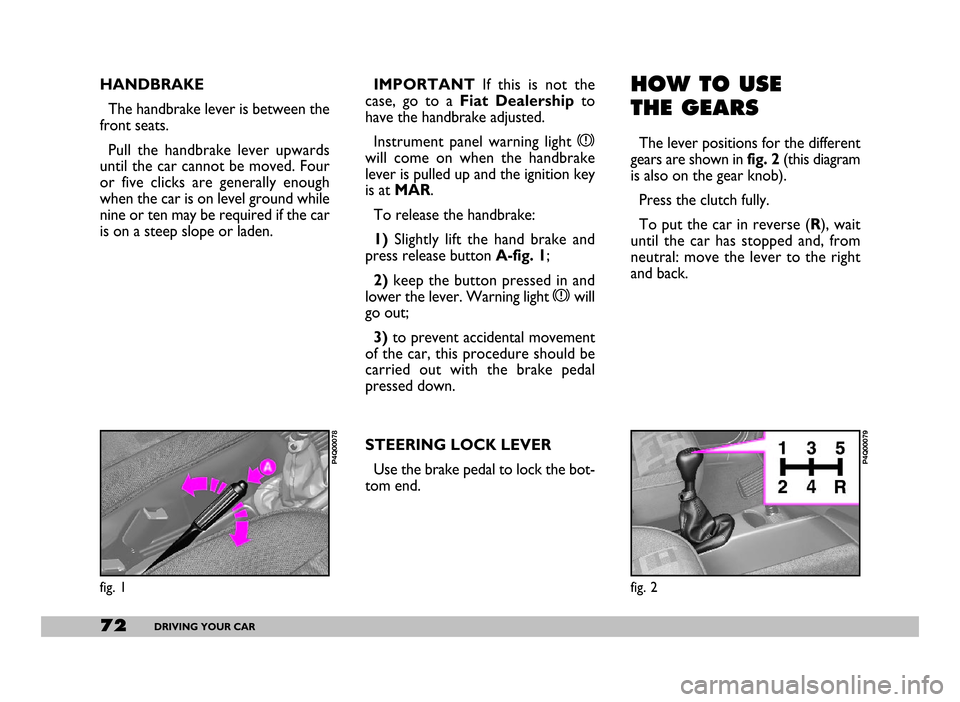
The handbrake lever is between the
front seats.
Pull the handbrake lever upwards
until the car cannot be moved. Four
or five clicks are generally enough
when the car is on level ground while
nine or ten may be required if the car
is on a steep slope or laden. IMPORTANTIf this is not the
case, go to a Fiat Dealership to
have the handbrake adjusted.
Instrument panel warning light x
will come on when the handbrake
lever is pulled up and the ignition key
is at MAR.
To release the handbrake:
1)Slightly lift the hand brake and
press release button A-fig. 1;
2)keep the button pressed in and
lower the lever. Warning light xwill
go out;
3)to prevent accidental movement
of the car, this procedure should be
carried out with the brake pedal
pressed down.
STEERING LOCK LEVER
Use the brake pedal to lock the bot-
tom end. HOW TO USE
THE GEARS
The lever positions for the different
gears are shown in fig. 2(this diagram
is also on the gear knob).
Press the clutch fully.
To put the car in reverse (R), wait
until the car has stopped and, from
neutral: move the lever to the right
and back.
fig. 1
P4Q00078
fig. 2
P4Q00079
Page 74 of 154
73DRIVING YOUR CAR
IMPORTANT Reverse gear can
only be engaged when the car is com-
pletely stationary. With the engine
running, before engaging the reverse
gear, wait for at least two seconds
with the clutch pedal pressed fully
down to avoid damaging or grating the
gears. SAFE DRIVING
In designing the Fiat 600, Fiat has
made every effort to come up with a
car able to provide driver and pas-
sengers with top-class levels of safety.
Nevertheless it is always the behav-
iour of the person at the wheel that
determines road safety.
Below you will find some simple tips
to help you travel in safety under dif-
ferent conditions. You will no doubt
be familiar with many of them already
but it will be useful to read them all
carefully.
BEFORE GETTING BEHIND
THE WHEEL
– Make sure all lights including the
headlights are working properly.
– Adjust the position of the seats,
steering wheel, inside and outside rear
view mirrors properly for the best
driving position.
– Carefully adjust the head restraints
so the back of the head and not the
nape of the neck is supported. – Make sure that nothing (mats etc.)
gets in the way of the pedals when
they are pushed down.
– Make sure that any child restraint
systems (child seats, carriers etc.) are
properly fixed preferably on the back
seat.
– Place any objects in the boot in
such a way that they cannot be
thrown forwards in the event of an
accident.
– Do not eat a heavy meal before
travelling. Light eating will help keep
your reflexes prompt. Above all, do
not have anything alcoholic to drink.
Periodically, remember to check:
– tyre pressure and condition
– level of battery electrolyte
– engine oil level
– coolant level and condition of the
system
– brake fluid level
– windscreen washer fluid level. To change the gear
properly (with mechani-
cal clutch) you must push
the clutch pedal fully down. It is
therefore essential that there is
nothing under the pedals. Make
sure mats are lying flat and do
not get in the way of the pedals.
Page 75 of 154
74DRIVING YOUR CAR
WHEN TRAVELLING
– The first rule of safe driving is pru-
dence.
– Prudence also means putting your-
self into a position where you can pre-
dict wrong or imprudent behaviour
from other drivers.
– Stick closely to the rules of the
road in the particular country where
the vehicle is being driven and, above
all, do not exceed speed limits.
– Ensure that, besides yourself, all
the other passengers in the car have
their seat belts fastened, that children
are sitting in the appropriate child
seats and any animals in the car are
placed in suitable compartments.
– You should be physically fit and
mentally alert before setting out on
long journeys. Always fasten both front
and back seat belts and
those of any child seats.
Travelling with the seat belts un-
fastened increases the risk of in-
jury or death if you are in a colli-
sion.
Driving while drunk or
under the influence of
drugs or certain medi-
cines is dangerous for both you
and other road users.
Water, ice or salt on
road surfaces can deposit
on brake disks, reducing
braking efficiency on the first
braking.
Consider that fitting ex-
tra spoilers, alloy rims or
non standard wheel caps
can reduce ventilation of the
brakes and reduce their effi-
ciency under conditions of violent
or repeated braking or long
downhill travel.
Do not drive with ob-
jects on the floor in front
of the driver’s seat: they
could get caught under the ped-
als making braking or accelerat-
ing impossible. Pay attention to the
mats: even a minor prob-
lem to the braking sys-
tem may require increases brake
pedal stroke with respect to nor-
mal.
– Do not drive too many hours at a
time but stop at intervals to stretch
your legs and recover your energies.
– Constantly change the air in the
passenger compartment.
– Never coast downhill (i.e. with the
engine off): if you do, you lose the aid
of the engine brake, brakes booster
and power steering, so that braking
and steering require greater effort.
Page 128 of 154
127CAR MAINTENANCE
CLEANING SEATS
AND FABRICS
– Remove dust with a soft brush and
vacuum cleaner.
– Brush the seats with a damp
sponge with water and a neutral soap.
– Remove any grease stains with a
specific product.
CLEANING LEATHER SEATS
– Remove the dry dirt with a
chamois leather or very slightly moist
cloth without exerting too much pres-
sure.
– Remove liquid or grease stains
with a dry absorbent cloth without
rubbing. Then wipe with a chamois
leather or soft cloth moistened with
water and neutral soap.
If the stain does not come out, use a
special cleaning compound being par-
ticularly careful to follow the instruc-
tions for use.
IMPORTANT Never use alcohol
or alcohol-base products.PLASTIC PARTS INSIDE
THE CAR
Use special products designed not to
alter the appearance of the compo-
nents.
IMPORTANT Do not use alcohol
or petrol to clean the instrument
panel.
Do not keep aerosol
cans in the car. There is
the risk they might ex-
plode. Aerosol cans must never
be exposed to a temperature
above 50°C; when the weather
starts to get hot the tempera-
ture inside the car might go well
beyond that figure.INTERIORS
From time to time check that water
has not collected under the mats
(from dripping shoes, umbrellas etc.)
which could cause the steel to rust.
Never use inflammable
products such as petro-
leum ether or petrol to
clean inside the car. The electro-
static loads that are generated
while rubbing to clean could be-
come a fire risk.
Page 148 of 154
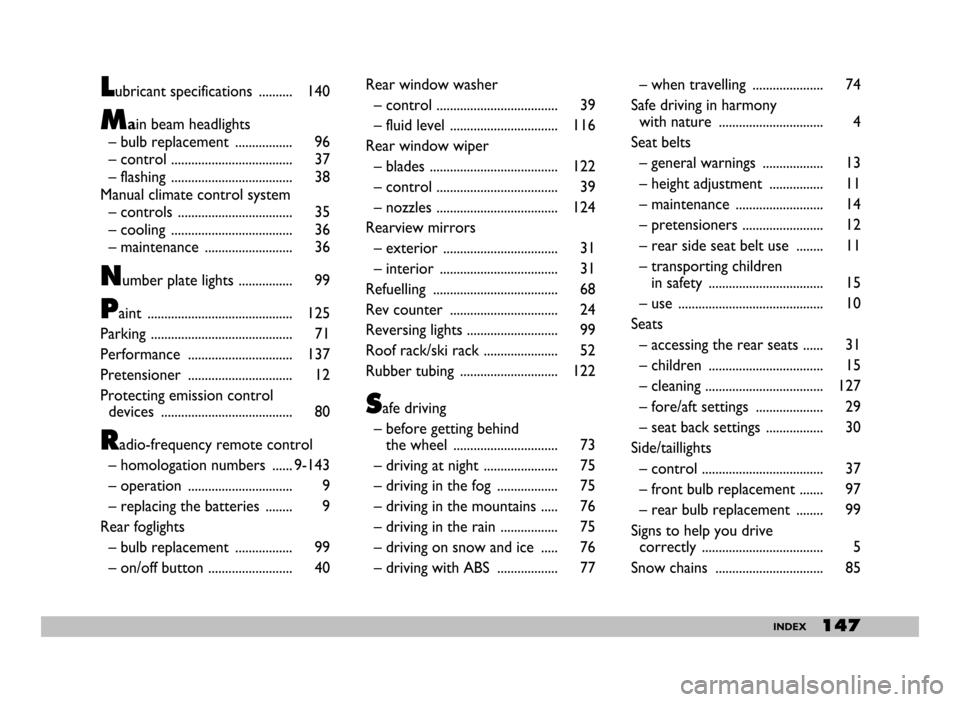
147INDEX
Lubricant specifications .......... 140
Main beam headlights
– bulb replacement ................. 96
– control .................................... 37
– flashing .................................... 38
Manual climate control system
– controls .................................. 35
– cooling .................................... 36
– maintenance .......................... 36
Number plate lights ................ 99
Paint ........................................... 125
Parking .......................................... 71
Performance ............................... 137
Pretensioner ............................... 12
Protecting emission control
devices ....................................... 80
Radio-frequency remote control
– homologation numbers ...... 9-143
– operation ............................... 9
– replacing the batteries ........ 9
Rear foglights
– bulb replacement ................. 99
– on/off button ......................... 40Rear window washer
– control .................................... 39
– fluid level ................................ 116
Rear window wiper
– blades ...................................... 122
– control .................................... 39
– nozzles .................................... 124
Rearview mirrors
– exterior .................................. 31
– interior ................................... 31
Refuelling ..................................... 68
Rev counter ................................ 24
Reversing lights ........................... 99
Roof rack/ski rack ...................... 52
Rubber tubing ............................. 122
Safe driving
– before getting behind
the wheel ............................... 73
– driving at night ...................... 75
– driving in the fog .................. 75
– driving in the mountains ..... 76
– driving in the rain ................. 75
– driving on snow and ice ..... 76
– driving with ABS .................. 77– when travelling ..................... 74
Safe driving in harmony
with nature ............................... 4
Seat belts
– general warnings .................. 13
– height adjustment ................ 11
– maintenance .......................... 14
– pretensioners ........................ 12
– rear side seat belt use ........ 11
– transporting children
in safety .................................. 15
– use ........................................... 10
Seats
– accessing the rear seats ...... 31
– children .................................. 15
– cleaning ................................... 127
– fore/aft settings .................... 29
– seat back settings ................. 30
Side/taillights
– control .................................... 37
– front bulb replacement ....... 97
– rear bulb replacement ........ 99
Signs to help you drive
correctly .................................... 5
Snow chains ................................ 85