key FIAT SEICENTO 2007 1.G Owner's Manual
[x] Cancel search | Manufacturer: FIAT, Model Year: 2007, Model line: SEICENTO, Model: FIAT SEICENTO 2007 1.GPages: 154, PDF Size: 3.68 MB
Page 58 of 154
57GETTING TO KNOW YOUR CAR
Do not apply stickers or
other objects to the
steering wheel or to the
passenger's air bag cover or on
the side roof lining. Never apply
objects on the dashboard on pas-
senger side (e.g. mobile phones)
since they could interfere with
proper passenger air bag inflation
and cause severe injuries. – car wedging under other vehicles
or protective barriers (for
example under a truck or guard
rail);
as it offers no additional protection
compared with the seat belts, conse-
quently, it would be pointless. There-
fore, failure to come into action in the
above circumstances does not mean
that the system is not working prop-
erly.FRONT AIRBAG
PASSENGER SIDEThe passenger side airbag was de-
signed and calibrated to protect a per-
son wearing seat belts.
When fully inflated, the bag will fill
most of the space between the dash-
board and the passenger.
Manual deactivation
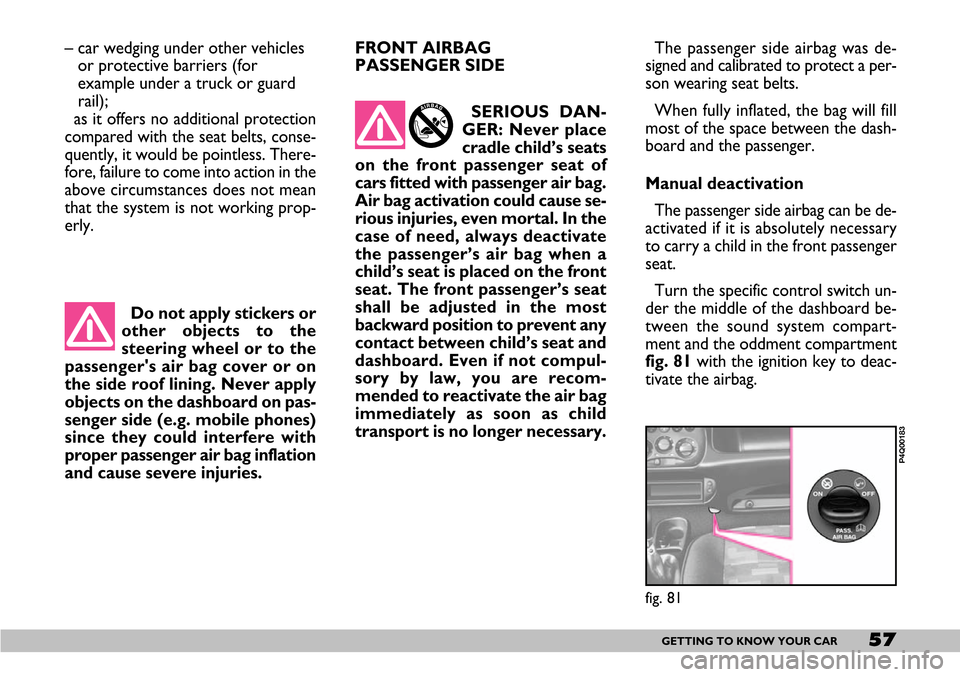
The passenger side airbag can be de-
activated if it is absolutely necessary
to carry a child in the front passenger
seat.
Turn the specific control switch un-
der the middle of the dashboard be-
tween the sound system compart-
ment and the oddment compartment
fig. 81with the ignition key to deac-
tivate the airbag. SERIOUS DAN-
GER: Never place
cradle child’s seats
on the front passenger seat of
cars fitted with passenger air bag.
Air bag activation could cause se-
rious injuries, even mortal. In the
case of need, always deactivate
the passenger’s air bag when a
child’s seat is placed on the front
seat. The front passenger’s seat
shall be adjusted in the most
backward position to prevent any
contact between child’s seat and
dashboard. Even if not compul-
sory by law, you are recom-
mended to reactivate the air bag
immediately as soon as child
transport is no longer necessary.
fig. 81
P4Q00183
Page 60 of 154
59GETTING TO KNOW YOUR CAR
If the ¬warning light
does not turn on when
turning the ignition key
to MAR or if it stays on when
travelling, this could indicate a
failure in safety retaining sys-
tems; under this condition air
bags or pretensioners could not
trigger in the event of collision
or, in a restricted number of
cases, they could trigger acci-
dentally. Stop the car and con-
tact Fiat Dealership to have the
system checked immediately. Do not travel with ob-
jects on your lap or in
front of you. Do not hold
a pipe, a pencil or similar be-
tween your lips. You could seri-
ously hurt yourself if the airbag
inflates in a collision.
The warning light
Fshould come on for ap-
proximately four seconds
and then flash for other four sec-
onds when the passenger side
airbag deactivation switch is
turned to ON and the ignition
key is turned to MAR to remind
you that the passenger side
airbag will be fired in the event of
an accident. The warning light
should then go out. Always drive with both
hands on the rims of the
steering wheel so that the
airbag is free to inflate during a
head-on collision and protection
yourself from serious injury. Do
not drive with your body bending
towards the steering wheel but
sit in an upright position with
your back resting against the
seat. If an attempt has been
made to steal the car or if
it has actually been stolen
or vandalised in any way or sub-
jected to flooding, have the
airbag system checked at a Fiat
Dealership.
Please note that airbags
can be triggered when
the engine is running also
if the car is stationary and an-
other vehicle crashes into it at
suitably high speed. As a conse-
quence, never sit children in the
front seat, also when the car is
still. On the other hand, the
airbags will not be fired if the car
is stationary and the key is not
turned. Missed operation in these
circumstances does not indicate
a fault.
Page 61 of 154
60GETTING TO KNOW YOUR CAR
Correct operation of
the front airbags and the
pretensioners is guaran-
teed as long as the car is not
overloaded.
The airbag does not re-
place seat belts but
rather increases their ef-
fectiveness. Furthermore, the
front airbag is not fired in the
event of low speed front colli-
sions, side collisions, rear-end
shunts and roll-overs. In these
cases, the passengers are only
protected by the seat belts which
for this reason must be fastened
at all times. EOBD SYSTEM
The EOBD (European On Board Di-
agnosis) system continuously monitors
the car emission system components.
Furthermore, the system warns the
driver of deterioration concerning the
emission system components by
means of the Uwarning light on the
instrument panelThe objective is to:
– monitor system efficiency;
– warn when failures can increase
emissions over the threshold estab-
lished by the European regulations;
– warn of the need to replace dete-
riorated components.
Furthermore, the system is equipped
with a connector for interfacing with
specific tools used to read the error
codes stored in the control unit mem-
ory along with a set of diagnostic and
engine specific parameters. This check can also be performed by
traffic controller agents.
Contact a Fiat Dealer-
ship as soon as possible if
the Uwarning light ei-
ther does not come on when the
key is turned to MAR or comes
on, with fixed or flashing light,
when travelling.
IMPORTANTAfter eliminating
the problem, your Fiat Dealership
will run a bench test to fully check the
system. In some cases, a long road
test may be required.
Page 62 of 154
61GETTING TO KNOW YOUR CAR
ELECTRICAL POWER
STEERING SYSTEM
IMPORTANT The electrical
power steering system only works
when the ignition key is at MAR.
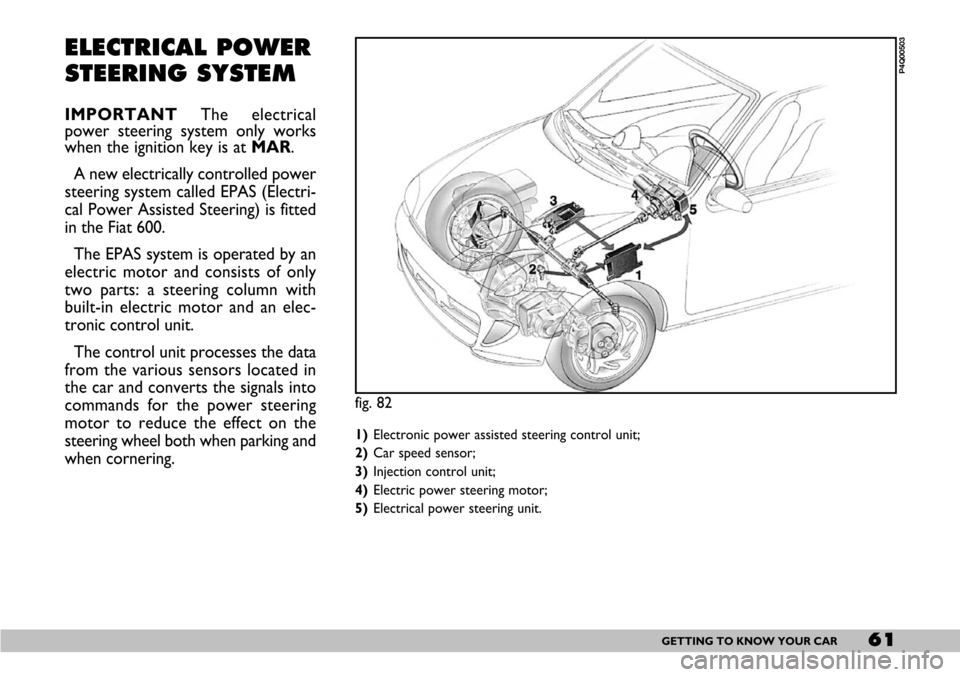
A new electrically controlled power
steering system called EPAS (Electri-
cal Power Assisted Steering) is fitted
in the Fiat 600.
The EPAS system is operated by an
electric motor and consists of only
two parts: a steering column with
built-in electric motor and an elec-
tronic control unit.
The control unit processes the data
from the various sensors located in
the car and converts the signals into
commands for the power steering
motor to reduce the effect on the
steering wheel both when parking and
when cornering.
P4Q00503
fig. 82
1)Electronic power assisted steering control unit;
2)Car speed sensor;
3)Injection control unit;
4)Electric power steering motor;
5)Electrical power steering unit.
Page 69 of 154
68GETTING TO KNOW YOUR CAR
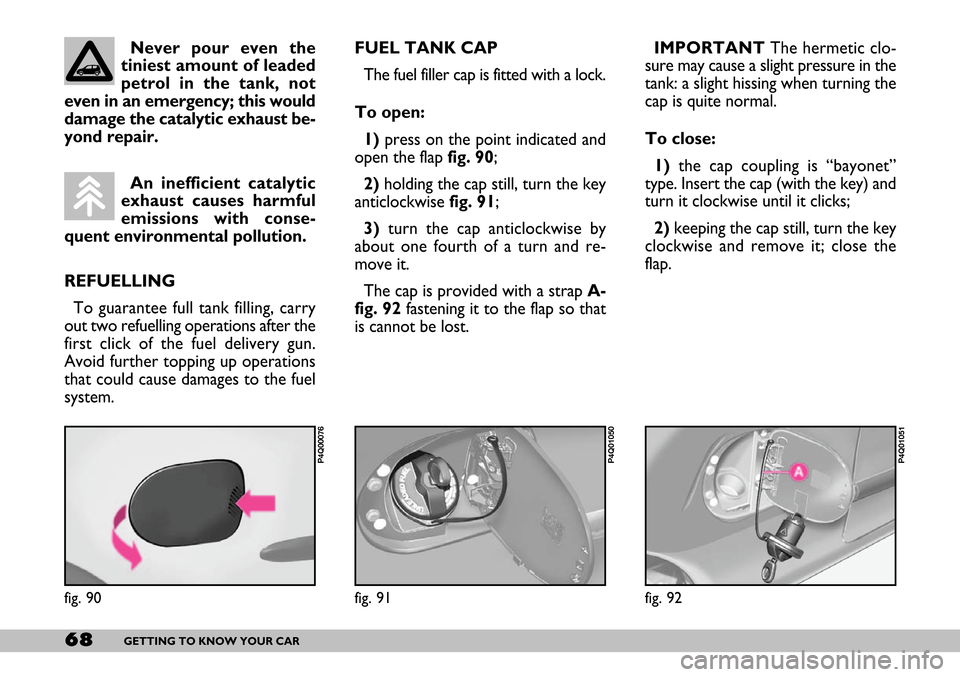
IMPORTANTThe hermetic clo-
sure may cause a slight pressure in the
tank: a slight hissing when turning the
cap is quite normal.
To close:
1)the cap coupling is “bayonet”
type. Insert the cap (with the key) and
turn it clockwise until it clicks;
2)keeping the cap still, turn the key
clockwise and remove it; close the
flap.
fig. 92
P4Q01051
Never pour even the
tiniest amount of leaded
petrol in the tank, not
even in an emergency; this would
damage the catalytic exhaust be-
yond repair. FUEL TANK CAP
The fuel filler cap is fitted with a lock.
To open:
1)press on the point indicated and
open the flap fig. 90;
2) holding the cap still, turn the key
anticlockwise fig. 91;
3) turn the cap anticlockwise by
about one fourth of a turn and re-
move it.
The cap is provided with a strap A-
fig. 92fastening it to the flap so that
is cannot be lost.
fig. 90
P4Q00076
fig. 91
P4Q01050
An inefficient catalytic
exhaust causes harmful
emissions with conse-
quent environmental pollution.
REFUELLING
To guarantee full tank filling, carry
out two refuelling operations after the
first click of the fuel delivery gun.
Avoid further topping up operations
that could cause damages to the fuel
system.
Page 71 of 154
70DRIVING YOUR CAR
STARTING
THE ENGINE1)Ensure that the handbrake is up.
2)Put the gear lever into neutral.
3)Press the clutch pedal fully down,
without pressing the accelerator.
4) Turn the ignition key to AVV and
let it go the moment the engine starts.
If warning lights ¢stay on when the
key is turned to MARturn the key to
STOPand then back to MAR. If the
light does not go off, try with the
other keys.If you are still unable to start the en-
gine, perform the emergency start-up
procedure (see
INANEMERGENCY) and
call your Fiat Dealership.
IMPORTANTDo not leave the ig-
nition key at MARwhen the engine is
off.
HOW TO WARM UP
THE ENGINE AFTER IT
HAS JUST STARTED
– Begin to move forward slowly let-
ting the engine turn at medium revs.
Do not accelerate abruptly.
– Do not push the engine to its limit
for the first few kilometres.
D D D D
R R R R
I I I I
V V V V
I I I I
N N N N
G G G G
Y Y Y Y
O O O O
U U U U
R R R R
C C C C
A A A A
R R R R
It is dangerous to let the
engine run in a garage or
other closed area. The
engine consumes oxygen and
gives off carbon dioxide, carbon
monoxide and other poisonous
fumes.
Do not touch the high
voltage cables (spark plug
leads) when the engine is
running.
IMPORTANT Do not press down
the accelerator before starting the en-
gine.
Page 72 of 154
71DRIVING YOUR CAR
EMERGENCY START-UP
If the Fiat CODE system fails to
recognise that code transmitted by
the ignition key (instrument panel
warning light ¢on) the emergency
start-up can be performed by using
the CODE card code.
See the
INANEMERGENCY. A quick burst on the ac-
celerator before turning
off the engine serves ab-
solutely no practical purpose and
wastes fuel.
IMPORTANTAfter a taxing drive
it is better to allow the engine to
“catch its breath” before turning it off,
by letting it idle to allow the temper-
ature in the engine compartment to
fall.
PARKING
Switch off the engine, pull up the
handbrake and put the car in 1st gear
if the car is pointing uphill, reverse if
downhill.
If the car is parked on a steep gradi-
ent it is a good idea to use a stone or
wedge to block the wheels.
Do not leave the ignition key at
MARbecause it drains the battery.
Always remove the key when you
leave the car. Bump starting by push-
ing, towing or rolling
downhill must be avoided
at all costs. This way of starting
could cause a rush of fuel into the
catalytic exhaust pipe and dam-
age it beyond repair.
Remember that as long
as the engine is not run-
ning, the power brakes
and power steering do not work.
You therefore have to use con-
siderably more effort on both the
brake pedal and the steering
wheel. SWITCHING OFF
THE ENGINE
Turn the key to STOPwhile the
engine is idling.
Never leave unsuper-
vised children in the car.
Page 73 of 154
72DRIVING YOUR CAR
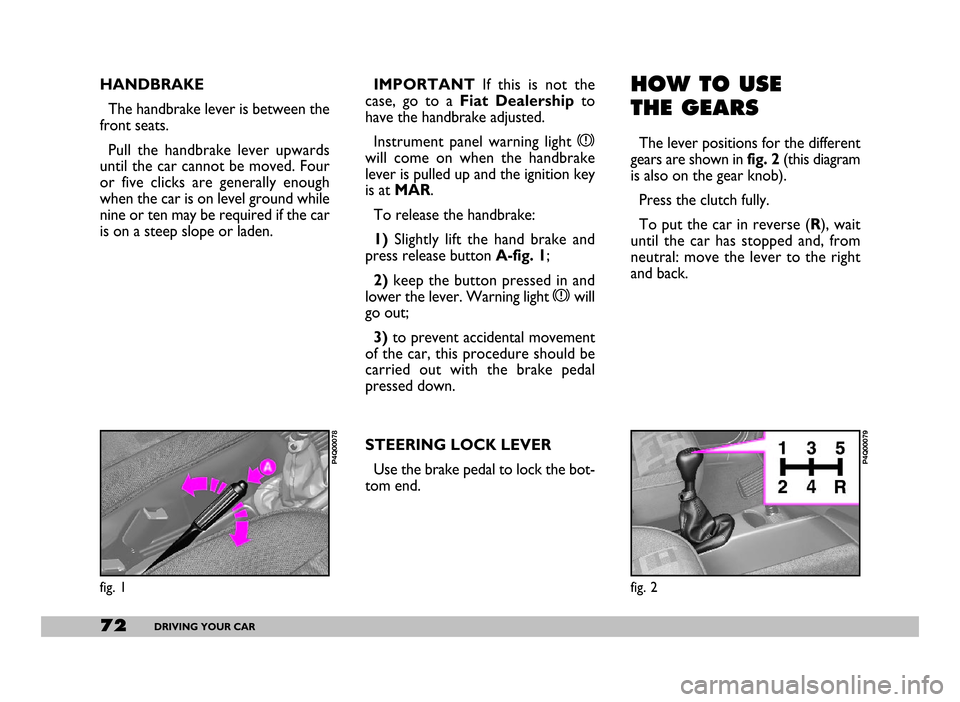
HANDBRAKE
The handbrake lever is between the
front seats.
Pull the handbrake lever upwards
until the car cannot be moved. Four
or five clicks are generally enough
when the car is on level ground while
nine or ten may be required if the car
is on a steep slope or laden. IMPORTANTIf this is not the
case, go to a Fiat Dealership to
have the handbrake adjusted.
Instrument panel warning light x
will come on when the handbrake
lever is pulled up and the ignition key
is at MAR.
To release the handbrake:
1)Slightly lift the hand brake and
press release button A-fig. 1;
2)keep the button pressed in and
lower the lever. Warning light xwill
go out;
3)to prevent accidental movement
of the car, this procedure should be
carried out with the brake pedal
pressed down.
STEERING LOCK LEVER
Use the brake pedal to lock the bot-
tom end. HOW TO USE
THE GEARS
The lever positions for the different
gears are shown in fig. 2(this diagram
is also on the gear knob).
Press the clutch fully.
To put the car in reverse (R), wait
until the car has stopped and, from
neutral: move the lever to the right
and back.
fig. 1
P4Q00078
fig. 2
P4Q00079
Page 77 of 154
76DRIVING YOUR CAR
IMPORTANT On stretches of
road with good visibility, switch off
your rear fog lights; the brightness of
these lights could annoy the people
travelling in the cars behind
– Remember that fog also means the
tarmac is wet and therefore manoeu-
vres of all kinds are more difficult and
stopping distances are longer.
– Keep a good distance from the
cars in front of you.
– As far as possible, avoid spurts of
speed or sudden deceleration.
– Do not overtake other vehicles if
you can help it.
– If you are forced to stop your car
(breakdown, limited visibility etc.) try
to stop off the road. Turn on the haz-
ard lights and, if possible, the dipped-
beam headlights. Rhythmically sound
the horn if you realise another car is
coming.DRIVING IN
THE MOUNTAINS
– When driving downhill use the en-
gine braking effect by engaging a low
gear so as not to overheat the brakes.
– Under no circumstances should
you drive downhill with the engine off
or with the car in neutral, let alone
with the ignition key out.
– Drive at a moderate speed with-
out cutting corners.
– Remember that overtaking while
going uphill is slower and therefore
requires more free road. If you are
being overtaken while driving uphill,
make it easier for the other vehicle to
pass. DRIVING ON SNOW
AND ICE
Here are some tips for driving in
these conditions:
– keep your speed down;
– use chains if the roads are covered
in snow: see paragraph
SNOW TYRESin
this chapter;
– mainly use the braking effect of the
engine and under all circumstances
avoid braking sharply;
– when braking in a car not fitted
with ABS, reduce the possibility of the
wheels locking by varying the pressure
you exert on the brake pedal;
– do not accelerate suddenly and
avoid swerving;
– in the winter, even apparently dry
roads may have icy patches. Be care-
ful therefore when driving over
stretches that do not get much expo-
sure to the sun or are lined with trees
or rock where ice might not have
melted;
– keep a good distance from the ve-
hicles in front;
Page 81 of 154
80DRIVING YOUR CAR
LOOKING AFTER EMISSION
CONTROL DEVICES
The correct use of pollution control
devices not only ensures respect for
the environment but also has an effect
on the car’s performance. Keeping
these devices in good condition is
therefore a fundamental rule for dri-
ving that is easy on your pocket and
on the environment too.
The first step to take is to follow the
Service Schedule to the letter.
If your car has a petrol engine use
only unleaded petrol.
If you have trouble starting, do not
keep turning the ignition key for long
periods. Be especially careful to avoid
bump starting the car by pushing, tow-
ing or rolling down hill: these are all
manoeuvres that can damage the cat-
alytic exhaust. For emergency starts
use only an auxiliary battery.If the engine begins to “lose its
smoothness” when travelling, con-
tinue your journey but reduce the de-
mands you are making on the engine
and go to a Fiat Dealershipas soon
as you can.
When the instrument panel fuel re-
serve warning light comes on, fill up as
soon as possible. A low level of fuel
can cause an uneven supply of fuel to
the engine with the inevitable increase
in the temperature of the exhaust gas
and serious damage to the catalytic
converter.
Never run the engine with one or
more spark plugs disconnected, even
for testing purposes.
Do not warm up the engine by let-
ting it idle for a while before moving
off unless the outside temperature is
very low and, even in this case, only
do so for less than 30 seconds.Do not install other heat shields
and do not remove those already fit-
ted to the catalytic converter and
exhaust pipe.
When functioning nor-
mally the catalytic con-
verter reaches high tem-
peratures. For this reason do not
park the car over flammable ma-
terial (grass, dry leaves, pine nee-
dles etc.): fire hazard.
Ignoring the above rules
may lead to fire.
Do not allow anything to
be sprayed onto the cat-
alytic converter, Lambda
sensor or exhaust pipe.