speed FIAT SEICENTO 2007 1.G Owner's Manual
[x] Cancel search | Manufacturer: FIAT, Model Year: 2007, Model line: SEICENTO, Model: FIAT SEICENTO 2007 1.GPages: 154, PDF Size: 3.68 MB
Page 80 of 154
79DRIVING YOUR CAR
Top speed
As speed increases, so does the fuel
consumption: note that passing from
90 to 120 km/h increases consump-
tion by about +30%. Keep your speed
as steady as possible and avoid un-
necessary braking and accelerations
that cost fuel and increase emissions
considerably. It is better to drive
“smoothly” trying to foresee the ma-
noeuvres to avoid imminent dangers
and always respect the safety distance
to avoid the need to slow down sud-
denly.
Acceleration
Sudden and sharp accelerations
revving up the engine increase con-
sumption and emissions; accelerate
gradually and do not exceed the max-
imum torque.USE
Cold start
Short journeys and frequent cold
start-ups do not allow the engine to
reach the best running temperature.
As a result, consumption rises (from
+15 to +30% in town) and so do the
harmful emissions.
Traffic situations and road
conditions
Consumption rises in heavy traffic, in
traffic jams where it is constantly nec-
essary to shift to low gears or in big
cities with many traffic lights.
Also twisting roads, mountain roads
and rough road surfaces pay a heavy
toll on consumption.
Hold-ups in traffic
During hold-ups (e.g.: level crossings)
switch off the engine.CHEAP RUNNING
THAT RESPECTS
THE ENVIRONMENT
Environmental protection has been
one of the guiding principles in the
production of Fiat 600. It is no acci-
dent that its pollution control equip-
ment is much more effective than that
required by current legislation.
Nonetheless, the environment can-
not get by without a concerted effort
from everyone.
By following a few simple rules you
can avoid harming the environment
and often cut down fuel consumption
at the same time.
On this subject, a few useful tips
have been given below to supplement
those marked by symbol #, at various
points of the handbook.
You are asked to read both the for-
mer and the latter carefully.
Page 82 of 154
81DRIVING YOUR CAR
TOWING
A TRAILER
IMPORTANTThe car must be fit-
ted with a homologated tow hitch and
suitable electrical system for towing a
caravan or trailer.
Installation must be carried out by
skilled personnel who will provide
specific documentation for authoris-
ing use on roads.
Fit special wing mirrors in accor-
dance with the highway code.
Remember that towing a trailer
makes it harder for the car to climb
the maximum gradients specified.
Engage a low gear when driving
downhill rather than constantly brak-
ing.
The weight that the trailer exerts on
the car tow hitch coupling reduces the
car carrying capacity by the same
amount. To ensure you do not exceed the
maximum towable weight (indicated
in the log book) you have to take into
account the trailer’s weight fully laden
including the accessories and personal
luggage.
Respect the speed limits enforced in
the country where you are towing the
trailer.TOW HITCH INSTALLATION
The tow hitch must be fixed to the
body by an expert in accordance with
the following instructions and re-
specting the additional and/or integra-
tive information provided by the tow
hitch manufacturer. The tow hitch to
be fitted must comply with the cur-
rent regulations in force with refer-
ence to Directive 94/20/EEC and
amendments. Use a tow hitch suited
for the maximum towable load of the
car version on which the tow hitch is
to be fitted.
Use a unified coupling for the elec-
trical connections. The coupling is
generally fitted on a specific mount
fastened to the tow hitch. The ABS system, if fit-
ted on the car, does not
control the trailer brak-
ing system. Therefore be extra
careful on slippery surfaces.
Under no circumstances
modify the car braking
system for trailer braking
control. The trailer’s braking sys-
tem must be completely inde-
pendent of the car’s hydraulic
system.
Page 85 of 154
84DRIVING YOUR CAR
WINTER TYRES
These are tyres which have been
specifically designed for use on snow
and ice and should be fitted in place of
the existing tyres.
Use winter tyres of the same size as
the tyres provided with the car.
Fiat Dealerships will be glad to of-
fer advice on the right type of tyres
according to your needs.
For information on the tyres to be
fitted, inflation pressure and winter
tyre specifications, follow the pre-
scriptions given in
WHEELS, TECHNICAL
SPECIFICATIONS
.The performance of winter tyres is
greatly reduced when the depth of the
tread is less than 4 mm. In this situa-
tion it would be safer to have them
replaced.
The specific characteristics of the
winter tyres mean that under normal
driving conditions or when driving
long distances on motorways, their
performance is greatly reduced in
comparison to those normally fitted
to the car.
The use of these tyres should there-
fore be limited to the conditions for
which they were designed.
IMPORTANTWhen using winter
tyres with a maximum speed rating
lower than the speed which can be
reached by the car (plus 5%), place a
suitable notice is the passenger com-
partment to inform the driver of the
top speed which the winter tyre can
run at (as per EC Directive).All four tyres should be the same
(brand and track) to ensure greater
safety when driving, braking and cor-
nering.
Remember not to invert the tyre di-
rection of rotation.
The maximum speed
for winter tyres with “Q”
marking is 160 km/h. Re-
spect the highway code speed
limits.
Page 86 of 154
85DRIVING YOUR CAR
SNOW CHAINS
The use of snow chains is regulated
by the legislation in force in the coun-
try the car is driven in.
The chains may only be applied to
the drive wheel tyres (front wheels).
Use only low profile chains (maxi-
mum height off the tyre: 12 mm).
We recommend using Lineaccessori
Fiat snow chains.
Check the tautness of the chains af-
ter driving some ten metres.Keep you speed down
when snow chains have
been fitted to the wheels.
Avoid potholes, steps and pave-
ments, and do not drive for long
stretches on snow-free roads,
otherwise you risk damaging the
tyres, suspension and steering.
IMPORTANTDo not fit snow
chains on a space-saver spare wheel.
If a front wheel (drive wheel) is punc-
tured and you require snow chains to
proceed, take a standard wheel from
the rear axle and fit the space-saver
spare wheel in its place. Having fitted
two standard wheels on the front
drive axle, you can use snow chains,
thus solving the emergency situation.
Page 114 of 154
113CAR MAINTENANCE
IMPORTANT - Remote control
If when the remote control button
is pressed the doors are not
locked/unlocked or the performed
operation signal (indicator lights on)
does not appear, change the battery,
using spare batteries of the same kind.
IMPORTANT - Engine oil
Should the prevailing use of the car
be under one of the following specially
heavy conditions:
– trailer towing
– dusty roads
– short distances (less than 7-8 km)
repeated and with external tempera-
tures below zero.
– frequently idling engines or long
distance low speed driving (e.g. taxis
or door-to-door deliveries) or in case
of a long term inactivity replace engine
oil more frequently than required on
SCHEDULED MAINTENANCE PLAN.IMPORTANT - Air cleaner
Replace the air cleaner more fre-
quently if the car is used on dusty
roads.
If you are in doubt about how often
the engine oil or the air cleaner should
be changed in relation to how you use
the car, contact a Fiat Dealership.
IMPORTANT - Battery
The charge in your battery should be
checked, where possible at the start
of the winter, to limit the risk of the
battery electrolyte freezing. This
check should be carried out more fre-
quently if the car is mainly used for
short trips or if it is fitted with acces-
sories that permanently take in elec-
tricity even when the ignition key is
removed, especially in the case of af-
ter market accessories.You should check the battery fluid
(electrolyte) level more frequently
than shown in the
SERVICE SCHEDULEin
this chapter if the vehicle is used in
hot climates or particularly demand-
ing conditions.
Maintenance of your car
should be entrusted to a
Fiat Dealership. For ordi-
nary routine maintenance oper-
ations which you are able to
carry out yourself, ensure that
you have the necessary tools and
original Fiat spare parts and flu-
ids available. Do not carry out
servicing operations if you have
no experience.
Page 135 of 154
134TECHNICAL SPECIFICATIONS
WINTER TYRES
Use winter tyres as indicated in the
WINTER TYRESchapter.
SMALL SPARE WHEEL
Printed steel rim.
Tubeless tyre.
SNOW CHAINS
Use only low profile chains, see the
SNOW CHAIN CHAPTER.
WHEEL GEOMETRY
Front wheel toe-in measured from
rim to rim: –1 ±1mm
The figures refer to the car in full
running order.Maximum speed rating
Q= up to 160 km/h.
R= up to 170 km/h.
S= up to 180 km/h.
T= up to 190 km/h.
U= up to 200 km/h.
H= up to 210 km/h.
V= up to 240 km/h.
Maximum speed rating
for snow tyres
Q M+S= up to 160 km/h
T M+S= up to 190 km/h
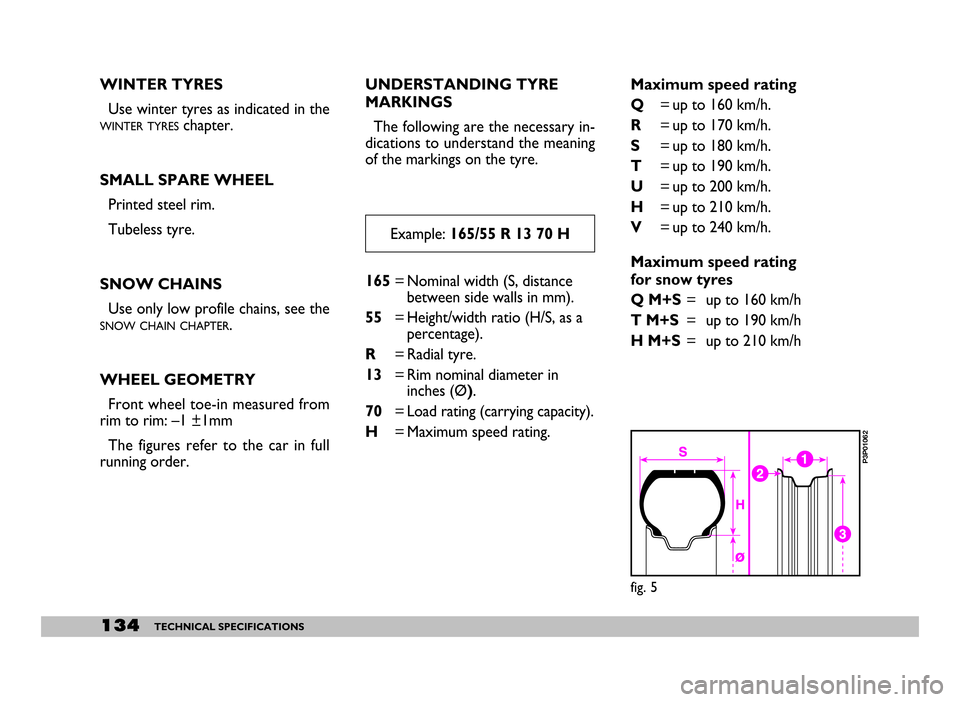
H M+S= up to 210 km/h Example: 165/55 R 13 70 H
165= Nominal width (S, distance
between side walls in mm).
55= Height/width ratio (H/S, as a
percentage).
R= Radial tyre.
13= Rim nominal diameter in
inches (Ø).
70= Load rating (carrying capacity).
H= Maximum speed rating.
fig. 5
P3P01062
UNDERSTANDING TYRE
MARKINGS
The following are the necessary in-
dications to understand the meaning
of the markings on the tyre.
Page 138 of 154
137TECHNICAL SPECIFICATIONS
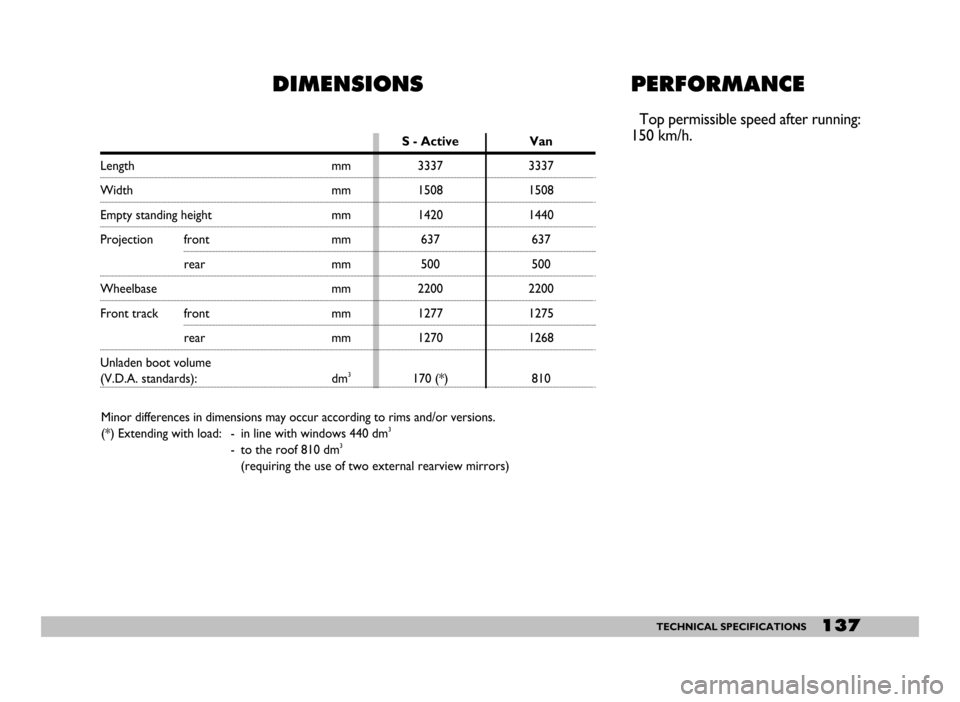
Length mm
Width mm
Empty standing height mm
Projection front mm
rear mm
Wheelbase mm
Front track front mm
rear mm
Unladen boot volume
(V.D.A. standards): dm3
PERFORMANCE
Top permissible speed after running:
150 km/h.
S - Active
3337
1508
1420
637
500
2200
1277
1270
170 (*)Van
3337
1508
1440
637
500
2200
1275
1268
810
DIMENSIONS
Minor differences in dimensions may occur according to rims and/or versions.
(*) Extending with load: - in line with windows 440 dm3
- to the roof 810 dm3
(requiring the use of two external rearview mirrors)
Page 143 of 154
142TECHNICAL SPECIFICATIONS
CO2EMISSIONS
The fuel consumption values shown
in the table below were defined ac-
cording to the type-approval specifi-
cations in European Directives.
Consumption values are defined by
means of the following procedures:
– an urban cycle: consisting of a
cold start and a simulated drive in city
streets;
– an extra-urban cycle: consisting
in frequent accelerations, in all gears,
simulating normal conditions of use.
Speed ranges from 0 to 120 km/h;
– average combined cyclecon-
sisting of 37% urban cycle and 63% ex-
tra-urban cycle.
FUEL CONSUMPTION
IMPORTANT Road and traffic
conditions, weather, general con-
ditions of the car, driving style,
fittings and accessories, use of
the climate control system, load,
roof racks and other situations
penalising aerodynamic penetra-
tion and effecting rolling resis-
tance will influence fuel con-
sumption rates which can be dif-
ferent from the values shown in
the table (see
CHEAP RUNNING
THAT RESPECTS THE ENVIRONMENT
in DRIVING YOUR CARchapter).
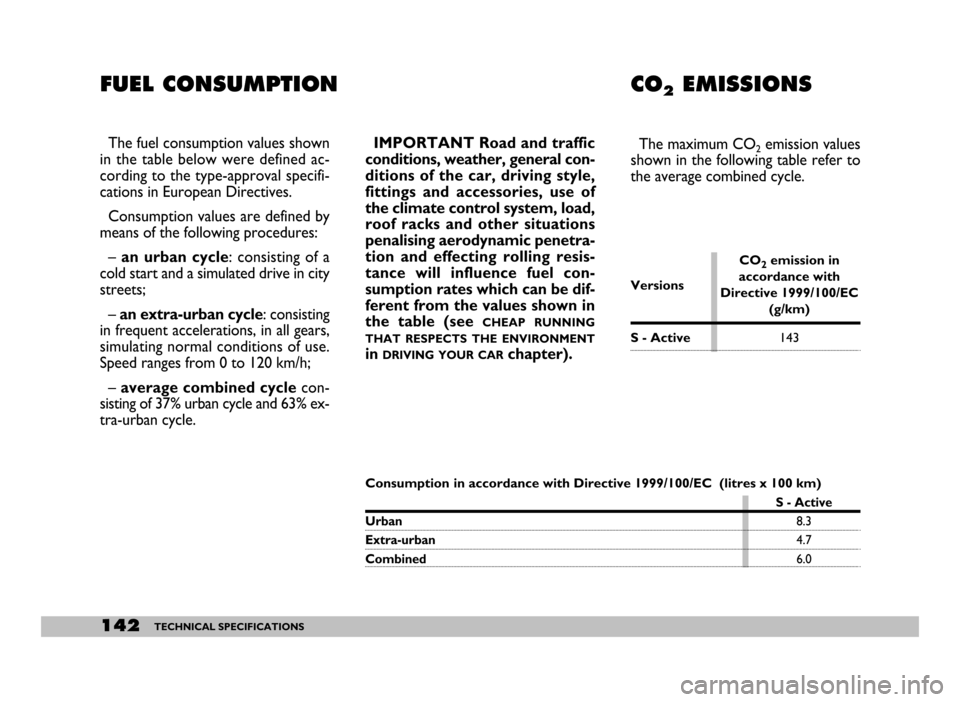
The maximum CO2emission values
shown in the following table refer to
the average combined cycle.
Consumption in accordance with Directive 1999/100/EC (litres x 100 km)
S - Active
Urban8.3
Extra-urban4.7
Combined6.0
CO2emission in
Versionsaccordance with
Directive 1999/100/EC
(g/km)
S - Active143
Page 149 of 154
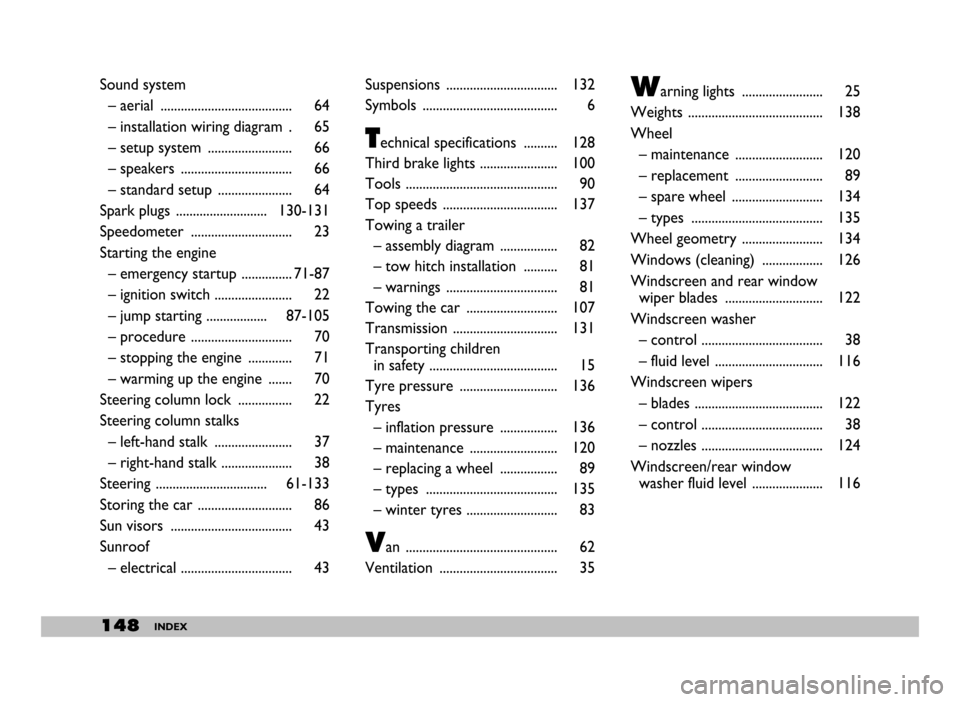
148INDEX
Sound system
– aerial ....................................... 64
– installation wiring diagram . 65
– setup system ......................... 66
– speakers ................................. 66
– standard setup ...................... 64
Spark plugs ........................... 130-131
Speedometer .............................. 23
Starting the engine
– emergency startup ............... 71-87
– ignition switch ....................... 22
– jump starting .................. 87-105
– procedure .............................. 70
– stopping the engine ............. 71
– warming up the engine ....... 70
Steering column lock ................ 22
Steering column stalks
– left-hand stalk ....................... 37
– right-hand stalk ..................... 38
Steering ................................. 61-133
Storing the car ............................ 86
Sun visors .................................... 43
Sunroof
– electrical ................................. 43Suspensions ................................. 132
Symbols ........................................ 6
Technical specifications .......... 128
Third brake lights ....................... 100
Tools ............................................. 90
Top speeds .................................. 137
Towing a trailer
– assembly diagram ................. 82
– tow hitch installation .......... 81
– warnings ................................. 81
Towing the car ........................... 107
Transmission ............................... 131
Transporting children
in safety ...................................... 15
Tyre pressure ............................. 136
Tyres
– inflation pressure ................. 136
– maintenance .......................... 120
– replacing a wheel ................. 89
– types ....................................... 135
– winter tyres ........................... 83
Van ............................................. 62
Ventilation ................................... 35
Warning lights ........................ 25
Weights ........................................ 138
Wheel
– maintenance .......................... 120
– replacement .......................... 89
– spare wheel ........................... 134
– types ....................................... 135
Wheel geometry ........................ 134
Windows (cleaning) .................. 126
Windscreen and rear window
wiper blades ............................. 122
Windscreen washer
– control .................................... 38
– fluid level ................................ 116
Windscreen wipers
– blades ...................................... 122
– control .................................... 38
– nozzles .................................... 124
Windscreen/rear window
washer fluid level ..................... 116