light FIAT SEICENTO 2007 1.G Service Manual
[x] Cancel search | Manufacturer: FIAT, Model Year: 2007, Model line: SEICENTO, Model: FIAT SEICENTO 2007 1.GPages: 154, PDF Size: 3.68 MB
Page 83 of 154
82DRIVING YOUR CAR
For electrical connection, a 7 or 13
pole 12VDC coupling must be used
(CUNA/UNI and ISO/DIN standards).
Follow the instructions provided by
the manufacturer of the car and/or
the tow hitch.The electrical brake (where relevant)
or other devices (electrical winch,
etc.) must be powered directly from
the battery by means of a lead with a
cross-section area no smaller than
2.5 mm
2. In addition to the electrical
connections, only the power wire foran additional electrical brake and for
internal trailer lighting with a power
not exceeding 15W can be connected
to the car’s electrical system.
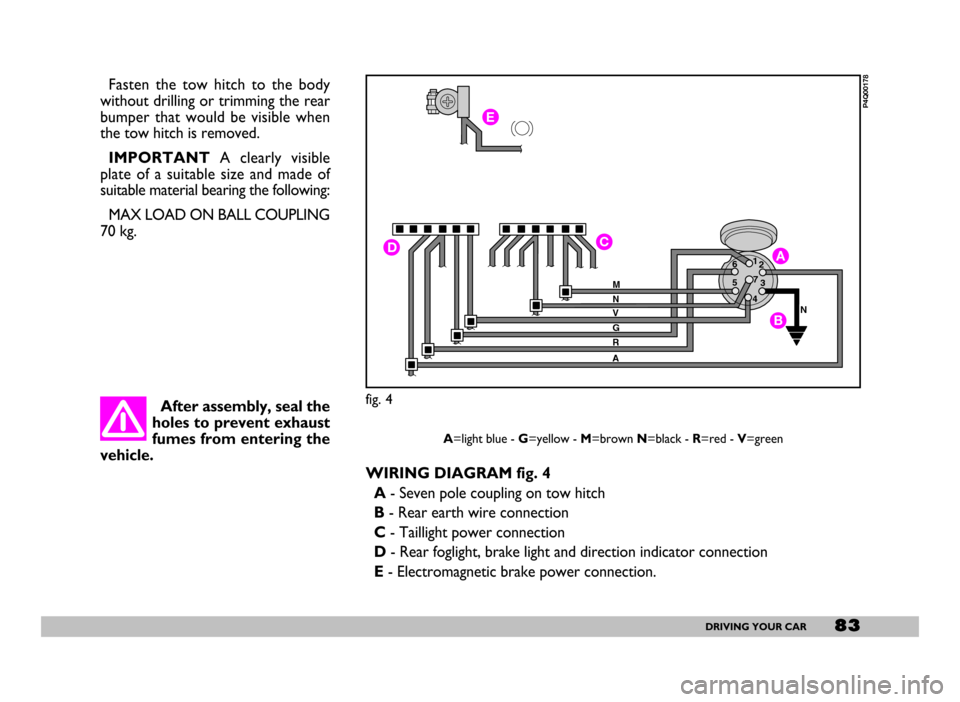
The coupling electrical connections
are shown in fig. 4.
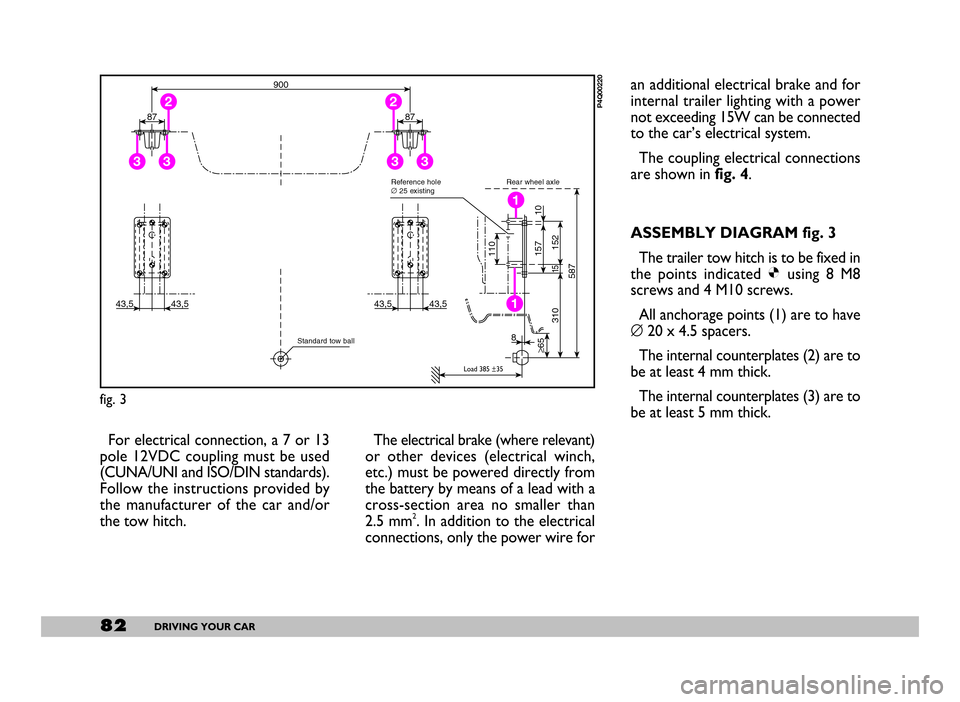
ASSEMBLY DIAGRAM fig. 3
The trailer tow hitch is to be fixed in
the points indicated Øusing 8 M8
screws and 4 M10 screws.
All anchorage points (1) are to have
∅20 x 4.5 spacers.
The internal counterplates (2) are to
be at least 4 mm thick.
The internal counterplates (3) are to
be at least 5 mm thick.
43,543,5
15
≥65
3108
152
587
110
10 157
43,543,5
1
1
87
33
287
33
2
900
fig. 3
P4Q00220
Rear wheel axle
Load 385 ±35
Reference hole
∅25 existing
Standard tow ball
Page 84 of 154
83DRIVING YOUR CAR
Fasten the tow hitch to the body
without drilling or trimming the rear
bumper that would be visible when
the tow hitch is removed.
IMPORTANT A clearly visible
plate of a suitable size and made of
suitable material bearing the following:
MAX LOAD ON BALL COUPLING
70 kg.
After assembly, seal the
holes to prevent exhaust
fumes from entering the
vehicle.
E
DCA
B
1
2
3
4 5 6
7
M
N
V
G
R
AN
fig. 4
P4Q00178
A=light blue - G=yellow - M=brown N=black - R=red - V=green
WIRING DIAGRAM fig. 4
A- Seven pole coupling on tow hitch
B- Rear earth wire connection
C- Taillight power connection
D- Rear foglight, brake light and direction indicator connection
E- Electromagnetic brake power connection.
Page 87 of 154
86DRIVING YOUR CAR
STORING THE CAR
The following precautions should be
taken if the car will not be used for
several months:
– Park the car in covered, dry and if
possible well-ventilated premises.
– Engage a gear.
– Make sure the handbrake is not
engaged.
– Remove the cables from the bat-
tery terminals (first remove the cable
to the negative terminal), and check
the battery charge. If the car is to be
stored for long periods the charge of
the battery should be checked every
month and recharged if it falls below
12.5V.– Clean and protect the shiny metal
parts using special compounds readily
available.
– Sprinkle talcum powder on the
rubber windscreen and rear window
wiper blades and lift them off the glass.
– Open the windows slightly.– Cover the car with a cloth or per-
forated plastic sheet. Do not use
sheets of non-perforated plastic as
they do not allow moisture on the car
body to evaporate.
– Inflate the tyres to + 0.5 bar above
the normal specified pressure and
check it at intervals.
– Do not drain the engine cooling
system.
Page 88 of 154
87IN AN EMERGENCY
I I I I
N N N N
A A A A
N N N N
E E E E
M M M M
E E E E
R R R R
G G G G
E E E E
N N N N
C C C C
Y Y Y Y
EMERGENCY
START-UP
If the Fiat CODE cannot deactivate
the engine immobilising system, the
¢and
Uwarning lights stay on and
the engine will not start. Follow the
emergency start-up procedure to
start the engine.
Read the whole procedure care-
fully before trying to carry it out.
If you make a mistake, you must turn
the ignition key back to STOPand
repeat the whole operation from the
beginning (step 1).
1)Read the 5-figure electronic code
given on the CODE card.
2)Turn the ignition key to MAR.3)Press and hold down the acceler-
ator pedal. The injection system warn-
ing light
Uwill come on for about 8
seconds, and then go out. At this
point release the accelerator pedal
and get ready to count the flashes of
warning light
U.
4) Count the number of flashes that
corresponds to the first figure of the
code on the CODE card, then press
the accelerator pedal and keep it there
until the
Uwarning light comes on
for four seconds and then goes out;
release the accelerator pedal.
5) The
Uwarning light will start
flashing again: after it has flashed the
number of times that corresponds to
the second figure on the CODE card,
press the accelerator pedal to the
floor and keep it there.
6) Do the same for the remaining
figures on the CODE card. 7) Once the final figure has been en-
tered, keep the accelerator pedal
pressed. The injection warning light
Uwill light up for four seconds and
then go out; release the accelerator
pedal.
8)The
Uwarning light will flash
rapidly for about 4 seconds to indicate
that the operation has been com-
pleted correctly.
9) Start the engine by turning the ig-
nition key from MARto AVV.
If, however, the
Uwarning light
stays on, turn the ignition key to
STOPand repeat the procedure
from step 1.
IMPORTANTAfter an emergency
start, you should contact a Fiat Deal-
ership, otherwise you will have to re-
peat the procedure described each
time you want to start the engine.
Page 89 of 154
88IN AN EMERGENCY
JUMP STARTING
If the battery is flat, you can use an-
other battery to start the engine. Its
capacity must be the same or slightly
greater than the flat battery (see the
chapter
TECHNICAL SPECIFICATIONS).
Proceed as follows:
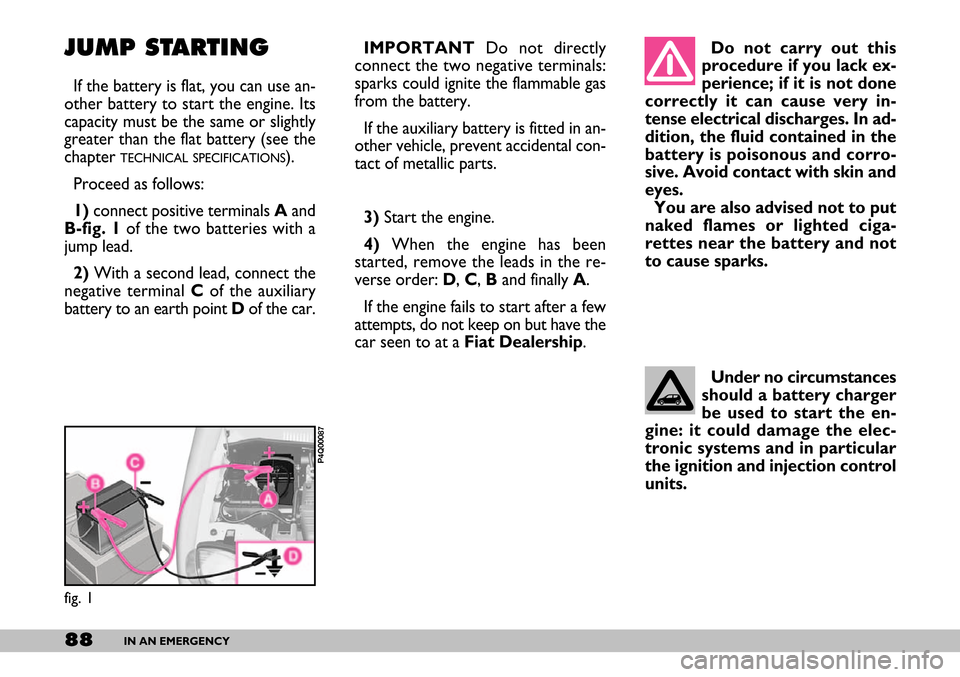
1)connect positive terminals Aand
B-fig. 1of the two batteries with a
jump lead.
2)With a second lead, connect the
negative terminal Cof the auxiliary
battery to an earth point Dof the car.IMPORTANTDo not directly
connect the two negative terminals:
sparks could ignite the flammable gas
from the battery.
If the auxiliary battery is fitted in an-
other vehicle, prevent accidental con-
tact of metallic parts.
3)Start the engine.
4)When the engine has been
started, remove the leads in the re-
verse order: D, C, Band finally A.
If the engine fails to start after a few
attempts, do not keep on but have the
car seen to at a Fiat Dealership. Do not carry out this
procedure if you lack ex-
perience; if it is not done
correctly it can cause very in-
tense electrical discharges. In ad-
dition, the fluid contained in the
battery is poisonous and corro-
sive. Avoid contact with skin and
eyes.
You are also advised not to put
naked flames or lighted ciga-
rettes near the battery and not
to cause sparks.
fig. 1
P4Q00087
Under no circumstances
should a battery charger
be used to start the en-
gine: it could damage the elec-
tronic systems and in particular
the ignition and injection control
units.
Page 90 of 154
89IN AN EMERGENCY
BUMP STARTING IF A TYRE IS
PUNCTURED
General instructions
Observe the instructions on this and
the following pages to use the jack and
space-saver spare wheel correctly. The space-saver spare
wheel is vehicle-specific.
Never use the wheel on
other models. Never fit other
model spare wheels on your car.
If you change the type of wheels
(alloy rims instead of steel rims)
you will have to change the en-
tire set of fastening bolts with an-
other set of suitably sized bolts.
Only use the spare-saver wheel
for emergencies. Do not exceed
80 km/h with the spare wheel fit-
ted. When driving with a space-
saver spare wheel fitted, the dri-
ving performance of your car
may change. Avoid accelerating
or braking suddenly, steering
abruptly or fast cornering.
A space-saver spare wheel has a
maximum life of 3,000 km after
which is must be replaced with a
wheel of the same type. Do not bump start by
pushing, towing or coast-
ing downhill. This way of
starting could cause a rush of fuel
into the catalytic exhaust pipe
and damage it beyond repair.
Remember that until
the engine has started
the brake booster and
power steering systems will not
work and a greater effort will
therefore be required to press
the brake pedal or turn the
steering wheel.
Alert other drivers that
the car is stationary in
compliance with local
regulations: hazard warning
lights, warning triangle etc.
Any passengers on board should
leave the car, especially if it is
heavily laden. Passengers should
stay away from oncoming traffic
while the wheel is being changed.
If the wheel is being changed on
a steep or badly surfaced road,
place wedges or other suitable
material under the wheels to
stop the car.
Page 94 of 154
93IN AN EMERGENCY
IMPORTANTFor cars equipped
with optional alloy wheels, a specific
spare wheel is required which differs
from that used on cars equipped with
steel rims. When fitting alloy rims to
replace steel rims at a later date, the
four original wheel bolts should be
changed with a new set of adequately
sized bolts and a specific spare wheel.
It is advised to keep the bolts and
the spare wheel, which would become
necessary if you should decide to re-
turn to the original type of wheels. IF A BULB BURNS
OUT Only touch the metal
part when handling halo-
gen bulbs. If the transpar-
ent bulb is touched it reduces the
intensity of the light emitted and
can also reduce the life of the
bulb. If you touch the bulb acci-
dentally, rub it with a cloth
moistened with alcohol and leave
it to dry. Modifications or repairs
to the electrical system
carried out incorrectly
and without bearing the features
of the system in mind can cause
malfunctions with the risk of fire.
You should, where pos-
sible, have your bulbs
changed at a Fiat Dealer-
ship. Correct operation of the ex-
ternal light beams are essential
for safe driving and compliance
with legal requirements. Halogen bulbs contain
pressurised gas which, if
broken, may cause small
fragments of glass to be pro-
jected outwards.
Page 95 of 154
94IN AN EMERGENCY
GENERAL INSTRUCTIONS
When a light is not working, check
that it has not fused before changing
the bulb.
For location of fuses, refer to
IF A
FUSE BLOWS
in this chapter.
Before replacing a bulb that does not
work, check that the contacts are not
oxidised.
Burnt-out bulbs must be replaced
with ones of the same type.
Always check the height of the head-
light beam after changing a bulb.
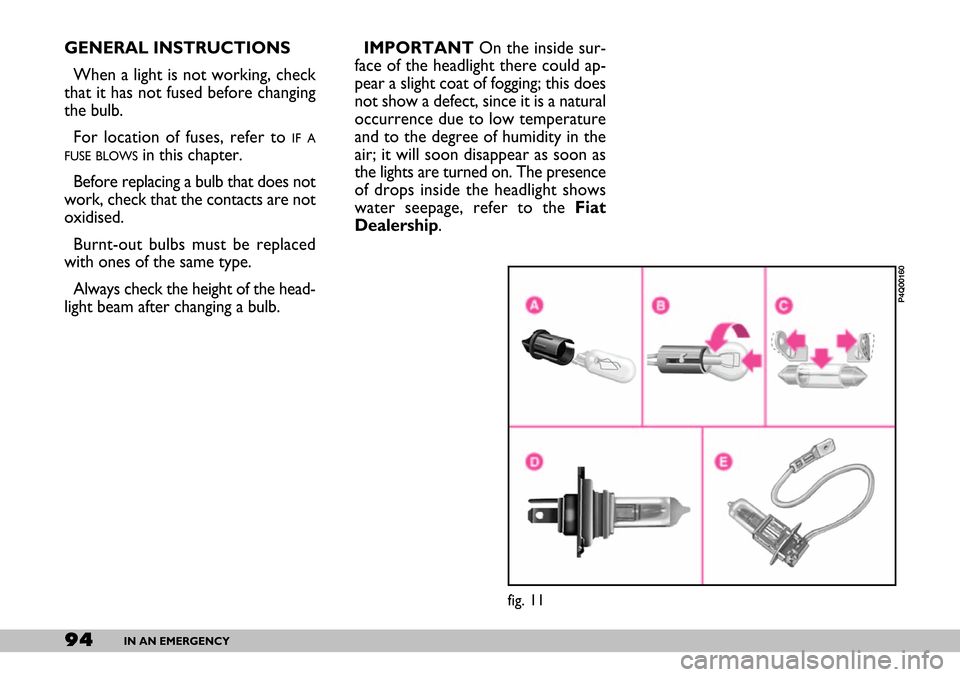
fig. 11
P4Q00160
IMPORTANTOn the inside sur-
face of the headlight there could ap-
pear a slight coat of fogging; this does
not show a defect, since it is a natural
occurrence due to low temperature
and to the degree of humidity in the
air; it will soon disappear as soon as
the lights are turned on. The presence
of drops inside the headlight shows
water seepage, refer to the Fiat
Dealership.
Page 96 of 154
95IN AN EMERGENCY
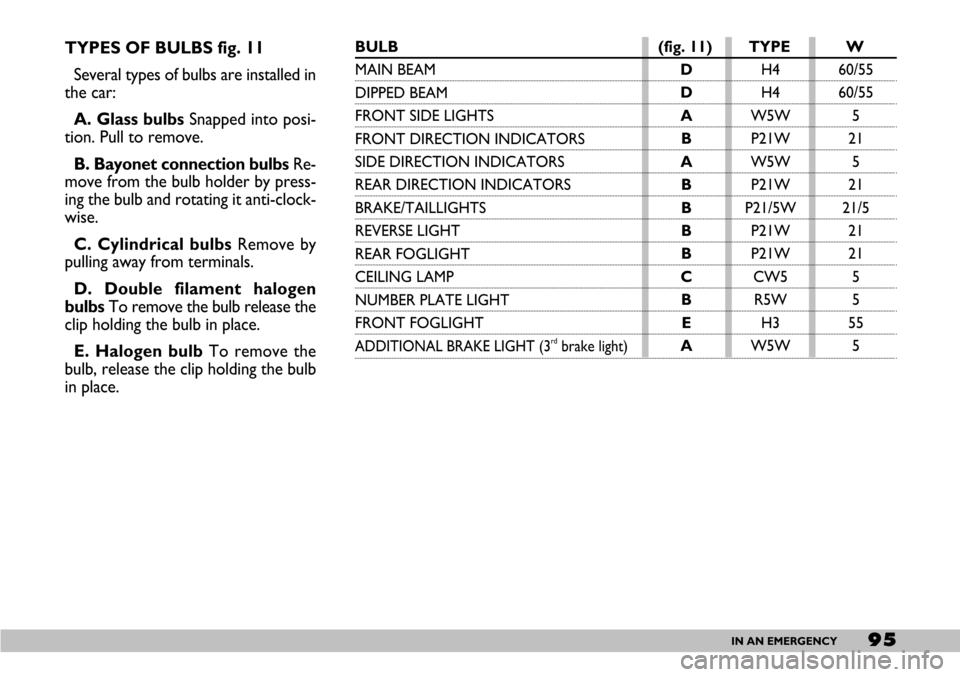
TYPES OF BULBS fig. 11
Several types of bulbs are installed in
the car:
A. Glass bulbs Snapped into posi-
tion. Pull to remove.
B. Bayonet connection bulbs Re-
move from the bulb holder by press-
ing the bulb and rotating it anti-clock-
wise.
C. Cylindrical bulbs Remove by
pulling away from terminals.
D. Double filament halogen
bulbs To remove the bulb release the
clip holding the bulb in place.
E. Halogen bulb To remove the
bulb, release the clip holding the bulb
in place. BULB (fig. 11) TYPE W
MAIN BEAM
DIPPED BEAM
FRONT SIDE LIGHTS
FRONT DIRECTION INDICATORS
SIDE DIRECTION INDICATORS
REAR DIRECTION INDICATORS
BRAKE/TAILLIGHTS
REVERSE LIGHT
REAR FOGLIGHT
CEILING LAMP
NUMBER PLATE LIGHT
FRONT FOGLIGHT
ADDITIONAL BRAKE LIGHT (3rdbrake light)
D
D
A
B
A
B
B
B
B
C
B
E
AH4 60/55
H4 60/55
W5W 5
P21W 21
W5W 5
P21W 21
P21/5W 21/5
P21W 21
P21W 21
CW5 5
R5W 5
H3 55
W5W 5
Page 97 of 154
96IN AN EMERGENCY
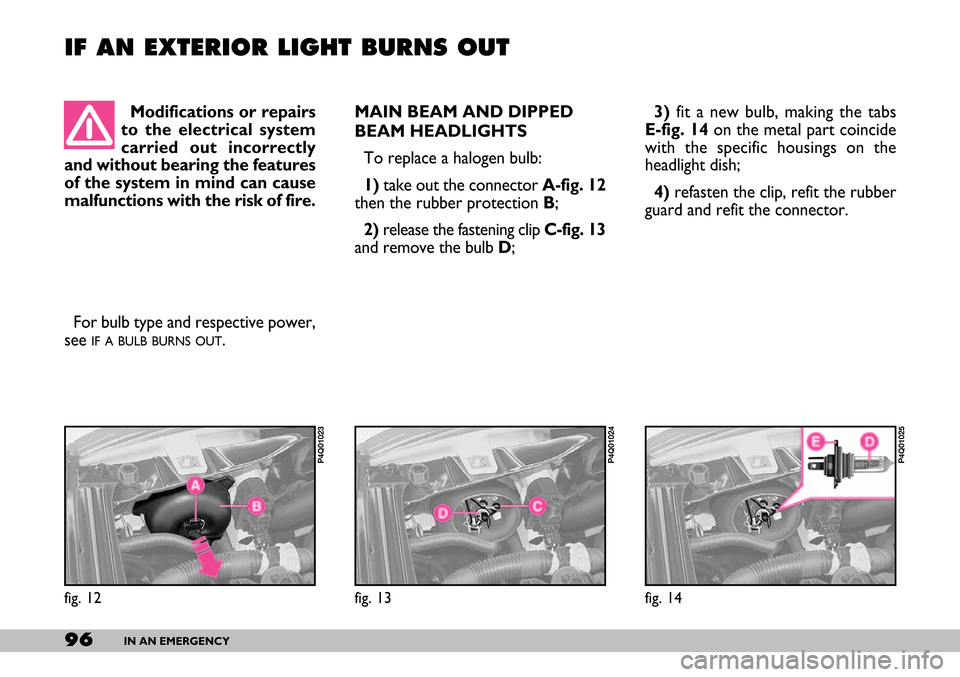
3)fit a new bulb, making the tabs
E-fig. 14 on the metal part coincide
with the specific housings on the
headlight dish;
4)refasten the clip, refit the rubber
guard and refit the connector.
IF AN EXTERIOR LIGHT BURNS OUT
MAIN BEAM AND DIPPED
BEAM HEADLIGHTS
To replace a halogen bulb:
1)take out the connector A-fig. 12
then the rubber protection B;
2)release the fastening clip C-fig. 13
and remove the bulb D;
fig. 12
P4Q01023
fig. 14
P4Q01025
Modifications or repairs
to the electrical system
carried out incorrectly
and without bearing the features
of the system in mind can cause
malfunctions with the risk of fire.
For bulb type and respective power,
see
IF A BULB BURNS OUT.
fig. 13
P4Q01024