oil FIAT SPIDER ABARTH 2017 Owner's Manual
[x] Cancel search | Manufacturer: FIAT, Model Year: 2017, Model line: SPIDER ABARTH, Model: FIAT SPIDER ABARTH 2017Pages: 292, PDF Size: 9.24 MB
Page 265 of 292
Clean the webbing with a mild soap
solution recommended for upholstery or
carpets. Follow instructions. Do not
bleach or dye the belts, this may
weaken them.
After cleaning the belts, thoroughly dry
the belt webbing and make sure there
is no remaining moisture before
retracting them.
Plastic And Coated
Parts
Clean interior plastic parts with a damp
cloth (if possible made from microfiber),
and a solution of water and neutral,
non-abrasive detergent.
To clean oily or persistent stains, use
specific products free from solvents and
designed to maintain the original
appearance and color of the
components.
Remove any dust using a microfiber
cloth, if necessary moistened with
water. The use of paper tissues is not
recommended as these may leave
residues. Instrument panel precautions
Prevent caustic solutions such as
perfume and cosmetic oils from
contacting the instrument panel. They
will damage and discolor the instrument
panel. If these solutions get on the
instrument panel, wipe them off
immediately.
Note: Never use alcohol, gasoline and
derivatives to clean the instrument
panel lens.
Caution!Do not use glazing agents. Glazing agents
contain ingredients which may cause
discoloration, wrinkling, cracks and peeling.
Instrument Panel Top
When cleaning, it is recommended that
you use a clean towel dampened in a
mild detergent to remove debris.
Caution!If the surface is rubbed harshly, it could
result in the surface being damaged leaving
white scratch marks. Window Interiors
If the windows become covered with an
oily, greasy, or waxy film, clean them
with glass cleaner. Follow the directions
on the container.
Note: Do not scrape or scratch the
inside of the window glass. It could
damage the thermal filaments.
Caution!When washing the inside of the window
glass, use a soft cloth dampened in
lukewarm water, gently wiping the thermal
filaments. Use of glass cleaning products
could damage the thermal filaments.
263
Page 266 of 292
Leather Parts — If
Equipped
Caution!Do not use Alcohol and Alcohol-based
and/or Ketone based cleaning products to
clean leather seats, as damage to the seat
may result.
Remove dust and sand first using a
vacuum cleaner or other means, then
wipe dirt off using a soft cloth with a
leather cleaner or a soft cloth soaked in
mild soap.
Wipe off the remaining cleaner or soap
using a cloth soaked in clean water and
wrung out well.
Remove moisture with a dry, soft cloth
and allow the leather to further dry in a
well-ventilated, shaded area. If the leather gets wet such as from
rain, also remove moisture and dry it as
soon as possible.
Note:
Because genuine leather is a natural
material, its surface is not uniform and
it may have natural scars, scratches,
and wrinkles.
To maintain the quality for as long
as possible, periodical maintenance,
about twice a year, is recommended. Caution! Sand and dust on the seat surface may
damage the overcoat of the genuine
leather surfaces and accelerate wear
.Greasy soiling on genuine leather may
cause molding and stains.
Rubbing hard with a stiff brush or cloth
may cause damage.
Do not wipe the leather using alcohol,
chlorine bleach, or organic solvents such
as thinner, benzene, or gasoline. Otherwise,
it may cause discoloration or stains.
If the seats get wet, promptly remove
moisture with a dry cloth. Remaining
moisture on the surface may cause
deterioration such as hardening and
shrinkage.
Exposure to direct sunlight for long
periods may cause deterioration and
shrinkage. When parking the car under
direct sunlight for long periods, shade the
interior using sunshades.
Do not leave vinyl products on the seats
for long periods as they may affect the
leather quality and coloring. If the cabin
temperature becomes hot, the vinyl may
deteriorate and adhere to the genuine
leather.
264
SERVICING AND MAINTENANCE
Page 277 of 292
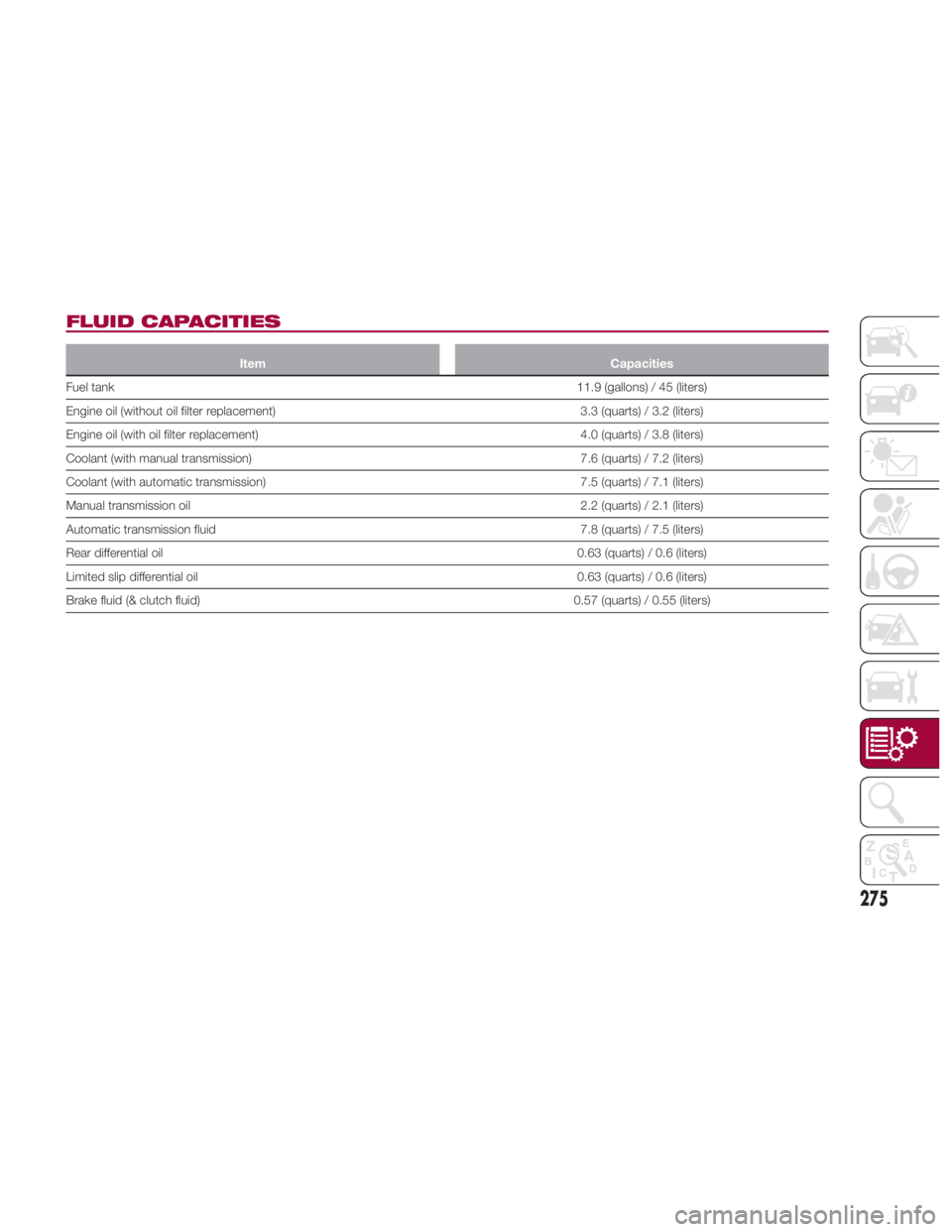
FLUID CAPACITIES Item Capacities
Fuel tank 11.9 (gallons)
/ 45 (liters)
Engine oil (without oil filter replacement) 3.3 (quarts) / 3.2 (liters)
Engine oil (with oil filter replacement) 4.0 (quarts) / 3.8 (liters)
Coolant (with manual transmission) 7.6 (quarts) / 7.2 (liters)
Coolant (with automatic transmission) 7.5 (quarts) / 7.1 (liters)
Manual transmission oil 2.2 (quarts) / 2.1 (liters)
Automatic transmission fluid 7.8 (quarts) / 7.5 (liters)
Rear differential oil 0.63 (quarts) / 0.6 (liters)
Limited slip differential oil 0.63 (quarts) / 0.6 (liters)
Brake fluid (& clutch fluid) 0.57 (quarts) / 0.55 (liters)
275
Page 278 of 292
FLUIDS AND LUBRICANTS Fluids And Lubricants
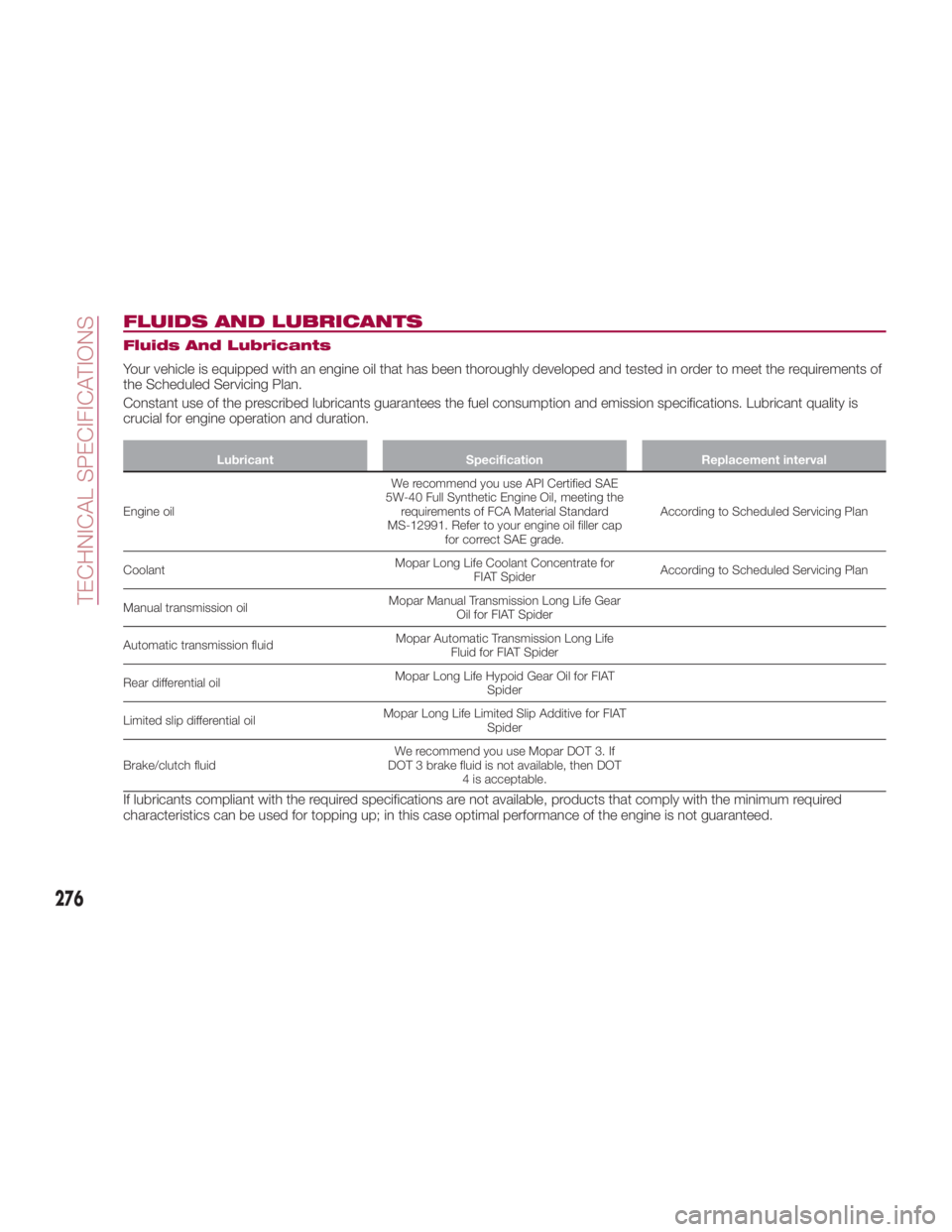
Your vehicle is equipped with an engine oil that has been thoroughly developed and tested in order to meet the requirements of
the Scheduled Servicing Plan.
Constant use of the prescribed lubricants guarantees the fuel consumption and emission specifications. Lubricant quality is
crucial for engine operation and duration. Lubricant Specification Replacement interval
Engine oil W e
recommend you use API Certified SAE
5W-40 Full Synthetic Engine Oil, meeting the
requirements of FCA Material Standard
MS-12991. Refer to your engine oil filler cap
for correct SAE grade. According to Scheduled Servicing Plan
Coolant Mopar Long Life Coolant Concentrate for
FIAT Spider According to Scheduled Servicing Plan
Manual transmission oil Mopar Manual Transmission Long Life Gear
Oil for FIAT Spider
Automatic transmission fluid Mopar Automatic Transmission Long Life
Fluid for FIAT Spider
Rear differential oil Mopar Long Life Hypoid Gear Oil for FIAT
Spider
Limited slip differential oil Mopar Long Life Limited Slip Additive for FIAT
Spider
Brake/clutch fluid We recommend you use Mopar DOT 3. If
DOT 3 brake fluid is not available, then DOT
4 is acceptable.
If lubricants compliant with the required specifications are not available, products that comply with the minimum required
characteristics can be used for topping up; in this case optimal performance of the engine is not guaranteed.
276
TECHNICAL SPECIFICATIONS
Page 287 of 292
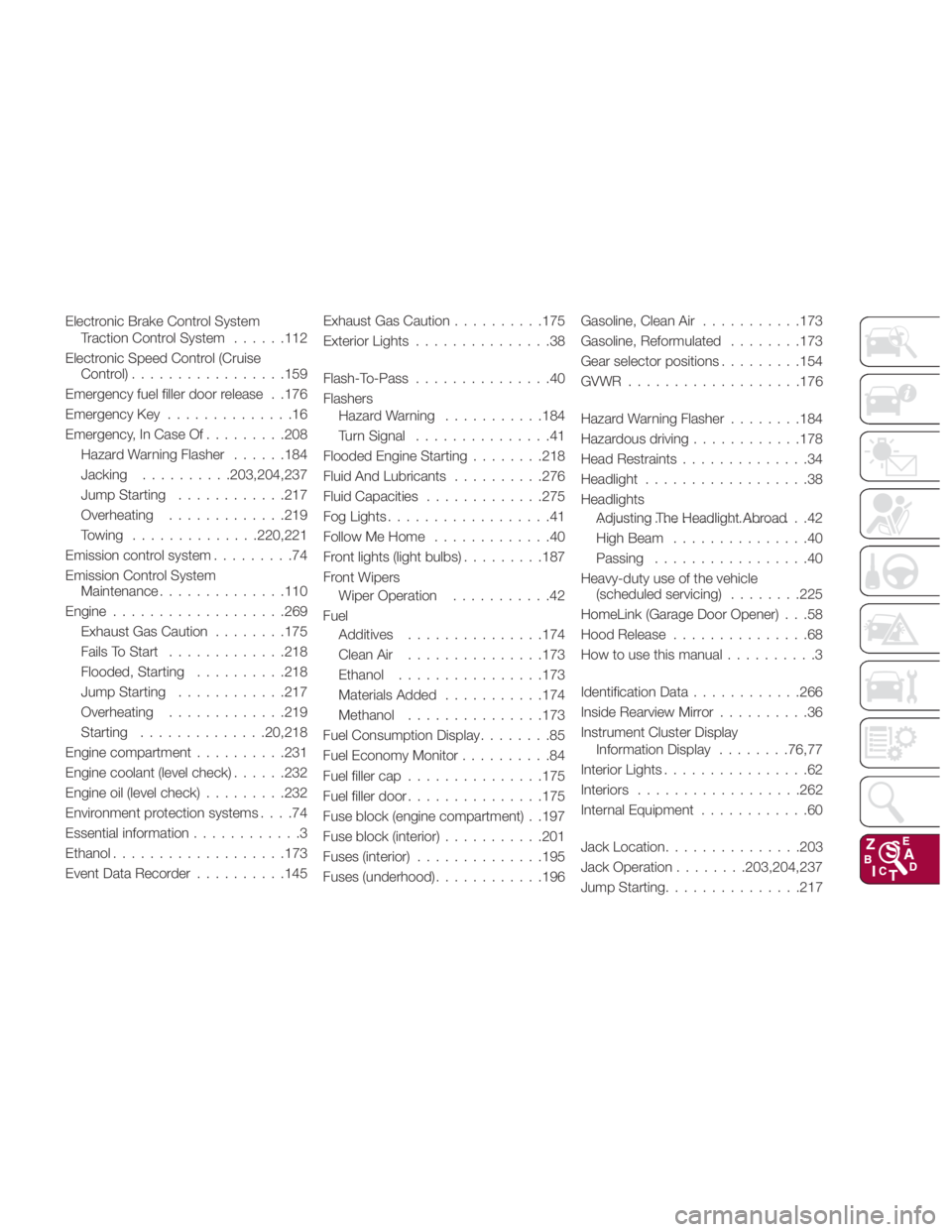
Electronic Brake Control System
Traction Control System ..... .112
Electronic Speed Control (Cruise
Control) ................ .159
Emergency fuel filler door release . .176
Emergency Key ..............16
Emergency, In Case Of ........ .208
Hazard Warning Flasher ..... .184
Jacking ......... .203,204,237
Jump Starting ........... .217
Overheating ............ .219
Towing ............. .220,221
Emission control system .........74
Emission Control System
Maintenance ............. .110
Engine .................. .269
Exhaust Gas Caution ....... .175
Fails To Start ............ .218
Flooded, Starting ......... .218
Jump Starting ........... .217
Overheating ............ .219
Starting ............. .20,218
Engine compartment ......... .231
Engine coolant (level check) ..... .232
Engine oil (level check) ........ .232
Environment protection systems ....74
Essential information ............3
Ethanol .................. .173
Event Data Recorder ......... .145 Exhaust Gas Caution ......... .175
Exterior Lights ...............38
Flash-To-Pass ...............40
Flashers
Hazard Warning .......... .184
Turn Signal ...............41
Flooded Engine Starting ....... .218
Fluid And Lubricants ......... .276
Fluid Capacities ............ .275
Fog Lights ..................41
Follow Me Home .............40
Front lights (light bulbs) ........
.187
Fr
ont Wipers
Wiper Operation ...........42
Fuel
Additives .............. .174
Clean Air .............. .173
Ethanol ............... .173
Materials Added .......... .174
Methanol .............. .173
Fuel Consumption Display ........85
Fuel Economy Monitor ..........84
Fuel filler cap .............. .175
Fuel filler door .............. .175
Fuse block (engine compartment) . .197
Fuse block (interior) .......... .201
Fuses (interior) ............. .195
Fuses (underhood) ........... .196 Gasoline, Clean Air .......... .173
Gasoline, Reformulated ....... .173
Gear selector positions ........ .154
GVWR .................. .176
Hazard Warning Flasher ....... .184
Hazardous driving ........... .178
Head Restraints ..............34
Headlight ..................38
Headlights
Adjusting The Headlight Abroad .......................42
High Beam ...............40
Passing .................40
Heavy-duty use of the vehicle
(scheduled servicing) ....... .225
HomeLink (Garage Door Opener) . . .58
Hood Release ...............68
How to use this manual ..........3
Identification Data ........... .266
Inside Rearview Mirror ..........36
Instrument Cluster Display
Information Display ....... .76,77
Interior Lights ................62
Interiors ................. .262
Internal Equipment ............60
Jack Location .............. .203
Jack Operation ....... .203,204,237
Jump Starting .............. .217